The most famous person who hid in an attic in the Netherlands from the Nazis during World War II is Anne Frank, whose diary became a posthumous literary sensation.
But there was another Jewish author, also hiding in a Netherlands attic, who also found a way to create literary art while in concealment. — Read the rest
London's Victorian Era Exhibition in 1897 featured a wide variety of modern innovations, the weirdest of which was a lamppost that doubled as a vending machine, dispensing coffee, cocoa, milk, tea, and a concoction called "fluid beef." Called the Pluto Lamp, this monstrous hybrid was installed throughout London. — Read the rest
BERLIN — Friedrich Merz has tried to move on from his conservatives’ historic defeats to the far right in eastern Germany, but his biggest test as chancellor — and of his grip over his own party — may still lie ahead.
The Alternative for Germany is pushing to deliver its biggest blow yet to the chancellor’s weakened coalition government by installing the country’s first far-right state premier since World War II in the eastern state of Saxony-Anhalt when lawmakers vote on the post in December.
Merz’s fellow Christian Democrats in Berlin fear regional members of their own party will help the AfD do this, creating a nightmare scenario for the chancellor. That concern stems from accusations that a group of Saxony-Anhalt conservatives already broke ranks by voting in a secret ballot for the AfD’s candidate for state speaker earlier this month, outraging national conservative leaders.
“The behavior of the CDU parliamentary group in Saxony-Anhalt with regard to past and upcoming elections is completely unacceptable,” Thomas Röwekamp, a CDU lawmaker who chairs the Bundestag’s defense committee, said. The AfD “wants to annihilate the CDU in Germany” by “forcing us into a debate about how to deal with it in order to divide the party,” he added. “We must not allow that to happen.”
Under pressure from conservatives in Berlin, Saxony-Anhalt CDU leader Sven Schulze announced a plan last week to have his party’s lawmakers leave the chamber during the initial two rounds of secret voting in December, ensuring none can vote for the far-right candidate — or be suspected of doing so. It’s unclear what the party would do in a potential third round, when the AfD would only need a majority of votes cast.
AfD leaders have openly said they are seeking defections from conservative ranks, a strategy designed as much to sow division among conservatives as to win the premiership. That approach seems to be working, at least partly.
Sven Schulze, outgoing Premier of Saxony-Anhalt and member of the German Christian Democratic Union, attends the first session of the Saxony-Anhalt state parliament since state elections on October 6, 2026 in Magdeburg. | Sean Gallup/Getty Images
State conservatives have faced intense criticism for appearing so divided and vulnerable to aiding the AfD that their leaders apparently have no choice but to avoid the vote altogether. “It’s about taking a stand and assuming responsibility, rather than shirking a decision,” Röwekamp said.
Local CDU lawmakers, however, say their approach is tactically necessary. “We have always drawn a clear line between ourselves and the AfD,” CDU state lawmaker Chris Schulenburg said. “We adhere to the principle of distinguishing ourselves on the basis of substance, but not excluding them [the AfD], because, after all, the party is not currently banned, and its parliamentarians were also democratically elected.”
AfD leaders, meanwhile, have rejoiced in the CDU’s disarray.
“This is nothing less than the CDU’s capitulation,” AfD national co-leader Tino Chrupalla said after the state conservatives announced their plan to leave the chamber. “They’re afraid of elections.”
Centrists flirting with radicals
For Merz, whose approval ratings are at historic lows, his party’s conduct in Saxony-Anhalt — and the prospect of a politically explosive AfD victory in December — are complicating efforts to move past last month’s humiliating election losses in eastern Germany and project renewed control as he attempts to focus on core priorities: backing Ukraine and reviving the economy.
Already, center-left lawmakers have attacked parts of Merz’s party as having failed to learn the lessons of Germany’s history, drawing parallels with the Nazis’ rise to power with conservative help.
The co-leader of the far-right Alternative for Germany (AfD) party Alice Weidel delivers a statement on October 6, 2026 at the Bundestag in Berlin. | John MacDougall/AFP via Getty Images
After local conservative lawmakers appeared to back the AfD’s candidate for the Saxony-Anhalt speaker earlier this month, Social Democratic Party (SPD) lawmakers in Berlin marched in protest past the Brandenburg Gate to a square where the Nazis carried out book burnings. SPD Defense Minister Boris Pistorius sang the national anthem and called the episode the breaking of a taboo that “we haven’t seen in this form for more than 90 years.”
Conservative lawmakers have retorted in recent weeks by attacking the SPD and Greens for letting their Berlin branches enter coalition talks with the Left — a far-left party rooted in the East German communist party— which won first in the city in last month’s election.
But for Merz and his coalition government, the stakes of the December vote in Saxony-Anhalt are far greater.
How the December vote will unfold remains highly unpredictable. Ultimately, the AfD’s candidate for the premiership, Ulrich Siegmund, could win the post with support from Alliance Sahra Wagenknecht, a small, populist-left party that has expressed openness to working with the AfD and shares its Kremlin-friendly views.
Merz is clearly alarmed by the prospect of CDU lawmakers covertly assisting the AfD — an outcome that could trigger his chancellorship’s greatest political crisis yet.
“People who do things like that — members of parliament who extend a hand — there is no place in the CDU for such a choice, and that will not change,” Merz said earlier this month. “The CDU will never elect extremists to public office or government positions anywhere in Germany.”
As we dive into lore this October, National Geographic TV recently took to Instagram to remind us of the myth-enshrouded Blåkulla, or “blue hill” when translated from Swedish. (It’s identified with Småland’s very real Blå Jungfrun, meaning “blue virgin” — this newer name came about because superstitious sailors wanted to avoid accidentally summoning evil spirits.) Witches were thought to gather in this area and meet with the Devil himself on Skärtorsdagen, or Maundy Thursday; these hags would sometimes fly over with abducted children. They didn’t only use broomsticks and the like as modes of transportation, but they additionally rode animals, upside-down cows, for instance. Their mischief has been captured in church art.
One of Nat Geo‘s experts, Professor Louise Nyholm Kallestrup, clarified, “The Blåkulla descriptions differ from other Sabbath stories. It’s the idea that this is also a bright place.” The dancing, eating, drinking, acceptance of gifts from the Evil One, and overall revelry eventually give way to a harsh reality, however. As another intellectual, Professor Ronald Hutton, informs us, “[…] the food and drink turns to ashes or leaves you hungrier and thirstier than before.” Let that be a lesson not to fall for Satan’s temptations. In the words of the late and great Ronnie James Dio, who didn’t even believe in “Heaven and Hell,” “The Devil is never a maker.” Rather, he’s a known deceiver.
That said, before I become even more moralistic, I’ll note that some of our Swedish friends would like you to know that their pagan folklore has been reinterpreted through a Christian framework, which, in their belief, has distorted it. This explains why it was thought that evil activity peaked during Holy Week, as the memory of Judas’ betrayal of Jesus persists.
Witches, the Devil, and Flying Cows: The Bizarre Legend of Sweden’s Blåkulla
During Holy Week in Sweden, children still participate in a tradition similar to Halloween. They dress up as the påskkärring, or “Easter witch,” with headscarves, aprons, and dresses/skirts while painting their cheeks rosy with freckles. Adorable Swedish munchkins may drag along twig brooms, coffee pots, and baskets. They go from door to door in search of sweets, often handing over a påskebrev, or personally made card for the occasion.
Unfortunately, historically, Scandinavia was home to brutal witch hunts, as explored by Nat Geo. Norway’s Vardø Trials were especially gruesome. In Scandinavian lore, musical abilities and associated ecstatic states are frequently linked to the Devil. Today, there are, in fact, plenty of self-proclaimed witches in Nordic lands, including groupies attached to the international musical phenomenon known as black metal. While most members of the black metal community are normal tax-paying and contributing members of society, some of its artists famously burned churches and committed other devilish crimes.
You can watch Nat Geo‘s full episode on the legend of Blåkulla above.
It used to be so easy to get away with things in school. The teacher, after all, was always turned around writing at the chalkboard! But then came a bit of technology, previously mostly used for military purposes, called the overhead projector. It would change far more than just the disciplinary record of students everywhere.
In this episode of Version History, we tell the story of the overhead projector. David Pierce is joined by The Verge's Jake Kastrenakes and Stanford professor Antero Garcia to discuss how overhead projectors were developed, how they made their way into classrooms, and how they changed so much about the way kids learn. …
On Friday, a new exhibit at the American Museum of Natural History in New York City opened: Monarch's Journey, featuring the work of cartoonist Peter Kuper.
From a museum statement:
"Wrapping the walls near the Museum's extensive butterfly research collection in the Richard Gilder Center for Science, Education, and Innovation, the exhibit explores the challenges monarchs face on their 3,000-mile flight through Kuper's bold illustrations, accompanied by a video installation of monarchs in motion.
R. Sikoryak is a cartooning mimic of incredible ability, drawing in the style of any other cartoonist with absolute precision. Boing Boing has written about his previous projects taking legal documents and illustrating them using various famous cartoonist styles and comics characters. — Read the rest
For the first 15 years or so of this century, subscription satellite TV was available in Latin America with a one-time purchase of a pirate box. The channel operators tried to stop it, and the pirates nimbly worked around the locks. — Read the rest
My cousin Laura had a diva’s charisma and a siren’s voice. She also had a mysterious past. When she died, she left me to tell the story of her defiant reinvention.
In November 2021, the Smithsonian’s National Museum of American History opened an exhibit called “The Electric Dr. Franklin,” describing “Benjamin Franklin’s pioneering contributions to electrical science.” The exhibit explained that, prior to becoming an abolitionist, he had enslaved people in his household. “Benjamin Franklin’s remarkable scientific accomplishments were, in part, enabled by slavery,” it declared.
The exhibit speculated that Franklin may have used enslaved people in his electrical research. “Franklin wrote about experiments in which he took shocks and used family and friends in these ways, although he seldom identified who in particular assisted him,” stated the exhibit, which closed in 2025 but can still be found online. “Indentured servants and enslaved people in his household could also have been used, although we may never know for certain.”
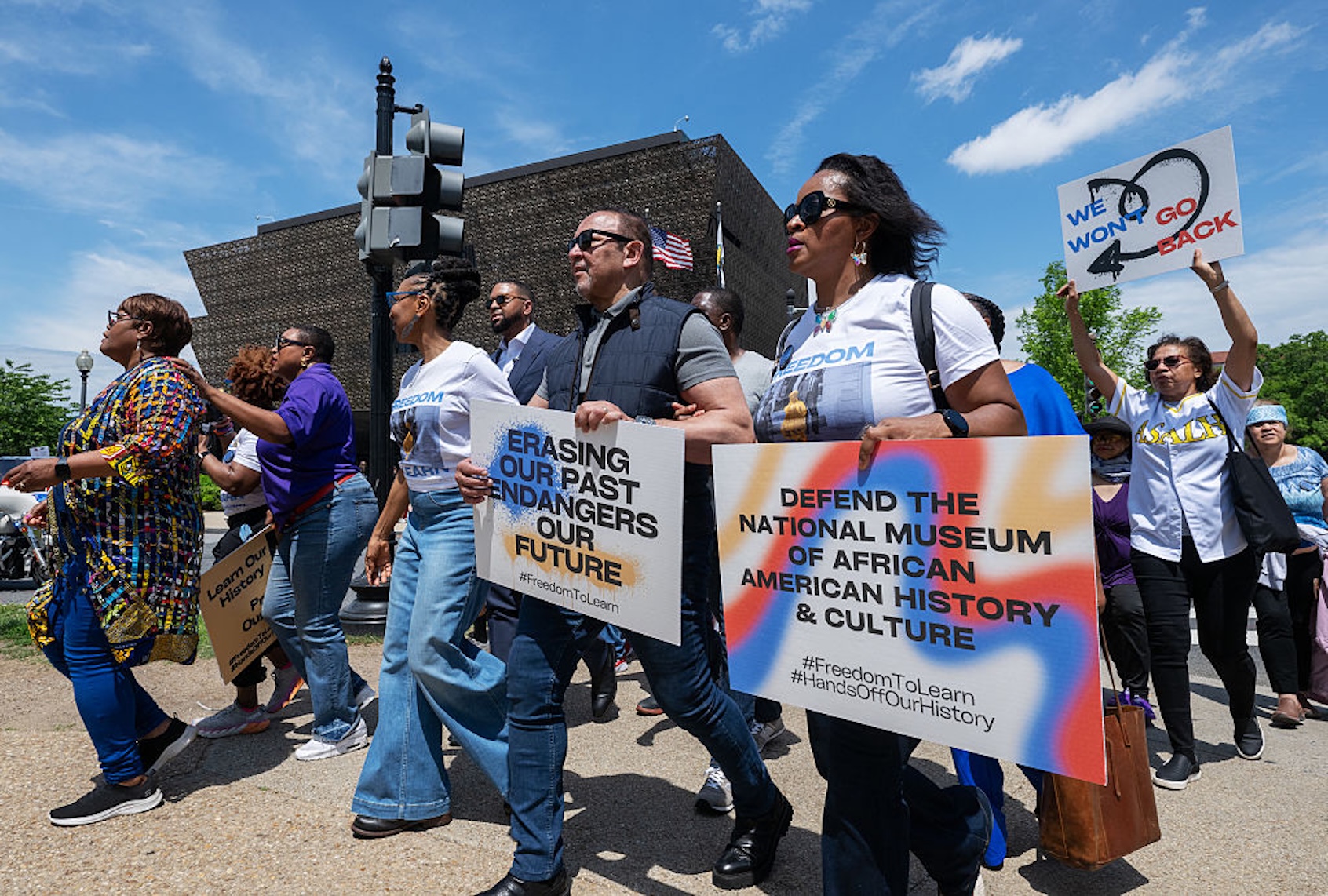
It was an eye-catching conjecture: one of the most revered of the Founding Fathers subjecting people held against their will to possibly painful shocks. And it was one of many details singled out for criticism in a blistering 162-page White House report released in July that argued that the museum had fallen victim to an “ideological capture” that “moved the Museum’s mission away from straightforward historical education and scholarship toward an extreme political activism that seeks to transform our country.”
For decades, the Smithsonian Institution, which draws some 15 million visitors every year to its assemblage of 21 museums — bounty that has no real global peer — has managed to stay mostly above the political fray. There have been occasional exceptions, such as the uproar over the National Air and Space Museum’s planned 1995 exhibit of the Enola Gay, the B-29 that dropped the first atomic bomb on Hiroshima. By and large, though, the institution maintained bipartisan support as the guardian of America’s history, ingenuity and natural heritage, even as political polarization spread and culture wars raged.
But that institutional exceptionalism is now imperiled as never before. In March 2025, President Donald Trump signed an executive order declaring that the Smithsonian had succumbed to “divisive, race-centered ideology.” This July 4, timed to coincide with the 250th anniversary of the Declaration of Independence, came the White House report. Later in July, two House committees held back-to-back hearings on the report, where Republican members took turns lambasting the museum’s director, Anthea Hartig, and forcing her to answer questions about exhibit items such as a “chrome and rubber crotch harness” designed for sadomasochistic sex. That week, Trump signed an executive order instructing the Department of the Interior to erect signs outside the museum “warning visitors about the ideological capture” on display there. The signs have yet to go up, but in late August, Interior Secretary Doug Burgum sent a letter to the Smithsonian’s Board of Regents declaring that other federal agencies “cannot in good conscience continue to support the Smithsonian under current leadership.”
The Smithsonian is independent of the executive branch, governed by a 17-member board led by the chief justice of the Supreme Court and with six members of Congress, three from each party, serving with nine private citizens and the vice president. But it depends on the federal government for 62% of its funding, receiving more than $1 billion per year, and warnings of deep budget cuts have grown ever louder. Finally, on Sept. 8, Smithsonian secretary Lonnie Bunch, the first African American person to lead the institution, announced he was stepping down at age 73, saying “it has been stressful.”
Seen from one vantage, the battle over the Smithsonian is but another example of Trump attempting with characteristic bombast to put his stamp on Washington institutions, alongside shuttering the Kennedy Center, replacing the East Wing of the White House with a huge ballroom and planning a 250-foot arch near Arlington National Cemetery.
But unlike some conflicts initiated by Trump, this one has been festering for years, independent of him, with complaints lodged by board members before he returned to office. The American history museum, the main focus of the administration’s ire, has wrestled for years with how, or even whether, it should present a unifying national narrative, an ambivalence that left it susceptible to the administration’s broadside. Meanwhile, the Smithsonian underwent a political awakening during the 2020 upheaval over the COVID-19 pandemic and murder of George Floyd that echoed responses in academia and other progressive realms.
This left it exposed to a new administration that viewed itself as a corrective against perceived woke excesses. “I said over and over again that there’s going to be a day of reckoning,” recalled Garret Graves, a Republican former congressman from Louisiana who served on the Smithsonian board in 2023 and 2024, in an interview. “You can either participate in it, help guide the Smithsonian back to something that makes more sense, or you can have an abrupt shift. I didn’t realize my words would ring as true as quickly as they did.”
Now, in the year that was supposed to be a crowning celebration of the nation’s 250th anniversary, the Smithsonian is instead in Trump’s crosshairs. And the question of how the country’s premier history museum should tell the nation’s story is suddenly up for grabs.
The National Museum of History and Technology opened on the National Mall in 1964. Its mission, said former assistant secretary of the Smithsonian Remington Kellogg that year, was to “awaken” a “clear understanding of the inspiring story of the United States — its origins, struggles, development, traditions, strength.” As the name reflected, the museum contained duelling missions from the start, showcasing American technological advances and telling a more general historical story.
In 1980, it was renamed the National Museum of American History, but the tension lingered. “It started out as a technology museum, and even now it has a lot of equipment, and to move from that to American history, that’s a huge change,” said Ivan Selin, a former chair of the museum’s board. “Unless you’re going to throw everything out and start over again, you’re going to have a very incoherent thing. Unless you have a clear strategy, you’re going to have some apples and oranges.”
Two decades after the name change, the lack of a unified approach had become an issue. In 1999, David Brooks wrote a scathing critique in the Weekly Standard, lamenting that the museum had so little on display about the nation’s defining moments (the Constitutional Convention, the Lewis and Clark Expedition, the Great Depression, etc.) and prominent figures who shaped them (Thomas Jefferson, Abraham Lincoln, Martin Luther King Jr., etc.). “It ignores or virtually ignores most of the major events in American history,” he wrote. “This is a museum of multicultural grievance, which simply passes over any subject, individual, or idea, no matter how vital to American history, that does not have to do with the oppression of some ethnic outgroup or disfavored gender.”
In 2001, in response to such critiques, the Smithsonian convened a blue-ribbon commission of historians and others led by Richard Darman, a former top aide in Republican White Houses. In 2002, the commission released its report, declaring that the museum “requires what its own leadership has described as a ‘transformation.’ It lacks aesthetic appeal, organizational coherence, and the perception of substantive balance.” The report recommended, among other things, a chronological introductory exhibit that contains “central theme lines for the examination and interpretation of American history” and that “should celebrate America’s remarkable strengths and achievements while also treating fairly and responsibly the ways in which America may have failed to meet the high standards it has proclaimed for itself.”
This would prove easier said than done. For one thing, the museum’s physical structure itself has never been coherent — “an awkward attempt to marry the classical and the modern, the building is legitimately neither,” wrote New York Times architecture critic Ada Louise Huxtable at its opening. “It’s a challenging space,” Brent Glass, who became director shortly after the blue-ribbon report in 2002, told ProPublica.
Above all, though, the commission’s recommendations faced resistance among the museum’s curators to the sort of great-man-of-history approach that Brooks and others were hankering for. There had been a trend in museum scienceaway from this, and away from straight chronology. “There was this whole museum movement to get away from a march through time, to a more episodic or specific sort of story,” John Gray, who succeeded Glass in 2012, told ProPublica. “It wasn’t done to get away from the story; it was finding a way to get people interested.”
In addition, the museum’s curators tended to be specialized in material culture — collecting and studying the museum’s several million objects and artifacts — rather than in conceptual storytelling. To make up for this, Gray’s team tried to enlist several leading academic historians to instill more of an overarching narrative structure. But they declined, saying they were concerned that such an approach could seem triumphalist and provide fodder for an America-first agenda. “We tried to organize [the museum] around ideas and ideals, ideals that were aspirational,” Gray said. “And we failed many times.”
The museum’s eventual solution was to divide the national story into subject areas, each represented by a standing exhibit: “American Enterprise” on business and innovation, “American Democracy” on politics,” “Many Voices, One Nation” on immigration, “The American Presidency,” “The Price of Freedom” on the nation’s wars, “Entertainment Nation” on culture, “America on the Move” on transportation.
Developing these required extensive debate, said the former directors. Some donors supporting the enterprise exhibit were upset that it devoted so much space to the role of slavery in American business. In crafting “The Price of Freedom,” the museum consulted with veterans’ groups to try to avoid a backlash like the one that arose on the Enola Gay. This effort succeeded, Glass said, despite the exhibit’s candor about the darker elements of the nation’s military history. “People can handle complexity,” he said. “They don’t feel bad about the country when told the whole story, and they’re grateful that they have access to the information.”
Scattered throughout the museum are countless highlights: the desk on which Jefferson drafted the Declaration of Independence; the top hat Lincoln wore to Ford’s Theatre on the last night of his life; the actual lunch counter from the 1960 Greensboro, North Carolina, Civil Rights sit-in; and, in a recent addition, a gunboat sunk during the Revolutionary War that is being restored on-site. But the overall effect can be disjointed and disorienting. And, with the museum’s dim lighting, dated technology and underutilized areas, it can feel at times as if one is wandering in a past-its-prime shopping mall or in the forgotten corner of an airport terminal.
It’s a stark contrast to the National Museum of African American History & Culture, which opened in 2016 under the direction of Bunch and, notably, has a clear chronological design. Of course, said Selin, the former American history museum board chair, the African American museum and the National Museum of the American Indian, which opened in 2004, have the advantage of a more focused subject, leaving it even less clear what remains for the American history museum, where attendance has declined in recent years. “You can find nowhere in any Smithsonian document a theory of what should be in the American history museum or the more particular museums or how many of these particular museums there should be,” Selin said. “There’s no charter whatsoever that says how they fit together.”
In March 2020, the Smithsonian shuttered its museums for the pandemic. A few months after that, Washington and other cities erupted in protests over Floyd’s murder in Minneapolis. Bunch, who became secretary of the Smithsonian in 2019, and other top officials embarked on a push to rethink the institution’s priorities, as reflected in the minutes of the Board of Regents meetings, which were now being held online. Bunch “briefed the Regents on his efforts to navigate the dual pandemics caused by the Coronavirus and issues surrounding race, racism, and racial identity,” the minutes of the June 2020 meeting stated. He announced the launch of “Smithsonian Cares,” a digital resource that would “provide tools and guidance to empower and inspire conversations about diversity, equity, access and inclusion.”
That October, the board discussed “the potential creation of a Chief Diversity Officer position, a review of organizational processes and policies that may have inadvertently created barriers to inclusivity, integrating and standardizing DEAI training across the organization, strengthening supervisory DEAI skillsets, increasing senior leadership’s focus on inclusivity, and identifying funding and resourcing strategies to implement DEAI efforts across the Institution’s functions and operations.” In February 2021, Bunch told the board that the Smithsonian’s five strategic priorities would include positioning it as a “trusted source for critical conversations and helping the nation grapple with important issues like race and identity.”
As the meeting minutes show, the institution’s elevation of identity was being encouraged by the newly installed Biden administration. In October 2021, the Smithsonian’s Office of Government Relations reported that the Smithsonian had “brought objects from the National Museum of American History to the White House for a temporary display recognizing Lesbian, Gay, Bisexual, Transgender, and Queer Pride Month.” Three months later, the office stated that it “continues to work closely” with the White House on “diversity, accessibility, access and inclusion efforts.” The Smithsonian noted plans for exhibits at the White House to mark “Black History Month in February, Women’s History Month in March, Asian-American and Pacific Islander Heritage Month in May, LGBTQ in June and Hispanic History Heritage Month in September.”
The post-2020 shift extended to the various museums, which started to reopen to visitors in spring 2021. To cite just one example, the National Portrait Gallery revised the signage for a portrait of Henry Laurens, South Carolina’s delegate to the Continental Congress, to reflect that he had made his wealth through chattel slavery. “When Floyd was killed, everyone acknowledged that now is the time to ask: What are the stories that we’re telling and were we being honest and fair in recounting those stories? We all looked at it through this lens,” Kim Sajet, who became the director of the Portrait Gallery in 2013, told ProPublica. “Everyone felt energized by that. We can’t change the past, but we need to acknowledge what happened in order not to repeat it in the future.”
But the new direction caused misgivings for some conservative supporters of the institution, such as Graves, who joined the regents as one of the three Republican congressional appointees in 2023. Graves told ProPublica that he had high regard for Bunch — “his accomplishment with the African American museum was remarkable” — but that he became worried that the Smithsonian was operating within a bubble. Its staff were living in a metro area that had voted overwhelmingly against Trump (and museum employees are generally among the most left-leaning of any profession), yet they were charged with presenting exhibits to visitors from all over the country and the world, a disconnect that the institution seemed insufficiently aware of.
Many board meetings would kick off with tours of a certain museum, and Graves and a fellow Republican appointee, Adrian Smith of Nebraska, would often be taken aback by what they saw. “Seventy-five percent of the time Adrian and I would be walking around and say, ‘Are you kidding me?’” Graves said. “It wasn’t interpreting science or history. It seemed to have an agenda, and that’s not what a museum should be.” What was missing, he said, was a sense of the nation’s achievements. “This country is a remarkable experiment,” he said. “We’ve had some grave sins, but my gosh, America is a net victory for the world. It’s unbelievable what happened here in 250 years and it’s worth celebrating.”
Graves retired from Congress at the end of 2024. In his farewell address to the regents that October, he warned against allowing the Smithsonian to become seen as affiliated with one party or ideological bent. “I felt like they were causing sustainability problems for the institution,” he said. “Politicizing the Smithsonian is an awful, awful idea, because then you only receive funds when there’s a Democratic majority. This is America’s museum and there should not be anything partisan about it.”
One week later, Trump won the election to return to the White House.
In his first term, Trump largely ignored the Smithsonian. In 2017, Bunch gave him a tour of the new African American museum, which Bunch recounted later in his memoir: “The president paused in front of the exhibit that discussed the role of the Dutch in the slave trade. As he pondered the label I felt that maybe he was paying attention to the work of the museum. He quickly proved me wrong. As he turned from the display he said to me, ‘You know, they love me in the Netherlands.’ All I could say was let’s continue walking.”
It took little time for Trump to make clear that, as on other fronts in his second term, things would be different this time around. First came the March 2025 executive order, which directed Vice President J.D. Vance to rid the Smithsonian of “improper ideology.” Two months later, Trump said that he was firing Sajet at the Portrait Gallery, calling her “a highly partisan person, and a strong supporter of DEI, which is totally inappropriate for her position.” The Smithsonian noted that Trump did not have the authority to remove Sajet, but she left anyway, hoping to spare the institution.
In August 2025, the White House issued a 120-day ultimatum to replace “divisive or ideologically driven language with unifying, historically accurate and constructive descriptions,” but with little follow-up, and for nearly a year, it looked as if the storm may in fact have passed. Then came the White House report on the American history museum, with such an exhaustive litany against Hartig, its director since 2018, and Bunch that it made plain the authors had been scouring their public statements and the museum. (Through a spokesperson, Bunch declined to be interviewed. Museum representatives did not respond to requests to speak to Hartig.)
In addition to citing the Franklin exhibit, the report noted that an exhibit called “Girlhood (It’s Complicated)” had included “the pages of a 6-year-old girl’s diary where she expresses fear about ‘getting boobs’ and wishes for her nonexistent ‘penis to grow.’” Another exhibit, on gay history, had “included a two-piece chrome and rubber crotch harness designed for sadomasochism.”
It criticized the museum for having trained staff using the “Museums as a Site for Social Action Toolkit,” a 200-plus-page roadmap on how to “truly transform the museum space,” which is linked “with white supremacy, hetero-patriarchy, abuse of labor, colonization, imperialist theft of art and artifacts, destruction or absencing of alternative ways of interpreting or representing art and artifacts, structural racism and other oppressions.”
Above all, though, the report criticized the museum on grounds that echoed Brooks and the 2002 blue-ribbon commission, saying that it failed to offer visitors a unified narrative of the nation’s history. “That story should be a basic consensus view that is not ideological or politicized, but presents the facts of history — what actually happened — as accurately as possible with minimal present-day bias,” the report stated. “It should tell the whole story of a nation, including the good and the bad, so Museum visitors can understand the development that led our nation to where it is today.”
For years, the Smithsonian had avoided major conflagrations partly by engaging in what one former official called the “care and feeding” of members of Congress on the two committees with purview over it, Appropriations and House Administration. If there was a potentially controversial exhibit, the museum would bring members over for a preview tour, so they had some context for complaints they might receive. But these efforts were on hold for a while because of the pandemic closures, and the Smithsonian’s government relations office experienced heavy turnover, as one of its directors had cancer and another died suddenly.
This context, combined with the fuel provided by the White House report, helped explain the level of vitriol that Hartig faced when she appeared at the two hearings in late July. Even by the standards of today’s decorum-less Congress, the hearings were wild affairs. At the first, held by the House Oversight Subcommittee on Delivering on Government Efficiency, Chair Tim Burchett, a Tennessee Republican, kicked things off by playing a lengthy string of video clips of Hartig offering tribal land acknowledgements at the start of her speeches. “I’m wondering, have you ever planned on deeding any of your personal property or property of the Smithsonian to any of these tribes?” he asked Hartig.
She adopted a conciliatory tone, saying the Smithsonian “takes the concerns raised in the White House Domestic Policy Council’s report seriously” but that “it does not fairly or accurately characterize the full body of work at the museum.” She assured the committee, “I love the United States of America. I consider it the privilege of my career to help preserve its treasures and serve the American people.”
This did not assuage committee Republicans. Burchett displayed museum images including the crotch harness and the diary mention of the 6-year-old girl wishing for a penis. “Ma’am, I mean, you have pictures of bondage. You have some overtly sexual things up there,” he said. “I’m not a fan.” Rep. Nancy Mace, a South Carolina Republican, pressed the point: “Are images of sexual fetishes appropriate for children? Yes or no?” Rep. Brandon Gill, a Texas Republican, noted that the toolkit that the museum used for staff training had referred to “politeness” as a feature of “white supremacy culture.”
Those defending Hartig were hardly less outspoken. David Blight, a Yale historian also testifying, compared the White House’s attacks on the Smithsonian to the German Third Reich, saying “their model may indeed be Joseph Goebbels’ committee on enlightenment, which is what the Nazis called their committee that tried to control museums.” Rep. Jasmine Crockett, a Texas Democrat, opened her remarks by saying, “Welcome to the White Pride Committee.” Rep. Kweisi Mfume, a Maryland Democrat, vowed to sacrifice his life for the Smithsonian. “We will not let you destroy that museum,” he said. “No matter how long it takes, how many battles are required, how much effort is needed, we will not allow that to happen unless you find a way to kill all of us and walk over our bodies to change history.”
The next day’s hearing, before the House Administration Committee, was more of the same. The bipartisan consensus around the Smithsonian appeared to lie in tatters.
On a recent Sunday, a group of visitors made their way into the centerpiece exhibit at the National Mall entry to the history museum, the giant Star-Spangled Banner that was flying over Fort McHenry in 1814 and inspired Francis Scott Key to write what became the national anthem. For safe-keeping, the flag is displayed in very low light, giving the chamber a sacred feel, like a cathedral crypt. “Oh my god, it’s huge,” said one woman. “I am shivering,” said another. “It’s insane,” said a third.
Every day, the museum, for all its imperfections, still makes a strong impression on many visitors. But its longstanding search for identity helped make it a target for an administration looking for weak spots, and now its future and that of the entire Smithsonian hangs in the balance. Three of the nine citizen slots on the Board of Regents are vacant, and three more will be next month. Whoever the remaining members of the board — which include Vance — select to fill those slots will help determine who is chosen to replace Bunch as secretary, and the institution’s future course. Much will depend on how much Chief Justice John Roberts, at the head of the board, decides to engage.
Any large institution can benefit from reassessment, and the Smithsonian and the American history museum in particular may well be overdue, especially as yet another focus area is about to be cleaved off, for the National Museum of the American Latino, scheduled to open early next decade. What gives so many supporters pause is for that reevaluation to happen under Trump, who hasn’t shown a lot of interest in how the various museums interact, much less in the nuances and subtleties of history.
“There will be a moment,” Sajet said, “when the American people will have to stand up and decide, is this what they want?”
Object permanence: Major AI breakthrough; Disney v Pooh tombstone; Vancouver riot kiss; Farage admits Brexit lies; Protecting the web from its founders; Sanders x Hillary; Surveillance pricing v your dollars.
It's not often that someone on a panel says something that makes my jaw drop, but that's what happened earlier this week when the moderator of a panel I was on in Toronto described jailbreaking an iPhone as "rampant theft of IP."
Some context: the panel was in Toronto, and the nominal subject was "digital sovereignty," though all the panelists (except me) interpreted that to mean "sovereign AI." All of their interventions were focused on how Canada could build and operate its own AI, which I found very weird, since there is no AI-related threat to Canadian sovereignty. If Donald Trump ordered OpenAI and Anthropic to turn off all of Canada's chatbots tomorrow, nothing would change: every firm, ministry and household would operate as per normal:
Now, that's not to say that Canada doesn't have a digital sovereignty problem – it really does! Donald Trump and US Big Tech have fused into a single entity and Trump now orders US tech giants to terminate the online accounts of foreign officials who displease him. When Microsoft turns off your Office365 account, you lose your working files, your calendar, your address book, your email archives, and the Outlook email address you use to log in to every online service:
So while turning off Canada's chatbots would not inflict any real harm on Canada, M365 terminations could paralyse any federal or provincial ministry, any structurally important firm, and most Canadian households.
The threat doesn't stop there: Trump can also order Apple and Google to brick any of Canada's iPhones or Android devices – terminating individual officials' mobile access, or terminating whole provinces. It's not just iPhones either – Trump can also brick any tractor in Canada:
This is the real digital sovereignty risk, and Canada needs to address it now. But Canada can't – our hands are tied…by us. In 2012, we passed a law, The Copyright Modernization Act, that criminalizes "jailbreaking," meaning that Canadian companies can't go into business figuring out how to install different app stores on phones and consoles, or change the firmware in tractors to enable independent repair, or reliably export their cloud data to rival Canadian services:
Why did we pass this law? Because the Americans promised us free trade and no tariffs on our exports if we agreed to it. That's a promise Trump tore up, but we're still holding up our end of the bargain. That's crazy. It means that American companies can use Canada's courts to destroy Canadian businesses that offer the Canadian people tools to help them escape Big Tech's sleazy ripoffs of their data and cash.
And boy do those US tech companies take in a lot of cash. The US ad-tech duopoly of Google/Meta rig the advertising market, taking 51% out of every ad dollar through an illegal, collusive arrangement called "Jedi Blue":
The US mobile tech duopoly takes 30 cents out of every dollar spent via an app, by forcing every app vendor to use their payment processors, which charge 1,000% more than any other payment processor in Canada. That means that every time a subscriber to a Canadian news site signs up through an app, 30% of the lifetime subscription revenue for that Canadian subscriber is funneled to one of two California companies.
The corollary, of course, is that if Canadian businesses were free to compete with US companies – if Canada stopped foolishly holding up its end of the bargain that Trump has dishonoured – then it would be as though every Canadian news outlet increased its subscriber base by 25% overnight! What's more, the Canadian companies that sell those jailbreaking tools would make billions out of US Big Tech's billions.
And that's where the moderator of this week's panel comes in. When I finished making this pitch, they turned to the rest of the panel and said something like, "Well, apart from rampant theft of IP, what else could Canada do to secure its digital sovereignty?"
That's when my jaw dropped. Making it possible for, say, a Canadian company to sell its own Canadian game to a Canadian customer, in Canada, without giving Apple or Xbox 30% of the purchase price, is not "theft of IP." It's not "theft of IP" for a rightsholder to sell their own products to their customers. It's not "theft of IP" for a Canadian owner of a device to decide for themselves which software they want to run on it. If buying software from the company that made it and installing it on a device you own is "theft of IP," then so is putting non-Nike shoelaces in your Air Jordans.
It's not "theft of IP." It's just good business. Moreover, it's the kind of good business that created America's tech giants in the first place. As Jeff Bezos tells his suppliers: "Your margin is my opportunity." US tech giants make whopping margins around the world, thanks to the anticircumvention laws that the US Trade Rep crammed down every US trading partner's throats, laws that allow US companies to use other countries' legal system to destroy their competitors.
I've been mulling this "rampant theft of IP" remark for a couple of days now, but it wasn't until a reader wrote to me to remind me about Apple's origin story that I realised what the punchline is. Apple founders Steve Jobs and Steve Wozniak financed their first product launch by selling "Blue Boxes" (devices that let you make free long distance calls by cheating the phone company) door to door in the UC Berkeley dorms:
Now, I'm not going to weep for the lost revenues that Jobs and Woz denied to AT&T. After all, AT&T was stealing that money from its customers, which is why, just a few years later, a federal court convicted AT&T of monopolistic practices and broke the company up:
But the legal term for what a Blue Box does is "toll theft," which is to say, Apple – a company literally founded on theft – now makes the majority of its profits by convincing people that making a competing product is literally stealing. A company whose founders got their seed capital by marketing illegal circumvention devices now markets products designed to make it a crime for a rightsholder to sell their own work to you.
I've long said that "every pirate wants to be an admiral":
But this is just a little too on the nose. When Apple went into business selling products to rip off the phone company, that wasn't progress. When Canadians go into business selling devices that let iPhone owners use their own property to do legal things – like buying copyrighted works directly from their creators – that is not piracy.
Canada has a real digital sovereignty problem, and it's not AI. Canada will not mitigate its digital sovereignty risk by successfully launching a Made in Canada version of the money-losingest venture in the history of the human species:
Canada's real digital sovereignty problem is its reliance on the apps, cloud services and devices that are tethered to the American cloud, access to which Donald Trump could – and does – terminate whenever he feels grumpy. Trump has repeatedly threatened to annex Canada and turn us into "the 51st state." He's trying to steal Alberta right now. Our digital sovereignty risk is the risk of Trump paralysing our country in order to steal Alberta – or the entire shop.
We can address that digital sovereignty risk – and make billions at the same time – by legalising jailbreaking and becoming the world's "disenshittification nation." Unlike a program to build Canadian AI, this will make billions, not lose them – and unlike Canadian AI, this will make our country more resilient and safer, by delivering products that Canadians – and the world – want to buy and will pay us a fortune for.
#15yrsago Rochester police use selective enforcement of parking laws to harass attendees at a meeting in support of Emily Good https://rochester.indymedia.org/node/7516
"Red Team Blues": "A grabby, compulsive thriller that will leave you knowing more about how the world works than you did before." Tor Books http://redteamblues.com.
"Chokepoint Capitalism: How to Beat Big Tech, Tame Big Content, and Get Artists Paid, with Rebecca Giblin", on how to unrig the markets for creative labor, Beacon Press/Scribe 2022 https://chokepointcapitalism.com
Currently writing: "The Post-American Internet," a sequel to "Enshittification," about the better world the rest of us get to have now that Trump has torched America. Fourth draft completed. Submitted to editor.
"The Reverse Centaur's Guide to AI," a short book for Farrar, Straus and Giroux about being an effective AI critic. LEGAL REVIEW AND COPYEDIT COMPLETE.
"The Post-American Internet," a short book about internet policy in the age of Trumpism. PLANNING.
A Little Brother short story about DIY insulin PLANNING
This work – excluding any serialized fiction – is licensed under a Creative Commons Attribution 4.0 license. That means you can use it any way you like, including commercially, provided that you attribute it to me, Cory Doctorow, and include a link to pluralistic.net.
Quotations and images are not included in this license; they are included either under a limitation or exception to copyright, or on the basis of a separate license. Please exercise caution.
"When life gives you SARS, you make sarsaparilla" -Joey "Accordion Guy" DeVilla
READ CAREFULLY: By reading this, you agree, on behalf of your employer, to release me from all obligations and waivers arising from any and all NON-NEGOTIATED agreements, licenses, terms-of-service, shrinkwrap, clickwrap, browsewrap, confidentiality, non-disclosure, non-compete and acceptable use policies ("BOGUS AGREEMENTS") that I have entered into with your employer, its partners, licensors, agents and assigns, in perpetuity, without prejudice to my ongoing rights and privileges. You further represent that you have the authority to release me from any BOGUS AGREEMENTS on behalf of your employer.
For this post, let's discuss a few other audiophile items that have come my way in recent weeks.First, let's talk about something I haven't brought up for awhile now: sample rate conversion (SRC).A few weeks ago, Spoon (a.k.a. Steven Elkins of Illustrate) sent me an E-mail about his new src.hydrogenaudio.org page evaluating and ranking the qualities of various software sample rate converters
Let's have some fun this week on miscellaneous topics.Occasionally, I'll highlight items I've either written or found on audio discussion forums I think would be good to share. One reason I decided to start doing a blog beyond just contributing to forum discussions was precisely because while the public forums are great for interactions with community members, meaningful posts often become
This is a guest post by SherAli Tareen, Professor of Religious Studies at Franklin and Marshall College.
At its core Rajbir Singh Judge’s dazzling monograph Prophetic Maharaja presents an argument for “dwelling in loss” rather than seeking the enticing yet entrapping desires for restoration, recovery, and healing. By writing a “historical narrative that refuses to historicize,” Judge pushes his readers to examine notions of sovereignty and history that the practice of dwelling might make available. Conceptually, through the example of Duleep Singh (d. 1893) and the politics his life and memory make possible, the book seeks to interrupt dominant scholarly notions of historicism and colonial logics of religion and sovereignty, that reappear in varied apparitions in contemporary scholarship as well. It is very rare for a monograph, and even rarer for a first monograph, to offer an example of close and patient reading that rattles deeply held and deeply prized normative assumptions of one’s field of intervention. Judge achieves precisely that. And he does so in multiple ways and registers.
In Panjab Studies, there is a pervasive trend of excavating a redemptive narrative of a Panjabi cosmopolitan ethos that might offer the fantasy of traversing and transcending the alleged juggernaut of religious convictions that according to this view stifle such “cosmopolitan” pasts and futures. The Sikh tradition, under the calculus of this desire for “Panjabiyyat” or “Panjabiness” can either work as a quintessentially hybrid religion that naturally inheres pluralism or as a model for a colonial infested discursive machine that can only be repaired through the prophylactic of secular baptism. Judge entertains none such fantasy. In fact, Prophetic Maharaja conducts a devastating indictment of the politico-conceptual coherence as well as the desirability of the secular quest for Panjabiyyat by presenting a reading of Duleep Singh’s quest for sovereignty that does not seek to resolve, recover, overcome, or redeem any restorative project of liberal redemption and goodness.
Through an analysis both painstakingly layered and theoretically vivacious, Judge masterfully walks his reader through a terrain of political theology populated by visions of sovereignty neither liberal nor secular, but rather nestled in the refusal to exercise the sovereign decision to historicize, humanize, and heal any alleged ruptures of history. Judge’s analysis of Duleep Singh’s attunement to the loss and possibility of sovereignty propels the reader to confront and wrestle with a grammar of life that is not driven by or available for secular projects of dividing that life into binaries like religion and culture, state and society, plural harmony and exclusivist bigotry. Life, Judge teaches us, taking a cue from anthropologist Talal Asad, is “essentially itself.”
One of the great lessons of this book that I found particularly striking and productive concerns its theorization of loss and its simultaneous recognition that loss escapes and exceeds any neat theorization. Judge is at his most brilliant and intellectually courageous during moments in this book when he meditates on the aporias of his own encounter with the conceptual constitution of his project. And remarkably, and again in a rare achievement, these are precisely the moments when his argument is most piercing and compelling. His discussion of loss is a great example of this. As Judge writes very early in the book (in its Introduction), signposting an analytical attitude and conviction he sustains throughout the monograph: “rather than provide a new theorization of loss-which cements a relation to loss-this book endeavors to reckon with the powerful resources that work on loss, such as mourning and melancholia, and what they have already provided.” Judge continues, in a flash of utter brilliance, “I contend with loss instead of transcending it through recovery [emphasis mine]…I do not tie a thread throughout the text that provides an adequate answer to loss because there might not be any answer to it. In this sense the book does not provide a theorization of loss but dwells in the various rhythms of loss. My goal is not to recognize loss and provide it taxonomic space but to sit with losses as they appear, disappear, and reappear throughout the text” (p. 13). This mini paragraph I have just cited represents a moment of tremendous significance in the study of South Asian History and Religion. Note, in the interest of careless readers who will rush towards the inconsiderate gesture, all too pervasive among historians of a certain ilk, to dismiss or undermine careful theoretical interventions as Judge’s here as convoluted high theory. Note particularly that dwelling, in Judge’s account, as both an analytical concept and as a mode and practice of life, is anything but passive inactivity. Exactly to the contrary, dwelling represents that aggressive commitment to a politico-conceptual ethic of refusing to repair and overcome loss through secular gestures of managing and healing the violence of history.
Dwelling in loss, instead of activating the secular instinct of historicizing, humanizing, and supposedly transcending loss makes possible a horizon of the political that comes to live with rather than attempt to overcome the aporias of life. Judge’s invitation to his readers to “sit with losses as they appear, disappear, and reappear” in the passage of a text or in the passage of history is I believe a profound call for suspending sovereign confidence in compensating for loss and treating the wound of historical contingency through the fantasy of historicist rigor, of returning life to its immanent materiality. What sort of politics and possibilities of sovereignty might become available by dwelling in loss, by sitting with rather than treating with the prophylactic of secular historicism the vertigo of historical conjunctures such as the one involving the loss, renewal, and diffusion of Duleep Singh’s aspiration for sovereignty? In asking and addressing this question, Judge successfully offers pathways for recognizing and exploring the political power and philosophical sophistication of imaginaries of sovereignty, like Duleep Singh’s, that are otherwise conveniently though perniciously catalogued as sorry tragedies of a colonized subject. Making Duleep Singh’s example speak back to and interrupt the alleged tragedy of his quest for sovereignty, Judge undertakes a critically important endeavor of decolonizing both colonial and contemporary secularist models of South Asian history populating the Western academy. This forum brings together outstanding scholars, conducting theoretically cutting edge critiques of secular power from multiple disciplinary perspectives, to engage, wrestle with, and celebrate a book with major ramifications and consequences in the study of religion, history, philosophy, and South Asia. The Prophetic Maharaja is in many ways a model and master seminar in bringing together invasive attention to the particularity of an archive and theoretical reflection that paves as well as shifts the terrain of multiple fields of knowledge simultaneously.
SherAli Tareen is Professor of Religious Studies at Franklin and Marshall College and currently a Patricia Crone member in the School of Historical Studies at the Institute for Advanced Study in Princeton NJ for the academic year 2024-25. His book Defending Muhammad in Modernity (University of Notre Dame Press, 2020) received the American Institute of Pakistan Studies 2020 Book Prize and was selected as a finalist for the 2021 American Academy of Religion Book Award in the Analytical-Descriptive Studies category. His second book is Perilous Intimacies: Debating Hindu-Muslim Friendship after Empire(Columbia University Press, 2023) which was selected as a finalist for the 2024 American Academy of Religion Book Award in the Textual Studies category.
Rajbir Singh Judge is Assistant Professor in History at California State University, Long Beach. Prophetic Maharaja: Loss, Sovereignty and the Sikh Tradition in Colonial South Asia was published in 2024, and over the next few weeks we have a series of contributors who’ll be offering their reflections, followed by a response from Rajbir. I’ll update this post with links to the other posts as they’re published:

 Login