Jamie Dettmer is associate editor and a foreign affairs columnist for POLITICO.
The war in Gaza hasn’t figured much in campaigning for Israel’s upcoming election — despite the likelihood that Israel’s Arab minority, Palestinian by heritage, might well decide who gets to be prime minister.
Israel’s Arabs make up around 20% of the electorate that will be casting ballots in the Oct. 27 parliamentary election. And thanks to complex coalition math, Arab parties might well be the ones to crown Prime Minister Benjamin Netanyahu’s main rival, former military chief Gadi Eisenkot, who leads a center-right opposition bloc.
But campaigns by both the Arab parties and Jewish politicians have avoided talking about what the outcome might actually mean for Jewish-Arab relations in the region, for the possibility of a two-state solution and even for U.S. President Donald Trump’s vision for a comprehensive peace-through-prosperity deal between Israelis and the Palestinians.
“The election campaign has been bizarre,” said Michael Milshtein, a retired Israeli army colonel and former head of Palestinian affairs in Israel’s military intelligence agency. “The campaign has been focused on domestic and personal issues, and on Netanyahu.”
That means it hasn’t included “the very deep complicated issue of the critical relations between us and the Palestinians, and what kind of scenarios or solutions are left after the Oct. 7 Hamas attack and the Gaza War — for any kind of political settlement,” Milshtein said.
But outside of Israel there’s alarm — especially among Arab leaders — over the absence of any serious debate about how to end the multi-front conflicts Israel is engaged in and what that might foretell, said HA Hellyer, a geopolitical scholar specializing in the region.
“Netanyahu, or not, the Israelis are on a particular trajectory when it comes to foreign and security policies,”Hellyer told POLITICO.
“Opposition politicians blame Netanyahu for Israel’s increasing diplomatic isolation and loss of support in parts of Europe and North America. But when you look at what they’re actually saying, they’re not arguing with the policies when it comes to Gaza. They support the overall settlement project in the West Bank. They support the incursion in Southern Lebanon. Their proposition is that they could have done things in a better way,” said Hellyer, who’s a fellow at Britain’s Royal United Services Institute.
Mentions of the Gaza conflict in election campaigns have been largely limited to clashes over who was to blame for failing to prevent the Hamas attack on southern Israel, which killed more than 1,200 people.The Eisenkot-led Change bloc has focused on Netanyahu’s role in the lead-up to the Oct. 7, 2023 massacre, pointing to the failures of his government and arguing he ignored warnings of a likely big Hamas attack. But the bloc has done little to flesh out its governing policy platform.
Meanwhile, Netanyahu’s campaign has sought to frame Eisenkot as an appeaser and puppet of Arab party leaders — such as Mansour Abbas, leader of the Islamist Ra’am party, and Ahmad Tibi, leader of Ta’al party — arguing he would compromise on core security issues to persuade them to join or vote with his coalition bloc after the election to give him a Knesset majority.
“The lack of real content is a major problem for such a crucial election,” the Jerusalem Post lamented in an editorial this week.
Few see any chance of a negotiated peace or a two-state solution any time soon. Israelis largely view international condemnation as biased, and say critics of Israel’s conduct in Gaza fail to understand what the country has to do to survive.
People walk past election campaign banners in Jerusalem on Oct. 22, 2026. | John Wessels/AFP via Getty Images
But at some stage or another, Israelis will have to have conversations about peace, and delaying them isn’t going to help the country reduce its deepening isolation or help repair strained ties with traditional allies, including Europeans, who are starting to impose sanctions and considering arms embargoes.
Former Israeli Prime Minister Ehud Olmert, a fierce Netanyahu critic, said that while there has been election debate about how successful the Gaza war has been in degrading Hamas, “it’s true that the main issue of our future with the Palestinians has been ignored.” He added: “Had I been running, I would have talked about it the whole time.”
So why hasn’t peace been on the agenda?
As Olmert sees it, the root lies in “the huge trauma of Oct. 7, along with the perception that public opinion, the mainstream, has shifted from where it was before the massacre and moved further rightward politically.” That isn’t uncommon: When Israel suffers a severe psychological blow, the political center-of-gravity habitually moves sharply to the right, favoring hawkish and nationalist positions and marginalizing more conciliatory perspectives.
“Nonetheless, the perception is that general public opinion has shifted and, therefore, all of the other parties are hesitant to talk about any political process with the Palestinians or about negotiations or about a two-state solution, and so on and so forth, because they worry they’ll lose support,” Olmert said.
Sven Burgsdorff, a former EU representative and ambassador to the West Bank, doesn’t subscribe to Olmert’s view, instead arguing there’s not much difference between Netanyahu and the leaders of the center-right Change bloc when it comes to Gaza or a two-state solution — something Netanyahu dismisses out of hand regularly, saying that Palestinian sovereignty is incompatible with Israel’s security.
“Even if the right-wing Netanyahu coalition were to be replaced by the current opposition, none of its main leaders — Eisenkot, Naftali Bennett, Yair Lapid and Avigdor Lieberman — question the IDF’s conduct [in] the war on Gaza, nor are they supportive of the idea of Palestinian self-determination. Only Yair Golan of the Democrats and the coalition of Arab parties are in favor of that,” he said in an interview.
Opposition leaders don’t criticize Netanyahu for the conduct of the Gaza war, Burgsdorff continued. Their issue with him is whether he was at fault for not protecting Israel from the 2023 attack. They also accuse him of being set on dismantling Israel’s democratic system and for having no exit strategy for his forays into broader regional conflicts.
Netanyahu has made a long political career out of leveraging external crises to keep his grip on power. And even now, it would take a brave commentator to write him off and suggest that Bibi the Magician, to use one of his nicknames, has lost the magic touch. The Israeli leader has pulled off stunning turnarounds in his long political career, including in the 1990s when he beat Shimon Peres in elections held just months after the assassination of then-Prime Minister Yitzhak Rabin.
Olmert still hopes for a Netanyahu defeat and says if Eisenkot is installed, he might make conciliatory moves like meeting with Mahmoud Abbas, the president of Palestinian National Authority.
“He won’t be able to do anything big or quickly with Bennett and Lieberman in his cabinet. Both of them are completely opposed to the idea of Palestinian sovereignty. They keep saying it all the time. ‘There will never be a Palestinian state,’” he said. “So the political space will be very limited.”
But without some serious movement toward a two-state solution, Israel could risk alienating more of its traditional allies in Europe and the U.S.
In so-called normal times and under business-as-usual administrations the job of White House Press Secretary doesn’t lead to renown or infamy. Those terms — normal, business as usual — don’t apply to Donald Trump’s tenure in the Oval Office, and his press secretaries have become household names mostly for the wrong reasons.
Sean Spicer’s claim to fame is being a terrible liar and an even worse dancer. Sarah Huckabee Sanders distinguished herself by reducing the once-frequent White House press corps briefings to very occasional insult exchanges peppered by lies. Her successor Stephanie Grisham, meanwhile, spends her time appearing on the One America News Network, Sinclair Broadcast Group stations, and Fox News instead of serving as a liaison between the press corps and the Oval Office.
More than 300 days have passed since the White House has held a news conference with reporters. In light of the recent saber-rattling between the U.S. military and Iran, that number is stunning. Times such as these require an official briefings from the White House and the military, who are charged with a duty to convey information to citizens via the press corps with clarity.
Such times also present tremendous opportunities to spin the administration’s actions in a persuasive light, leading citizens to have confidence in its actions. Indeed, Ari Fleischer used his position as George W. Bush’s press secretary to sell a war that has been dragging on now for 17 years.
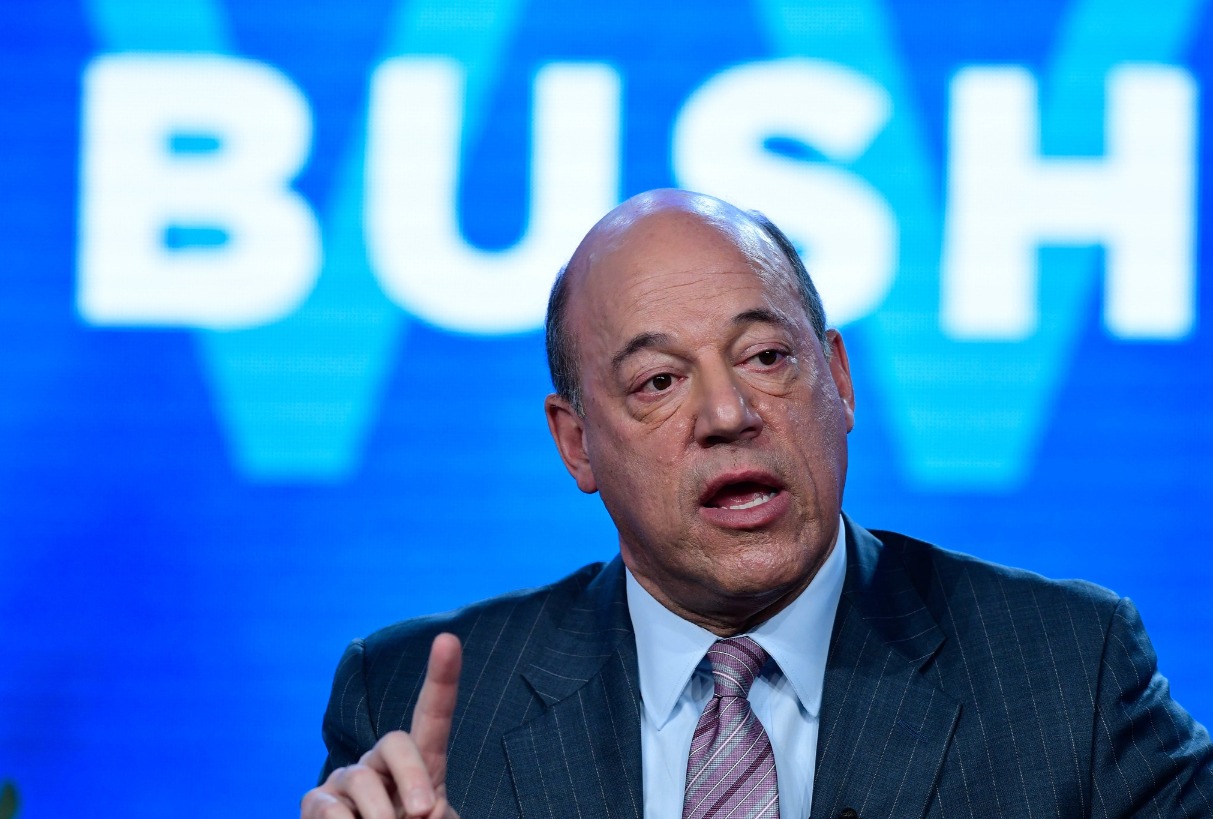
On Friday, Fleischer appeared in Pasadena to talk about the upcoming “American Experience” profile “George W. Bush,” part of PBS’ day of press conferences at the Television Critics Association winter press tour. This is where Salon sat down with him for an interview that took place before the “American Experience” panel.
Right around the same time, 13 former White House press secretaries, military and foreign service officials published a letter on CNN calling for the restoration of regular press briefings.
“An informed press corps strengthens our ability to govern,” the letter states. “Yes, presidents are now able to communicate directly via the internet, social media and tweets. But most Americans will learn about the work of the White House in the reports they see, read, and hear in what we collectively call ‘the press.'”
The statement then observes that regular White House briefings generally lead to better and more responsible reporting, later adding, “In times of military conflict and international crisis, these briefings take on even more importance. Americans want to know the latest developments and seek the truth. On social media, wild rumors can fly, and our adversaries can manipulate disinformation to their advantage. This is now well documented.”
“For that reason, among many, the country needs trusted sources of information delivered on a timely and regular schedule. That is the fundamental responsibility of people who serve as spokesmen and women for presidents, cabinet secretaries and other high-ranking government officials.”
White House spokesman Hogan Gidley responded to the letter by calling its writers “D.C. establishment swamp creatures.”
Among those who signed are Victoria Clarke, who worked under Defense Secretary Donald Rumsfeld, and Scott McClellan, who worked under Bush as his press secretary.
Missing from that list are McClellan’s fellow Bush-era press secretaries Dana Perino and Fleischer. Perino is now a Fox News anchor, and Fleischer is a contributor at Fox News.
In this one-on-one conversation with Salon, Fleischer talked about his view of the press’ relationship with the White House in the current climate and was asked to reflect on his time as press secretary to the second President Bush, specifically with regard to conveying false information about Saddam Hussein possessing weapons of mass destruction that led us to the U.S. invasion of Iraq in 2003.
Please note that this interview has been lightly edited for clarity and length.
I don’t know if you read the recent Twitter challenge from authors Don Winslow and Stephen King to Stephanie Grisham.
No, I haven’t.
They stated that if she would hold a press briefing, they’ll give $200,000 to St. Jude’s Charity. This was a serious offer, speaking to the fact that there has not been a White House press briefing for more than 300 days.
Yeah.
You held that job and observed the traditional means of operating as an information bridge between the White House and the press corps. So what do you think about the fact that the last couple of press secretaries have been not only less approachable, but granting less access to official information coming out of the White House?
I’m a traditionalist, so it concerns me a lot and there’s a tremendous value to the briefing. There certainly was during the Bush era, and historically now, the advantage to a president is you have people reinforce his message and buttress what he says. The advantage to the country is it gives reporters a chance to ask more probing, longer follow-up questions.
But everything’s changed now in this era of hostility between President Trump and the press. And I’ve never seen such rancor and hostility in both directions. And so as much as I’m a traditionalist and see the benefits of the briefing, I don’t know that if they brought the briefing back in this current environment, it would serve the press, the public or the press secretary any good cause. I just think it would turn the room into nothing but a TV show that was full of nasty arguments both directions.
I’m not going to disagree with the partisan rancor in this country. That is abundantly clear. But I do not believe that what you’re saying about the animosity in terms of the press, particularly the actual people in that briefing room, is justified.
I say that because there is a habit nowadays, as we’re consuming media, of conflating the people who are on the ground and in that room doing their job as journalists and asking questions, with punditry. You know this. You’re a pundit. So I understand that you’re going to have a viewpoint on this topic that’s going to be a bit skewed. But I just want to say that when you’re blaming both sides, I need to disagree with that.
The questions that are being asked are probing and they’re certainly pressing tough issues with the president. But I would also say that the reaction the president has had, and the press secretaries from Sean Spicer to Sarah Huckabee Sanders and now what we seen of Stephanie Grisham, that is where the rancor has showed up. And you can call me biased on the behalf of those journalists, but when I’m watching the news, the rancor is really elevated from the [White House] side.
Just one other factor I’ll mention – and I’ll come back to that. But there’s another big factor here that’s changed things. And that’s the accessibility of the president himself versus President Obama, President Bush, President Clinton. No predecessor has been as open and accessible to the press as the president himself. And that is the primary job of the White House press corps, is to ask the president hard questions. So he’s doing it on virtually a daily basis, whether it’s a good day for him or a bad day —
As he’s getting on a helicopter with very loud rotors where he limits amount of time spent answering questions.
—that matters. I mean, if you’re, if you’re sitting there, they’re getting seven, eight, nine, 10 questions —
They’re getting in a couple of questions repeated seven, eight, nine, 10 times…And he’s not really answering those questions.
I don’t think that’s the case.
I’m just saying that there’s a difference between those formal briefings, which as you know, you have a controlled environment that you, as the press secretary, used to your advantage. Just in terms of being able to distill information accurately and effectively to the press. What you did, and I’m not saying this was right, but you distilled the message to the press, and the press gave it credibility and repeated it. I’ll also say the press should have questioned you even more. I would say that to every press secretary.
But the role that the press secretary plays carries a certain level of respect with the press. By saying Trump is more accessible, that doesn’t necessarily mean that the press is getting a better value in the information he’s sharing.
That’s on the press, not on the president. They have daily access and the press can get out of it whatever they seek. And I don’t think venue matters. They have access to the president, which is an improvement over prior White Houses for the press. So given the fact that the president is so accessible, I still wish as a traditionalist there were the briefing, but I’m realist enough to know that that rancor, that hostility would turn into a nasty red hot TV show where the few grandstanders in the room will spoil it for the lot of them, particularly print reporters who really do just want to get questions answered.
[CNN White House correspondent] Jim Acosta, for example. He acts like a pundit when he should be a correspondent. He states his opinion. He tells the White House what they should be concluding, and I think it’s that type of grandstanding along with the breakdown of the media in the modern era that has led to such polarizing media outlets. We used to have a much more dedicated, neutral fact-finding press corps and now, in both directions, the press takes stands for and against. And I think that’s a reality that’s going to live long after President Trump as well. There’s just been a breakdown on what the media represents that’s changed with this polarization. All of it in the Trump era leads me to think that as traditional as I am, and as constructive as the briefing can be, it makes little to no sense to fiddle with the Trump administration.
At the same time you have to also consider who is that in that room. You’re talking about the breakdown in the media. But there are people in that room who aren’t actually, and I am saying this politely, traditional media. They’re not even really media at all. The White House has invited propaganda machines into that room.
They’ve always been there.
So you’re saying this is normal, that you let in the likes of One America News, conspiracy bloggers ,and newsletter writers, you let those in during the Bush era?
Oh yeah. I mean, my approach during the Bush era was the press secretary should not be the person who decides who was or who was not media. There were people who worked for me who made that decision based on logistics and Secret Service reviews. I don’t think it’s helpful for the press secretary to decide you are acceptable as a journalist. That’s a thin line on thin ice. So I had people in there who were far, far left pundits and then far, far right pundits. That’s the way it goes. I’d spend most of my time taking questions from the front couple of rows, which is where the traditional mainstream outlets sit.
The difference now is that when Trump has appeared and asked questions, he’s gone to the “friendlier” outlets that aren’t actual news organizations. And that’s something as press secretary when you would brief Bush, my guess is, and you can clarify this, but I suspect you encouraged him to take questions from the traditional news outlets that carried the most weight.
He did, regularly. What really changed is the internet and social media has created profound changes in the way the media operates. And then breakdown of the media in terms of the polarization that the rest of the nation is going through as well.
When I was there, there was no Facebook, there was no Twitter, it was the dawn of the social media internet era. Toward the end of the Bush years, Twitter existed and Facebook existed, but I remember thinking if we ever wanted to produce a White House video, we would have released it through government channels and I’d have been hammered for creating government propaganda.
Technology changed, and the Obama administration regularly released YouTube videos and it was widely accepted. It was measured then by how many clicks it got as a measure of whether it was popular, whether it was successful. Gone was the notion that this could be propaganda even though the only difference was who carried it: YouTube versus the government channel.
Technology has really changed everything for the media probably in many ways that are positive in many ways that are negative and we’re still flushing that out.
Let’s talk about that. A lot of your tweets and recent interviews have been quoted. You are getting on Fox News and saying a lot of things in the moment, that you’re having thrown back in your face and you’re being asked to defend yourself.
I’m talking about everything that’s happening in Iran, the missile strikes in Iraq, and all the reaction around this new conflict in the Middle East. People have taken issue with your recent initial reaction of “we’ll be greeted as liberators,” which is what you said in 2003. After that, there were marches in the streets of Iran showing that not to be the case.
Looking at this part of a 17-year war – one which you had role in starting – it’s curious to me that now, 17 years later that you wouldn’t look back and observe that maybe we shouldn’t be doing this, maybe we shouldn’t be increasing tensions with Iran.
Yeah, I’d do it the same way I always have. And that’s to say what I believe. It’s not complicated.
Not even in hindsight?
First off, you have to make the distinction between the military operation, the war itself, and then the occupation. The aftermath fact is from March of 2003 till roughly July, August of 2003, we were greeted as liberators. You could go to cafes and downtown Baghdad, sit outside and have meals. It was a peaceful city. People welcomed the Americans. Starting in the fall of 2003 predominantly, that’s when the occupation turned terrible. And that’s when we start to lose many more lives. And that’s when the tide turned.
So two things can be right at the same time. We were greeted as liberators, and then a guerrilla war became a highly successful guerrilla operation. And we didn’t handle the occupation, right? We handled the military invasion. We didn’t handle the occupation.
But I’m talking about the information that was dispensed to the press before the war.
I’ll get back to that. The other big thing was the issue of weapons of mass destruction. This is an entirely legitimate issue. Of course, I faithfully and accurately reported to the American people precisely what the CIA concluded. The CIA concluded the Saddam had weapons of mass destruction, biological or chemical, no if, ands, or buts.
And the UN investigators went in and didn’t find any conclusive evidence of WMDs.
The CIA said that he had them. That was the CIA’s conclusion. And that was what the president relied on when he made the decision to go to war.
Now, tragically, that intelligence turned out to be wrong, and we all acknowledge that that’s what led to the creation of the war. They called the Robb-Silberman Commission, a bipartisan investigation into how and why it went wrong. Their conclusion was it was an intelligence failure. That’s the heart of it.
And to this day, I’m certain that if the CIA had said to President Bush, “We don’t know. We’re not sure if he has weapons of mass destruction or not,” there never would have been [a war].
And the tragedy is the information turned out to be wrong and we went to war based on a wrong conclusion by the CIA.
Famously, you said that you didn’t support Trump in the election. But you do now. At what point do you look at the events that are either connected to Trump or that he’s precipitated in terms of tensions not just between party but also between the people of this country and say to yourself, “Enough is enough”? Or, “You know what? Looking back, I might not have been correct in this initial assessment”? At what point do you maybe reassess and actually say in public, “Maybe I wasn’t correct?”Do you apologize for anything?
In the primary, I voted for somebody else. I wanted to be for him in the general against Hillary Clinton. And as I watched it all unfold, I ultimately left my ballot blank at the presidential level and voted for him all the levels below president. And as I have watched President Trump, there are many times I have criticized him and there are many times that I have praised him. I’m not afraid to be independent and call it as I see it.
I regularly defended [Special Counsel Robert Mueller] because I know Bob Mueller. I know what a man of integrity is. I was one of few, if not the only person, on Fox News from start to finish to defend Bob and Bob Mueller’s honor and integrity and how he conducted that investigation. And I’ve never hesitated to criticize the president on Twitter or on Fox News.
. . . So I don’t hide what I think or say. And I think one of the highest duties you have having once worked at the White House is no longer to be a spokesperson for any one president or cause. That’s what I used to do with tremendous pride. Now the more important thing is to try to shine a light on what’s right, what’s wrong, what worked, what didn’t, and explain it.
And that’s what I’ve tried to do with President Trump. There are things that he’s done that . . . I don’t support his manner. His style is not mine. It’s not like that any of the people that I’ve worked for. It’s too truculent. It’s too offensive.
But I’ll also point out that many of the criticisms against him are too truculent and too offensive. He’s been called Adolf Hitler, he’s been called Mussolini. As soon as he was the president-elect, a movement [arose] that was based on the word “resistance,” which was the word used against the Nazis in France. . . . Talk about going beyond the norms. These are all actions beyond the norms.
But do you believe that he has been a normal president? You’ve worked for a man who I think people would say operated within the social contract of what we expect from a president.
He’s the president that the American people through the electoral college elected. And I see a lot of people who rejected that, who tried to overturn it in the electoral college, if they could have, who are now trying to overturn it through impeachment if they can. And I think that is equally, if not more so, violative of the norms that I believe are important to the traditions that George Bush represented and the people that I used to work for represented. So I think there’s way too much hostility in the system. But it’s on every side. It’s not just President Trump.
Just to clarify, what would you say those norms are?
To treat people you disagree with, with respect. When President Obama was reelected in 2012 I tweeted the next morning, congratulations to President Obama. He’s my president and he’s all our president. I think that’s the way we should all be. That’s how you show respect for the American people and the decisions made within our constitutional system. I didn’t vote for President Obama. I voted for Mitt Romney, but I recognized he’s my president. As soon as President Trump was elected, you had this massive movement on Twitter and social media saying, “not my president.”
That same thing happened with Obama.
But not by me. You’re asking me questions of me. That’s why I said to you, I instantly tweeted, he’s my president. I wanted to strike that civil tone that much more representative of the Bush family’s tone. So if you’re asking about my behavior, I can just tell you what I’ve done. And that’s represented by what I believe about President Bush. and how you treat people, and how you should be civil with people even if you disagree with them.
You’re a contributor to Fox News and a lot of people have pointed out that Fox is one of the less respectful, less civil, less considerate proponents of discourse right now, particularly in politics. So when you’re talking about respect and civility — obviously they employ you, so there’s only so much you can say — but what do you see that they’re contributing to this conversation?
Well, I think you have to make a distinction between opinion shows and news shows.
Viewers don’t make that distinction.
But I think there is a distinction between the opinion shows and the news shows, and the news shows are superb. I think Bret Baier’s show at six o’clock is one of the best, most fair shows in journalism, and their daytime shows as well. I wake up in the morning, I watch CNN in the morning, and I watch Fox in the afternoon because I like the balance. I want to hear what all parties are saying and I think you can make many of the same points you made about Fox, about CNN and certainly about MSNBC.
So that’s part of that polarization, the breakdown in the media that I was talking about. But I also suggest if you see the things that I say on Fox, it is very much an independent voice and a voice that reminds people about the importance of civility.
This is the point I was making to you about Bob Mueller and I could give you dozens of examples where I’ve said things that were critical of the president and said things that are supportive of the president. I don’t have to be polarizing.
The “American Experience” two-part biographical profile “George W. Bush” with Fleischer airs Monday, May 4, and Tuesday, May 5 at 9 p.m., on PBS member stations.
BRUSSELS — High jet fuel prices could trigger “the biggest increase in airfares, I would say, in history in Europe” next year, Ryanair CEO Michael O’Leary told reporters Tuesday.
If fuel prices remain twice as high as before the U.S. war against Iran, O’Leary warned ticket prices could rise by up to 20%.
Hedging contracts have locked in fuel prices for much of airlines’ consumption so far. This has helped European carriers avoid sharp ticket price increases, despite jet fuel prices more than doubling following disruptions to shipping through the Strait of Hormuz since the war in the Middle East began.
But O’Leary said most European airlines lack significant hedging next year. “As we go out into next year, we’re only 15% hedged at $85 a barrel. Basically, we’re unhedged into the summer of 2027,” O’Leary told POLITICO in an interview ahead of a press conference in Brussels.
Ryanair’s hedging contracts expire in April 2027. “We will still be profitable, although less profitable than currently, if oil prices remain high,” he said.
O’Leary warned that fewer available seats and higher fares could become the new normal as more airlines face financial struggles. “You’re going to see dramatically less capacity this winter and into the summer of 2027.”
Ryanair itself is cutting 20 routes from Belgium this winter as a response to an increase in national aviation taxes, from €2 in 2025 to €7 from January.
The fuel price hike is also intensifying the airline sector’s opposition to EU climate policies, which many carriers argue are adding to their already rising operating costs.
Ryanair had long advocated extending the EU’s Emissions Trading System to all flights to and from the EU, a call O’Leary reiterated on Tuesday.
“It’s indefensible that … Europe’s citizens are paying all these environmental taxes, while the Yanks, the Asians and the Chinese land and take off in Europe completely exempt from their fair share of environmental taxes.” He added that Ryanair would pay €1.5 billion in ETS compliance costs in 2026.
He argued that the ETS should also cover long-haul services operated by European rivals such as Lufthansa and Air France-KLM.
“And why not? Those are the most expensive flights in the world. They’re also the most profitable flights they have, because they’re exempt from Europe’s bullshit environmental taxation,” O’Leary said.
The EU currently applies the ETS to aviation emissions from flights within the European Economic Area, as well as flights to Switzerland and the U.K. The European Commission proposed last summer to extend carbon pricing, starting in 2029, to flights departing the EU for destinations within 5,000 kilometers of Frankfurt Airport, including to North Africa and the Middle East.
The proposal would affect Ryanair’s flights to destinations such as Morocco, while continuing to exempt most long-haul services operated by other airlines to more distant destinations like the U.S. and China.
BRUSSELS — European Commission President Ursula von der Leyen wants EU leaders to look into the idea of developing bloc-wide strategic gas reserves amid concerns the continent faces a winter shortage, three diplomats and two EU officials told POLITICO.
Europe’s existing gas storage caverns — which are typically refilled over the course of the year by commercial actors — are running at record lows this year after high summer prices linked to the war in Iran undercut market incentives to restock, leaving the bloc underprepared for winter.
While it wasn’t immediately clear to diplomatic officials what form the reserve idea would take, one senior EU official described it as a long-term measure to cushion the bloc against future supply risks, as countries already do with oil and refined products. The Commission president’s comments came at a major summit of European leaders in Brussels on Thursday.
Documents detailing November plans to revamp the bloc’s gas security architecture, seen earlier this year by POLITICO, include plans to encourage better crisis management by companies. However, they stop short of explicitly endorsing strategic reserves that governments would have to fill to a set level to offset supply shortages, regardless of market conditions.
Countries that typically rely on commercial refilling have already been forced to change tack this year as the limits of the existing model became clear. The Netherlands has moved to subsidize energy purchases, costing it almost €1 billion, while Germany is exploring whether to develop its own strategic stockpile.
A separate Commission proposal to set up an EU-wide mechanism to carry out joint energy purchases was received without enthusiasm by EU leaders on Thursday, two diplomats said.
At a Monday night rally in Nebraska, President Donald Trump spoke about the Iran war and record-high oil prices, both of which are outraging voters and promise to be deciding factors in the November midterm elections. First the president downplayed the high costs, saying they are “artificial” and “a little bit high.” Then Trump said that by attacking Iran, he was promoting peace.
“It’s a small price to pay for keeping the world safe, keeping our country safe,” Trump said to applause. “They can take out a city. Let them take let it let them take out Los Angeles. Let them take out San Diego. That’s this is a very small price to pay and it’s going to be over with very soon. It’s essentially almost over with and they might keep going a little long. You know, they always say they have a big threshold for pain. They need it. Let me tell you.”
The New York Times reported “It was not immediately clear what Mr. Trump meant,” but to others, the message was clearly about inciting violence on an American city. Politicians, especially in California, erupted in outrage, at least on social media. San Diego Mayor Todd Gloria posted on X that “San Diego is not collateral damage … Keep our city out of your reckless war talk.” Los Angeles Mayor Karen Bass described Trump’s comments as “dangerous,” posting on X that “In the face of irresponsible threats, as Angelenos, we know how to stand together and protect our city.”
California Gov. Gavin Newsom echoed Bass, posting on X that Trump’s comments could be “treasonous” and claimed he is “directing the State Threat Assessment Center to actively monitor the situation in the event that foreign actors interpret the President’s remarks as an invitation to target California.” All three are Democrats but at least one Republican shared the sentiment that Trump’s speech wasn’t harmless.
“As a Navy veteran, I served to protect Americans, not write off American cities as an acceptable price of war,” Jim Desmond, a Republican congressional nominee in a San Diego metro district, posted on X. “Our job is to keep Americans safe, stand up to our enemies, and make sure a threat like that never becomes reality. No American city is expendable, and no American family should ever be treated as collateral damage.”
But on Tuesday, the White House said this was all just a big misunderstanding and the president actually wants to prevent Tehran from taking out a city. White House Communications Director Steven Cheung posted on X that “The media freakout over President Trump’s comments is not rooted in reality. He was clearly stating U.S. cities would have been threatened if a nuclear Iran hadn’t been stopped. America is safer because of the President. Iran has no nuclear, no navy, no air force, and no money.”
Also on Tuesday, it was reported that most families of the six soldiers killed in the deadliest attack of the Iran war would not be attending a major White House event for Gold Star families hosted by Trump.
The Orange Menace, who has notably been sued by women over alleged "affairs" during his current marriage, gave his bag carrier a good once-over and then described her as a "perfect person," where perfect seems to mean her legs.
While musing over television vehicles for Natalie, Diaper Don also offered up Los Angeles and San Diego to Iran as targets for retribution. — Read the rest
The price of diesel fuel is displayed outside of a Shell gas station in Carson, California, on September 22, 2026. | Patrick T. Fallon/AFP via Getty Images
But diesel fuel — the lifeblood of shipping, agriculture, and heavy industry — usually flies under the radar. Its price has surged too, and while truckers and farmers are feeling the initial blow, the rest of the country won’t be far behind.
“Most products in America are shipped along the road via trucks,” Nathan Bomey, a business reporter at Axios, told Today, Explained co-host Noel King. Diesel prices “directly affect their cost of doing business, which then eventually trickles down and affects the consumer.”
On the podcast, Bomey discusses what’s driving the price spike, how quickly it’s going to become a problem for everyday consumers, and whether electric semi trucks could offer a way out.
Below is an excerpt of the conversation, edited for length and clarity. There’s much more in the full podcast, so listen to Today, Explained wherever you get your podcasts, including Apple Podcasts, Pandora, and Spotify.
What is happening with diesel?
There was one major geopolitical event this year that disrupted the entire energy economy, which is the US and Israel attacking Iran. Iran is at the center of the oil economy in some ways, but primarily you have to look at the closure of the Strait of Hormuz and the jockeying over it that has happened in the months since.
Once they closed the strait, it disrupted the entire global energy economy because it handles a substantial portion of the shipping bringing supplies out of the Middle East. That affected diesel prices, gasoline prices, jet fuel prices, and effectively everything based on crude oil.
Who are the people right now that are profoundly freaked out about the cost of diesel?
First off, truckers are freaked out because their cost of doing business is going much higher. Farmers are also freaked out because they’re already facing real pressures from trade wars and things that are out of control, like climate issues, that have caused their costs to go higher.
The price of diesel affecting farmers eventually affects the price they charge, which ultimately gets to the consumer because it ends up costing more to pay for things like an ear of corn.
How stark do you think this might be? In a month or two, do you think I could go down to Walmart and see that something I buy all the time is now a dollar more expensive?
I think the impact is imminent. This flows through very quickly. We’re not talking about months; we’re talking about weeks, if not days, before people will start to notice increases, especially in the grocery aisle. That’s the first place people will notice it because fresh food has to be shipped on a weekly basis. Diesel prices are going to have a big effect on food inflation. This is coming off of several years of food price increases that we experienced in the wake of the pandemic.
We’re also barreling toward the holiday shopping season, which is going to be affected by this as well. If a toy, for example, is made with a resin affected by the cost of crude oil, which also affects the cost of diesel, and then it’s shipped over the road to Walmart in a truck that uses diesel, all of these things add up and will probably lead to higher prices.
We’ve also got an issue with heating oil, which is a fuel used primarily by households in the Northeast to heat their homes. Heating oil, diesel, and all of these oil-based products are caught up in this vortex right now. Ultimately, it is not something the ordinary person can do much about.
Do the industries that rely on diesel have any other options?
There are definitely alternatives to diesel, but in many cases, they cannot be switched to quickly. If you think about the trucking industry, they are invested heavily in big rigs that take products from place A to place B. If you are invested in a truck, yes, you could theoretically switch, but you would be scrapping this huge investment you’ve made. Diesel trucks are not really going anywhere immediately. A lot of times, they’re simply still the best way to get somewhere.
You can switch to rail; railroads are definitely a competitor to trucking, but really only best for certain types of products. There are other types of trucks you can buy. Compressed natural gas or liquid natural gas is an alternative fuel for some trucks, and biodiesel can actually be good. Hydrogen is more of a futuristic thing down the road.
In the short term, there is the possibility of using electric trucks. That is starting to become more realistic. In fact, in recent days, Tesla began major production of the Tesla Semi, an electric semitruck we’ve been waiting for for years. I remember covering this in 2018 when Tesla debuted the semi, and we all thought it was going to be coming out soon.
It has taken nearly a decade for this to finally become a reality in large proportions, but the Tesla Semi is an electric truck that could be an alternative for some. There are other companies making electric trucks too, so that could be viable. But the problem with electric trucks is that the battery is so heavy, making it tough to compete with diesel on shipping heavy items.
It was often joked that when the Tesla Semi first debuted, the very first thing it shipped was a bunch of bags of Cheetos because they were so light and the truck couldn’t handle extra weight. They had a deal with PepsiCo, and it wasn’t ready at the time to ship anything heavy.
It’s a lot better now, but the issue is still how heavy electric truck batteries are, which will make them somewhat limited in capacity. However, we are seeing some demand for the Tesla Semi that indicates it might become more competitive because of the price of diesel.
So when prices are high, generally somebody somewhere is benefiting. Who is it, in this case?
The people benefiting from diesel prices being so high are the refineries, which a lot of people don’t think about much because they’re the middle person in this entire process. They take the crude oil and turn it into usable diesel for a pickup truck, a semi truck, or farming equipment.
The refinery business is experiencing high demand right now, and there’s limited capacity to do this because of issues in Russia, Iran, and other places throughout the world. There’s really nowhere else to do this, and therefore they can charge higher prices. That means higher profits for the refineries.
All of this is shaping up to potentially mean a really ugly winter. One thing I think about a lot is that American consumers will accept a lot of pain. We had Covid — the inflation, and shortages of literally everything. Then we had the war in Ukraine, and prices went up again.
People still keep spending money, even as we predict this one’s going to get bad. People go to the store and spend money, and maybe they gripe, but it’s not like we’re out in the streets. Do you think this coming diesel shock — imminent, in your words — is going to be different?
I’m not an economist, but there is an interesting phenomenon emerging in the economy where consumer sentiment is at rock bottom, but consumer spending is actually really strong. There’s a gap emerging between what people say they feel and what they’re actually doing — in this case, they’re still spending.
Maybe it’s YOLO spending. They’re thinking they don’t have much going for them, so they’re just going to keep spending. I’ve experienced that a little bit, so I don’t blame anybody.
At the end of the day, the numbers matter a little bit more than what people say they feel. But I do think people are going to hit a breaking point because they simply cannot continue this level of spending if the underlying fundamentals of the economy start to collapse.
British counterterrorism police are investigating a possible Iran connection after five men were arrested near a U.S.-used air base on suspicion of preparing a terrorist act.
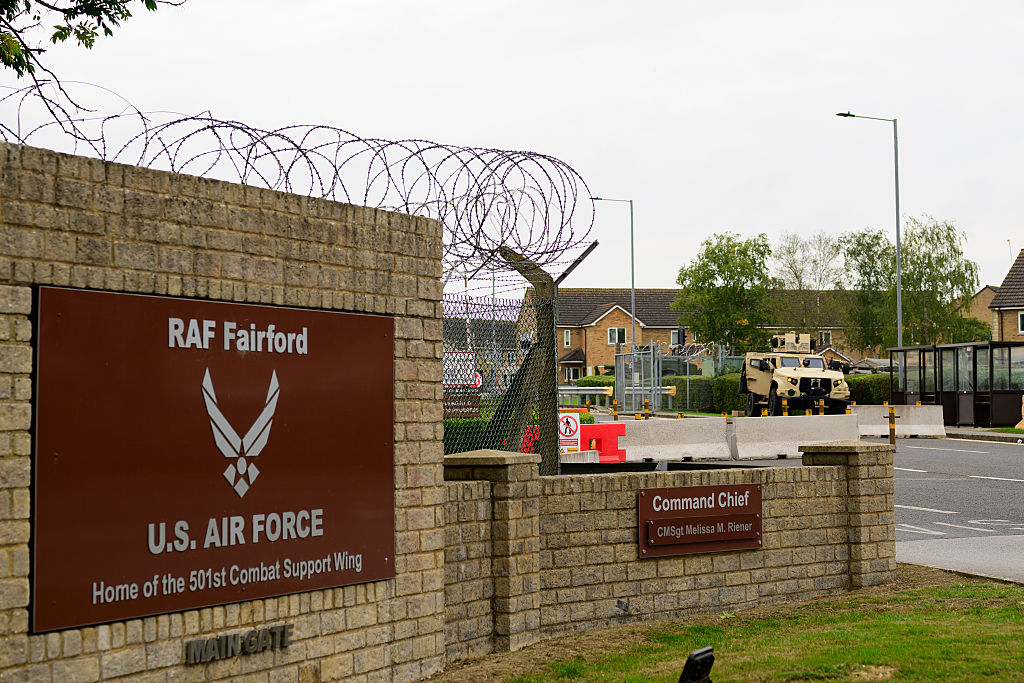
Police received a call shortly after midnight Sunday about three suspicious vehicles apparently traveling toward RAF Fairford in Gloucestershire, England, near the southern Welsh border. Armed officers stopped the vehicles and arrested five men in nearby Whelford on suspicion of explosives offenses.
The men were later also arrested on suspicion of preparing a terrorist act, according to Counter Terrorism Policing.
Investigators are examining whether the suspected plot is linked to Iran, according to multiple reports. A source familiar with the investigation told Reuters that an Iran-linked motive is considered the leading possibility, while Russian sabotage and an Islamist plot are also being examined.
British authorities have not publicly identified a motive or said who they believe was behind the alleged plot.
RAF Fairford has played a role in U.S. military operations during the war with Iran. American B-1 and B-52 bombers have operated from the base, including for strikes on Iranian missile sites.
Iran‘s Revolutionary Guards warned Britain in July against allowing U.S. bombers to operate from Fairford, saying bases used for attacks on Iranian territory could become legitimate targets.
Police established a roughly 400-meter cordon around the vehicles while an explosive ordnance disposal team examined them. About 85 nearby households were advised to evacuate as a precaution.
President Donald Trump said Sunday that U.S. and British authorities had worked together on the investigation and claimed the suspects intended to cause “big damage.”
“We had them under investigation,” Trump told reporters. “They were looking to do big damage to our fort.”
British authorities have not publicly confirmed Trump’s characterization of the alleged plot or said how long the suspects had been under surveillance.
“We are in the early stages of an investigation, and five men remain in custody,” Deputy Assistant Commissioner Vicki Evans, the senior national coordinator for Counter Terrorism Policing, said.
Police said the immediate incident has been contained, but the investigation remains ongoing.
President Donald Trump said Saturday that he rejected Iran’s proposal to reopen the Strait of Hormuz, days after publicly calling on Tehran to reopen the critical shipping route and suggesting a deal could end the seven-month war.
“They made a proposal, but I rejected it,” Trump told reporters outside the White House on Saturday.
Iranian officials unveiled the proposal during a week of diplomacy surrounding the United Nations General Assembly in New York. The plan would reopen the Strait of Hormuz within seven days and pause fighting across the region while the two sides pursued broader negotiations.
In exchange, Tehran sought an end to the U.S. blockade of Iranian ports, sanctions relief and access to frozen Iranian assets, according to reports. Iranian Foreign Minister Abbas Araghchi said Friday that the proposal had been transmitted to U.S. officials through mediators.
The Wall Street Journal first reported that Trump had rejected the proposal, citing U.S. officials. The newspaper also reported that Trump has told aides he expects the United States to resume bombing Iran after the November midterm elections.
Trump’s rejection comes just days after he used his address before the U.N. General Assembly to demand that Iran reopen the strait while threatening the country with “annihilation” if it failed to reach an agreement with the United States.
“I have a big decision to make,” Trump told world leaders Tuesday, presenting Iran with a choice between a deal that would allow the country to rebuild or further U.S. military action.
Trump also predicted that an agreement with Tehran could come after the midterms, while insisting that the November elections were not influencing his decisions on the war.
Iranian President Masoud Pezeshkian responded from the same U.N. stage Wednesday, saying Tehran remained open to diplomacy but would not negotiate under threat. U.S. and Iranian officials also communicated through Qatari and Pakistani mediators during the gathering, contacts Secretary of State Marco Rubio described as significant despite the limited progress.
The Strait of Hormuz remains one of the world’s most important energy corridors, and its closure during the war has disrupted global oil shipments and contributed to higher energy prices.
Trump appeared to have another idea for the waterway Friday, sharing a map on Truth Social in which the Strait of Hormuz had been relabeled the “TRUMP STRAIT.”
Despite Trump’s rejection of Iran’s latest proposal, indirect diplomacy has not formally ended. An American official described this week’s mediated discussions as “positive and constructive,” while Iranian officials said Saturday they were awaiting an official U.S. response.
For now, however, the proposal that could have reopened the strait within a week appears to have met a considerably shorter response from the president: no.
On Tuesday, Donald Trump stood before the United Nations General Assembly to give a speech in which he made it clear that the United States has now fully abandoned its last remaining fig leaf of decency and morality on the world stage, and has embarked on an imperialist model not seen since the 19th century. Since this was a Trump speech, filled with his usual bombast and braggadocio, it didn’t have quite the shock value it might have carried in the past. But there was a new atmosphere in the room. The world sees America as a threat now, and countries are making new arrangements.
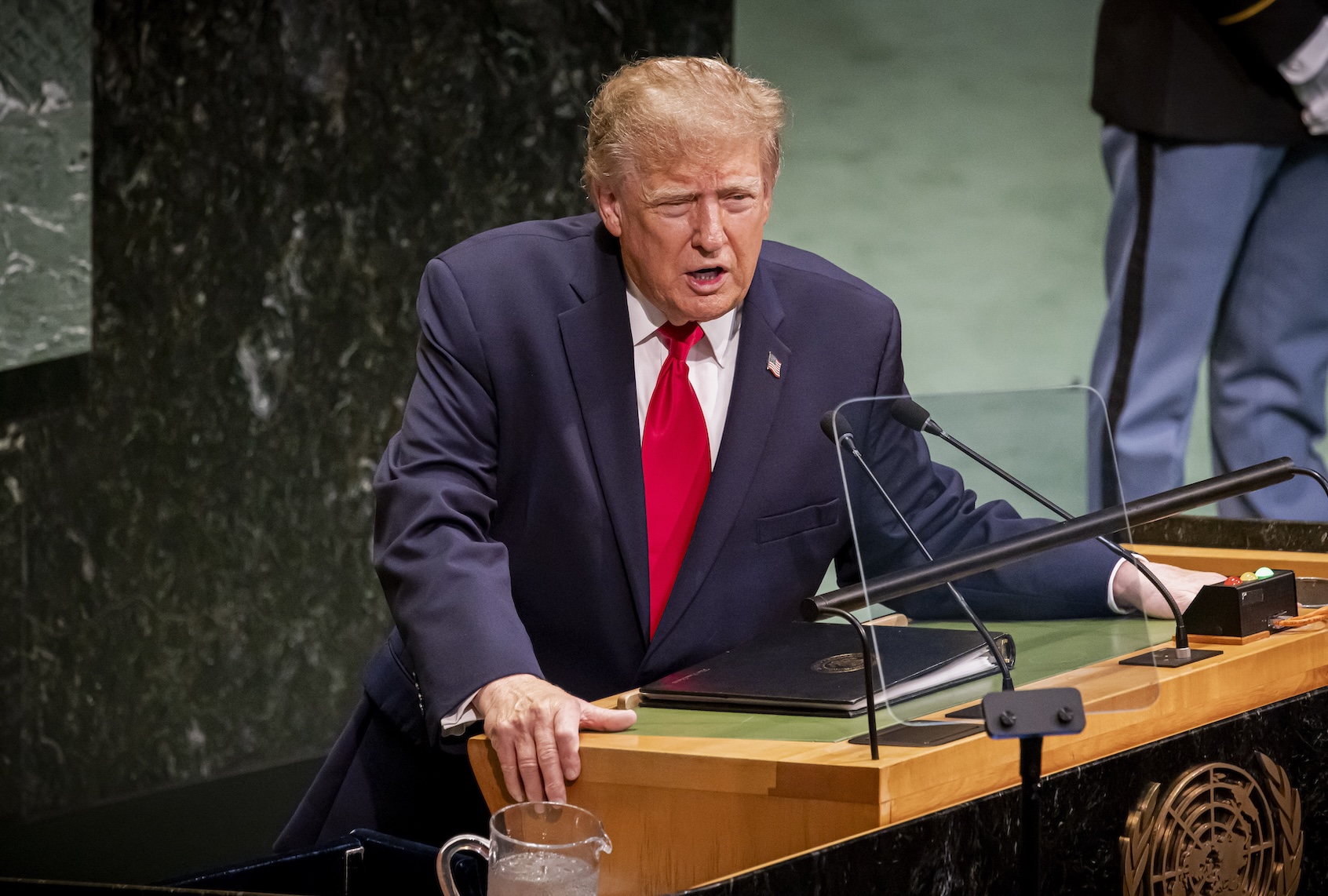
The speech was the worst he’s given, and that’s saying something. Delivered with a bored, desultory tone, the obviously tired president spent 40 minutes rambling on and on with his usual litany of grievances and lies. He made it clear that he sees no limits on his power. Looking directly at the Iranian president, he mused aloud, “I have a big decision to make. Will a deal be made with Iran that lets them rebuild? Or do I annihilate the Islamic Republic? Do I drive them into hell with no chance of survival, and no hope of future greatness for generations?” It was outrageously provocative and insulting, and on Wednesday, Iranian President Masoud Pezeshkian responded in his own U.N. speech by describing the Islamic Republic as “victims of terrorism” at the hands of the U.S., while claiming “we are ready for dialogue and diplomacy and negotiations without accepting the language of force.”
In many ways, this was familiar ground for the president. But there was one portion of his speech that brought home just how far gone American foreign policy is today. Speaking of his policy of murder on the high seas in the Caribbean, Trump claimed that drug traffickers, whom he calls “terrorists,” must be “killed, exiled or detained as enemy combatants without the possibility of release, which is what we’re doing.” The Navy is routinely blowing up small boats and killing human beings based upon unproven claims that they are transporting drugs. No U.S. or international law sanctions such a thing. And according to a fact-check by the New York Times, Trump’s assertion that this operation has reduced the flow of drugs by 90% is a blatant lie. It has made no difference at all. The policy is an abomination, and it proves to the world that the United States has abandoned all fealty to the rule of law, not to mention common decency.
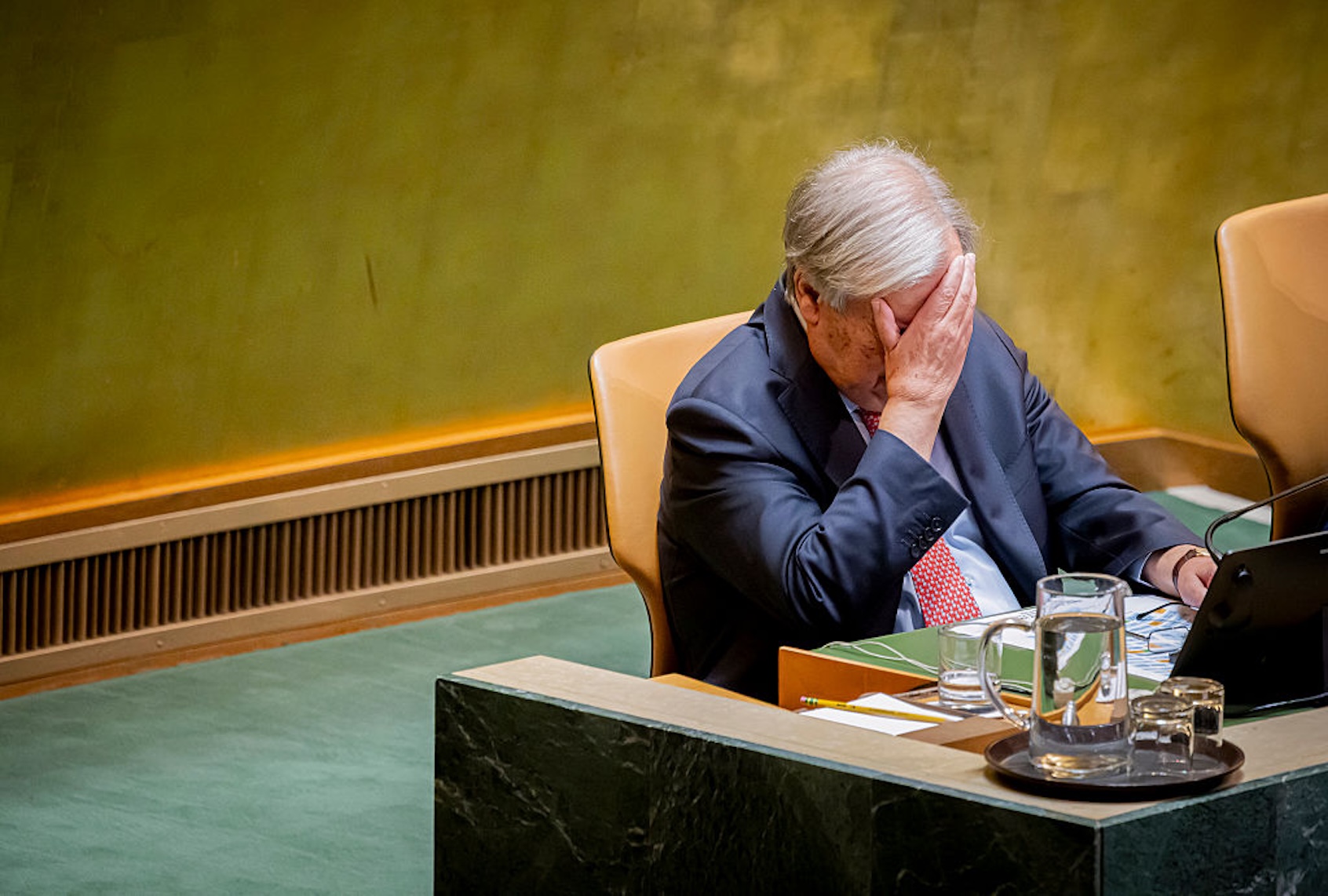
(Patrick van Katwijk/Getty Images) United Nations Secretary General Antonio Guterres during the speech of President Donald Trump during the 81st U.N. General Assembly on Sept. 22, 2026.
But that wasn’t all. The president bragged about his actions in Venezuela, declaring that since his incursion in January, which deposed President Nicolás Maduro, Trump has now acquired “more than 60% of the oil in the world . . . it was a war, but it’s perhaps the biggest deal ever made. To the victor belong the spoils. You’ve all heard that.” (The number is actually about 23%, according to the Times.) We have certainly heard that before — from him. The saying is one of his favorite maxims, but it hasn’t been uttered by any other world leader for centuries. He went on to proclaim, “Our actions in Venezuela are proof that the United States will no longer permit threats to America to gain a foothold anywhere in the Western Hemisphere. And if necessary, we will use our unmatched military might to secure the vital national interests of the United States.” What threat Venezuela posed to our “vital national interests” is unclear, unless it means simply having something we want to take.
To say this at the U.N., which was formed to prevent this very behavior, confirms every nation’s worst fears about what the United States has become under Trump. It is crude, antediluvian imperialism, and the assembled dignitaries did not applaud or even respond, although the Iranian and Cuban delegations did walk out when they were threatened.
The U.S is obviously now seen by many as a rogue state, disrespected and disdained by allies and adversaries alike. All you had to do was look at the faces of those in attendance to see it.
But many are realizing, even as Trump besmirched the U.S. and U.N. alike, there is a new “leader of the free world” on the scene.
Mark Carney did not speak at the General Assembly, but he did hold bilateral meetings and a press conference. In the process, the Canadian prime minister gave some measure of hope to those — including many Americans themselves — who see the U.S. as a threat to world peace and yearn for something better.
Mark Carney did not speak at the General Assembly, but he did hold bilateral meetings and a press conference. In the process, the Canadian prime minister gave some measure of hope to those — including many Americans themselves — who see the U.S. as a threat to world peace and yearn for something better. “This is, in many respects, a time that comes once or twice every century,” Carney told the media gathered in New York. “What comes ahead, it’s not wishful multilateralism, which defends only the status quo, nor a cold realpolitik that dismantles the status quo altogether. The alternative that Canada and many others are pursuing is values-based realism, an approach that’s both principled and pragmatic.”
The last few weeks have been productive for Carney, as he led a summit of big money investors and CEOs, partnering with former prime minister Steve Harper to make a bipartisan pitch for opportunities in manufacturing, natural gas, mining and ports on two oceans. Canada has a wealth of resources, including an educated workforce. You know, kind of like America — before it turned itself into a global pariah.
Carney followed his U.N. appearance with a triumphant trip to Europe, where he was greeted like a rock star, obviously appreciated for his bold break with the U.S. that began with a visionary speech in January at the World Economic Forum in Davos that called for a new world order. On Sept. 16, at the meeting of the European Commission, President Ursula von der Leyen called for Canada to become the European Union’s first “associate member.” In making the case, she said, “We must urgently reimagine our partnerships. And build global coalitions for our resilience and democracies.”
In his speech, which was greeted ecstatically by E.U. members, Carney said “Put simply: we’re in a position where we need to pursue calibrated alliances, integrating deeply with those countries who share our values, remaining open-eyed with those who do not.”
That vision was put into action this week in New York, when Carney and leaders from the European Union and six other nations announced “Partners for Multilateralism,” which he described as “a new forum that looks at universal institutions, practical coalitions and capacities that exist outside of governments to build trust and bring people together.” The prime minister explained that they do not see this as an attempt to form consensus among nations, an impossible task, but to instead create a new paradigm for countries “formed around problems rather than geography or size, not as an alternative to multilateralism, but as an instrument of it.”
I have written before that the post-World War II order has run its course. The end of the Cold War, and the burden of being the world’s policeman and guarantor of security, has warped America’s values. It was clearly time for something new, hopefully better, to emerge in the 21st century. But Trump’s bellicose “transactional” approach, aside from the clear corruption and immorality, exacerbates the problem at a time of serious global challenges that include nuclear threats, climate change and the emergence of artificial intelligence. These issues demand cooperation. But Trump prefers to blow everything up — and reap the financial rewards wherever he can find them.
Finally, someone is proposing something new to take its place. It’s still in the very nascent stages, and who knows where it will go? But it’s a serious proposal that seeks to find some stability and predictability in a modern, multi-polar world that requires both cooperation and flexibility.
We can thank Carney for taking the president’s threats to Canadian sovereignty seriously and starting this overdue conversation. He is the man to whom those who believe in freedom and democracy now look for leadership, and we should all be grateful that he has willingly taken on the role.
One of the key arguments for a great power — other than the great power itself wanting to be one — is that they act as a guarantor of stability and the status quo. That is far from the only public or global good. And a great power will ensure that status quo on its own terms and mostly to its own advantage. But if you have any acquaintance with history, you know you can do a lot worse than relative peace and the status quo. Trump’s Iran War has been a bracing illustration of all these realities. Once the great power starts letting things break, those breakages can start multiplying very fast. Eventually you’ll find a new equilibrium, of course. But eventually can take a long time. And again, even a passing acquaintance with history tells us that things can suck without end for extended periods of time.
There’s an interesting New York Times piece from over the weekend that illustrates all these things. We know the outline. But it provides new details. As a knock-on effect of the U.S. war with Iran, the ongoing battle between Saudi Arabia and the Houthi rebel government in Yemen has again become hot. In recent weeks, the Houthis have partly cut off Saudi Arabia’s other path to the ocean. Put simply, the Saudis can export oil through the Strait of Hormuz or the Red Sea. The former has been mostly closed for months. Now the Houthis are in de facto or near control of the second. That’s a big crisis for the Saudis. This is part of the larger U.S.-Iran battle because the Houthis are clients of Iran. And Iran’s core strategy has been to create enough pain for the U.S.’s regional allies that they will force the U.S. to end the war. Remember, each time the U.S. attacks Iran, they respond by attacking the various Gulf emirates.

 Login
Login