Beneath the Church of All Saints in the Czech Republic is this magnificent chapel that is decorated entirely with human bones. It even features an ornate chandelier made out of bones. It looks like something from a fantasy movie, but it is entirely real. — Read the rest
We visited the Nanzoin Temple in the mountainous region of Sasaguri, near Fukuoka, on our last trip to Japan. It's a short train ride from Hakata Station in Fukuoka, and it transports you to a different world.
Built on a gently sloping hillside, the Nanzoin Temple is a sprawling Buddhist center that boasts the largest bronze reclining Buddha statue in the world. — Read the rest
I ate lamb ribs sticky with tamarind and dates, watched fairy tales transformed into extravagant burlesque, learned to make stained glass and watched people take shots of alcohol poured directly from the head of a bluefin tuna during my latest trip to New York City. It wasn’t exactly a conventional sightseeing itinerary, but that’s increasingly how I like to experience the city.
I used to live in New York, and no matter how many times I return, it never fails to surprise, delight, frustrate and invigorate me. I spent another week revisiting favorites and adding to the list of must-visit places I might never get to. The possibilities seem endless, particularly when you’re willing to follow your curiosity. From unforgettable meals to unexpected experiences, here’s where mine took me this time — and where I’d happily go again.
One of my favorite things about eating in New York is how easily a casual lunch can become one of the most memorable meals of the trip. Take LAUT in Union Square, the first Malaysian restaurant in New York City to be awarded a Michelin star. While the establishment hasn’t retained it, if the bustling lunch crowd was any indication, it’s certainly a worthwhile stop. The menu draws from Singaporean, Thai and Malaysian cuisine, with fragrant curries, flaky roti, chewy noodles and wok-fried dishes.
We loved the fried butter garlic soft-shell crab with fragrant, crispy curry leaves. The roti canai was another standout, perfectly flaky and served with a spice-forward sauce you’ll want to eat with a spoon. Bone-in duck curry followed, braised in coconut milk with lime leaf and tomato, and served with rice. It had a stick-to-your-bones constitution, and you could easily get lost in the flavorful sauce.
Peruvian food is influenced by flavors from around the globe, with delicious peppers, lots of citrus and fresh ingredients as the stars of the show. At Mission Ceviche, also in Union Square, I found an excellent lunch menu offering a variety of ceviches — ceviche nikkei was my favorite! — and tiraditos, cravable mocktails and main dishes ranging from classics like lomo saltado to whole grilled branzino over a bright tomato chorrillana sauce. I could have easily downed several basil breeze mocktails.
Harlem is home to Red Rooster, co-founded by the acclaimed Marcus Samuelsson. Inspired by Black American, Southern and Caribbean cuisines, the restaurant serves as a gathering place with live music, good food and a lively atmosphere. The service was excellent despite the full restaurant and busy bar, and we ordered a variety of dishes for the three of us.
I loved fried chicken and this one was coated in a crispy shell while perfectly juicy inside, served with greens and unctuous mashed potatoes. Jerk wings were great, too, as well as the Uptown Guac, served with fried hushpuppies. Surprisingly, the highlight of our meal was dessert: a strawberry and mango salad with coconut sauce. So refreshing, and a perfect way to end the meal.
Of course, not every great food discovery requires a sit-down meal. Two small but mighty cafes in Greenwich Village made particularly memorable stops, each with a very different specialty.
Savory pastries meet halloumi from Cyprus at Hello Halloumi, a small bakery where the cheese is the star of the menu. Halloumi appears fried, baked into pastries, turned into grilled cheese, served as the meat in a “burger,” and featured in gyro wraps and bowls. The rose cloud matcha was delicious, and if you want something sweet, don’t miss the tahinopita, a cinnamon roll-style treat slathered in decadent tahini icing.
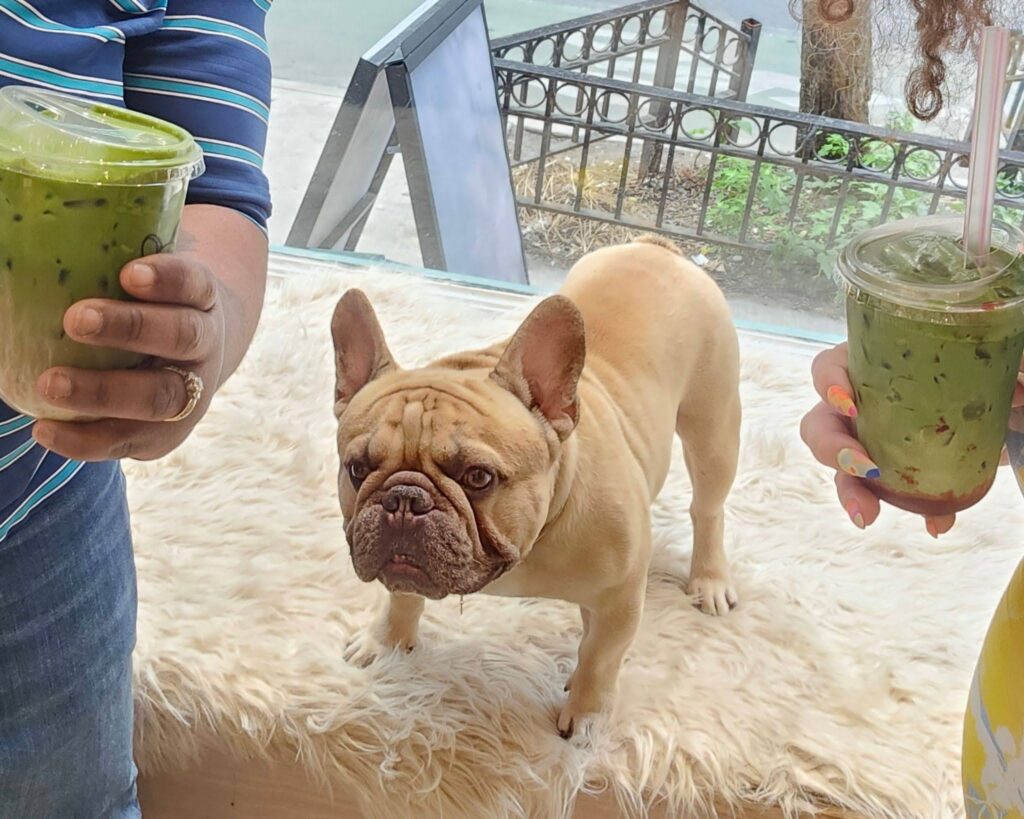
(Chaya Milchtein) Matcha and a Frenchie at Kawaii Cafe
Nearby, Kawaii Cafe is a little Vietnamese coffee shop with a French bulldog named Latte as its mascot that should be a required stop for any coffee or matcha lover. Kim, the owner, came to the United States from Vietnam and worked as a nail tech. Kawaii’s signature beverages hearken back to those days, when she’d talk to clients and hear all about their relationship problems. Situationship, Thirst Trap and What Are We are all handcrafted drinks inspired by those conversations.
Coffee beans are carefully sourced from Vietnam, cream toppings and jellies are made in-house, and vibrant green matcha from Shizuoka, Japan, makes for unforgettable combinations. The matcha was so good I came back twice!
Leisurely dinners
For dinner, New York offers endless opportunities to get a little more adventurous. Some of my favorite dishes from this trip came from restaurants drawing on different culinary traditions and finding exciting ways to bring them together.
At Eyval in Bushwick, an Iranian restaurant that bills itself as “recreating traditional Iranian cooking for a contemporary audience,” the dining room was bustling and lively, with every table full when we arrived. The menu isn’t overly extensive, but every dish we ate balanced flavors, textures and ingredients superbly.
I could eat the citrus, date and cabbage salad every day and probably never get tired of it. The punchy, rich chile-tahini dressing balances perfectly with the sweet, chewy dates, bursts of orange and crunchy cabbage. Match made in heaven, really. Then there were fall-off-the-bone lamb ribs with a sticky tamarind-and-date sauce that you just have to lick your fingers after devouring, and a saffron half chicken, pressed and served over rice studded with barberries and pumpkin seeds. This restaurant will live rent-free in my brain for quite some time.
Marcus Samuelsson’s Hav & Mar offers another inventive approach to familiar ingredients. Born in Ethiopia and raised in Sweden, Samuelsson draws on both culinary traditions at this seafood-focused restaurant. The space is beautiful and lively, with mermaids on the walls and a central bar. The menu is spice-forward, with raw and cured dishes, small plates and a range of entrees.
We loved the crudo trio: tuna tartare with miso and injera, hamachi with gooseberries and crispy onions, and berbere-cured salmon, lox-style, in an orange broth. The highlight of our meal was a whole crispy-skin branzino served with fresh injera, shiro and plenty of herbs, while dry-aged lamb chops rounded out our order. My only regret is skipping the Hav bread basket, with teff biscuits, blue cornbread and injera crisps.
New York can also deliver an exceptional steak dinner, whether you’re drawn to Brazilian specialties or an old-school white-tablecloth institution.
The dimly lit Berimbau Brazilian Table in Midtown, from restaurateur Mario de Matos, was a delight, with a relatively small menu of Brazilian specialties. We started with the nearly obligatory pão de queijo, crispy, cheesy, chewy bread that’s naturally gluten-free and positively scrumptious.
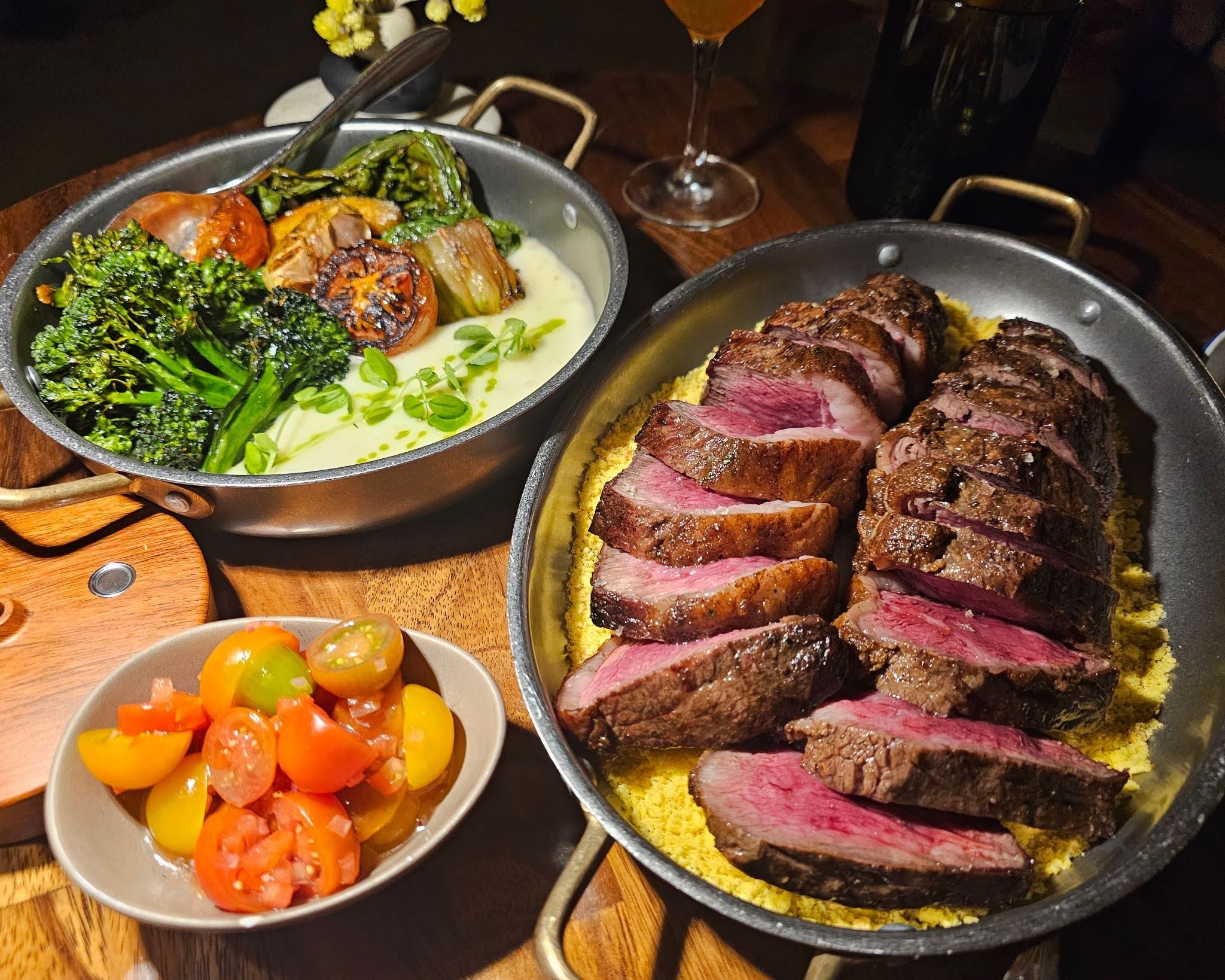
The star of the menu is clear immediately: tableside-carved prime picanha, a treat for the eyes and certainly the taste buds. The massive 38-ounce portion sits on a bed of corn farofa, a textural delight, and is served with cheesy yuca purée, charred vegetables and salada vinagrete that adds a much-needed acidic punch. It technically serves three but is perfect for two, with plenty of leftovers. This might have been the best picanha I’ve ever had. The service, ambiance and lighting make it an excellent choice for a memorable meal.
Gallagher’s Steakhouse, on the other hand, is where you go for an old-school New York experience, complete with waiters in bow ties, dry-aged steaks and classic sides. Originally a speakeasy that opened during Prohibition, it changed hands several times and became a New York City institution.
The menu offers classics: a raw bar with delicious oysters (ask for horseradish, they have it!), Caesar salad, French onion soup and other starters. Steaks of all kinds, some dry-aged in the meat lockers you walk past as you’re seated, can be topped with blue cheese or served with bone marrow. I’d skip the latter, even as a bone marrow lover.
We opted for a well-aged, medium-rare T-bone steak cooked over hickory logs, with buttered corn and spinach served family-style. In the classic Gallagher’s way, the waiter fills your plate. Endearing or disconcerting? You decide. Save room for the New York cheesecake. It’s made in-house and was a surprising standout.
And for a completely different kind of fine dining, there’s Sushi Akira, where chef-owner Nikki Zheng is right at home behind the counter.
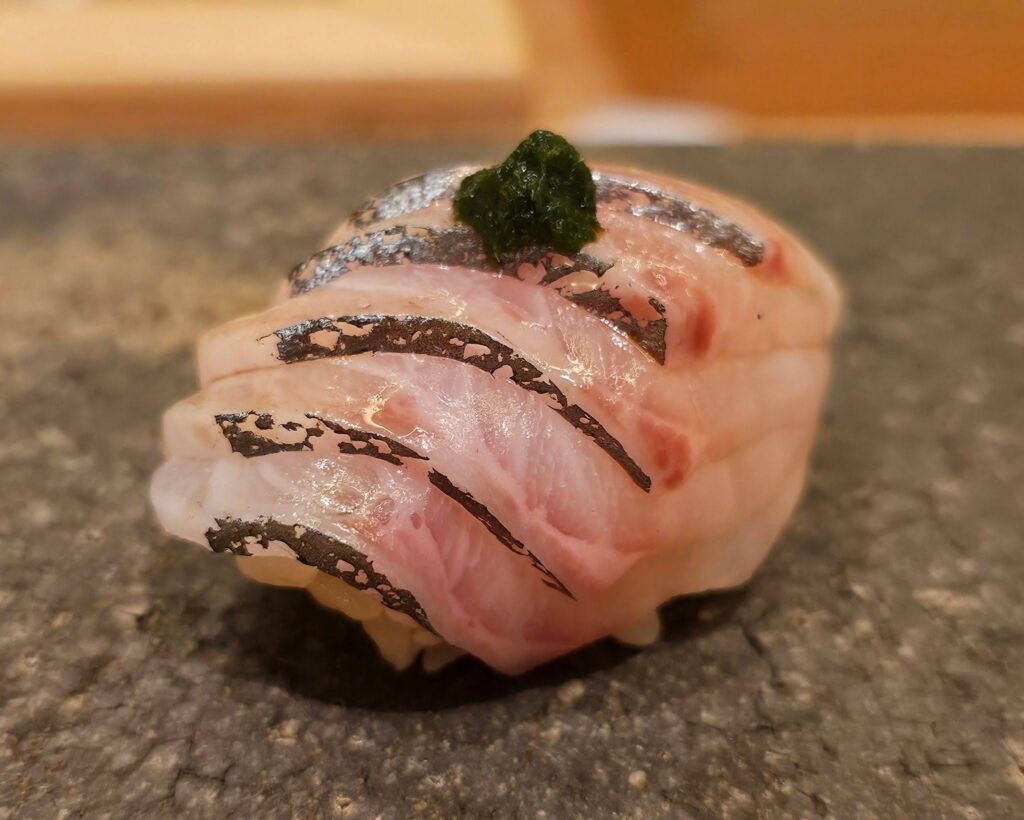
Sushi Akira specializes in Edomae-style sushi, using curing, marinating and dry aging to bring out the best texture and flavor of each ingredient without relying on heavy sauces. Chef Zheng is generous with her time, answering questions and explaining techniques and ingredients as she creates an 18-course omakase. Each carefully crafted piece of nigiri changes depending on what’s in season, and the meal unfolds in a choreographed dance for just 16 lucky diners.
Get the sake pairing if you’re imbibing, even if you don’t usually think of yourself as a sake drinker. The selections brilliantly complemented and enhanced each course and introduced me to combinations I wouldn’t have expected.
(Jodyann Morgan) Stripped jack nigiri at Sushi Akira
For a lively dinner with a group, I loved MangoSeed in Brooklyn’s Flatbush neighborhood. The playlist really set the mood. Billed as “Caribbean-inspired” and heavily influenced by Jamaican cuisine, the restaurant offers a fun atmosphere, hearty food and excellent service. My wife and I invited her mother, niece and nephew to join us, and despite the restaurant’s size, it fit our multigenerational group perfectly.
We really enjoyed the whole grilled fish with charred lemon and spicy jerk wings. Order a rum punch if you like a fruity drink that packs a punch, pun intended. A beloved favorite, the baked four-cheese mac and cheese was gooey and decadent. The rice and peas and oxtail didn’t quite live up to our high standards, but they rounded out the meal. And for dessert, the chocolate cake was moist and deeply chocolatey, a surprising standout for the entire group.
Getting around
Of course, getting to and around New York City can be stressful. Between traffic and the sheer number of people, it can overwhelm even seasoned travelers. A couple of transportation services made my recent visits easier.
Having a professional driver from Gotham Ride Chauffeur Service pick you up at the airport can help a trip start off right. The company tracks your flight so the driver can meet you even if it’s delayed, and you’re greeted with cold beverages while you take a load off.
I’ve used the service on two trips, and both were a breeze, even when one of my flights was turned around midair and another was canceled as we were about to get into the car. Those are precisely the moments when having some help with the logistics makes a difference.
For getting around town, I’ve also been testing alternatives to the usual rideshare options. I lived in New York during the golden age of rideshare, when it was largely budget-friendly and so many new apps were popping up that the competition was fierce. In the years since, Uber and Lyft have become the primary choices, but whenever I return, I try to test-drive newer options.
Empower isn’t exactly traditional rideshare. The company bills itself as a software platform, allowing drivers to set their own rates and keep 100% of the fare revenue while paying a daily or monthly fee to use the service.
On my visits, drivers were available quickly, rates were reliably lower than the Uber fares I was comparing against, and service was what you’d expect. I plan to use the app again the next time I’m in New York City.
Experiences worth booking
As much as I love eating my way through New York, every trip deserves a few experiences that don’t revolve entirely around a restaurant reservation. This time, that meant everything from burlesque and close-up magic to a four-hour stained-glass class and a very unusual encounter with a bluefin tuna.
For a night out with some genuine spectacle, Company XIV reimagines classic stories like “Little Red Riding Hood” as full-scale burlesque productions. Complete with live singing, expert choreography, ballet, aerial performances and costumes designed to be removed piece by piece, the shows are sensual and mesmerizing.
The theater is a magnificent setting for each performance, decked out in velvet and glitter, with chandeliers overhead. If you enjoy a really good performance art, you must catch a show at Théâtre XIV. Whether you’re with a lover or a group of friends, prepare to be dazzled!
(And if you’re peckish before or after the show, stop by Tortillería Mexicana Los Hermanos, just a three-minute walk away. The restaurant operates inside a tortilla factory that has been making tortillas in-house since 1998, and the food never disappoints. I always get the carnitas, perfectly crispy and deeply savory, served in fresh, warm tortillas.)
For another kind of performance, consider the tuna-cutting experience at Sushi by Bou. If your TikTok feed looks anything like mine, you’ve probably watched plenty of videos of live tuna cuttings. If omakase isn’t interactive or exciting enough for you, this is a chance to watch an entire bluefin tuna being carved, sliced and served in an endless parade of toro, akami and more.
Sushi by Bou curated a party-like atmosphere in a room full of eager sushi lovers. Libations flowing, delicious fatty tuna passed around, and alcohol poured directly into your mouth from the tuna head itself were some of the highlights. You can even scrape tuna directly off the ribs if you choose. It’s not exactly a typical sushi dinner, but that’s part of the fun.
For an experience that trades culinary spectacle for old-fashioned wonder, there’s Chamber Magic at the glitzy Lotte New York Palace.
Tune out everything and let yourself believe in magic — at least for an hour and 45 minutes. Magician Steve Cohen makes everyone feel like an important part of the show. Held on Friday and Saturday, with a cocktail-attire dress code, the performance brings together just 64 people to giggle, laugh and try to figure out how Cohen pours someone’s perfect cocktail from a teapot unprompted, among other magical acts. You’ll leave with a wide smile, enchanted by the experience.
Not all my favorite activities involve watching someone else demonstrate a skill, though. I love finding a creative experience while traveling, particularly when it means learning something new and bringing home a one-of-a-kind souvenir I made myself.
Craftsman Ave in Brooklyn offers classes for even the most adventurous crafter, including knife making, leatherwork, textiles and stained glass, which I chose. Its introduction to stained glass is a four-hour class that walks you through every step of making a wall hanging, from selecting your design to cutting the glass, soldering and finishing the piece.
My wife and I have taken many craft classes, but this one felt more advanced than anything we’d tried before, with experienced artists working alongside us. I definitely felt frustrated at times because it took me a while to grasp each step. But in the end, I was glad I took the class, even if my cat was more amateur than I’d hoped.
If you’re looking for a bite before or after class, stop by Sahadi’s at Industry City, just a few minutes away on foot. The longtime Lebanese grocer has been operating in New York since the late 1800s, and this location has a grab-and-go deli as well as seated lunch and dinner service.
Another New York experience worth considering is having something made specifically for you. Have you ever put on a suit and had it fit perfectly? Me neither! Nothing off the rack makes me feel like a million bucks.
That’s what makes Alan David Custom in Midtown such an interesting stop. The bespoke tailoring house crafts suits to your exact measurements and requirements, guiding you through the process from fabric selection to final fitting.
The fabric choices are endless, and every detail is dictated by you rather than a mass-market clothing producer: pocket or no pocket, type of stitching, exact fit, even the hemline for the style of shoes you actually wear. After the initial measurements, the company can ship a basted fitting and arrange a virtual fitting to finalize the details before sewing and sending the finished garment.
Whether you’re preparing for a big occasion or simply tired of wearing something that doesn’t quite fit, it’s a luxury experience that offers something more personal than an ordinary shopping trip.
Where to stay
After a full day of exploring, there’s something to be said for returning to a comfortable hotel, particularly one that feels a little different from the generic, nondescript rooms you can find almost anywhere.
The Kimberly Hotel has old-school charm and timeless elegance, with gracious, helpful service and a massive round fish tank in the lobby that you can get lost in. The hotel has 194 rooms, including one- and two-bedroom suites.
We stayed in a massive one-bedroom suite, even by regular standards, with a lounge area and kitchenette complete with a microwave and refrigerator that we put to good use. The bed was super comfortable, but the bathroom was tiny considering all the space. A balcony with Manhattan views was simply the pièce de résistance. Even if your room doesn’t have a balcony, you can get 360-degree views at the rooftop lounge, aptly called Upstairs at The Kimberly.
The lobby is inspired by a living and dining room spread across two spaces, with the registration desk at the center. It’s designed to give you room to relax and connect, and it’s great for people-watching, although the hustle and bustle means it isn’t a place to go for peace and quiet.
Our room was surprisingly spacious for New York City, with a table, chairs and a jetted tub — which was quite difficult to climb into, if I’m honest. Kimpton Ashbel is also pet-friendly, with no deposit required and no weight, size or breed restrictions, a huge boon for travelers with pets.
My stained-glass cat didn’t turn out quite as I’d hoped, and there are still countless restaurants on my list I never managed to visit. But I came home with some excellent meals, a few wonderfully strange memories and plenty of reasons to return.
Elevate your taste buds
New York’s legal cannabis scene is flourishing, with countless dispensaries competing for your business. Each dispensary offers a different experience depending on your style and preferences.
Housing Works Cannabis Co. is both New York’s first legal recreational cannabis dispensary and one of a handful of nonprofit dispensaries. If the name sounds familiar, it’s because Housing Works has been serving homeless and low-income New Yorkers, particularly people living with HIV, in a variety of capacities for years. The dispensary, just a short walk from Union Square and the Village, puts all of its profits toward supporting that mission.
Then there’s The Daily Green in Times Square, impossible to miss beneath digital green billboards with cannabis displayed in bold newspaper type. The massive dispensary has a selection to match, with products ranging from pre-rolls and tinctures to topicals and vapes, including New York brands like ayrloom and national ones including STIIIZY and Dogwalker.
An interactive bud bar lets customers get a firsthand look at different cannabis varieties, with a terpene guide providing additional information. It’s a distinctly different experience from visiting a small neighborhood shop, and an interesting example of how cannabis has become part of the Times Square retail landscape.
On the Upper West Side, Superfly Dispensary offers another approach. The budtenders are knowledgeable, cannabis varieties are available to examine under magnification, and the selection intentionally includes LGBT- and Black-owned brands. Superfly also serves as a community hub, with weekly yoga and Pilates, disco nights, Halloween parties and brand activations. There’s something for people looking to connect and spend time with like-minded neighbors, not simply shop. Great choices include ayrloom’s Lychee Dream pre-rolls, Good Tide guava gummies and Sluggers Lemon Cherry Gelato vape.
Last month I went to Japan with my family. It was my 10th time in Japan. But until this visit, I had never gone to any island other than Honshu, the one that has Tokyo, Kyoto, and Osaka. This time we went to Kyushu, which is south of Honshu. — Read the rest
When I was in Japan earlier this month, we visited the village of Kurokawa Onsen, which has over 25 Japanese hot-spring bathhouses you can walk to. It was an incredible experience.
You can read all about the spas at Kurokawa Onsen with a Google search, so I will instead tell you about the fantastic cat I met in the village. — Read the rest
When I was in Fukuoka, Japan, last week, I stopped by Rakusuien garden, a small strolling garden with a koi pond, a waterfall, a picturesque bridge, and meticulously tended plants. It also has a tea house, but on the day we went, there was no tea ceremony. — Read the rest
An underground monorail, non-existent bizarrely skinny killer whales, directions to extinct attractions, guide maps that bear no resemblance to reality. AI-generated Disney theme park guide books are flooding the market, filled with hallucinated slop that would drive a trusting tourist insane with misinformation. — Read the rest
When I was in Nagasaki earlier this month, I visited the Atomic Bomb Museum there. One of the displays, which showed the damage caused by the bomb that the U.S. dropped on the city, had long audio narration in Japanese only. — Read the rest
Minecraft, the world's most successful video game and now a blockbuster movie series, will soon bring its blocky voxelated world into reality. Minecraft World, first revealed in March, will open in 2027 at Chessington World of Adventures, just outside London, and will include a 70-room themed hotel. — Read the rest
On Friday, a new exhibit at the American Museum of Natural History in New York City opened: Monarch's Journey, featuring the work of cartoonist Peter Kuper.
From a museum statement:
"Wrapping the walls near the Museum's extensive butterfly research collection in the Richard Gilder Center for Science, Education, and Innovation, the exhibit explores the challenges monarchs face on their 3,000-mile flight through Kuper's bold illustrations, accompanied by a video installation of monarchs in motion.
Object permanence: Delta v dovening; "Play Money"; Alabama's ethnic cleansing; We trust neuroscience over psychology; Billionaires' anti-homeless pogrom; Game devs v DRM; What security means; Microsoft, tear down that wall! Publisher won't revert rights; SNL's Trump/Clinton debate; Chicago Tribune's murder; AI after AI.
No matter where you shop, you're getting screwed by Amazon. Amazon has found a way to make everything you buy – at Target, at a mom-and-pop shop, even direct from the manufacturer – more expensive. And they're not the only one: Expedia's done the same thing, but for hotel rooms.
Here's how Amazon broke the economy: first, they locked in a key group of shoppers. The vast majority of affluent shoppers in the USA have Amazon Prime accounts. Having prepaid for a year's shipping in advance, those Prime subscribers start their purchasing journey by searching Amazon, and if they find what they're looking for, that's where it ends.
America's affluent top decile – the 10% of richest Americans – do the majority of America's shopping, a phenomenon that has only been accelerated by America's precipitous slide into oligarchy, which has exhausted the savings and the credit-card limits and the home equity of the majority of Americans, who increasingly can't afford to buy anything:
If you want to sell things in America, you must sell them in the place where the top decile shops, and that's Amazon. For merchants, that is an incredibly expensive proposition: 51-60% of every dollar you spend with an independent merchant on Amazon is claimed by Amazon through junk fees, listing fees, commissions, processing fees and other scams:
Merchants don't have 51-60% margins they can afford to turn over to Amazon. To remain viable while selling on Amazon, they have to raise prices. Amazon doesn't mind if prices go up, so long as Amazon's price remains competitive. So Amazon imposes a requirement on its suppliers called "most favored nation," which requires sellers to offer their best price on Amazon:
Practically speaking, that means that when you raise your price on Amazon, you must raise your prices everywhere by the same amount, which means that no matter where you shop (Target, Walmart, the corner store or direct from the factory), you pay the Amazon Tax.
The Amazon Tax is a prime (you should forgive the expression) example of enshittification, in which an intermediary (a business that sits between buyers and sellers, AKA, "a platform") screws both customers and sellers to benefit itself.
But Amazon isn't the only example of a powerful digital intermediary that has used its market power to impose an economy-wide tax. Wherever you look online, you find digital giants who grew the way Amazon grew (buying all of their competitors) and then did what Amazon did (squeezing buyers and sellers, making prices higher everywhere).
That's what happened with Expedia. Almost every travel site you can find online has been purchased by Expedia (Hotels.com, Travelocity, and Orbitz), and the ones that aren't Expedia subsidiaries were acquired by its main rival, Priceline (Booking.com, Kayak, Agoda and even Opentable). Nearly all the hotel rooms are booked by a tiny minority of travelers – largely that same top decile that Amazon has so thoroughly captured and locked in – and hoteliers can't live without their business, and they're almost all Expedia and/or Priceline customers. Expedia accounts for 80% of all hotel bookings by dollar value.
Expedia's position, in other words, is basically Amazon's position, so Expedia is doing exactly what Amazon is doing: they charge huge fees to hotels, and then force the hotels to raise their prices everywhere through a "most favored nation" deal:
But – as Lee Hepner writes for the BIG newsletter – Expedia has figured out ways to out-Amazon Amazon. They've copied one of Amazon's sleaziest businesses, and made it worse:
Here's Amazon's sleaziest commercial practice: when you search Amazon, the top results for your search aren't the best matches for your queries; they're products sold by the companies willing to pay the most for search placement, in a "real-time auction" that runs every time you search. The cost of winning that auction comes out of your pocket through higher prices: the first result for an Amazon query is, on average, 29% more expensive than the best match. The top row is 25% more expensive. On average, the best match for your query is 17 positions down the screen, on the second page, where almost no one ever bothers to scroll:
This rip-off is Amazon's most profitable line of business, more profitable than AWS or Prime. It makes the company more than $80b/year. And – incredibly – Expedia's found a way to make it even worse.
Like Amazon, Expedia auctions off its search results. They call this their "VIP listing" program. Practically speaking, hotels have to pay for this, because it boosts booking rates by 42% (the first ten results on an Expedia search-results page get 62% of the clicks). VIP listing is expensive for the merchant – but it's even more expensive for you and me.
That's because Expedia requires hotels in its VIP listings programs to raise their prices on non-Expedia sites by 10-25%…INDEFINITELY.
Let me repeat that: to stay in business, hotels need to be on Expedia. To stay in business on Expedia, hotels have to raise their prices to pay Expedia's junk fees, but they have to raise their prices everywhere else. But to really stay in business on Expedia, hotels have to use the VIP program, which is even more expensive. And – one more time – hotels in the VIP program have to jack up their prices everywhere else, INDEFINITELY. This means that, throughout the economy, hotel prices are rising at a superinflationary rate, because Expedia – who command 80% of the market – are pushing those prices up.
This goes a long way to explaining why US hotel rates rose 58% from a 2020 average of $103/night to a 2025 average of $162/night. It explains why hotel prices rose by 5% last year, which is double the rate of inflation. And this is why Expedia stock is up 65% since the start of the Iran war, a fact that Expedia CEO Ariane Gorin attributes to "higher margins" from "higher prices":
In his coverage of the Expedia lawsuit – which brought many of these details to light – Hepner notes that hotels themselves have undergone near-total cartelization, with Hilton, Marriott, and Choice International owning the majority of all hotels after a string of acquisitions that went largely unchallenged by slumbering antitrust regulators around the world. These consolidated chains have also jacked up prices and enshittified their service, slashing housekeeping and check-in staff and allowing their facilities to slip into disrepair.
This, too, is characteristic of monopolization: whenever a monopoly takes over part of its supply chain, the rest of the supply chain consolidates to prevent itself from being ripped off by the new giant. This is the story of publishers consolidating to defend themselves from Borders/B&N, Walmart and Costco, then Amazon; and it's the story of literary agencies consolidating to resist the power of those overgrown publishers.
And it's the story of health-care, which saw consolidation in pharmaceuticals leading to mergers among hospitals, who screwed the insurers, who also consolidated.
In every case, it's the workers and the people who rely on them that get the shitty end of the stick. Hotel guests, readers and patients pay more for inferior products. Writers, editors, doctors, nurses, hotel staff and housekeepers get lower pay and worse working-conditions:
There is nothing wrong with the idea of an intermediary. Most writers can't publish and sell their own books, and few travelers can navigate finding hotels in strange cities without help. The problem of intermediaries is that when intermediaries gain monopoly power – by buying their rivals and capturing buyers and sellers – they are able to squeeze both. As Tim Wu says, this is the moment when a company that's supposed to be helping becomes a predator, acquires "main character syndrome" and makes every transaction all about the middleman, at the expense of the people buying and selling:
There are so many reasons for inflation and the cost of living crisis: wage stagnation, wars of choice in Iran, environmental cataclysm after environmental cataclysm. But under cover of these real factors is a cohort of what Matt Stoller calls "economic termites," parasites that have infested the walls of our economy and are devouring it from within.
You can't solve this by shopping. Calling the hotel direct won't fix it: they have to be on Expedia to survive, and to be on Expedia, they have to sign up for VIP service, and to keep VIP service, they have to make their prices higher everywhere. To fix this, we need systemic action: the corporate death penalty for the companies that are consuming the structural members of our society.
"Red Team Blues": "A grabby, compulsive thriller that will leave you knowing more about how the world works than you did before." Tor Books http://redteamblues.com.
"Chokepoint Capitalism: How to Beat Big Tech, Tame Big Content, and Get Artists Paid, with Rebecca Giblin", on how to unrig the markets for creative labor, Beacon Press/Scribe 2022 https://chokepointcapitalism.com
“Once Is Enemy Action,” a science fiction novel about the origins of modern technofascism. Today's words: 508 (25536 total).
"The Post-American Internet," a sequel to "Enshittification," about the better world the rest of us get to have now that Trump has torched America. Fourth draft completed. Submitted to editor.
A Little Brother short story about DIY insulin PLANNING
This work – excluding any serialized fiction – is licensed under a Creative Commons Attribution 4.0 license. That means you can use it any way you like, including commercially, provided that you attribute it to me, Cory Doctorow, and include a link to pluralistic.net.
Quotations and images are not included in this license; they are included either under a limitation or exception to copyright, or on the basis of a separate license. Please exercise caution.
"When life gives you SARS, you make sarsaparilla" -Joey "Accordion Guy" DeVilla
READ CAREFULLY: By reading this, you agree, on behalf of your employer, to release me from all obligations and waivers arising from any and all NON-NEGOTIATED agreements, licenses, terms-of-service, shrinkwrap, clickwrap, browsewrap, confidentiality, non-disclosure, non-compete and acceptable use policies ("BOGUS AGREEMENTS") that I have entered into with your employer, its partners, licensors, agents and assigns, in perpetuity, without prejudice to my ongoing rights and privileges. You further represent that you have the authority to release me from any BOGUS AGREEMENTS on behalf of your employer.
Forget "Don't be evil"; Google's true motto is a form of vulgar spidermanism: "With great power comes no responsibility." The internet's de facto boss is an absentee landlord.
Google – a thrice-convicted monopolist – is the gateway to the internet, with more than a 90% search market share that it attained by buying out all its competitors and bribing Apple more than $20b/year not to start a rival search engine:
Google likes to position itself as a wise steward of the internet. They say they use their vast troves of data about the internet and its users to connect the right person with the right information at the right moment. As their mission statement has it, "organize the world's information and make it universally accessible and useful":
The tacit argument is, "Sure, we repeatedly violated antitrust law in order to monopolize the internet, but the internet needs a monopolist. It's scary out there! We have amassed power so that we can protect and guide you."
It's a bullshit argument and no one should accept it – but even if you think it's worth harnessing monopoly power to promote a wise king to rule over the internet, you'd still want Google to take that responsibility seriously. If we're to have a landlord for our civilization's digital nervous system, let's not have it be an absentee landlord.
Google is an absentee landlord. In 2019, they chose to deliberately worsen search results in order to make you search repeatedly to find the information you're seeking, because every fresh query lets them serve fresh advertisements:
Not all of Google's enshittification can be attributed to deliberate sabotage. Much of it is the result of neglect. Ask Google for a product review and they'll pass over the most rigorous, honest websites on the internet in favor of affiliate scammers who repackage Amazon best-of lists to peddle overpriced, underperforming junk that's sometimes so bad it's dangerous:
And of course, Google AI search results present the company with a highly refined and confident-sounding way to launder spam into product recommendations:
Could Google do better? Provably so. Kagi, a small company that runs a search engine powered by Google's own search index consistently delivers results that are substantially superior to Google's – using Google's own infrastructure:
If Kagi (a startup with a handful of engineers) can extract useful search results from Google's databases, then Google – a thrice-convicted monopolist that's had its pick of thousands of the top computer scientists from the world's most prestigious universities for a generation – could also do so.
They just choose not to.
They're too big to fail. They're too big to jail. They're too big to care.
Google's AI search isn't a way to fix its broken core product: it's a way to partially remediate the damage Google itself inflicted on the open internet, while imprisoning the web in a walled garden that would make Steve Jobs drool:
It's a deadly combination: Google has committed hundreds of billions to stock buybacks and its AI money-furnace, financed by mass layoffs targeting the people who keep the core services useful. The too-big-to-care company is still the internet's gatekeeper, but half the guards at the gate have been fired and the other half have pulled so much overtime that they keep falling asleep on the job.
Google has become a scammer's paradise.
Take Google's "answer box." This is the part of the search results page that tries to answer your query directly, without sending you elsewhere for that info. Back in 2023, Google's Answer Box was taken over by scammers who impersonated airline help desks. When Google's users searched for airlines' toll-free phone numbers, Google directed them to phones that rang in the scammers' boiler room, where they were tricked into giving up their passport info and credit card numbers to boiler-room thieves:
(This was an especially devastating attack because the airlines themselves hide their customer service phone numbers – as enshittified monopolists, they want your money, not your complaints – so it's normal to search Google for the number you're seeking, rather than scouring the airlines' deliberately confusing customer service sites.)
This is especially galling because Google has an extensive "verified merchant" program that goes to enormous lengths to establish the true identity of every merchant whose businesses are listed on Google, in maps, ads and search results. Google "knows" which URLs belong to the airlines. If it can be tricked into scraping a different website for the airlines' phone numbers, that's because Google couldn't be bothered to connect its own database of canonical airline URLs to the process that serves phone numbers to the 90% of the web-using public who search with Google.
Google's database of the canonical URLs for businesses doesn't stop at airlines or even large businesses. Nearly every local merchant has undergone Google's verification process, which includes a step where Google physically mails a postcard with a unique number to the merchant's registered address, which the merchant must then key into Google to prove that they're located where they say they are.
Despite this, Google's ad-sales system will happily sell anyone the right to advertise a different website for queries for specific merchants, and those ads appear above the real result for the business's website. To make this even worse, Google's spent years making it more difficult to distinguish ads from "organic" search results, changing the font and size of the "ad" warning to make it harder to spot, and making the font and color of the ad itself closer to the color of the search results below it.
This is a gift to fraudsters. I had my own run-in with it in 2023, when I was tricked by a Google ad into ordering dinner from my local Thai place using a scam site that had cloned the restaurant's menu. The scammers marked up the price by 15%, then passed the order on to the restaurant, pocketing the vig:
This scammer – based out of a UC Berkeley dorm-room – had copied hundreds of restaurant websites, then bought Google ads for the restaurants' names, ensuring that searchers would see the scam result before the real one. Remember: Google knows what the true URL is for every one of those restaurants but it sold the scammer ads for a different URL that appeared when people searched for the restaurant by name.
Google could trivially add a step to the ad sales pipeline that detects mismatches between a merchant's known URL and the URL in an ad bought against the merchant's name. It could automatically resolve these mismatches by sending an email to the merchant's verified email address that says, "Hey, are you buying an ad with a new URL? If so, just reply to this email."
I don't know why Google doesn't do this. Maybe they make huge sums from these scam ads and they don't want to forego the revenue. Or maybe they just don't care.
Whichever it is, there's real consequences for this negligence by the internet's absentee landlord. Take abortions: fake abortion clinics – where pregnant women are bullied or tricked out of the abortions they're seeking – buy Google ads against the names of real abortion clinics. Google makes millions sending abortion-seekers to fake abortion providers:
Google started off as the ideal "intermediary" – the fancy economist's term for a "middleman." They took as their duty to figure out the best websites for you to look at based on your interests, serving as an honest broker between internet users and internet publishers. In the quarter-century since the company's founding, as it transformed itself into a monopolist, it developed the curse of every intermediary: it got Main Character Syndrome.
This is Tim Wu's formulation: the reason for an intermediary existence is to serve the parties to the transaction. Ebay says it exists to connect buyers and sellers, Uber is supposed to connect drivers and riders, dating sites are supposed to connect people with their love-matches. But intermediaries are cursed with an enviable position: by dint of sitting between these different groups of people, the intermediary learns everything about both sides of the transaction, while each side only knows about its own position.
Amazon knows the price you're willing to pay, it knows who's set the lowest price, and it knows how many identical items that match your query are for sale. But the sellers don't know any of that, and you only know some of it. By capitalizing on that information (rather than using it to efficiently match buyers and sellers), Amazon can match you with the sellers willing to pay the highest junk fees, rather than the ones who offer the best price for the best goods:
This is Wu's Main Character Syndrome in action. Once Amazon attains a dominant market share, it can maximize its own welfare at the expense of its buyers and sellers, transforming itself from a helper to a parasite:
Google says it wants to "organize the world's information and make it universally accessible and useful," but every dime it spends fighting fraud (a critical part of this mission!) is a dime it can't spend on stock buybacks, executive compensation and AI servers. "Organize the world's information and make it universally accessible and useful" is the mission of a good intermediary; "do the absolute minimum to fight fraud" is the mission of a formerly good intermediary with terminal Main Character Syndrome.
Google keeps finding ways to expose its users to fraud while lining its own pockets. That restaurant markup scam that caught me in 2023? Three years later, it's way worse.
San Francisco City Attorney David Chiu just filed suit against GuestReservations.com, BookOnline.com and Booking Holdings for running a massive version of the restaurant menu scam – one that extracted millions from people booking hotel rooms:
Here's how the scam worked: these companies put up websites with deceptive URLs, like SanFranciscoMarriott.GuestReservations.com, and then bought the associated Google ad-word ("San Francisco Marriott"). At the top of Google searches for "San Francisco Marriott booking" was the ad for SanFranciscoMarriott.GuestReservations.com. This site would sell you a room at the Marriott, at a markup of 35% to 85%.
This is a pure ripoff. If Google had served the correct result at the top of the page – if it had used its own database of confirmed merchants and their associate websites to validate its ads – then people booking hotels would have saved 35% to 85% on their rooms.
City Attorney Chiu says that the perps here registered domains for all kinds of hotels, even tiny ones in small towns, all over America. That means that it's not just visitors to San Francisco who got screwed by these creeps – it's also San Franciscans who booked hotel rooms around the country.
Google bears the lion's share of the blame here, but Visa and the other credit card companies are critical to these scams. Card companies allow merchants to set terms of service that refuse refunds under almost any circumstances, and, more often than not, the card issuers side with the merchants over their own customers when they call to cancel a charge from one of these scammers.
I discovered this for myself when I was tricked into buying theater tickets from a ripoff site that had registered the URL of the show I wanted to go to. I figured out that I'd been rooked within a minute of clicking the buy button, but it took months and multiple appeals – and ultimately a threat to cancel my credit card – to get Visa to refund me.
Visa – another bloated monopolist with terminal Main Character Syndrome – can see that it has merchants who generate zillions of appeals and charge-backs because they run scam businesses like these. They could treat these merchants as the fraudsters they are, but because the crooks wreathe themselves in gauzy excuses and lengthy terms of service, Visa enables these massive, nationwide cons.
Google, Visa and the other monopolists who serve as de facto regulators for our society have arrogated to themselves the power to observe every transaction and block the obvious scams. We pay for their failure to take minimal, obvious steps to protect us from the scammers who thrive on their platforms.
Why should they? They're the main characters. They're Bizarro-world spidermen, whose great power confers no responsibility.
"Red Team Blues": "A grabby, compulsive thriller that will leave you knowing more about how the world works than you did before." Tor Books http://redteamblues.com.
"Chokepoint Capitalism: How to Beat Big Tech, Tame Big Content, and Get Artists Paid, with Rebecca Giblin", on how to unrig the markets for creative labor, Beacon Press/Scribe 2022 https://chokepointcapitalism.com
“Once Is Enemy Action,” a science fiction novel about the origins of modern technofascism. Today's words: 623 (1336 total).
"The Post-American Internet," a sequel to "Enshittification," about the better world the rest of us get to have now that Trump has torched America. Fourth draft completed. Submitted to editor.
A Little Brother short story about DIY insulin PLANNING
This work – excluding any serialized fiction – is licensed under a Creative Commons Attribution 4.0 license. That means you can use it any way you like, including commercially, provided that you attribute it to me, Cory Doctorow, and include a link to pluralistic.net.
Quotations and images are not included in this license; they are included either under a limitation or exception to copyright, or on the basis of a separate license. Please exercise caution.
"When life gives you SARS, you make sarsaparilla" -Joey "Accordion Guy" DeVilla
READ CAREFULLY: By reading this, you agree, on behalf of your employer, to release me from all obligations and waivers arising from any and all NON-NEGOTIATED agreements, licenses, terms-of-service, shrinkwrap, clickwrap, browsewrap, confidentiality, non-disclosure, non-compete and acceptable use policies ("BOGUS AGREEMENTS") that I have entered into with your employer, its partners, licensors, agents and assigns, in perpetuity, without prejudice to my ongoing rights and privileges. You further represent that you have the authority to release me from any BOGUS AGREEMENTS on behalf of your employer.
We’ve all been there: sitting on the floor at your gate, clutching a sad airport meal, wondering how your relaxing vacation turned into a stress spiral. With fewer air traffic controllers and a jam-packed summer travel season, canceled and delayed flights are basically a guarantee. I’m curious if you’ve noticed similar stuff and how you’re beating the travel woes—let me know.
But one brand wants to turn that chaos into happy hour. For two days only—July 17 and 18—Cayman Jack (yes, the margarita in a bottle brand) is opening The Cayman Club: A Missed Flight Lounge at JFK’s TWA Hotel. And the only way to get in? Show proof of a delayed, canceled, or missed flight.
Welcome to Like a Local, our travel series where writers share how to spend an ideal long weekend in their favorite hometowns. This time, Kristine shares her favorite spots in Bernal Heights—SF’s offbeat gem with dreamy views and even better bites.
Known for its unique blend of natural beauty, culture, and history, San Francisco consistently ranks in the top cities to visit in the U.S. for good reason. It’s also long been a haven for the offbeat, the quirky, creatives, revolutionaries, dreamers, and seekers.
Welcome to Like a Local, our travel series where writers share how to spend an ideal long weekend in a favorite town or city. This time, Marisa brings us to Cohasset, Massachusetts—a charming coastal town just south of Boston.
As I was growing up in New York City and New Jersey, living on the New England coast seemed like a dream. Yet, as an adult, when life threw us a curveball, we jumped on a chance to move to Boston—and I am so glad we did. We loved our time there, exploring the charming cobblestone streets and trying all the clam chowder. But as our family grew out of our cozy apartment, we knew we needed more space and eventually settled in the coastal town of Cohasset, about 45 minutes south of Boston. We’ve lived here for five years now, and it truly feels like we’re home.
Welcome to Like a Local, our series where travelers share their ideal long weekends. This time, Tessa shows how to do Sonoma—wine, food, and fun—with kids in tow.
Sonoma, affectionately known by locals as "Slow-noma," offers a charming, laid-back pace that’s perfect for a relaxing weekend trip. While Wine Country isn’t typically known as a family destination, after spending time there with two toddlers, I’ve realized that Sonoma is a place people of all ages can (and should) enjoy. It’s one of our home bases when we visit the U.S., and a spot we never tire of exploring. Though Sonoma is a small town of roughly 11,000, it offers renowned food and wine while remaining down-to-earth and unpretentious.
There’s something electric about checking into a hotel in a new city or country—the thrill of the unfamiliar, the view from your window, the anticipation of what lies just outside your door. And then, of course, there’s the food. Because while location and amenities shape a stay, it’s the dining options at these Grand Hyatt destinations that transform it—from a great trip into the kind you’ll never stop talking about.
The right dish can transport you: to another place, another time, even another version of yourself. It sets the mood, captures a feeling, and defines the rhythm of your travel experience. At Grand Hyatt hotels, the sheer range of culinary offerings means every stay becomes more than just visiting one destination—it becomes a global journey through your palate.

 Login