Reading view

Even MAGA loves socialism now

As you may have noticed, many members of the American media and political classes are currently rending their garments in terror and despair at the perceived threat of “socialism.” It’s not at all clear what that word means in 2026, in this context or any other. 

It only helps a little to observe that whatever “socialism” is supposed to refer to these days, it doesn’t have much to do with an economic or political system where the state or the working class control the means of production. I’m sure we could find people out there who advocate that. Hell, I might be among them, if it were a remotely realistic possibility. But none of those people are prominent in the current (and long overdue!) internal power struggle within the Democratic Party and the American left writ large.

Come to think of it, you know who really wants state control of the economy, if only in an incoherent, ass-backward, “Mixed-up Files of Mrs. Basil E. Frankweiler” kind of way? Donald Trump, that’s who. For all his extended excoriations of Democrats as woke America-hating Marxist radical traitors, Trump has meddled more extensively and more directly in the economy than any Democratic president since Franklin D. Roosevelt. 

It’s clearly going too far to call Trump a socialist, largely because profoundly corrupt autocratic or oligarchic regimes like his cannot easily be captured in ideological categories. He’s definitely not a democratic socialist (or a constitutional democrat of any other variety). But there’s no way around the fact that his fantastical DIY presidency has consigned conventional right-wing ideology about the sacredness of free-market capitalism to the proverbial dustbin. Let’s put it this way: Romanian dictator Nicolae Ceaușescu called himself a socialist; legendary Argentinian president Juan Perón did not. Trump belongs on the same historical shelf as those guys, if only as a wannabe.

Almost everything about Trump’s management of the economy during his second term, and pretty much everything else, has been disastrous. But even if we assume that the epic personal and institutional graft of his presidency will not survive his departure, he has created a haphazard regime that’s so deeply enmeshed in fossil fuels, Big Tech and AI, rare earths, pharmaceuticals, shipbuilding, semiconductors and the weapons industries that no one will be able to disentangle it anytime soon. 

It’s going too far to call Trump a socialist. But his fantastical DIY presidency has consigned conventional right-wing ideology about the sacredness of free-market capitalism to the proverbial dustbin.

As Indiana University scholar Sarah Bauerle Danzman told Foreign Policy in 2025, it’s “jarring” to encounter “a Republican administration embracing state capitalism in a way we haven’t seen in a long time, while all the time decrying ‘socialism.’” According to more recent reporting in Forbes, the federal government now holds equity stakes in roughly 30 different companies across a range of industries. “What started with a ‘golden share‘ in U.S. Steel,” writes Keith Johnson of Foreign Policy, “has morphed into a government takeover of vast swathes of the economy,” best exemplified by capricious tariff policies that seem motivated by the president’s personal whims and grievances. As libertarian economist Tad DeHaven tells Johnson, since all this “is driven by one man’s personal desires, there is no plan and no strategy. It changes by the day.”

Fanatical Republicans from deep-red districts can keep staging government shutdowns and preaching the defeated gospels of Milton Friedman as much as they like. But it’s difficult to imagine any future GOP putting the genie all the way back in the bottle and entirely undoing this unexpected turn to oligarcho-socialism or state capitalism or, ahem, national socialism or whatever else it might be called. The Econ 101 term would be “dirigisme,” which was coined to describe the highly interventionist, quasi-socialist economy that rebuilt France after World War II and has more recently been applied to China, Singapore, South Korea and so on.

This raises the amusing possibility that the mainstream Democratic Party — always ready to turn itself into the punchline of historical irony — will once again end up holding the bag for a set of policies supported by their donor class and literally no one else. More than 70% of registered Democrats, according to a Fox News poll taken in March, say that capitalism is “not working very well or not working at all.” So naturally the party leadership seems prepared to go to the barricades to defend it.


To be entirely fair, in some cases the centrist moral panic over “socialism” seems to refer to rational or at least straightforward electoral concerns. Fairly or otherwise, mainstream Democrats convinced a tiny plurality of Wisconsin voters that gubernatorial candidate Francesca Hong was too much of a humorless leftist to survive exposure to the mythical but coveted “median voter” in November. They may well have been correct; we don’t get to re-run the experiment and find out.

But in other instances, such as Zohran Mamdani’s historic victory in New York in 2025 and a series of Democratic primary wins by progressive or socialist-aligned candidates in that city and across the country, the hysteria has more to do with generational and attitudinal change — yeah, I’m sorry, with a vibe shift — than with specific policy proposals or ideological labels. 


Want more sharp takes on politics? Sign up for our free newsletter, Standing Room Only by Amanda Marcotte, also a weekly show on YouTube or wherever you get your podcasts.


On one level, it seems incredible that deep-dyed Democratic insiders like James Carville or former DNC chair Jaime Harrison are surprised that their party, which collectively decided to “resist” the second coming of Trump by doing absolutely nothing and steadfastly ignored the scale of Israel’s war crimes in Gaza for as long as possible, is seen as hopelessly weak by its own voters. Carville recently called for a “schism” (a delightfully old-fashioned word) within the Democratic Party, and Harrison has urged the so-called socialists to leave the Demo-normies alone and “focus on building the party you actually support.” That old saw about being careful what you wish for comes to mind.

Guys like James Carville and Jaime Harrison were raised on ancient fables of the ideological excesses of the 1960s and ‘70s, and no doubt still get misty-eyed over Bill Clinton and the “New Democrats” of 1992.

On the other hand, there’s nothing especially mysterious about those attitudes. Those guys and others like them were raised on ancient fables of the ideological excesses of the 1960s and ‘70s, and no doubt still get a bit misty-eyed over Bill Clinton and the “New Democrats” of 1992. Don’t stop thinking about tomorrow!

Their version of the Democratic Party eagerly devoured the devil’s candy, in the form of unbreakable partnerships with Madison Avenue, Wall Street and Silicon Valley and closed-door, $10,000 fundraising dinners in East Hampton and the Napa Valley. There’s no escape from that kind of political bargain on this side of the apocalypse. 

They have always viewed left-wing opposition as childish and contemptible, but not far below the surface they have dreaded the day it rises up to bite them in the ass and destroy their glorious temples of political triangulation. That day has now come, and they are in danger of becoming the last advocates of a faith that both the right and left have abandoned. They can only hope that Donald Trump’s corruption and incompetence will save them from their own. 


The post Even MAGA loves socialism now appeared first on Salon.com.
  •  

Trump’s FIFA pal in trouble as plan to sell off World Cup collapses

By most objective standards, the 2026 FIFA World Cup tournament — which concluded two weeks ago in New Jersey with Spain’s grueling 1-0 victory over Argentina — was a major success. Despite global anxiety over the collision between the world’s largest sporting event and Donald Trump’s “America First” regime, stadiums were mostly full across North America, fans and players from all sorts of large and small countries seemed to enjoy themselves (and tried to smuggle home large quantities of ranch dressing) and, of course, something like $15 billion flowed into FIFA’s coffers. 

Just below the surface, however, the soccer world was seething with discontent. That erupted into all-out rebellion this week, which could finally bring down Gianni Infantino, the Swiss administrator who has served as FIFA chief executive for the last decade. Unpacking the byzantine history of alleged or actual corruption within FIFA and the numerous regional and national federations under its purview would be a dissertation-length project. But it’s definitely not wrong to say there’s a Trump angle, and that Infantino’s marriage of convenience and shared sensibility with the U.S. president may bring his downfall. 

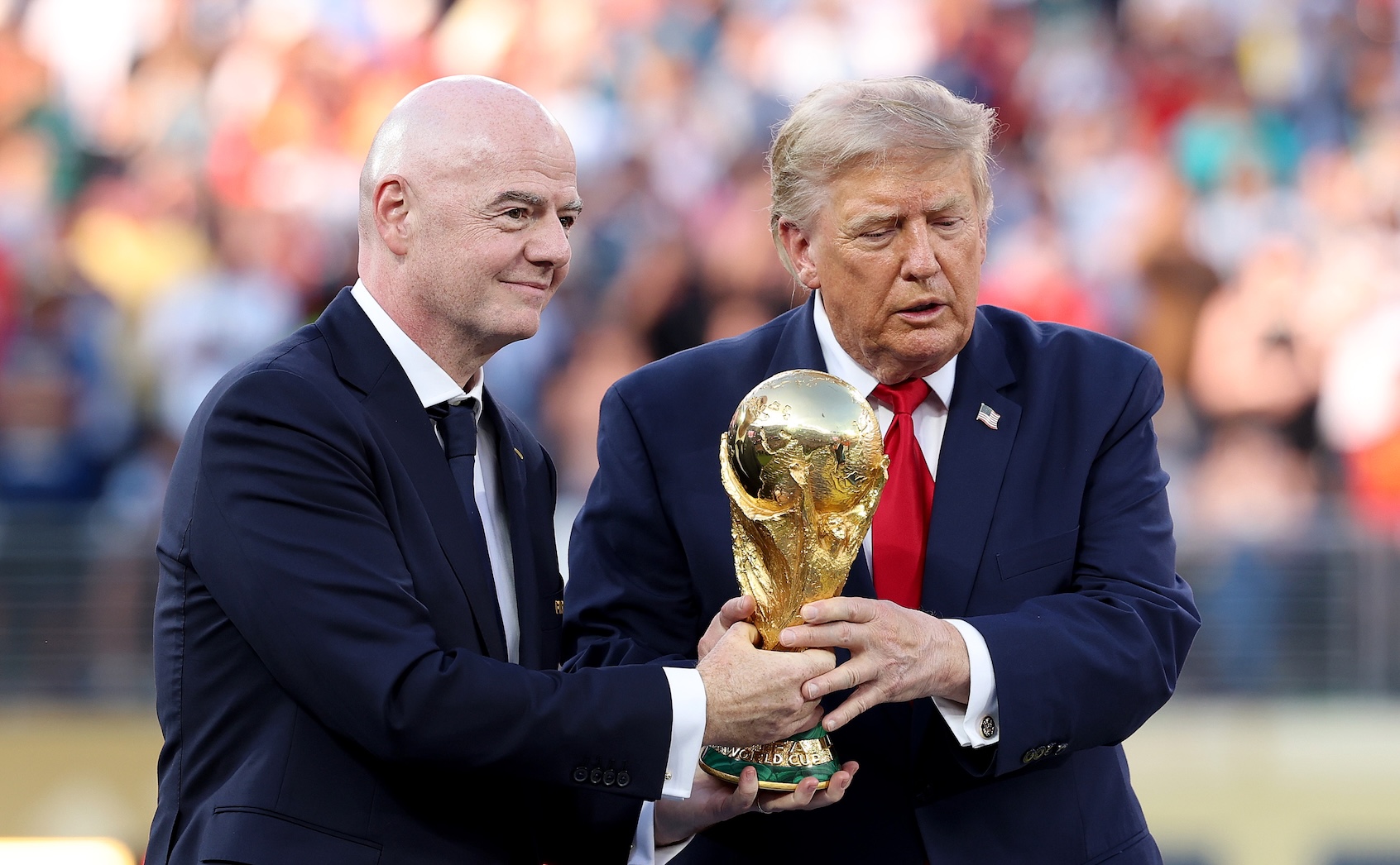
Even before this year’s tournament, Infantino stood accused of commercializing or “Americanizing” world soccer — a process he did not start but has certainly accelerated — and of shamelessly cozying up to Trump, whom he presented with the newly-invented FIFA Peace Prize, aka the “Temu Nobel,” last December. That was all inarguably true, and the guy has form, as they say on British cop shows. Back in 2022, while seeking to justify holding the World Cup in Qatar, an autocratic monarchy with a famously dreadful human rights record, Infantino launched a thousand memes with this memorable monologue:

“Today I have very strong feelings, I can tell you. Today I feel Qatari. Today I feel Arab. Today I feel African. Today I feel gay. Today I feel disabled. Today I feel a migrant worker.”

If it seems extraordinary that a major executive of any enterprise, anywhere in the world, could say stuff like that and still have a job four years later, you are beginning to appreciate the hallucinatory Infantino experience. Anyway, in 2026 Infantino seems to have swapped all those intersectional identities for an adjunct MAGA membership, and this year’s World Cup pushed the soccer world’s bizarre love-hate relationship with its leader into overdrive. 

Even before this tournament, Infantino stood accused of “Americanizing” world soccer — a process he did not start but has certainly accelerated — and shamelessly cozying up to the current occupant of the White House. This was inarguably true.

Tom Burrows of the Athletic did a nice job this week of summarizing the indictment: Infantino drove World Cup ticket prices to previously unimagined levels, introduced “commercial breaks in each half [of matches] dressed up as hydration breaks” — a network-friendly innovation that global football had resisted for decades — capitulated to Trump in reversing a red-card suspension for U.S. star striker Folarin Balogun, and introduced a “surreal halftime show” featuring Madonna, BTS and Justin Bieber in the final match, in obvious (and inept) imitation of the Super Bowl. 

All of that, mind you, came before Infantino’s big surprise this past week: Apparently without consulting any relevant stakeholders, he announced a plan to spin off commercial rights to the World Cup into a new for-profit company (FIFA is a nonprofit, like other international sporting federations) and then sell off a big chunk of that company to an investment consortium led by Joshua Kushner, the younger brother of Trump son-in-law Jared Kushner. So it’s not entirely accurate to say that Infantino wanted to sell world soccer’s biggest brand to the Trump family. But it’s not exactly false either. 

To coin a phrase, you can’t make this stuff up. But the good news, or the kind-of good news, or the “why in God’s name did this take so long” news, is that Infantino has finally choked on an overdose of hubris. His proposal collapsed within 48 hours and as of this weekend has been abandoned completely. (Soccer fans will discern unmistakable echoes of the European Super League, a proposed NFL-style closed competition for Europe’s top club teams that was announced in 2021 and imploded within a few weeks.)

UEFA, the federation that governs European soccer and is by far the most powerful of FIFA’s regional subsidiaries, wasted no time in rejecting Infantino’s scheme and announcing that none of its 55 national teams would participate in any FIFA competitions until the proposal was ditched. That was almost certainly enough to torpedo this galaxy-brain plan, and other regional confederations — most notably Concacaf, which represents North America, Central America and the Caribbean, and therefore includes the U.S. — soon followed UEFA’s lead, if not as aggressively. 

Donald Trump did not pick up the phone on this occasion. (“Johnny who? Really, I barely know the guy.”) Only the Confederation of African Football — whose member nations, fairly or otherwise, are perceived as Infantino supporters — remained silent. More on that shortly.

Anyone who follows world soccer already knows that UEFA has its own extensive history of political intrigue and internal scandal, and is not well positioned to play populist hero in this drama. But as is so often the case in world affairs, there are no good guys in the story and you have to pick your poison. One could draw a rough analogy with the European Union, a deeply flawed entity that nonetheless represents some degree of ideological or economic counterweight to Trump’s America. In this particular confrontation, Europe held nearly all the cards. 

If Infantino somehow pushes through his scheme to sell shares in the World Cup, he will do so — believe it or not — by casting himself as a defender of the downtrodden and underprivileged. He feels gay and African and disabled, remember?

While the next men’s World Cup, FIFA’s biggest golden goose, is still four years away, the consequences of a European boycott would have been felt immediately. The under-20 Women’s World Cup begins in Poland about a month from now, and qualifying playoffs for FIFA’s second-biggest event, the Women’s World Cup (to be held next summer in Brazil) are set for October. Given his avowed commitments to promoting the women’s game and youth soccer at all levels, Infantino simply couldn’t afford to play chicken with UEFA and risk losing those tournaments. Joshua Kushner and his family, one imagines, will not starve. 

This may be stretching the point, but there’s a thematic resemblance at work here to the worldwide pushback against Big Tech data centers, and against the opaque government processes that gets them built, as well as to the popular and legal resistance that has stalled the $110 billion merger between Warner Bros. and Paramount. It’s also true that Infantino is now understood, both to soccer fans and the world at large, as a proxy for Donald Trump, which looks like a much worse bet than it did a year ago. Infantino was cruising to likely re-election as FIFA president next year, but right now it’s an even-money bet that he can survive the next month. 


Want more sharp takes on politics? Sign up for our free newsletter, Standing Room Only by Amanda Marcotte, also a weekly show on YouTube or wherever you get your podcasts.


Like his White House buddy, Infantino has thrived on a remarkable ability to weaponize greed and cynicism, both on an epic scale and at ground level. He fully intended to push through his scheme to sell shares in the World Cup by casting himself, believe it or not, as a defender of the downtrodden and underprivileged. He feels gay and African and disabled, remember? The uncomfortable truth is that he has ruled over a vast global sports and merchandising empire largely by fulfilling his promises to channel lots of money into regional and national federations in the Global South that have historically had few resources. 

Under Infantino’s proposed plan, each of FIFA’s 211 federations — at least the ones who supported him! — would have received an immediate cash infusion of $40 million, with further annual installments to follow. That sum would barely make a difference to the football gods in England, Spain or France, but would been enormous in Malawi or Madagascar. Affluent European nations don’t need infusions of private equity capital to build new stadiums and support younger players, and can afford to stand up to Infantino’s Trump-flavored bribery scheme. For players, parents, coaches and local officials in sub-Saharan Africa, the equation might have looked very different. Why should they care where the money comes from? This particular grift may have failed, but in a world built on massive structural inequality, grifters tend to prosper.

The post Trump’s FIFA pal in trouble as plan to sell off World Cup collapses appeared first on Salon.com.

  •  

Anthony Minghella, 1954-2008

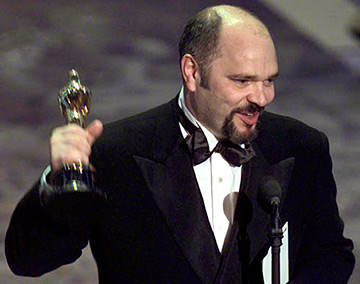
English writer and director Anthony Minghella has died at age 54, according to various news reports. It’s a sad and early departure for one of the best-loved figures in the British film industry. Minghella was chairman of the British Film Institute, where he had vowed to stem the outflow of British talent to the United States. He won the 1997 best-director Oscar for “The English Patient,” an international hit that launched a new wave of high-gloss, star-studded literary adaptations. His other films as a director included “Truly Madly Deeply” in 1990, “The Talented Mr. Ripley” in 1999 and “Cold Mountain” in 2003. Minghella apparently underwent surgery for a growth in his neck last week at Charing Cross Hospital in London. He had seemed to be recovering normally, but suffered a fatal hemorrhage early on Tuesday morning.

Minghella had recently completed a 90-minute pilot episode of “The No. 1 Ladies Detective Agency,” a planned television series based on Alexander McCall Smith’s best-selling novels about a Botswanan female detective. The program is scheduled to premiere this weekend on BBC One in Britain, and has been acquired for U.S. broadcast by HBO. He was reportedly close to beginning production on his next film, “The Ninth Life of Louis Drax,” which he had adapted from Liz Jensen’s novel and was planning to shoot in California. It’s too early to know whether that film will be scrapped, or possibly made with another director.

I’ll set aside my own mixed assessment of Minghella’s work and observe that he had an unerring eye for projects that combined big-screen cinematic spectacle, a literary pedigree and wide appeal among upscale audiences. He saw himself first and foremost as a storyteller, and had few artistic pretensions. Unlike so many people in his trade, Minghella was universally well liked on both sides of the Atlantic. Former British prime minister Tony Blair, who worked with Minghella on a 1995 campaign video and became his friend, told the BBC: “Anthony Minghella was a wonderful human being, creative and brilliant, but still humble, gentle and a joy to be with. Whatever I did with him, personally or professionally, left me with complete admiration for him, as a character and as an artist of the highest caliber.”

The son of Italian immigrants who owned an ice cream factory, Minghella was born on the Isle of Wight in 1954. His brother Dominic and sister Edana both work as writers for British television. He is survived by his wife, the choreographer Carolyn Choa, and two children, one of them the actor Max Minghella, who appeared in “Syriana” and “Art School Confidential” and is now a student at Columbia University in New York.

The post Anthony Minghella, 1954-2008 appeared first on Salon.com.

  •  

Trump’s foreign policy enters its decadent, desperate end stage

It’s tough to find any semblance of a silver lining in the humiliating implosion of Donald Trump’s foreign policy over the last year, especially after a week that has brought us another escalation of the war no one supports, a recycled trade war with Canada, an out-of-nowhere nuclear deal with a country that should never have access to nuclear weapons, and yet more threats against a small nation that poses no threat to the United States. 

But here’s the upside, just maybe: The tiny and perverse cadre of “anti-anti-Trump leftists” has been decisively silenced. If you find that phrase baffling, consider yourself fortunate. You evidently haven’t wasted any of your one wild and precious life arguing with renegade Marxists about whether the Trump-Putin alliance, in world-historical terms, was “objectively” superior to neoliberal internationalism on the Clinton-Obama model. 

If this is a safe space, I will admit here that at one time I was around one-third vulnerable to such arguments. I don’t mean the part about Trump being a force for progressive change in any sense, even if entirely by accident, since that was obviously and hilariously wrong, not to mention based on the same “enemy of my enemy” pretzel logic that produced the disastrous Nazi-Soviet pact of 1939. But on the level of a sophomore-seminar intellectual exercise, I could understand why self-appointed contrarians like Julian Assange and Glenn Greenwald saw Trump as a disruptive force who might upend the softcore imperialism of the previous three or four decades, which had led to the “forever wars” in Iraq and Afghanistan and the global hegemony of corporate capital. 

You didn’t have to be an unregenerate Leninist or an online troll or a Pat Buchanan-style paleoconservative (or all three at once!) to be momentarily seduced by Trump’s “America First” nonsense. Disgruntled Americans of all varieties voted for Trump by the millions, based in large part on his populist, isolationist rhetoric. Maureen Dowd’s notorious “Donald the Dove, Hillary the Hawk” column from 2016 should be inscribed above the gates of one of the lower circles of hell as a permanent warning to know-it-all media commentators. 

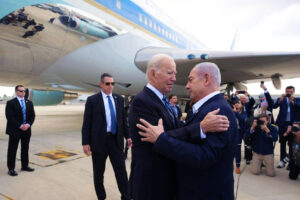
It was, of course, immensely helpful to Trump’s agenda of fabrications, exaggerations and outright lies that we experienced the failings of mainstream U.S. foreign policy all over again during the strange interregnum of Joe Biden’s presidency, with its pious invocation of a “rules-based order” — where the rules are set by America, of course — and its theological commitment to a now-entirely-imaginary “two-state solution” in the Middle East. Several things can be said in retrospect about Biden’s fateful embrace of Benjamin Netanyahu on the Tel Aviv tarmac after the Oct. 7 attacks: It was an authentic and heartfelt gesture, it was a grievous political error and it paved the way for a humanitarian catastrophe now widely perceived as genocidal. 

Joe Biden; Benjamin Netanyahu

(GPO/ Handout/Anadolu via Getty Images) Joe Biden is welcomed by Benjamin Netanyahu at Ben Gurion Airport, Oct. 18, 2023.

Trump’s return to power has, at the very least, finally confounded all the doofuses who ever took anything he said at face value, and has also dispensed with the contradictory or two-faced rhetoric of the Biden years. There’s no more talk of universal human rights or the spread of democracy. The fundamental logic of Trumpian policy is cynicism all the way down: We don’t care about any of those things and we never did. To paraphrase Stephen Miller, surely the most instrumental figure in the Trump White House, the only thing that matters is power. 

Maybe we should be grateful for the epic and reckless corruption of this administration, since Miller’s ambitious schemes to reshape America and the world as a white-supremacist wonderland are consistently undercut by the enormous levels of graft surrounding him. (Miller strikes me as a true believer whose corruption is moral rather than financial, one of many traits he appears to share with Joseph Goebbels.)


Want more sharp takes on politics? Sign up for our free newsletter, Standing Room Only by Amanda Marcotte, also a weekly show on YouTube or wherever you get your podcasts.


As the Trump administration veers unsteadily into its lame-duck phase and a likely midterm wipeout, its quest for a legacy achievement becomes increasingly pathetic, not to mention increasingly dangerous. Trump’s dance of death with the Iranian regime might have a comical aspect if the lives of many thousands of people and the future of the global order were not at stake. By goading the president into restarting the war for the third time (by my count), the new roster of hardline leaders in Tehran, at least for now, have strengthened both their domestic control and their international reputation. It’s difficult to imagine, in fact, how Trump and his ludicrous cast of advisers could possibly have screwed this up worse than they did. (D.C. rumors suggest that high-testosterone “Secretary of War” Pete Hegseth will ultimately be compelled to walk the plank over this fiasco.)

Maybe we should be grateful for the epic corruption of this administration, since Stephen Miller’s ambitious schemes to reshape America and the world as a white-supremacist wonderland are consistently undercut by the enormous levels of graft around him.

Meanwhile, the search for something that can be pitched to last-ditch MAGA loyalists as a victory, no matter how petty and insignificant, continues. Trump has never given up on his dream of seizing or annexing Greenland, but it was always more like an extortion scheme or a real estate scam than a military threat. Roughly the same applies to his improvised plan to rebuild Gaza as a Trumpified new Riviera, which took even Netanyahu by surprise and was never likely to escape the uncanny valley of AI fantasy. 

I’m inclined to feel similar about this week’s reports that Seb Gorka, an unhinged far-right free radical with some sort of roving-ninja role in the Trump White House, is urging a military assault against Islamist militia groups in Mali, a West African nation with complicated internal dynamics and no relationship whatever to U.S. national security. Again, this might be amusing if real human lives weren’t at stake, and if billions in taxpayer dollars appropriated by Congress for aid to impoverished countries like Mali weren’t being diverted to right-wing nationalists, white supremacists and anti-LGBTQ groups instead of humanitarian and healthcare NGOs. (Read this ProPublica report for more on that.)

Things have truly gotten dark if we’re looking to JD Vance and Marco Rubio as the proverbial adults in the room, managing the worst impulses of their increasingly disinhibited and incapacitated boss. I don’t know which of those two geniuses signed off on the reported nuclear deal with Saudi Arabia, which may fall apart, goddess willing, under the weight of its impromptu idiocy and the fact that literally no one thinks it’s a good idea. Mohammed bin Salman, that kingdom’s journalist-murdering leader, is roughly the last person in the world who should have access to nuclear materials. If this deal goes through, it could rank among the very worst of Trump’s foreign policy blunders. Of course there’s still time for more. 

The post Trump’s foreign policy enters its decadent, desperate end stage appeared first on Salon.com.

  •  
❌