Over the past week, the East Potomac Park case has morphed from another of President Trump’s personalist projects in D.C. to a burgeoning confrontation between the executive and judicial branches.
U.S. District Judge Ana Reyes had, by her own admission, bent over backwards to accommodate the Trump administration as it defended its supposedly nascent plan to remake a popular park in the heart of monumental D.C.
But then — in violation of her orders that the administration provide advanced notice and a chance for the court to intervene before undertaking any major projects in the park — the National Park Service removed hundreds of trees from the park’s golf course after providing scant notice just before 5:00 p.m. ET on a Friday before a holiday weekend.
That led to a fiery hearing in front of Reyes on Columbus Day in which she deplored the conduct of the administration and its DOJ attorneys. The hearing culminated with Reyes temporarily blocking any more tree removals at the park.
In the kind of self-defeating move that’s become common in cases where Trump has taken a close personal interest, the Trump DOJ responded to the courtroom woodshedding with a defiant motion on Friday evening calling on Judge Reyes to step aside from the case.
The motion to disqualify was over the top, accusing her of “histrionics,” “bias,” “disdain,” “open hostility,” and “animosity” toward the Trump administration in this and other cases.
The motion was signed by a single attorney: Stanley E. Woodward, Jr., the No. 3 official at DOJ.
Judge Reyes last night denied the motion to disqualify herself but not before eviscerating the Justice Department again: “That is a serious charge. The Court answers it. With the record.”
With that prelude, Judge Reyes spooled out pages of transcripts from prior proceedings in the case that rebutted the administration’s claims against her, before concluding:
It is easy to weaponize selective quotations to bring a baseless recusal motion. But it is much harder to meet the demanding legal standard against a full record. By any objective measure, the Government fails to meet the standard for recusal.
But things didn’t stop there.
Trump announced over the weekend that he plans to begin work on remaking the park on Nov. 15, closing it for 15 months. So much for Trump’s plans being nascent, as the administration had insisted for months. Judge Reyes took judicial notice of Trump’s post on Sunday and asked if it changed the administration’s prior position in the case:
The Court ORDERS that the Government notify it, by 8:00 p.m. today, whether it continues to take the position that it took in its October 16, 2026, filing, that, “there is no final agency action” and that “at most [] the President has given preliminary thought to” the plan to rebuild East Potomac Golf Course.
In its response — signed again only by Associate Attorney General Woodward — the administration insisted nothing had changed.
Then came this morning’s pre-dawn tirade from President Trump in which he called Judge Reyes a “crazed lunatic.”
Another hearing in the case is underway this morning on whether to issue a preliminary injunction blocking the administration’s plan. In her Sunday order, Reyes upped the ante by requiring Woodward and Deputy Assistant Attorney General Robert N. Stander to appear in person at today’s hearing.
Stay tuned …
We Can Afford to Have Nice Things
WASHINGTON, DC – OCTOBER 18: Logs and debris are piled on the course at East Potomac Golf Links on October 18, 2026 in Washington, DC. The National Park Service confirmed in a filing they had marked over 500 trees for removal as the Trump Administration mulls over a renovation for the golf course. (Photo by Tasos Katopodis/Getty Images)
Until the open clash between Trump and Judge Reyes, I’d hesitated to cover the East Potomac Park case for a national audience because in some ways it’s a parochial D.C. issue and not of the same import as, say, the demolition of the East Wing of the White House, the blight of the Trump Triumphal Arch, the renamings of the Kennedy Center and the Institute of Peace, or the unspeakable painting of the intricate exterior of the grand Eisenhower Executive Office Building.
But there’s more going on here than a threat to one public golf course.
For those not familiar, it should be noted that while the public golf course within the historic park is at the center of the dispute, the identity, public use, and access to the park as a whole is at stake. The park features a heavily used paved waterfront loop for walkers, runners, and cyclists. It has a playground and picnic area. People fish, enjoy the views of the D.C. core and northern Virginia, and watch planes taking off and landing from DCA.
The park was created for the public by Congress in the late 19th century and then was built using fill on the tidal mud flats of the Potomac. The low-cost golf course, like two other public courses in D.C. on National Park Service land, has always catered to a broad clientele, trying to keep the sport accessible.
What makes this a national story beyond the clash with Judge Reyes is that the narrowing of public spaces is happening in parallel with the shrinkage of civic life under Trump. The concern is that Trump’s plan would make the golf course more exclusive and less accessible. It would alter the public nature of the park as it has existed for more than 100 years.
Must See
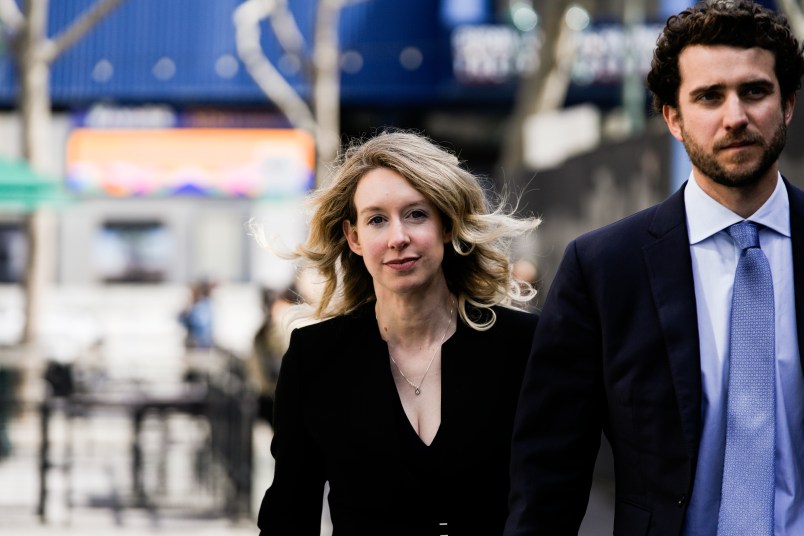
SAN JOSE, CA – Former Theranos CEO Elizabeth Holmes alongside her boyfriend Billy Evans, walks back to her hotel following a hearing at the Robert E. Peckham U.S. Courthouse on March 17, 2023 in San Jose, California. Holmes appeared in court for a restitution hearing. (Photo by Philip Pacheco/Getty Images)
Let me join the chorus of reviewers urging you to go see Nathan Fielder’s “You Can See Everything.” It’s among the smartest documentaries I’ve ever seen.
I came to it unfamiliar with Fielder’s previous work and with only passing Wikipedia-level familiarity with the Theranos scandal.
If you’re a Theranos obsessive, you may come away disappointed. It’s not a Theranos documentary. It’s a psychological profile of Elizabeth Homes and of her romantic partner Billy Evans. While it may be tempting to make a judgment on Holmes’ culpability in the Theranos scandal based on Fielder’s work — and audiences probably come out of theaters chatting about exactly that — it would be a mistake.
The Theranos fraud, while inextricably woven into the documentary, exists separate and apart from it. Trials and depositions and financial filings and good investigative reporting already explore the fraud itself in great detail. This isn’t that. (If you feel the strong need for a villain in the documentary, Billy more than fills that role on his own — even though he had nothing to do with Theranos and didn’t first meet Holmes until after the company’s collapse.)
What really sets Fielder’s documentary apart is its acute self-awareness. It grapples openly with the range of challenges that confront documentarians and storytellers: the limits of objectivity, the nature of truth, the intrusive role of the observer, the inevitability of bias, the constraints of narrative forms. I’m barely even getting started. There’s a lot going on.
Fielder inoculates himself against the most obvious criticisms by confronting them as part of the story he’s telling. It gets super meta at times, but it doesn’t lose the thread of the story. I can’t say much more than that without spoiling it for you.
If you’re comfortable with uncertainty, bask in nuance, enjoy the challenge of juggling competing explanations, and can tolerate not having everything reduced to a single “answer,” you’ll delight in this artwork.
News? Tips? Feedback? Please let me know. For sensitive information, use the encrypted methods here.
In 2020, Maricopa County became the epicenter for Trump’s claims the election was stolen. Six years, later the president and his allies are dusting off their “rigged” playbook ahead of the midterms.
President Trump’s inexplicable decision to waive some sanctions on Russia, announced late Friday, essentially gives a pass to the forces of evil in the Kremlin. The move effectively nullifies legislation that was named after the late Republican Senator Lindsey Graham, passed by huge bipartisan majorities in both the House and Senate, and signed by the president. This decision is the latest in a long series that this administration has taken to appease or accommodate the Russians in misguided attempts to get them to negotiate. Russian President Vladimir Putin pockets these naive offerings and still refuses to talk.
Surveys show that most Americans stand with Ukraine as it defends itself against Russia, view Putin as a dangerous threat who shouldn’t be trusted, and want to see the United States offer more assistance to Ukraine.
Few wars in recent history have been so black-and-white: Russia is the guilty party that invaded Ukraine for no good reason. Ukraine is, for its part, defending its freedom, sovereignty, and territorial integrity.
And yet there is much misinformation and disinformation circulating that blurs the picture. To address the problem of phony narratives, it is useful to contrast Russia and Putin with Ukraine and its president, Volodymyr Zelensky.
Putin came to power in August 1999, when his predecessor, Boris Yeltsin, designated him prime minister and his preferred successor; Yeltsin resigned from office at the end of that year and named Putin acting president, three months before the next presidential election. Putin had used his time as prime minister to deploy brutal force against the Chechens in 1999. Zelensky became the leader of Ukraine in 2019, when he won by a landslide in a free and fair election certified by domestic and international observers. Putin hasn’t won a legitimate election throughout his two-plus decades in power.
Putin is a murderous dictator who kills his own citizens as well as those of his neighbors. He treats his troops as cannon fodder. Zelensky is a democratically elected leader whose term has been extended because Ukraine cannot credibly conduct elections under martial law, which was declared after Russia invaded on a full scale in 2022.
Under Putin, Russian forces deliberately target civilian areas, including hospitals, apartment buildings, and schools. They also seek to destroy energy facilities and water supplies to freeze out Ukrainians and force them into submission. Zelensky and Ukrainian forces focus on Russian energy facilities that provide Putin with funding for his war campaign, but generally seek to minimize civilian casualties.
Putin first started the war against Ukraine in 2014, when he illegally annexed Crimea and then moved into Ukraine’s Donbas region. Zelensky wasn’t even in politics that year, so he can’t be blamed for starting the war.
Putin refuses to end the war, enter serious negotiations, or even entertain a cease-fire. Zelensky and Ukraine have shown tremendous willingness to negotiate, freeze the fighting at its current stage, and sort out the status of Russian-occupied land through diplomacy, without conferring recognition of Russian control.
Putin has ignored Trump’s repeated efforts to end the war, including the recent energy-cease-fire announcement, by continuing to strike Ukrainian energy targets. Zelensky had suspended retaliatory strikes against Russian refineries for three days but lifted that pause after Russia kept bombing Ukraine.
Putin sought to topple the Zelensky government through his full-scale invasion, in 2022, to take over massive amounts of Ukrainian territory and to subjugate the country under Russian rule. Zelensky and the people of Ukraine simply have sought to live in peace and exercise their right to determine their independent future.
Putin wishes to challenge and undermine democratic nations and the institutions that bring them together, such as NATO and the European Union. Ukraine seeks to join these institutions and assume its rightful place as a full member of the Euro-Atlantic community.
Putin supports Iran against the United States, providing both intelligence aimed to target and kill Americans as well as weapons systems to help that cause. Zelensky and Ukraine offered the United States and its allies in the Middle East anti-drone capabilities and insights on how to fight the Iranian Shahed drones, which have been used against Ukraine.
Putin relies on North Koreans and others who have been trafficked into Russia’s side of the war. Casualties are merely a statistic for him and for North Korea’s leader, Kim Jong Un. Zelensky has never asked the West to send its troops to fight on Ukraine’s side, but he does seek Western assistance to defend against the much larger Russian military.
Putin depends on China’s purchases of Russian energy and provision of dual-use technology to back his war. Ukraine looks to the West for its support.
Putin and Russia are key parts of CRINK, the grouping of the authoritarian regimes in China, Russia, Iran, and North Korea that seek to weaken and threaten the West. Ukraine is the bulwark against a major part of this dangerous alignment.
Putin and Russian forces have launched provocations against Europe and the United States, almost daring war with the West. These have included major violations of NATO airspace; drone attacks and interference with European airports and flights; assassinations and attempted killings on Western soil; cyberattacks; and election interference. Ukraine stands between Russia and Europe, fighting for its freedom as well as the safety and security of the continent.
Putin oversees one of the most corrupt regimes in the world. He has obliterated rule of law and sanctity of contracts, making Russia a highly inhospitable place to do business, including in the energy sector. Ukraine, while experiencing its own problem of corruption, actively seeks to confront that problem while encouraging and desperately needing Western investment. Russia ranks 157th out of 182 nations in Transparency International’s corruption index, while Ukraine ranks 104th. Putin has destroyed Russian civil society; Ukrainian civil society is vibrant and calls out corruption on a regular basis.
What does all of this mean for the United States and Europe? For starters, they should stand unequivocally with Ukraine against Russia. History will reflect poorly on the West if it concludes that our policy and position were wishy-washy at best in a war so clearly black-and-white.
They should provide the military assistance that Ukraine needs to defend itself, save lives from Russian bombardment, regain territory that Russia illegally occupies, and win the war. The war has been an unmitigated disaster for Russia; more than 1.5 million have been killed or wounded, and the conflict has caused severe economic strain. At some point, Russia might reach a breaking point; the West should help accelerate that process, because that may be the only way to get Putin to end the war he started.
Europe should support Ukraine financially to help offset the costs of Ukraine’s forced increased military spending and reconstruction. To do this, Europe should finally move from freezing to seizing the roughly $300 billion in Russian assets that are in Western financial institutions, mostly in Belgium’s Euroclear. These funds, which Russia should never recover after what it has done to Ukraine, would provide a major financial assist to Ukraine and allay the potential burden on the West.
Pressure to end the war should be applied and increased on Putin and Russia, the ones who started it—not Ukraine. This means a serious tightening of sanctions implementation, including stronger enforcement against Russia’s shadow fleet that generates energy-export income, and no business deals with Russia that ease the sanctions pressure and provide financing for its war effort. It means ending loopholes that allow Western-made parts essential for Russian weapons to slip through the sanctions.
The United States should also raise the costs on countries—especially China and India—that import Russian energy. And the West should not sign energy or any other deals with Putin and Russia, as the Trump administration announced on October 9 regarding diesel. Such efforts are read in Moscow as weakness and reinforce Putin’s thinking that he is winning and can outlast the West’s support for Ukraine.
The West should stop inviting Putin to various meetings, such as the G20 gathering hosted this year by the United States. He has been indicted by the International Criminal Court for war crimes against Ukraine (specifically the abduction of Ukrainian children, though he is guilty of much more). He is responsible for the worst security crisis on the European continent since World War II. He needs to be isolated and treated as the pariah and threat that he is, not welcomed with red-carpet treatment.
President Trump’s inexplicable decision to waive some sanctions on Russia, announced late Friday, essentially gives a pass to the forces of evil in the Kremlin. The move effectively nullifies legislation that was named after the late Republican Senator Lindsey Graham, passed by huge bipartisan majorities in both the House and Senate, and signed by the president. This decision is the latest in a long series that this administration has taken to appease or accommodate the Russians in misguided attempts to get them to negotiate. Russian President Vladimir Putin pockets these naive offerings and still refuses to talk.
Surveys show that most Americans stand with Ukraine as it defends itself against Russia, view Putin as a dangerous threat who shouldn’t be trusted, and want to see the United States offer more assistance to Ukraine.
Few wars in recent history have been so black-and-white: Russia is the guilty party that invaded Ukraine for no good reason. Ukraine is, for its part, defending its freedom, sovereignty, and territorial integrity.
And yet there is much misinformation and disinformation circulating that blurs the picture. To address the problem of phony narratives, it is useful to contrast Russia and Putin with Ukraine and its president, Volodymyr Zelensky.
Putin came to power in August 1999, when his predecessor, Boris Yeltsin, designated him prime minister and his preferred successor; Yeltsin resigned from office at the end of that year and named Putin acting president, three months before the next presidential election. Putin had used his time as prime minister to deploy brutal force against the Chechens in 1999. Zelensky became the leader of Ukraine in 2019, when he won by a landslide in a free and fair election certified by domestic and international observers. Putin hasn’t won a legitimate election throughout his two-plus decades in power.
Putin is a murderous dictator who kills his own citizens as well as those of his neighbors. He treats his troops as cannon fodder. Zelensky is a democratically elected leader whose term has been extended because Ukraine cannot credibly conduct elections under martial law, which was declared after Russia invaded on a full scale in 2022.
Under Putin, Russian forces deliberately target civilian areas, including hospitals, apartment buildings, and schools. They also seek to destroy energy facilities and water supplies to freeze out Ukrainians and force them into submission. Zelensky and Ukrainian forces focus on Russian energy facilities that provide Putin with funding for his war campaign, but generally seek to minimize civilian casualties.
Putin first started the war against Ukraine in 2014, when he illegally annexed Crimea and then moved into Ukraine’s Donbas region. Zelensky wasn’t even in politics that year, so he can’t be blamed for starting the war.
Putin refuses to end the war, enter serious negotiations, or even entertain a cease-fire. Zelensky and Ukraine have shown tremendous willingness to negotiate, freeze the fighting at its current stage, and sort out the status of Russian-occupied land through diplomacy, without conferring recognition of Russian control.
Putin has ignored Trump’s repeated efforts to end the war, including the recent energy-cease-fire announcement, by continuing to strike Ukrainian energy targets. Zelensky had suspended retaliatory strikes against Russian refineries for three days but lifted that pause after Russia kept bombing Ukraine.
Putin sought to topple the Zelensky government through his full-scale invasion, in 2022, to take over massive amounts of Ukrainian territory and to subjugate the country under Russian rule. Zelensky and the people of Ukraine simply have sought to live in peace and exercise their right to determine their independent future.
Putin wishes to challenge and undermine democratic nations and the institutions that bring them together, such as NATO and the European Union. Ukraine seeks to join these institutions and assume its rightful place as a full member of the Euro-Atlantic community.
Putin supports Iran against the United States, providing both intelligence aimed to target and kill Americans as well as weapons systems to help that cause. Zelensky and Ukraine offered the United States and its allies in the Middle East anti-drone capabilities and insights on how to fight the Iranian Shahed drones, which have been used against Ukraine.
Putin relies on North Koreans and others who have been trafficked into Russia’s side of the war. Casualties are merely a statistic for him and for North Korea’s leader, Kim Jong Un. Zelensky has never asked the West to send its troops to fight on Ukraine’s side, but he does seek Western assistance to defend against the much larger Russian military.
Putin depends on China’s purchases of Russian energy and provision of dual-use technology to back his war. Ukraine looks to the West for its support.
Putin and Russia are key parts of CRINK, the grouping of the authoritarian regimes in China, Russia, Iran, and North Korea that seek to weaken and threaten the West. Ukraine is the bulwark against a major part of this dangerous alignment.
Putin and Russian forces have launched provocations against Europe and the United States, almost daring war with the West. These have included major violations of NATO airspace; drone attacks and interference with European airports and flights; assassinations and attempted killings on Western soil; cyberattacks; and election interference. Ukraine stands between Russia and Europe, fighting for its freedom as well as the safety and security of the continent.
Putin oversees one of the most corrupt regimes in the world. He has obliterated rule of law and sanctity of contracts, making Russia a highly inhospitable place to do business, including in the energy sector. Ukraine, while experiencing its own problem of corruption, actively seeks to confront that problem while encouraging and desperately needing Western investment. Russia ranks 157th out of 182 nations in Transparency International’s corruption index, while Ukraine ranks 104th. Putin has destroyed Russian civil society; Ukrainian civil society is vibrant and calls out corruption on a regular basis.
What does all of this mean for the United States and Europe? For starters, they should stand unequivocally with Ukraine against Russia. History will reflect poorly on the West if it concludes that our policy and position were wishy-washy at best in a war so clearly black-and-white.
They should provide the military assistance that Ukraine needs to defend itself, save lives from Russian bombardment, regain territory that Russia illegally occupies, and win the war. The war has been an unmitigated disaster for Russia; more than 1.5 million have been killed or wounded, and the conflict has caused severe economic strain. At some point, Russia might reach a breaking point; the West should help accelerate that process, because that may be the only way to get Putin to end the war he started.
Europe should support Ukraine financially to help offset the costs of Ukraine’s forced increased military spending and reconstruction. To do this, Europe should finally move from freezing to seizing the roughly $300 billion in Russian assets that are in Western financial institutions, mostly in Belgium’s Euroclear. These funds, which Russia should never recover after what it has done to Ukraine, would provide a major financial assist to Ukraine and allay the potential burden on the West.
Pressure to end the war should be applied and increased on Putin and Russia, the ones who started it—not Ukraine. This means a serious tightening of sanctions implementation, including stronger enforcement against Russia’s shadow fleet that generates energy-export income, and no business deals with Russia that ease the sanctions pressure and provide financing for its war effort. It means ending loopholes that allow Western-made parts essential for Russian weapons to slip through the sanctions.
The United States should also raise the costs on countries—especially China and India—that import Russian energy. And the West should not sign energy or any other deals with Putin and Russia, as the Trump administration announced on October 9 regarding diesel. Such efforts are read in Moscow as weakness and reinforce Putin’s thinking that he is winning and can outlast the West’s support for Ukraine.
The West should stop inviting Putin to various meetings, such as the G20 gathering hosted this year by the United States. He has been indicted by the International Criminal Court for war crimes against Ukraine (specifically the abduction of Ukrainian children, though he is guilty of much more). He is responsible for the worst security crisis on the European continent since World War II. He needs to be isolated and treated as the pariah and threat that he is, not welcomed with red-carpet treatment.
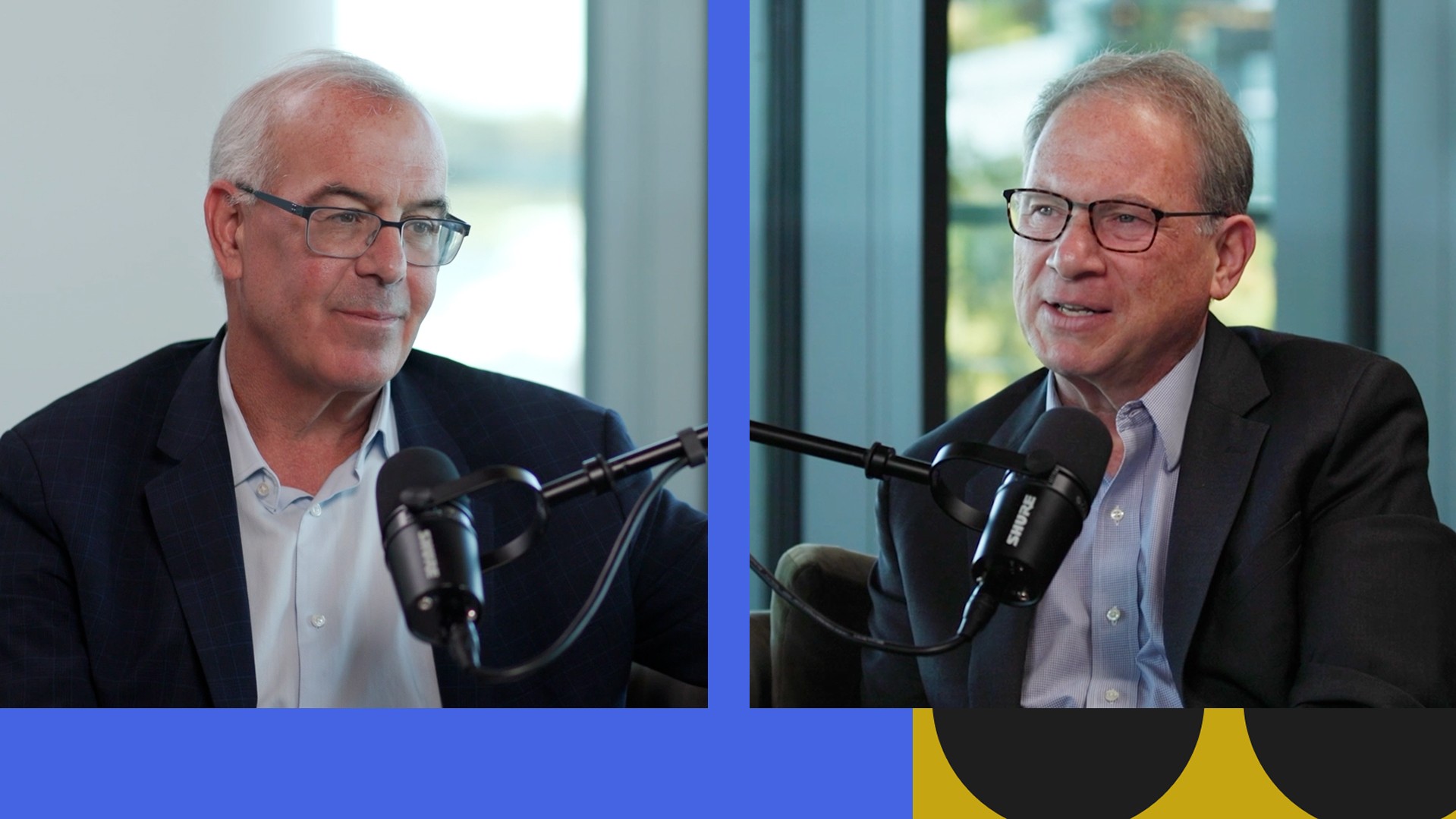
One of the paradoxes of our moment is that the excesses of Donald Trump’s presidency seem to demand our obsessive attention, while Trump himself obviously thrives on that attention—and all of the social division that comes with it. What if the clearest way out of our political crisis is taking politics less seriously? In this episode of The Permanent Questions, David Brooks speaks with his old friend (and new boss), Atlantic editor in chief Jeffrey Goldberg, about the pleasures and pitfalls of a life spent covering politicians, the limits of partisanship, and the need to see life from the redwood’s perspective.
The following is a transcript of the episode:
David Brooks: Our topic today is politics. What role should politics play in your life? How much of your spiritual, emotional, and mental energy should you devote to politics?
Now, I am something of a political junkie. I grew up as a political correspondent covering people, and I can say there’s nothing more fun in journalism than going to a rally in Iowa or New Hampshire or anywhere people are campaigning, talking with the folks, watching them scream, watching the passion. It’s just Americana in all its glory, both good and bad.
So I really care about politics. I really care about politicians. I admire them in general. They’re good people in rotten circumstances. And yet I also feel that we’ve over-politicized our society. Everything is red or blue. Where you live is red or blue. What car you drive is determined by red or blue. The TV shows you watch are determined by red or blue. Who you marry and befriend, how you think about the WNBA.
When you make politics your religion, you think you have a sense of belonging, but you really don’t. You’re not sitting with your community members; you’re just hating the same people. You have the illusion of righteous action. You’re doing something good for the country. But you’re not feeding the poor or sitting with the widow; you’re just hating people on social media. It gives you the illusion of all the things that you get in a real community or a real faith or a real philosophy, but you just end up in a cultural war.
I’m trying to figure out: How do I care about politics without over-caring?
My guest today is Jeffrey Goldberg. You probably know him as the editor in chief of The Atlantic magazine. As you watch or listen to this conversation, you will notice that Jeff and I know each other. We’ve known each other for 25 years. You’ll see that we have, as all old friends do, a certain way of talking to each other. We have a certain banter, which involves a lot of interruption. That’s our conversational style.
What you are about to witness is us at our most slow paced, our most earnest, our most serious. Jeff and I will be talking about what role politics should play in our lives. But in order to get there, I thought we’d compare notes about our careers, the politicians we’ve covered, what we’ve thought about them, what’s been important, what’s been unimportant.
Jeffrey Goldberg, welcome to The Permanent Questions.
Jeffrey Goldberg: Thank you.
Brooks: This must be—
Goldberg: I’m very wary.
Brooks: —a thrill for you. You do edit a magazine, you’ve won some prizes, but this really is pretty much the pinnacle of your career.
Goldberg: You know, I applied to Yale, and I got rejected. I didn’t even get wait-listed. They were just like, “What, are you joking?” So I consider this getting into Yale. Aren’t you a professor at Yale?
Brooks: I’m a faculty member at Yale.
Goldberg: What does that mean? What’s the difference between a professor and a faculty member?
Brooks: Professors know what they’re talking about.
Goldberg: Good one.
Brooks: We’re going to talk politics, if we can get on track here, which is highly unlikely.
Goldberg: It’s really deeply unlikely.
Brooks: We’ve spent our lives covering this stuff.
Goldberg: Isn’t that sad?
Brooks: I know. So I’m gonna ask you, I want to get your political origin story.
Goldberg: My political origin story?
Brooks: When did you first have a brush with politics?
Goldberg: My first brush with politics was when, as a 2-year-old, I urinated on Al Shanker’s lap.
Do you remember Al Shanker?
Brooks: Of course. He was head of the American Federation of Teachers.
Goldberg: He led the 1968 teachers’ strike. My father was one of the leaders of the teachers’ strike. And the story is told that they were having a meeting in their Brooklyn apartment, and I was seated on Al Shanker’s lap, and I pissed all over him.
Brooks: Really?
Goldberg: I grew up in that kind of household with posters on the wall with quotes: “To sin by silence when they should protest makes cowards out of men.” That was by the bathroom, I remember.
Brooks: I had a similar upbringing, weirdly.
Goldberg: It’s not that weird, actually.
Brooks: My parents volunteered for Ed Koch back when he was a liberal member of Congress.
Goldberg: He was a liberal reformer. He was fighting Carmine DeSapio and the remnants of the Tammany machine.
Brooks: I think also Watergate—I don’t know, I’m slightly older than you, but when I saw the Watergate hearings, I thought, That is so cool., I wanted to be—I was on the side of G. Gordon Liddy and the Watergate co-conspirators.
Goldberg: I have recollections of it being on constantly in the house. And just a general and deep loathing of Nixon in the cohort of my parents and their friends, which later on I realized was overdone. I don’t take the Lynyrd Skynyrd position on Watergate. But—
Brooks: Wait, what is the Lynyrd Skynyrd position?
Goldberg: “Watergate does not bother me. Does your conscience bother you?” But I just think Nixon is much more interesting. In the full light of what we know now about the possibilities in American politics, I think Nixon is a very interesting character. But at the time, he was Satan incarnate, which is kind of funny in retrospect.
Brooks: Now, did you have heroes? I remember when I got a little older, and I became more politically aware, when I was in high school—this is the kind of kid I was—I had a Hubert Humphrey poster on my wall. It was not Joe Namath or Tom Seaver.
Goldberg: You’re such a loser.
Brooks: It was Hubert Humphrey. But it had the saying: “Some people talk change. Others cause it.” And I knew even then I wanted to be the kind of person who only talks.
Goldberg: Some people just don’t even open their mouths. They just think about it.
Brooks: I was like a mainstream Democrat. Scoop Jackson was big in our household, and Birch Bayh.
Goldberg: Scoop Jackson became a hero of mine later, in college, but not then.
I think I was just very, very influenced by what was hanging on the walls of the house. There was a famous, very moody photo of JFK and RFK consulting with each other.
Brooks: One difference between us: I’ve always had a political ideology. I’ve always had a label that I’ve labeled myself. When I was a kid—or in college, even, I was a socialist. I had read John Reed.
Goldberg: Who wasn’t, though? You read John Reed?
Brooks: Yeah, he wrote a book called Ten Days That Shook the World.
Goldberg: I just waited for the movie. I watched the Warren Beatty movie.
Brooks: Yeah, there’s a movie called Reds—Warren Beatty, Diane Keaton—which was one of my favorite movies. I was like, “Yeah, revolution.” And I loved The Communist Manifesto.
Goldberg: Wait, how could a Hubert Humphrey poster and The Communist Manifesto coexist?
Brooks: Because I swung left in college. I just hung out in the library. I didn’t go to classes. I just hung out. And I read a magazine called the New Masses, which was a communist magazine from the 1920s and ’30s. I became in love with magazines.
There was a historian named Richard Pells, who basically argued that all of human history is controlled by The New Republic, and he covered American history as if it was The New Republic. So it gave me the conviction, which I have to this day, that ideas matter more than anything else in politics, and that small magazines in particular drive the intellectual debate.
Goldberg: It’s funny, I read the Old Masses, which was a pro-Cossack magazine, at the same time.
Brooks: Lessons on how to chase down Jews. (Laughs.)
Goldberg: I’m a reporter. I’m not like you. I didn’t read the New Masses.
Although I did go to the library and read a lot of magazines. I read The New Republic, definitely. I wasn’t really a New Yorker guy or an Atlantic guy. More Atlantic in high school than New Yorker. But I was definitely—when I started reading The New Republic, and I guess this was the Kinsley era, so after college, I really had this kind of feeling. I was like, “Who are these people? How do they know so much? Why do these words shine off the page?”
Brooks: Was it my writing that caused this a lot?
Goldberg: I didn’t remember your pieces personally. I’m sure someone read them, but it wasn’t me. You wrote for The New Republic in that period?
Brooks: Occasional freelance. I was more a National Review guy.
Goldberg: I read the National Review just because I just went for—this is sort of the way I am, I guess, why I fell into magazines—I would privilege in my mind good writing over almost anything.
That’s why George Will’s my favorite columnist. I don’t agree with him on everything, but the man can write. I mean, next to you, he’s my favorite. But you’re not a columnist anymore; you’re more of a video personality.
Brooks: I’m a talk show host. I’m a game show host. Bob Barker.
Goldberg: You’re like Phil Donahue. You’re not going to ask me about my feelings in this session?
Brooks: No, don’t worry. I’m going to your intellectual life. That void is big enough.
Goldberg: Yes, it is. (Laughs.)
I’ve written about this; it’s no secret. I was a self-identified socialist Zionist at 15. Actually, this is true: With a group of friends, we once marched in St. Mark’s Place, in the village. We once were at a rally carrying the banner “Socialist Zionists for Animal Rights.” Huge constituency.
Brooks: Now did you ever have a book or an event that shifted your political view?
Goldberg:Animal Liberation by Peter Singer. I’m serious.
Brooks: Is that true, really?
Goldberg: Yeah, I became a vegetarian out of that, until I realized that I really like hamburgers too much.
I read deeply in socialist theory and Zionist theory, and there was a kind of almost Bolshevik inevitability to my early path. I ended up living on a kibbutz that was still organized like a kibbutz in the kind of collectivized sense. And then I realized that socialism is ridiculous.
Brooks: For what reason?
Irving Kristol went to the army and decided if we became socialists, the people he was serving with would turn it into a racket. So he said, “Oh, I can’t be for socialism.”
Goldberg: It just seemed to go against—I mean, I’m making a very broad statement here—human nature. People like things. They like to acquire things, like to acquire status. You can tell them, “That’s wrong. Don't be like that.” But I’m also like that. I like to have acquisitions. I like to collect things. I like the material world also. And I like to see people being rewarded for working harder than other people. I believe in equality, but I don’t believe in equity in the sense that I don’t think that people are born with the same level of skill.
Maybe I’m straying too far away from the point of this. What is the point of this session?
Brooks: The role politics plays in your life. But we’re starting out with the ideas of politics.
Goldberg: There just seems something unnatural about socialism, this overwhelming desire. It seemed resentment based a little bit too much for me. “There should be no such thing as a billionaire”—I’m not in that camp. I’m in the camp that there should be a lot of millionaires. I don’t want to cap anybody’s success. I would bring the floor up.
I don’t think that makes me a socialist or a Democratic socialist. I think this makes me a common-sense, non-cruel believer in some kind of meritocratic possibility.
Brooks: It’s somewhat similar. I read Edmund Burke in college, and that was a shock. He just said: The world’s really complicated. If you think you socialists can plan reality, good luck with that.
Goldberg: Socialism doesn’t survive first contact with humans and all of their ridiculous complexity.
Brooks: And a lot of my heroes became the neoconservatives, like Irving Kristol and Gertrude Himmelfarb. They were lefties who grew up in Brooklyn, but they also grew up immigrant kids, and they looked at their parents and how they had made it in America, and it was hard work. It was bourgeois values. It was education. And they looked at the hippies and think, What are you guys doing?
Goldberg: They’re destroying, because they could either make or destroy, and so they were in the destruction phase.
Brooks: We both, early in our careers—you way more than me—reported from abroad. I was abroad basically the first six years of the ’90s.
Goldberg: And you count Belgium as abroad, don’t you?
Brooks: I was covering the Soviet Union—that’s abroad. I was covering South Africa—that's abroad. I was covering the Middle East.
Goldberg: Yeah, that’s true.
Brooks: These are abroad places.
Goldberg: Those are abroad.
Brooks: As far as I know. I wasn’t in Greenland, like most parts of America.
Goldberg: I mean, I’m just saying that, you know, Brussels is not—
Brooks: Okay, Mr. Obscure Foreign Correspondent.
Goldberg: I’m just saying, it’s a direct flight. Anything with a direct flight …
Brooks: That’s fine.
Goldberg: And a wide selection of cheese ...
Brooks: To me it was the daring adventures with waffles. That’s what I had in Brussels.
Did you have your worldview shaped by events—as you call them—abroad, where there’s no direct flights?
Goldberg: The first thing I think of is coming home from Pakistan. I spent part of the late ’90s, early 2000, up to 9/11, going in and out of Pakistan and Afghanistan. I don’t think I’ve ever really articulated this before, but part of my belief system is that America is better than any other place.
I’m American. I love America. I recognize all the flaws, especially right now, but I’m American. Another observation I would make—these all kind of marry up—is that there’s too many journalists in America, or commentators or whatever you wanna call them, who see America as the locus of evil in the world, and that everything that happens in the world that’s bad is somehow caused, directly or indirectly, by the United States. And I just don’t buy that.
Does that send me down a more conservative pathway? In one superficial sense. But I think that the broadening experience of seeing how tens of millions of people live and realizing that we built something pretty good for ourselves gave me some perspective and some appreciation that sometimes, let’s say, people who come out of the Ivy League don’t really have.
They think that America is the locus of all bad in the world, and I have no patience for that anymore.
Brooks: You had a much more—
Goldberg: I’m not saying things are going so great, by the way.
Brooks: I just want to establish that, just to show that we’ve spent our lives on the importance of politics, both foreign and domestic. And I really care about politics.
I think that my favorite person I ever covered was John McCain.
Goldberg: Yeah, probably me too. Just to be around him.
Brooks: He was just so much fun. People forget that. He took me to casinos to teach me how to play craps.
Goldberg: He once introduced me to a group of Hungarian right-wingers as, “This is Jeff Goldberg. He’s a communist reporter.” You know? Whatever happens, happens. And I was like, “Jesus, man. Will you just stop?”
Brooks: But I ask you all this because we’ve spent a lot of our life in politics. And obviously politics matters a lot, both foreign and domestic.
Goldberg: Or does it?
Brooks: I’m now of a mood that we’re over-politicized as a country. I have this line: “We’re over-politicized and under-moralized.” We spend too much time paying attention to whatever cable TV is covering that particular hour and less about the things that really matter.
Goldberg: When you say “we,” what do you mean?
Brooks: We as a national society.
Goldberg: I don’t know about that. If you add up all the people who watch cable news, it adds up to a very, very small percentage of the American population.
I think most people aren’t, and most people are probably healthier than the people who do pay inordinate attention to politics or are involved in politics. Is the reality the general perception of reality, or is the reality something deeper? I do think that most people in America don’t pay day-to-day attention to it. We’re just around people who do.
If you’re asking in my own life, I’ve come to realize—here’s where everybody quotes the late Breitbart: We all understand now that “politics is downstream from culture.” But I would say that, especially now, culture is downstream from psychiatry and theology and tribalism and anxiety and resentment and a whole basket of sometimes inchoate human impulses and emotions that are buried deep in our lizard brains. You know what I mean?
To go upstream, you’ve got to be a salmon now in politics, if you’re writing about politics, and go as far upstream as you can go. That’s where you’re going to find out some possibly meaningful truths.
Brooks: I agree with Breitbart, though I should say Gramsci got there first, and a lot of people wrote about culture first.
Goldberg: Your old socialist roots coming out.
Brooks: My theory is that people are emotionally and spiritually quite disturbed right now, and they don’t go to church, and so politics has become the religion for a lot of people.
Goldberg: That’s why I stopped a long time ago falling in love with politicians. Because falling in love with anything human—any movement or anything that’s human created—is going to lead to disappointment.
I don’t mean falling in love with a human. You know my wife. She’s perfect.
Brooks: She’s now throwing her shoes at you, metaphorically.
Goldberg: I don’t know if she listens to your podcast.
Brooks: I’ll send her this part.
Goldberg: She knows you. She can just call you if she has to find out what you’re thinking at any given moment.
There are humans I love. But humans involved in public life who you fall in love with—that’s bad.
Brooks: I don’t know if I agree with that. I was deep into McCain and Obama.
Goldberg: Is there any politician who hasn’t disappointed you in some way in your 80 years in politics?
Brooks: All people except my kids and my wife have disappointed me, except my boss has never disappointed me.
Goldberg: Your new boss, not the old boss. The old bosses were terrible.
Brooks: But I’ve still gotten enthusiastic about various campaigns. It really mattered to me that Obama, McCain—the 2008 election was really tough on me, because I admire these two guys the most.
Goldberg: I wish they could’ve run the country together. If you melded some of McCain’s instincts and impulses with Obama’s thoughtfulness and analytical heft, you would’ve had a really interesting president.
Brooks: They would’ve killed each other.
Goldberg: No, I mean, in the one person, if you could just combine that.
David Brooks: I still want to believe in politics, and I still do believe in it. And I think most politicians are in it for the right reasons. The problem comes to me when people say they wouldn’t marry somebody from the other party, and that’s a very high percentage right now.
Goldberg: This is why religion is important. One of the many reasons religion is important. It says that humans are limited. Humans are broken, and humans are deeply imperfect. Any system of thought that demands some level of humility …
This is what I can’t stand about politics—the certainty of everybody. Because everybody needs religion. Human beings need religion. Some people just make politics their religion.
Brooks: My argument is that it gives you the simulation of religion without the actual religion. It gives you a simulation that you belong to a group, but you’re not really in a community. You’re just hating the same people.
Goldberg: You’re not in a community, and you’re accepting only half of what religion has to offer. You engage in judgment, but you don't really engage in mercy. That’s what our politics is like. It’s judgment without mercy.
It matters to me so little now what a person’s positions are on a set of issues compared to their character and to their core beliefs about themselves, their family, their community, their country, the world system that we have.
I don’t care that much if someone believes X about Y bill.
Brooks: This is why I think being over-politicized is not just a small group of people. I think what you just expressed—another way to say it is when you're looking at a candidate, the first lens is: Are they a good person? Are they a trustworthy human being?
Goldberg: Are they mentally stable?
Brooks: That would be nice.
Goldberg: I like to look at someone who’s committed to his or her family.
Brooks: And also, do they have good judgment? A lot of politics is just looking at the world, seeing what matters here. The third lens should be: Do they agree with me? Are they on my team?
But if you look at, say, the Texas primary race, where Ken Paxton beat John Cornyn, I don’t think people are applying the character frame or the judgment frame. They’re applying the partisanship lens.
Then for the Democrats, Graham Platner up in Maine. Even after a lot of his scandals got out, a lot of Democrats were willing to stay because he’s on the team.
Goldberg: This is a cliche already, but partisanship does make you stupid. Partisanship, excessive partisanship especially, turns you into a robot. Or, put it this way: It turns you tribal. What’s amusing, leftists who believe in universal principles and universalism get pretty tribal as well. Tribalism makes you kind of dumb.
Brooks: Have you lost friends over Trump?
Goldberg: Have I lost friends over Trump?
You’re assuming that I have friends and not a series of shifting alliances.
Brooks: Well, we’re momentarily friends.
Goldberg: Again, shifting alliances.
Have I lost friends over Trump? No.
I have more Republican friends than the average Washington-based “mainstream” journalist, but my Republican friends are disproportionately anti-Trumpers who’ve become so committed to it. It’s like, all right already with Trump. You know what I mean?
It’s funny. This is a possible insight into The Atlantic. The Atlantic is meant to be the magazine of the American idea. The American idea posits that you have a strong liberal group and a strong conservative group battling it out in public for primacy of their ideas, and you have to convince the public that your ideas are right.
I think it’s very important to have conservatives and liberals writing and arguing in the pages of The Atlantic. So I try to get as many conservatives as we can. Unfortunately, all they want to do is write about Trump. Every so often I have to remind a conservative writer, “Can you just come out against abortion randomly or something to remind our readers that you have positions?”
I understand how personal it is for them. I understand what it must be like to see the party that they believed in become a cult of personality around an individual, rather than a place for the ventilation of conservative ideas.
Anyway, I’m going off on a tangent, but that’s a long way of saying: I can’t say I lost friends over that.
Brooks: I don’t believe in losing friends over politics. I just think that’s a misalignment.
Goldberg: Well, it doesn’t really matter what you believe. It matters what your friends believe.
Brooks: I grew up in the conservative movement, so I have a lot of conservative friends. I have conservative family members—MAGA conservative types. And they’ll occasionally say, “How much do I have to pay you to stop writing?” They don’t like what I write, but we have fun with it, and we argue all the time about it.
Goldberg: Here’s the thing. This is what makes me most nervous about America. The thing that will keep the United States united is nothing more and nothing less than the ability, the willingness, of Americans to consciously impose restraints on themselves. Restraints on how far they will go, rhetorically and otherwise, to express their differences with their fellow Americans.
You have to start from a position: No American is my enemy. I don’t have to like him, I don’t have to agree with him, but no American is my—I mean, the way Trump talks about enemies of the people is obviously horrible—enemy. And I will impose restraints on myself. I have the First Amendment right to say whatever I want, but I don’t need to exercise that right to the detriment of the American project.
That’s how we get out of this. We don’t get out of it through legislation, we don’t get out of it through constitutional amendment, we don’t get out of it through demography. We get out of it because people decide that more unites us than divides us.
Brooks: I used to think we needed a war against Canada, but now we may actually get a war against Canada.
Goldberg: I think that the liberals, for good reason, would be like, “Why are we having a war against”—I mean if Canada, like, sucker punched us. Martians maybe.
Brooks: I just mean some common foe. Martians would be a good one.
Goldberg: But I think it’s almost deeper than that. In the Middle East, there’s very obvious existential wars. We don’t have—there’s very little chance that China just attacks the United States in a Pearl Harbor–style way.
China might very well attack Taiwan, and that causes a huge discussion in the American public about: Do we defend or do we not defend? But I don’t see an outside party coming in and unifying the American people in the way that the shock of Pearl Harbor unified the American people.
Brooks: I would go back to what we talked about earlier. My experience in the ’90s abroad made me so pro-American. I just love all Americans. You can’t love America and hate half the country. I love going to Trump areas, I love going to—Brooklyn I have problems with, but—
Goldberg: Depends on what part of Brooklyn. Brooklyn is wildly diverse.
Brooks: But my fear is not only that there are no limits to how we exercise our partisanship, but that we’ve lost faith in the art of persuasion.
I have this weird pet peeve when politicians say we’re going to fight. When they use that word fight, which is now omnipresent, I want to say, “Fighting is for fascists. Democracy is about persuasion.”
But I know a lot of journalists, opinion journalists, who don’t believe in persuasion.
Goldberg: You’re going to make a lot of money as a political consultant, by the way.
Brooks: It is about persuasion.
Goldberg: Of course. Persuasion is the coin of the realm in democracies, and coercion is the coin of the realm in autocracies.
I don’t like coercion. I would love to be persuaded. I think it’s actually healthy for your brain to allow it to be persuaded by evidence. It means that the pistons are functioning.
Brooks: But there’s a lot of people in our business—and there are economic incentives to be—in the mobilization business, not in the persuasion business.
Goldberg: Huge. And yet it’s not as if 350 million Americans have to wake up tomorrow morning and say, “Persuasion, not coercion. No American is my enemy. I will impose restraint on the way I talk in order to make sure that my fellow Americans understand that I do not consider them enemies.” I understand that’s a hard one. There are structural ways, there are algorithmic ways, of lowering the temperature.
If we had non-sociopaths running social media companies, they might program for unity or fact as opposed to programming for anger. But here we are.
Brooks: Tell me if I’m being an old fogey.
Goldberg: You’re an old fogey.
Brooks: Thank you. I appreciate that. That was a bit of emotional bath that I needed.
I used to admire politicians more as people, and I don't know if the politicians are getting lesser or if the system is getting lesser, or some of the people I admired—I was just down in Georgia and I met Sam Nunn’s daughter. Sam Nunn was a senator, and he knew so much about defense policy. He was a deeply knowledgeable guy, as much as any policy wonk.
We talked about McCain and Obama. They struck me as bigger. Ted Kennedy was just a great, great legislator. I think the two best legislators of my lifetime have been Ted Kennedy, who really knew what everybody in the room needed, and Nancy Pelosi.
Goldberg: Seemingly every Republican in the Senate in Ted Kennedy’s long tenure there had a bill with Ted Kennedy.
Kennedy would always find something to agree with someone on and then legislate to their mutual advantage. It was an amazing thing to watch.
It’s funny, when you talk to old senators who are like, “I co-sponsored that with Ted Kennedy.” And then they’re like, “And I know you’re surprised by this.” No, it’s not surprising.
He was also so secure as a liberal icon. If Ted Kennedy said, “I’m doing something with Orrin Hatch,” the liberals of Massachusetts would say, “Oh, wow, you’re a great legislator,” not, “What are you doing with Orrin Hatch?”
Brooks: But there was a skill to being a legislator, which they really worked on. Now, it’s a skill that’s getting on TV, but the skill of politics—
Goldberg: It’s just performance now. I think it’s the social media temptation. The ability to express your feelings 24 hours a day instantaneously is not a good thing. You could spend all day long trying to maintain your filters, and you can’t. Even people of dignity succumb.
I would really like the next president to be just a dignified person who doesn’t rise to the bait all the time and just explains to the American people over and over again, “This is what a president does; this is what a president doesn’t do. I’m not gonna do the things that presidents don’t do.”
Brooks: Okay, let’s talk about the future. I’m going to tell you why I’m optimistic about America, and you can tell me why my theory is ridiculous.
Goldberg: What’s second prize? (Laughs.)
Brooks: We decline the fall of the Roman Empire. In 2020, I’m reading a book, I’m sitting at home, during COVID, and I’m reading a book by Samuel Huntington, The Promise of Disharmony.
The Promise of Disharmony is the subtitle. The title was American Politics. And he says every couple of generations, America goes through a moral convulsion. People get disgusted with established power, high distrust, they want to burn everything down. There’s a new passionate generation comes on the scene, new form of communications technology.
He says this happened in the 1770s, the revolutionary period; 1830s, Andrew Jackson populist era; 1890s, the Industrial Revolution, which leads to the progressive era; and the 1960s. And these periods, he says, are brutal to live through.
So he’s writing this in 1982, and he says, “If the pattern holds sometime around the second decade of the 21st century, America will go through another moral convulsion.” And I’m like, “Well done, Professor Huntington.”
But the good news is you come out of them. We’ve been through this six or seven times before.
Goldberg: The question is: How do we come out?
Brooks: I think we come out of them the way we’re coming out of them right now, which is you have a cultural shift, a value shift, and then that leads to a politics shift. And we’ve gone through a period of brutal nihilism.
And I think—I look at the Fred Rogers movies, where people are weeping in the theater because they want to see a good person. Or you go to Ted Lasso. People loved it because they wanted to see a good person, upbeat. I just saw Devil Wears Prada 2. The Anne Hathaway character’s a good person.
I think most of Zohran Mamdani’s policies are horrific, but he smiles when he talks. He’s a happy guy, and I think he’s a brilliant politician.
To me, this is all part of a buildup of a cultural-value shift, a vibe shift as big as we’ve seen in any of these other moral convulsions. It makes total sense to me that that’s what’s about to happen, and we’re seeing the early days of it.
Goldberg: It’s funny, because my perfect president would combine the best qualities of Anne Hathaway and Zohran Mamdani. How did you know that?
How do you read my mind like that? How do you do that? I’m perfectly open to the idea that this is a midlife crisis, or whatever you want to call it, and that we’re coming out. I’d prefer not to think that it’s a terminal illness.
I think that there’s one huge—Put aside AI, which I don’t know how that ball bounces, right? But social media generally, I don’t know what you can do contemplatively in an age of social media.
All that being said, if people on the right accept the basic undergirding principles of creedal nationalism, which is: We all swear allegiance to a constitution, and we love the flag, and everybody lives here together, and we’re a big multicultural democracy, and the American idea is that no one is better than me, and I’m not better than anyone. And people on the left have to not talk about identity and division all the time and try to divide based on resentment categories, right?
On the right, downplay the nativist impulses that are universal. And on the left, downplay the things that divide and up play the things that unite.
Because—you and I both know this, because we’ve traveled around the world—when you meet an American outside America, it’s the greatest thing in the world. Doesn’t matter where you’re from, you're just so ineluctably American, and you’re so excited. Doesn’t matter that you’re from Brooklyn, and this one is from Montana—you’re American.
That’s what I love about America. It’s a shame that sometimes you have to go outside of America to get that feeling among Americans. I don’t have a prescription for how to make people understand these things, and I hope that we can find our way to these things the easy way and not the hard way.
But at the end of an easy way or a hard way is this renewed understanding, I think.
Brooks: I think nations decline not when they go through turmoil but when they run out of energy. And we have not. We have all this mishigas around us, but we haven’t run out of energy, that’s for sure.
Goldberg: No, we haven’t run out of energy for the mishigas. But at a certain point, these things, you forget. I was in Cyprus once, and you cross the DMZ, and you talk to people on both sides, and they’re like, “I don’t know. I don’t remember.” Like, “What’s the last crazy thing that happened here?” “I don’t know.” And you’re like, “If it went back to Greece, would you care?” “No.”
Things burn out. You know? But we’re not at that burn stage yet.
Brooks: I want to bring us home here with this question—
Goldberg: Did we accomplish anything in this podcast?
Brooks: We did.
Goldberg: Is this a podcast?
Brooks: This is a pointillist painting by Seurat. And we have had so many points that all add up to one beautiful picture. And that picture is to me—
Goldberg:The Atlantic magazine.
Brooks:The Atlantic magazine, embodied truth.
There was a guy, Abraham Kuyper, and he had a theory of the spheres, that there are a lot of different spheres in society. There’s a political sphere, there’s a religious sphere, there’s a capitalist sphere, there’s a family sphere. And it’s really important to keep them apart, and to know that the logic of one sphere does not pertain to the logic of other spheres.
His argument was that we’ve collapsed all the spheres, and we’ve taken the logic of politics and applied it to the logic of education. Our higher ed, at least, is super politicized. Our logic of popular culture, that’s super politicized.
Every scandal that breaks up, it breaks down immediately on partisan lines. Everything is seen through that lens, and so we’ve broken down the spheres, and that’s a problem for all of us.
Goldberg: I think we have to segregate the impulses of politics away from the other parts of life that are more complicated and more—you know, politics can make you inhuman.
Brooks: And you know, to get down to your daily life—
Goldberg: I’m getting older, so I attribute this to chronology, but I’m more in the nature, spiritual religion. I think part of it is—and this has been a theme of this conversation, I will try to organize a coherence to this conversation—I think that the older you get in journalism, and maybe politics too, I think now I’ve seen most things.
Many of the things that I’ve seen in politics and journalism I’ve seen three or four or five times. Nothing’s new under the sun, to borrow from Ecclesiastes. Nothing is new, and that makes it a little bit more boring, so you’re trying to find the thing that’s actually transcendent out of this.
On one hand, it leads to what our friend Ruth Marcus calls “calm mastery.” It’s like, Okay, I’ve been through that crisis already. I did that. I know what happens. But on the other hand, you’re looking for something more.
I read more Emerson than I used to. I read more Bible than I used to. I read Psalms more than I used to. I try very deliberately to go into nature more than I used to. I was just last week out in the redwoods, and there’s nothing like it: Go right up to a redwood and look up.
You’re really going to think that some fight on MS Now or Fox is important? Standing next to a 1,400-year-old redwood? It’s just putting things into perspective and understanding that not much matters. The things that matter, matter hugely, but not much actually matters.
I’m sorry, I’m getting on a—
Brooks: No, this is why The Permanent Questions is here for you.
Goldberg: Oh, that’s good.
Brooks: That’s what we’re doing. This is what—
Goldberg: So if I listen every week, I will understand?
Brooks: We are the verbal equivalent of a redwood. And I just wanted to express—so the point of this podcast—
Goldberg: You’re one of the shorter redwoods I’ve ever met, by the way.
Brooks: Spiritually tall.
Goldberg: But spiritually your canopy shades us all.
Brooks: Ultimately, your decision to hire me was a wise one. I think that’s why we’re here.
Goldberg: As wise as a redwood.
Brooks: Jeffrey Goldberg, thank you for being on The Permanent Questions.
Goldberg: Thank you.
Brooks: There were times when I was covering political campaigns and I would be deep in political everything, and I would take time off to read an essay written by the essayist C.S. Lewis. He talked about how medieval people looked at the night sky. We see the night sky, and we see balls of gas. They looked at the night sky, and they just saw enchantment. His description of the way they saw the world as enchanted always used to lift my spirit. In the midst of a political season, I needed something to lift my spirit.
So I resonated when Jeff talked about the redwoods—that maybe as you get older, or maybe we just are exhausted by the politics of the last 10 years, when Jeff talked about going out to the redwoods, sitting under a redwood and looking up, suddenly the world is enchanted again. Or he talked about reading the Bible, reading spiritual books, reading deeper literature. Suddenly, in the midst of the random flux of political debate, it’s important to care about the permanent things.
That’s one of the reasons that motivated me to do this podcast, frankly. I was tired of the daily bounce of politics. I wanted to step back at what really mattered. And I think with Jeff’s conversation, we saw how important that is.
Thanks so much for joining us for this week’s conversation with Jeffrey Goldberg.
The Permanent Questions is produced and edited by The Atlantic in partnership with Yale University. New episodes of The Permanent Questions come out on Sundays. You can subscribe at The Atlantic’s YouTube channel, on Spotify, on Apple, or wherever you get your podcasts.
If you want to support this work or the work of my colleagues, you can subscribe to the publication at TheAtlantic.com/Listener. See you next week.
One of the paradoxes of our moment is that the excesses of Donald Trump’s presidency seem to demand our obsessive attention, while Trump himself obviously thrives on that attention—and all of the social division that comes with it. What if the clearest way out of our political crisis is taking politics less seriously? In this episode of The Permanent Questions, David Brooks speaks with his old friend (and new boss), Atlantic editor in chief Jeffrey Goldberg, about the pleasures and pitfalls of a life spent covering politicians, the limits of partisanship, and the need to see life from the redwood’s perspective.
The following is a transcript of the episode:
David Brooks: Our topic today is politics. What role should politics play in your life? How much of your spiritual, emotional, and mental energy should you devote to politics?
Now, I am something of a political junkie. I grew up as a political correspondent covering people, and I can say there’s nothing more fun in journalism than going to a rally in Iowa or New Hampshire or anywhere people are campaigning, talking with the folks, watching them scream, watching the passion. It’s just Americana in all its glory, both good and bad.
So I really care about politics. I really care about politicians. I admire them in general. They’re good people in rotten circumstances. And yet I also feel that we’ve over-politicized our society. Everything is red or blue. Where you live is red or blue. What car you drive is determined by red or blue. The TV shows you watch are determined by red or blue. Who you marry and befriend, how you think about the WNBA.
When you make politics your religion, you think you have a sense of belonging, but you really don’t. You’re not sitting with your community members; you’re just hating the same people. You have the illusion of righteous action. You’re doing something good for the country. But you’re not feeding the poor or sitting with the widow; you’re just hating people on social media. It gives you the illusion of all the things that you get in a real community or a real faith or a real philosophy, but you just end up in a cultural war.
I’m trying to figure out: How do I care about politics without over-caring?
My guest today is Jeffrey Goldberg. You probably know him as the editor in chief of The Atlantic magazine. As you watch or listen to this conversation, you will notice that Jeff and I know each other. We’ve known each other for 25 years. You’ll see that we have, as all old friends do, a certain way of talking to each other. We have a certain banter, which involves a lot of interruption. That’s our conversational style.
What you are about to witness is us at our most slow paced, our most earnest, our most serious. Jeff and I will be talking about what role politics should play in our lives. But in order to get there, I thought we’d compare notes about our careers, the politicians we’ve covered, what we’ve thought about them, what’s been important, what’s been unimportant.
Jeffrey Goldberg, welcome to The Permanent Questions.
Jeffrey Goldberg: Thank you.
Brooks: This must be—
Goldberg: I’m very wary.
Brooks: —a thrill for you. You do edit a magazine, you’ve won some prizes, but this really is pretty much the pinnacle of your career.
Goldberg: You know, I applied to Yale, and I got rejected. I didn’t even get wait-listed. They were just like, “What, are you joking?” So I consider this getting into Yale. Aren’t you a professor at Yale?
Brooks: I’m a faculty member at Yale.
Goldberg: What does that mean? What’s the difference between a professor and a faculty member?
Brooks: Professors know what they’re talking about.
Goldberg: Good one.
Brooks: We’re going to talk politics, if we can get on track here, which is highly unlikely.
Goldberg: It’s really deeply unlikely.
Brooks: We’ve spent our lives covering this stuff.
Goldberg: Isn’t that sad?
Brooks: I know. So I’m gonna ask you, I want to get your political origin story.
Goldberg: My political origin story?
Brooks: When did you first have a brush with politics?
Goldberg: My first brush with politics was when, as a 2-year-old, I urinated on Al Shanker’s lap.
Do you remember Al Shanker?
Brooks: Of course. He was head of the American Federation of Teachers.
Goldberg: He led the 1968 teachers’ strike. My father was one of the leaders of the teachers’ strike. And the story is told that they were having a meeting in their Brooklyn apartment, and I was seated on Al Shanker’s lap, and I pissed all over him.
Brooks: Really?
Goldberg: I grew up in that kind of household with posters on the wall with quotes: “To sin by silence when they should protest makes cowards out of men.” That was by the bathroom, I remember.
Brooks: I had a similar upbringing, weirdly.
Goldberg: It’s not that weird, actually.
Brooks: My parents volunteered for Ed Koch back when he was a liberal member of Congress.
Goldberg: He was a liberal reformer. He was fighting Carmine DeSapio and the remnants of the Tammany machine.
Brooks: I think also Watergate—I don’t know, I’m slightly older than you, but when I saw the Watergate hearings, I thought, That is so cool., I wanted to be—I was on the side of G. Gordon Liddy and the Watergate co-conspirators.
Goldberg: I have recollections of it being on constantly in the house. And just a general and deep loathing of Nixon in the cohort of my parents and their friends, which later on I realized was overdone. I don’t take the Lynyrd Skynyrd position on Watergate. But—
Brooks: Wait, what is the Lynyrd Skynyrd position?
Goldberg: “Watergate does not bother me. Does your conscience bother you?” But I just think Nixon is much more interesting. In the full light of what we know now about the possibilities in American politics, I think Nixon is a very interesting character. But at the time, he was Satan incarnate, which is kind of funny in retrospect.
Brooks: Now, did you have heroes? I remember when I got a little older, and I became more politically aware, when I was in high school—this is the kind of kid I was—I had a Hubert Humphrey poster on my wall. It was not Joe Namath or Tom Seaver.
Goldberg: You’re such a loser.
Brooks: It was Hubert Humphrey. But it had the saying: “Some people talk change. Others cause it.” And I knew even then I wanted to be the kind of person who only talks.
Goldberg: Some people just don’t even open their mouths. They just think about it.
Brooks: I was like a mainstream Democrat. Scoop Jackson was big in our household, and Birch Bayh.
Goldberg: Scoop Jackson became a hero of mine later, in college, but not then.
I think I was just very, very influenced by what was hanging on the walls of the house. There was a famous, very moody photo of JFK and RFK consulting with each other.
Brooks: One difference between us: I’ve always had a political ideology. I’ve always had a label that I’ve labeled myself. When I was a kid—or in college, even, I was a socialist. I had read John Reed.
Goldberg: Who wasn’t, though? You read John Reed?
Brooks: Yeah, he wrote a book called Ten Days That Shook the World.
Goldberg: I just waited for the movie. I watched the Warren Beatty movie.
Brooks: Yeah, there’s a movie called Reds—Warren Beatty, Diane Keaton—which was one of my favorite movies. I was like, “Yeah, revolution.” And I loved The Communist Manifesto.
Goldberg: Wait, how could a Hubert Humphrey poster and The Communist Manifesto coexist?
Brooks: Because I swung left in college. I just hung out in the library. I didn’t go to classes. I just hung out. And I read a magazine called the New Masses, which was a communist magazine from the 1920s and ’30s. I became in love with magazines.
There was a historian named Richard Pells, who basically argued that all of human history is controlled by The New Republic, and he covered American history as if it was The New Republic. So it gave me the conviction, which I have to this day, that ideas matter more than anything else in politics, and that small magazines in particular drive the intellectual debate.
Goldberg: It’s funny, I read the Old Masses, which was a pro-Cossack magazine, at the same time.
Brooks: Lessons on how to chase down Jews. (Laughs.)
Goldberg: I’m a reporter. I’m not like you. I didn’t read the New Masses.
Although I did go to the library and read a lot of magazines. I read The New Republic, definitely. I wasn’t really a New Yorker guy or an Atlantic guy. More Atlantic in high school than New Yorker. But I was definitely—when I started reading The New Republic, and I guess this was the Kinsley era, so after college, I really had this kind of feeling. I was like, “Who are these people? How do they know so much? Why do these words shine off the page?”
Brooks: Was it my writing that caused this a lot?
Goldberg: I didn’t remember your pieces personally. I’m sure someone read them, but it wasn’t me. You wrote for The New Republic in that period?
Brooks: Occasional freelance. I was more a National Review guy.
Goldberg: I read the National Review just because I just went for—this is sort of the way I am, I guess, why I fell into magazines—I would privilege in my mind good writing over almost anything.
That’s why George Will’s my favorite columnist. I don’t agree with him on everything, but the man can write. I mean, next to you, he’s my favorite. But you’re not a columnist anymore; you’re more of a video personality.
Brooks: I’m a talk show host. I’m a game show host. Bob Barker.
Goldberg: You’re like Phil Donahue. You’re not going to ask me about my feelings in this session?
Brooks: No, don’t worry. I’m going to your intellectual life. That void is big enough.
Goldberg: Yes, it is. (Laughs.)
I’ve written about this; it’s no secret. I was a self-identified socialist Zionist at 15. Actually, this is true: With a group of friends, we once marched in St. Mark’s Place, in the village. We once were at a rally carrying the banner “Socialist Zionists for Animal Rights.” Huge constituency.
Brooks: Now did you ever have a book or an event that shifted your political view?
Goldberg:Animal Liberation by Peter Singer. I’m serious.
Brooks: Is that true, really?
Goldberg: Yeah, I became a vegetarian out of that, until I realized that I really like hamburgers too much.
I read deeply in socialist theory and Zionist theory, and there was a kind of almost Bolshevik inevitability to my early path. I ended up living on a kibbutz that was still organized like a kibbutz in the kind of collectivized sense. And then I realized that socialism is ridiculous.
Brooks: For what reason?
Irving Kristol went to the army and decided if we became socialists, the people he was serving with would turn it into a racket. So he said, “Oh, I can’t be for socialism.”
Goldberg: It just seemed to go against—I mean, I’m making a very broad statement here—human nature. People like things. They like to acquire things, like to acquire status. You can tell them, “That’s wrong. Don't be like that.” But I’m also like that. I like to have acquisitions. I like to collect things. I like the material world also. And I like to see people being rewarded for working harder than other people. I believe in equality, but I don’t believe in equity in the sense that I don’t think that people are born with the same level of skill.
Maybe I’m straying too far away from the point of this. What is the point of this session?
Brooks: The role politics plays in your life. But we’re starting out with the ideas of politics.
Goldberg: There just seems something unnatural about socialism, this overwhelming desire. It seemed resentment based a little bit too much for me. “There should be no such thing as a billionaire”—I’m not in that camp. I’m in the camp that there should be a lot of millionaires. I don’t want to cap anybody’s success. I would bring the floor up.
I don’t think that makes me a socialist or a Democratic socialist. I think this makes me a common-sense, non-cruel believer in some kind of meritocratic possibility.
Brooks: It’s somewhat similar. I read Edmund Burke in college, and that was a shock. He just said: The world’s really complicated. If you think you socialists can plan reality, good luck with that.
Goldberg: Socialism doesn’t survive first contact with humans and all of their ridiculous complexity.
Brooks: And a lot of my heroes became the neoconservatives, like Irving Kristol and Gertrude Himmelfarb. They were lefties who grew up in Brooklyn, but they also grew up immigrant kids, and they looked at their parents and how they had made it in America, and it was hard work. It was bourgeois values. It was education. And they looked at the hippies and think, What are you guys doing?
Goldberg: They’re destroying, because they could either make or destroy, and so they were in the destruction phase.
Brooks: We both, early in our careers—you way more than me—reported from abroad. I was abroad basically the first six years of the ’90s.
Goldberg: And you count Belgium as abroad, don’t you?
Brooks: I was covering the Soviet Union—that’s abroad. I was covering South Africa—that's abroad. I was covering the Middle East.
Goldberg: Yeah, that’s true.
Brooks: These are abroad places.
Goldberg: Those are abroad.
Brooks: As far as I know. I wasn’t in Greenland, like most parts of America.
Goldberg: I mean, I’m just saying that, you know, Brussels is not—
Brooks: Okay, Mr. Obscure Foreign Correspondent.
Goldberg: I’m just saying, it’s a direct flight. Anything with a direct flight …
Brooks: That’s fine.
Goldberg: And a wide selection of cheese ...
Brooks: To me it was the daring adventures with waffles. That’s what I had in Brussels.
Did you have your worldview shaped by events—as you call them—abroad, where there’s no direct flights?
Goldberg: The first thing I think of is coming home from Pakistan. I spent part of the late ’90s, early 2000, up to 9/11, going in and out of Pakistan and Afghanistan. I don’t think I’ve ever really articulated this before, but part of my belief system is that America is better than any other place.
I’m American. I love America. I recognize all the flaws, especially right now, but I’m American. Another observation I would make—these all kind of marry up—is that there’s too many journalists in America, or commentators or whatever you wanna call them, who see America as the locus of evil in the world, and that everything that happens in the world that’s bad is somehow caused, directly or indirectly, by the United States. And I just don’t buy that.
Does that send me down a more conservative pathway? In one superficial sense. But I think that the broadening experience of seeing how tens of millions of people live and realizing that we built something pretty good for ourselves gave me some perspective and some appreciation that sometimes, let’s say, people who come out of the Ivy League don’t really have.
They think that America is the locus of all bad in the world, and I have no patience for that anymore.
Brooks: You had a much more—
Goldberg: I’m not saying things are going so great, by the way.
Brooks: I just want to establish that, just to show that we’ve spent our lives on the importance of politics, both foreign and domestic. And I really care about politics.
I think that my favorite person I ever covered was John McCain.
Goldberg: Yeah, probably me too. Just to be around him.
Brooks: He was just so much fun. People forget that. He took me to casinos to teach me how to play craps.
Goldberg: He once introduced me to a group of Hungarian right-wingers as, “This is Jeff Goldberg. He’s a communist reporter.” You know? Whatever happens, happens. And I was like, “Jesus, man. Will you just stop?”
Brooks: But I ask you all this because we’ve spent a lot of our life in politics. And obviously politics matters a lot, both foreign and domestic.
Goldberg: Or does it?
Brooks: I’m now of a mood that we’re over-politicized as a country. I have this line: “We’re over-politicized and under-moralized.” We spend too much time paying attention to whatever cable TV is covering that particular hour and less about the things that really matter.
Goldberg: When you say “we,” what do you mean?
Brooks: We as a national society.
Goldberg: I don’t know about that. If you add up all the people who watch cable news, it adds up to a very, very small percentage of the American population.
I think most people aren’t, and most people are probably healthier than the people who do pay inordinate attention to politics or are involved in politics. Is the reality the general perception of reality, or is the reality something deeper? I do think that most people in America don’t pay day-to-day attention to it. We’re just around people who do.
If you’re asking in my own life, I’ve come to realize—here’s where everybody quotes the late Breitbart: We all understand now that “politics is downstream from culture.” But I would say that, especially now, culture is downstream from psychiatry and theology and tribalism and anxiety and resentment and a whole basket of sometimes inchoate human impulses and emotions that are buried deep in our lizard brains. You know what I mean?
To go upstream, you’ve got to be a salmon now in politics, if you’re writing about politics, and go as far upstream as you can go. That’s where you’re going to find out some possibly meaningful truths.
Brooks: I agree with Breitbart, though I should say Gramsci got there first, and a lot of people wrote about culture first.
Goldberg: Your old socialist roots coming out.
Brooks: My theory is that people are emotionally and spiritually quite disturbed right now, and they don’t go to church, and so politics has become the religion for a lot of people.
Goldberg: That’s why I stopped a long time ago falling in love with politicians. Because falling in love with anything human—any movement or anything that’s human created—is going to lead to disappointment.
I don’t mean falling in love with a human. You know my wife. She’s perfect.
Brooks: She’s now throwing her shoes at you, metaphorically.
Goldberg: I don’t know if she listens to your podcast.
Brooks: I’ll send her this part.
Goldberg: She knows you. She can just call you if she has to find out what you’re thinking at any given moment.
There are humans I love. But humans involved in public life who you fall in love with—that’s bad.
Brooks: I don’t know if I agree with that. I was deep into McCain and Obama.
Goldberg: Is there any politician who hasn’t disappointed you in some way in your 80 years in politics?
Brooks: All people except my kids and my wife have disappointed me, except my boss has never disappointed me.
Goldberg: Your new boss, not the old boss. The old bosses were terrible.
Brooks: But I’ve still gotten enthusiastic about various campaigns. It really mattered to me that Obama, McCain—the 2008 election was really tough on me, because I admire these two guys the most.
Goldberg: I wish they could’ve run the country together. If you melded some of McCain’s instincts and impulses with Obama’s thoughtfulness and analytical heft, you would’ve had a really interesting president.
Brooks: They would’ve killed each other.
Goldberg: No, I mean, in the one person, if you could just combine that.
David Brooks: I still want to believe in politics, and I still do believe in it. And I think most politicians are in it for the right reasons. The problem comes to me when people say they wouldn’t marry somebody from the other party, and that’s a very high percentage right now.
Goldberg: This is why religion is important. One of the many reasons religion is important. It says that humans are limited. Humans are broken, and humans are deeply imperfect. Any system of thought that demands some level of humility …
This is what I can’t stand about politics—the certainty of everybody. Because everybody needs religion. Human beings need religion. Some people just make politics their religion.
Brooks: My argument is that it gives you the simulation of religion without the actual religion. It gives you a simulation that you belong to a group, but you’re not really in a community. You’re just hating the same people.
Goldberg: You’re not in a community, and you’re accepting only half of what religion has to offer. You engage in judgment, but you don't really engage in mercy. That’s what our politics is like. It’s judgment without mercy.
It matters to me so little now what a person’s positions are on a set of issues compared to their character and to their core beliefs about themselves, their family, their community, their country, the world system that we have.
I don’t care that much if someone believes X about Y bill.
Brooks: This is why I think being over-politicized is not just a small group of people. I think what you just expressed—another way to say it is when you're looking at a candidate, the first lens is: Are they a good person? Are they a trustworthy human being?
Goldberg: Are they mentally stable?
Brooks: That would be nice.
Goldberg: I like to look at someone who’s committed to his or her family.
Brooks: And also, do they have good judgment? A lot of politics is just looking at the world, seeing what matters here. The third lens should be: Do they agree with me? Are they on my team?
But if you look at, say, the Texas primary race, where Ken Paxton beat John Cornyn, I don’t think people are applying the character frame or the judgment frame. They’re applying the partisanship lens.
Then for the Democrats, Graham Platner up in Maine. Even after a lot of his scandals got out, a lot of Democrats were willing to stay because he’s on the team.
Goldberg: This is a cliche already, but partisanship does make you stupid. Partisanship, excessive partisanship especially, turns you into a robot. Or, put it this way: It turns you tribal. What’s amusing, leftists who believe in universal principles and universalism get pretty tribal as well. Tribalism makes you kind of dumb.
Brooks: Have you lost friends over Trump?
Goldberg: Have I lost friends over Trump?
You’re assuming that I have friends and not a series of shifting alliances.
Brooks: Well, we’re momentarily friends.
Goldberg: Again, shifting alliances.
Have I lost friends over Trump? No.
I have more Republican friends than the average Washington-based “mainstream” journalist, but my Republican friends are disproportionately anti-Trumpers who’ve become so committed to it. It’s like, all right already with Trump. You know what I mean?
It’s funny. This is a possible insight into The Atlantic. The Atlantic is meant to be the magazine of the American idea. The American idea posits that you have a strong liberal group and a strong conservative group battling it out in public for primacy of their ideas, and you have to convince the public that your ideas are right.
I think it’s very important to have conservatives and liberals writing and arguing in the pages of The Atlantic. So I try to get as many conservatives as we can. Unfortunately, all they want to do is write about Trump. Every so often I have to remind a conservative writer, “Can you just come out against abortion randomly or something to remind our readers that you have positions?”
I understand how personal it is for them. I understand what it must be like to see the party that they believed in become a cult of personality around an individual, rather than a place for the ventilation of conservative ideas.
Anyway, I’m going off on a tangent, but that’s a long way of saying: I can’t say I lost friends over that.
Brooks: I don’t believe in losing friends over politics. I just think that’s a misalignment.
Goldberg: Well, it doesn’t really matter what you believe. It matters what your friends believe.
Brooks: I grew up in the conservative movement, so I have a lot of conservative friends. I have conservative family members—MAGA conservative types. And they’ll occasionally say, “How much do I have to pay you to stop writing?” They don’t like what I write, but we have fun with it, and we argue all the time about it.
Goldberg: Here’s the thing. This is what makes me most nervous about America. The thing that will keep the United States united is nothing more and nothing less than the ability, the willingness, of Americans to consciously impose restraints on themselves. Restraints on how far they will go, rhetorically and otherwise, to express their differences with their fellow Americans.
You have to start from a position: No American is my enemy. I don’t have to like him, I don’t have to agree with him, but no American is my—I mean, the way Trump talks about enemies of the people is obviously horrible—enemy. And I will impose restraints on myself. I have the First Amendment right to say whatever I want, but I don’t need to exercise that right to the detriment of the American project.
That’s how we get out of this. We don’t get out of it through legislation, we don’t get out of it through constitutional amendment, we don’t get out of it through demography. We get out of it because people decide that more unites us than divides us.
Brooks: I used to think we needed a war against Canada, but now we may actually get a war against Canada.
Goldberg: I think that the liberals, for good reason, would be like, “Why are we having a war against”—I mean if Canada, like, sucker punched us. Martians maybe.
Brooks: I just mean some common foe. Martians would be a good one.
Goldberg: But I think it’s almost deeper than that. In the Middle East, there’s very obvious existential wars. We don’t have—there’s very little chance that China just attacks the United States in a Pearl Harbor–style way.
China might very well attack Taiwan, and that causes a huge discussion in the American public about: Do we defend or do we not defend? But I don’t see an outside party coming in and unifying the American people in the way that the shock of Pearl Harbor unified the American people.
Brooks: I would go back to what we talked about earlier. My experience in the ’90s abroad made me so pro-American. I just love all Americans. You can’t love America and hate half the country. I love going to Trump areas, I love going to—Brooklyn I have problems with, but—
Goldberg: Depends on what part of Brooklyn. Brooklyn is wildly diverse.
Brooks: But my fear is not only that there are no limits to how we exercise our partisanship, but that we’ve lost faith in the art of persuasion.
I have this weird pet peeve when politicians say we’re going to fight. When they use that word fight, which is now omnipresent, I want to say, “Fighting is for fascists. Democracy is about persuasion.”
But I know a lot of journalists, opinion journalists, who don’t believe in persuasion.
Goldberg: You’re going to make a lot of money as a political consultant, by the way.
Brooks: It is about persuasion.
Goldberg: Of course. Persuasion is the coin of the realm in democracies, and coercion is the coin of the realm in autocracies.
I don’t like coercion. I would love to be persuaded. I think it’s actually healthy for your brain to allow it to be persuaded by evidence. It means that the pistons are functioning.
Brooks: But there’s a lot of people in our business—and there are economic incentives to be—in the mobilization business, not in the persuasion business.
Goldberg: Huge. And yet it’s not as if 350 million Americans have to wake up tomorrow morning and say, “Persuasion, not coercion. No American is my enemy. I will impose restraint on the way I talk in order to make sure that my fellow Americans understand that I do not consider them enemies.” I understand that’s a hard one. There are structural ways, there are algorithmic ways, of lowering the temperature.
If we had non-sociopaths running social media companies, they might program for unity or fact as opposed to programming for anger. But here we are.
Brooks: Tell me if I’m being an old fogey.
Goldberg: You’re an old fogey.
Brooks: Thank you. I appreciate that. That was a bit of emotional bath that I needed.
I used to admire politicians more as people, and I don't know if the politicians are getting lesser or if the system is getting lesser, or some of the people I admired—I was just down in Georgia and I met Sam Nunn’s daughter. Sam Nunn was a senator, and he knew so much about defense policy. He was a deeply knowledgeable guy, as much as any policy wonk.
We talked about McCain and Obama. They struck me as bigger. Ted Kennedy was just a great, great legislator. I think the two best legislators of my lifetime have been Ted Kennedy, who really knew what everybody in the room needed, and Nancy Pelosi.
Goldberg: Seemingly every Republican in the Senate in Ted Kennedy’s long tenure there had a bill with Ted Kennedy.
Kennedy would always find something to agree with someone on and then legislate to their mutual advantage. It was an amazing thing to watch.
It’s funny, when you talk to old senators who are like, “I co-sponsored that with Ted Kennedy.” And then they’re like, “And I know you’re surprised by this.” No, it’s not surprising.
He was also so secure as a liberal icon. If Ted Kennedy said, “I’m doing something with Orrin Hatch,” the liberals of Massachusetts would say, “Oh, wow, you’re a great legislator,” not, “What are you doing with Orrin Hatch?”
Brooks: But there was a skill to being a legislator, which they really worked on. Now, it’s a skill that’s getting on TV, but the skill of politics—
Goldberg: It’s just performance now. I think it’s the social media temptation. The ability to express your feelings 24 hours a day instantaneously is not a good thing. You could spend all day long trying to maintain your filters, and you can’t. Even people of dignity succumb.
I would really like the next president to be just a dignified person who doesn’t rise to the bait all the time and just explains to the American people over and over again, “This is what a president does; this is what a president doesn’t do. I’m not gonna do the things that presidents don’t do.”
Brooks: Okay, let’s talk about the future. I’m going to tell you why I’m optimistic about America, and you can tell me why my theory is ridiculous.
Goldberg: What’s second prize? (Laughs.)
Brooks: We decline the fall of the Roman Empire. In 2020, I’m reading a book, I’m sitting at home, during COVID, and I’m reading a book by Samuel Huntington, The Promise of Disharmony.
The Promise of Disharmony is the subtitle. The title was American Politics. And he says every couple of generations, America goes through a moral convulsion. People get disgusted with established power, high distrust, they want to burn everything down. There’s a new passionate generation comes on the scene, new form of communications technology.
He says this happened in the 1770s, the revolutionary period; 1830s, Andrew Jackson populist era; 1890s, the Industrial Revolution, which leads to the progressive era; and the 1960s. And these periods, he says, are brutal to live through.
So he’s writing this in 1982, and he says, “If the pattern holds sometime around the second decade of the 21st century, America will go through another moral convulsion.” And I’m like, “Well done, Professor Huntington.”
But the good news is you come out of them. We’ve been through this six or seven times before.
Goldberg: The question is: How do we come out?
Brooks: I think we come out of them the way we’re coming out of them right now, which is you have a cultural shift, a value shift, and then that leads to a politics shift. And we’ve gone through a period of brutal nihilism.
And I think—I look at the Fred Rogers movies, where people are weeping in the theater because they want to see a good person. Or you go to Ted Lasso. People loved it because they wanted to see a good person, upbeat. I just saw Devil Wears Prada 2. The Anne Hathaway character’s a good person.
I think most of Zohran Mamdani’s policies are horrific, but he smiles when he talks. He’s a happy guy, and I think he’s a brilliant politician.
To me, this is all part of a buildup of a cultural-value shift, a vibe shift as big as we’ve seen in any of these other moral convulsions. It makes total sense to me that that’s what’s about to happen, and we’re seeing the early days of it.
Goldberg: It’s funny, because my perfect president would combine the best qualities of Anne Hathaway and Zohran Mamdani. How did you know that?
How do you read my mind like that? How do you do that? I’m perfectly open to the idea that this is a midlife crisis, or whatever you want to call it, and that we’re coming out. I’d prefer not to think that it’s a terminal illness.
I think that there’s one huge—Put aside AI, which I don’t know how that ball bounces, right? But social media generally, I don’t know what you can do contemplatively in an age of social media.
All that being said, if people on the right accept the basic undergirding principles of creedal nationalism, which is: We all swear allegiance to a constitution, and we love the flag, and everybody lives here together, and we’re a big multicultural democracy, and the American idea is that no one is better than me, and I’m not better than anyone. And people on the left have to not talk about identity and division all the time and try to divide based on resentment categories, right?
On the right, downplay the nativist impulses that are universal. And on the left, downplay the things that divide and up play the things that unite.
Because—you and I both know this, because we’ve traveled around the world—when you meet an American outside America, it’s the greatest thing in the world. Doesn’t matter where you’re from, you're just so ineluctably American, and you’re so excited. Doesn’t matter that you’re from Brooklyn, and this one is from Montana—you’re American.
That’s what I love about America. It’s a shame that sometimes you have to go outside of America to get that feeling among Americans. I don’t have a prescription for how to make people understand these things, and I hope that we can find our way to these things the easy way and not the hard way.
But at the end of an easy way or a hard way is this renewed understanding, I think.
Brooks: I think nations decline not when they go through turmoil but when they run out of energy. And we have not. We have all this mishigas around us, but we haven’t run out of energy, that’s for sure.
Goldberg: No, we haven’t run out of energy for the mishigas. But at a certain point, these things, you forget. I was in Cyprus once, and you cross the DMZ, and you talk to people on both sides, and they’re like, “I don’t know. I don’t remember.” Like, “What’s the last crazy thing that happened here?” “I don’t know.” And you’re like, “If it went back to Greece, would you care?” “No.”
Things burn out. You know? But we’re not at that burn stage yet.
Brooks: I want to bring us home here with this question—
Goldberg: Did we accomplish anything in this podcast?
Brooks: We did.
Goldberg: Is this a podcast?
Brooks: This is a pointillist painting by Seurat. And we have had so many points that all add up to one beautiful picture. And that picture is to me—
Goldberg:The Atlantic magazine.
Brooks:The Atlantic magazine, embodied truth.
There was a guy, Abraham Kuyper, and he had a theory of the spheres, that there are a lot of different spheres in society. There’s a political sphere, there’s a religious sphere, there’s a capitalist sphere, there’s a family sphere. And it’s really important to keep them apart, and to know that the logic of one sphere does not pertain to the logic of other spheres.
His argument was that we’ve collapsed all the spheres, and we’ve taken the logic of politics and applied it to the logic of education. Our higher ed, at least, is super politicized. Our logic of popular culture, that’s super politicized.
Every scandal that breaks up, it breaks down immediately on partisan lines. Everything is seen through that lens, and so we’ve broken down the spheres, and that’s a problem for all of us.
Goldberg: I think we have to segregate the impulses of politics away from the other parts of life that are more complicated and more—you know, politics can make you inhuman.
Brooks: And you know, to get down to your daily life—
Goldberg: I’m getting older, so I attribute this to chronology, but I’m more in the nature, spiritual religion. I think part of it is—and this has been a theme of this conversation, I will try to organize a coherence to this conversation—I think that the older you get in journalism, and maybe politics too, I think now I’ve seen most things.
Many of the things that I’ve seen in politics and journalism I’ve seen three or four or five times. Nothing’s new under the sun, to borrow from Ecclesiastes. Nothing is new, and that makes it a little bit more boring, so you’re trying to find the thing that’s actually transcendent out of this.
On one hand, it leads to what our friend Ruth Marcus calls “calm mastery.” It’s like, Okay, I’ve been through that crisis already. I did that. I know what happens. But on the other hand, you’re looking for something more.
I read more Emerson than I used to. I read more Bible than I used to. I read Psalms more than I used to. I try very deliberately to go into nature more than I used to. I was just last week out in the redwoods, and there’s nothing like it: Go right up to a redwood and look up.
You’re really going to think that some fight on MS Now or Fox is important? Standing next to a 1,400-year-old redwood? It’s just putting things into perspective and understanding that not much matters. The things that matter, matter hugely, but not much actually matters.
I’m sorry, I’m getting on a—
Brooks: No, this is why The Permanent Questions is here for you.
Goldberg: Oh, that’s good.
Brooks: That’s what we’re doing. This is what—
Goldberg: So if I listen every week, I will understand?
Brooks: We are the verbal equivalent of a redwood. And I just wanted to express—so the point of this podcast—
Goldberg: You’re one of the shorter redwoods I’ve ever met, by the way.
Brooks: Spiritually tall.
Goldberg: But spiritually your canopy shades us all.
Brooks: Ultimately, your decision to hire me was a wise one. I think that’s why we’re here.
Goldberg: As wise as a redwood.
Brooks: Jeffrey Goldberg, thank you for being on The Permanent Questions.
Goldberg: Thank you.
Brooks: There were times when I was covering political campaigns and I would be deep in political everything, and I would take time off to read an essay written by the essayist C.S. Lewis. He talked about how medieval people looked at the night sky. We see the night sky, and we see balls of gas. They looked at the night sky, and they just saw enchantment. His description of the way they saw the world as enchanted always used to lift my spirit. In the midst of a political season, I needed something to lift my spirit.
So I resonated when Jeff talked about the redwoods—that maybe as you get older, or maybe we just are exhausted by the politics of the last 10 years, when Jeff talked about going out to the redwoods, sitting under a redwood and looking up, suddenly the world is enchanted again. Or he talked about reading the Bible, reading spiritual books, reading deeper literature. Suddenly, in the midst of the random flux of political debate, it’s important to care about the permanent things.
That’s one of the reasons that motivated me to do this podcast, frankly. I was tired of the daily bounce of politics. I wanted to step back at what really mattered. And I think with Jeff’s conversation, we saw how important that is.
Thanks so much for joining us for this week’s conversation with Jeffrey Goldberg.
The Permanent Questions is produced and edited by The Atlantic in partnership with Yale University. New episodes of The Permanent Questions come out on Sundays. You can subscribe at The Atlantic’s YouTube channel, on Spotify, on Apple, or wherever you get your podcasts.
If you want to support this work or the work of my colleagues, you can subscribe to the publication at TheAtlantic.com/Listener. See you next week.
It used to be so easy to get away with things in school. The teacher, after all, was always turned around writing at the chalkboard! But then came a bit of technology, previously mostly used for military purposes, called the overhead projector. It would change far more than just the disciplinary record of students everywhere.
In this episode of Version History, we tell the story of the overhead projector. David Pierce is joined by The Verge's Jake Kastrenakes and Stanford professor Antero Garcia to discuss how overhead projectors were developed, how they made their way into classrooms, and how they changed so much about the way kids learn. …
One of the first lessons I learned, right after I moved to Paris, was to never, ever be on time for a dinner party. When i got my first invitation to a dinner party, my hosts told me, “Come at 8pm…which in Paris, means to come at 8:20 or 8:30pm.”
Subsequently, when I have guests for dinner, I expect them to be at least 20 minutes late, although there’s much debate on how late you’re actually supposed to be. But if you’re on time, or early, your host likely won’t not be ready and you’ll probably catch them by surprise.
It’s a tricky balance when you’ve inviting people for dinner, since you want make sure when everyone’s at the table, dinner will be ready and perfectly cooked. If your friends show up very late, and you’ve made something like pork roast, which can take a while to bake, but will dry out if overcooked, you’re sunk.
So one technique I rely on is braising. Braising is cooking something long and slow, which softens cuts of meat and poultry, and infuses whatever you’re cooking with flavor. In the case of a tagine, a North African dish that benefits from braising, your cooking the meat in a broth of onions, aromatics, and spices, which all come together after a stint in the over to make a perfect one-pot meal, that’s can be kept warm in the oven until everyone is at the table.
In Paris, with so many Arabic and North African butchers around, it’s easy to find cuts of meat that lend themselves to slow-braising, and tagines are quite popular in France. When I wrote my book, My Paris Kitchen, someone wrote to me, wondering why I had non-French recipes in my book. Just like people in other countries, such as Americans who make Mexican and Asian foods at home, or Dutch people who eat rijsttafel, an Indonesian meal composed of many side dishes, French people regularly eat a variety of foods from other cultures, especially in Paris, which is a melting pot, where you can enjoy couscous in Belleville, dosas in the Indian quarter, and Vietnamese noodles in the thirteenth arrondissement. But really, you can get all those foods in just about every corner of the city.
Tagines are simple to make, and once you’ve made one, you’ll wonder what took you so long to make one? You’re basically just browning the meat in a Dutch oven or large pot, then sautéing an onion with spices and seasonings, adding a few spoonfuls of tomato paste or a can of tomatoes, some stock or water, then braising it in the over for a few hours.
This is my basic recipe that I make often. It works great with a lamb shoulder, which you can have your butcher cut into pieces for you. If you can only get a whole lamb shoulder, you can skip the sautéing step and just braise the lamb shoulder whole. If you can get lamb shanks, this recipe works well with four of them.
I like to serve it with pearl couscous, which you can see above. It’s basically pasta pearls, and goes by several different names. Regular couscous is also an option, as is rice-shaped pasta, known as orzo
You can substitute a cut up chicken for the lamb. If using chicken, reduce the oven time to 1 to 1½ hours. I also like to add prunes, raisins or dried apricots or cranberries to the tagine, during the last 20 minutes of cooking. You can vary the spices depending on what you have or can get. The saffron is optional since that can be more difficult (and expensive) to obtain, but I like the flavor of it in a tagine. Sometimes I use tomato paste in my tagines, and other times I add a can of crushed tomatoes. I put a jar of harissa, North African hot sauce, on the table, for guests who like a little spice with their tagine. (And hosts like me, who like it too!) A favorite brand of harissa in the U.S. is made by NY Shuk.
Course Main Course
Cuisine Mediterranean
Keyword tagine
Servings 6servings
Ingredients
1lamb shouldercut into 4 pieces
1 1/2teaspoonskosher or sea saltplus more, to taste
1medium onionminced
2 1/2cups (600ml)chicken stockor water
1teaspoonground ginger
1 teaspoon ground cumin
1teaspoonground turmeric
2teaspoonspaprika
1teaspoonground cinnamon
freshly-ground black pepper
1small bunch fresh cilantrotied with a string, plus a few sprigs for garnish
a pinch of saffron threads(optional)
2tablespoonstomato pasteor one 14 ounce (400g) can crushed tomatoes
Harissafor serving
Instructions
Massage the pieces of lamb shoulder with the salt.
Heat a few tablespoons of oil in a Dutch oven over medium-high heat, and sear the lamb pieces very well, turning them only after they’re nicely browned (this step adds flavor to the tagine.) As you cook the lamb pieces, don’t crowd them in. If your Dutch oven isn’t big enough to cook them all in a single layer at the same time, brown the lamb pieces in batches.
Preheat the oven to 350ºF (175ºC). Once the lamb is browned, remove the pieces from the pot and set them on a plate. (If there is a lot of fat in the pan, you can remove some of it, but leave a film of it in the bottom of the pan.)Add the chopped onion to the pot and some of the stock (or water), then scrape the bottom of the pan with a flat wooden spatula to release the flavorful browned bits. Add the spices, the rest of the water, the bunch of cilantro, the saffron, if using, and the tomato paste or crushed tomatoes. Give everything a quick stir to mix everything together.
Cover the pot and bake in the oven for 2 1/2 to 3 hours, turning the lamb over in the liquid a few times during baking. The liquid should just be simmering gently. If it’s boiling, turn down the heat. Add more liquid if necessary while it's cooking so the meat is half submerged in liquid. When the meat starts to fall off the bone, that’s when it’s ready. Taste the liquid and add more salt if desired.
Pull the meat off the bones. Spoon the meat and some juices into bowls over a bed of couscous or pearl couscous (pasta). Garnish with a sprigs of fresh cilantro.
Notes
To serve, remove the cilantro and discard. Squeeze some lemon juice into the liquid and add more salt, if desired. Serve with rice or bulghur, along with juices from the tagine. At the table, make sure you have a tube of harissa handy, the fiery Moroccan hot sauce.
It’s Saturday morning and it’s a big day in France with strikes and major demonstrations nationwide. But everyone has to eat, so we hit the Marché d’Aligre in our neighborhood, to gather some things for the weekend.
My weekend projects are Lamb tagine, Green curry, and Riz au lait (rice pudding) from my book, Ready for Dessert, for a recipe that I’ll be sharing here in the newsletter shortly.
The lamb tagine is from my book, My Paris Kitchen and the North African butcher was so happy that I was making a tagine, he gave me a bouquet of fresh mint to make tea with, to drink afterwards.
We also picked up persimmons, avocados, speck, shallots, Japanese eggplant, and Romain’s favorite cheese!
Hi, friends! Welcome to Installer No. 148, your guide to the best and Verge-iest stuff in the world. (If you're new here, welcome, hope you're enjoying all your pumpkin-flavored everything, and also you can read all the old editions at the Installer homepage.)
This is an edition of The Atlantic Daily, a newsletter that guides you through the biggest stories of the day, helps you discover new ideas, and recommends the best in culture. Sign up for it here.
The botched execution of Christa Pike, who survived two injections of what was intended to be a lethal dose of pentobarbital on September 30, is—horrifically—not unique: As my colleague Elizabeth Bruenig wrote, it wasn’t even the first botched execution in Tennessee this year. The fact that officials tried twice to kill her is somewhat more unusual, but not without precedent.
Consider the case of Margaret Dickson, a Scottish woman of the early 1700s. Estranged from her husband, Dickson took up work as a domestic in the town of Kelso, where she conceived a child out of wedlock but hid the pregnancy for fear of being shunned. She testified that she’d disposed of the baby after it was stillborn, but the body was found, and she was arrested. Under Scottish law at the time, concealment of a pregnancy was considered evidence of intent to commit infanticide. Dickson was convicted and sentenced to hang in Edinburgh in 1724.
Following what was then the practice, Dickson’s execution was public. She was hanged; her body was placed in a coffin and carted away for burial (by some accounts following a tussle with body snatchers who hoped to procure the corpse for dissection by medical students). Along the way, the burial party stopped for a beer, at which point noise was heard from inside the coffin. The lid was pried off, and Dickson was found alive, though confused. Dickson’s survival became an object of fascination and Dickson herself a sort of folk hero, the historian Mikki Brock, the author of a forthcoming book about Dickson, told me. Authorities in Edinburgh initially sought to rehang her, but they were never able to marshal enough support to do so. Dickson, who came to be nicknamed “Half-Hangit Maggie” (that is, half-hanged), lived into the 1750s.
Or take Joseph Samuel, a criminal who was sent from England to a penal colony in Australia. Once there, he was implicated in the murder of a police officer investigating a robbery. Samuel was convicted and sentenced to hang in September 1803, also publicly. It didn’t go well. On the first try, the rope around Samuel’s neck snapped. On the second, the noose unraveled. By then, the crowd was growing restive; a hasty third attempt also ended with a broken rope. Observers at the scene concluded that the mishaps were a sign from God that Samuel should not be killed, and the governor apparently concurred, commuting Samuel’s sentence to life imprisonment. (Three years later, Samuel disappeared at sea during an escape attempt with other convicts and was presumed drowned; perhaps God’s view was not as clear as it seemed at the gallows.)
A third celebrated case was that of John “Babbacombe” Lee, who was convicted of the 1884 murder of his employer and sentenced to die. (By that point, executions in Britain had moved out of the public and into prison yards.) Just like Samuel, Lee was spared by malfunctioning equipment: A trapdoor under the gallows, meant to release the condemned and snap his neck, had been tested, yet it failed three times to open. Lee’s sentence was commuted to life by the British home secretary, Sir William Harcourt, who said, “It would shock the feelings of anyone if a man had twice to pay the pangs of imminent death.” Lee was eventually paroled in 1907. Now infamous as “the man they couldn’t hang,” he wrote an autobiography and was the subject of a 1912 silent film, but he then faded from the historical record. He appears to have died in the 1940s, perhaps in Milwaukee.
When I first heard the stories of Half-Hangit Maggie and Babbacombe Lee as a child, I knew they were historical, but they seemed to belong more to the realm of myth or fairy tale. Hangings, mysterious mechanical failures, assertions of divine intervention—all of these seemed like things out of fiction. It was easy to chuckle at quaint details, such as the apocryphal tale that Dickson was required to remarry her husband because she’d been declared dead. And though I’d read about the beheadings of Charles I and Louis XVI, the specter of public execution felt distant enough from modern civilization to be faintly unreal.
Now all of these things seem much less remote. Until President Trump reversed course yesterday, the Defense Department planned to livestream the execution of Nidal Hasan, who massacred comrades at Fort Hood in 2009. Pike’s fate is up in the air after her twice-failed execution. Pike, who was convicted of a brutal murder in 1995, has returned from a hospital to prison. The state official who oversaw capital punishment has resigned, and the governor has temporarily paused all executions in Tennessee. Her lawyers have requested that her sentence be commuted to life in prison.
The doctor and ethicist Lydia Dugdale writes in The Dispatch that U.S. history offers a grim precedent. In 1946, a 16-year-old boy confessed to killing his employer and was sentenced to die via electrocution. A first attempt failed, and his lawyers sought to block a second. The Supreme Court ruled against them, and he was killed that year. But Dugdale argues that this precedent should not apply here. “From Pike’s markedly swollen and chemically burned arms, to her profound cognitive impairment (the severity of which remains unknown), the state has already inflicted a cruel and unusual punishment on Christa,” she writes. Setting aside the law, “as a matter of sheer ethics, if the state has vowed not to punish prisoners cruelly but has inadvertently done so, the state ought not attempt the same method of execution again.” (In this year’s other botched Tennessee case, Tony Carruthers’s failed execution left him partially paralyzed. He received a one-year reprieve, and advocates have called for his sentence to be commuted.)
The historical cases of the men and women they couldn’t hang feel much closer to the present day than they once did. And although some of the visceral details still sound like the stuff of myth, the pragmatic and humane outcomes of these situations stand out more against the backdrop of the recent news. Support for the death penalty has dropped since the 1990s, barely topping 50 percent today. Views are closely correlated with religion—white Protestants are far more likely to back it than any other group, according to polling from the Public Religion Research Institute. For religious supporters of capital punishment, the idea that a failed execution is a sign from above might not be so far-fetched. Among the nonreligious, many people may flatter themselves to believe that contemporary society possesses greater reason and logic than our forebears. Just as we try to understand our ancestors by how they handled cases such as those of Dickson, Samuel, and Lee, future generations will judge our society by its actions.
President Trump’s new White House press secretary, Katie Zacharia, was fired after less than a week in the role, according to three people familiar with the matter. Her dismissal followed criticism of her first press briefing on Tuesday and questions about her legal credentials.
Representative Alexandria Ocasio-Cortez donated $1 million to support Democrat Abdul El-Sayed’s Senate campaign in Michigan. El-Sayed is running against Republican Mike Rogers in a race that could determine control of the Senate in November.
Dispatches
Over/Under: Gamblers are more likely to lose money than make it—yet they keep coming back, Will Gottsegen writes. In the first edition of Over/Under, he explores why bettors return to casinos and prediction apps even when it’s not in their financial interest.
Big Tech Oligarchs Have a Terrible Plan for Humanity
By Bernie Sanders
Should human beings remain in control of planet Earth? Or should we be replaced as the dominant species? As absurd as these questions may sound, and as obvious as the answers may seem, the Big Tech oligarchs funding the artificial-intelligence revolution have responded in ways that should alarm all of us.
In Silicon Valley, some of the wealthiest people on Earth believe that they have the power to create a superior species. Sam Altman, the head of OpenAI, wrote in 2017 that AI would allow humans to become “the first species ever to design our own descendants.” What this means for humans, however, remains unclear. According to Altman, we will either jump-start digital intelligence “and then fade into an evolutionary tree branch, or we can figure out what a successful merge looks like.” In other words, humans have a choice: face extinction or merge with machines. “I believe the merge has already started,” Altman added, and is “probably our best-case scenario.”
A great folk hero needs a good nickname, which is why Billy the Kid and “Pretty Boy” Floyd endure. Babbacombe Lee—the name comes from the site of the murder—belongs to that tier. I first encountered it on the strange, entrancing cover of an album, a 1971 “folk-rock opera” by the English band Fairport Convention. I wouldn’t rank “Babbacombe” Leeas prime Fairport, but it’s an entertaining listen. As for Half-Hangit Maggie, anyone visiting the Grassmarket in Edinburgh, the site of her execution, can have a pint at her namesake pub, Maggie Dickson’s. Just don’t expect it to produce any miraculous resuscitations.
— David
Rafaela Jinich contributed to this newsletter.
When you buy a book using a link in this newsletter, we receive a commission. Thank you for supporting The Atlantic.
This is an edition of The Atlantic Daily, a newsletter that guides you through the biggest stories of the day, helps you discover new ideas, and recommends the best in culture. Sign up for it here.
The botched execution of Christa Pike, who survived two injections of what was intended to be a lethal dose of pentobarbital on September 30, is—horrifically—not unique: As my colleague Elizabeth Bruenig wrote, it wasn’t even the first botched execution in Tennessee this year. The fact that officials tried twice to kill her is somewhat more unusual, but not without precedent.
Consider the case of Margaret Dickson, a Scottish woman of the early 1700s. Estranged from her husband, Dickson took up work as a domestic in the town of Kelso, where she conceived a child out of wedlock but hid the pregnancy for fear of being shunned. She testified that she’d disposed of the baby after it was stillborn, but the body was found, and she was arrested. Under Scottish law at the time, concealment of a pregnancy was considered evidence of intent to commit infanticide. Dickson was convicted and sentenced to hang in Edinburgh in 1724.
Following what was then the practice, Dickson’s execution was public. She was hanged; her body was placed in a coffin and carted away for burial (by some accounts following a tussle with body snatchers who hoped to procure the corpse for dissection by medical students). Along the way, the burial party stopped for a beer, at which point noise was heard from inside the coffin. The lid was pried off, and Dickson was found alive, though confused. Dickson’s survival became an object of fascination and Dickson herself a sort of folk hero, the historian Mikki Brock, the author of a forthcoming book about Dickson, told me. Authorities in Edinburgh initially sought to rehang her, but they were never able to marshal enough support to do so. Dickson, who came to be nicknamed “Half-Hangit Maggie” (that is, half-hanged), lived into the 1750s.
Or take Joseph Samuel, a criminal who was sent from England to a penal colony in Australia. Once there, he was implicated in the murder of a police officer investigating a robbery. Samuel was convicted and sentenced to hang in September 1803, also publicly. It didn’t go well. On the first try, the rope around Samuel’s neck snapped. On the second, the noose unraveled. By then, the crowd was growing restive; a hasty third attempt also ended with a broken rope. Observers at the scene concluded that the mishaps were a sign from God that Samuel should not be killed, and the governor apparently concurred, commuting Samuel’s sentence to life imprisonment. (Three years later, Samuel disappeared at sea during an escape attempt with other convicts and was presumed drowned; perhaps God’s view was not as clear as it seemed at the gallows.)
A third celebrated case was that of John “Babbacombe” Lee, who was convicted of the 1884 murder of his employer and sentenced to die. (By that point, executions in Britain had moved out of the public and into prison yards.) Just like Samuel, Lee was spared by malfunctioning equipment: A trapdoor under the gallows, meant to release the condemned and snap his neck, had been tested, yet it failed three times to open. Lee’s sentence was commuted to life by the British home secretary, Sir William Harcourt, who said, “It would shock the feelings of anyone if a man had twice to pay the pangs of imminent death.” Lee was eventually paroled in 1907. Now infamous as “the man they couldn’t hang,” he wrote an autobiography and was the subject of a 1912 silent film, but he then faded from the historical record. He appears to have died in the 1940s, perhaps in Milwaukee.
When I first heard the stories of Half-Hangit Maggie and Babbacombe Lee as a child, I knew they were historical, but they seemed to belong more to the realm of myth or fairy tale. Hangings, mysterious mechanical failures, assertions of divine intervention—all of these seemed like things out of fiction. It was easy to chuckle at quaint details, such as the apocryphal tale that Dickson was required to remarry her husband because she’d been declared dead. And though I’d read about the beheadings of Charles I and Louis XVI, the specter of public execution felt distant enough from modern civilization to be faintly unreal.
Now all of these things seem much less remote. Until President Trump reversed course yesterday, the Defense Department planned to livestream the execution of Nidal Hasan, who massacred comrades at Fort Hood in 2009. Pike’s fate is up in the air after her twice-failed execution. Pike, who was convicted of a brutal murder in 1995, has returned from a hospital to prison. The state official who oversaw capital punishment has resigned, and the governor has temporarily paused all executions in Tennessee. Her lawyers have requested that her sentence be commuted to life in prison.
The doctor and ethicist Lydia Dugdale writes in The Dispatch that U.S. history offers a grim precedent. In 1946, a 16-year-old boy confessed to killing his employer and was sentenced to die via electrocution. A first attempt failed, and his lawyers sought to block a second. The Supreme Court ruled against them, and he was killed that year. But Dugdale argues that this precedent should not apply here. “From Pike’s markedly swollen and chemically burned arms, to her profound cognitive impairment (the severity of which remains unknown), the state has already inflicted a cruel and unusual punishment on Christa,” she writes. Setting aside the law, “as a matter of sheer ethics, if the state has vowed not to punish prisoners cruelly but has inadvertently done so, the state ought not attempt the same method of execution again.” (In this year’s other botched Tennessee case, Tony Carruthers’s failed execution left him partially paralyzed. He received a one-year reprieve, and advocates have called for his sentence to be commuted.)
The historical cases of the men and women they couldn’t hang feel much closer to the present day than they once did. And although some of the visceral details still sound like the stuff of myth, the pragmatic and humane outcomes of these situations stand out more against the backdrop of the recent news. Support for the death penalty has dropped since the 1990s, barely topping 50 percent today. Views are closely correlated with religion—white Protestants are far more likely to back it than any other group, according to polling from the Public Religion Research Institute. For religious supporters of capital punishment, the idea that a failed execution is a sign from above might not be so far-fetched. Among the nonreligious, many people may flatter themselves to believe that contemporary society possesses greater reason and logic than our forebears. Just as we try to understand our ancestors by how they handled cases such as those of Dickson, Samuel, and Lee, future generations will judge our society by its actions.
President Trump’s new White House press secretary, Katie Zacharia, was fired after less than a week in the role, according to three people familiar with the matter. Her dismissal followed criticism of her first press briefing on Tuesday and questions about her legal credentials.
Representative Alexandria Ocasio-Cortez donated $1 million to support Democrat Abdul El-Sayed’s Senate campaign in Michigan. El-Sayed is running against Republican Mike Rogers in a race that could determine control of the Senate in November.
Dispatches
Over/Under: Gamblers are more likely to lose money than make it—yet they keep coming back, Will Gottsegen writes. In the first edition of Over/Under, he explores why bettors return to casinos and prediction apps even when it’s not in their financial interest.
Big Tech Oligarchs Have a Terrible Plan for Humanity
By Bernie Sanders
Should human beings remain in control of planet Earth? Or should we be replaced as the dominant species? As absurd as these questions may sound, and as obvious as the answers may seem, the Big Tech oligarchs funding the artificial-intelligence revolution have responded in ways that should alarm all of us.
In Silicon Valley, some of the wealthiest people on Earth believe that they have the power to create a superior species. Sam Altman, the head of OpenAI, wrote in 2017 that AI would allow humans to become “the first species ever to design our own descendants.” What this means for humans, however, remains unclear. According to Altman, we will either jump-start digital intelligence “and then fade into an evolutionary tree branch, or we can figure out what a successful merge looks like.” In other words, humans have a choice: face extinction or merge with machines. “I believe the merge has already started,” Altman added, and is “probably our best-case scenario.”
A great folk hero needs a good nickname, which is why Billy the Kid and “Pretty Boy” Floyd endure. Babbacombe Lee—the name comes from the site of the murder—belongs to that tier. I first encountered it on the strange, entrancing cover of an album, a 1971 “folk-rock opera” by the English band Fairport Convention. I wouldn’t rank “Babbacombe” Leeas prime Fairport, but it’s an entertaining listen. As for Half-Hangit Maggie, anyone visiting the Grassmarket in Edinburgh, the site of her execution, can have a pint at her namesake pub, Maggie Dickson’s. Just don’t expect it to produce any miraculous resuscitations.
— David
Rafaela Jinich contributed to this newsletter.
When you buy a book using a link in this newsletter, we receive a commission. Thank you for supporting The Atlantic.
When he was in charge of Apple, Steve Jobs was notorious for projecting a “reality distortion field.” That was the jokey way his employees described Jobs’s mix of charisma and bravado and his demanding management style—which would lead people to accept seemingly impossible deadlines, or to promise that they could fix unfixable problems. A malfunctioning version of the same phenomenon once surrounded Elizabeth Holmes, the disgraced founder of the failed medical start-up Theranos. She worshipped Jobs, imitating his style and unnerving confidence, even while presiding over an imploding enterprise. Her promises of a device that could affordably perform rapid medical tests with only a drop of blood were, at best, fantastical; once valued at $9 billion, Theranos collapsed into nothing. In 2022, Holmes was sentenced to 11 years in prison for defrauding her investors.
In the new documentary You Can See Everything, the comedian and television auteur Nathan Fielder steps into Holmes’s reality-distortion field. Fielder, accompanied by his co-director, Lance Oppenheim, and a small camera crew, essentially moved into Holmes’s abode for the 34 days before she reported to federal prison. The team received fairly unfettered access to her, her two small children, and her partner, the entrepreneur Billy Evans, who professes obsessional devotion to Holmes. What Fielder was expecting to find while staying at the family’s Del Mar, California, rental is unclear, but he ends up in an odd and unsettling game of cat and mouse: He’s trying to suss out whether Holmes is a master manipulator or someone so deeply convinced of her own genius that she can’t distinguish fiction from fact.
The film capturing that experience is an odyssey of human perception. Fielder knows that no matter how intimate his time with Holmes is, the minute the camera is trained on her, both he and the audience will be consumed by the question of whether she’s giving yet another performance. The movie unfolds and evolves over nearly three hours, spanning both the month ahead of Holmes’s May 2023 incarceration and the years following; throughout, Fielder pores over his interactions with not just Holmes but also the people around her, sifting for kernels of authenticity. What emerges is a transfixing portrait of a phenomenon most viewers will understand—a deep desire to empathize, even as we are horrified by what’s occurring or suspect we’re being lied to.
Holmes would disagree about that last part. Early on, she plainly states to Fielder that she has never told a lie, a statement so bewildering that it cracks his reliably deadpan expression. Watching him work to make sense of what she could mean by that, I thought of Jobs’s strange force of personality. Holmes has saucer-shaped, striking blue eyes, and she repeatedly meets Fielder’s squinty gaze with an unblinking stare and gauzy smile. Holmes may indeed be flatly misleading her interviewer, but she comes off as unnervingly sure that she’s being honest; she’s perhaps deceiving herself alongside the people in her orbit.
Evans is a vital part of her new facade, which has morphed from the elite-businesswoman persona of her CEO days to that of a loving mother and partner. Holmes often has a child draped over her, and she seems profoundly attached to her worshipful partner. Yet at other times, Evans gives off a controlling air. He plucks a bowl from her because she’s not stirring eggs quickly enough. When Fielder’s questions probe too close to an uncomfortable topic, Evans will show up, put his hands on Holmes’s shoulders, and softly try to shut down the conversation. The claustrophobic proximity between Fielder and his subjects comes across visually: Oppenheim shoots them all with zoom lenses, holding on their faces for a discomfitingly long time as they wince, frown, and grin. Like his co-director, he’s searching for the truth by getting as physically close as he can. Given Holmes’s past, however, the task of uncovering anything feels impossible.
Fielder is obviously uninterested in relitigating the details of Holmes’s case; she appears firmly assured that she did nothing wrong, and he knows there’s nothing he can do to tell her otherwise. Instead, he pokes at how she takes in the world, and how Evans is helping to feed her surreal self-image. It also becomes apparent that the pair are working on a new version of Theranos, chatting to investors and patent lawyers on the phone with abandon. When the harsh reality facing her—that she’ll soon have to leave her children behind—peeks through, her devastation seems genuine. But those moments then flit by as Holmes and Evans try to ponder a brighter future.
The first half of the movie consists of captivating fly-on-the-wall footage. The second half, which Fielder and Oppenheim have begged critics not to spoil (and I do think it’s fun to experience it cold), establishes You Can See Everything as one of the best films of the year. That portion finds Fielder fixating on his brief time with Holmes and the untoward influence Evans had over it: He brings in other perspectives to consult, re-creates scenes to better understand them (something he’s wont to do, especially on his fascinating HBO show, The Rehearsal), and, most important, reckons with his role in telling this chapter of Holmes’s life story.
Fielder is smart enough to know that his celebrity presence further pierces the bubble around how we perceive ourselves and one another. But he quickly developed a sort of emotional intimacy with Holmes, even as he sought to remain objective. You Can See Everything is a bold title, an invitation from Holmes that she is unlikely to follow through on. Can Fielder see everything that’s going on in her head? Beyond that, can he be an effective audience surrogate so viewers can see what he sees? The true question of this documentary isn’t just whether Holmes—who has been a figure of societal fascination for more than a decade—is putting on another performance, but also whether that’s all we, the viewers, crave from Holmes anyway.
When he was in charge of Apple, Steve Jobs was notorious for projecting a “reality distortion field.” That was the jokey way his employees described Jobs’s mix of charisma and bravado and his demanding management style—which would lead people to accept seemingly impossible deadlines, or to promise that they could fix unfixable problems. A malfunctioning version of the same phenomenon once surrounded Elizabeth Holmes, the disgraced founder of the failed medical start-up Theranos. She worshipped Jobs, imitating his style and unnerving confidence, even while presiding over an imploding enterprise. Her promises of a device that could affordably perform rapid medical tests with only a drop of blood were, at best, fantastical; once valued at $9 billion, Theranos collapsed into nothing. In 2022, Holmes was sentenced to 11 years in prison for defrauding her investors.
In the new documentary You Can See Everything, the comedian and television auteur Nathan Fielder steps into Holmes’s reality-distortion field. Fielder, accompanied by his co-director, Lance Oppenheim, and a small camera crew, essentially moved into Holmes’s abode for the 34 days before she reported to federal prison. The team received fairly unfettered access to her, her two small children, and her partner, the entrepreneur Billy Evans, who professes obsessional devotion to Holmes. What Fielder was expecting to find while staying at the family’s Del Mar, California, rental is unclear, but he ends up in an odd and unsettling game of cat and mouse: He’s trying to suss out whether Holmes is a master manipulator or someone so deeply convinced of her own genius that she can’t distinguish fiction from fact.
The film capturing that experience is an odyssey of human perception. Fielder knows that no matter how intimate his time with Holmes is, the minute the camera is trained on her, both he and the audience will be consumed by the question of whether she’s giving yet another performance. The movie unfolds and evolves over nearly three hours, spanning both the month ahead of Holmes’s May 2023 incarceration and the years following; throughout, Fielder pores over his interactions with not just Holmes but also the people around her, sifting for kernels of authenticity. What emerges is a transfixing portrait of a phenomenon most viewers will understand—a deep desire to empathize, even as we are horrified by what’s occurring or suspect we’re being lied to.
Holmes would disagree about that last part. Early on, she plainly states to Fielder that she has never told a lie, a statement so bewildering that it cracks his reliably deadpan expression. Watching him work to make sense of what she could mean by that, I thought of Jobs’s strange force of personality. Holmes has saucer-shaped, striking blue eyes, and she repeatedly meets Fielder’s squinty gaze with an unblinking stare and gauzy smile. Holmes may indeed be flatly misleading her interviewer, but she comes off as unnervingly sure that she’s being honest; she’s perhaps deceiving herself alongside the people in her orbit.
Evans is a vital part of her new facade, which has morphed from the elite-businesswoman persona of her CEO days to that of a loving mother and partner. Holmes often has a child draped over her, and she seems profoundly attached to her worshipful partner. Yet at other times, Evans gives off a controlling air. He plucks a bowl from her because she’s not stirring eggs quickly enough. When Fielder’s questions probe too close to an uncomfortable topic, Evans will show up, put his hands on Holmes’s shoulders, and softly try to shut down the conversation. The claustrophobic proximity between Fielder and his subjects comes across visually: Oppenheim shoots them all with zoom lenses, holding on their faces for a discomfitingly long time as they wince, frown, and grin. Like his co-director, he’s searching for the truth by getting as physically close as he can. Given Holmes’s past, however, the task of uncovering anything feels impossible.
Fielder is obviously uninterested in relitigating the details of Holmes’s case; she appears firmly assured that she did nothing wrong, and he knows there’s nothing he can do to tell her otherwise. Instead, he pokes at how she takes in the world, and how Evans is helping to feed her surreal self-image. It also becomes apparent that the pair are working on a new version of Theranos, chatting to investors and patent lawyers on the phone with abandon. When the harsh reality facing her—that she’ll soon have to leave her children behind—peeks through, her devastation seems genuine. But those moments then flit by as Holmes and Evans try to ponder a brighter future.
The first half of the movie consists of captivating fly-on-the-wall footage. The second half, which Fielder and Oppenheim have begged critics not to spoil (and I do think it’s fun to experience it cold), establishes You Can See Everything as one of the best films of the year. That portion finds Fielder fixating on his brief time with Holmes and the untoward influence Evans had over it: He brings in other perspectives to consult, re-creates scenes to better understand them (something he’s wont to do, especially on his fascinating HBO show, The Rehearsal), and, most important, reckons with his role in telling this chapter of Holmes’s life story.
Fielder is smart enough to know that his celebrity presence further pierces the bubble around how we perceive ourselves and one another. But he quickly developed a sort of emotional intimacy with Holmes, even as he sought to remain objective. You Can See Everything is a bold title, an invitation from Holmes that she is unlikely to follow through on. Can Fielder see everything that’s going on in her head? Beyond that, can he be an effective audience surrogate so viewers can see what he sees? The true question of this documentary isn’t just whether Holmes—who has been a figure of societal fascination for more than a decade—is putting on another performance, but also whether that’s all we, the viewers, crave from Holmes anyway.
It's been a couple of days since Apple's big smart home announcement, and we have some more information - and a bunch of new questions - about the Apple HomeView. The device has plenty of computing oomph, is always connected to power, and looks like a perfect place to run a bunch of apps. And yet the HomeView is relying almost entirely on CarPlay. What gives here?
Beginning next week, we’re going to be using a new email provider to send out Morning Memo each day. If you already receive Morning Memo by email, you don’t need to do a thing. Morning Memo will still come to you the same as usual, but directly from TPM instead of from Substack. You’ll still be able to read Morning Memo in the email version or on Substack or at TPM.
Trump DOJ Sues California
I’ve had my hair on fire the last three days on the Trump administration’s unprecedented new interference in the midterm elections because it represents a high water mark in its effort to intrude in state-run elections.
Sequestering and not counting already-cast ballots — on the dubious grounds that the Trump administration has identified alleged noncitizens who received mail-in ballots — is a dramatic escalation of its month-long attack on state-run federal elections. (It also fits perfectly into the thematics of a GOP campaign largely being run on racist and xenophobic themes in the absence of any affirmative arguments for more of the same.)
But we haven’t really talked about the administration’s end game here, which has now become a little more clear.
At this stage, the administration doesn’t appear to be advancing a strategy to tilt the outcomes in particular elections by disqualifying a significant number of ballots or by suppressing the overall vote. Even if that was its goal, the numbers involved at this point just aren’t big enough.
We learned yesterday in the lawsuit that the Trump DOJ filed against California that its list of “likely noncitizen voters” contained in the vicinity of 20,000 names. I had assumed that the DOJ list was specific to Los Angeles County since acting Deputy Attorney General Trent McCotter sent his list on an encrypted thumb drive (along with a sticky note containing the password). But the lawsuit says the 20,000 names is a statewide list — “with many addresses listed in Los Angeles County.” (That’s down a wee bit from the 190,000 noncitizen voters that the Trump administration previously claimed California had.)
Even if you account for the atmospherics of the DOJ suing to weed out alleged noncitizen voters having some dampening effect on minority voter turnout, the number of alleged noncitizen voters aren’t anywhere near big enough to have either a significant or predictably pro-GOP effect on election outcomes in California.
So what does that leave as plausible goals for the administration?
Goal #1: Get a federal court somewhere to rule that the law provides a role for the federal government in making sure noncitizens don’t vote
Given what the law says, including the Constitution, legal experts insist it’s a long-shot bid. But it’s a gambit with a high upside and not much political downside. You don’t make shots you don’t take, etc.
That being said, I’m struggling with why the Trump DOJ would pick California as the venue for this gambit versus a reliably red state in a federal circuit that is more obviously MAGA-tilted than the 9th Circuit Court of Appeals, which covers California.
(For what it’s worth, the Trump DOJ is trying to get the California case in front of the Trump-appointed judge who presided over Hunter Biden’s tax fraud conviction, arguing that this case is related to an election case he’s already hearing. But there’s nothing about U.S. District Judge Mark C. Scarsi that marks him as a radical MAGA-coded judge. Already fighting back, California wants the case assigned to a Clinton-appointed judge who is already hearing a election case that it claims is more related than Scarsi’s is.)
Ultimately prevailing in the California lawsuit — or in yet-to-be-filed cases in other states — would open the door wide to the Trump administration being able to intervene in the election in much more robust ways under the guise of policing the virtually nonexistent problem of noncitizen voting.
But with less than three weeks until voting ends, it might make more sense to view this as a long-term bid with bigger potential impacts coming after the 2026 election — except in one regard, which brings us to the next goal.
Goal #1A: Create election chaos
In the short term, with Republicans almost certain to lose the House and the Senate increasingly at risk, sowing chaos has mostly upside for the GOP. In that sense, the California lawsuit is less a legal strategy than a political one.
Noncitizen voting is the Big Lie of 2026, so think of this as a prelude to a post-election refusal to accept the results, fights over close individual races, and desperate attempts to salvage a majority in either chamber. Conflicting court rulings, emergency appeals, and a last-ditch bid to get the Supreme Court to decide the election somehow all gin up a crisis atmosphere that’s then used to justify extraordinary interventions of one form or another.
The point isn’t to fear-monger here, but just to note that chaos favors the sure loser desperate to do anything to avoid their fate.
Goal #2: Delegitimizing a Democratic win
Regardless of the outcome of the California lawsuit, the Big Lie of noncitizen voting will inevitably be sustained past the election into the new Congress — as a GOP hand-wave to minimize its own losses, dismiss the Democratic mandate, resist a post-election narrative of MAGA’s demise — and soothe the wounded ego of a certain former reality TV star.
The lawsuit in California helps to fortify that rhetorical argument, even if the Trump DOJ ultimately loses. Time and again, MAGA has seized on setbacks and losses as proof of is own victimhood.
One caveat to all of the above: California may not be the only place that the Trump DOJ decides to do battle on noncitizen voting while voting is underway. It laid the same groundwork in some two dozen states as it did in California by requesting voter information over the past several months in its pursuit of the mythic noncitizen voter, ultimately losing repeatedly in court. If you see evidence of this happening in other states, please let me know. My contact info is linked at the bottom of this post.
And now the Trump administration is attempting to strip Democratic congresswoman Ilhan Omar, who was born in Somalia, of her citizenship so as to deport her. This is more than just another persecution of one of Trump’s political enemies. Rather, his government is tacitly declaring the citizenship of all foreign-born people provisional, their Americanness something that can be revoked. It’s a frontal attack on the idea of constitutional equality.
Uneven Playing Field Alert
Your occasional reminder that U.S. elections are, by law, tilted in favor of monied interests to a greater extent than at any point since at least the Gilded Age:
NYT: Avalanche of G.O.P. Cash Keeps the Party Competitive Despite Its Problems
Politico: Megadonors are powering Republicans’ spending advantage
NYT: Most of Ken Paxton’s Money Can Be Traced to One Man: Elon Musk
See You Back Here Monday
Check out Morning Memo playlists on Spotify and YouTube.
News? Tips? Feedback? Please let me know. For sensitive information, use the encrypted methods here.
Sign up for Video Village, a new weekly newsletter in which David Sims unearths cinematic gems and brings readers into his movie obsession.
To kick off this newsletter, I sent out a message declaring that movies were “undeniably back.” Within days, it seemed that the sky was falling again. Two venerable studios, Paramount and Warner Bros. Discovery, officially merged on October 6, further consolidating power in Hollywood into just a few conglomerates. The new entity has been dubbed Skydance, the name of the original production company that CEO David Ellison founded in 2006. Not much has outwardly changed thus far, new moniker aside. But internally, Ellison has already made at least one concerning decision. Once the deal closed, two key leaders at Warner Bros., the bolder and more risk-taking of the two studios, were immediately shown the door: Michael De Luca and Pam Abdy, the co-chairs of Warner Bros. Motion Picture Group. Their departure suggested what many industry analysts had feared: that their new boss was no longer a fan of taking big, bold risks.
After all, the news that De Luca and Abdy were exiting the company—to be replaced by Paramount’s current team, which will oversee what has been referred to as the “Paramount Warner Bros. Motion Picture unit” (try saying that three times fast)—arrived right before a historically bad weekend for the studio. The Tom Cruise project Diggeropened on October 2 to only $8 million domestically, on a budget that reportedly climbed as high as $180 million; that’s an especially anemic number given Cruise’s involvement as both star and co-producer. Digger now stands as Warner Bros.’ final release before it joined Skydance, and the movie’s catastrophic box-office performance is the latest in a series of tough beats for the company this year. Given the film’s wild ambition, its failure will also be a fitting coda for an era that was very up-and-down financially—but often creatively thrilling.
De Luca and Abdy took over Warner Bros. Pictures in 2022, bringing with them a strategic reset. They were bothwell-regarded names in the world of awards-friendly indie cinema, shaking up a studio that was bouncing back from a theatrical strategy unpopular with the industry: putting blockbusters on HBO Max the day they were released. De Luca was a storied executive whose career included green-lighting boundary-pushing projects by Paul Thomas Anderson and David Fincher and earning Best Picture Oscar nominations for such movies as The Social Network and Moneyball. Abdy started out her career at Danny Devito’s hyper-cool Jersey Films and worked on The Revenant and The Big Short, among other awards-season hits, as president of the production outfit New Regency.
Together, they presided over a splashy period at Warner Bros. in which they focused on recruiting big stars and major auteurs while they also shed the remains of the prior leadership’s flailing, expensive approach to the DC Comics franchise. But their results were inconsistent: In 2023, the giant success of Barbie in the summer and Wonka at Christmastime buoyed the studio. The following year, Furiosa: A Mad Max Saga and Joker: Folie à Deux were such expensive flops that industry experts began predicting De Luca and Abdy would soon lose their jobs.
Instead, last year, the duo spearheaded a cinematic slate that will likely be spoken about in hushed tones in Hollywood C-suites for generations. A Minecraft Movie took advantage of its kid-friendly IP to make nearly $1 billion worldwide, despite being barely coherent. The relaunch of the DC cinematic universe went splendidly with Superman, directed by the new DC Studios co-chair, James Gunn. The silly sequels Final Destination Bloodlines and The Conjuring: Last Rites punched above their weight commercially. Zach Cregger’s Weapons was not just a horror hit but also a critical favorite that won major awards. Ryan Coogler’s Sinners, whose high budget met prerelease skepticism from box-office analysts, was a cultural sensation and a financial boon. And Anderson’s blockbuster, One Battle After Another, earned just enough money to justify its scale before taking the Oscar for Best Picture.
In basically each of these cases, De Luca and Abdy’s calculation of betting on creators who had an established track record and pairing them with reliable stars worked. Meanwhile, safe comic-book and video-game adaptations helped shore up any business concerns. This year, however, the same approach has resulted in a lot of swings and misses. Collaborations between acclaimed directors and performers, such as Maggie Gyllenhaal and Jessie Buckley’s The Bride!, failed to make back their budget; Supergirl and Practical Magic 2 were box-office disappointments, in part because of poor reviews. Warner Bros. couldn’t even claim thesurprise success of Coyote vs. Acme, a Looney Tunes movie that it sold to the indie distributor Ketchup Entertainment after deciding in 2023 not to release it; it became a sleeper family hit this summer.
Maybe Digger flopping was the final straw for Ellison. Or maybe the Skydance CEO was always intent on keeping his own team in charge. Paramount has adopted a more populist, risk-averse strategy since Ellison took over that studio in 2025. This year’s schedule included crowd-pleasing horror films and a Jackass clip-show-style sequel, although none was particularly successful with theatergoers; a new live-action Street Fighter and the latest edition in the Angry Birds franchise are on the way. Indeed, it even has a Tom Cruise movie on the slate for 2028—but rather than being an auteurist effort like Digger, it’s a sequel to the 1990 NASCARdrama Days of Thunder that I’d argue nobody was really asking for.
Skydance seems to be planning to keep Paramount and Warner Bros. separate, the industry reporter Matthew Belloni suggested in a Puck column last week. Ellison has also promised that Skydance will keep up a furious pace of releases, perhaps in recognition of Hollywood’s agita when Netflix almost got its hands on Warner Bros. during the merger drama; the concern was that films released as part of “Netflix Warner Bros.” would not be shown in cinemas at all. But the departure of De Luca and Abdy certainly suggests that any weirder Hail Mary passes will be few and far between.Sure, they haven’t all worked—but a hit like Sinners doesn’t happen without a couple of other tough throws that fail to connect.
Meanwhile, some viewers are seemingly already reclaimingDigger as a cult classic; maybe that’s just quick-turn nostalgia for a moment in Hollywood that appears to be further slipping away. Or perhaps it’s a sign that some portion of the audience will always be clamoring for audacious work—the kind that is and will still be made by studios of all sizes. Just maybe not by Warner Bros., going forward.
An Essay I Enjoyed
Illustration by Paul Spella*
The Most Cursed Team in American Sports
By Kaitlyn Tiffany
The mythical story of the Buffalo Bills could be told like this: Their fans are crazy and live in the snow. They shovel this snow out of their stadium to help their godforsaken football team, which, until recently, was most famous for losing the Super Bowl four times in a row in the early 1990s. According to one theory, those failures fed into Timothy McVeigh’s derangement before he planned and executed the Oklahoma City bombing. The franchise was an utter disaster, for the most part, until the 2018 arrival of an otherworldly quarterback named Josh Allen, who has exhibited many heroics. But he has yet to bring his team to the Super Bowl.
A gorgeous new release this week is William and David Greaves’s Once Upon a Time in Harlem. The project restores old, unreleased footage shot by William, which his son, David, helped assemble and spruce up for a new generation to understand. William Greaves, who died in 2014, was a former actor who, dispirited by the opportunities afforded him in postwar Hollywood, became a challenging, acclaimed filmmaker. His body of work is well worth a deep dive, particularly the avant-gardedocumentary Symbiopsychotaxiplasm: Take One, which is itself about the reality-warping process of making documentaries. Once Upon a Time in Harlem, however, was left unfinished for decades.
The documentary captures a party the elder Greaves threw in August 1972, bringing together every living member of the Harlem Renaissance he could find to Duke Ellington’s townhouse. He let the cameras roll as the group chatted, caroused, and unfurled memories of that flourishing era for Black art. David, then age 26, helped his father with the filming; more than 50 years later, he went through 60,000 feet of footage to pick out the best moments. The result is a rather stunning look back at an event filled with people who were already looking back; it’s a beautiful echo of an echo. Once Upon a Time in Harlem is debuting in select cinemas, but it’s a must-see—and will hopefully expand soon.
What Else I’m Watching
Chris Rock’s Misty Greenreceived a mixed reception at this fall’s festivals, but it’s somewhat redeemed by Rosalind Eleazar’s lead performance. She plays a fading actress striving for a role while her personal life disintegrates around her, and her masterful on-screen sloppiness helps explain away some of the dodgier plot twists. I’ve always found Rock’s directorial career frustrating; although he has good taste and influences (this film has major Safdie-brothers energy), he always falls a little short of what he’s imitating.
Criterion’s humongous Stanley Kubrick box set will finally be on shelves Tuesday, and it’s an unsurprisingly impressive package from those doyens of physical media. All 13 of his features have received sparkly restorations, and the collection also includes his daughter Vivian’s documentary Making The Shining, which offers a glimpse into the much-mythologized auteur’s process.The rare international version of The Shining, which is far shorter than the U.S. theatrical cut, is one of the best Easter eggs on offer.
Another movie that had long been thought lost is the director’s cut of Ken Russell’s intense psychological horror The Devils, which was censored and outright banned in many countries on its 1971 release. The original version was officially unavailable for years, but a 4K restoration of it is now touring theaters. A 17th-century-set dramatization of witch-hunting within the French Catholic church, The Devils is genuinely shocking—especially given the era of its release—but should be required viewing for genre completionists.
 Login
Login