❌

Reading view

The First Fight of the New Senate Is Already Here

(Photo illustration by Bill Kuchman/The Bulwark | Photos: Getty, Shutterstock)

War games

Government funding runs only through December 11, meaning much of the lame-duck period between now and the convening of the 120th Congress in January will be dedicated to arguments about whether and how to keep the lights on under the Capitol dome. Fresh off their party’s historic midterm victories, some Senate Democrats are eager to turn the funding fight into an opportunity to force an end to the Iran war.

Their plan involves withholding Democratic votes from the waning Republican majority’s spending legislation until money supporting the war effort is stripped out. Only then would the government be funded. With their current 53-vote majority, Senate Republicans would need votes from seven Democrats (or a combination of Democrats and independents) to get a spending bill on Trump’s desk before the next Congress is seated. We can probably assume that number is six given Sen. Jon Fetterman’s (D-Pa.) voting history. Still, the arithmetic gives the current Dem senators unusual leverage to extract concessions: If Republicans refuse to entertain the Democrats’ offer at all and instead allow the government to shut down, and that shutdown lasts through the new year, the budget would soon fall out of congressional Republicans’ hands entirely. But many Democrats have yet to declare themselves for or against the gambit, and disagreements over the approach have already led to a minor dustup over what to do with the mandate they believe voters gave their party through their commanding midterm results.

Senate Democrats who spoke with me before the vote series late afternoon on Monday dodged the question of whether they endorsed the budget hardball strategy, choosing instead to keep their options open.

Get Press Pass in your inbox every Tuesday and Thursday

“I’m very, very, very opposed to the Iran war,” said Sen. Ron Wyden (D-Ore.). “I think this was a colossal mistake from the beginning.”

When I pressed further, Wyden avoided making any kind of comment on whether government funding could provide a mechanism for bringing the war to an end. Instead, he reiterated, “This is a huge mistake that we’re gonna end as soon as possible.”

Sen. Andy Kim (D-N.J.) told me, “I do think [ending the war] needs to be at the top of the agenda for what we’re pushing to make sure that we’re delivering on lowering costs for American families and just stopping this unconstitutional war.”

Asked whether a government shutdown could provide a pathway to ending American involvement in the conflict, Kim didn’t foreclose the possibility.

“Look, I have to check in with [Senate Appropriations ranking member Patty Murray (D-Wash.)] just in terms of what the latest is,” he said. “You know, she’s running those negotiations, so I don’t wanna step out of turn here. She’s been doing a great job to try to make sure we’re managing that. But certainly from my end, I don’t wanna see us funding this war.”

“Our goal is to end the war,” said Sen. Peter Welch (D-Vt.). “Figuring out how to do it is the challenge.”

“I do not want a shutdown,” Welch added. (Of course, this statement does not necessarily mean he opposes using a shutdown.)

Sen. Jack Reed (D-R.I.), the ranking Democrat on the Armed Services Committee, echoed his colleagues’ desire to end the war “as quickly as possible.” When asked if that means a shutdown could be in the offing, Reed said, “I hope not.”

Meanwhile, I want to provide a bit of clarity on an issue that people have been kicking around online: If a government shutdown extends into the new congressional term in January, it will have no effect on the seating of new lawmakers. The House and Senate will convene ordinarily and swear in new members as scheduled. So don’t fret—it’s not a super-secret trump card for House Republicans to pull from their sleeve.

Share

Squabbling, wheeling, dealing, scrambling, and fighting over government funding is all fairly routine on Capitol Hill. But Senate Democrats’ tense debate over who should lead the chamber in the new year has added another layer to the normal drama.

Sen. Chris Van Hollen (D-Md.) is challenging Senate Minority Leader Chuck Schumer for the top spot in the new Congress. Van Hollen told reporters he is “not planning to vote for anything that provides any funding to fuel the war in Iran,” including a continuing resolution to keep the lights on in government.

Sen. Cory Booker (D-N.J.) provided a lengthy football metaphor for how he views the leadership race.

I will tell you, Chuck Schumer was our quarterback and helped us to win the Super Bowl. And it’s very hard to beat Montana.1 But I’m much more focused on the team and the fact that we need to make sure that we have all these extraordinary all-stars, all-pro athletes on this team. And I wanna make sure that all of them have roles, and we’re leading in a way that just includes our strengths.

Booker did not publicly back either Schumer or Van Hollen and said he intends to keep his vote secret.

The leadership election is slated for December 1. But the direction of the upper chamber will be decided through legislative action. And the funding fight has become the first major test for newly ascendant Democrats, even before their majority is seated in January.

Share

Glory

Earlier this fall, I traveled across Iowa to find out whether the state’s voters were concerned that the 93-year-old Sen. Chuck Grassley (R-Iowa) might die in office. Given that he acknowledged the possibility himself, it’s not a particularly unreasonable concern to have.

Now that the elections are over and Democrat Rob Sand is set to move into Terrace Hill, the governor’s mansion in Des Moines, I wanted to check in with Grassley about whether he is considering resigning his seat two years early during the lame duck, which would make it possible for the outgoing Republican governor to appoint a like-minded replacement, or if he’s instead planning to serve out his full term and potentially even run for re-election in 2028.

Grassley gave me an unequivocal answer: “If you’re asking me if I’m going to resign, the answer is no.”

He didn’t have a ready response to my followup about whether he intends to run to keep his seat. (If he won in 2028, he would be 101 years old at the end of his next term.) Grassley said he is putting off that decision until the new year.

“I’ll make that announcement in the next year,” Grassley said. “So the answer is no, I haven’t decided.”

Grassley has been warming the same Senate seat for forty-five years. His political career dates back to the Eisenhower administration. It could still continue for quite a bit longer. If that’s the case, we can look forward to his extraordinary tweets continuing well into the next decade.

Leave a comment

No hard feelings

This morning on the House side of the U.S. Capitol, incoming freshman lawmakers conducted a lottery to determine the order they got to pick their offices in the Capitol complex.

While most of the offices are built on the same plan, some of them are quite far from the chamber where members are expected to vote every week. The first-choice pick went to Rep.-elect Shannon Taylor (D-Va.), who was also celebrating her birthday. Her colleagues sang for her when the news was announced.

The last pick went to Rep.-elect Mark Teixeira (R-Texas). The former New York Yankees first baseman is likely to get the farthest and smallest office.

Obviously, this is the best way the freshman office lottery could’ve gone.

1

Surely a nod to Joe Cool.

  •  

The Blue Wave Didn’t End the Gerrymandering Arms Race

(Photo illustration by Bill Kuchman/The Bulwark | Photos: Shutterstock)

I’m afraid I just blue myself

“They messed up in my district,” Rep. Henry Cuellar (D-Texas) told me as we stood just outside the Capitol before the afternoon vote series on Wednesday. “They actually made my district more Democratic, and I went up to the speaker and said, ‘Mr. Speaker, do I thank you or do I thank the White House for making my district?’”

Cuellar handily won re-election after Texas Republicans carved up the state’s electoral maps in the summer of 2025 with the goal of creating more districts for their GOP colleagues to win. They did so at Trump’s prompting, and other states followed their lead. The plan, for now, has backfired. In Texas and elsewhere, the Democratic wave caused recently diluted districts to become more competitive, ultimately resulting in colossal Republican defeats and the election of one of the largest Democratic House majorities in modern history. Now Democrats, who over the past two years have redrawn congressional districts in some states they controlled to counteract Republicans’ efforts, are going on offense, exploring ways they can strengthen their own maps by borrowing from the Republican strategy. But some see major downsides and undue risks in this plan. After all, the public won’t give the party a blue wave in every election cycle.

“I didn’t expect this large of a victory on this, but it is something that they have to be careful about,” Cuellar said.

In an interview with WISN, Wisconsin Gov.-elect David Crowley said he would sign legislation ordering the creation of a new map that would theoretically benefit Democrats in the state. As I previously reported, other states, including Virginia, Pennsylvania, New Jersey, and Maryland, are teeming with Democrats eager to adjust their maps in advance of the next election cycle.

But some of the moderate members with whom I spoke—both Democrats and Republicans—want everyone to lay down their pencils and rulers and implement standards to stop partisan redistricting.

Read more

  •  

Stephen Miller Is a Problem

(Photo illustration by Bill Kuchman/The Bulwark | Photos: Getty, Shutterstock)

Run this town

As I was finishing this newsletter, word came from House Republicans that they settled on Rep. Jim Jordan of Ohio to be their new leader as they move into the minority in January. With Speaker Mike Johnson saying he didn’t want the job, the choice came down to Jordan, the in-your-face chairman of the Judiciary Committee and Freedom Caucus cofounder, and the widely liked and relatively milder-mannered Steve Scalise, who has spent nearly four years as majority leader after about a decade as the Republican whip. Jordan and Scalise previously faced off in 2023, clashing over who would succeed Speaker Kevin McCarthy; ultimately, neither had enough support, and the job went instead to Johnson.

I just shot a quick video on this:

Empire state of mind

Donald Trump’s decision last week to name Stephen Miller as his new White House chief of staff gives the impression that instead of learning from and correcting the policy mistakes of the past two years, the president intends to double down on them. Miller has been unapologetically racist, and his prejudices and hatreds have fueled much of the Trump administration’s nativist agenda, especially in the area of immigration enforcement. He will now hold even more power over the administration’s policy direction.

Naturally I wanted to ask Republican senators, newly returned to Capitol Hill on their first day back in session, for their thoughts on Miller’s promotion.

First, I sought out two of the Republicans leaving Congress at the end of the term. I hoped they would offer some unvarnished honesty, and they did not disappoint.

“I think it’s the worst possible thing that could have happened this week,” Sen. Thom Tillis (R-N.C.) told me. “Look, this guy was deputy White House chief of staff and senior policy advisor and homeland security advisor. Tell me, what in Homeland Security before Markwayne Mullin got there was going well for this administration?”

“So, for a year, this guy is helping advise on homeland security where we lost the immigration reform and border security issue, right? And then you take a look at some of the missteps with Greenland and a number of other things,” Tillis added. “[Miller is] the last person who should be trying to settle things down.”

Sen. John Cornyn (R-Texas) was only slightly more circumspect. When I asked him whether last week’s election results, a Republican calamity, warranted some reflection on the past two years of GOP policy—with Miller a leading voice developing it—Cornyn jokingly pointed at Tim Scott (R-S.C.) and said, “I’m gonna talk to the expert here and find out.” Scott, the National Republican Senatorial Committee chairman, has received a drubbing over the party’s extraordinary losses in the upper chamber.

Get Press Pass in your inbox every Tuesday and Thursday

What sort of White House will Miller manage? Based on the man’s character, rhetorical habits, and political priorities, it’s reasonable to assume he will lead in a combative and unapologetic direction, and in ways that may even surpass the already belligerent stance of the first two years of Trump’s second term. Miller has called critics of Trump’s tariffs “economically illiterate, historically illiterate, and probably functionally illiterate.” He has encouraged Fox News to fire its pollster, who showed that Trump’s tariffs were unpopular—and he did so during an appearance on Fox News. He has said Republicans should ignore the “panicans” who were worried about the Iran war. He has called Democrats the “jihad party.” And he called one senator’s criticisms of ICE’s brutality “unimaginably stupid,” all while proclaiming that the world is governed only by power.

Encouraged by the departing lawmakers’ honesty about Miller’s appointment, I also asked Republicans whose Senate careers are still in the safe category if they were comfortable with the man Trump was placing at the wheel. The answers they gave me varied: Some seemed to be in denial, some refused to see the appointment as their concern, and others defended Miller’s character and record, even to a point of outright sycophancy.

Sen. Mike Rounds (R-S.D.), who just secured another six years in the Senate, told me bluntly, “The president decides who he wants as his chief of staff, and he does not ask us for permission.”

Sen. James Lankford (R-Okla.) coauthored a bipartisan immigration reform bill in 2024 that Miller harshly condemned as a secret vehicle for “amnesty”; Lankford’s Republican colleagues ultimately tanked the legislation at Trump’s urging. Even so, the senior senator from Oklahoma dismissed the idea that Miller’s xenophobia presents a full picture of his personality and policy priorities, telling me, “Stephen is smart and tough, and he has the trust of the president.”

“I think people should sit down and talk to him,” Lankford added. “Quite frankly, I find a lot of people unwilling to actually have a conversation with him. And people that can sit down and have a conversation with him will find a very different person.”

Sen. Bernie Moreno (R-Ohio), who’s made a name for himself as an unshakeable Trump loyalist, said Miller’s appointment is a signal that the administration is ready for war.

“It is definitely a period of reflection,” Moreno said. “We got our asses kicked. There’s no question about that, and there’s no candy-coating that. None of us should try to dance around that very fact.”

“The president appointing Stephen Miller is pretty straightforward. It’s I think what Senator [John] Thune said today, which is if Democrats want to actually advance an affordability agenda and actually get things going for the American people and help the lives of working Americans and grow our middle class, I think Republicans are all in to help that,” Moreno added. “And if they wanna be idiots and put some of these crazy, socialist mantras in place and go back to Biden-era ridiculousness, then we need to go into the arena like gladiators. And that’s where Stephen Miller comes in.”

Miller has steadily climbed the Trump ladder over the past decade while many of his fellow travelers have fallen into the political abyss from positions several rungs above him. His influence with the president has grown to a point that he has successfully pushed for multiple policies that have directly damaged the economy and sent Trump’s approval ratings through the floor. He’s now in a better position than ever to keep pushing.

Share

99 problems

About a decade after it was founded, the Problem Solvers Caucus is on life support. The bipartisan centrist group’s Republican members suffered such devastating losses in the midterm elections that it is not clear how it will continue to function in the next Congress without a heavy recruiting push.

Prior to the elections, the group’s roster boasted 43 members, with roughly equal proportions of Republicans and Democrats. After the once-in-a-generation Democratic wave crashed across the country last week, a dozen of the caucus’s Republican members have lost or are on track to lose when the final totals are announced. That means that just seven Republicans in the Problem Solvers Caucus will retain their seats in the 120th Congress, compared to nineteen Democrats.1 (Democratic exits from the caucus were purely the result of retirements; each Democratic caucus member who ran for re-election won.)

“There’s churn on both sides, but certainly a lot more churn on the Republican side right now,” problem-solving Rep. Josh Harder (D-Calif.) told me Monday evening. “But as you know, in a divided government, there’s always members that are willing to work together, and I think there’s especially going to be an incentive for folks that are currently—or going to be—in the minority to find opportunities to build some bridges.”

Unfortunately, the Problem Solvers will not be in a position to solve any problems until they figure out how to make up their losses heading into the new year. Any path forward for the caucus will need to include both a recruitment drive and a new strategic vision for how they might actually influence the House agenda.

Harder noted, “I think there’s going to be a good recruiting push for sure on Problem Solvers and for those of us on [the Build America Caucus],2 as well.”

“Time will tell, but I think we have to reconstitute,” Rep. Salud Carbajal (D-Calif.) told me. “A number of Republicans have to see the Problem Solvers as having value—as something that they wanna participate with and commit to because the mission of the Problem Solvers is something that they have to understand and commit to.”

“Certainly, I think there’s hope,” the Democratic problem-solver added. “It’s just a matter of reconstituting and seeing how it plays out.”

“That’s kind of the way that works, right?” said Rep. Blake Moore (R-Utah), one of the few Republicans in the caucus to survive the midterm elections with his career intact. “I mean, when the Dems lose the majority, they lose members of that committee, as well. It’s not unexpected.”

Moore sounded a bit more defeated than his Democratic counterparts in the group, hinting that there will be little enthusiasm for their work from the GOP side.

The Problem Solvers Caucus took its current form in 2017, growing out of earlier negotiations and organizing by the centrist organization No Labels.3 The caucus gains power to help steer the congressional agenda when partisan squabbling reaches critical levels, especially in the context of small margins between the majority and minority parties. But when House Democrats assume power in January, the size of their majority—they will have something like eighty-five more seats than Republicans—means they will have few incentives to reach across the aisle to join hands with their diminished and defeated opponents, whether problem solvers or not.

Leave a comment

Young forever

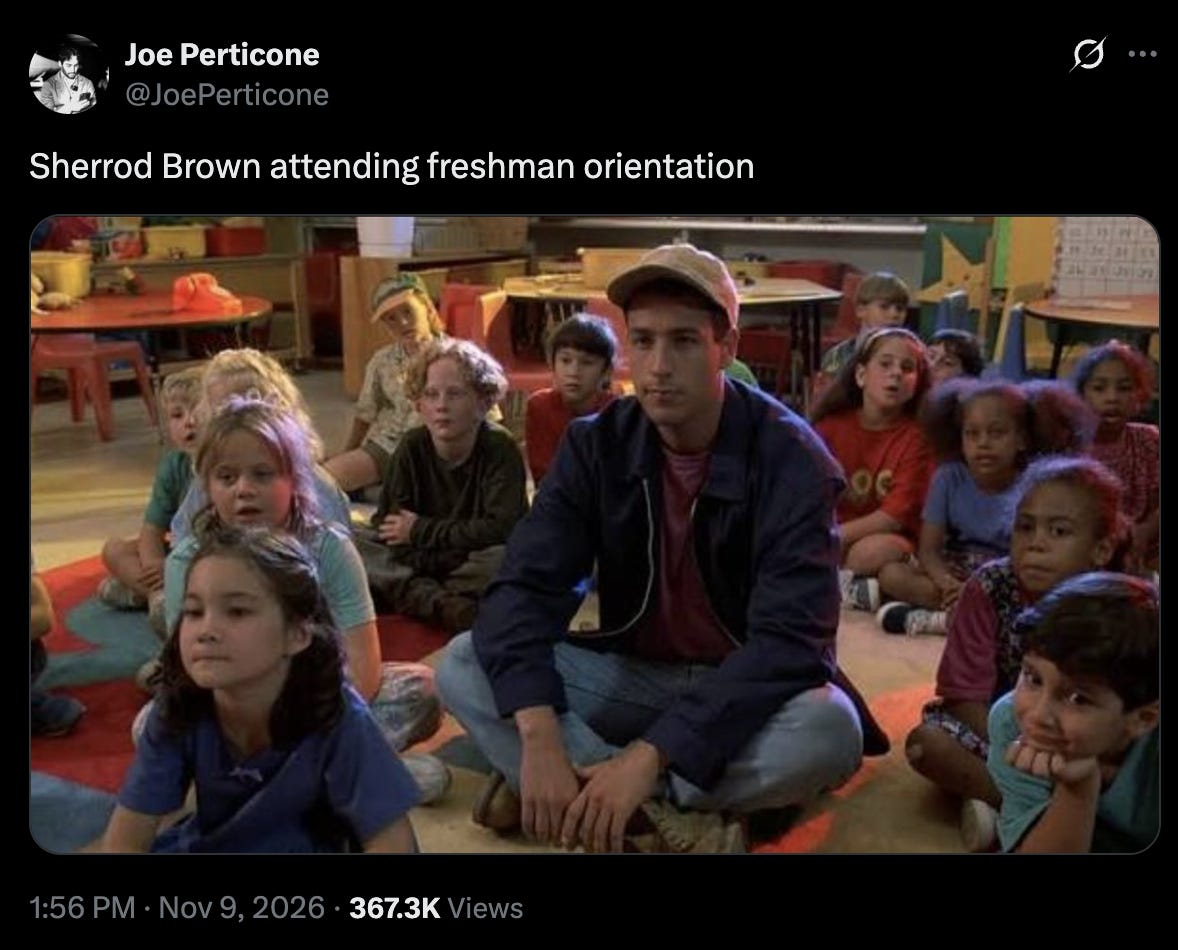
On Monday, Senator-elect Sherrod Brown (D-Ohio) celebrated his 74th birthday. He spent the day in freshman orientation alongside the several other Democrats who triumphed in last Tuesday’s wave elections.

Brown was a bit out of place during these proceedings. He has either run for public office or held it during every election cycle since 1974, when Gerald Ford was in office. That’s a fifty-two-year career in politics, almost two decades of which he has spent as a senator. Perhaps the facilitators threw in some special tips and tricks to help enliven his orientation for the familiar role.

I found the whole situation very amusing. I even posted that Brown must be feeling a bit like Billy Madison:

When I caught up with the new-old senator later in the day on Monday, he told me that people kept sending him my post. As for what it’s like to be the big kid in class, Brown joked, “It’s kinda cool.”

1

I have included in the Republican tally a likely (but still uncalled) win by caucus member Maria Salazar (R-Fla.); she was leading at the time of writing.

2

The Build America Caucus is a newer group with a similar orientation to that of the Problem Solvers; it is also composed of centrist members of both parties. The midterm elections resulted in cuts to its Republican side, too.

3

No Labels is best known for its controversial and ultimately abortive campaign to recruit and run a third-party candidate for president in the 2024 election.

  •  

Dems Aren’t Backing Off Their Own Redistricting Push

(Photo illustration by Bill Kuchman/The Bulwark | Photos: Shutterstock)

TUESDAY’S MASSIVE MIDTERM VICTORIES catapulted Democrats to control of the House, the Senate, governors’ mansions, and state legislatures across the country. But the party isn’t content with the once-in-a-generation shift in its favor. In fact, officials are already pondering ways to win more.

Several Democratic officials have told The Bulwark that they remain committed to carrying on mid-decade redistricting efforts that the party started but put on ice over the past year. Calling it a top agenda item, they characterized it as both an offensive effort to win more House seats and a defensive measure in case Republicans continue to push for redistricting in GOP-controlled states.

The states these officials cited as top targets include

Read more

  •  

My Bar Crawl Through the MAGA Meltdown

(Photo illustration by Bill Kuchman/The Bulwark | Photos: Shutterstock, CNN)

You’ve received a new message from Butterworth’s

Hi Joe, We’re sorry to tell you that we have to cancel your reservation for tonight, Tuesday, November 3. Because of increased security measures around Capitol Hill for Election Night, we’ve decided to adjust our operations for the evening, and we can’t host your party as planned. We know this is short notice, and we’re truly sorry for the inconvenience. We’d love to welcome you back soon. Please reply to this message or book another night on OpenTable, and we’ll make sure you’re well taken care of when you come in. Thank you for understanding, and stay safe tonight. -General Manager, Butterworth’s

This email landed in my inbox shortly before I left The Bulwark’s newsroom on Election Day to begin my walk around town. Although I’d made my reservation at Butterworth’s, the Capitol Hill restaurant known for its MAGA clientele and ownership, weeks in advance, I was getting the boot. I’d only meant to treat the bistro as a pit stop during my busy night navigating watch parties, where I expected to see the horseshoe theory of problem drinking—the converging excesses of celebration and despair—enacted at scale. But I still wanted to know why I’d been preemptively turned away.

Read more

  •  

AOC Quietly Lays the Groundwork

(Photo illustration by Bill Kuchman/The Bulwark | Photos: Getty, Shutterstock)

The future is not set

Dumfries, Virginia
Rep. Alexandria Ocasio-Cortez (D-N.Y.) has been campaigning furiously in the final stretch of this midterm election cycle, visiting states across the union to boost a range of candidates who hope that the charismatic congresswoman’s considerable name I.D. will help them run up the numbers against their Republican opponents. It’s usually helpful for a party star to campaign with others, especially in this attention economy, and Ocasio-Cortez is being a good team player here. But campaigning hard now also positions her well for a potential presidential bid in 2028.

It’s not unusual for a lawmaker with higher ambitions to travel as much as Ocasio-Cortez has done this year. Arizona’s Sen. Mark Kelly, a widely discussed potential presidential candidate from the other side of the Democratic spectrum, has ventured to twenty-three different states this cycle to promote candidates up and down the ballot. For all the talk of factionalism in the Democratic party, most senior Dems are doing a good job maintaining a big tent approach, and Ocasio-Cortez’s final stop bridged the gap between the Democratic Socialists of America and the centrist New Democrat Coalition.

On Friday evening, Ocasio-Cortez showed up to a crowded auditorium in Virginia’s 7th Congressional District—which, according to nonpartisan ratings, is not in much jeopardy—to boost incumbent Democratic Rep. Eugene Vindman.

“We cannot simply hope that voters will return their ballots or get to the polls,” AOC said. “We gotta bring them there. And that’s why all of us have been knocking doors. It’s why I myself have been touring the country. And this is my last stop on the swing.”

Virginia State Delegate Rozia Henson told me Ocasio-Cortez’s presence would likely juice Vindman’s turnout, while also shoring up the congresswoman’s favorability in the state for a theoretical primary campaign in two years. The DNC has scheduled Virginia to vote sixth in the 2028 Democratic presidential primaries, just before Super Tuesday.

“I think it is important [that AOC is in Virginia], because in my district, I represent Route 1 all the way up to Fort Belvoir. There was some concerns with progressive voters and how they felt with [Vindman],” Henson said. “So to have that additional voice just like AOC here, it helps shorten that narrative relating to his votes [in Congress].”

“I thought that from the perception—her being super progressive, socialist, et cetera, et cetera—and him more on the moderate side, to see that collaboration here today makes a difference,” Henson commented. Acknowledging Virginia’s newfound status as an early presidential primary state, he added, “There might be possibilities of what happens next, but we’ll see when that bridge gets here.”1

The fact that Ocasio-Cortez is campaigning in locales home to centrist or moderate voters is a sign of the importance of progressives to the Democratic coalition, said Usamah Andrabi, communications director for Justice Democrats, a leftist organizing group.

“I think the left and progressives are leading this party forward with bold and visionary ideas that voters actually want to see us fight for,” Andrabi told me. “It makes sense that more establishment-aligned candidates are trying to align themselves with those campaigns, candidates, and issues, because they are simply what the people are demanding.”

Part of being in a broad coalition is making a heads-I-win-tails-you-lose bargain with the other factions. If Democrats underperform today, progressives will blame moderates for failing to deliver the radical change that people want, while moderates will blame progressives for poisoning the party’s brand with more moderate voters. If Democrats have lots to celebrate, the credit will shift in equal and opposite directions. And in that case, you can expect to see more candidates like Ocasio-Cortez barnstorming these purple-ish districts in the future.

“We cannot simply exist where our base already exists, right?” Andrabi added. “We’ve had a really successful cycle on the left, and now we have an opportunity to continue growing and organizing working-class communities in these purple and red districts in the South and across the country, because that is the future of building power for working-class communities and for the left.”

Maybe so, but during Friday’s event, Ocasio-Cortez wasn’t spiking the ball for the party’s progressive wing, and actually emphasized the need for a broader appeal and even drew comparisons between herself and Abigail Spanberger, Virginia’s more centrist governor.

“In 2018, your great Governor Abigail Spanberger flipped Virginia’s 7th district. Governor Spanberger and I were elected in the same class, and I had the absolute honor of serving with her,” she said. “It is such a testament to the hard work of your community and everything you did to deliver that victory on a razor-thin margin.”

Things weren’t always so collegial, however. During their time in Congress, Spanberger was part of a bloc of early-career House Democrats who distanced themselves from Ocasio-Cortez and the so-called “Squad” composed of staunch progressives.

After the 2020 elections, Spanberger continued to deride politicians who brand themselves as far-left, an apparent shot at Ocasio-Cortez and her allies in Congress.

“We need to not ever use the word ‘socialist’ or ‘socialism’ ever again,” Spanberger said in 2020. “We lost good members because of that.”

Five years later, though, Ocasio-Cortez and Spanberger found common ground. AOC sent a fundraising appeal for Spanberger’s 2025 gubernatorial campaign, soliciting her large and powerful base to support Spanberger, whom she called “a brawler for the working class.”

Join now

Virginia is a funny place for a high-profile Dem to be campaigning this late in the game—but maybe not for someone who travels as much as AOC does. Ocasio-Cortez released a campaign memo Tuesday, highlighting her campaign stops in pivotal primary states, fundraising prowess, and heavyweight status as a coveted endorser for candidates across the country.

“In the coming days and weeks, much will be discussed about the future of the Democratic Party and 2028. You may be asked whether you support her running for President or for Senate in New York or staying in the House of Representatives,” the memo read. “We’d recommend you rely on the details of this memo and answer that Rep. Ocasio-Cortez will continue to do what she’s always done: look for ways to do the most good for the most people. But, over the course of the last two years, she has proven herself to be one of the most effective voices in the country for America’s working class.”

With the exception of former Transportation Secretary Pete Buttigieg (who travels more than virtually everyone else in the potential 2028 field) and nearby Maryland Gov. Wes Moore, few outside Dems have stumped in the Old Dominion, primarily because Democrats feel confident about their prospects in the state and their exertions are needed elsewhere. The Northern Virginia suburbs were hit hard by the Trump administration’s DOGE agenda, turning some of the state’s metropolitan areas sharply against Republicans—a shift felt in the state’s off-year elections in 2025 in which Democrats significantly overperformed. Polls indicate Virginia is almost certainly poised to continue on that blue trend today.

Looking forward to 2028, Virginia has become especially important for prospective Democratic presidential candidates. Not only is it now an early primary state, but it represents a useful cross-section of the new Democratic coalition: highly educated voters in the sprawling D.C. suburbs, a diverse immigrant community, college students, and black voters. Added to this is the fact that Virginia is close to D.C., making it easy for Washington-based candidates to hop over and campaign while Congress is in session. Virginia will be a busy destination for anyone looking to lock up support early in the next election cycle.

There will no doubt be many Democrats making trips down to Virginia to announce their presidential bids in the near future. But if she decides to jump in, Ocasio-Cortez is already one step ahead.

Share

Hasta la vista, baby

This election cycle brought many surprises. Among them was the return of the sex scandal—or at least sex scandals with real consequences.

After the bipartisan effort to force the Trump administration to make good on its promise to reveal the contents of its files on Jeffrey Epstein, various candidates and public officials found themselves tethered to criminal or otherwise slimy behavior. Candidates across the country have been the target of campaign ads highlighting their ties to the many individuals named in the files, even when there’s been no confirmed wrongdoing.

Beyond that, several candidates in key races have been dogged by allegations of sexual impropriety. After allegations of sexual misconduct against Maine Democratic Senate candidate Graham Platner and California gubernatorial candidate Eric Swalwell emerged, the pressure became so great that each had no choice but to abandon their campaign.

The dynamic is different in the Republican party, where candidates marred by sex-related allegations have maintained a fighting chance, perhaps because of their party leader’s seemingly unequivocal support for accused perverts and philanderers. (And also . . . because of the party leader himself.) Voters, however, may not be as forgiving as the institutional GOP. Candidates with messy personal lives include Texas Senate candidate Ken Paxton, whose affairs and divorce have been well documented; and Rep. Lauren Boebert (R-Colo.), who was kicked out of a performance of the Beetlejuice musical for disruptive behavior that included aggressively sexual PDA with a man, denied rumors of sexual relationships with male and female staffers, and had to address her son Tyler’s child abuse conviction and the separate charges against him of producing and distributing sexually explicit material depicting a minor. On October 23, the Cook Political Report shifted Boebert’s race from “Solid Republican” to “Lean Republican.”

In a similar vein, Rep. Max Miller (R-Ohio) has stayed in his race for Ohio’s 7th Congressional District despite credible allegations of physical and domestic abuse against his ex-wife and daughter. Top Republicans, including House Speaker Mike Johnson and his potential replacement, Rep. Jim Jordan (R-Ohio), have continued to support Miller despite the allegations.

The sex scandals circling over these GOP candidates have not come without some electoral consequence, however. Paxton is at risk of becoming the first Republican to lose a U.S. Senate race in Texas since 1988, despite his and his surrogates’ efforts to paint his Democratic opponent, state Rep. James Talarico, as another kind of deviant.

There’s an obvious difference between the two parties here. The Democratic candidates embroiled in these scandals have been forced from their respective races. The Republican candidates have maintained support despite their personal issues. But voters don’t seem very keen to lend their support. We’ll know in a few days.

Leave a comment

No problemo

All right. It’s Election Day. Once you’ve voted, there’s not much more to do other than to stay vigilant and watch the returns. You can do that by tuning into The Bulwark’s livestream tonight starting at 7 p.m. ET.

But I’d like to make it a little more fun for you. So here are two cocktail recipes to keep yourself refreshed this evening with some patriotic flair.

For the blue cocktail, make a classic negroni, but replace the Campari with some blue curaçao. This is one of the easiest cocktails out there, and it’ll be a bright blue to celebrate a blue wave.

  • 1 oz gin

  • 1 oz sweet vermouth

  • 1 oz blue curaçao

  • A dash of orange bitters

  • Garnish with an orange peel

For the red one, I’d recommend a Kir Royale. It’s an easy twist on a mimosa made by replacing orange juice with a splash of crème de cassis, which adds some bitter flavor turning the standard glass of sparkling white wine a bright red.

  • 4–5 oz of champagne or prosecco

  • 1 splash of crème de cassis

If you end up making either of these cocktails, I’d love to see the results. Send me a picture and a toast over on X or in an Instagram story. I’m @JoePerticone on both platforms.

1

Bridges aren’t known for traveling to specific destinations. But there will certainly be many to cross when the 2028 cycle gets started, however soon that may be.

  •  

Pre-Election Livestream

Sunday night, we went live for a pre-election night broadcast for members featuring Joe Perticone, Andrew Egger, Tim Miller, Sam Stein, Lauren Egan and Jonathan Cohn. The gang covered the latest news in the hottest races and answered questions from members.

Leave a comment

Read more

💾

  •  

Mike Rogers May Have an Imaginary Friend Who Loves Tariffs

(Photo illustration by Bill Kuchman/The Bulwark | Photos: Getty, Shutterstock)

Re-grifter

Mike Rogers, the Republican nominee in Michigan’s Senate race, met a guy. A guy with a story. And the guy’s story, which is about getting more work after his company became more successful, has become Rogers’s favorite story. He loves the story so much, he’s been telling it every chance he gets.

There are just a few problems: When Rogers tells the story, he often presents it as a recent revelation—a conversation he had just a “couple of weeks ago” or “the other day,” even though he’s told the story at least 31 times over the past year and a half. It’s also not exactly clear who Rogers’s guy is, which industry he works in, or if he is actually a composite guy made up of several people. That’s because Rogers’s anecdote changes rather frequently.

The point of Rogers’s story is that Trump’s tariffs have directly made life better for people who work in manufacturing. As Rogers tells it, this guy—who is sometimes several guys or even an entire factory’s worth of guys—has a business that has been able to add a second shift because of increased orders resulting from reshoring, a happy consequence of Trump’s tariffs.

The first recorded instance of Rogers relating the anecdote occurred in May 2025, when, during a local radio interview, he said, “I talked to a guy who is putting on a second shift for the first time in twenty-five years because automobile companies are trying to reshore here in the United States. That’s a win, that’s a win for Michigan.”

Rogers repeated the story later that week in another interview. (In that instance, he mentioned that the guy worked as a “fabricator.”) Over the rest of the summer, Rogers brought up what the guy told him three more times that we were able to find. This makes sense—it’s a great, illustrative story if your goal is to advocate for and defend Trump’s tariff policy, which Rogers has done throughout his Senate campaign.1

During a town hall event in September 2025—four months after initially telling the anecdote—Rogers mentioned it again, but this time, he moved up the timestamp to make it a bit more current.2

“They are starting to repurpose and reshore here in Michigan,” Rogers said. “Talked to a guy just a couple—two weeks ago, adding a second shift. Why? Because the car companies called them and said, ‘Well, I really can’t bring it from China anymore. How about you?’”

Rogers would bring up the second-shift man dozens more times over the following year. But as he did, he started tinkering with more details.

Check out this supercut of the 31 times we found Rogers telling variations of the story:

Read more

  •  

Democrats Get Ready for the Sore-Loser-in-Chief

(Photo illustration by Bill Kuchman/The Bulwark | Photos: Getty, Shutterstock)

Stopping the steal

While it might feel to you as though this year’s midterm elections sneaked up on us, a handful of House Democrats have been preparing for this moment for years. One of the upshots of January 6th and the related attempts to disrupt the certification of Joe Biden’s 2020 presidential win was that congressional Democrats realized they could no longer count on American elections going smoothly. As a result, there is now significant infrastructure to track and respond to election disputes as they arise. Democrats are just hoping that they’re not missing anything.

Multiple lawmakers have expressed concern about the upcoming vote and tried to fortify what they see as vulnerabilities.

“The Department of Justice has been anything other than a bulwark. They’ve been an aggressor, and they continue to try to disrupt and throw, frankly, spaghetti at the wall,” said Rep. Joe Morelle (D-N.Y.). “But I think we’re prepared. I know we’re prepared, and we’re observing and watching every move they make.”

Get Press Pass in your inbox every Tuesday and Thursday

During the past year, the administration has sought to restrict mail-in voting, mused about deploying ICE agents and other federal law enforcement officers to polling locations, and much else. The expected flurry of lawsuits and election challenges is keeping Democrats and local officials up at night.

As I noted last week, Marc Elias, a Democratic election lawyer deeply involved in the party’s planning process to respond to disputes, said he’s expecting the Trump administration to use the same kind of flood-the-zone strategy that the president and his allies used after losing the 2020 election. “Those will be defeated,” Elias said.

Democrats are already working to preempt these anticipated maneuvers, which will put them in a better position to deal with other, less-predictable challenges that might come up on or after Election Day. Trained congressional staffers are being sent to races where Republicans or rogue election officials might try to contest unfavorable results. They are primarily going to serve as observers, taking contemporaneous notes and recording witness accounts that could become useful in court if results are disputed. While Democrats have enlisted nearly three hundred staffers for these roles, where they are ultimately sent will depend on which races have the most problems.

“I think it’ll be an expanded list beyond what we would typically do,” said a senior Democratic staffer on the House Administration Committee. “We could be somewhere between sixty or seventy districts.”

Morelle, who is the ranking Democrat on the House Administration Committee, repeatedly expressed confidence in his team’s ability to prevail over anything the administration throws their way. Over the summer and into the fall, Morelle has led shadow hearings to examine readiness efforts and take stock of resources in high-pressure districts across the United States.

But lawmakers are also feeling a bit nervy about the possibility that the federal government will use intimidation tactics at polling sites and ballot drop-off locations for mail-in voting. And they’re not thinking only about whether ICE agents will show up at polling stations.

Rep. Mark Takano (D-Calif.) told reporters that “ICE being deployed and even visible, even if it’s outside of the 200-foot perimeter” of a polling precinct or high-traffic ballot drop-off location, could intimidate key voter demographics.

“There’s some credible fear among American citizens who may be of Latino descent, who may be of Asian descent,” Takano said. “People might have legitimate fears that they could be apprehended by ICE.”

While voting is underway in many states, the Trump administration has already started to meddle, filing a lawsuit in the Alaska Senate race arguing that voters might not understand the difference between the two Dan Sullivans.1

That’s the argument of a lawsuit filed by the Justice Department, contending that Alaska should delay the certification of its results in the event that incumbent Republican Sen. Dan Sullivan loses the race to Democratic challenger Mary Peltola by a margin less than or equal to the number of votes received by the other Dan Sullivan. A federal judge fast-tracked the suit, which the DSCC and Peltola campaign supported; it could be dismissed later this week.2

Beyond House Democrats’ official efforts to prevent midterms meddling, Democrat-aligned groups like Indivisible are gathering names to mobilize election observers and protesters in key states in case of shenanigans.

While public polling generally indicates Democrats will perform well next week, a blue wave is not a sure thing. Regardless, there are widespread feelings among Dems that major blue victories are imminent, and most Democrats in Congress believe the president and his supporters are reacting to that narrative by preparing to fight to prevent it, however they can, from becoming reality.

Share

Empty parking lots for Mike Rogers

Over the past week, Press Pass has done some revealing reporting on the super PAC formerly known as “Democrats for Mike Rogers.” Our most salient finding is that the organization is not actually made up of Democrats; it’s instead an astroturf operation funded by GOP megadonors and contracting for services from MAGA-connected firms.

On Saturday, the group attempted to definitively show that they are a grassroots operation after all by hosting a get-out-the-vote rally in Detroit. The event featured a rap performance, free food, and a bounce house. Could an astroturf organization do *this*?, they practically dared reporters to ask.

The answer to that question is, Yes. A source passed along pictures of the turnout at this rally/concert/bounce house event, and I in turn am passing them along to you.

I guess the “Democrats for Mike Rogers” were all just out of frame, laughing too.

Leave a comment

Hilton Rewards

Yesterday marked fifty-nine years since former Sen. John McCain’s (R-Ariz.) A-4 Skyhawk crashed over Hanoi, Vietnam. North Vietnamese forces captured him there and tortured him for more than five years.

McCain’s story and his refusal to break despite years of abuse are likely familiar to Press Pass readers, but my favorite account of it can be found in this famous profile of McCain written during the 2000 presidential campaign by David Foster Wallace.

After detailing McCain’s cinematically terrifying descent into a lake, his capture, and the beatings that followed, Wallace prompted readers to think hard about how they might act if, like McCain—the son and grandson of four-star admirals—they were offered the opportunity to return home early in the place of POWs captured before him. In DFW’s vintage style, it’s both serious and hilarious.

Imagine how loudly your most basic, primal self-interest would have cried out to you in that moment, and all the ways you could rationalize accepting the offer. Can you hear it? If so, would you have refused to go? You simply can’t know for sure. None of us can. It’s hard even to imagine the pain and fear in that moment, much less know how you’d react.

But, see, we do know how this man reacted. That he chose to spend four more years there, in a dark box, alone, tapping code on the walls to the others, rather than violate a Code. Maybe he was nuts. But the point is that with McCain it feels like we know, for a proven fact, that he’s capable of devotion to something other, more, than his own self-interest. So that when he says the line in speeches in early February you can feel like maybe it isn’t just more candidate bullshit, that with this guy it’s maybe the truth. Or maybe both the truth and bullshit: the guy does – did – want your vote, after all.

Read the whole campaign trail dispatch from 2000 at Rolling Stone. It’s a long one, so I recommend printing it out for a more comfortable read. (You can also read this story in the pages of Wallace’s essay collection Consider the Lobster, which is worth having on your shelf but can also be found in virtually any American public library.)

1

Or the two Dans Sullivan, if you prefer.

2

The Alaska Supreme Court has already decided that both Sullivans can appear on ballots, and the candidates are labeled in a way that should prevent anyone who can read from becoming confused about which is which.

  •  

Pre-Election Day Livestream This Sunday Night

Tune in: Sunday, November 1 at 8:30 p.m ET for a livestream exclusively for Bulwark+ members featuring Q&A and live chat.

Join us this Sunday for a pre-election night livestream for members featuring Joe Perticone, Andrew Egger, Tim Miller, Sam Stein, Lauren Egan and Jonathan Cohn. The gang will cover the latest news in the hottest races and take your questions.

Leave a comment

Can’t join us live? No problem. We’ll post the show afterwards on the Bulwark Takes feed and on the site.

Read more

  •  

Democrats for Mike Rogers Employs Firm of ‘MAGA Warrior’

(Photo illustration by Bill Kuchman/The Bulwark | Photos: Shutterstock, Getty)

THE SUPER PAC FORMERLY KNOWN as “Democrats for Mike Rogers” might be aiming its efforts at recruiting Dems to defeat Abdul El-Sayed in the Michigan Senate race. But according to their latest FEC filings, the group’s funds are coming almost entirely from deep-pocketed Republican donors.

In Tuesday’s edition of Press Pass, we wrote about the group’s predominantly Republican contributors as well as payments the group made to an ex-Democrat who did not disclose her relationship to the organization while appearing on Fox News to promote Rogers.

Only a few of the group’s donors had been recorded in the FEC’s database at that point. But now, a lot more information has come in. The latest batch of Federal Election Commission filings show that many of the high-dollar donors to TFM—Democrats for Mike Rogers’s currently operating name—are simply longtime Republican megadonors. I suppose ‘Republicans Seeking Democrats for Mike Rogers’ just wouldn’t look as compelling on a lawn sign.

Richard Bassuk, a real estate executive from New York City, has a typical TFM donor profile. In addition to the $15,000 he sent the group, he also donated $1,000 to Susan Collins’s re-election bid, $3,500 to Sen. John Cornyn (R-Texas), $3,300 to House Speaker Mike Johnson, and $3,500 to the American Israel Public Affairs Committee (AIPAC), which was specifically earmarked to support the campaign of Rep. David Valadao (R-Calif.), one of the House GOP’s most vulnerable incumbents. Bassuk also contributed $125,000 to the United Democracy Project, which is affiliated with AIPAC and has spent more than $20 million attacking Rogers’s Democratic opponent, El-Sayed. Bassuk has donated to many other Republicans, as well.

Support our independent political journalism and catch scoops like this right in your inbox by signing up for a free or paid Bulwark subscription.

Another TFM donor, Fanny Hanono, has also contributed to Collins’s campaign, and she opened up her pocketbook to support Florida Republican Reps. Randy Fine and Maria Salazar. (During the Senate primary in Michigan, she also sent some money to El-Sayed’s moderate Democratic opponent, Haley Stevens.) And in addition to the $100,000 he sent to TFM, Anthony Soave has given to the National Republican Senatorial Committee (NRSC), House Republican Conference Chairwoman Lisa McClain (R-Mich.), and JD Vance’s 2022 Senate campaign.

Other donors, such as David Jacques Farahi and Steven Kimmelman, have contributed to a mix of Republicans and Democrats in the current election cycle and past cycles.

One of the most high-profile donors to TFM is Maria Letica Saad, who over the past couple years has given $100,000 to the NRSC, in addition to making donations to Turning Point USA’s PAC and a host of other Republican candidates. The single corporate donation to TFM came from Penske, a transportation services company headquartered in Michigan, which contributed $250,000. Penske’s past donations include a half-million-dollar gift to the GOP-aligned Senate Leadership Fund.

Just three of the individual donors reside in Michigan. All three have lengthy histories of financially supporting GOP candidates and causes. The first is Soave; the other two are Alan Zekelman and Eric Bronstein, who donated $1,000 to embattled Rep. Max Miller (R-Ohio) in May.

With all these Republican donations coming in, you might wonder what TFM is doing with their newfound largesse.

One such expenditure includes paying for legal consulting from Lex Politica, a Texas-based firm founded by Chris Gober. Gober is currently running for Congress in Texas’s 10th Congressional District on the strength of an endorsement from President Donald Trump, who called him a “MAGA warrior.” Gober has several other right-wing campaigns and causes on his firm’s client roster. They include Elon Musk, Sen. Ted Cruz (R-Texas), Texas Senate candidate Ken Paxton, and Republicans who were investigated for election subversion in 2020. Other partners at Lex Politica have resumes that span the Republican political ecosystem. Among them is Jessica Furst Johnson, who lists on her X profile current or past associations with the Republican Governors Association, the National Republican Congressional Committee, and the National Republican Senatorial Committee.

Astroturf organizations that advertise themselves as bravely crossing party lines are hardly a novel concept. But TFM is decidedly a Republican-fueled operation.

Thanks for reading! This post is public so feel free to share it.

Share

  •  

To Motivate Base, GOP Cites Ancient Fear: France

Photo Illustration by Sarah Rogers/The Bulwark | Photos Getty, Shutterstock

Euro tripping

Republicans are attempting to rally their dispirited political base with a bit of imported esprit. Widely broadcast scenes of rioting in France have given Republicans a new stockpile of violent imagery that they are attempting to associate with the Democratic slate of candidates for the House and Senate this election cycle.

Read more

  •  

These Michigan ‘Democrats’ Come With Republican Financing

(Photo illustration by Bill Kuchman/The Bulwark | Photos: Shutterstock)

Wait a minute, Doc. Are you telling me you built a Democratic PAC out of Republicans?

The “Democrats for Mike Rogers” PAC, which recently rebranded as “Together for Michigan” (TFM), has a straightforward pitch: It represents the interests of, well, Democrats who support Republican Senate candidate Mike Rogers.

The group launched to much fanfare after Abdul El-Sayed won the Democratic primary, playing up the idea that he would be undone in the general election because his candidacy would fracture the Democratic coalition. But the PAC’s latest Federal Election Commission filings indicate that, notwithstanding its original name or its primary political theme, the operation is predominantly Republican-backed.

The group’s two biggest donations came from GLCF, Inc. (Great Lakes Conservatives Fund) and American Unity PAC, which donated $50,000 and $25,000 to the PAC, respectively. GLCF is a super PAC dedicated to supporting conservatives, and it has already spent a lot of money to run pro-Rogers ads this cycle. American Unity PAC’s stated mission is “focused exclusively on protecting and promoting Republican candidates for U.S. Congress who support freedom for all Americans, including people of faith and the LGBT community.”

TFM’s roster of individual, non-organizational donors is rather short—and the filing it made with the FEC likely does not cover the donations and expenditures it made when it was operating previously as Democrats for Mike Rogers. But of the four people TFM did list as having donated, several have a history of Republican support.

Get Press Pass in your inbox every Tuesday and Thursday

Michael Sandler, a donor based in Michigan, contributed $1,000 to TFM. While Sandler has donated to several Democratic campaigns, he’s also contributed to Rep. Mariannette Miller-Meeks, one of the most vulnerable Republican House candidates this election cycle.

A $2,500 donation from William Orgel, a donor from Tennessee, fits a pattern of Republican contributions: Orgel gave thousands to Republican Sen. Bill Hagerty’s campaign, as well as Nikki Haley’s 2024 presidential campaign.

Fellow Tennessean Corey Trotz contributed a few hundred dollars to TFM in September; his mix of past support for the campaigns of members of both parties includes a donation to former Republican Rep. Steve Fincher in 2009.

TFM’s treasurer is Karen Whitsett, a conservative-coded former Democrat in the state legislature who campaigned alongside Rogers at a Democrats for Mike Rogers event last month, before the PAC’s name was changed.

TFM has spent nearly $5 million in either support for Rogers or opposition to El-Sayed, according to their annual expenditure totals. The group has also paid $30,000 to former Pontiac, Michigan council member Melanie Rutherford for “Grassroots Consulting” services. Two weeks after receiving those payments, Rutherford appeared on Fox News, touting Rogers and attacking El-Sayed—a clip that was amplified by numerous MAGA accounts. During the segment, it was never disclosed that she had received those payments.

On X, the Democrats for Mike Rogers account regularly bashes Democratic Senate candidate Abdul El-Sayed, posting that he is “endorsed by the enemies of America,” that El-Sayed “would be Senator for U.S.-designated terrorist groups,” and that he “hates Black Michiganders.”

If those sound eerily familiar to the Republican attack lines against El-Sayed, well, now you have a good idea why.

Share

I’ve seen this one. This is a classic.

Despite the Trump administration’s repeated efforts to undermine the security of American elections (to say nothing of what this president did last time an election didn’t go his way), the Democrats tasked with shoring up the legal protections in advance of next month’s midterms are confident that the elections will go smoothly. There are a few reasons for that.

In a call with reporters Monday, Rep. Joe Morelle (D-N.Y.), who is leading House Democrats’ election security agenda, said that after identifying a wide range of threats, Democrats have headed off a number of them, but many still remain active.

“I will say we started with about 150 threats,” Morelle said. “We’re down to about 70 because threats keep getting taken off the board. We talked about the postal service and [Trump’s] efforts to stop mail-in balloting—that’s gone away.”

Morelle’s confidence in the integrity of voting by mail isn’t something he shares with everyone in the party right now, but the courts have offered some reassurance in recent weeks.

“[Trump’s] efforts to try to invoke the SAVE Act and the SAVE America Act—those haven’t happened,” Morelle added. None of the several competing versions of the SAVE (America) Act passed.

Morelle also mentioned a post–Election Day strategy meant to make sure electoral processes remain fair and transparent through the first day of the new Congress on Sunday, January 3, 2027.

Morelle explained he has enlisted around 270 Democratic congressional staffers to function as election observers. They are being trained to take notes and provide evidence backups in the event of tampering.

“I will send them all across the country. They will be in their official capacities to be able to observe counts and recounts, to take firsthand accounts,” Morelle said of the House staffers. “We want contemporaneous notes should there be a challenge or a contest for anyone and we have to, in the Committee on House Administration, make a recommendation to the House about who to seat. But we’re on it.”

On the legal front, Democrats are preparing for the possibility of MAGA-related scheming to affect between forty and sixty of the more consequential congressional races. As Democrats have beefed up their legal rapid response and decided where to invest resources, they’ve had to put some thought into determining where local officials might engage in the kinds of election subversion that occurred in some precincts in 2020.

“Obviously, there are a lot of very good election officials, but there are also the Tina Peterses of the world,” said Marc Elias, a Democratic election attorney, referring to the Colorado elections clerk convicted of crimes related to her shenanigans trying to prove 2020 election conspiracy theories. (Her sentence was commuted by Colorado Gov. Jared Polis in May following a pressure campaign from Trump.) “There are also the bad election officials,” Elias said.

The attorney recalled the legal fights that followed the 2020 presidential election, when Trump used any ready-to-hand conspiracy theory or election-denying narrative he could find to make his case, and much of the Republican party felt bound to follow his lead. Elias expects a similar pattern to take shape if this year’s midterms result in overwhelmingly Democratic victories.

“I think that Donald Trump collects optionality of what he may find useful at any time, and then he sort of progresses through from the least preposterous to the most preposterous, and loses, right?” Elias said. “And that’s what we saw in 2020 when I was representing President Biden. We saw a series of cases in the days after the election—we won those—and then the cases got more and more preposterous, and then ultimately escalated to violence on January 6th.”

“So, I’m not saying there’s going to be violence,” Elias clarified. He added:

I do think, though, that we will see this escalation afterwards from the counties and what they can try to do there. Those will be defeated, but there’ll be a lot of activity, I suspect, and then they may try to create an uber-narrative around non-citizen voting that they use to argue that states shouldn’t certify results, that people shouldn’t get certificates of election at the state level . . . and then, ultimately, whether they take those to the floor and whether they take those to election contests under the Federal Contested Election Act—we’ll see.

Current polling strongly suggests the 2026 midterm elections could go very well indeed for Democrats. Trump and his administration have been seeking to preemptively undermine the results to maintain their power in Congress, but the House Democrats believe they are well positioned to prevent any further tampering or scheming that could compromise the results. In a particularly consequential-feeling election cycle, they hope they aren’t missing anything.

Leave a comment

This is heavy… denim

While other American industries have recently contracted largely as a result of Trump’s tariffs or his continuing elective war with Iran, there are signs of hope within one industry in particular—one that once fostered and then neglected one of our nation’s greatest inventions.

That invention, of course, is American selvedge denim. We haven’t produced it at scale domestically for years. But a new factory is now up and running, and fans of high-quality jeans across the nation have greeted this news as a beacon of light in a dark time.

Jeremy Freed writes:

In early November last year, Mount Vernon Mills, a 180-year old fabric mill and America’s largest denim producer, posted an Instagram video of a semi truck backed into a loading bay, its cargo shrouded in a white plastic sheet. The video, set to the opening chords of AC/DC’s “Hell’s Bells,” didn’t reveal much, but for those attuned to the fate of American-made selvedge over the last few years, it marked a major milestone. Under that white sheet was one of 40-some Draper X3 looms salvaged from the legendary Cone White Oak denim mill in Greensboro, North Carolina. To those who worship at the altar of 20th century workwear, it represented nothing less than the salvation of American denim. A little less than a year later, that machine and 20 others like it are up and running, fabric samples are being shipped to clothing brands across the country, and a new chapter in a 120-year story is beginning.

To be clear, the reopening of a single stateside denim factory is not going to make the slightest difference in the larger economic outlook of the United States, which remains dim. But the Mount Vernon Mills story shows that at least some Americans still crave strong craftsmanship enough to be willing to pay extra to support production on U.S. soil. That’s objectively a good thing.

Read the whole article.

Share

  •  
❌