Login
Login
What 29 US states suing Meta got wrong, or completely forgot
Two days ago, a child privacy trial that BBC says may be the biggest threat yet to Instagram and Facebook started in the US.
As usual: If you like what you find here, thanks in advance for your subscription (possibly but not necessarily paid) or, even better, one-time donations for any amount, or consulting, writing or speaking work.
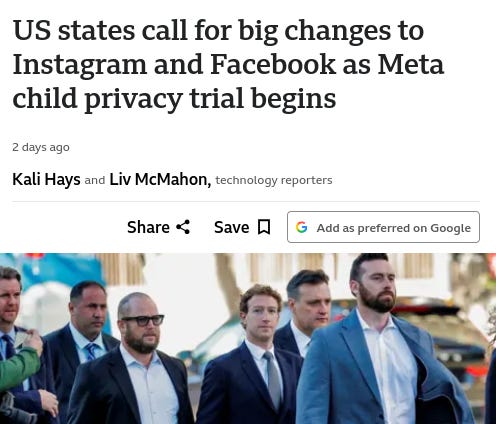
According to that article, the 29 US states suing Meta, the company that owns Instagram, Facebook, WhatsApp and other stuff, want it to give up most of what being on social media is today. Namely, those states demand that Meta:
removes “like” counts
removes infinite scroll
implements a process of parental verification for teenage users
changes Meta’s “dopamine-manipulating recommendation algorithms”
removes many image filters that change one’s appearance in photos
removes autoplay of video content
removes creation of multiple accounts
removes disappearing or “ephemeral” posts, such as Instagram Stories
What’s right in that list
Almost everything in that list is good. After decades, it would take an incredible amount of naivety to not see the huge negative effects of certain “features” on public mental health and political discourse. Because, no matter how the lawsuit is worded, it has nothing to do with children, nothing at all: all those features are stuff that makes almost all adults more lonely, more stressed and at the same time more convinced of their intrinsic superiority.
So that list is almost perfect, and enforcing it is long overdue... except, if it is complete, two points that shouldn’t be there at all, not in that form at least, and two others that should be there before everything else, because they would greatly reduce the effects of all the negative features.
What shouldn’t be there
The first demand in that list that, as a minimum, is very badly explained and misdirected, is the third one:
“implement a process of parental verification for teenage users”
In general, “parental verification” of what a minor does is a no-brainer, right? What are parents for, if they don’t (also) verify what their kids do? Point is, how can social media set this up for parents, without implementing mandatory age verification for everybody online? But if that is what that the lawsuit wants (by all means correct me if I got it wrong!), why on Earth they did it?
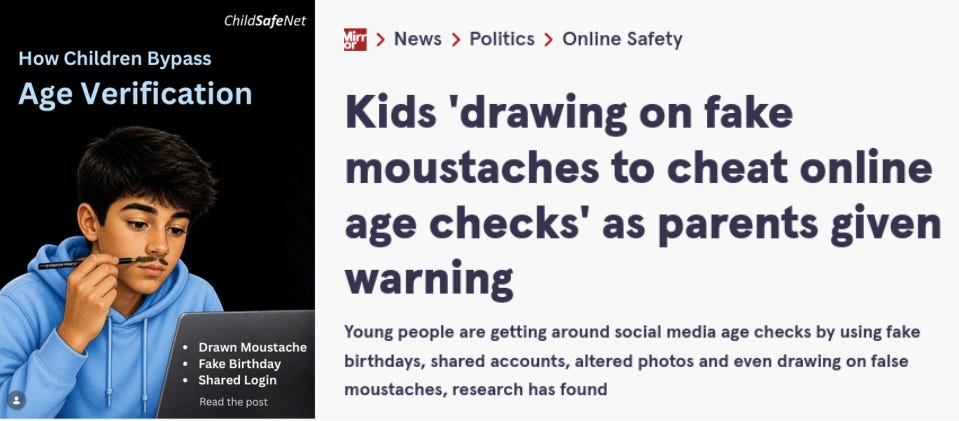
Why demand something that, really unsurprisingly, has been found almost useless in the champion country of online age verification, Australia, multiple times including... the day before that US trial started?
But never mind Australia: why demand something that is infinitely more complicated, expensive and full of harmful side effects than the ONLY “age verification” that would actually work in the real world? Seriously, why? What’s the real point of that lawsuit, helping parents to do the one right thing, or just helping US Big Tech to spend money?
The other demand that shouldn’t be there is the seventh:
“remove creation of multiple accounts”
Having multiple accounts should be recommended and almost mandatory, not forbidden. The possibility of keeping interactions with friends, family, work and public discussions as separate as possible is necessary both for mental health, both individual and public. Only people who never really grew up like Zuckerberg can argue in good faith that “having two identities for yourself is an example of a lack of integrity”. Quoting myself, “since the dawn of society, individuals have been able to pursue happyness, or at least function decently, also thanks to the possibility to act and feel differently in different contexts. Family, friends, workplace, church, amateur football team, volunteering... The way we behave and expect to be treated by others needs not to be the same in all those contexts. Actually, it needs to not be the same. “.
You may argue that this should apply to adults only, not children, and you may be right. Luckily, we don’t need to argue over this, because the right way to protect children from online dangers has nothing to do with numbers of accounts.
What’s missing: going back to the future

Do you still remember or, depending on your age: did you ever know that, as far as communication goes, the pre-digital era was much more advanced than this one? Back then, everybody could write or talk with everybody else blissfully ignoring which kind of social media platform they were using, for one and one reason only: all the social media platforms of the time, i.e. all the brands of paper, pens and fixed phones were 100% compatible with each other.
In those times so technologically advanced that they really feel science-fiction now, had someone tried to market any kind of paper, pen or phone, whose “content” would be readable or hearable only by people having the same brands of paper, pen or phone whould have been rightfully treated as a complete moron.
Now, instead, you need Instagram to interact with Instagram users, Facebook for Facebook users, TikTok for TikTok, Twitter for Twitter and so on, while the only really interoperable digital system that still resists, email, is snobbed just by the generations supposed to be more digitally competent. Is 2026 really, really backwards and primitive, or what?
Going back to a future that makes sense is possible, and really easy. All it takes is courts forcing adversarial interoperability and mandatory RSS feeds for every social media platform. If you have no clue about what those two things mean, don’t worry, they are real easy:
RSS feeds are a 100% open system, available since 2001, to get “all the latest news from as many sources you want in one window, on your schedule, and without intermediaries and the endless centralized tracking of social media” (continues here). If social media were forced to let you see your own timeline in RSS format, you could read it with dozens of programs that already exist, on any digital device. You would, that is, get all the good of logging on Facebook, or any other social media, without all the downsides. And the platform shouldn’t change a thing, except add support for a really simple, universally known standards.
Indeed, RSS is so beneficial that every website, not just social media, should be forced by law to publish its RSS feed in every page, to give you the same reading convenience. As far as that trial goes, Meta’s fines should be used to run huge educational campaigns that encourage everybody to get all their online “news”, from holiday pictures from relatives to world-shaking events, via RSS feeds.
Adversarial interoperability is the full solution for social media of which RSS, as good as it is, only is the easiest implementation of the “reading”, that is passive half. This apparently obscure term simply means that Facebook, Instagram or anybody else cannot force you to only use their websites or mobile apps to see other users posts, or write your owns. They must let every third party developers free to create alternative apps that do the same, and you to use them, in the ways and with the feature set that work better for you. Seriously, adversarial interoperability is the same thing that makes calling an iPhone user with an Android phone (still) work, nothing more.
You have always had adversarial interoperability for writing on paper and traditional phone calls, and you are 1000% entitled to have it even for digital services. After free speech and privacy, adversarial interoperability isn’t just the biggest digital right you have: it’s the easiest to get by far, if you just demand it. And when I say easy, I mean “so easy that reading and writing your own Facebook wall without using the Facebook app or website was possible fourteen years ago (1):

until Facebook, to keep people locked inside their cage, removed that interface with impunity because no regulator was honest or competent enough to object.
Add those two people-liberating points to the list of demands for that trial, educate people (especially parents!) to use them, and half the harm done by infinite scroll, “likes” and so on to children and adults alike will vanish, even if the features remain.
Then again... why still bother with social media?
Trials like that one are sorely due for Meta and similar companies, and I do hope they get from them so much financial pain and enough obligations to change to become unrecognizable. For better or for worse, however, social media are yesterday’s battle, as I wrote last February and repeated two weeks ago. The sooner new trials start to fine and limit AI abuses on children and everybody else, the better. In the meantime, THE only child protection that doesn’t simply work for real, but is immediately applicable at no cost, remains the same: no smartphones before 16, period.
I say fourteen years because I myself wrote in February 2012, for the now defunct TechRepublic website, the tutorial from which the last screenshot comes from. Later explanations of the same procedure are still online however, here and here.