Reading view

Democrats’ key to winning the midterms

American voters desperately want relief from rising prices — especially the increasingly unaffordable cost of healthcare. Democrats have a plan for that.

Massachusetts Sen. Elizabeth Warren recently introduced the Break Up Big Medicine Act with Sen. Josh Hawley, R-Mo., a bill that would split up the huge conglomerates that have made the current healthcare system so expensive and frustrating to navigate. Businessman Mark Cuban recently quipped that breaking up these near-monopolies could bring costs down by 40%.

If Democrats run on this healthcare affordability agenda, we stand a good chance of flipping not just the House, but the Senate too.

Insurers like UnitedHealth or Cigna don’t just sell coverage. They’ve consolidated power over virtually every part of our healthcare system, operating hospitals, clinics and pharmacy networks. And they use that control to generate billions in profits — by pushing patients toward care at the facilities they control.

UnitedHealth Group, for example, generates about 40% of its revenue — about $180 billion — from transactions between its thousands of subsidiaries. Its insurance branch steers patients to its roughly 90,000 affiliated doctors, and pressures those physicians to refer patients to its affiliated hospitals and clinics rather than lower-cost independent providers. And that’s not all. The company’s pharmacy benefit manager (PBM) arm pushes patients to affiliated pharmacies. Those pharmacies frequently upcharge patients for medicines, sometimes by 10 times the acquisition cost.

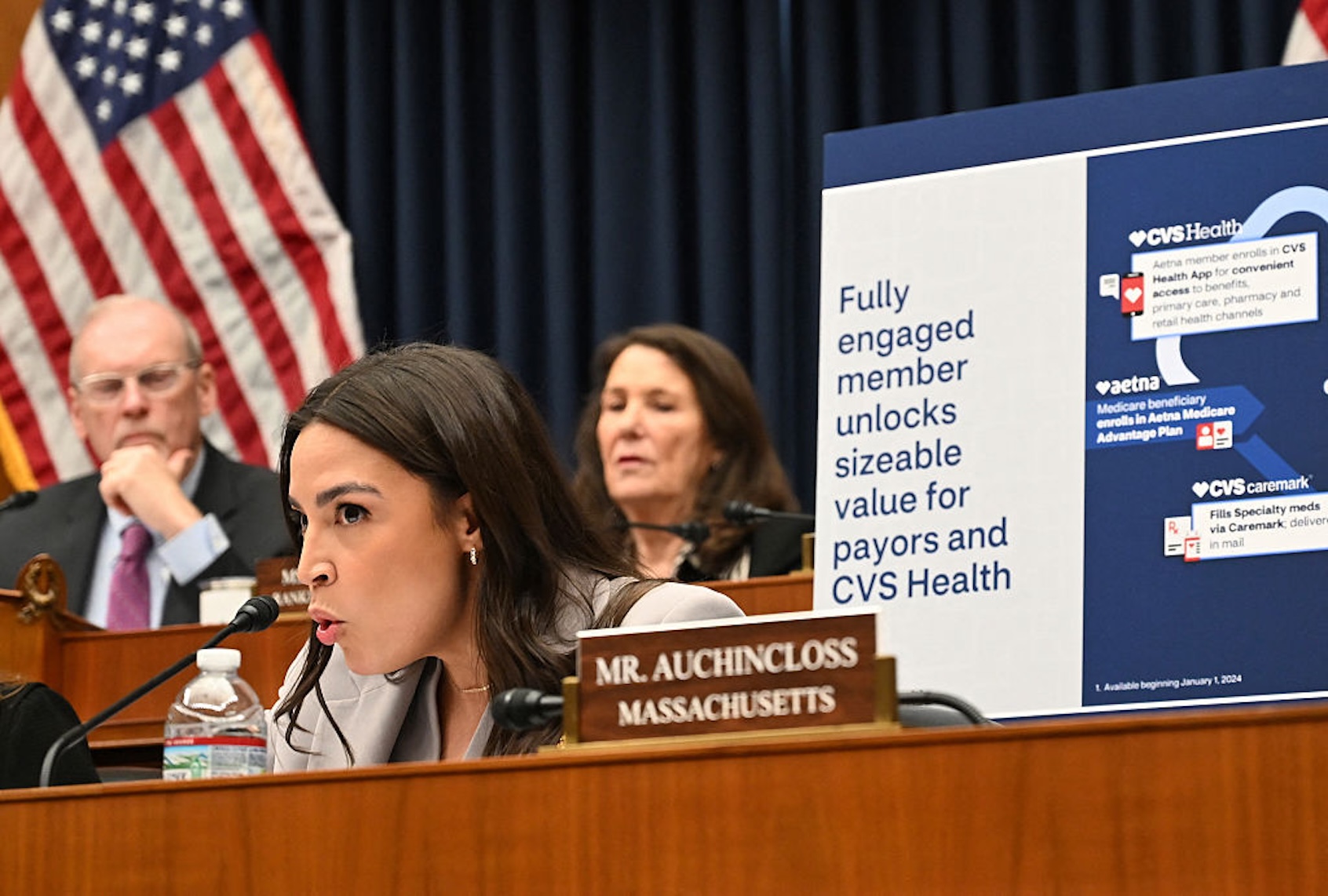
UnitedHealth Group is the largest of these conglomerates, but it’s hardly the only firm that operates this way. CVS Health owns Aetna, one of the nation’s largest insurers, in addition to the more than 9,000 CVS pharmacies it’s best known for. It also owns CVS Caremark, one of the nation’s largest PBM.

In theory, PBMs exist to save employers money by overseeing all the drug-related details of health insurance plans, and using their bulk-buying power to negotiate with pharmaceutical companies for big discounts and rebates. PBMs often tell employers that they pass along all the discounts and rebates they receive to the employer, minus a small fee for their services.


Start your day with essential news from Salon.
Sign up for our free morning newsletter, Crash Course.


What they typically don’t mention is that many PBMs are affiliated with foreign-based entities called “group purchasing organizations.” In 2025, the House Oversight Committee launched an investigation into whether PBMs are using these overseas entities to skirt government oversight. Lawmakers have raised concerns that these arrangements allow PBMs to retain rebate-related revenue and fees within opaque corporate structures, rather than transparently passing those savings on to employers and patients.

Meanwhile, insurers continually deny coverage for treatments and procedures that patients need. They often force doctors to get insurer approval — known as prior authorization — before prescribing, or they force patients onto less effective drugs. That places an immense administrative burden on physicians, who can spend an average of 12 hours per week completing prior authorizations, time that they’d certainly rather spend with patients.

Prior authorization can have dire consequences for patients. More than eight in 10 patients that face prior authorization simply give up on treatment. About a quarter of doctors say that prior authorization delays have led to a serious adverse event for a patient in their care — whether that’s hospitalization, permanent damage or death.

Breaking up the healthcare conglomerates that have enriched themselves by immiserating patients and cheating employers is good policy.

Polls show that voters overwhelmingly support bold healthcare reform. According to a recent poll, nearly seven in ten insured Americans identified either lowering out-of-pocket costs or nixing prior authorization as the single most important change they want from their health insurance. It would be a mistake for Democrats to content themselves with merely tweaking the Inflation Reduction Act, the party’s last major healthcare reform, which primarily focused on reducing the federal government’s pharmaceutical spending.

That kind of incrementalism won’t work — Democrats cannot win by being Republican-lite. We need to target the insurer and PBM practices that directly drive up Americans’ out-of-pocket costs and force too many people to choose between filling their prescriptions and filling their gas tanks.

If Democrats are looking for a 50-state strategy for the midterms — something I insisted on as chair of the Democratic National Committee during the 2006 blue wave — Sen. Warren’s bill offers a great place to start.

The post Democrats’ key to winning the midterms appeared first on Salon.com.
  •  

Immigration crackdown cripples America’s caregiving industry

Caregivers in the U.S. are paid just under $26,000 a year on average for the most important work there is. And this June, we learned the government drew up a plan to mark many of them dead.

Let’s back up: When someone who receives Social Security dies, the government owes nothing for the month of the death, even if she lived to its final day. Benefits run a month behind, so her last payment lands after she’s gone, and the bank is told to send it back. We have a system that can find a dead woman’s last dollar and claw it back inside a month. It’s made to ignore the living woman who bathed her, fed her, and sat with her at the end.

And now we know just how little this government values her.

Last month, The Washington Post reported on a whistleblower disclosure from senior Social Security Administration executive Jeremiah Schofield, filed with Sens. Elizabeth Warren, D-Mass. and Richard Blumenthal, D-Conn. It describes a plan, devised by Elon Musk’s DOGE and the Department of Homeland Security, to enter nearly 2.7 million living immigrants into the Social Security Administration’s Death Master File, the database used by banks, employers and agencies to confirm who has died. To be marked dead is to be severed from wages, banking and all social benefits.

That was the point: make immigrants miserable enough to self-deport. Two memos reportedly from then-Homeland Security Secretary Kristi Noem to the acting Social Security Commissioner, Leland Dudek, waved off the legal warnings, the disclosure says, stating “death is a state of ineligibility.” It didn’t matter that the people were alive.

The agency says the plan wasn’t carried out. But roughly 6,000 immigrants were marked dead last year, some of whom had to walk into a government office and prove they were still breathing. And when they did, Immigration and Custom Enforcement was there waiting to arrest them.

Even without the fear that this stunt evoked, aides and the night nurses are already leaving — their protections revoked, status in question — but the need for them isn’t shrinking. Over the next decade, the U.S. will have 10 million openings in direct care. We’ll squeeze this need into the margins.

Even without the fear that this stunt evoked, aides and the night nurses are already leaving — their protections revoked, status in question — but the need for them isn’t shrinking.

The care crisis will be intensified by the Supreme Court’s June 25 ruling in Mullin v. Doe, which clears the way to revoke the Temporary Protected Status of roughly 350,000 Haitians and 6,000 Syrians by July 10. This decision has been covered as a healthcare-staffing crisis, and it is that. But that is smaller than the truth: This will be a whole-lifespan problem, as the same workforce holds up both ends of American caregiving, elder care and childcare.

The PHI, a national research organization for the direct-care workforce, has already warned that without immigrant care workers, family caregivers will be forced to leave the workforce or cut their hours to fill the gap. That loss lands hardest on women across every sector and level of the workforce — caregiving is already the number one reason women voluntarily leave their jobs, cited by 42% of those who quit, according to Catalyst research — at a moment when women’s declining labor force participation is already draining the U.S. economy to the tune of an estimated $650 billion a year, or 2.9% of GDP.

New York and Massachusetts sit among the states with the most engaged care policy in the country. Florida and Ohio sit near the opposite end of that spectrum. It hardly matters. Take the caregivers out, and all four states end up in the same place: families with no one to turn to. No state legislates its way out of this loss. Without a caregiver, there is no care. Hard stop.


Start your day with essential news from Salon.
Sign up for our free morning newsletter, Crash Course.


In much of East Asia, however, shaped by Confucian ideals of filial duty, and in Latino families bound by familismo, tending to the old and the dying is a calling claimed with pride. In the Philippines, which sends caregivers to the whole world, the work is a point of honor.

Other societies put public money in the place of reverence. The Netherlands has covered long-term care under universal insurance since 1968 and now devotes more of its GDP to it, about 4%, than any country tracked by the Organization for Economic Cooperation and Development. Sweden, Norway and Denmark similarly fund it as a public good, not a private scramble.

In Japan, the two meet. A Confucian, deeply familial culture, it wrote care into law, requiring every citizen over 40 to carry long-term care insurance, and spending, in 2020, 67% more of its economy on that care than we did. Reverence and infrastructure, together.

The U.S. managed neither. We file care work under menial; overwhelmingly staff it with women, people of color, and immigrants; and pay as if they could feed their families on the sheer joy of being useful.

The reverence born in other countries arrives here, carried by the first generation, and finds nothing to hold onto: no paid leave, no funded care, no status, no relief. If it survives, it does so against the steady pull of a country that degrades and ignores caregiving. The further individuals get from arrival, the easier it becomes to forget cultural standards. That is not immigrants shedding their values. It is a country that imports devotion and budgets nothing to keep it alive.

And now we are chasing away the immigrants.

One in five of the people caring for our children are immigrants — more than 40% in New York City, half in LA — more than half of whom are not citizens. When these hands go, the need remains. Intense work lands on the daughter, the wife, the sister, who absorbs the collapse, on top of her own life and career, uncompensated. It lands on the Panini Generation, pressed between aging parents and young children without paid leave or reprieve.

That daughter is often the one the family was proudest to send away. Education carries a woman farther from home — two to three times farther from her family, research finds, than her less-schooled peers. In her memoir, “My Life In Full,” Indra Nooyi, who left her parents in India to ultimately run PepsiCo, wrote that her mother raised her with “one foot on the accelerator and one on the brake, to go succeed and then come back to family.”

So, we lose. We lose in our communities, as neighbors disappear and businesses shutter with a workforce afraid to show. We lose in our homes, where we need those extra, loving hands. We lose in our accounts, drained by the care no one will fund. We lose in our companies, as women leave when caregiving can’t be negotiated. We lose in our relationships. We lose our people. And then, we reach our melting point and quietly lose ourselves.

The U.S. machine can find the dead and reclaim their last dollar inside a month. It purposefully leaves destitute the people who rocked, fed, bathed, lifted and bury us. Whose hands have caught everything this country dropped and asked almost nothing back. That’s what they get — and we lose.

The post Immigration crackdown cripples America’s caregiving industry appeared first on Salon.com.

  •  
❌