Reading view

Meloni, Frederiksen unite to condemn ‘uncontrolled immigration’ after Ceuta crisis

Right-wing Italian Prime Minister Giorgia Meloni and center-left Danish Prime Minister Mette Frederiksen on Monday reiterated their push to combat illegal migration after thousands of unauthorized migrants surged into Spanish exclave Ceuta in late July.

“We are aware that many might be wondering about our cooperation. We come from very different political backgrounds, and we certainly do not agree on everything,” Meloni posted in a “joint message” on Facebook, sharing an archival photo of herself and Frederiksen.

“We do not accept uncontrolled immigration to Europe, and we have promoted a strict immigration policy, both in our Nations and in Europe,” the statement continued.

In response to the Ceuta crisis, which reignited Europe’s long-running debate on illegal migration, Denmark and Italy had sent a joint letter to the European Commission demanding immediate action at the EU’s external borders. The letter was co-signed by 20 other European heads of state and government.

Italy has since been one of the harshest critics of Spain’s left-wing government and its migration policies, with Rome announcing border controls for travelers arriving from Spain on Friday.

Meloni and Frederiksen argued that the adverse effects of illegal migration — “rising crime rates, growing pressure on public services, and an erosion of citizens’ trust” — were indisputable.

“For too long, ordinary people … have paid too high a price because of uncontrolled immigration,” they said.

“We are both proud of Europe’s Christian cultural heritage and want to protect it. We expect those who come to our countries and choose to make Europe their home to respect our values and not seek to impose ways of life on us that we do not share,” they said.

  •  

A new rival is forcing Italy’s Meloni back to her far-right roots

PISA, Italy — Giorgia Meloni doesn’t want to be beaten at her own game.

With an election approaching next year and a new far-right rival emerging, the Italian prime minister — whose political origins lie in Italy’s post-fascist right — is putting aside the moderate image she has built over her four years in office and hardening her tone on migration and security.

Meloni’s government was the first in the EU to attack the Spanish government over a sudden influx of migrants from Morocco into the Spanish exclave of Ceuta last week. 

While France and other countries tightened border checks, Italy went further and announced it had suspended the EU’s free-movement Schengen agreement with Madrid. Now, in Italian airports, passengers from Spain are asked to join a different line. 

Meloni’s office has made clear it has no intention of lifting the controls until at least Aug. 15, escalating the clash with Spain, which retaliated by imposing checks on travelers from Italy.

“We will not back down one millimeter on illegal immigration,” Meloni posted on X while her allies attacked the socialist Spanish government, accusing it of failing to manage migration flows. “Defending our borders, stopping human traffickers, and ensuring effective repatriation will continue to be this government’s policy,” she added.

The clash with Spain is just the latest sign that the Italian leader is doing all she can to secure her core, hard-right electorate in the face of a challenge from the right by Roberto Vannacci, a former general and member of the European Parliament.

With an election expected as early as next spring, Vannacci’s far-right National Future party has been advancing in the polls, overtaking one of Meloni’s coalition partners, the far-right League party, and gaining on another, Forza Italia, according to POLITICO’s Poll of Polls

For Meloni, who began her political career in the youth wing of Italy’s post-fascist movement, the challenge strikes particularly close to home.

“There is no doubt that there is concern about containing the competition from National Future,” said Marco Tarchi, a leading right-wing political scientist. “It all boils down to a sharpening of tone. The issues — security, immigration, identity — remain the same as before.” 

During the electoral campaign that brought her to power in 2022, Meloni promised to crack down on illegal migration by putting in place a naval blockade off Italy’s coast. Though that project never ultimately happened, Meloni’s government did open detention hubs in Albania to house migrants while their asylum applications are processed. 

Vannacci, who is campaigning on security and a hard line on immigration, is calling for a more radical solution: “remigration” — a yet-to-be-detailed plan to encourage migrants to return to their countries of origin.

The crisis in Ceuta, during which tens of thousands of migrants crossed from Morocco into the Spanish exclave and nearly 100 died, provided Meloni with an opportunity to show that fighting irregular migration remains an absolute priority for her government.

Roberto Vannacci sings the national anthem during a rally in Genoa, Italy on July 11, 2026. | Emanuela Zampa/Getty Images

Meloni’s reaction was “purely the result of domestic political calculations,” said Giorgio Gori, a member of the European Parliament from the left-wing Democratic Party. The Italian prime minister is trying to secure her electorate “by showing that she is loyal to the right-wing slogan and propaganda on migration and beyond.”

For Giovanni Orsina, director of the political science department at Rome’s Luiss Guido Carli University, Meloni’s priority at this stage is “that the Brothers of Italy [Meloni’s party] doesn’t start losing votes too” — in preparation for a potential alliance with Vannacci before or after next year’s election.

“Vannacci has been growing a lot in polls, especially over the past two months,” said Lorenzo Pregliasco from the YouTrend polling firm, noting that National Future is polling at over 7 percent

“Without Vannacci, the center-right could lose the upcoming election,” he said. “These seven points matter a lot.”

The Vannacci effect

Nicola Procaccini, Meloni’s lieutenant and co-chair of the European Conservatives and Reformists (ECR) group, denies that Meloni is shifting on policy to protect herself from Vannacci.

“She stands where she has always stood,” he told POLITICO. “She simply isn’t the racist, xenophobic fascist she was made out to be when she first took office. And she isn’t one now, either.” 

Meloni is also facing a challenge to her support for Ukraine, with both the League and Vannacci advocating a softer line on Moscow, opposing military aid to Kyiv and arguing against an increase in defense spending. 

Though Meloni has portrayed herself as a strong backer of Ukraine, her reliance on the League for support has meant Italy has contributed just €3 billion in four years, roughly the equivalent of €1 a month for every Italian citizen, less than the cost of an espresso.

Italy has also declined to join NATO’s PURL (Prioritized Ukraine Requirements List), an arms-buying scheme set up last summer after U.S. President Donald Trump ended new military aid commitments to Kyiv.

Ukraine is where Meloni’s real difference with Vannacci lies, argued Tarchi, who teaches at the University of Florence and is considered the key figure of a movement called the New Right.

“Otherwise, the gap is artificially exaggerated in rhetoric and posturing for tactical reasons,” he said.

Meloni’s allies haven’t ruled out an alliance with Vannacci but they stress that the possibility will depend on where he stands on key values such as foreign policy.

If he seeks “to position Italy, alongside Russia, China, Iran, and North Korea, clearly, it is not possible to stand together,” said Procaccini. “If, instead, he chooses the West — the democracies, Western nations, Western liberal democracies — then we can certainly stand together.”

  •  

‘One child is enough’: What’s behind the West’s baby bust

VILARDEVÓS, Spain — Nestled in the scrubby hills of northern Spain, this small village feels like a place that has fallen out of time. In reality, it offers a glimpse of the demographic future.

When Yaiza Ferreiro Collazos begins her English lesson on a June morning, eight children are sitting in front of her. The oldest are in sixth grade, the final year of primary school; the youngest are in fourth.

Teaching them together is not always easy, the 30-year-old says. But there are too few pupils to separate them.

The Rodolfo Núñez Rodríguez nursery and primary school opened in 1974 and was built for 700 children from Vilardevós and the surrounding villages. Today, it has 31 pupils, from preschool through sixth grade.

Apart from the school bell, the building is eerily quiet, even during breaks. The silence extends into the village. Most people encountered in its lanes are old. Many houses are abandoned, their façades marked with signs reading Se vende — for sale.

Vilardevós is an extreme case, but not an isolated one. Across Europe, birth rates are falling, populations are aging and fewer young people are entering the workforce.

Modern welfare states rest on an intergenerational bargain. Today’s workers finance pensions and health care for older people, trusting that others will eventually do the same for them.

Low fertility is straining that bargain. Fewer young people are entering the workforce just as large generations approach retirement. Pension reform has already become one of Europe’s most politically difficult issues, and the viability of the Social Security system is a perennial concern in the United States. Those political pressures will continue to intensify as the population ages.

That has forced governments to confront an increasingly urgent question: Can they persuade people to have more children — and, if not, can immigration prevent the demographic arithmetic from breaking down?

Why birth rates are falling

For a population to remain stable over time without immigration, women must have an average of about 2.1 children. According to the latest Eurostat data, the European Union’s fertility rate — the average number of children a woman is expected to have over her lifetime — fell to 1.34 in 2024. In Spain, the lowest among the continent’s large countries, it was 1.1 and still declining.

The United States is only slightly less exposed. Its fertility rate, long higher than Europe’s, has also dropped well below replacement level. According to the Centers for Disease Control and Prevention, it fell to 1.6 in 2024.

For a long time, falling birth rates were not treated as an urgent problem. After all, their effects take decades to emerge: A decline in births does not become a shortage of workers until roughly a generation later. By the time schools empty and pension systems come under strain, the demographic trajectory is set.

Europe and the United States also appeared less exposed than parts of East Asia. Taiwan, Hong Kong and Singapore are already grappling with fertility rates below one child per woman.

Then there is the harder question: Why is this happening?

There are many competing explanations. Karen Benjamin Guzzo, a sociologist at the University of North Carolina, has argued that part of the fall in the U.S. reflects a public-health success: Americans have become better able to avoid teenage pregnancies and unintended births. But beyond that, the story is similar on both sides of the Atlantic.

Housing is too expensive. Women are prioritizing their careers. Men are taking longer to mature. Religion has lost influence. Smartphones and social media are weakening real-world relationships. Fear of climate change makes having children feel useless and cruel.

Each hypothesis has its adherents, along with its own books, podcasts and preferred evidence. None, on its own, fully explains the decline.

Berkay Ozcan, professor of social and public policy at the London School of Economics, has little patience for attempts to identify a single culprit. The decline, says the 47-year-old father of two, is driven by a combination of causes. Insecure labor markets and high housing costs play a role, as do changing values, longer periods of education and rising expectations of parenthood.

But all these factors have a common effect: postponement. Surveys show that young people still want, on average, about two children. But many delay parenthood until they feel professionally, financially and emotionally ready, Ozcan says — and often wait longer than they intended.

Eva Beaujouan agrees, and she speaks from more than just professional experience. When the University of Vienna demographer was 34, she and her partner started trying to have a child. They finally managed five years later, after using IVF.

“I would never have imagined, starting at 34, that I would have issues,” says Beaujouan, who is now 48 and has focused her research on late parenthood.

Delayed parenthood extends well beyond affluent urban professionals. “Postponement is now observed in all social strata,” she says.

Assisted reproduction can create false reassurance. It may improve the chances of conception, but it cannot guarantee a child or fully overcome the effects of age. “It is invasive,” she says. “It is expensive. It creates inequalities. Not many people can afford it. And of course, it often fails.”

The cost of children

The fertility problem reflects a basic economic contradiction: Children are essential to the welfare state, but economically disadvantageous to the households that raise them.

In the past, children contributed labor and provided security in old age. In modern welfare states, that role has largely disappeared. “Although having children is necessary for the functioning of the welfare system, they do not have an economic function within the household,” says Beaujouan.

For all the meaning and fulfillment they may bring, raising children is expensive, can interrupt careers and may reduce lifetime earnings. Bringing up a child costs roughly $320,000 for a middle-class family in the United States, according to inflation-adjusted estimates based on U.S. Department of Agriculture data. In Britain, the Child Poverty Action Group, an anti-poverty charity, estimates the cost at about £250,000. For a household solely concerned with financial security in retirement, that money may offer a greater economic return if it is saved and invested instead.

What may be rational for individual households, however, can be damaging when repeated across an entire society.

Martin Bujard, research director at Germany’s Federal Institute for Population Research, explains the problem from an office in Wiesbaden crowded with stacks of paper. Before the conversation can begin, the 50-year-old sociologist and father of two has to clear a space for our two cups of coffee.

For an industrial country, Bujard says, quality of life does not depend primarily on the number of inhabitants. The crucial factor is how many people are entering the labor market relative to those retiring.

“If that is roughly in balance, the economy and welfare systems work,” Bujard says. “If only a few young people come up behind while very many retire, things become tricky.”

Searching for solutions

Back in Vilardevós, Yaiza Ferreiro Collazos remains in the classroom after the lesson and talks about her own plans. The 30-year-old is childless, like all her female friends.

“We work, and afterward we want fun or time for ourselves,” she says.

Collazos and her friends sometimes discuss having families, but she worries about what motherhood would require her to give up. “If I had a child, I could no longer continue my current life,” she says. She also worries about how pregnancy would change her body.

Governments across Europe have spent years trying to make such decisions easier. So far, none has found a reliable way to reverse falling fertility.

Two decades ago, Germany launched a major expansion of childcare for children under three. The reform was aimed primarily at closing the gap between the former West and East Germany. During the years that followed, fertility rose from around 1.4 to around 1.6 children per woman. But then the gains petered out — and the rate fell again. By 2025, it had reached a new historic low of 1.32.

Hungary relied more heavily on financial incentives. Former Prime Minister Viktor Orbán’s government — proudly “illiberal” by its own description — offered parents bonuses and fiscal advantages, including an income-tax exemption for mothers with four or more children. Fertility rose from about 1.25 in the early 2010s to around 1.6 in 2021, before falling back to roughly 1.4.

Attempts at persuasion have fared no better. In 2016, Italy introduced a “Fertility Day” campaign. One advertisement showed a young woman holding an hourglass beside the slogan: “Beauty has no age. Fertility does.” The campaign provoked widespread outrage.

“It is very difficult to develop such campaigns,” says Beaujouan. “If you tell women at a later stage that if they do not start having children before such an age they will have trouble, then they start feeling guilty and anxious.”

Her assessment of the policy record is harsh. “I have not seen anything yet that would increase fertility rates,” she says. “Some policies can lay reasonable conditions for having children. And if they were not here, fertility may be even lower in some places. But they are rarely a motor of fertility rates.”

The immigration alternative

There is one response that has changed the demographic numbers where family policies and tax incentives have not: immigration. Spain offers perhaps the clearest example.

By the logic of its birth rate, the country should be shrinking. Instead, its population has grown from 46.5 million a decade ago to almost 50 million today. Foreign-born workers accounted for more than 70 percent of Spain’s employment growth between 2019 and 2024, according to an analysis by Esade, a prominent Spanish business school.

The country’s immigration policy is, however, hardly a template for the rest of Europe. Much of its recent immigration has come from Latin America, especially Colombia and Venezuela — countries where Spanish is the mother tongue and Christianity is the dominant religion. That does not make integration automatic. But it makes things easier.

In much of the rest of Europe, immigrants have been harder to absorb: Newcomers often arrive without the language, credentials or cultural familiarity that make it easier to find work and settle quickly. Migrants from Muslim-majority societies have also faced greater political and public pushback than Spain’s Latin America newcomers.

That may help explain why Prime Minister Pedro Sánchez has been more willing than most European leaders to embrace large-scale immigration. Spain, he argues, needs younger workers to keep its economy growing and its welfare state afloat. His government recently launched one of Europe’s largest regularization programs for undocumented migrants. By early July, 1.2 million people had already applied.

But immigration solves one demographic problem by creating a different political challenge. Sánchez’s critics argue that the government counts the economic benefits while underestimating the pressure on housing, schools and public services, as well as the difficulties of integration and social cohesion.

Spain’s conservative opposition and the far-right Vox party accuse Sánchez of rewarding illegal immigration. Vox leader Santiago Abascal has claimed that the government is creating a “pull effect” and accelerating what he calls an “invasion.”

The recent crisis in Ceuta, a Spanish exclave on Morocco’s northern coast, demonstrated just how politically explosive immigration has become in Europe. In late July, tens of thousands of migrants, almost all of them young men, crossed into the territory, overwhelming local authorities. Some factors remain disputed, including the role of the Moroccan government, but the political backlash was immediate: Twenty-two of the EU’s 27 leaders signed a letter warning that Madrid’s generous policies risked creating a “pull factor” for irregular migration and placing pressure on other member states.

This criticism is backed by a public increasingly skeptical of large-scale immigration. Recent polling by YouGov, a London-based opinion research firm, found that majorities in Britain, France, Germany, Italy, Sweden and Denmark said immigration over the past decade had been too high. In the United States, about half the population supports deporting immigrants back to their countries of origin.

The controversy will not be resolved anytime soon. Just as the consequences of collapsing birth rates take decades to become fully visible, the long-term effects of large-scale immigration unfold slowly.

Renewal and resistance

Luton, 1,350 kilometers north of Vilardevós and half an hour by train from London, offers a contrasting picture of Europe’s demographic future. The English city has just under a quarter of a million inhabitants. In 2024, its fertility rate was 2.0, the highest in the country. The national figure was about 1.4.

Data provided by the city administration points to one important difference: Women in Luton tend to have children earlier. One in three births is to a woman aged 25 to 29, compared with one in four across England. Births to women aged 35 to 39, by contrast, account for a larger share nationally than they do in Luton.

Immigration is central to that pattern. Two-thirds of babies born in Luton in 2025 had a mother who was born abroad, according to figures provided to POLITICO by the local council. Across England, the share was about one-third.

Tahmina Saleem, the Labour politician who chairs the town council, describes Luton as “super-diverse and proud of it.” Born in Sheffield to parents from Punjab, she argues that the city attracts families because it still offers jobs, including through its international airport, while housing remains cheaper than in London. Behind her, on the wall, hangs a portrait of King Charles III in a scarlet parade uniform.

The diversity is most visible in the neighborhood of Bury Park, where many newer families have settled. Shops, travel agencies and religious institutions reflect the area’s large Muslim population and its links to South Asia and elsewhere. Women in headscarves and hijabs are a common sight. Travel agencies advertise the Hajj and Umrah, the major and minor pilgrimages to Mecca, and grocery stores sell halal products.

Luton is also illustrative of the political backlash that large-scale immigration can engender.

While Saleem sees immigration as having made the city younger and more open, others see Luton as a symbol of a country becoming demographically and culturally unrecognizable.

The far-right English Defence League emerged in the city in 2009, drawing heavily from the football-hooligan milieu and organizing against immigration and Islam. Its best-known leader, Stephen Yaxley-Lennon, better known as Tommy Robinson, is also from Luton. Robinson has built his political identity on the same themes.

His influence now extends far beyond his hometown. In May 2026, Robinson drew roughly 60,000 supporters to a “unite the kingdom” rally in London, evidence that the grievances first mobilized in places such as Luton have become a national political force. The previous September, an even larger rally drew an estimated 110,000 people and featured a video link with Elon Musk, the tech billionaire who has repeatedly amplified Robinson’s agenda on his social media platform X.

“Tommy comes by now and then with cameras and foreign journalists to provoke us,” says Hamza Parker, a volunteer at Discover Islam Public Information Centre, a nonprofit organization in central Luton. “But he does not succeed.”

Limits of policy

Back in Vilardevós, Mayor Tamara Balboa García studies the population pyramid of her municipality. Of its 1,598 inhabitants, just 66 are 14 or younger. More than 960 are 60 or older. For every child or teenager, there are almost 15 senior citizens.

If the trend continues, García says, the village will eventually cease to have a future. But she insists that decline is not inevitable. The municipality helps returnees and newcomers find housing and work, particularly in agriculture, wine production and elder care. And even though the municipality is shrinking, it still has a supermarket, a pharmacy, a football pitch, an outdoor swimming pool, several bars, a bank branch and, of course, the school with its tiny classes.

A local nonprofit, Portas Abertas (“Open Doors”), plays a central role in the effort to keep the city alive. Andrea Rodríguez, the social educator who runs its local office, describes how the organization helped one immigrant family settle in the village: The mother, a trained nurse, found work quickly; the father was placed first as a truck driver and later as a baker; their child joined an after-school program.

Rodríguez’s own life is an example of what Portas Abertas wants to achieve. She left Vilardevós as a young woman for her training, but later returned. Four years ago, she bought a house for €92,000.

When the reporter looks at her incredulously, Rodríguez laughs. “It was even in good condition!”

Unlike the mayor, the schoolteacher and many other women in the village, Rodríguez has a child: a four-year-old daughter.

Before the reporter can ask whether she plans to have another child, Rodríguez answers.

“One child is enough.”

  •  

Italy says it won’t take orders from Spain on border checks

GROSSETO, Italy — The Italo-Spanish clash on border controls is escalating.

Italy on Friday said it has no intention of suspending border checks on travelers from Spain, “a friendly country,” and rebuffed Madrid’s threats to retaliate if Rome maintains the emergency measures it instituted in response to the mass arrival of migrants in the Spanish exclave Ceuta last week.

“Italy does not accept ultimatums or demands from abroad regarding national security and border control,” the Office of Italian Prime Minister Giorgia Meloni wrote in a statement.

Earlier in the day, the Spanish government had threatened to take “proportional measures” if Rome did not stop its reintroduced border checks and temporary suspension of the Schengen Agreement by Aug. 9.

In its statement, Rome said it would keep these controls in place “at least until August 15 and, in any case, until security and terrorism risks to Italy can be completely ruled out,” adding that a new “migratory wave” is expected in Ceuta on that date.

“Only when it is certain that there will be no security or terrorism risks for Italy, that there will be no new wave and that there are no irregular migrants heading toward European territory will it be possible to reconsider what has already been decided,” said the document.

  •  

Two more deaths at Delaney Hall detention center as ICE arrests surge

Additional deaths involving Delaney Hall, a private immigration jail run by The GEO Group in Newark, New Jersey, has sparked renewed calls for the closure of the notorious 1,000 bed facility even as the Trump administration dramatically increases arrests and detentions across the nation.

On Saturday Aug. 1st, 41 year-old Edwin Lopez-Cornejo died while in custody. Multiple press reports and Lopez-Cornejo’s mother maintain that Lopez-Cornejo, a father of a 12-year-old girl, who suffered from chronic illness, died from medical neglect after he was refused treatment. He had been in the United States for 20 years and was taken into custody on his way to work.

In a statement shared with CNN, Immigration and Customs Enforcement said that Lopez-Cornejo “experienced a medical emergency while in ICE custody,” and GEO Group staff “responded immediately and called 911 for emergency medical services.”

After the confirmation of Lopez-Cornejo’s death, Rep. Robert Menendez (D-NJ) disclosed he had learned of a third death in late July in which the detainee experienced a seizure not long after arriving at Delaney Hall. According to Menendez’s account, GEO Group and ICE officials told him they called for EMS and the unidentified man was taken to University Hospital where he died. His name and additional details have yet to be disclosed. 

Back in December 2025, 41 year-old Jean Wilson Brutus died while in custody in Delaney Hall. At that time, 30 people had died in ICE custody across the country that year.

Unlike the high profile violent confrontations witnessed in Minneapolis that sparked massive street protests and culminated in the murders of Renee Good and Alex Peretti, ICE is now utilizing non-law enforcement databases for programs like Medicare to target and apprehend thousands of people who are actually in this country legally. In fact, scores of American citizens have been abducted off the street and detained.

Since Delaney Hall re-opened as a private immigration prison at the start of the second Trump admin, grassroots groups like NJ Pax Christi and Eyes on Ice NJ have had a humanitarian witness at the site located next to the Essex County Correctional Facility in the Ironbound section of Newark.

At least 22 people have died in ICE custody in 2026, with close to four months still to go in this year.

Back on May 9, 2025 masked federal agents abducted Newark Mayor Ras Baraka off of a public street outside the private jail, only to release him later that day after a mass non-violent protest. While charges were dropped against Baraka, President Donald Trump’s Department of Justice continues to prosecute Rep. LaMonica McIver (D-N.J.) on charges related to that day that could result in a 17 year jail term. McIver, along with Rep. Robert Menendez Jr. (D-N.J.) and Rep. Bonnie Watson Coleman (D-N.J.), who were also on site at Delaney Hall that day, insist they were there only fulfilling their constitutionally-protected oversight duties.

The city of Newark has been pressing for The GEO Group to permit a fire inspection and obtain a certificate of occupancy for the sprawling private jail. Back in 2021, activists had successfully lobbied the state of New Jersey to prohibit municipal and county governments as well as private facilities from entering into new contracts with ICE to house immigration detainees.

Private jailers like The GEO Group successfully challenged the legislation in court. At the time, the Biden administration was holding more than 26,000 detainees nationwide at more than 120 sites. Multiple press reports indicate the Trump administration is now holding almost three times that number at over 450 facilities in all 50 states, Washington D.C. and in U.S. territories. In July, ICE reported it had arrested 51,000 people, the largest number in the Department of Homeland Security’s history, according to ABC News.

On the 2024 campaign trail, Trump pledged to target millions of U.S. residents and “deport them so rapidly” he would “rescue every town that had been invaded and conquered.” In that same campaign, Vice President JD Vance advanced an admittedly completely fabricated story about Haitian immigrants in Springfield, Ohio kidnapping and eating their neighbors’ domestic pets. The claim was so outrageous that local municipal officials and Ohio’s Republican Governor Mike DeWine spoke out on behalf of Springfield’s Haitian residents, who they said had filled jobs in the rust belt town that had actually helped revive the local economy.


Start your day with essential news from Salon.
Sign up for our free morning newsletter, Crash Course.


At least 22 people have died in ICE custody in 2026, with close to four months still to go in this year. That does not include the multiple fatal shootings just since Trump was sworn in for the second time. According to the Guardian, last month’s fatal shooting of 52 year-old Lorenzo Salgado Araujo was the 10th such fatal ICE shooting since Trump regained office.

In an interview with WBAI Pacifica Radio, Rep. Analilia Mejia (D-N.J.), who has been in Congress for less than three months, recounted that in her multiple visits to Delaney Hall “what was clear was that there were individuals being detained with chronic health conditions that were not receiving the kind of care that is necessary and mandated by their doctors.”

Lack of access to timely medical care has been a long standing and well-documented complaint throughout the ICE system and private contract immigration prisons across the nation.

Over the Memorial Day weekend, 300 detainees launched a hunger and labor strike at Delaney Hall. Under the GEO Group business model, detainees maintain the private jail for a dollar a day. Earlier this summer, large crowds of protestors converged on Delaney Hall in support of the hunger strikers.

(Photo by Spencer Platt/Getty Images) ICE agents stand guard in front of protesters outside Delaney Hall which is being used as an Immigration and Customs Enforcement detention center on May 26, 2026 in Newark, New Jersey.

While New Jersey Gov. Mikie Sherrill has been a vocal opponent of the private jail and was turned away when she initially came for a visit, she did call out the New Jersey State Police at the height of street protests outside Delaney in solidarity with the hunger strikers.

The move marked a significant escalation and came after the Trump administration threatened to suspend the processing of international flights at Newark Liberty International on the eve of the World Cup, in which New Jersey had invested heavily.

Henry Craver, writing for the American Friends Service Committee, described GEO and ICE’s repressive and violent response to the show of solidarity for the hunger strike.

“In one incident guards tried to remove a strike leader soon after the strike began,” Carver wrote. “When other detained people formed a human shield around him, armed officers returned in force. They swept through multiple units, physically assaulted people, and deployed tear gas. People in those units told AFSC that they struggled to breathe for hours after.”

Carver continued: “The retaliation escalated in the following weeks. Hundreds of detained people have been transferred out of Delaney Hall to facilities in Colorado, Arizona, New Mexico, Texas, Louisiana, Mississippi and Pennsylvania — far away from their families and communities.”

With a Republican Congress very much under the control of Trump, efforts at oversight of ICE and the private prison system that has expanded significantly has been left to the Democrats, who are in the minority. Grassroots efforts at the municipal level have been far more effective in galvanizing resistance to the creation of new immigration prisons.

State lawmakers also have a mixed record when it comes to reigning in ICE’s mass deportation strategy. A federal judge recently struck down New York State’s legislation to prohibit federal agents from wearing masks while letting stand a provision that prohibits town and county governments from entering into so-called 287(g) partnership that deputizes local police to enforce immigration laws.

“I need to say that every single American should be paying attention to what’s happening here — our government is treating a set of people with such impunity, with such inhumanity it is costing them their lives,” Mejia said. “Now we can debate our positions on immigration and immigration reform but I think it is fair to say that essentially sentencing people to death is not what the American people are calling for or want.”

Mejia continued: “It is imperative that at least the state of New Jersey is pushing hard to make sure that our state officials have full and unrestricted access to these detention centers to ensure the well being of these individuals. These are human beings.”

Trump has repeatedly described undocumented immigrants as “animals,” “illegal monsters” and “gang members” staging “the largest invasion in the history of our country.”

These claims, which have been the way the Fox media complex frames the immigration, are easily debunked by study after study that found immigration into the U.S. is actually associated with lower crime rates.

A previous version of this article originally appeared on WBAI. Read the original here.

The post Two more deaths at Delaney Hall detention center as ICE arrests surge appeared first on Salon.com.

  •  

Washington holds up approval for France’s US ambassador pick amid human rights spat

PARIS — The United States is dragging its feet on approving President Emmanuel Macron’s pick for French ambassador to Washington amid a spat over human rights at the United Nations, according to three people familiar with the dispute.

Macron may have charmed U.S. President Donald Trump with pleasantries and fine dining at Versailles Palace during his June visit to France, but the delay in approving the new envoy reveals that diplomatic tensions between the two countries are still simmering.

Aurélien Lechevallier, a longtime Macron ally, was expected to take office next month but his posting is yet to be approved by the U.S. Department of State — a process that is usually a formality between allied countries.

According to two people familiar with the matter, the Trump administration took offense at a social media post from France’s mission to the U.N. in Geneva that criticized Washington’s decision to side with Russia and North Korea against the renewal of U.N. High Commissioner for Human Rights Volker Türk’s mandate.

“The U.S. used to be a beacon of human rights. Not anymore,” wrote the French mission on X last month. “And the world no longer listens to it.” The post prompted the U.S. delegation to walk out of a U.N. Security Council meeting in protest.

“The United States is very disappointed in the irresponsible and disrespectful rhetoric from the French,” said an official from the Department of State in response to a written question about Lechevallier’s clearance process. “We are responding appropriately to their comments.”

Türk, an Austrian national who has been high commissioner since 2022, has drawn U.S. ire for his criticism of the country’s immigration policy and Israel’s war in Gaza.

Two of the individuals also expressed hope that the dispute, which was first reported by Reuters, would blow over and Washington would not block Lechevallier’s appointment.

Love-hate relationship

The spat illustrates the volatile relationship between the U.S. and its oldest ally France. While Macron and Trump have shared moments of camaraderie in front of the cameras, they have polar opposite world views and regularly spar over NATO, Ukraine and trade relations.

Trump’s participation in the June G7 summit in Evian was praised as a high point in the relationship, with the U.S. president showing signs of support for Ukraine and prolonging his visit to France to join Macron and his wife for dinner at the gilded Versailles Palace.

“We have our ups and downs in our relationship with the U.S.,” said a former French official, who has kept informed of the transatlantic relationship. Macron is capable of challenging America’s bullying at the Economic Forum of Davos, but “can also hug President Trump and invite him to sign his Iran deal in Versailles.”

The hold-up in Lechevallier’s approval process will end up being “an anecdote,” said the former official, who, like others quoted here, was granted anonymity to discuss a sensitive topic. “But it confirms we are not afraid of a confrontation” with Washington, they added.

For a senior figure from Macron’s Renaissance party, however, the U.S. targeting a senior French diplomat is “staggering.” Lechevallier is currently chief of staff to Foreign Minister Jean-Noël Barrot and was Macron’s classmate at the elite ENA graduate school.

“We’ve been extremely cooperative, even considerate, on Iran … We’ve been polite and diplomatic. And we’re faced with something that is a bit humiliating,” said the official.

Diplomatic tensions

The French foreign ministry declined to comment on Lechevallier’s stalled approval procedure and has not protested publicly. But Paris has not rowed back its criticism of the U.S. human rights record either.

“Our position was known. We supported the renewal of the high commissioner’s mandate,” said a French diplomat. “Differences of opinion over a [U.N.] vote do not call into question the strength of our relationship or our ability to work together.” Last month, the U.S. voted against the renewal of Türk’s term, accusing him of leading the U.N. human rights system “to its deathbed.”

Despite the personal relationship between Trump and Macron, the dispute comes at a time of simmering diplomatic tensions with the U.S. Barrot has sharply criticized Washington over its military intervention in Venezuela, as well as its threats against Greenland. He also vowed France would never give in to U.S. “blackmail” over trade tariffs.

Relations with U.S. Ambassador to France Charles Kushner have also soured over his perceived lecturing on the fight against antisemitism in France and his alleged interference in French political life. Kushner, the father of Trump’s son-in-law Jared, was twice summoned to the foreign ministry.

“Kushner had problems [with the French foreign ministry] … He was humiliated. Maybe this is also payback,” said the former French diplomat.

Jerry Wu contributed reporting.

  •  

Spain sweats over its isolated territories in Africa

The surge of migrants into the Spanish exclaves of Ceuta and Melilla last week has thrown Madrid onto the defensive over the status of its two autonomous cities in northern Africa — and Morocco’s long-standing claim to them.

The ease with which tens of thousands of migrants penetrated the border has ramped up a sense of vulnerability to hybrid attack. And that alarm has only been amplified by a fear that traditional NATO allies in the U.S. and the EU are no longer fully dependable because of their political feuds with Socialist Prime Minister Pedro Sánchez.

Buoyed by an increasingly warm relationship with U.S. President Donald Trump, Rabat is seizing the moment and doubling down on its claims to Ceuta and Melilla, which it sees as occupied territory, in Morocco’s state-aligned press.

But, more alarmingly for Madrid, that argument is no longer coming exclusively from Rabat. Questions over Spain’s centuries-old control of the fortress cities have also been raised in a U.S. Congress report, and by Israel’s ambassador to the U.N.

It is a sign of the level of concern in Madrid that the government is now having to make public declarations on a point of international law that — only a week ago — it would have thought was self evident.

“Ceuta and Melilla are not to be touched,” Defense Minister Margarita Robles said during a press conference on Monday. “Everyone must be very clear that Spanish territorial integrity and sovereignty are not up for debate.”

The government’s rejection of Morocco’s claims has done little to reduce worries in Spain over what would happen if Rabat dials up the pressure. This week, national newspapers have been filled with columns expressing fears of a “Green March 2.0” — pointing out the parallels with Morocco’s use of a mass popular mobilization to take over the province of Spanish Sahara in 1975.

José Manuel García-Margallo, who served as Spain’s foreign minister between 2011 and 2014 and is a member of the center-right People’s Party, said it was vital for Spain to show its control over the cities is not negotiable.

“Do you think the British would have allowed 60,000 Spaniards to enter Gibraltar?” he asked. “I’d encourage this government to be a little bit more British.”

“We should aim to be friends with Morocco,” he added. “But it’s important to ensure that even your friends understand that there are red lines that simply cannot be crossed.”

Imperial legacies

Ceuta and Melilla are among the few remaining vestiges of the vast Spanish Empire. They have been under Madrid’s rule since 1668 and 1497, respectively, and are fully-integrated parts of Spain — and the European Union.

But since gaining independence from France in 1956, Morocco has consistently claimed sovereignty over both settlements, which it characterizes as “colonies” that are “occupied” by Spain. And those territorial aspirations have been underscored in the country’s largely state-aligned press following last week’s events.

Migrants receive water on the beach next to the CETI (Centros de Estancia Temporal de Inmigrantes) in Ceuta on Aug. 2, 2026. | Adri Salido/Getty Images

“The central question is no longer whether these cities will be reintegrated into their natural environment, Morocco, but how long it will take and how many human tragedies will have to be endured in the meantime,” wrote Le360, a publication considered close to the Moroccan royal household.

Morocco’s claims on Ceuta and Melilla have lately been boosted by Rabat’s international allies — among them, a prominent Republican politician in the U.S.

In an interview with Spanish newspaper El Español in April, U.S. Congressman Mario Díaz-Balart, who serves on the powerful Committee on Appropriations, stated “Ceuta and Melilla are in Moroccan territory” and questioned whether the autonomous cities “are part of Spain or should be part of Morocco.”

He also noted that while Spanish Prime Minister Sánchez was “jeopardizing” the alliance between the U.S. and Spain by opposing the war in Iran, Rabat had been Washington’s steadfast ally.

Weeks later, as U.S. lawmakers prepared an appropriations bill that included a proposal to allocate $40 million to Morocco for defense and security expenditures, Díaz-Balart submitted a congressional report noting “the Spanish-administered cities of Ceuta and Melilla are located in Moroccan territory and remain the subject of Morocco’s longstanding claim.”

The document additionally expressed support for “diplomatic engagement” on “the future status” of the autonomous cities.

Speaking to POLITICO, Díaz-Balart denied the congressional report had been intended to signal a major shift on Ceuta and Melilla.

“It’s been an issue of dispute for some time. Morocco has been a strong ally of the United States — it was the first country to recognize the United States. And we’ve had good ties with Spain over the years. All we were asking is for Secretary [of State Marco] Rubio to keep an eye on this and be sure that both sides are talking about this issue,” he said.

But the congressman’s willingness to give a platform to Rabat’s claims on Ceuta and Melilla reflects how close Morocco and the United States have become since 2020. That year, Trump took the landmark step of recognizing Rabat’s claim to the disputed territory of Western Sahara in exchange for the normalization of relations between Morocco and Israel. 

Last week, Trump reaffirmed that recognition in a statement issued by the U.S. Embassy in Rabat at the same moment as the migrants surged into Ceuta. Rabat showed its pleasure with this decision by announcing that it had renamed a major highway after the president.

Adding to Spain’s concerns about its territories in North Africa, Israeli Ambassador to the United Nations Danny Danon reacted to the images of last week’s migrant influx by hitting back against Madrid’s criticism of the war in Gaza and challenging Spain’s presence in Ceuta and Melilla.

A February 2024 image showing the fences and wall marking the border between Morocco and Spain’s North African Melilla exclave. | Oscar Del Pozo/AFP via Getty Images

“Maybe before it continues lecturing us, it’s time it explained to the world why it still maintains colonial enclaves in Africa,” he wrote on X.

Israel’s head of mission in Madrid, Dana Erlich, later clarified that Danon’s comments did not represent an official position.

García-Margallo said the problems with Díaz-Balart and Danon were a consequence of Sánchez’s foreign policy.

“I’m also not surprised that those claims are being amplified in other parts of the globe … The current government’s relations with the Trump administration and with the government of Israel have deteriorated tremendously in recent times,” he said. “When you make a point of showing you’re against specific countries, consequences are to be expected.”

The specter of the ‘Green March’

For Spaniards, the idea that Morocco could engineer a situation to annex territory is far from theoretical speculation. Many still remember Morocco’s 1975 “Green March,” an operation that forced the handover of Spanish Sahara.

“Rabat deployed tens of thousands of civilians to overwhelm border posts in Spanish Sahara in 1975 as dictator Francisco Franco lay dying,” said José Luis Rodríguez Jiménez, history professor at Madrid’s Rey Juan Carlos University and author of a book on the fall of Spanish Sahara.

“At the time, it wasn’t clear who was running — or would run — Spain, and Morocco took advantage of the weakness of the Spanish state to take over the province,” he said.

Half a century later, he said, Morocco’s King Mohammed VI had detected similar weakness in Sánchez, whose minority government is unable to pass major legislation and whose inner circle is caught in web of embarrassing corruption scandals.

As former Foreign Minister García-Margallo put it: “I don’t have the slightest doubt that the current government’s weakness has contributed to this crisis.”

Historian Rodríguez Jiménez said Rabat had sporadically tested Madrid’s willingness to defend its territories in northern Africa.

In 2002, a squad of Moroccan marines launched an “invasion” of Perejil Island, an uninhabited Spanish islet off the coast of Ceuta, sparking a week-long crisis that only concluded when Spanish special forces were deployed to evict them.

And in a strikingly similar incident to last week’s massive influx of migrants into Ceuta, in 2021 some 8,000 people surged into the autonomous city after Morocco abruptly withdrew its gendarmes from the border.

Spain’s Interior Minister Fernando Grande-Marlaska at a press conference called in response to the recent influx of migrants into Ceuta on Aug. 1, 2026. | Adri Salido/Getty Images

Rodríguez Jiménez argued Sánchez had blundered by responding to that incident by reversing Spain’s historic support of Western Sahara’s self-determination and accepting Morocco’s bid to control the disputed territory.

“The government opted to placate Rabat, failing to understand that this was seen as a sign of weakness in Morocco, a country which is not our friend, and which has every interest in exploiting our vulnerabilities,” he said.

“What happened last week was a dress rehearsal for an eventual invasion,” he added. “And Rabat has noted Madrid’s complete inability to repulse that attack.”

Spanishness ‘beyond all doubt’

Spanish officials reject the accusation that the Ceuta crisis has made Madrid look weak, with Interior Minister Fernando Grande-Marlaska on Tuesday insisting the crisis showed the country to be a “strong” and respected regional player.

That ability to project strength to Rabat is increasingly important as NATO’s commitment to defending Ceuta and Melilla appears less certain than it once did. Back in 2022, then-Secretary General Jens Stoltenberg specifically listed the North African cities as falling under the alliance’s aegis.

But things have changed since then. Trump has cast doubt on NATO’s commitment to common defense and his relationship with Spain, which he has repeatedly lambasted for its lackluster defense spending and failure to support the Iran war, is particularly rocky.

When asked about NATO’s position now, an official said: “We don’t speculate on hypothetical scenarios,” while adding the alliance was “ready and well-postured to protect and defend all allies.”

García-Margallo said that NATO’s common defense commitment is only as strong as “our allies’ willingness to support us … the interpretation of the terms of any treaty is ultimately a political decision.”

POLITICO asked the Spanish foreign ministry what measures the government had taken to address concerns about the international conversation over Ceuta and Melilla, especially in relation to Díaz-Balart’s congressional report.

The ministry did not answer the questions directly, but hit back at any assertion that the cities’ sovereignty could be negotiable.

“The Spanishness of Ceuta and Melilla is beyond all doubt and is recognized as such by international law and the entire world,” a spokesperson said.

Eric Bazail-Eimil contributed reporting from Washington. Victor Jack contributed reporting from Brussels.

  •  

The Farage and Lowe drama that’s consuming the British right

LONDON — Two of Britain’s leading right-wing politicians are stuck in a will-they-won’t-they tussle — and it could have big implications for the next general election.

Nigel Farage and Rupert Lowe have spent the week flirting with, retreating from … and then once again talking up a rapprochement between their two parties, Farage’s Reform UK and Lowe’s Restore Britain.

It comes after months of bitter briefing against Farage by Lowe, whose hard-right party — while still polling in single digits — has eaten into support for Farage’s much larger right-wing force.

POLITICO recaps the saga — and tries to map out what it could mean for the wider British right.

Who are the key players?

Farage has been a dominant figure in British politics for many years. He was originally leader of the Euroskeptic UKIP, then the Brexit Party, and now Reform UK after a comeback at the 2024 general election. That election delivered five Reform MPs, including Farage … and Rupert Lowe himself.

Best known to some for a tumultuous stint as chair of Southampton Football Club, the multimillionaire Lowe briefly joined Farage in the European Parliament in 2019 as a Brexit Party MEP. He unsuccessfully stood for Reform in a 2024 by-election, but the pair were reunited after the general election when Lowe won the coastal seat of Great Yarmouth.

Why did they fall out?

It’s complicated. On the surface, it’s a policy split, but there’s plenty of personal bad blood too.

Farage has always taken a hardline approach to immigration — but some of Lowe’s stated positions went too far even for him. The Great Yarmouth MP publicly backed the deportation of families of people convicted of child grooming, a move the Reform UK leader rejected. Lowe said he had been “silenced” by the party.

Then Elon Musk weighed in. In January last year, the tech tycoon used his platform to lay into Farage, saying he was no longer the right person for the job — and giving his backing to Lowe. Lowe is a hit on the Musk-owned social platform X, where his lengthy posts have topped up his earnings.

After publicly criticizing Farage’s management of Reform, Lowe lost the Reform UK whip in March 2025. In a significant escalation, he was reported to the police over alleged threats of physical violence against Reform chairman Zia Yusuf — though no further action was taken by the authorities.

The pair’s mutual loathing only seemed to escalate.

Lowe sat as an independent MP in the House of Commons, before setting up Restore Britain as a cross-party group, publishing policy papers on mass deportations and holding its own inquiry into the emotive issue of grooming gangs.

It became a full-blown party this February, capitalizing on the Great Yarmouth MP’s growing X following.

What’s that meant for Farage?

The Reform UK leader, who has a well-established history of falling out with one-time allies, initially kept his distance from Lowe, claiming the hard-right party’s following is minimal.

However, Lowe’s movement has already proven effective at splitting the already fragmented right-wing vote. The Great Yarmouth First party, an affiliate of Restore, picked up nine seats at May’s local elections and denied Reform a majority on Norfolk County Council, although Reform still made huge gains nationally.

At the Makerfield by-election, which Labour’s Andy Burnham won shortly before becoming British prime minister, Restore Britain bagged 6.8 percent to Reform’s 34.5 percent. Even though their combined totals wouldn’t have beaten Burnham, Farage lambasted the result, asking Restore voters: “What do you want?”

A similar pattern emerged at last week’s Greater Manchester mayoral by-election to succeed Burnham, where Restore picked up 8.7 percent of first preference votes.

What’s the latest on a rapprochement?

After the Greater Manchester contest, Lowe shot a 12-minute X video calling for the two men to put “personal differences aside” to deliver credible change. Lowe’s monologue had five conditions. They included a referendum on the death penalty, banning halal and kosher meat, and preventing former ministers from the center-right Conservatives who’ve defected to Reform from having a role in a future Farage government.

The following day, Farage claimed he had reached out to Lowe but had received no reply. Lowe then denied this and accused Farage of “outright lying about our private conversations” — even publishing a purported WhatsApp message from the Reform UK boss.

Farage told Times Radio those claims were “extraordinary” and that Lowe is “not a very easy person to deal with.” But he insisted he has a willingness to “put past differences aside in the interest of getting some sort of unity” … which suggests the pair might come to the table.

What does this mean for the Tories?

There’s another layer of intrigue to this row, too.

The Conservatives — who were running Britain until a spectacular general election defeat in 2024 — have ruled out any arrangement with Farage’s Reform UK, decrying the party’s economic policies and questioning Farage’s financial affairs.

But they have sounded much more conciliatory towards Lowe.

The party gave him one of its seats on the House of Commons Public Accounts Committee, which scrutinizes government spending. Party Leader Kemi Badenoch even praised Lowe as someone who “turns up to work. Nigel Farage doesn’t.”

Those answers suggest that placating Lowe — and his huge online following — is no longer seen as bad politics for Britain’s two big right-wing parties.

  •  

Democrats’ missed opportunity on Trump’s immigration cruelty

On July 26 in Pennsylvania, House Democratic Leader Hakeem Jeffries introduced the party’s Fighting for an Affordable America agenda to mark 100 days until November’s midterm elections. The plan, according to the Associated Press, calls for “restoring healthcare cuts, bringing the cost of living down and ending the war in Iran to beat Republicans and hold President Donald Trump accountable.” 

Democrats always want to run on kitchen table issues, and this time they have an opening you could drive the Titanic through. Even among Trump’s most fervent followers, the war in Iran is unusually unpopular; it’s the first time I can ever remember Republicans not rallying around a war started by a GOP president. In fact, the party used to rally around so-called “Democrat wars” too, at least most of the time, even as they condemned them for being mistakes. Trump, though, seems to have broken that knee-jerk reaction, which, if it lasts, may end up being one of the only things he has done right, even if it was by accident. 

After Trump and the GOP’s anti-democracy turn, there are no Democrats — and vanishingly few independents — who are clamoring for a “return to normal,” if anyone can even remember what that looks like.

“Holding Donald Trump accountable” is obviously a necessary goal, and we can only hope that if they take back the House, and perhaps the Senate, Democrats will spend the next two years hammering Republicans on corruption, malfeasance, criminality and incompetence, pounding as many nails into the MAGA coffin as possible in anticipation of a hard-fought 2028 campaign. After Trump and the GOP’s anti-democracy turn, there are no Democrats — and vanishingly few independents — who are clamoring for a “return to normal,” if anyone can even remember what that looks like.

As we get further into Trump’s second term, the rise of the progressive left, generated at least in part by the desperate need for generational change, is bringing some longstanding issues to the surface. Younger Democrats aren’t talking about politics in technocratic terms, as the party’s politicians have been doing for the last 30 years, offering up 10-point economic plans and telling the public how they can work the system more efficiently. They see politics in largely moral terms, and they are ready to address some of the thorniest moral issues we face. 

Oligarchy is at the top of the list, an issue that has animated the left since at least the Occupy Wall Street movement began in 2011. Fifteen years later, a global backlash against billionaires who have outsize influence over politics — and who do not pay their fair share — is taking shape.

The left also rejects America’s global role as security guarantor, particularly in light of the tragedy taking place in Gaza, which has been aided and abetted by the U.S. government. The party’s mainstream has moved substantially in their direction, leading to an unprecedented split in the House caucus in July that saw over a hundred House members vote to cut off aid to Israel. Whether it was done out of genuine desire to end the blank check or simply to allow members a symbolic vote going into the midterms, it’s clear that the intense opposition to Israel’s actions have made a difference, despite the ongoing debate about the scope of the policy. 

These moral issues are animating a significant faction of the party, and they are having an impact. But I find myself wondering why another moral issue, much closer to home and shocking almost beyond comprehension, isn’t getting much play on the campaign trail. 

We are witnessing a fascist crusade taking place on the streets of America every single day that has seen federal immigration officers shoot and kill at least eight people since January. Over the weekend, a Salvadoran immigrant being held at the notorious Delaney Hall detention center in New Jersey died after experiencing a medical emergency, the second death the facility has seen since December.


Start your day with essential news from Salon.
Sign up for our free morning newsletter, Crash Course.


The treatment of immigrants of all statuses, and sometimes American citizens who happen to look “foreign,” is an abomination. But aside from perfunctory nods to abolish Immigration and Customs Enforcement, it seems to have become background noise.

Masked federal agents are killing people with impunity. They are splitting up families without compunction, throwing people in camps and deporting them to countries they have never even visited. Now, with the permission of the MAGA-compliant Supreme Court, the Trump administration is in the process of deporting Haitians who have been here legally for decades by forcing them to leave immediately or wear an ankle bracelet in anticipation of being sent to a country which our own State Department says is too dangerous to visit. These are people who own property and businesses, and many of them have American-born children. They also happen to be Black. 

This is not a popular policy. While most congressional Republicans still approve of Trump’s immigration agenda, many of them aren’t thrilled with the administration’s deportation policy. According to Strength in Numbers, most Americans are appalled and prefer a path to citizenship for non-criminals. Trump’s cruel priorities clearly work for many rank-and-file Republicans, and this seems to have some timorous Democrats spooked. But if there has ever been an issue that the left should be screaming about every single day, it’s this.

Many Americans are out in the streets protesting and putting themselves on the line. In fact, average voters may be more up in arms than Democratic politicians. If the progressive left wants to consolidate the party behind a more virtuous set of values, this is the issue that will rally the entire spectrum of ideologies. Jeffries and party leaders should move it to the very top of the agenda, and make Trump’s abuses a rallying cry across the country.

The Democratic Party should not play politics with this; the president’s abuses are happening right here on our own streets, in our own communities. It is the moral issue of our time.

The post Democrats’ missed opportunity on Trump’s immigration cruelty appeared first on Salon.com.

  •  

Greece’s Mitsotakis: EU needs new tools to fight back against weaponized migration

Kyriakos Mitsotakis is the prime minister of Greece.

Europe’s security environment has fundamentally changed.

Alongside conventional military threats and cyberattacks, the EU is increasingly confronted with a more insidious form of hybrid pressure: the deliberate instrumentalization of migration by state and nonstate actors seeking to test Europe’s resilience, undermine its cohesion and extract political concessions.

Recent events at Europe’s borders, most notably in the Spanish exclave of Ceuta, are the latest reminder that migration is no longer just a humanitarian issue or management challenge. In some cases, it has become a tool of geopolitical coercion.

The EU has made important progress on this issue with its Pact on Migration and Asylum. It has introduced mechanisms to manage migratory pressure, including flexibility in its procedures and solidarity among member countries. But these tools are designed for situations that remain, at their core, manageable. They do not adequately address scenarios in which migration is weaponized, or where flows are engineered, amplified or facilitated in a way that creates a de facto hybrid challenge.

To be sure, we don’t yet know what caused the situation that unfolded in Ceuta last week. But scenarios like these are not unprecedented.

Greece faced a similar situation at its land border with Turkey in Evros in 2020, as did Lithuania, Poland and Latvia at their borders with Belarus in 2021. What we are witnessing in these cases is not a gradual increase in arrivals but the sudden, massive and often coordinated movements of people — sometimes in the tens of thousands within just a few days — that overwhelm national capacities and test the EU’s resilience as a whole.

In such extreme circumstances, the immediate and full application of standard asylum and reception systems for all arrivals is not simply difficult — it is often impossible. Systems risk paralysis, public trust erodes and the very functioning of Schengen is put under strain.

Europe needs to acknowledge this gap and act decisively.

What is required is a dedicated European framework for situations of mass and instrumentalized migratory pressure, with clear and objective criteria for its activation. These criteria should combine quantitative elements — such as the scale and speed of arrivals relative to a country’s capacity — with qualitative indicators, including any evidence of coordination, facilitation or involvement by third countries or organized criminal networks.

Once triggered under a specifically defined EU emergency regime, a mechanism like this could allow for temporary, proportionate and strictly controlled adjustments to standard procedures. Accelerated asylum processes must also continue to be part of the toolbox, particularly for individuals coming from countries with low recognition rates for international protection.

EU flags fly in front of the European Commission’s Berlaymont building in Brussels on Feb. 17, 2025. | Thierry Monasse/Getty Images

But this is not sufficient.

Europe has to be honest about the limits of its fast-track asylum procedures. In clearly defined exceptional situations of extreme and disproportionate pressure — whether at land borders or following mass arrivals by sea — member countries should be given the option, under a dedicated EU emergency regime, to temporarily suspend asylum applications for newly arrived persons while proceeding with the swift return of those not entitled to remain, in full compliance with the EU’s legal obligations.

This is not a departure from Europe’s values but a necessary adaptation to new realities.

Moreover, any such measures must be strictly time-bound, proportionate and subject to robust safeguards. Full respect for EU law, the Charter of Fundamental Rights of the EU and the principle of non-refoulement remains non-negotiable. At the same time, safeguarding international obligations must go hand in hand with the EU’s ability to protect its borders and preserve its internal stability.

Crucially, this balance cannot be sustained without genuine European solidarity. No member country facing this kind of pressure should stand alone. Operational support from EU agencies, coordinated return efforts and financial and technical assistance must be automatically mobilized whenever a mechanism to this effect is activated.

Without such a framework, the risks are clear. Frontline countries remain exposed, incentives grow for hostile actors to exploit migration for geopolitical purposes and internal divisions within the bloc deepen. Most importantly, citizens’ confidence in Europe’s ability to effectively, fairly and collectively manage its borders will continue to erode.

Europe has always adapted its policies to changing realities. Migration is no exception. And recognizing that it can be weaponized is not alarmism — it is realism.

The EU must now equip itself with the legal and operational tools needed to defend its external borders, deter those who seek to exploit its openness and respond to this new reality firmly, lawfully and collectively.

POLITICO occasionally publishes opinion pieces from guest authors to offer our readers a range of perspectives on the intersection of power and politics. The views expressed are those of the authors and do not reflect the views of POLITICO.

  •  

46 Democrats Voted for the Laken Riley Act. For Some, It’s Now a Midterms Liability.

This story was originally reported by Mel Leonor Barclay of The 19th. Meet Mel and read more of their reporting on gender, politics and policy.

In the aftermath of Donald Trump’s second election, voting for legislation to boost immigration enforcement could have seemed like a safe choice to some Democrats, who tied Donald Trump’s second presidential victory to a rejection of their party’s handling of immigration. 

Forty-six Democrats broke with their party to support legislation named after the murdered Georgia college student Laken Riley. Now, for some, that vote is a potential liability, as primary opponents say the votes cosigned Trump’s mass deportation agenda. 

  •  

Europe tightens borders after deadly Ceuta migrant surge

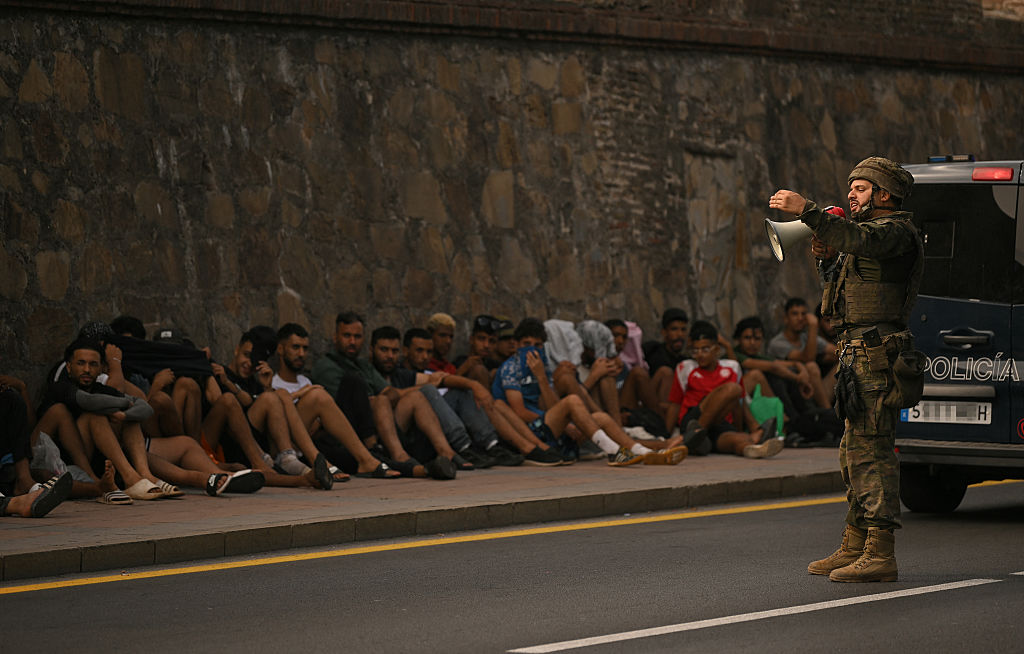
European leaders scrambled Saturday to contain the political fallout from a mass migration surge into Spain’s North African enclave of Ceuta, where authorities say roughly 50,000 people crossed from Morocco in an unprecedented two-day rush that left at least 67 people dead.

Spanish officials said crossings largely stopped overnight after Morocco increased enforcement and thousands of migrants voluntarily returned. Spain also began installing a 500-meter floating barrier off Ceuta’s coastline while deploying additional police and military personnel to prevent further crossings.

The humanitarian crisis has quickly become a political one. Italy temporarily reinstated border controls with Spain for one month, while 22 European Union member states called for an emergency discussion on strengthening the bloc’s external borders. Spanish Prime Minister Pedro Sánchez criticized calls to isolate Spain, arguing the country’s border controls remain intact and warning against measures that could undermine European unity.

Ceuta, along with the nearby Spanish enclave of Melilla, forms the European Union’s only land border with Africa, making it a longstanding flashpoint in debates over migration. While Spain has introduced a pathway to legal residency for some undocumented immigrants already living in the country, officials rejected claims that the policy triggered the latest crossings, instead blaming migrant-smuggling networks and misinformation circulating on social media.

Reuters reported that many migrants who reached Ceuta have already returned to Morocco after encountering overcrowding, food shortages and little prospect of continuing onward into mainland Europe. Spanish officials said migrants who enter Ceuta cannot freely travel into the rest of Spain because identity checks remain in place before any ferry or air travel to the mainland.


Start your day with essential news from Salon.
Sign up for our free morning newsletter, Crash Course.


President Donald Trump seized on the crisis Saturday, posting on Truth Social that the scenes in Spain resembled what he claimed occurred under former President Joe Biden and warning that the United States would face an even larger “invasion” if Democrats return to power. Similar claims have circulated widely online, though Spanish officials dispute comparisons to U.S. immigration policy and say the circumstances surrounding the Ceuta crossings are unique to the enclave’s geography and legal status.

The post Europe tightens borders after deadly Ceuta migrant surge appeared first on Salon.com.

  •  

Senate Report Describes ‘Top-Down Culture of Cruelty’ in ICE Detention

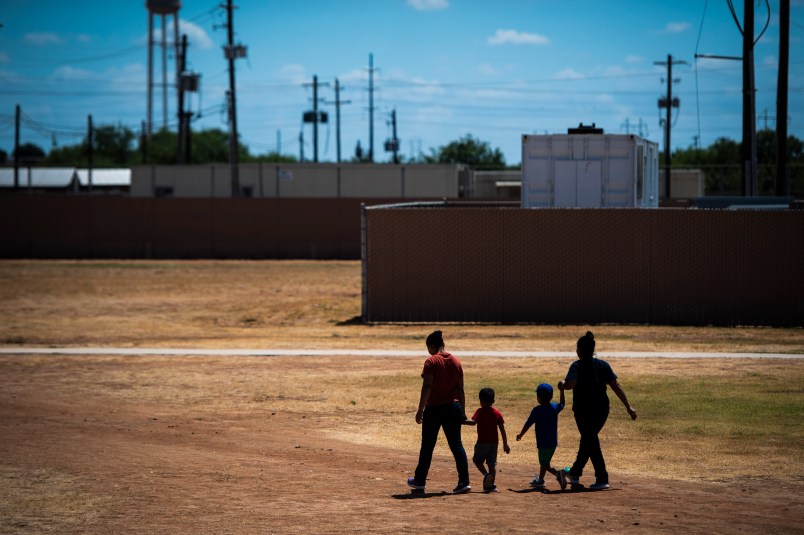
A new report from Senate Democratic Whip Dick Durbin (D-IL) details shocking allegations about the conditions inside an ICE detention facility in Texas. The report, which was published on Friday, was based on interviews Senate staff conducted with “approximately 20 family units and approximately 40 women detained in the adult detention unit” at the South Texas Family Residential Center in Dilley, Texas, it said. In a statement released along with the report, Durbin described the findings as part of “an ongoing investigation into medical and mental health care” in immigration detention facilities. He also called for the Senate Judiciary Committee, of which he is the ranking member, to hold a hearing on the issue. 

 “Children and their parents described a top-down culture of cruelty among Dilley staff, including guards deliberately disrupting children’s sleep at night, purposely entering rooms without knocking, and taunting children who are often provided with inedible food by eating candy and pizza in front of them,” Durbin said.  

Steven Owen, the vice president of communications at CoreCivic, a private prison company that operates the Dilley facility, disputed the claims made in the report in an email to TPM.

“The critical characterizations of the Dilley Immigration Processing Center (DIPC) do not reflect the operations, standards or care provided at the facility. DIPC was purpose-built to meet the needs of families, and families are housed together in accommodations designed to support family unity, safety and children’s well-being,” Owen said, adding, “Claims that children are denied care or experience delayed medical assessment are false. DIPC maintains on-site pediatric expertise, and emergency services are activated when a child’s clinical presentation requires off-site care.” The children and their families at DIPC receive health care that is clinically rigorous, federally overseen and delivered with dignity. Residents receive:”

Owen also provided links to material CoreCivic prepared including a primer created response to prior critical reporting on conditions at the Dilley facility.

When reached by TPM, the White House referred all questions about the report to Immigration and Customs Enforcement. ICE did not respond to a request for comment, but an unnamed spokesperson for the Department of Homeland Security, which oversees the agency, provided a statement. The DHS spokesperson stated “any claim that there are subprime conditions at ICE detention facilities is FALSE.” They also claimed “Dilley does meet federal detention standards and actually undergoes regular audits and inspections.”

“Another day and another hoax about the South Texas Family Residential Center. Nearly every single day, this office responds to media questions on FALSE allegations about illegal alien detention centers,” the DHS spokesperson said. “The media is clearly desperate for these allegations of inhumane conditions at this facility to be true.”

Along with the other disturbing claims, Durbin’s report alleges there is “substandard medical care” at Dilley. 

“Poor medical care was the most urgent concern raised by both families and adult women. They described a range of unaddressed health issues and voiced that, because they were not receiving adequate care, those medical conditions are worsening,” the report said. 

Specific issues detailed in the report include a mother and child who were ill yet allegedly “were repeatedly refused blankets to address the extremely cold temperatures in their unit.” The report also described multiple instances where detainees said they were not given care despite “extreme” pain and others who said chronic or troubling conditions were not addressed. 

Along with the allegedly inadequate medical care, the report also claimed facility staff failed to provide detainees with proper meals. 

“One family reported finding worms and a fingernail in their food. Several families said their children refused to eat facility meals entirely,” it said.

A lack of required educational programs is another issue detailed in the report, which said Judiciary Committee staffers found “no evidence that the facility was meeting … basic education standards.”

“One 16-year-old described the education offered at Dilley as ‘drawing in coloring books,’ which was not appropriate for students his age,” the report said.

The lack of school programs was described in the report as part of a pattern of “psychological harm to children” that included “demeaning, dismissive, and abusive behavior by Dilley staff.”

“One parent reported that guards who are perceived as ‘too nice’ are scolded by supervisors and told to be harsher. A guard told the parent: ‘You only have three rights here: drink, sleep, eat.’” the report said.

The report also said Dilley detainees face a lack of access to family members and attorneys.

“Many of them stated they have committed no crimes, have pending immigration cases, have minor children at home, and have lived in the United States for years. They stated repeatedly that they have followed the rules, and they are not criminals—and do not understand why they are being treated as if they are. They are desperate to be reunited with their families and spoke about their efforts to seek release through habeas petitions,” the report explained. 

Dilley has been a hotbed for protests and activism that have taken place around the country in response to ICE and President Donald Trump’s mass deportation agenda. Durbin claimed the Judiciary Committee staff had issues speaking to detainees as part of what the report described as “DHS obstruction.”

“My staff visited Dilley as part of an ongoing investigation into medical and mental health care, solitary confinement, and access to counsel in immigration detention. During that visit, in an attempt to curtail oversight, DHS imposed an arbitrary two-hour time limit on visiting the facility,” Durbin said in his statement.

Other members of Congress have similarly accused DHS and ICE of attempting to thwart lawmakers’ right to conduct oversight in what they have called a violation of legislation. The practice led to a successful lawsuit in federal district court. In his statement, Durbin also suggested some of the things Judiciary Committee staff observed at Dilley violate the Flores Settlement Agreement, a court ruling that sets standards for immigration detention. 

Durbin has previously released reports on conditions at ICE detention facilities in Florida and Louisiana. Overall, his latest report blamed the issues in detention centers on Trump administration policies. 

“The Trump Administration is intentionally subjecting longtime law-abiding residents of our communities and children who have grown up in our communities to neglectful and dangerous detention conditions,” the report said, adding, “In a desperate attempt to meet Stephen Miller’s quotas in furtherance of the Trump Administration’s mass deportation campaign, immigration officials now target law-abiding families attending immigration

court hearings and ICE check-ins.”

Durbin’s report also predicted the issues observed at Dilley will have devastating consequences and that “more people will die in detention without necessary medical care.” 

“Medical care in immigration detention is dangerously inadequate. Immigration detention facility staff routinely deny or defer necessary medical treatment, providing only minimal care until emergency care is required. Without better policies for quickly addressing urgent medical needs, including facilitating release, more individuals, including children, will die in Detention,” the report said. “Thirty-two people died in ICE custody in 2025—the highest number in more  than two decades. Twenty-two people have already died in ICE custody thus far in 2026.”

This story was updated at 9:31 pm with a response from CoreCivic. It was also updated at 4:38 pm on August 1, 2026 with the statement from a DHS spokesperson.

  •  

The Trump asylum change that could fast-track deportations

A black immigration court sign is seen on a white wall; out of focus in front of it is the face of an immigration agent covered with a mask.
An immigration court sign is seen as federal agents patrol the halls of the Ted Weiss Federal Building in New York City on May 12, 2026. | Michael M. Santiago/Getty Images

This story appeared in The Logoff, a daily newsletter that helps you stay informed about the Trump administration without letting political news take over your life. Subscribe here.

Welcome to The Logoff: The Trump administration is further limiting due process for asylum-seekers in the US.

What’s happening? On Tuesday, the administration issued a rule changing how some asylum requests are handled. Under the new policy, immigrants in more than 444,000 asylum cases could be denied the chance to speak with an asylum officer and claim asylum, which requires them to have experienced persecution, or the threat of persecution, in their home country because of their race, religion, nationality, political opinions, or another characteristic. 

Instead, those immigrants would be redirected to immigration judges — who could order their deportation without any additional process. 

The change, according to the administration, is intended to help clear a substantial backlog in the US asylum system, which has 1.4 million cases currently pending. But it fits a pattern by the Trump administration of dramatically curtailing access to asylum in the US. 

What’s the context? Under the second Trump administration, many previous immigration judges have been forced out or fired from their roles. Their replacements, as Bloomberg reported earlier this year, are minimally trained and instructed to deny most asylum claims outright. 

What’s the big picture? The Trump administration also has a long record of sending immigrants back into dangerous situations in their home countries, or even to countries to which they have no connection. 

Last year, as my colleague Ian Millhiser reported, the Supreme Court effectively allowed the administration to nullify the Convention Against Torture and send immigrants to war-torn countries like South Sudan

And those deportations are poised to get worse: In June, the Court also cleared the way for Trump to end temporary protected status for immigrants from Haiti and Syria, without consideration of procedural rules. Now, Immigration and Customs Enforcement is reportedly preparing to target hundreds of thousands of Haitians living in the US for deportation, even though the island nation is dealing with serious and widespread gang violence

With less than 100 days until the 2026 midterm elections, don’t miss my colleague Astead Herndon’s new newsletter, The Midterms, Actually. Every week, Astead breaks down the big ideas and key people behind the political shifts shaping the 2026 elections. You can subscribe here.

And with that, it’s time to log off…

Want to spend less time on social media? Here’s some excellent advice from my colleague Constance Grady, available here with a gift link

Thanks for reading, have a great evening, and we’ll see you back here tomorrow!

  •  

Trump Is Reshaping Immigration Courts With Help From a Brutal Comic Book Character

This story was originally reported by Candice Norwood of The 19th. Meet Candice and read more of their reporting on gender, politics and policy.

Masked law enforcement officers in tactical gear throwing civilians to the ground. In some cases — like Renee Good, Lorenzo Salgado Araujo and Joan Sebastian Guerrero — officers shoot people dead. Others disappear into detention before being deported to countries where they may have no family or connections.

Critics argue that the great country President Donald Trump envisions could be taken right out of a dystopian novel. A version of this society has existed since 1977 in the comic book world of Judge Dredd, a British series set in the year 2099 AD that depicts an authoritarian police state in the eastern United States. 

And Judge Dredd is the image the Trump administration has chosen to assist with recruiting new immigration judges.

  •  

Her brother was convicted of terrorism over a protest he didn’t even attend

Earlier this year, Daniel Sanchez-Estrada was sentenced to 30 years in prison for moving a box of zines. He was charged with corruptly concealing a document or record, one of the nine people convicted in the prosecution following last year’s noise demonstration at the Prairieland Detention Center near Dallas in northern Texas. Unlike the others convicted in this case, Sanchez-Estrada was not at the protest and maintains he had no role in its planning.

According to prosecutors, Sanchez-Estrada moved the zines at the request of his wife, Maricela Rueda, who attended the demonstration and was sentenced to 70 years in prison after being convicted of rioting, explosive charges and providing material support to terrorists. But no evidence was presented at trial regarding why Sanchez-Estrada moved the publications, which a defense committee has subsequently told Salon “was done entirely of his own accord and for his own reasons.”

The Prairieland case has been widely criticized for its application of terrorism charges against protesters. Sanchez-Estrada’s conviction, in particular, has been criticized for the harsh sentencing applied and his tangential connection to the protest. Ana Bell, the sister of Sanchez-Estrada, spoke with Salon about her brother’s case and what it means for free speech in Trump’s America.

This interview has been edited for length and clarity. 

How is your family holding up, and how has the trial and conviction impacted you and your family personally?

My brother Dez was the main caregiver for my parents, with him having the most flexible schedule. He could easily schedule his appointments for whenever my mom didn’t have a doctor’s appointment and stuff like that. We’re not complaining. They’re parents, and we love them. We want to take care of them. It did present a challenge that we weren’t expecting because he was the main person taking care of them.

My younger brother is a teacher, so he’s usually in a classroom. I opened a bookstore a couple of months ago, so I’m trying to run the business and everything. It’s been interesting with all of the things that we have to take care of. We were talking yesterday, I had to figure out how to deal with his taxes. He was detained, I have his power of attorney, and I’m just like, “Okay, so a lot of this stuff that is in the house, what is receipts, what is actually business expenses? Stuff like that is not something that one is expecting to do, and all of a sudden you have to take care of it, and it adds an additional layer of stress that wasn’t there before.

“Everything that’s happening right now, it’s very hurtful, very painful for our family.”

And that’s on top of the emotional roller coaster. You don’t know if this is the last conversation we will have for a while, because he could be moved to a different facility and then we have to figure out how to set up communications, how to set up his commissary. Like, would we be allowed to visit him in person? Is he even at a distance where we can drive to see him?

For example, this weekend, on Saturday, we were able to visit. My mom, dad and his stepdaughter. So he was able to see me and he was so happy that she was there. But then on Sunday, when it was my turn to go visit him, we showed up, and visitations had been canceled, so we didn’t get to see him on Sunday. Now we have to wait until next Saturday or Sunday, and hope that from here until then, he hasn’t been moved to a different facility, and we didn’t miss our chance to see him.

Sometimes he calls and we miss the phone call, or sometimes the number doesn’t work, and like you’re trying to press five to answer the call, and it just hangs up the call instead. It’s an emotionally-charged situation, even though it was just a phone call. It all adds up because right now, everything feels like an open wound that we have been trying to heal, and it’s not closing. Everything is fresh. Everything just gets harder.

Could you talk a little bit about how it feels having people on the internet trading incorrect information about your brother?

I’m not saying that these people have ill intent, but I do believe that words have a lot of power and the words we use to communicate can make a breakthrough.

Someone asked me in a comment if he had just printed the magazines, and someone would come and grab them from that house, and I was just like, “You have completely wrong information.” These were magazines that he bought. They weren’t 10 or 20 copies of the same magazine. They were one like one copy about freedom, one about the environment. They were materials that he read, and he critiqued.


Start your day with essential news from Salon.
Sign up for our free morning newsletter, Crash Course.


I think people just need to take a step back before making a statement and actually do a little bit of research because a lot of the information is just one Google away. You can go on the internet right now and look for all the evidence. It’s available. It has been unsealed. Once you have that in your hands, you can see all the information, not just what I say, not just what the government is saying.

I try not to spend a lot of time online doing this because, as I said, I do run a business. I have three kids. I’m a single mom. There is a lot of misinformation out there, and a lot of people are just running with it, kind of like a case of broken telephone.

Everything that’s happening right now, it’s very hurtful, very painful for our family. If I don’t check my emotions before I start talking with people, I could make it a bigger issue than it actually needs to be.

For me, it’s very important right now for people to understand that while my brother is the one who is in jail, and the government is not literally stating, “We are coming for your freedom of speech.” That’s exactly what is happening. He is just the vessel right now.

Could you speak a little bit about what it’s been like to witness this campaign from the government to paint your brother in this way? I think the idea that you could be convicted for what amounts to moving a box of your own magazines is a very foreign idea to most Americans.

It is very disturbing. I just opened a bookstore. So what are the odds that I literally have countless works right now in my store of examples of people who fought against fascism? I only sell fiction, but you have Katniss Everdeen in “The Hunger Games,” you have Harry Potter in Hogwarts, you have Thomas in “The Maze Runner.” You have all these characters that are literally standing up to oppression and fascism, and those who are in power and they show an amount of corruption that you think only happens in books.

“We felt that the government was trying to make an example out of people who are not content with the current administration.”

We felt that the government was trying to make an example out of people who are not content with the current administration. Judge Reed, at my brother’s sentencing, said it. The state is trying to make an example to not encourage people with similar ideologies to follow this path. “The reason why you guys are getting this many years,” and this is me paraphrasing, “It’s because we’re trying to make an example.” He said the quiet part out loud, and it’s on the record.

This is the reason why I encourage people over and over to look at the court transcripts, listen to what the prosecution presented as their case, listen to what the defense attorneys were questioning and asking for and then see who told the truth by looking at the evidence that they’ve presented to you.

In my brother’s case, when you look inside the box, everything was dated prior to COVID. Even if you did not like the political observations of some of those magazines, essays, critiques, poetry or whatever was in ther, these are feelings from the people, and they’re protected under the First Amendment. You are allowed to feel how you want. You are allowed to feel that the current administration is the best one ever, and you’re allowed to tell that to people and not go to jail. But you’re also allowed to do the opposite and it still doesn’t earn you a sentence.

None of the stuff that was in there, whether it was for or against the government, was a crime or illegal to have, and it was not used to persecute anybody who took part in the noise demo, which my brother was not an attendee of.

My understanding is that you must commit a crime in order to be punished, right? It’s not because of what you think. It’s not because of what you read. It’s not because of what you have in your house. Even more absurd is that it’s not because of the paper magazines, books or pamphlets that you have in your house. That’s what is so incredibly disturbing to me.

What is your message to other people who might be critical of the current government, to would-be protesters?

If I could just give one word of advice to people, as a person who loves this country but doesn’t love what is happening right now, it would be to study the Constitution and fight for it. Listen to which political candidates right now are talking about freedom of speech or immigration issues. Ask yourself what things seem to be in jeopardy in our Constitution and find a way to make a change for those. I do not believe that staying quiet is the way to go. I also don’t believe violence is the answer. I do believe that we all need to speak up and defend and uphold the Constitution.

Why do you think the government decided to go after your brother? Assuming this conviction stands, there will be potentially profound implications for the First Amendment and who does and does not enjoy freedom of speech in this country.

I actually think that if he had been somebody else, it would have been the same thing. With him, I feel like the main reason why was that his wife was at the noise demonstration. She was arrested on July 4, and the government had a whole day to look into her and see who she was married to. He was arrested on Sunday, and they did a big production. I watched a video of his arrest.

“In the current political climate, anyone who has brown skin is low-hanging fruit. It’s someone who you expect to get lost in the system.”

I saw all the units that were surrounding him and asked, “What is this?” They came after him as if he were a terrorist, and all he had with him was a box of zines. At some point, they claimed it was explosives, but when they opened it, it was just paper. In the current political climate, anyone who has brown skin is low-hanging fruit. It’s someone who you expect to get lost in the system.

But the fact is that he’s an immigrant — an immigrant who has legal status in the county but an immigrant regardless. Right now, there is so much hateful and hurtful feelings towards immigrants that I feel he was just the perfect scapegoat. It changed the whole thought process of how they see him. They completely dehumanized him simply because of that.

For me, it just aligns so perfectly with everything that they were looking for in a “terrorist.” Even the beard. Some people were crazy about how he had a beard and said that he was in a sleeper cell and all this stuff. He’s a tattoo artist who loves cats. This is outrageous.

There are some headwinds in that this appeals to the Fifth Circuit and then the Supreme Court, both of which are very closely tied to the current administration and their view of the world. At the same time, these judges who handled the case, they do have a record of going too far, even for the Fifth Circuit, and so I’m wondering how optimistic you are about your brother being able to prevail through the legal system.

I wanted to believe that justice would be served. I wanted to believe that we would be bringing my brother [home], but the moment I heard the sentence for Autumn Hill and the reasons that the judge gave, the judge said that the sentence was not more than he thought was reasonable to give. That changed my perspective on that moment. I lost hope before we got to my brother’s sentencing. I lost hope because it didn’t make any sense. It didn’t make any sense from the legal point of view that they would receive this much punishment for something that was so minimal.

I don’t know how to feel. Part of me wishes that I could be hopeful again, because we’re gonna keep fighting regardless. I made the statement before that we’re probably going to spend every last minute of our lives trying to fight for his freedom, and that’s very unfortunate because he’s so young. They’re all so young, but they shouldn’t be behind bars. And I feel that the justice system is failing them, and it’s failing all of us. If the appeal doesn’t work, then it will be just like a failure in the justice system. I want to be hopeful, but I’m not holding my breath.

Do you think there is a chance of a potential political solution to this, or is there the political bravery out there to speak to this issue? I’ve spoken with people who have suggested that the next president should consider a pardon if they don’t prevail on appeal.

I don’t think the current administration will do it at all. But I would like to think that we will vote better next time, and that if we have not been successful with the appeal, or we’re still fighting this case, we could ask for a pardon.

So I’m hoping that if we end up having to go that route, we are able to ask for it and that it might be granted. I would like for the judicial system to actually do its part and be just.

The post Her brother was convicted of terrorism over a protest he didn’t even attend appeared first on Salon.com.

  •  

At Delaney Hall, the struggle persists after cameras left

While the hunger and labor strike at the Delaney Hall immigration detention facility in New Jersey ended weeks ago, conditions within the facility have not improved, and may be even worse than before the strike there. Now, policies are seemingly directed at obscuring conditions in the for-profit facility operated by The GEO Group.

In May of 2025, Delaney Hall, which operated as a holding facility for those picked up by Immigration and Customs Enforcement from 2011 to 2017, was recommissioned to support President Donald Trump’s mass deportation agenda. On May 22, detainees at Delaney Hall launched a hunger and labor strike at the facility, capturing national attention to what they described as inhumane conditions in the facility. In particular, detainees described unsanitary, moldy or spoiled food and mistreatment by guards. The strike led to significant protests outside the Newark, New Jersey, detention center, and high-profile clashes between protesters and the guards there as well as a frenzy of attention from the national press.

On June 22, advocates for detainees there said that the strike had ended, though not because conditions had improved, but rather because the facility and the Department of Homeland Security had adopted a tactic of frequently transferring detainees between facilities, which effectively broke the ability of detainees to organize themselves within the facility.

Volunteers at an aid tent maintained by local religious groups and organizers say that conditions at the facility have not improved, and may even be getting worse for some, based on conversations with released detainees and their families.

Haydee Colon Hernandez, a pastor at Saint John’s Lutheran Church in Summit, New Jersey, relayed one story in which guards seemingly retaliated against a man in a wheelchair following a conversation between the detainee and Sen. Andy Kim, D-N.J., in which she says guards told the man, “Do you think that just by talking to the senator you’re going to be released?”

“If you want to tell a guy that is in a wheelchair, ‘Stand up when I’m talking to you,’ that’s really abuse. He said, ‘I wasn’t able to get up. I’m in a wheelchair,’” Hernandez said.

Other complaints include persistently low-quality food, isolation within the facility, and frequent transfers between Delaney Hall and other facilities, which serve to prevent organizing in the detention center. One volunteer also described a new system adopted, in which new detainees, often there for shorter periods of time, are kept away from longer-term detainees. Those who are held for shorter periods of time also describe better conditions upon release than other detainees who are held for longer periods. Other volunteers said that the families of detainees have been intermittently encouraged not to discuss conditions in the facility after visits to their family members.

“ICE has really escalated in kidnapping people out in the community.”

In response to a request for comment from Salon, an ICE spokesman denied any allegations of “subprime conditions or overcrowding” at Delaney Hall.

“All detainees are provided with proper meals, water, medical treatment, and have opportunities to communicate with their family members and lawyers. We offer everything a traditional ICE detention facility offers, including access to free legal services and a law library, a variety of reading materials detainees can borrow in our library, recreational space and religious accommodations. All detainees receive full due process,” the spokesperson said.

The frequent transfers between facilities is one of the most important developments since the strike, according to Sally Pillay, the director of the Mami Chelo Foundation, and one of the lead organizers at the aid tent, which provides assistance to both families visiting the facility and those released.

(Photo by Adam Gray/Getty Images) Detainees stand by a window inside the federal immigration center at Delaney Hall in Newark, where ICE is housing detained immigrants on May 26, 2026 in Newark, New Jersey.

“ICE has really escalated in kidnapping people out in the community,” Pillay said. “So every day, hundreds and hundreds of people are being brought into the facility, and every day, hundreds and hundreds of people are being moved out.”

Pillay theorized that the frequent transfers, alongside preventing organizing within the facility, also make it harder for detainees to file habeas corpus petitions, which is a legal mechanism that allows detainees to challenge their detention in court.

Pillay, who has spoken with hundreds of detainees and their families, said that detainees are typically woken up around 1 a.m. for transfers, and that the transfer bus will leave anywhere between 4 a.m. and 10 a.m.

Gabriela Soto, the wife of Martin Soto, a leader of the hunger strike, recalled her experiences with ICE attempting to move her husband from Delaney Hall, which was ultimately successful.

“I saw my husband being thrown into a van from the ramp inside, going into the visiting chapel, two ICE agents grabbed my husband by his ankles and his wrists and threw him in the van. I just hate to see — or to understand why they will do these things,” Soto said in an interview with Salon.

Martin Soto was in Delaney Hall from February until late May, and according to Soto, he was transferred to the Elizabeth Detention Center in New Jersey around 2 a.m. on May 25.

Other volunteers said that it has been harder to gauge what is happening at the facility from the outside due to the disassembly of the so-called “First Amendment” area, which blocked off traffic in the lane of Doremus Ave. closest to Delaney Hall. Before the disassembly, they said they could often hear commotion and sometimes screams from inside the facility, potentially owing to alleged instances where guards pepper-sprayed and beat detainees with batons.

(Photo by Adam Gray/Getty Images) An ICE agent sprays chemical irritants at protesters and media outside the federal immigration center at Delaney Hall, where ICE is housing detained immigrants on May 27, 2026 in Newark, New Jersey. The ongoing protests, which became tense over the holiday weekend, come amid reports of a hunger strike by detainees.

Delaney Hall is not the only detention facility plagued by allegations of abuse. A recent report from Human Rights Watch and the American Civil Liberties Union found that detainees at the Camp East Montana detention center were forced to endure filthy conditions, fed inedible meals and denied medical care. Detainees also described frequent beatings. DHS denies those allegations.

DHS, in response to a request for comment, also claimed that they provide comprehensive medical care to everyone in ICE custody and that ICE maintains a “zero-tolerance policy for all forms of assault involving individuals in ICE custody.”

“ICE takes every allegation of misconduct seriously and is committed to holding perpetrators fully accountable. Protecting the rights and safety of those in our care is a top priority. This includes safeguarding against abuse by staff, contractors, volunteers, or other detained individuals,” the DHS spokesperson said.

Kathy O’ Leary, a mainstay at the aid tent who works with Pax Cristi, spoke with Salon both during and after the strike and noted that visitation has been much more restricted since the strike began in May, and as tensions escalated throughout June.

For example, visitors were once allowed to wait in an indoor air-conditioned room and are now expected to wait for visitation in an outdoor seating area inside of a chain link fence near the gate of the facility. Inside the facility, there are other issues with heat. For example, during a dangerous heat wave in early July, air conditioning in one section of the facility also went down.


Start your day with essential news from Salon.
Sign up for our free morning newsletter, Crash Course.


O’Leary cited persistent issues with transparency at the privately owned for-profit detention center as well. If a legislator is visiting for an inspection, they are now required to present privacy waivers for each detainee they want to speak with, which must be signed by the detainee. However, visitors aren’t allowed to bring the papers with them when they visit family in detention, meaning that the only chance detainees have to sign the papers is during a weekly visit to a nearby law library. O’Leary said that the aid tent keeps these papers on hand, but even the volunteers and organizers there needed assistance from legislative aides to ensure they were filled out correctly, and that language barriers can prove a challenge for detainees and their families.

“They’re a little confusing. We have them here in the tent. They’re a little confusing for even for us to figure out. We’ve had to ask the legislative aides for help,” O’Leary said.

Separate from the aid tent, protests at the facility persist, with a grassroots group of activists maintaining a mutual aid table of their own near the detention center. One protester who goes by Basher, and has become a fixture of the protest efforts, said that even though the cameras have left, protests at the facility continue, with between 20 and 30 protesters showing up most nights. In recent days, however, owing to recent killings by ICE in Basher’s view, ICE and guards have been more reluctant to clash with protesters.

In recent weeks, immigration enforcement officers have shot and killed two people: Lorenzo Salgado Araujo in Texas and Johan Sebastian Guerrero in Maine. In Florida, another yet-to-be-identified man was killed after being struck by a semi-truck in Florida while fleeing ICE.

The post At Delaney Hall, the struggle persists after cameras left appeared first on Salon.com.

  •  

Immigration crackdown cripples America’s caregiving industry

Caregivers in the U.S. are paid just under $26,000 a year on average for the most important work there is. And this June, we learned the government drew up a plan to mark many of them dead.

Let’s back up: When someone who receives Social Security dies, the government owes nothing for the month of the death, even if she lived to its final day. Benefits run a month behind, so her last payment lands after she’s gone, and the bank is told to send it back. We have a system that can find a dead woman’s last dollar and claw it back inside a month. It’s made to ignore the living woman who bathed her, fed her, and sat with her at the end.

And now we know just how little this government values her.

Last month, The Washington Post reported on a whistleblower disclosure from senior Social Security Administration executive Jeremiah Schofield, filed with Sens. Elizabeth Warren, D-Mass. and Richard Blumenthal, D-Conn. It describes a plan, devised by Elon Musk’s DOGE and the Department of Homeland Security, to enter nearly 2.7 million living immigrants into the Social Security Administration’s Death Master File, the database used by banks, employers and agencies to confirm who has died. To be marked dead is to be severed from wages, banking and all social benefits.

That was the point: make immigrants miserable enough to self-deport. Two memos reportedly from then-Homeland Security Secretary Kristi Noem to the acting Social Security Commissioner, Leland Dudek, waved off the legal warnings, the disclosure says, stating “death is a state of ineligibility.” It didn’t matter that the people were alive.

The agency says the plan wasn’t carried out. But roughly 6,000 immigrants were marked dead last year, some of whom had to walk into a government office and prove they were still breathing. And when they did, Immigration and Custom Enforcement was there waiting to arrest them.

Even without the fear that this stunt evoked, aides and the night nurses are already leaving — their protections revoked, status in question — but the need for them isn’t shrinking. Over the next decade, the U.S. will have 10 million openings in direct care. We’ll squeeze this need into the margins.

Even without the fear that this stunt evoked, aides and the night nurses are already leaving — their protections revoked, status in question — but the need for them isn’t shrinking.

The care crisis will be intensified by the Supreme Court’s June 25 ruling in Mullin v. Doe, which clears the way to revoke the Temporary Protected Status of roughly 350,000 Haitians and 6,000 Syrians by July 10. This decision has been covered as a healthcare-staffing crisis, and it is that. But that is smaller than the truth: This will be a whole-lifespan problem, as the same workforce holds up both ends of American caregiving, elder care and childcare.

The PHI, a national research organization for the direct-care workforce, has already warned that without immigrant care workers, family caregivers will be forced to leave the workforce or cut their hours to fill the gap. That loss lands hardest on women across every sector and level of the workforce — caregiving is already the number one reason women voluntarily leave their jobs, cited by 42% of those who quit, according to Catalyst research — at a moment when women’s declining labor force participation is already draining the U.S. economy to the tune of an estimated $650 billion a year, or 2.9% of GDP.

New York and Massachusetts sit among the states with the most engaged care policy in the country. Florida and Ohio sit near the opposite end of that spectrum. It hardly matters. Take the caregivers out, and all four states end up in the same place: families with no one to turn to. No state legislates its way out of this loss. Without a caregiver, there is no care. Hard stop.


Start your day with essential news from Salon.
Sign up for our free morning newsletter, Crash Course.


In much of East Asia, however, shaped by Confucian ideals of filial duty, and in Latino families bound by familismo, tending to the old and the dying is a calling claimed with pride. In the Philippines, which sends caregivers to the whole world, the work is a point of honor.

Other societies put public money in the place of reverence. The Netherlands has covered long-term care under universal insurance since 1968 and now devotes more of its GDP to it, about 4%, than any country tracked by the Organization for Economic Cooperation and Development. Sweden, Norway and Denmark similarly fund it as a public good, not a private scramble.

In Japan, the two meet. A Confucian, deeply familial culture, it wrote care into law, requiring every citizen over 40 to carry long-term care insurance, and spending, in 2020, 67% more of its economy on that care than we did. Reverence and infrastructure, together.

The U.S. managed neither. We file care work under menial; overwhelmingly staff it with women, people of color, and immigrants; and pay as if they could feed their families on the sheer joy of being useful.

The reverence born in other countries arrives here, carried by the first generation, and finds nothing to hold onto: no paid leave, no funded care, no status, no relief. If it survives, it does so against the steady pull of a country that degrades and ignores caregiving. The further individuals get from arrival, the easier it becomes to forget cultural standards. That is not immigrants shedding their values. It is a country that imports devotion and budgets nothing to keep it alive.

And now we are chasing away the immigrants.

One in five of the people caring for our children are immigrants — more than 40% in New York City, half in LA — more than half of whom are not citizens. When these hands go, the need remains. Intense work lands on the daughter, the wife, the sister, who absorbs the collapse, on top of her own life and career, uncompensated. It lands on the Panini Generation, pressed between aging parents and young children without paid leave or reprieve.

That daughter is often the one the family was proudest to send away. Education carries a woman farther from home — two to three times farther from her family, research finds, than her less-schooled peers. In her memoir, “My Life In Full,” Indra Nooyi, who left her parents in India to ultimately run PepsiCo, wrote that her mother raised her with “one foot on the accelerator and one on the brake, to go succeed and then come back to family.”

So, we lose. We lose in our communities, as neighbors disappear and businesses shutter with a workforce afraid to show. We lose in our homes, where we need those extra, loving hands. We lose in our accounts, drained by the care no one will fund. We lose in our companies, as women leave when caregiving can’t be negotiated. We lose in our relationships. We lose our people. And then, we reach our melting point and quietly lose ourselves.

The U.S. machine can find the dead and reclaim their last dollar inside a month. It purposefully leaves destitute the people who rocked, fed, bathed, lifted and bury us. Whose hands have caught everything this country dropped and asked almost nothing back. That’s what they get — and we lose.

The post Immigration crackdown cripples America’s caregiving industry appeared first on Salon.com.

  •  

ICE arrested a nun on her way to church. Does MAGA care?

A sheriff’s deputy escorts a black-robed priest and a white-and-purple-robed minister.
Members of a spiritual delegation arrive at the Broadview Immigration and Customs Enforcement (ICE) processing center to administer Ash Wednesday sacraments to detainees on February 18, 2026, in Broadview, Illinois. | Jacek Boczarski/Anadolu via Getty Images

On June 28, Sister Leticia “Letty” Ugboaja, a Catholic nun from Nigeria, stepped out of her home to take the short, one-block stroll to her church in McAllen, Texas. It should have been uneventful: dressed in her white habit and bearing a rosary, Sister Letty was walking to Sunday morning mass at Our Lady of Sorrows.

She didn’t make it — US Immigration and Customs Enforcement agents stopped, arrested, and handcuffed the 56-year-old. They took her to a detention facility an hour away, reportedly confiscated her rosary, and declined to bring her the medication she takes. She called her diocese for help — and as news spread, both Republican and Democratic members of Congress appealed directly to Homeland Security Secretary Markwayne Mullin for details. Hours later, she was released — without explanation.

Plenty of questions surrounding this incident remain. According to her diocese, Sister Letty had worked as a registered nurse in the area for about a decade and entered the country legally. 

But the incident is not a one-off — and instead is representative of a concerning trend in America over the last year. Though ICE and President Donald Trump’s immigration enforcement activities have receded from national headlines, Sister Letty’s detention shows how two forces are clashing in the second Trump term: the drive for hardline immigration enforcement and the constitutional imperative of preserving religious liberty and free exercise in America. 

The tightening of federal immigration enforcement around religious spaces and believers

The last year of Trump’s mass deportation program has produced many cases like Sister Letty’s — even if they haven’t made national news. Federal immigration agents have detained and harassed Catholic, Protestant, and Muslim chaplains and priests, while sparking fear across denominations — particularly as religious leaders and communities organized and led responses to immigration crackdowns across the country.

Both the Department of Homeland Security and Immigration and Customs Enforcement did not immediately respond to requests for comment on Sister Letty’s case, or other religious liberty concerns. They have also not responded to requests for comment to other local and national outlets in the case of Sister Letty.

In November, the Episcopal bishop of Texas reported that a Kenyan priest working for the Texas Department of Criminal Justice had been detained by ICE while leaving his workplace and transferred to a detention facility. His diocesan leaders said he was working in the US legally, and had the proper documentation to be in the US. In July 2025, a Muslim hospital chaplain in Ohio was arrested and detained during an immigration check-in. An Egyptian immigrant, he was held in detention for weeks before finally being released. And earlier this year, Catholic Cardinal Blase Cupich of Chicago reported that priests in his archdiocese have been stopped by federal agents and ordered to prove their citizenship. That’s all on top of clergy who were shot at with pepper balls or sprayed with tear gas at anti-ICE protests in Illinois and California.

Yet this clash has shown up not just through harassment of clergy and those dedicated to religious life, but also in restrictions on how those in detention receive pastoral care, how those trying to provide that care are allowed to operate, and whether places of worship can be free of a federal presence. 

For years, federal immigration enforcement was limited by “sensitive location” rules designed to protect places like hospitals, schools, and churches from unnecessary intimidation. Those guidelines were first formalized during the Obama administration, kept in place by the first Trump administration, and reaffirmed during the Biden presidency. Nor were these restrictions entirely new: Some form of protection for houses of worship has existed for more than 30 years, according to the legal organization Democracy Forward. 

But DHS rescinded the “sensitive location” rules at the start of the second Trump presidency — to “empower” CBP and ICE  to go after “criminals” who “will no longer be able to hide in America’s schools and churches to avoid arrest,” according to a DHS statement at the time — triggering legal responses from immigrant rights and religious freedom groups.

“For decades, the federal government recognized a simple truth: targeting people at houses of worship violates religious freedom and harms communities,” Bradley Girard, the senior counsel at Democracy Forward, said earlier this year when announcing friend-of-the-court briefs in federal cases brought by a coalition of Quaker, Sikh, and Baptist groups. “These briefs make clear that the Trump-Vance administration’s policy is not only unlawful — it is dangerous. It chills religious exercise and undermines public safety by driving people into the shadows.”

Many of those suits ended up succeeding — at least in getting judges to protect various Baptist, Lutheran, Christian, and Sikh places of worship that could prove they were being affected by immigration raids. But broader federal protections for places of worship have not yet been formalized.

Instead, churches, religious organizations, and legal aid organizations have waged piecemeal legal fights to secure religious liberty protections, like in Minnesota and Illinois — particularly to exercise pastoral care, like providing counseling, sacraments, and religious rituals. In Minneapolis, for example, Groundwork Legal, a local nonprofit, public interest law firm, sued ICE over a ban on clergy access to the Bishop Henry Whipple Federal Building.

“Under federal law — both the Constitution and statute — it’s clear that the government can only limit the ability of somebody to practice their religious faith, including the ability to provide [or receive] pastoral care, in the least restrictive means possible given the circumstances,” Irina Vaynerman, the co-founder and lead attorney of Groundwork Legal, told me. “And here, a categorical bar from even entering the building, to offering that care to anyone who wants to receive, it was obviously not the least restrictive means.”

Groundwork filed that suit in February on behalf of multi-denominational faith organizations and faith leaders under both the federal Religious Freedom Restoration Act and the First Amendment’s free exercise protections. They won a preliminary injunction in March, with a judge ordering the federal government to allow faith leaders to offer pastoral care to those held by ICE at the building.

Catholic clergy and religious leaders launched a similar suit last fall in Illinois after ICE and CBP officials denied clergy access to the Broadview federal center to minister to detained people — including offering Communion to them. They won a partial victory this year, when a judge ordered federal agents to allow clergy access for Ash Wednesday services — and in May, ICE and religious leaders reached an agreement to allow daily visits once again while litigation plays out. 

Vaynerman reiterated to me that the Illinois case is still playing out — these agreements and changes are temporary reprieves, in part because no national protections or guarantees have been formalized beyond piecemeal fights over religious liberty and free exercise in specific cities and around specific federal buildings or places of worship.

“Certainly this is something that we know folks are experiencing across the country…and we know that this is happening all over the country because there is not a standard protocol or policies related to this incredibly important constitutional and statutory right,” she said. “It is so important that the government recognizes [the importance of pastoral care] and then offers that level of access that is constitutionally required to support people going through one of the darkest times in their lives.”

  •  
❌