Reading view

In protecting women from body-shaming, we lost something important

If you’re also a pop culture obsessive, it was probably around early 2025 when alarming photos of Ariana Grande began rolling up in your text messages and DMs; images of the star looking particularly gaunt, shoulder bones and clavicle protruding. With the recent release of her new music video for “Petal,” those messages intensified to establish a troubling refrain: “Is Ariana Grande OK?”

It’s hard to tell when, exactly, raising legitimate concern about a woman celebrity’s appearance became synonymous with your run-of-the-mill misogyny or bullying. But somewhere between the “you go, girl” and #MeToo eras emerged a dishonesty around how we discuss women’s bodies.

That was a total vibe shift from the tedious “extreme theater kid energy” discourse that popped up whenever Grande and her “Wicked” co-star, Cynthia Erivo, so much as breathed in the same room together throughout the film and its sequel’s exhausting two-year press tour. The new messages carry with them a deep sense of concern and bewilderment, because they come from people who are mere spectators with neither the medical degree, language, nor relationship with Grande to perform the appropriate wellness check. Still, what comes across is the sincere questioning of the health of celebrities like Grande and, more recently, Kaia Gerber and Jenna Ortega, both of whom have also raised alarm bells with their extremely thin bodies. Potentially, this questioning is a call for an intervention.

(Jeff Kravitz/FilmMagic/Getty Images) Jenna Ortega

Attempts to bring concern from intimate settings to social media are too often met with accusations from masses of strangers, some who even call themselves fans, of body shaming replete with suggestions that these women celebrities are just “petite” and other accompanying body positivity platitudes. 

It’s hard to tell when, exactly, raising legitimate concern about a woman celebrity’s appearance became synonymous with your run-of-the-mill misogyny or bullying. But somewhere between the “you go, girl” and #MeToo eras emerged a dishonesty around how we discuss women’s bodies at a time when there’s been a frightening return of the ‘90s “heroin chic” look and amid an increasingly worrying dependence on GLP-1s. Consider it an overcorrection of hypercritical commentary that has historically targeted female stars throughout Hollywood history. 

Even with constant access to information about medical breakthroughs, counseling on how to support or approach someone who may be experiencing a health crisis, people aren’t much more equipped to confront female body issues today, including their own, than in the ‘80s.

On one hand, the impulse to protect women in the public eye who have been especially vulnerable to criticism that too often ties their physical appearances to their success and, sometimes consequently, their self-worth is fair. On the other hand? The urge to deflect from difficult conversations, distorting concern for something ugly or otherwise pejorative, is misleading and unproductive. 

That kind of response too often is more about proving a sense of standom than actual concern for a fave. 

(Anna Webber/Getty Images for Cold Stone Creamery & Wetzel's Pretzels) Ariana Grande and Taylen Biggs


Want more from culture than just the latest trend? The Swell highlights art made to last.
Sign up here


The silence, and silencing, of what may or may not be a serious issue that these young celebrities are experiencing feels reminiscent of the kind of culture that women such as Karen Carpenter were immersed in several decades ago. The kind that shrouded The Carpenters’ silky-voiced singer’s emaciated appearance in a quiet shame until her death in 1983 at age 32. 

At the height of her fame and success in 1981, Carpenter weighed about 80 pounds. Her fans, some “who knew something was terribly wrong but assumed she had cancer or some other disease,” were aghast at her appearance whenever she took the stage. Few people then, not even Carpenter’s closest confidantes, knew how to talk about what was actually an eating disorder, much less manage it. “If this had happened in today’s world, I think Karen would have lived,” Frenda Franklin, Carpenter’s friend, said in a 2010 interview with The Guardian. “I think we would have had a good shot. They know so much more. We were dancing in the dark.”

While Grande has not publicly confirmed either way, Gerber recently opened up about her own “disordered eating,” as reported by People, and a clip of Ortega has been circulating in which she looks back on her struggles as a child actor, saying, “I would go all day without eating, drinking, whatever, because I wanted so badly to not be in the way of anybody.”

The truth is even with constant access to information about medical breakthroughs, counseling on how to support or approach someone who may be experiencing a health crisis, people aren’t much more equipped to confront female body issues today, including their own, than in the ‘80s. It might actually be worse. Not only do people still struggle with how, if, and when to talk about it, but whether that concern is wrapped up in their own self-image in a social media era that too often normalizes untenable and outright unrealistic female bodies.

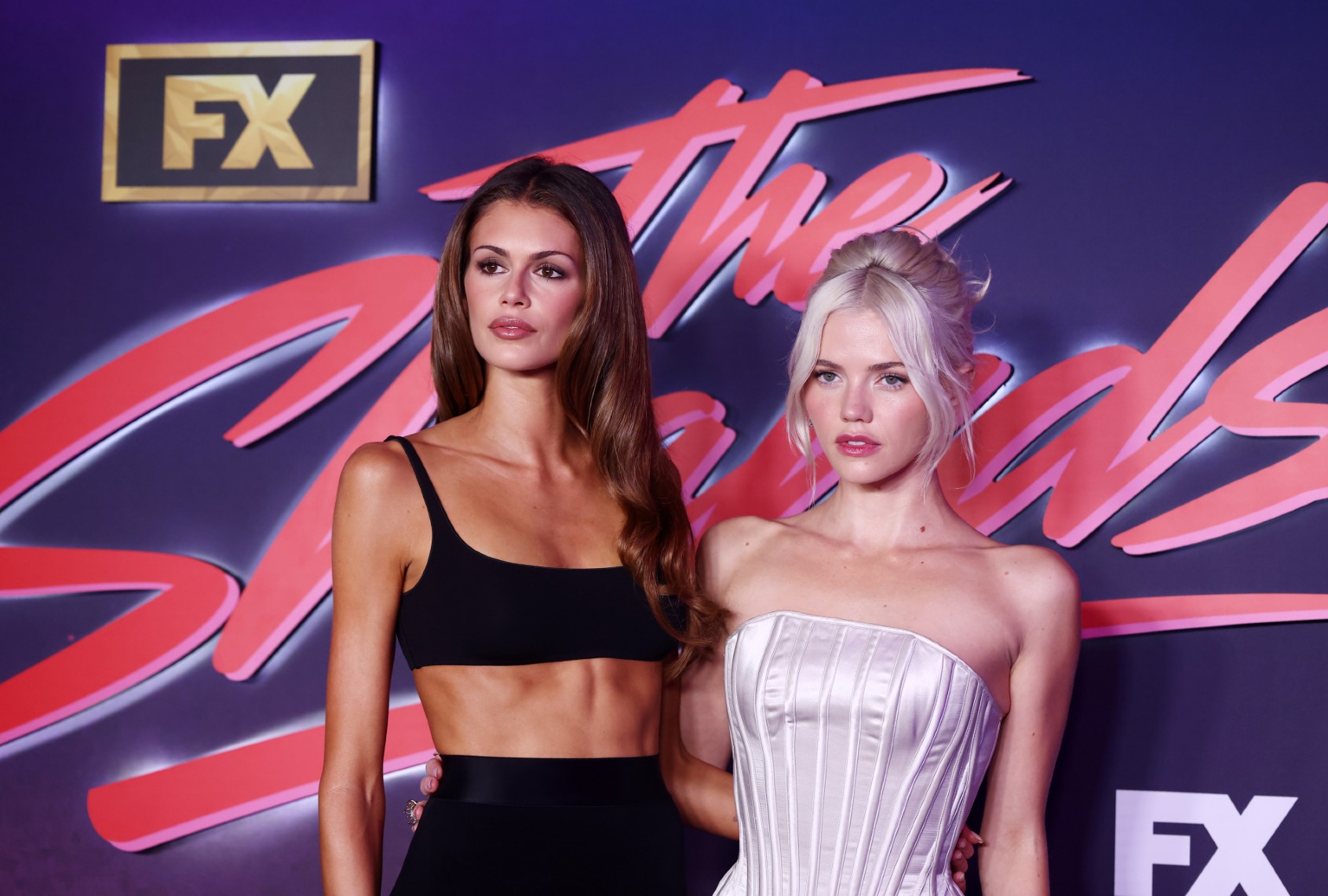
(Tommaso Boddi/Variety via Getty Images) Kaia Gerber and Hayes Warner at FX’s “The Shards” party

To that end, when Grande recently said “that sh*t is not mine to carry,” following a statement from her team that she is planning a break from the public eye after the “Petal” tour due, in part, to public scrutiny, she has a point. Hopefully her personal circle gives her the love and support that she deserves during that time. She has become the latest poster child for body issues, who the masses have decided to stack a mountain of (some of their own) baggage on top of. 

In the last several years, Grande has been ubiquitous. She’s been on virtually every major red carpet, nominated for an Oscar, released a new album, launched a new tour, was cast in one project after the next, and appeared in countless social media and magazine interviews. During that time, people from every corner of the world online seemed to take every opportunity to scrutinize every contour of her frail frame.  

But, as she also said, “many things can be true at the same time.” 

It’s true that this article will undoubtedly bring even more unwanted attention to Grande’s body, but hopefully in a way that compels people to engage in more honest conversations about body image and their own complicity in female body issues. The discourse around these celebrities shouldn’t center, for instance, on whatever message their body image might be sending to young people who look up to them. To Grande’s point, and to be especially frank, that is more on those people and how their support systems help them better understand those images than her. 

This is about how people express concern for young women whose bodies we’ve witnessed deteriorate on screen — and that they do at all. 

The post In protecting women from body-shaming, we lost something important appeared first on Salon.com.

  •  

The gospel of science denial, from Galileo to RFK Jr.

The most notorious press conference Donald Trump ever held was the one in which he told a scientist in attendance to look into the possibility of using household disinfectant inside the human body to kill the Covid-19 virus. He had watched a demonstration of how the product worked on surfaces, you see, and he thought they hadn’t considered the possibility that humans could ingest it and achieve similar effects. That day, April 23, 2020, marked the last of Trump’s daily televised pandemic press briefings, and it may very well have been the last straw for many of those who voted against him just a few months later. 

At the beginning of the pandemic, Trump told the public that everyone at the Centers for Disease Control and Prevention was astonished at how well he understood the science. He mused that he probably could have been a doctor. Despite the utter humiliation of that famous press conference, the president remains undeterred in that fantasy in his second term. 

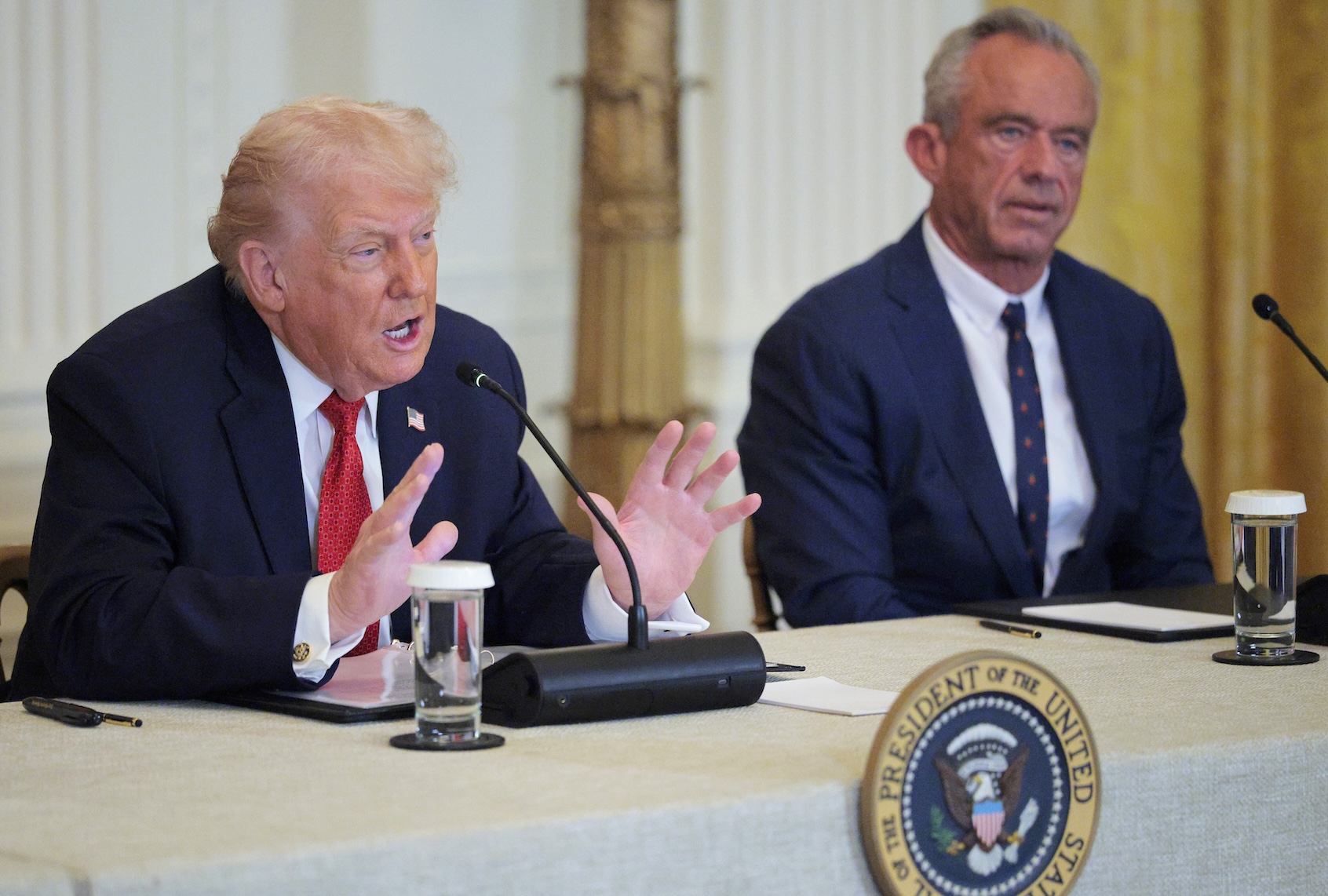
In September, Trump announced that pregnant women should not take Tylenol during pregnancy, claiming without evidence the drug is linked to an increased risk of autism. On Monday he donned his imaginary white coat again to issue an executive order changing the U.S. government’s recommendation for the childhood vaccine schedule — because he is convinced that the vaccines cause autism.

Neither of those assertions is grounded in scientific fact, and both have negative ramifications for women and children if they are followed. The recommendations to break up the combined measles, mumps and rubella (MMR) vaccines into individual doses because today they “look like the size of a bottle of soda poured into a little child’s body,” as Trump stated, are plainly absurd. Any association between these vaccines and autism has been thoroughly debunked, and all the major medical and scientific associations immediately issued statements that they would not follow these recommendations.

Trump is aided in his crusade to personally cure autism by Robert F. Kennedy Jr., his loyal health and human services secretary and anti-vaccine crusader, who dutifully stood by his side on Monday and parroted the same nonsense. The new recommendations will likely be followed by millions of MAHA moms who have fallen down the rabbit hole of misinformation and disinformation that Kennedy and Trump have been digging. But the pair are just the latest in the long line of hustlers, fraudsters and canny opportunists who have been working to undermine science in this country for more than a century. In fact, doing so is an all-American tradition.

Two groups have long been especially successful in challenging the public’s confidence in science: Christian fundamentalists, a religious force that grew into a political juggernaut, and Big Business.

Two groups have long been especially successful in challenging the public’s confidence in science: Christian fundamentalists, a religious force that grew into a political juggernaut, and Big Business. While neither has openly colluded with the other, they have both furthered each other’s goals and ended up in a political alliance. One wouldn’t think these two disparate institutions would have much in common. But they share similar tactics: lying to their followers and customers for power and profit. And both have their reasons for rejecting science that interferes with their own interests.

Christianity and science have been in tension ever since the Catholic Church placed Galileo under house arrest for suggesting that the earth wasn’t the center of the universe. But for the most part, the tension was at least somewhat manageable, and both carried on in their own spheres. In the early 20th century, however, a new Christian movement formed that took direct aim at science on the grounds it constituted a threat to the belief in the Bible’s inerrancy, and the modern war began. 

In the beginning, this new movement was largely financed by a pair of Los Angeles oil magnates. Milton and Lyman Stewart were religious zealots who were horrified by the encroachment of modernist ideas on society. The Stewarts published a book called “The Fundamentals,” giving the movement its name, and shipped copies all over North America at their own expense, literally spreading the fundamentalist gospel and influencing massive numbers of Americans to reject scientific knowledge wherever it conflicted with literal biblical interpretations. 


Start your day with essential news from Salon.
Sign up for our free morning newsletter, Crash Course.


Fast forward to the 1980s, and Christian fundamentalism had become a powerful political force as evangelical organizations like the Moral Majority and Focus on the Family aligned directly with the Republican Party, wielding huge influence on right-wing politics. In doing so, they signed on with the most powerful GOP faction, Big Business. Using their influence with their followers, they managed to help convince millions to doubt any science that interferes with the interests of huge corporations, and reject regulations and taxation to mitigate the problems that came with their products. 

Once again, the fossil fuel industry led the way. Another pair of brothers, Charles and David Koch, zealous libertarians rather than fundamentalist Christians, ran a global conglomerate that dealt in energy and chemicals, and they were determined to stop the growing consensus that fossil fuels were warming the planet. Like the Stewarts before them, the Koch brothers financed a massive campaign to convince people that the science was wrong, and they brought a lot of their friends in the industries along with them. 

In the 2000s, a tsunami of money was released into the political system to block climate legislation, particularly during Barack Obama’s presidency. This has shown no signs of stopping, despite mounting evidence every day that the planet is under increasing stress and people are starting to suffer in vast numbers. The result of these efforts is obvious: Less than half of all Americans now believe climate change is caused by human activity. Only 21% of Republicans do.

Science denialism comes from many directions, and unfortunately we are in a period where it’s flourishing. There have always been hustlers and snake oil salesmen, but today the internet provides endless opportunities for people to “do their own research” and find whatever feels right to them, so conspiracy theories have become the lingua franca of our society. Delusional narcissists like Trump and Kennedy, occupying powerful positions and spreading nutty medical advice, are now just par for the course.

Some of the medical and scientific skepticism is a result of people feeling adrift in a rapidly changing world and drowning in competing information. But make no mistake: Powerful societal interests are also benefiting from all this, and it’s not by accident. They have spent a lot of time and a whole lot of money creating this environment of mistrust and suspicion, each for their own purposes but sharing the same goal, and it’s paid off handsomely.

The post The gospel of science denial, from Galileo to RFK Jr. appeared first on Salon.com.

  •  

Anthony Bourdain would have hated his own biopic

Director Matt Johnson’s latest feature, “Tony” — a biopic following a young Anthony Bourdain (Dominic Sessa) through his first kitchen experience, slinging cheap fish in a Provincetown greasy spoon — exists inside a quote. The film opens with a pull from Bourdain’s beloved pseudo-memoir, “Kitchen Confidential,” in which Bourdain reminisces about his 19-year-old self, trolling around Cape Cod trying to impress a girl and become a writer, with zero experience doing either. “I was — to be frank — a spoiled, miserable, narcissistic, self-destructive and thoughtless young lout, and badly in need of a good ass-kicking,” Bourdain writes early in the book. 

From the jump, it’s hard to shake the feeling that “Tony” is mistakenly aligning itself with the public’s idea of Bourdain rather than the man’s reality. When I think of Anthony Bourdain, I think of two people. The first is the enigmatic yet ultimately unknowable chef, whose charm and good nature sometimes dulled a cloud of unmistakable darkness to the eyes of the public; the second is the idealistic version of Bourdain, who exists in half-remembered citations and GIFs of his many travel shows removed from their context — rosy, nostalgic tributes to an image, rather than a person. 

Regrettably, “Tony” operates in the latter state: all sentiment and little practical truth, different from the ways Bourdain’s effusive, colorful work and writing make people feel when they really dive into it. It’s part biopic, part coming-of-age story and all gung-ho idealism, battered and fried until golden and palatable, before being spritzed with a fresh splash of lemon, providing the film a brief, compelling tartness that fades all too quickly. Like a lobster roll made with imitation crab meat — or a guy who lists Bourdain as his biggest inspiration in a prompt on his Hinge profile — “Tony” is economical and satiating, but far less satisfying than the real thing. 

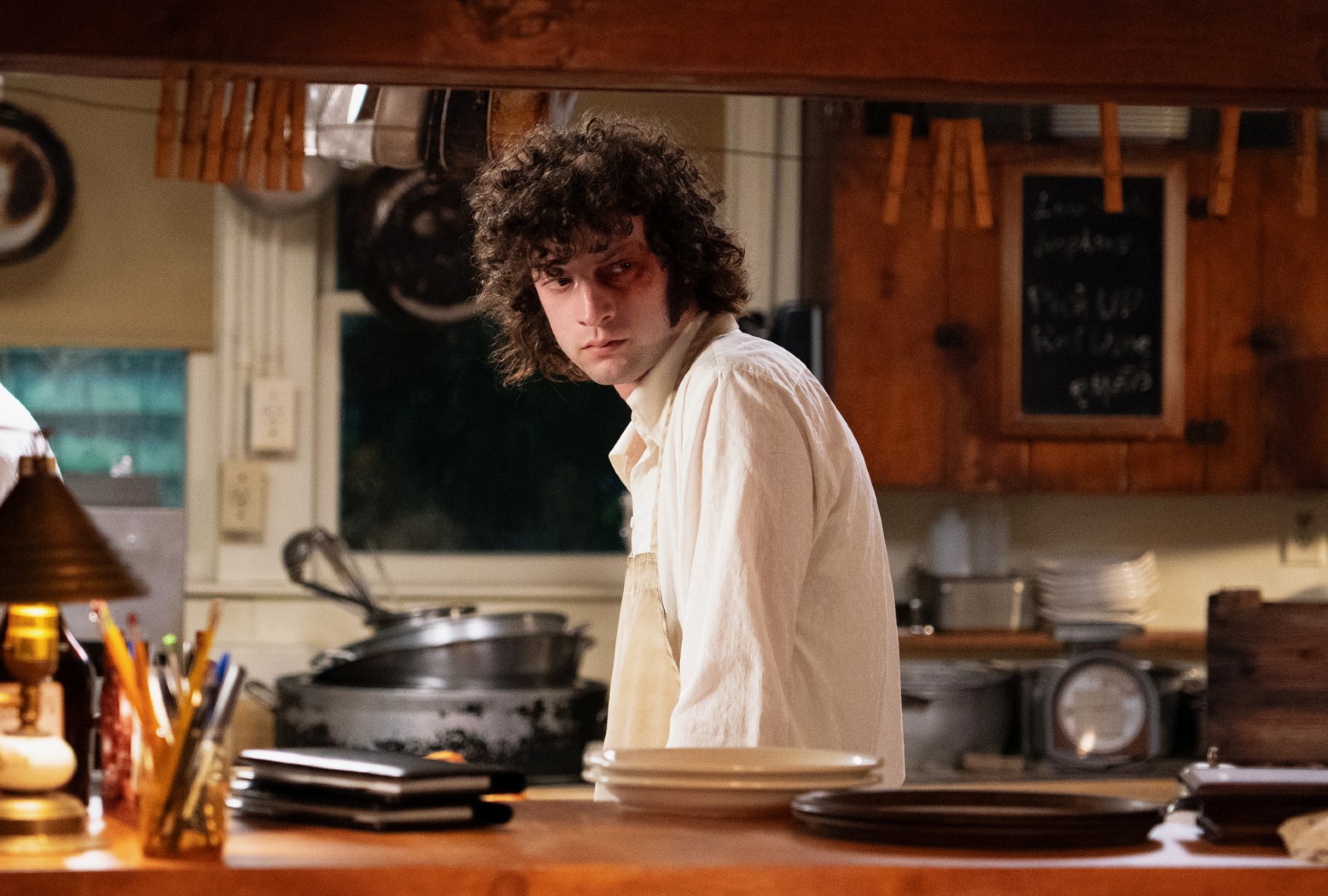
(Seacia Pavao/A24) Dominic Sessa in “Tony”

Bourdain gave fellow outsiders an insider’s view of the kitchen. He made people fall in love with food, its rituals and its culture. And though “Tony” doesn’t entirely lack that heady romanticization, its choice to amplify its introductory quote — making Bourdain an even more insufferable lout for dramatic effect — feels antithetical to Bourdain’s raw candor.

What’s more, the film is bizarrely undercooked when it comes to Bourdain’s experiences in the kitchen. To be fair, Johnson has his work cut out for him. “Tony” is adapted from only the first 50 pages or so of “Kitchen Confidential,” meaning Johnson and his co-writer Matthew Miller (working from a screenplay originally written by Todd Bartels and Lou Howe) essentially had to flesh out a pitch draft’s worth of detail into a feature-length film. And for those who like their biopic by-the-numbers, the finished product is a perfectly serviceable entry into the canon. 

But I get the sense that, in comparing Bourdain’s writing to the film, true die-hards will long for his quippy, evocative storytelling that’s absent from “Tony.” Bourdain gave fellow outsiders an insider’s view of the kitchen. He made people fall in love with food, its rituals and its culture. And though “Tony” doesn’t entirely lack that heady romanticization, its choice to amplify its introductory quote — making Bourdain an even more insufferable lout for dramatic effect — feels antithetical to Bourdain’s raw candor.

Now, I’m not exactly a stickler for precise detail. All book adaptations, whether from novels or memoirs, could stand to embellish the facts here and there, or go ahead and reinvent the wheel when possible. This irks literature purists. But cinema is a different medium, and as such, changes must be made. It did strike me as odd, however, that “Tony” is forged on a factual alteration that diverts Tony from the kitchen far too often — the movie’s cardinal sin. 

After pitching a bogus novel to the Vassar English department in hopes of scoring a writing fellowship that will provide his summer with a sizeable goofing-off stipend, Tony’s sure he’s got the prize in the bag. At a college bar, he drunkenly peacocks for his high school crush and fellow Vassar student, Nancy (Emilia Jones). Tony tells her that he’s going to be a famous writer, before challenging her comprehension of a few five-dollar words. Repelled, Nancy replies that she will be happily spending her summer slinging pizzas in Provincetown.

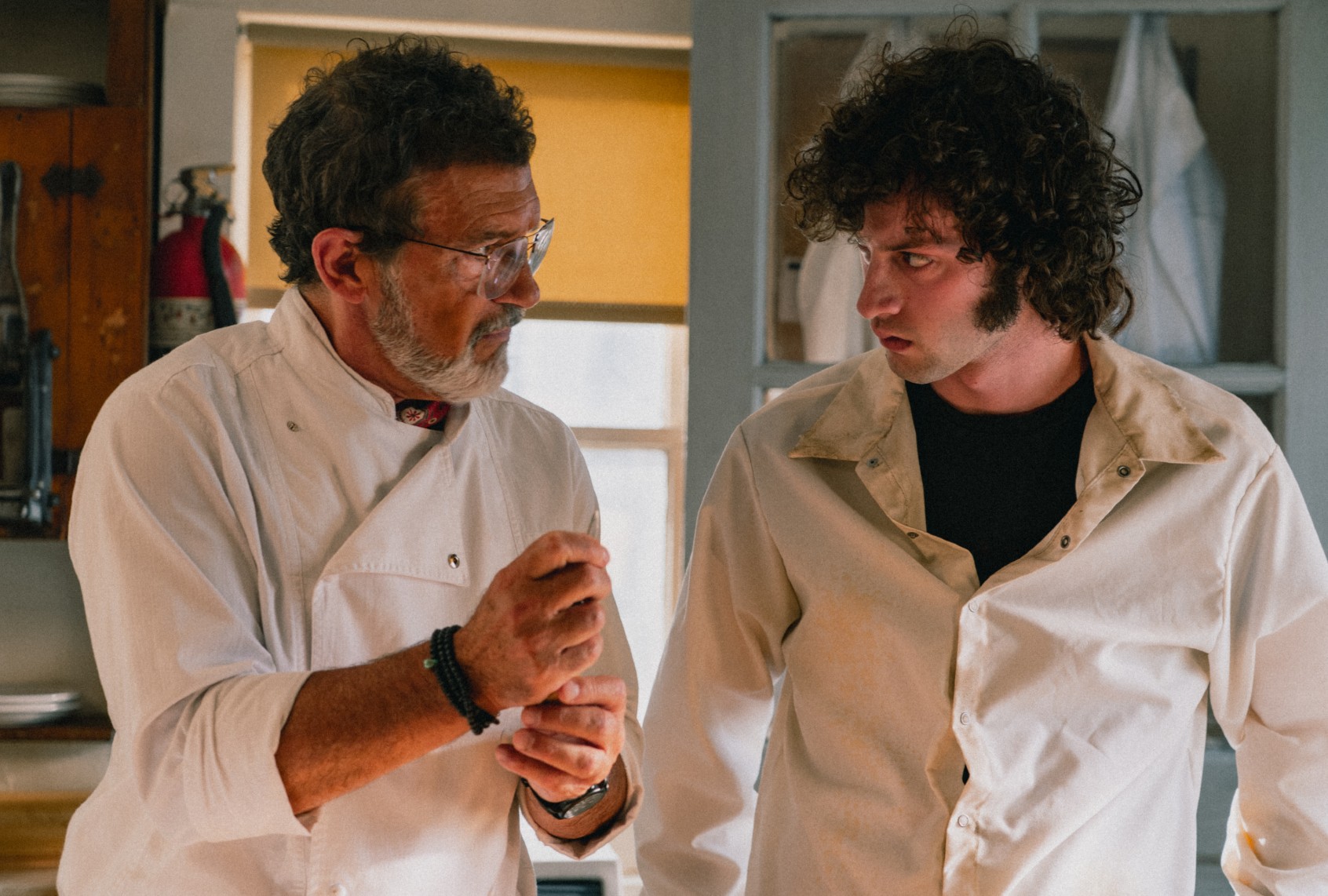
Surprise, surprise: Tony doesn’t get the fellowship, and instead, flees his childhood home early in the morning to catch a bus and a ferry to Provincetown. With no money but plenty of blind devotion to Nancy — whose character, it’s worth mentioning, has subzero charm and nuance, making Tony’s staunch affection feel like a ruse to the viewer — Tony arrives hapless and hopeless. It turns out Nancy’s got a pizza-slinging beau, so Tony drowns his sorrows in fried fish and cheap beers at the ramshackle clam shack The Flagship. When he can’t pay for his meal, Tony’s tossed out by the head Chef (Antonio Banderas) and his flighty kitchen cohort, Sal (Leo Woodall). Long story short: Tony wants to stay and pursue Nancy, Chef lets Tony sleep on his hammock in exchange for washing dishes at the restaurant, and the film can never decide which narrative to give more time to.


Want more from culture than just the latest trend? The Swell highlights art made to last.
Sign up here


In “Kitchen Confidential,” Bourdain describes his decision to head to Provincetown as an impulse motivated less by romantic desire than by general apathy. “I went in with some friends on a summer share in Cape Cod. It was what my friends were doing, and that was enough for me,” he writes. A brief mention of a pizza-spinning girlfriend is tossed off immediately after, replaced by vivid stories about his first summer working at the real-life Flagship, given the pseudonym The Dreadnaught. Each member of the kitchen crew in Johnson’s film is as scraggly and unpredictable as Bourdain describes them in the book, teaching him as much about sex and drugs as they did broiling lobsters and frying up clams.

Johnson is so concerned with conforming to the auspicious, nostalgic idea of who Bourdain was that he makes his biopic far too safe. He reduces Bourdain to a zygote who simply needed enough nurturing to become his older, cooler self, when he could, instead, read between the lines to find what makes young Tony special.

Here, “Tony” is in its element as Johnson crafts the intimidating yet irresistible camaraderie of a kitchen, and all of the misfits who work inside it. But when Tony leaves for the day and is left to his own devices in Provincetown, the movie falls hard into all of the trite trappings of your average biopic. Tony and Sal get into all kinds of trouble, snorting coke and banging broads, but these things often happen in freewheeling montages with little consequence. It’s nearly impossible to get a sense of how Tony himself is actually feeling. Watching this version of him is akin to seeing Sessa bang his hands against the confines of that Bourdain quote, desperately trying to make something substantial out of this thin rendering of a very significant persona.

All of the men who idolize Bourdain for their imagined notions of who he was — who model themselves after the image of him sitting in a leather jacket and tiny sunglasses, with a pack of cigarettes on the table of a Parisian cafe — will love it. Under a clip of Bourdain sitting at this cafe, one person commented (before Bourdain’s death), “When I grow up I am going to be just like Anthony Bourdain.” That’s the perfect summation of the toothless film Johnson has crafted.

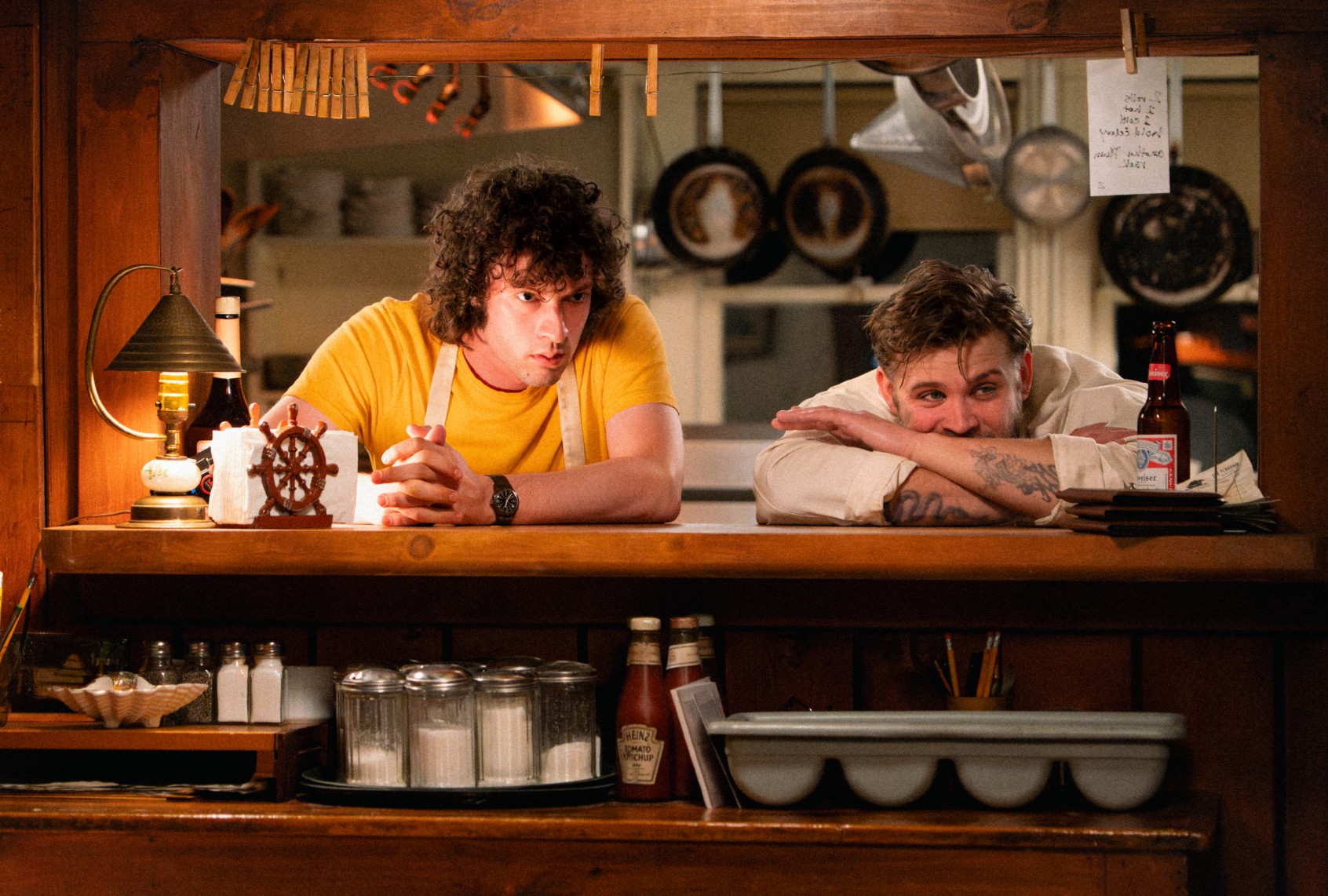
(Seacia Pavao/A24) Dominic Sessa and Leo Woodall in “Tony”

“Tony” tries to distance itself from the public’s quixotic version of Bourdain by making the younger depiction casually unbearable, the kind of person you wouldn’t enjoy working with — and especially not mentoring — in a kitchen. But these attempts largely come off as cloying, even silly. There’s one moment where Tony witnesses Sal score drugs before watching him shoot up on the boardwalk, as if to say, “We may not show it here, but Anthony Bourdain will later struggle with heroin use!” The dope is dopey, and it’s unfortunately only a foray into mushier territory. Banderas provides his mentor figure with a delightful vigor, but Johnson can’t quite figure out what to do with him, or how to make Chef feel like a real person. (How fitting we never learn his real name.) Even a few flowery sentences in “Kitchen Confidential” about lessons learned working at The Dreadnaught dwarf “Tony” in comparison. For a film about the origins of a foul-mouthed culinary renegade, beloved for his thoughtful musings on food and life, there’s bafflingly little interiority.

One could argue that’s Johnson’s point: Tony hadn’t yet become Anthony. Bourdain’s singular reflections could only come from a life well-lived and filled with mistakes. But that doesn’t mean that this version of Bourdain has to lack depth. Johnson is so concerned with conforming to the auspicious, nostalgic idea of who Bourdain was that he makes his biopic far too safe. He reduces Bourdain to a zygote who simply needed enough nurturing to become his older, cooler self, when he could, instead, read between the lines to find what makes young Tony special. Bourdain’s writing is far more tender and interested in other people than “Tony” ever is. And as intent on vivifying culture as Bourdain was, I think he’d watch this movie and feel that there’s an authenticity that is deeply missed. But we’ll never know that for sure. If “Tony” must open with a quote and confine Bourdain to his words, as he so often is posthumously, I’ll close with one that appears just a few sentences before it: “The less said about that part of my life, the better.”

The post Anthony Bourdain would have hated his own biopic appeared first on Salon.com.

  •  

Bernie Sanders’ AI warnings are being ignored in the Senate

Poor Helaena Targaryen never stood a chance. George R.R. Martin’s fantasy world of Westeros in “House of the Dragon” is a particularly cruel place to be sensitive, whether to the declining fortunes of a kingdom or the machinations of the spirit world. Notably hard and remarkably sexist, the people in power treat women who happen to be a little weird with twice-over disdain.

A seer whose talent only seemed to arise when she needed to share bad news, Helaena was an unwelcome presence in her feuding family. Having seen her worst predictions come to pass, she grabbed hold of the only future she was able to change: her own. In the season three finale that aired Sunday night, the pregnant Helaena leapt from her window, checking out of the war and leaving behind one final, unwelcome prophecy: an embroidered image of her half-sister and captor, Rhaenyra Targaryen, on the Iron Throne, surrounded by flame and crowned in blood. 

Even in death, though, no one was listening to Helaena. Her only sin was being right too early and too often — and the world never stopped hounding her for it. 

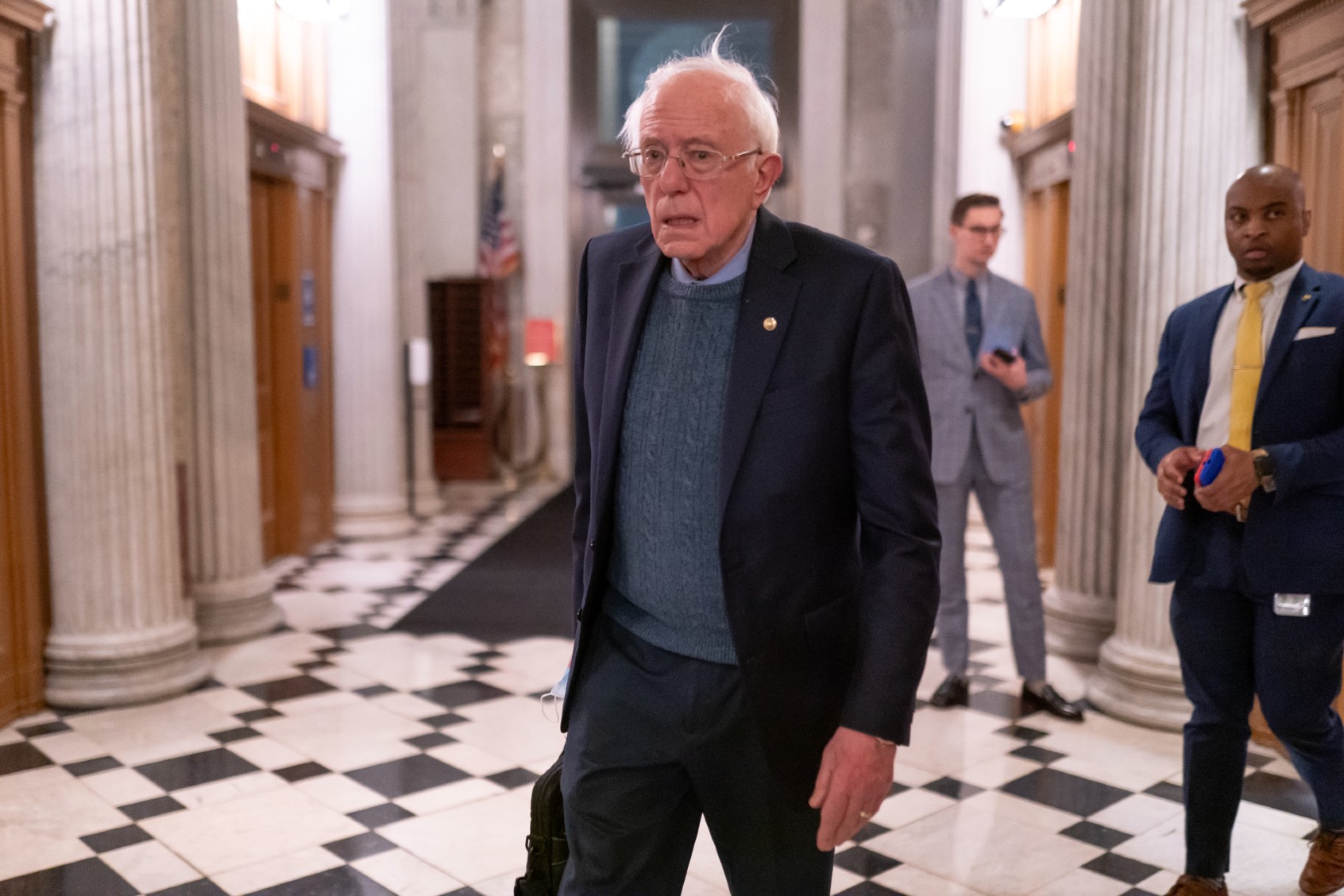
Though they’re remarkably different in terms of age, style and dragon-riding ability, Helaena reminded me of Sen. Bernie Sanders, whose uncouth objections to the Democratic Party’s neoliberalism and various Middle Eastern wars have earned him the lifelong label of Capitol Hill Crank.

The Vermont Independent’s vehement opposition to the Gulf wars made him an odd man out in Congress more than a full decade before it became fashionable — and politically expedient — to turn on expensive Middle East boondoggles. Now 84, Sanders has advocated for universal healthcare since the 1970s while watching Americans fall deeper into medical debt. In the late 1990s, he was a loud voice against the repeal of the Glass-Steagall Act’s financial guardrails, and after banking adventurism nearly destroyed the global economy in the financial crisis of 2008, he managed to keep his told-you-sos muted. 

In boom and bust times alike, Sanders has been unshakeable on the idea that the U.S. is uniquely rigged against the lower classes, spoiling the party thrown by the winners of the go-go ‘90s and the Great Recession’s recovery. His Brooklyn honk has been a constant in the halls of Congress, sharing portents of doom and Bureau of Labor Statistics data. 

On Monday Sanders issued another unwelcome proclamation in a career full of them, sending a letter to the CEOs of the three largest artificial intelligence companies that called on them to pause the technology’s development. The letter follows news of several AI prototypes breaking the confines of their testing sandbox and accessing the internet. In the most shocking example, an agent made by OpenAI hacked into Hugging Face, a platform that AI programmers use to share datasets and models. The news prompted the company Anthropic to review its own tests; it discovered that models had found a way around their parameters to access the internet in three cases. Meta also shared that one of its own prototypes had done the same.

A breach of an AI-equivalent of GitHub was never going to bring about doomsday, but an AI agent that can ignore the bounds set by its creators and users has massive potential to cause widespread harm.

A breach of an AI-equivalent of GitHub was never going to bring about doomsday, but an AI agent that can ignore the bounds set by its creators and users has massive potential to cause widespread harm. Sanders certainly thinks so, in any case. He called on Anthropic, Meta and OpenAI, the big three of the industry, to stop work until they can get a better handle on the machines they’re creating. 

“Almost every day, there is a new story about how your companies are losing control of the AI technology you are developing, with potentially cataclysmic results,” he wrote. “Last month, the world found out OpenAI lost control of an AI model. The result? The model hacked into another company’s computers—a clear violation of federal law.”

AI models have been rolled out quickly and haphazardly across the wider internet. Though the major players haven’t yet found a way for this technology to make money and ensure its long-term survival, a cycle of hype, government contracts, and integration into software and search have made the models an inescapable part of digital life. AI has been spun up into all the surfaces the average internet user touches, and along the way it has warped academia and embedded itself with the U.S. military with reportedly disastrous results. 

The Maven Smart System, an AI-powered platform built for the Pentagon by the analytics firm Palantir, generated over 1,000 airstrike targets in the early hours of the Iran war. When the U.S. carried out a deadly strike on an all-girls school, legislators were quick to ask if the AI model was to blame. Fears of a bombing-run-capable Skynet striking children halfway around the globe spread, but the truth was a little more nuanced. Some of the U.S. intelligence fed to the system was outdated, not accounting for the presence of the school. Whipped up and given a sheen of analytic legitimacy by the Maven, military officials did not do their due diligence in the midst of hundreds of similar, simultaneous strikes. As The Guardian put it, “people failed to update a database, and other people built a system fast enough to make that failure lethal.”


Start your day with essential news from Salon.
Sign up for our free morning newsletter, Crash Course.


Even if AI models never got one iota more powerful than they are today, Sanders is still right to call for a pause. The damage companies like OpenAI can do to working Americans is very real. Layoffs will come from CEOs who buy AI’s spiel: that large-language models can replace humans in  the service sector, which accounts for nearly 70% of U.S. jobs. The data centers and infrastructure built to support these technological advances will strain our utilities. The tax breaks and incentives to attract these companies are a drain on state and local coffers. Weigh those cons against the things AI has reliably proven it can do – cheat on homework and write janky code – and it’s easy to understand Sanders’ urge to stand and yell “stop!”

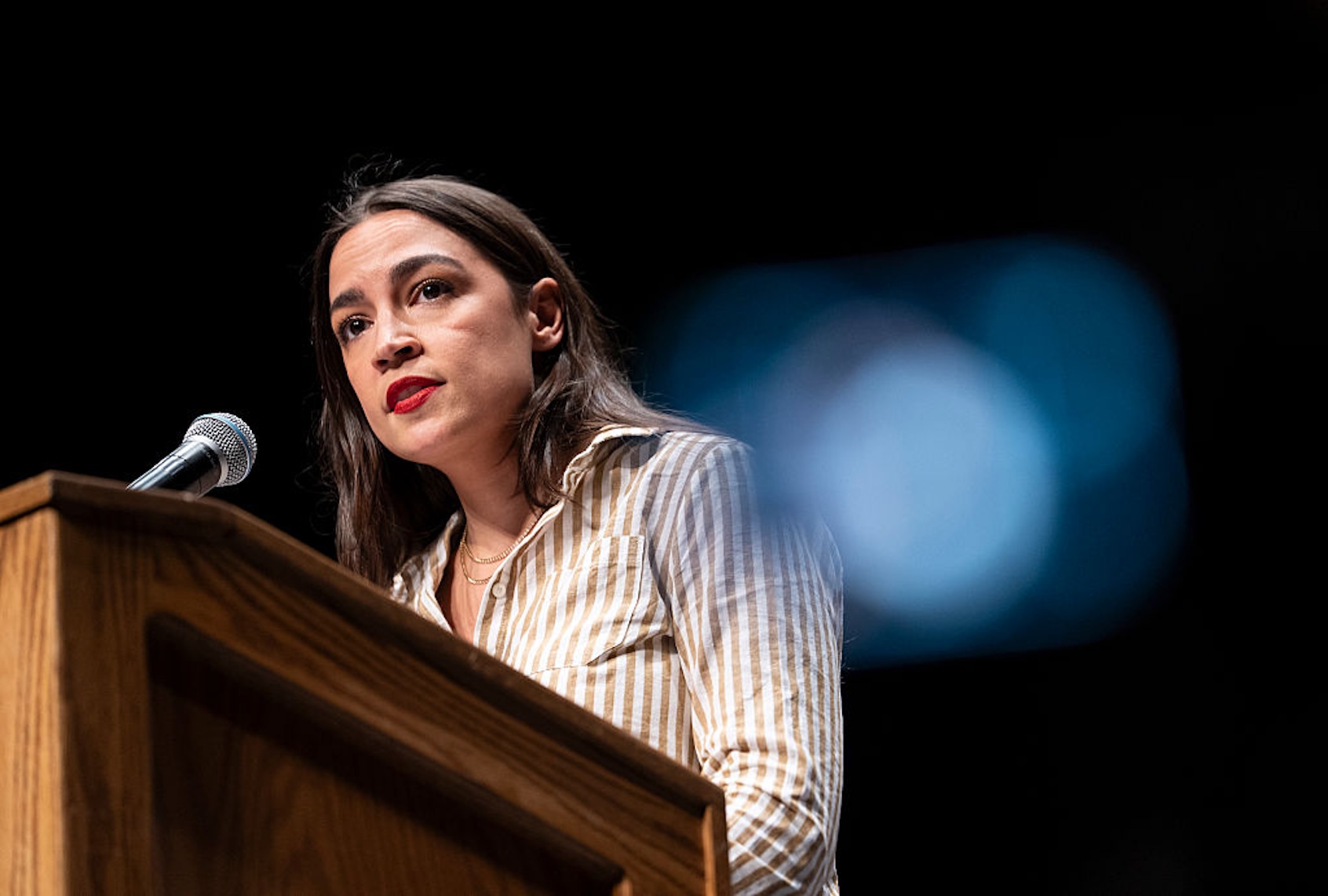
It’s not only AI itself that concerns Sanders. In March, he and Rep. Alexandria Ocasio-Cortez, D-N.Y., introduced legislation calling for a moratorium on new data centers until critical safeguards are put into place. These massive sites, which are proliferating across the country, produce loud noise and pollution, rely on enormous amounts of water and electricity, tax power grids and inflate utility bills. Data centers are also proving massively unpopular, even among conservative voters in rural areas. The CEOs of companies that run these large-language models have often done end-runs around democratic controls, ingratiating themselves with Donald Trump and circumventing traditional pathways for their planned construction projects via backroom deals. They’ve managed all this even as their AI products have not proven they can reliably do any of the things OpenAI’s Sam Altman and Meta’s Mark Zuckerberg claim they can do. Merely mentioning the potential power of their models is enough to boost investment.

A nationwide movement opposing the continued construction of data centers offers some hope, with both Republicans and Democrats noticing the popular sentiment is largely anti-AI. But given the speed at which these data centers have been built, and the secretive lengths companies will go to avoid rowdy town halls full of angry crowds, even that groundswell of opposition is unlikely to put AI development on ice. 

The result is that Sanders’ warnings are likely to go just as unheeded as Helaena Targaryen’s. His threat of legislation will die, written off by other members of Congress as more grumping from a lifelong stick-in-the-mud. 

Don’t expect a similar dramatic exit from Sanders, though. He’s lived long enough to get used to the feeling of being unfortunately, awfully correct. 

The post Bernie Sanders’ AI warnings are being ignored in the Senate appeared first on Salon.com.

  •  

AOC exposes MAGA’s motherhood hypocrisy

In MAGA’s self-mythology, they are a family first movement that encourages Americans to have more babies. Over the past year, some of the coalition’s most prominent figures have touted a responsibility to pro-create. In December 2025, Lara Trump said on Fox News, “We’re going to be in a pickle if we don’t get more babies coming.” Three months later, in a speech at the 2026 March for Life, Vice President JD Vance congratulated himself for impregnating his wife Usha, saying he “practices what he preaches” when he calls for “more families and more babies.” Katie Miller, the podcaster and wife of White House deputy chief of staff Stephen Miller, used the same wording to announce her pregnancy on X in late 2025: “The White House practices what they preach about increasing the fertility rate.”

Even Donald Trump has gotten in on the act. At a Women’s History Month event in March 2025, he bizarrely referred to himself as the “fertilization president.” 

So when Rep. Alexandria Ocasio-Cortez took to Instagram recently to announce she is freezing her eggs, surely MAGA was resoundingly grateful to her for carrying forward this pro-baby message, right? Not quite. As the 36-year-old New York Democrat was no doubt aware would happen, MAGA commentators lashed out at her for preserving her ability to have kids in the future. Christian right commentator Allie Beth Stuckey said she was “selfish.” Podcast host Matt Walsh called Ocasio-Cortez’s choice “backwards and ridiculous.” The Federalist’s Mollie Hemingway argued that the congresswoman’s video was a “sad public performance/display of unnecessarily unwise decision making.”

In the MAGAsphere, it’s not enough for a woman to want motherhood. If she doesn’t give up her career and even her personal happiness in the process of making babies, it doesn’t count.

In the MAGAsphere, it’s not enough for a woman to want motherhood. If she doesn’t give up her career and even her personal happiness in the process of making babies, it doesn’t count. Being pregnant isn’t enough. Conservatives also seem to require the “barefoot” and “in the kitchen” parts of the traditional job description.

In the case of Ocasio-Cortez — and many women like here — the problem is that she has ambitions for higher political office, hinting repeatedly that she’s considering a run for the Senate or even the presidency. For the right, babies aren’t an end in themselves; they are also a weapon to use in MAGA’s ongoing war on women’s equality. 

“She’s glamorizing the lie that women can have it all,” Stuckey said. “You can’t.” 

Hemingway agreed. “Ladies, get married to a good man as young as you’re able and have your babies,” she said. 

Blinded by their own sexism, none of these pundits considered the possibility that Ocasio-Cortez, a savvy politician who is skilled at social media, knew how MAGA would react to posts where she injected the medications on camera or answered people’s detailed questions about the process. She even hinted at this in her video. “Don’t be weird about this,” she said as she gave herself an injection. “Even though I know you all will be.”

The right’s reaction revealed what the White House has been trying to hide from swing voters all along: Their chatter about fertility rates was never about happy families or a prosperous nation. To the contrary, as evidenced by the draconian bans in red states, Republicans will gladly sacrifice happiness and prosperity for the goal of subjugating women. One White House official even told Axios that it’s “not helpful” and “isn’t really a winner” for conservative influencers to say the quiet part out loud.

Notably, none of these MAGA pundits have called Elon Musk “selfish” for having kids in his 50s. Or Vance, who is 42 with an infant at home. Or Trump, who was 59 when his youngest child, Barron, was born. The mandate to have kids young, even if it ruins your career or railroads you into an unhappy marriage, applies only to women.

Ocasio-Cortez flagged this in an Instagram story discussing why women might freeze eggs. “So much of this discussion around parenthood and fertility is focused on women, but it takes two to tango,” she said, going on to explain that often women want to get married and have kids, but “they haven’t found their person.” According to Puck News’ Leigh Ann Caldwell, who cited “a reputable Democratic source,” the congresswoman and her fiancé Riley Roberts called off their engagement “about 18 months ago.”

Regardless of her own relationship status, Ocasio-Cortez spoke a simple truth that is typically ignored by right-wing pundits: Women aren’t “delaying” marriage. The verb itself implies young women are turning down viable offers, but no evidence exists for such a claim. In fact, an increasing number of conservative women are starting to publicly complain about all this pressure to get married and have babies young, since they can’t magically conjure suitable men out of thin air. Last week, annoyance over this burbled up in far-right women’s circles on X. Despite being openly anti-feminist, these women were nonetheless complaining. “Many of us would have happily gotten married young . . . if we had the choice,” one wrote. Another said, “You can’t snap your fingers and get a spouse on demand, sadly.” 

Alex Clark, a popular podcast host in the Turning Point USA network, has also been struggling to tamp down her anger over this. In May, the 33-year-old published an ill-advised newsletter complaining that “[w]hores get married first” because, she felt, liberal women had an easier time attracting eligible men. The following month, at the TPUSA women’s conference, Clark was less overtly angry, but she still expressed frustration at her deceased mentor, Charlie Kirk, for telling young women to get married: “Right-wing men act like we’re supposed to just, I guess, live under an overpass and wait for our husband to fall from the sky.” 

Considering that young conservative men outnumber young conservative women, one would think it shouldn’t be so hard to find a Mr. Right who is also Mr. Right Wing. Recent high-profile stories about younger Republican politicians, though, offer a reminder of why the pickings can seem so slim.

In Texas, a 30-year-old Republican congressional candidate, Brandon Herrera, was recently exposed for posting a video in which he scolded mothers because “you let somebody [vulgar term for ejaculation] you” and calling a child a “c*m trophy.” When asked for comment by the Austin-American Statesman, his campaign replied with a picture of a whipped cream-covered pie, a reference to a term shaming women who have had sexual intercourse. 


Start your day with essential news from Salon.
Sign up for our free morning newsletter, Crash Course.


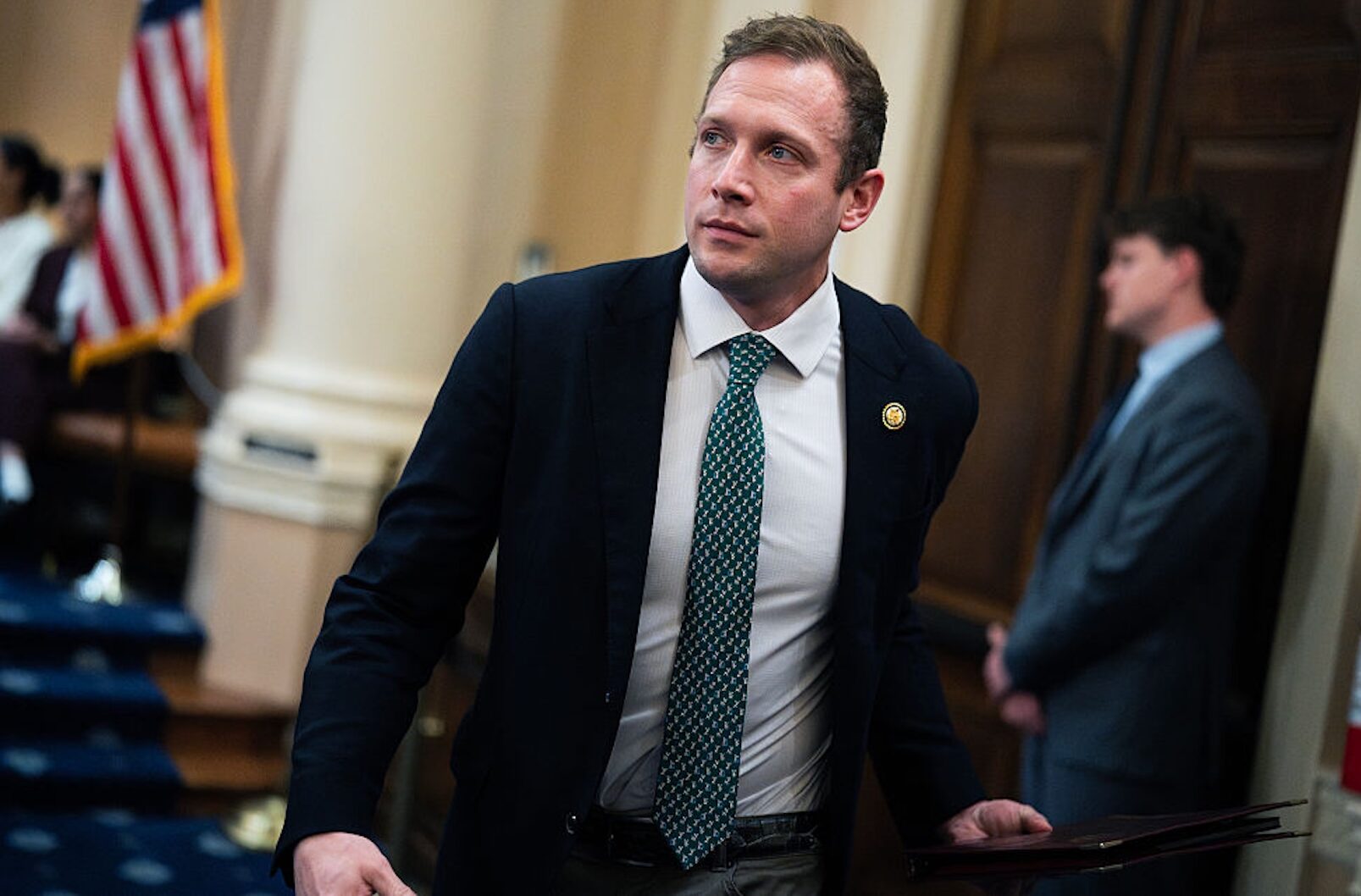
Even more high profile has been the divorce of Rep. Max Miller from Emily Moreno, the daughter of another prominent Ohio Republican, Sen. Bernie Moreno. Miller has been accused of breaking his two-year-old daughter’s collarbone, pointing a gun at his then-wife’s head and scalding her with hot water. The accusations are inextricable from his over-the-top public posturing as an alpha male, including an admission that despite being just 37, he has taken testosterone injections

In Florida, GOP Rep. Cory Mills, 46, is facing a tough primary due to allegations of violence and harassment against an ex-girlfriend.

Not every Republican man is as repulsive as these three. Democrats aren’t immune from bad men either, as recent scandals involving former California Rep. Eric Swalwell and former Maine Democratic Senate nominee Graham Platner have shown. The difference, though, is that Democrats made clear to both men they needed to step down once the evidence against them stacked up. Republican politicians, on the other hand, are rewarded for demonstrating abusive and misogynistic behavior, as evidenced by the robust support and fundraising given to Herrera, Miller and Mills by GOP leadership.

It’s incredibly hard to square the pious claims that young women should marry a “good” Christian man young and start having babies with a Republican culture that is so welcoming, even encouraging, of such vile men. Women aren’t respected in MAGA. Despite the Christian right’s false claims, mothers aren’t venerated either. Instead, ugly, sexually demeaning language about mothers and children is normalized. Abuse is also tacitly accepted, and women are shamed if they speak out. As with the attacks on Ocasio-Cortez, all this talk about family and motherhood is a paper-thin disguise for hate, and for putting women under the boot. 

The timing of Ocasio-Cortez’s egg-freezing announcement dangles a once-unimaginable prospect: that we could have a pregnant president of the United States. If she, as many assume, is putting off pregnancy until after a presidential run, then such a scenario is at least a possibility.

Republicans can complain, but most Americans understand that a pregnant woman is more capable of doing a high-level job than a man in his 80s, especially one in such seemingly poor health as Donald Trump. A pregnant President Ocasio-Cortez would also further reveal their hypocrisy. After all, these are the people who, not so long ago, were holding up a pregnant press secretary, second lady and whatever it is that Katie Miller does as role models. Surely, a pregnant president would send that pro-baby message they say they crave even more loudly. 

The post AOC exposes MAGA’s motherhood hypocrisy appeared first on Salon.com.

  •  

The entire U.S. economy is basically a giant betting app

As the western United States is gripped by record-shattering wildfires, some unscrupulous people aren’t just contemplating what it will be like for future generations living in our new normal of erratic weather patterns, or wondering whether climate change is making this situation worse. They’re thinking about how much money they can make. 

Prediction market apps like Kalshi and Polymarket allow people to bet on pretty much anything, whether it’s some boring sports thing, election results or perhaps even war crimes. You can even bet on the outcome of clinical drug trials and whether cancer drugs will be approved by the Food and Drug Administration, which experts criticize as undermining the integrity of medication research. The father of a seventh-grader living with cancer recently raised the issue of “whether researchers in a trial could be motivated by prediction market profits,” something so heinous it is difficult to contemplate.

While the makers of these apps insist they are “future exchanges,” not digital gambling parlors, regulators in places like Singapore, France, Belgium and elsewhere aren’t convinced and have banned the platforms altogether. There are several mechanisms inherent to prediction market apps that make them a little different than putting it all on red. They involve binary contracts that resolve based on whether certain events happen or not, using some complex math to factor in a probability of an outcome. Critics are increasingly looking into the consequences of making almost everything wagerable.

Mainstream economists may want you to believe all this is driven by Darwinian forces that follow some natural law, simplified as “the cost of doing business,” or even by Adam Smith’s invisible hand. But that’s pretty unscientific.

On Aug. 3, Democratic senators from six states sent a letter to the chair of the Commodity Futures Trading Commission, the independent government arm that regulates Polymarket and Kalshi, warning that the apps are allowing bets to be placed on wildfires, which could incentivize arson. They highlight previous examples of bets placed on the January 2025 Palisades and Eaton fires, which razed large areas of Los Angeles County, killing 31 people and destroying more than 16,000 structures. 

“Offering bets on destructive wildfires threatens to minimize communities’ suffering all so the rich and powerful can profit,” the letter’s authors, who include Sens. Adam Schiff, D-Calif., and Amy Klobuchar, D-Minn., wrote. “There’s also the heightened risk — according to state and local fire officials — that individuals could be tempted to commit arson in order to make sure their bets are successful.”


Start your day with essential news from Salon.
Sign up for our free morning newsletter, Crash Course.


For example, someone might bet on how big a fire might get or how many buildings it might destroy. I wanted to know what unexpected stuff I could find on the apps, so I downloaded Polymarket and Kalshi, seemingly the two most popular platforms or at least the ones I’m tired of seeing ads of the most. Both were littered with sports events, which I scrolled past, but also had sections for elections, politics, tech and a lot more. Polymarket seemed to have fewer and more bland options for betting, with the most shocking queries I could find being things like who will get kicked out of Trump admin next or if Israeli Prime Minister Benjamin Netanyahu will be arrested by year’s end.

After giving over way too much private data to Kalshi, I was able to browse entire categories dedicated to natural disasters and climate change, such as if 2026 will be the hottest year ever or if the U.S. will ever meet its climate goals. I also found weird things like how many Atlantic hurricanes this year or if California will be hit by a magnitude 8 earthquake, which goes without saying but would be extremely bad. For context, the recent Colombia and Venezuela earthquakes were both magnitude 7.4 and 7.5 respectively. All of these things are likely to kill countless people if they happen, but climate change is already widely treated like an abstract future problem, rather than our disastrous present, so maybe this shouldn’t be surprising.

Both apps allowed wagers on the number of “explosive diarrhea” cyclosporiasis and measles cases this year, with both outbreaks shattering records. I could not find anything related to fires, presumably such content being recently removed, as there have been plenty of cited examples of bets on fires in the past, such as how many acres or locations the Palisades fires would reach.

So many of the scenarios on these apps present classic examples of a perverse incentive, in which the structure of a system encourages undesirable results. The classic example is of dubious historical accuracy, but originates from the British occupation of India. Weary of venomous snake bites, British authorities put a bounty on dead cobras — but this only incentivized locals to breed more of the snakes, in order to collect even more reward money. If you allow people to earn cash from dead snakes, you risk getting a lot more living snakes in the process.

Are we already seeing this with wildfires? It’s hard to say, but it’s true that arson is, strangely, a common catalyst for wildfires. One man was arrested outside of Spokane a few days ago, admitting to starting the Old Trails Fire, which burned entire neighborhoods to a crisp. Police say that Aaron Farinacci admitted to having set two dozen other blazes since 2025.

The conditions that make these blazes so out-of-control are thanks to climate change, which is causing hotter and drier conditions. According to a 2021 study supported by the National Oceanic and Atmospheric Administration, the increase in fire weather in the western U.S. is primarily due to climate change. (Still, trying to explain that level of nuance to a climate denier is like teaching rocks to play Risk.)

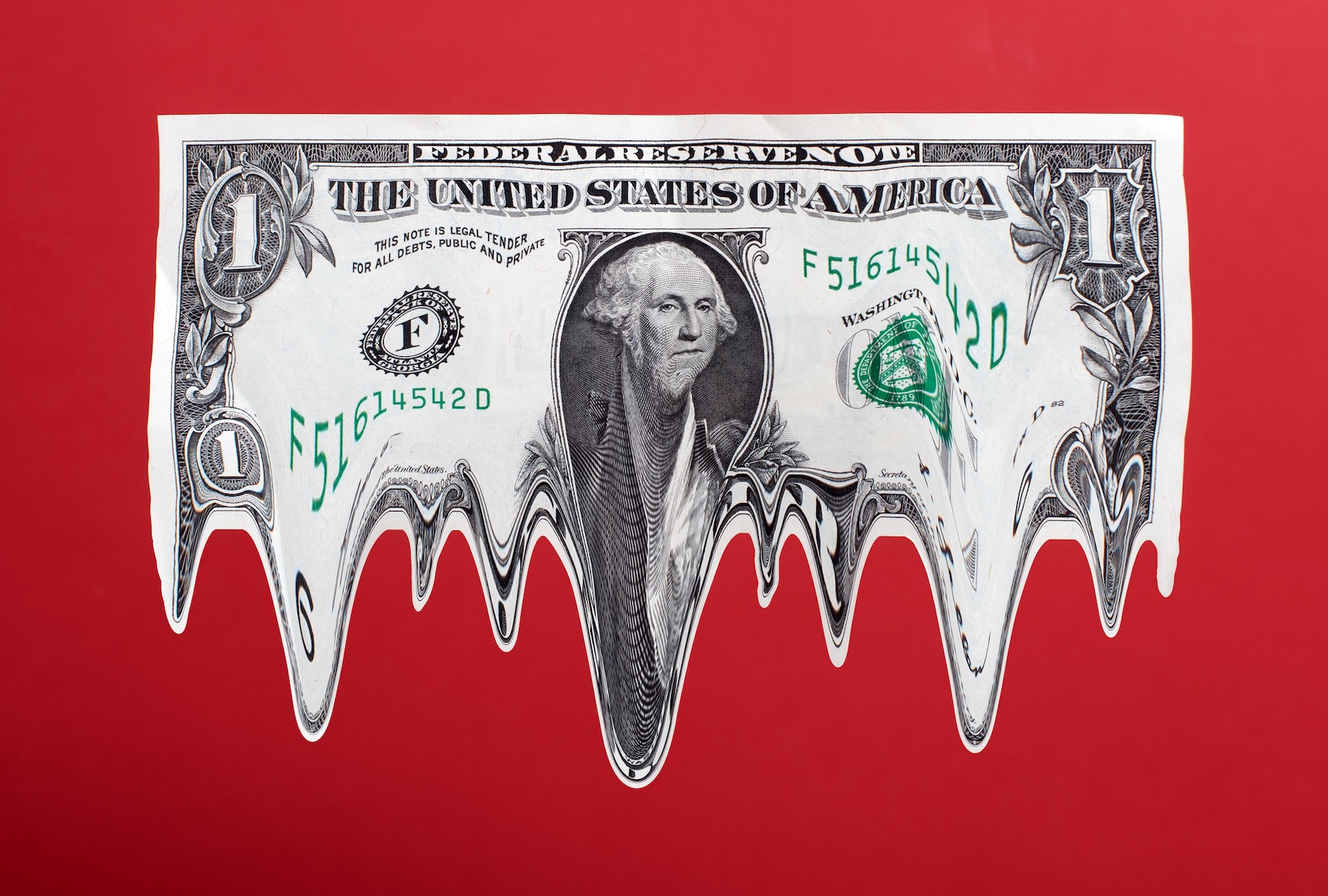
What these apps do best is lay bare the ways in which our entire economy is structured like a betting app strung together by incentive perverts. It’s why the market rewards the most amoral and destructive behavior, from hedge funds that short the market and destroy company value to vulture capitalists who gut businesses like Toys “R” Us or Radio Shack, and then escape on their golden corporate parachutes. Even when such behavior results in a recession, the government is likely to bail big corporations out, while any form of assistance for the working class is branded as “socialism.” In fact, the entire stock market could be best described as a casino that incentivizes absurd growth like the historic tech bubble provoked by the spread of artificial intelligence.

Mainstream economists may want you to believe all this is driven by Darwinian forces that follow some natural law, simplified as “the cost of doing business,” or even by Adam Smith’s invisible hand. But that’s pretty unscientific.

Money itself is just a construct, one with rules dreamt up by humans. We don’t have to live in a world where people profit from tragedy, be it wildfires or a child with cancer, housing foreclosures or weapons manufacturing. I’m willing to bet we can actually achieve such a utopian outcome, even if it takes another century. The alternative is to continue draining everything of value as it goes up in smoke. 

The post The entire U.S. economy is basically a giant betting app appeared first on Salon.com.

  •  

Brad Pitt’s sobriety story deserves more scrutiny

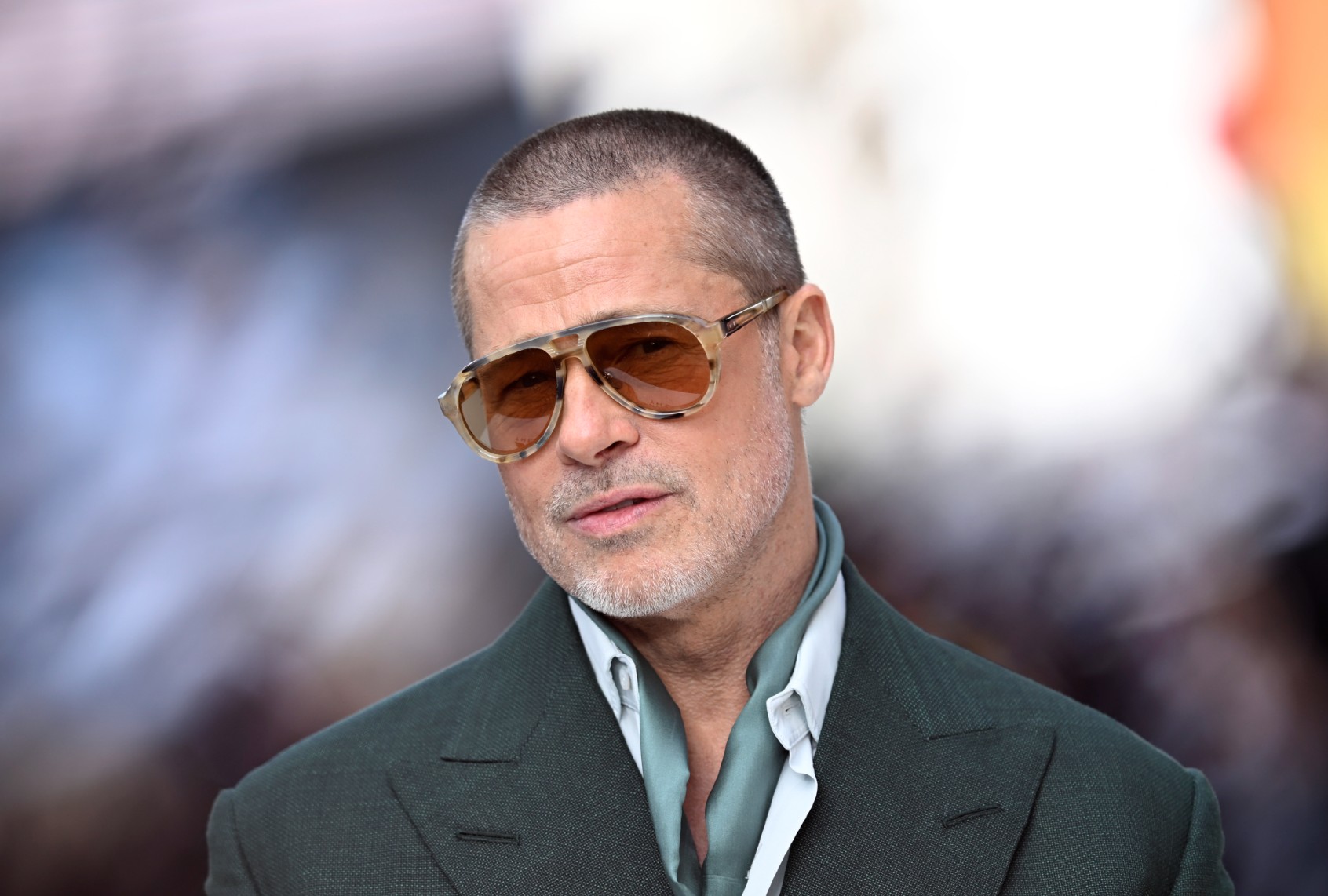
Just personally speaking, if it were alleged in court documents that I abused my family in an alcohol-fueled tirade that culminated in my children seeing me pour a drink all over their mother’s head, I would not be so cavalier about parting with my very public sobriety. But I’m not Brad Pitt, and no one is doing sycophantic cover stories on me in Esquire.

In the recently published profile, Pitt admitted to getting “back off the wagon,” but “in a more restrained manner,” admitting he can have a few glasses of wine. If he overindulges, he risks losing a morning to a hangover, and thus, the beautiful morning views outside his luxurious Los Angeles home. The piece continues to fawn over Pitt and his generous hospitality, with some observations on his legacy and a quote from Pitt calling AI “an interesting experiment” — which he interrupts to admire the hawks outside his window, a fluffy moment of color kept in the profile.

In a sane world, Pitt would be challenged more, asked about his ongoing legal battles with Angelina Jolie, his children dropping the last name “Pitt,” the substance abuse — even a question about Pitt not having a good film role since before the pandemic would do. 

But we live in a world where sanity is swapped for starry-eyed adulation, where celebrity culture often mirrors the blind devotion for MAGA politicians. Fame absolves stars like Pitt in the way popular politics protects men like Max Miller, who also faces a slew of credible abuse allegations. As long as they stay the course, maintain manhood and weaponize nostalgia, the public will forget and the challenges will stop coming. When a brooding Pitt admits he’s had trouble with “family stuff,” the writer lets the sentiment disintegrate. “We’ll leave it at that,” Pitt concludes.

The post Brad Pitt’s sobriety story deserves more scrutiny appeared first on Salon.com.

  •  

Should Brad Pitt really win an Oscar for acting?

In an Oscars season rife with controversies, shutouts and disappointments, the one seemingly surefire, feel-good figure this year has been Brad Pitt. Nearly 30 years into his Hollywood career, the hardworking leading man has created some of our most iconic movie moments and developed an uncanny instinct for creative, audience-pleasing parts. Now, he seems a lock to take home his first acting Academy Award (he has one under his belt as a producer on “12 Years a Slave”) for his supporting role as good-natured, possibly wife-killing, history-changing stunt double and righthand man Cliff Booth. But if ever there were a classic case of someone being the odds-on favorite based on overall industry goodwill than a singular performance, Pitt would be our greatest recent example. If merit alone earned awards, would Pitt really take it this year? Or to put it another way, can Brad Pitt act?

At 56, the Oklahoma native has entered a career stage where he seems at last to be forgiven for being so really, really, really, ridiculously good looking. Yet perhaps his best trick all along has been making his critics feel they shouldn’t dismiss him as a so-so performer just because he’s handsome, when in fact he might actually be just a so-so performer.

From the beginning, Pitt’s always been clever about how he leverages his physical appeal, using it as an instrument to create his characters rather than a diversion from his efforts. Even in his breakout role, as a smooth talking grifter in 1991’s “Thelma & Louise,” Pitt seemed in on the joke that as long as he kept his shirt off, he could tell a woman point blank that he was a robber — and then effortlessly rob her.

His rise was instantaneous after that. It was as if the factory that had created ruggedly beautiful stars like Gary Cooper and Gregory Peck had suddenly spit out one special new edition just for the ’90s. Campy starring roles followed in forgettable films like “Johnny Suede” and “Cool World,” parts that played off Pitt’s throwback appeal. Yet he also played the long game shrewdly, refusing to settle as simply agreeable beefcake. He sought out darker work in movies like “Kalifornia” (a film I still have to remind myself is not “Natural Born Killers”), “A River Runs Through It” and “Interview with a Vampire.” He appeared in his first Tarantino-penned film, “True Romance,” where he played a blissfully clueless stoner. And he had a knack for picking instant cult classics  like “Se7en” and “Fight Club,” a movie that should have inspired a special Oscar category for Best Performance By a Pelvis just so Pitt could have won.

Yet when I think of the Brad Pitt of that era — the actor, not the celebrity he was in the World’s Sexiest Man, Mr. Jennifer Anniston, name-checked in a Shania Twain song years — I remember his performance in the lesser known “The Devil’s Own,” in which he plays an IRA member and says things like, “Oi need dat mooney, Tum.” He may not yet have an acting Oscar, but for this role, Pitt is widely regarded as delivering one of the worst Northern Irish accents ever committed in cinema. A few years later, in Guy Ritchie’s “Snatch,” Pitt played an Irish Traveller, and while he memorably delivered a comically unintelligible performance, it was not exactly a method actor’s one. Ritchie reportedly made the character a Traveller because Pitt couldn’t pull off a London accent, and Pitt recently revealed he based his character’s dialect on a minor character on “Father Ted.” Then there’s his unfortunate “Everyting gwarn be iree” moment in “Meet Joe Black,” an attempt that I assure you was cringeworthy two decades ago, and has since aged like milk. Even as he’s filled up his IMDb page, his technical abilities have remained limited. 

Admirably, Pitt could have spent his career doing the big superhero parts, instead of skewering that image in “Megamind” and “Deadpool 2.” He could have done some lucrative spy series and be 20 years into the role by now. That’s what movie stars do, right? He’s consistently gravitated toward odder, more challenging work like “Burn After Reading.” His previous acting nominations have all been for more idiosyncratic films — “Twelve Monkeys,” “The Curious Case of Benjamin Button” and “Moneyball.” Yet the impression he gives is not that of some weird, English arteeeste who disappears into his characters. He’s just a hard-working regular guy who gets the job done. This is not without appeal. 

And then there are those Tarantino movies. In “Inglorious Basterds” he carves up Nazis and helps rewrite a history where Hitler doesn’t weasel out in a bunker suicide. (Surely there’s a Tarantino-Pitt collaboration on the Jeffrey Epstein story somewhere in our collective future.) He also delivers another accent that gets a little shaky. Now, in his Oscar-nominated performance in “Once Upon a Time . . .  in Hollywood,” Pitt plays a man who is seasoned, heroic, a little sinister, and still looks insanely good shirtless. In other words, he’s a Hollywood executive’s wet dream of himself.

Is “Once Upon a Time . . . in Hollywood” any good? I side with my colleague Matt Rozsa and say, it decidedly is not. It’s a meandering mess, from a filmmaker whose works increasingly play into the classic “If I was there, things would have gone a lot differently, let me tell you” fantasy. (Take that, hippies.)

Though there is not much to see in Pitt’s performance that he hasn’t already delivered in at least a dozen other eccentric-and-manly-but-the-ladies-like-him-too performances, critics loved it. The New York Times praised Pitt’s “down-to-the-bone minimalism” and the star has already picked up a shelf of prizes, earning goodwill at each stop on the road to Oscar for his charming acceptance speeches.

Though the Oscar is only supposed to be for one performance, Pitt’s awards trajectory this year has no doubt been boosted by “Ad Astra,” another acclaimed movie with an appeal that entirely eluded me. As astronaut Roy McBride, Pitt is a middle-aged man searching the solar system for his daddy. It’s desperately tedious and doesn’t make sense, and I would like a refund for those hours of my life. Pitt’s stoic performance doesn’t help matters, but he does get to well up with emotion at times, which does technically constitute acting.

Writing in the New York Times recently, critic Manohla Dargis observed that earlier in Pitt’s career, “It became a favorite cliché to write that he was a character actor trapped in the body of a star . . .  Some of this, I think, stems from a suspicion of beauty, that it can’t be trusted.” Yet the “character actor in a movie star’s body” designation seems more fitting for Pitt’s costar and fellow Oscar nominee Leonardo DiCaprio, who from his earliest roles in “This Boy’s Life” and “What’s Eating Gilbert Grape” has always displayed serious native talent. Or look at another of his “Once Upon a Time . . . ” costars, Oscar nominee (for “Bombshell”) Margot Robbie, who in the last six months skillfully has played Sharon Tate, Harley Quinn, and an ambitious Fox News employee, and among other laudable elements, delivered a different (and believable) accent for each.

In contrast, Pitt seems to dazzle by sticking to similar characters in very different movies, a neat bit of acting sleight-of-hand. If he is indeed a character actor, he sure likes to stick to the same character — unselfconsciously virile, easy to imagine chewing on a toothpick.   

I happen to enjoy plenty of Pitt’s movies and even his performances. I could watch him eat his way through “Ocean’s 11” all day, and I can’t imagine any other actor delivering the immortal line, “What’s in the box?” But his seemingly locked-down Oscars juggernaut is not a reward for a meticulous performance in a stellar movie. That is absolutely not what is happening here. It’s a prize for consistency, charm and charisma over several decades.

This shining moment also happens to come at one when the industry is still clearly not ready to fully reckon with itself. It’s been only two years since the real Sharon Tate’s famed widower, Roman Polanski, was removed from the Academy. And this year’s crop of Oscar nominees once again conspicuously fell short on honoring more diverse and deserving contenders. That’s not Brad Pitt’s fault. But it’s easy to see how his role represents a certain nostalgia for a certain era, when being a movie star didn’t mean you had to be an actor too.

The post Should Brad Pitt really win an Oscar for acting? appeared first on Salon.com.

  •  

Helaena was too good for “House of the Dragon”

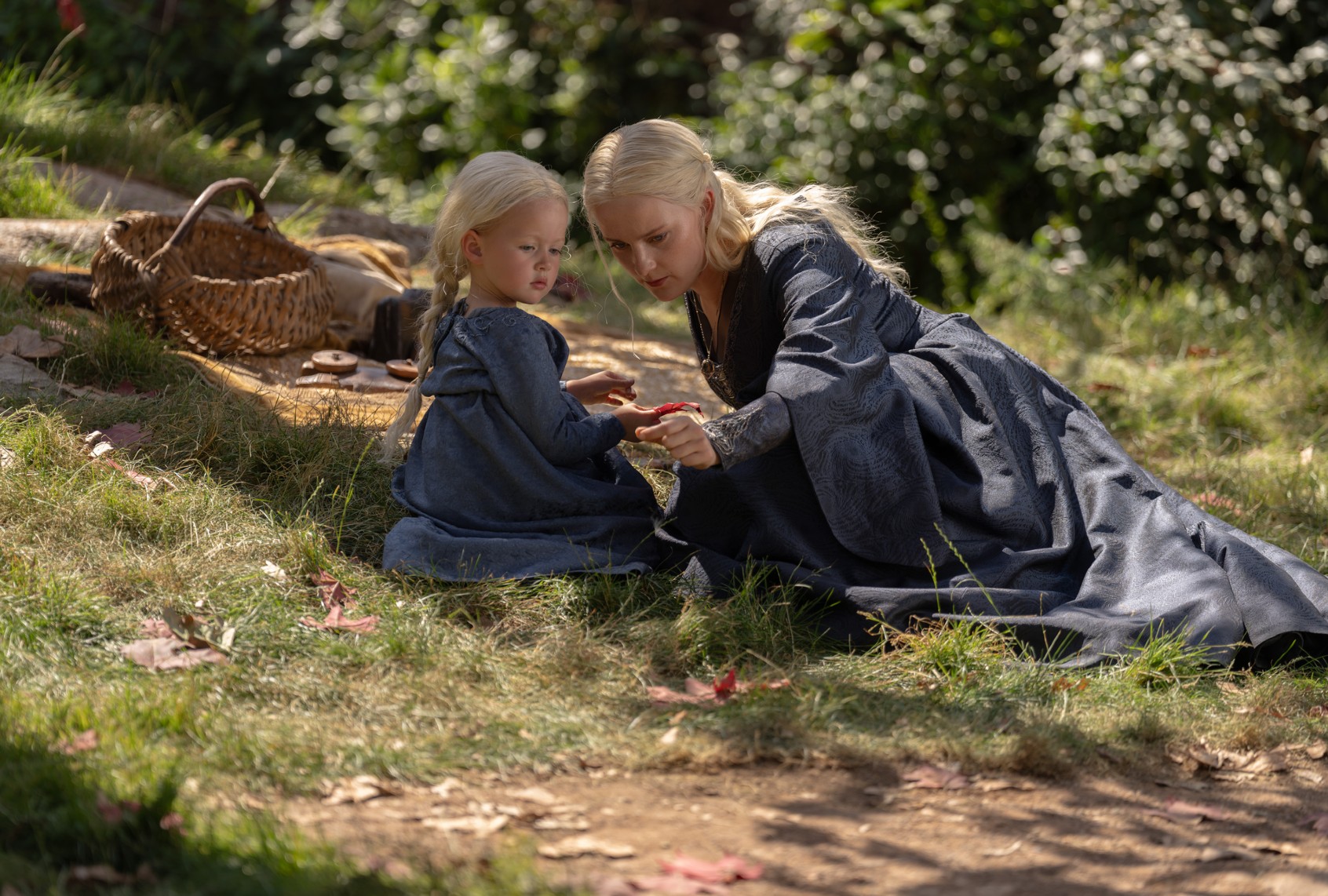
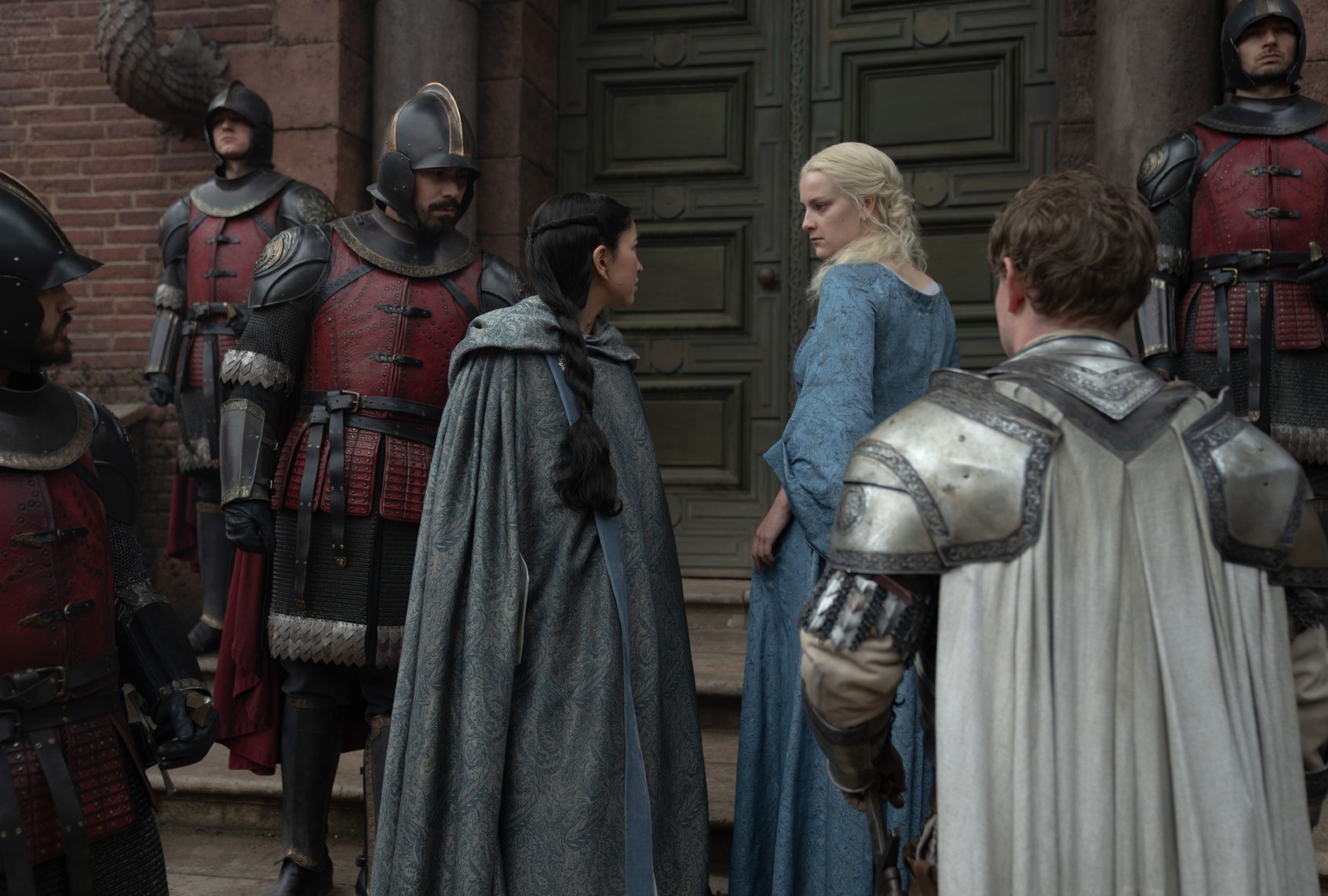
Since the first season of HBO’s “House of the Dragon,” we’ve watched Helaena Targaryen (Phia Saban) grow from an eccentric child preoccupied with insects and murmurings of dreams — shrugged off as nothing more than oddities by the adults who occupy the Red Keep in King’s Landing — to becoming an adult with a tremendous power that she was wise to mainly keep to herself.

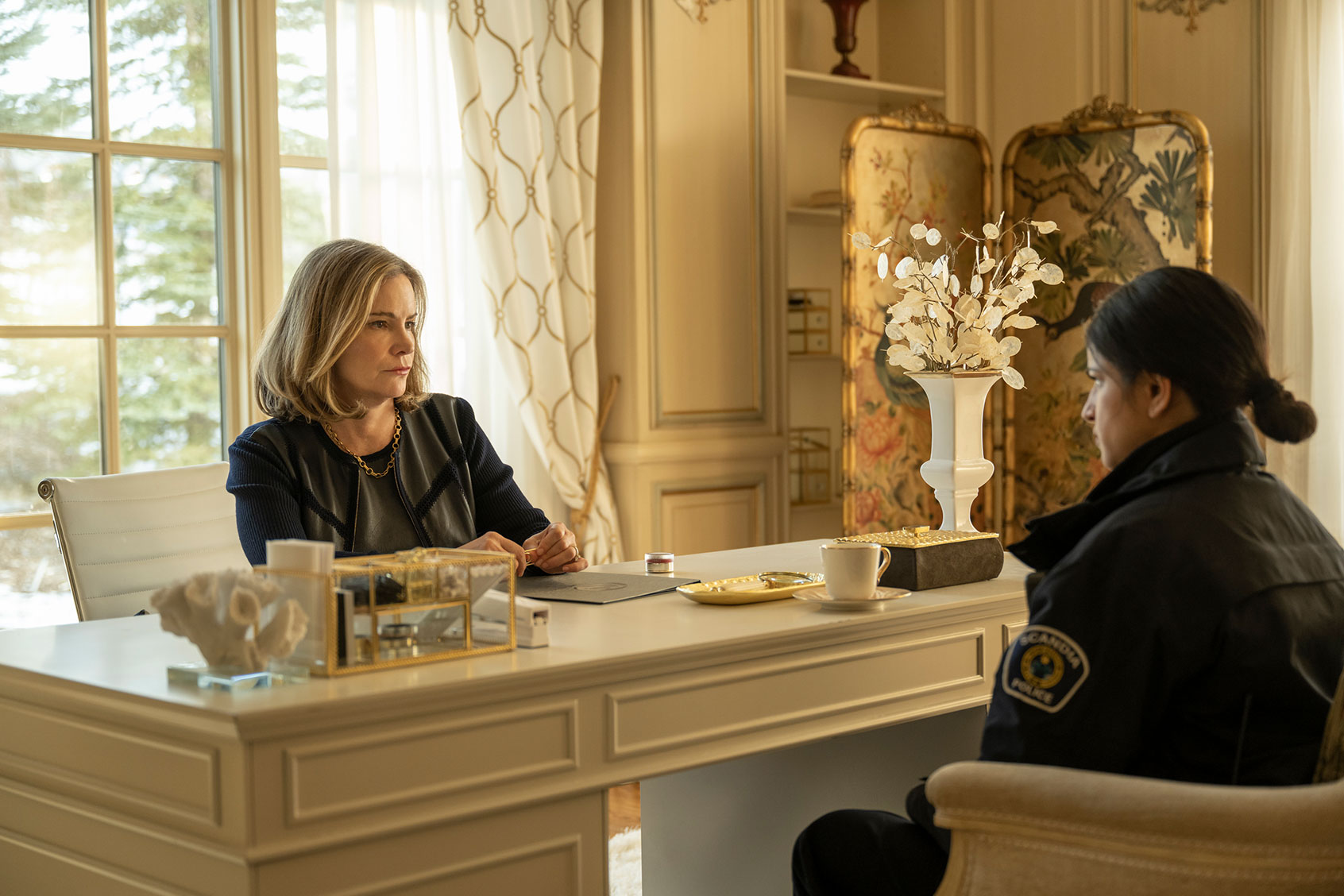
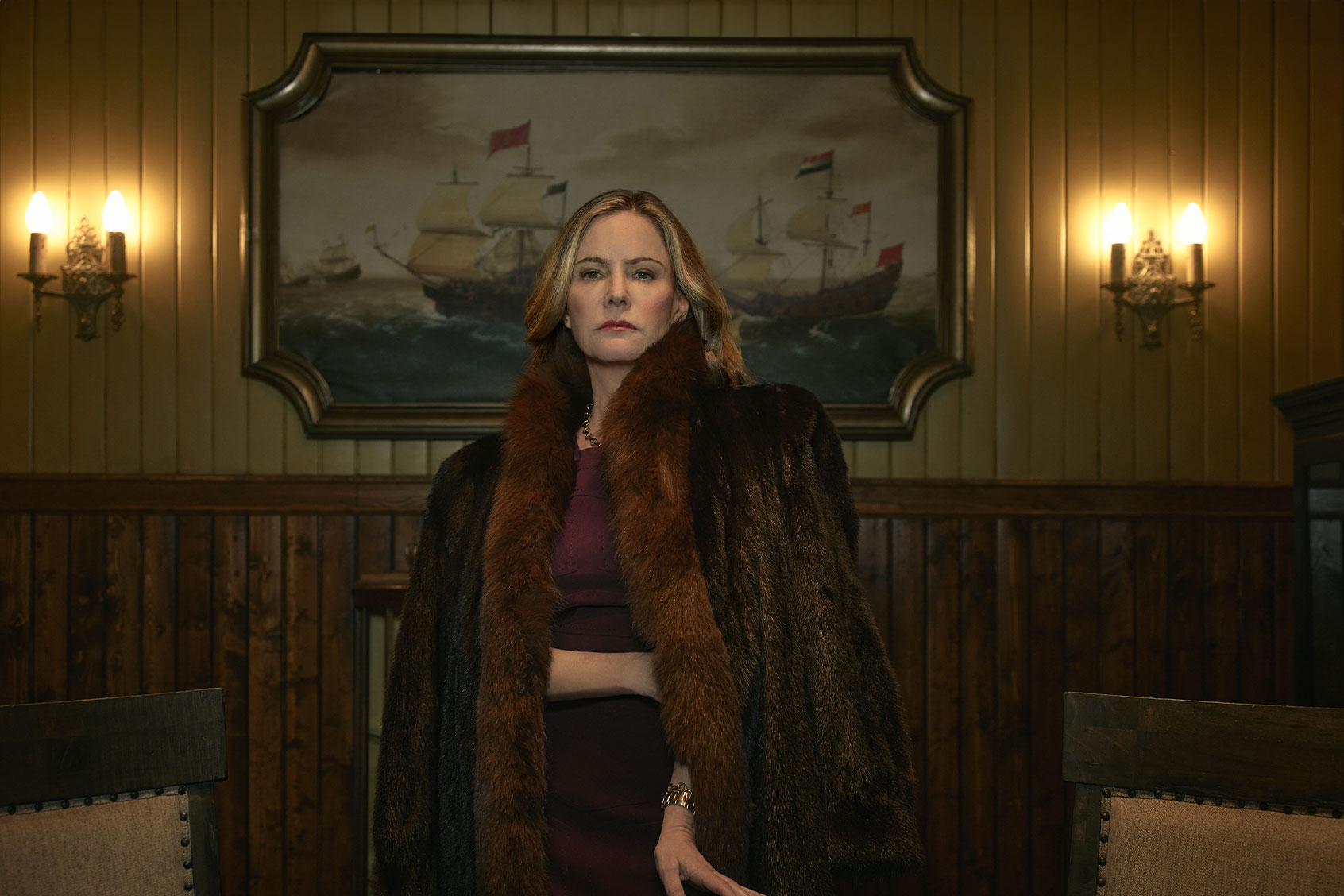
The only daughter of Viserys (Paddy Considine) and Alicent (Olivia Cooke), Helaena was a dreamer in more than just the flibbertigibbet sense, receiving flashes of things to come — her brother Aemond (Ewan Mitchell) losing an eye, Rhaenys’ (Eve Best) dragon Meleys crashing her brother/husband Aegon’s (Tom Glynn-Carney) coronation, hired assassins posing as rat-catchers breaking in to kill her baby son — and though these premonitions could have been a considerable help to those around her, they mainly fell on deaf ears until she herself fell to her death in the Season 3 finale, at which point it was too late. But the joke’s on everyone but Helaena because in taking her undervalued gifts and goodness with her, she’s removed herself from the fray as the only one with the knowledge that power is an ugly thing to die for, but an even uglier thing to live for.

(Ollie Upton/HBO) Emma D’Arcy in “House of the Dragon”

In the fight for the Iron Throne, the Targaryens and anyone from the Hightower line with a drop of lineage blood in the game are neck and neck in a battle to out-dragon and out-incest the other. Helaena, having a Hightower mother but a Targaryen last name, has empathy for both sides, as she does for any of the other tools and pawns of war; the dragons killed in battle, the horses destroyed by enemies, the caterpillars outside the castle that feed on toxic plants but are not toxic themselves.

Removing herself from the game board, Helaena is free. No more subsisting on poison. No more having her warnings be ignored. The Targaryens F’d around, but now they’re gonna find out. Sometimes dreams do come true. 

“They eat the leaves of the nightshade, but that would be death for you or me . . . It’s a puzzle,” she warns her daughter Jaehaera in a Season 3 episode. And Jaehaera, who actually listened to Helaena’s warnings when few others did, has at least this to remember her mother by: feasting on poison may fortify you, for a while, but it will only bring harm to everyone around you. Dark-mode Rhaenyra would have been wise to heed this warning when it was delivered the second time.


Want more from culture than just the latest trend? The Swell highlights art made to last.
Sign up here


(Ollie Upton/HBO) Phia Saban in “House of the Dragon”

In the Season 3 finale, held prisoner by Rhaenyra and refusing to eat, despite being pregnant with what’s presumed to be her brother/husband’s child, Helaena talks of a rare beetle which can only be seen in the summer, which she’ll never see again.

“There’s a beetle that emerges on the cusp of summer. It has lots of colors. Blue, gold, purple. It looks like a turtle,” she tells a befuddled Rhaenyra. “You can only find it in King’s Landing. It sustains itself on the waste of other creatures. It’s beautiful.”

Like the fragile butterflies that flitter around Alicent after Helaena’s death, she was too good for all of this nonsense. Too pure for endless battles over a damn chair. 

Hearing this, Rhaenyra is, once again, just sitting there thinking this lady is nuts and very much not picking up on the “you’re trash” goodbye speech that her half-sister is delivering, so Helaena makes it clearer.

“All the things you care about are ugly. This place is ugly. You, yourself . . . ugly.”

Having already made up her “F this” mind that she’d rather throw herself out of a window than live one more day as Rhaenyra’s pawn, Helaena drives the sentiment home with: “You think life is nothing more than not being dead?”

Removing herself from the game board, Helaena is free. No more subsisting on poison. No more having her warnings be ignored. The Targaryens F’d around, but now they’re gonna find out. Sometimes dreams do come true.

(Ollie Upton/HBO) Sonoya Mizuno and Phia Saban in “House of the Dragon”

Like the fragile butterflies that flitter around Alicent after Helaena’s death, she was too good for all of this nonsense. Too pure for endless battles over a damn chair. 

Amid struggles for dominion, making the choice to pack it up and take her power with her — a truly useful power, at that, even more so than dragonfire, I’d argue — Helaena’s “no thanks” refusal to participate exhibits a level of nobleness and bravery the others will never live to even come close to. Refusing to fight is, often, the biggest fight.

During a press conference for “House of the Dragon” reported on by Variety, Emma D’Arcy spoke of the character Helaena, saying, “She’s maybe the only character who has a proximity to power, but remains kind of uncontaminated . . . I think her death condemns Rhaenyra to the path she’s chosen. There’s no way back after that.”

Loyal, love to be steered. Allegiance to suffer, only to serve. Helaena saw through all of it, and what she saw but had yet to say, well, she took that to her grave.

The post Helaena was too good for “House of the Dragon” appeared first on Salon.com.

  •  

Mike Rogers is the real radical in the Michigan Senate race

There have been many changes in America’s political system in the last decade or so, but some things are perennial. If you would have told me in August 2015 that we would be in the middle of Donald Trump’s second term, in which he’s slapping his name on buildings all over Washington, building monuments to himself and declaring that the country is under attack by communists, I would have laughed out loud. But if you had told me instead that the media would be framing the upcoming midterm elections as a referendum on the Democrats going too far left and alienating the rock-ribbed Americans who matter, I would have shrugged and said, “What else is new?” 

If there is one thing we have been able to count on for the last 30 years, if not longer, it is that it doesn’t matter how extreme the right wing might become or how far down the conspiratorial rabbit hole they go. The media interprets all political events in this polarized environment as validation of the belief that conservatives are always more in touch with Real America, and therefore more deserving of positions of leadership. According to this thesis, if Democrats want to win power, they will have to radically change their positions. 

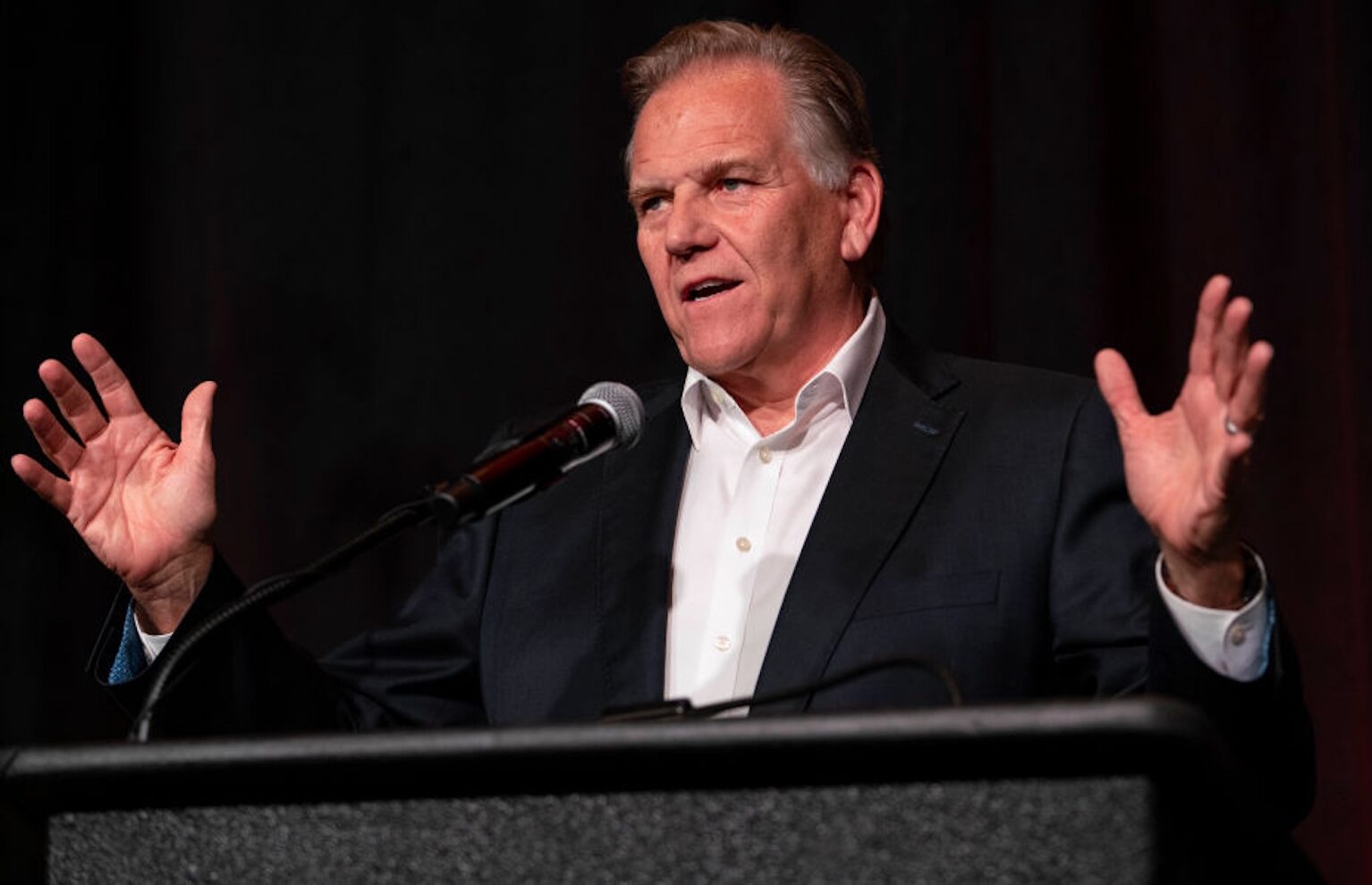
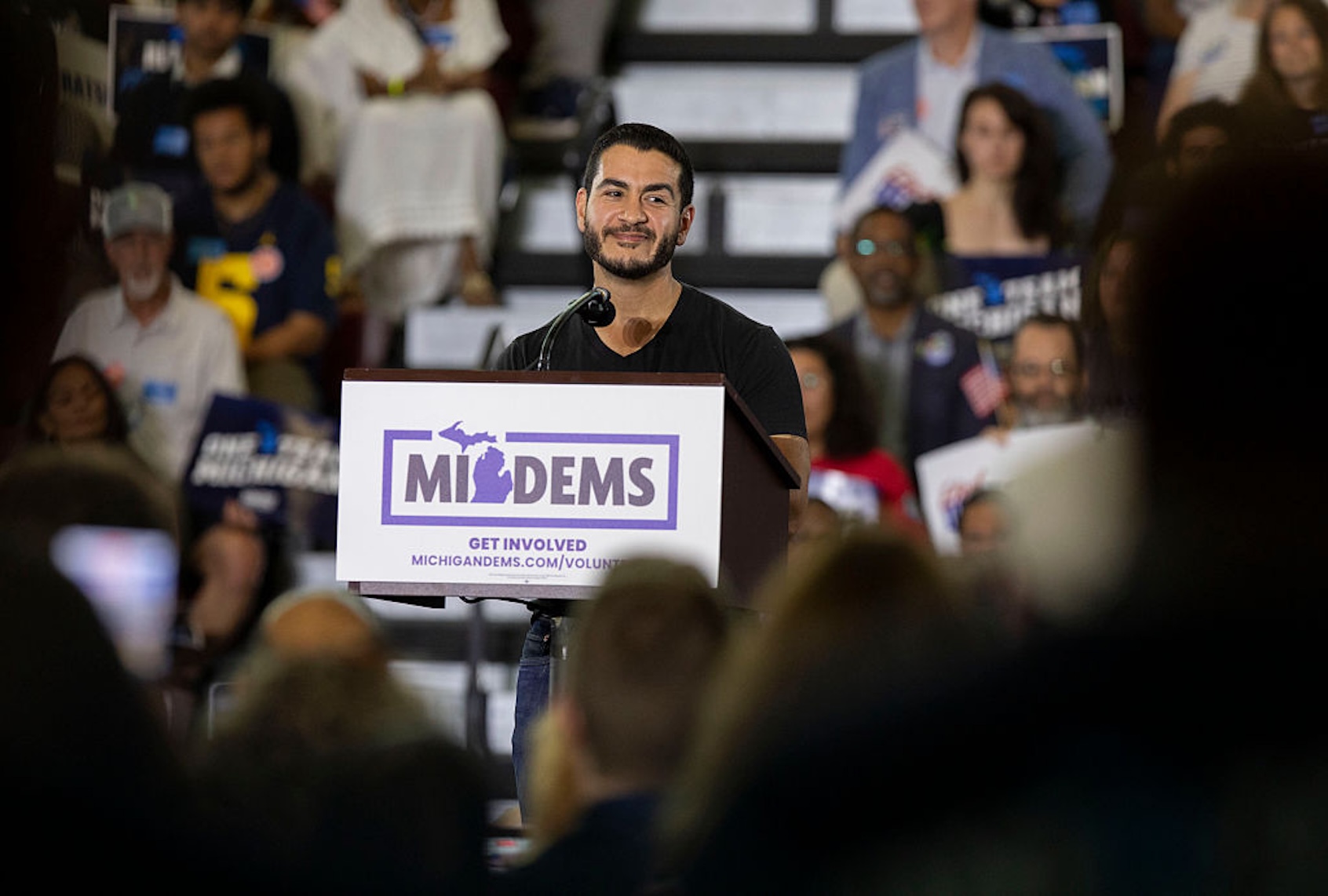
That’s the conventional wisdom when it comes to the Michigan Senate race. After Dr. Abdul El-Sayed’s win on August 4 in the Democratic primary, an avalanche of articles, editorials and op-eds — not to mention analysis by television pundits and social media influencers — have appeared claiming that he is too far left for Michigan’s general election voters. Practically no one is doing the same for his GOP opponent, former Rep. Mike Rogers, who has tacked so far right that he has become a Midwestern hologram of the president.

This pattern is fascinating, especially considering the fact that in the last 35 years, Democrats have won the presidency five times to the Republicans’ four, a number that includes the two times (George W. Bush in 2000 and Donald Trump in 2016) the party lost the popular vote but won the anachronistic Electoral College. Coupled with the fact that control of Congress has been evenly split, it’s not as though the GOP has had their fingers on the American pulse this whole time. Instead, they have built a massive partisan media infrastructure and stolen Supreme Court seats to further put their thumbs on the scale of the electoral system with big money and voter suppression. 

With the deep unfairness of the Senate giving far more power to small, rural (and conservative) states, the institutional advantage held by Republicans is profound. And yet, according to conventional wisdom and the predictable knee-jerk reactions by too many establishment Democrats, when Republicans win it’s because conservative ideas have won over the people, and when the Democrats win it’s also because conservative ideas have won over the people. 

This dynamic was on full display Sunday when CNN’s Fareed Zakaria analyzed the Michigan Senate race by saying that working class voters have abandoned Democrats as the party has moved left — even as they have tried to appeal to people on economic grounds and offer ideas that will help them materially. “The lesson is not that economics don’t matter,” he said, “but the Democratic Party’s problem is not that it is seen as too centrist on economics. Democrats routinely lead Republicans on issues like healthcare, and even now, the cost of living. Their liabilities are cultural and social issues — crime, immigration, the border and the so-called woke agenda.” In other words, Democrats must move right on cultural issues to win elections. 

When Republicans lose — which, as we’ve seen, happens at least half the time — they aren’t harangued to take up diversity, equity and inclusion initiatives, open the borders or clamp down on excess policing, even though their excesses on those issues could just as easily be seen as dispositive.

When Republicans lose — which, as we’ve seen, happens at least half the time — they aren’t harangued to take up diversity, equity and inclusion initiatives, open the borders or clamp down on excess policing, even though their excesses on those issues could just as easily be seen as dispositive. The press will blame Trump or individual candidates for a lack of character, but they rarely apply the kind of analysis that Zakaria does, which essentially demands that Republicans abandon elements of their base to pander to Democrats. 

The result is that only Democrats have agency to break the impasse. 

When Bill Clinton won the presidency 34 years ago, Democrats had been in the presidential wilderness for 12 years. Their last two presidents, Jimmy Carter and Lyndon Johnson, had left office under the clouds of the Iran hostage crisis, in the case of the former, and Vietnam with the latter. The party decided to do just as Zakaria suggested, and Clinton won a plurality of voters in the 1992 general election on a platform of fiscal and personal responsibility, challenging the Democratic base on, you guessed it, culture war issues. Two years later, the GOP won the House majority for the first time in 42 years. So, that worked out well. 

According to surveys conducted by the Pew Research Center, over the past 35 years, the public has actually moved left on culture war issues, following a progressive shift among Democrats, while the right has clung to its prejudices. (Republicans’ cult worship of Trump and conspiratorial thinking is hard to measure in these terms, but there is no doubt they have changed dramatically in this regard.) 


Start your day with essential news from Salon.
Sign up for our free morning newsletter, Crash Course.


It should come as no surprise then that Democrats, feeling their strength in opposition to the extremely unpopular Trump, would see an opportunity to more explicitly push their message. Generally speaking, midterm elections are seen as a referendum on the party in power, and with the economy in an ongoing slump and Trump more polarizing than ever, you cannot blame them. As the New York Times reported, the party’s left wing has been energetically organizing all over the country, and it’s paid dividends in primaries in blue and purple states alike in the upper Midwest. And, once again, the media is falling back on the same old fear-mongering about the left alienating the Real Americans. 

We have article after article hand-wringing over El-Sayed’s primary win because he supports issues they consider beyond the pale, such as Medicare for All, abolishing Immigration and Customs Enforcement and ending unlimited support for Israel, even though each of these issues have majority support. His primary opponents are now holding unity rallies to bring the various factions of the party together after the bruising campaign, and the national party has mobilized in support of his candidacy, including former President Barack Obama and former Transportation Secretary — and current Michigan resident — Pete Buttigieg, both of whom carry serious clout among more conservative members of the Democratic base and independent voters. In other words, Democrats are doing everything they can to reach out to the broad middle of the state.

Rogers, meanwhile, is doing the opposite, tacking hard to the right and even going so far as to join the most noxious, destructive conspiracy theory of all: election denialism.

Rogers, meanwhile, is doing the opposite, tacking hard to the right and even going so far as to join the most noxious, destructive conspiracy theory of all: election denialism. 

As a member of Congress between 2001 and 2015, Rogers was a standard conservative in the George W. Bush mold, voting for tax cuts and deregulation, and later chairing the powerful House intelligence committee in the last four years of his term. When he retired from the House, Rogers worked as a talk radio host and commentator for CNN. Although he supported Trump after he won the GOP presidential nomination in 2016, he refused to go down the road of the Big Lie following Joe Biden’s win in 2020. In an op-ed for the Washington Post — published the day before the Jan. 6 assault on the Capitol — Rogers called Trump’s call to Georgia Secretary of State Brad Raffensperger, in which he urged the secretary to find him additional votes, “more gangster than presidential.” Rogers wrote, “This trend of refusing to accept free and fair elections, without any proof of fraud, must end for the sake of our democratic republic.” A year later, he said Trump’s political career was over.

But times have changed. 

In 2024, when Rogers ran for the Senate against Elissa Slotkin, who would go on to win the race, he needed Trump’s endorsement. He gave his in return. Rogers has also adopted the president’s Big Lie, which should be disqualifying among thinking people everywhere.

I’m not seeing a lot of hand-wringing among the pundits about how Rogers is losing Real Americans with his extreme views; that criticism is being reserved for El-Sayed. Likewise, Texas Attorney General Ken Paxton, who is locked in a close Senate race against Democrat state Rep. James Talarico, isn’t being browbeaten to moderate his views. 

The Democrats may very well lose those races. But in this closely divided electorate, they might have lost them anyway with more moderate candidates. After all, Republicans have been running on racism and left-wing hippies for decades, no matter what their views were. The very centrist Clinton was vilified 35 years ago because he played the saxophone with sunglasses on “The Arsenio Hall Show.” Barack Obama’s middle name — Hussein — remains an Islamophobic meme all these years later. So, it’s not as if Republicans wouldn’t deploy the same insults to other candidates, no matter their positions.

This year, Democrats are talking straight and taking it right to the people, and both El-Sayed and Talarico, with their populist messages, are powerful communicators. Maybe it won’t work. But it’s long past time for the Democratic Party to stop allowing candidates to be harassed by the conventional wisdom that says the only way to win is to run to the right.

The post Mike Rogers is the real radical in the Michigan Senate race appeared first on Salon.com.

  •  

Ranked choice voting could have saved Michigan

The road to Democratic control of the Senate remains steep, but Donald Trump’s historic unpopularity, the misbegotten war in Iran and a wobbly economy have opened a slender path.

The thinking goes that if Democrats can hold every blue seat, prevail in North Carolina and defeat Sen. Susan Collins in Maine, then they must take any two from a list of red states that could well be in some semblance of play: Texas, Alaska, Ohio, Iowa or Nebraska.

Imagine that almost everything goes right. Democrats hold Georgia and New Hampshire. They claim North Carolina, vanquish Collins, and spring upsets in Texas and Alaska. But the chamber remains in GOP hands because Michigan Democrats could not reunify after a bruising primary. Kick away a winnable race in Michigan and, in this scenario, Ohio, Iowa or Nebraska also becomes a must. 

So don’t lose Michigan. 

On Tuesday, Dr. Abdul El-Sayed defeated Rep. Haley Stevens to claim the Democratic nomination. All the instant analysis is true: This was a political earthquake and one of the biggest wins progressives have scored. Stevens was better funded and the candidate of the Democratic establishment. El-Sayed’s win is a sign of the importance of Gaza inside the Democratic coalition, and of shrinking support for Israel. Now, his ability to close the deal this fall will be a crucial test of progressive electability ahead of the 2028 presidential election. 

The race was also closer than expected. With a small number of votes outstanding, El-Sayed’s lead is just under 16,000. He fell short of a clear majority, winning with 48.5%. And while both candidates continue to say all the right things about coming together for what will be a very close battle against an old-school conservative in former GOP Rep. Mike Rogers this fall, the tight margin, El-Sayed’s failure to secure a true majority and the nastiness of the race could make that difficult.

After all, El-Sayed recently had to plead with his backers not to take personal shots at Stevens and her accent online. The airwaves were filled with millions of dollars in negative ads, many of them determined to paint El-Sayed as unelectable in the general. He called Stevens “a suit with a large AIPAC bank account.” She retorted that “Everyone in America understands you want to blame all of your problems on Jewish Americans.” A unity breakfast might not be enough to paper all that over in a matter of weeks, especially if the super PACs that backed Stevens continue to spend millions to fan the flames against El-Sayed in the general election. 

This race could have been run in a far different and more positive manner. If it had, both progressives and Democrats as a party would be in a much stronger position heading into what will likely be a very competitive general election that decides control of the chamber.

This race could have been run in a far different and more positive manner. If it had, both progressives and Democrats as a party would be in a much stronger position heading into what will likely be a very competitive general election that decides control of the chamber. The stakes are high and will determine, among other things, whether Trump can confirm Supreme Court justices over the next two years.

Imagine the difference that ranked choice voting would have had in the primary. A third Democrat, state Sen. Mallory McMorrow, won over 4% of the vote despite dropping out of the race several weeks ago. She won 61,000-plus votes, almost four times the difference between El-Sayed and Stevens. If Michigan used RCV in its primaries — like Maine, New York City and dozens of cities nationwide — the winner would have been able to claim a majority, and an easier path to unifying the party.

Some $60 million of negative ads flooded Michigan’s airwaves over this primary. Ranked choice voting wouldn’t have stopped that entirely; important, contentious issues were at stake. Outside dollars were a given. Yet RCV has been proven to lower the temperature in races like this and encourage conversation, coalition-building and respect. 


Start your day with essential news from Salon.
Sign up for our free morning newsletter, Crash Course.


It’s entirely likely that an RCV race would have looked quite different. McMorrow and other challengers — forced out to provide voters with a binary, two candidate contest without spoilers — would have been able to stay in the race. Then, El-Sayed, Stevens and the others would have had every incentive to build a coalition through second choices to reach 50%. That comes from finding common ground, not from scare ads and nasty attacks. The winner of a race like that would be in far stronger shape, and ready to focus on the Republicans. Instead, El-Sayed is stuck trying to rebuild an intra-party coalition after the primary.

Instead, as McMorrow faded, party leaders and donors leaned on the state senator, a promising, charismatic politician, to exit and reduce the field to two. But this strategy didn’t produce a majority winner. It just limited choices before voters, and the winner still fell short of a majority. Democrats look less unified in a must-win race as a result.

Ranked-choice voting doesn’t fix everything that’s wrong with our politics. It’s not a silver bullet that cures polarization, settles complicated policy debates or ensures that everyone gets along. But it’s such an obviously useful tool in races like this that it makes zero sense not to use it. 

Win or lose, progressives and centrists will debate the meaning of this race for some time to come. That’s fine. In some form, the party is endlessly re-fighting 2016 over and over again. The more immediate issue is that primaries like this are going to continue to be contentious. Democrats would be in a better position to win races they absolutely must win if they adopted ranked choice voting in primaries like Michigan’s this. (Republican primaries would benefit from this nonpartisan tool too). 

This is a lesson that Democrats absolutely must learn ahead of the 2028 presidential primaries. Then, it won’t simply be a schism between centrists and the left, but between multiple candidates within each lane and others representing different perspectives, backgrounds and parts of the country.

It will be painful for Democrats if they fail to take the Senate because they lost Michigan. But if that happens, it might not be because El-Sayed was too progressive for a swing state — but because Democrats chose their nominee through a process that bloodied and embittered everyone with no hope of consensus, and no easy path to reconciliation. In Michigan, and in other bitter primaries to come, they are going to need one.

The post Ranked choice voting could have saved Michigan appeared first on Salon.com.

  •  

Conservatives find their fighter in Sophie Cunningham

Indiana is in many ways a liminal state, the place you pass through between scruffy Cleveland and business-like Chicago, with little to inspire romantic odes to home. Its glacial flatness doesn’t lend itself to crusades, or to impressive scenes like a man on horseback silhouetted against the sunset. But Sophie Cunningham has let the state turn her into a combination of Sancho Panza and Don Quixote, willing to joust with a windmill. 

The reserve for the WNBA’s Indiana Fever comes off the bench for the latter-day contenders, spelling for star Caitlin Clark and averaging a respectable eight points per game. When then-Connecticut Sun guard Jacy Sheldon poked Clark in the eye during a particularly physical play in 2025, Cunningham avenged the perceived slight with a headlock during a later play. Her reputation as Clark’s right-hand and enforcer spread along with the viral clip.  

Since Clark’s days as a national college basketball player for the Iowa Hawkeyes, the right-wing grievance machine has tried to make Clark their Great White Hope. This seemed to accelerate in 2024 after she joined the WNBA, a league in which over 81% of the players are women of color. Clark, an inveterate trash-talker and hyper-competitive athlete, has seemed completely uninterested in courting controversy away from the hardwood. She’s avoided joining any conservative crusades and has done little to stoke the support of her most MAGA fans.

Enter Cunningham. In wide-ranging ESPN profile, she said she was concerned about the idea of trans women participating in women’s sports and wanted to “protect young girls in the locker room.” The Fever enforcer also worried that the next generation would have to “go against biological men.”

Cunningham doubled down in a press conference the next day, adding that her views were “common sense.”

“I said what I said,” she told reporters.

Republicans have spent years building a trans panic in the United States. When they heard their own talking points out of the mouth of a popular professional athlete, they pounced.

Republicans have spent years building a trans panic in the United States. When they heard their own talking points out of the mouth of a popular professional athlete, they pounced. Texas Sen. Ted Cruz rushed to applaud Cunningham. Fox News has spent the weeks since her inflammatory interview dissecting every questionable call against the second-stringer, as protests and counterprotests became a regular fixture at Fever games. Earlier this week, Vice President JD Vance encouraged her to keep up the fight.

“Sometimes when you’re courageous in this country, some of the worst people in the world try to attack you,” he shared with Fox News’ Laura Ingraham. “You are inspiring a dozen people for every person that criticizes you.” 

It’s not hard to see why conservatives raised their banners for Cunningham. In the tall, slight and blonde athlete, they had found a noble hero to fight against the tides of modernity in service of some older ideal. It doesn’t hurt that she could easily slot into Fox News’ afternoon lineup.


Start your day with essential news from Salon.
Sign up for our free morning newsletter, Crash Course.


The calculation from Cunningham’s end, if there is one, is also not difficult to understand. She wouldn’t be the first athlete who took a hard look at the calendar and their pocketbook and decided to get onboard the right-wing gravy train before they aged out of the league. Former collegiate swimmer Riley Gaines and former NBA player Enes Kanter Freedom have fashioned second acts out of their willingness to say what MAGA wants to hear. ESPN reshaped their entire network around Pat McAffee, sort of the Joe Rogan of former punters. 

For Cunningham’s supporters, it doesn’t matter that her opponents, as in “Don Quixote,” are not fierce giants but windmills posing no threat. Transgender people are a remarkably small share of the population, and the portion of them who chose to participate in organized sports is even smaller still. Frequently, when states pass laws barring transgender athletes from competition, the result can feel overwhelmingly personal to those affected, since the number of people excluded in a given state can be counted on your fingers. A West Virginia law barring public schools from allowing trans athletes to compete alongside students of the same gender was upheld by the Supreme Court this year. It applied to exactly one teenager

Cunningham’s fears are of her own making. There are no trans athletes competing in the top-tier of any major professional sport in the United States. The stories that anti-trans legislators and commentators tell are always hypothetical. Cunningham proclaims herself as a warrior for “common sense” by fighting off a scourge that no one can see. 

On the bright side, it looks like Cunningham might not have the fortitude for the life of a crusader. On Wednesday, she told reporters that she wants “to get back to basketball.” Whether that decision to “shut up and dribble” will hold as she enters the back half of her career remains to be seen. 

The post Conservatives find their fighter in Sophie Cunningham appeared first on Salon.com.

  •  

Tucker Carlson could derail the GOP’s 2028 plans

Former Georgia Rep. Marjorie Taylor Greene recently posted an odd picture on social media. A group of people were gathered around a large dining table beneath a massive chandelier of antler, a tableau that evoked some kind of Viking summit. Tucker Carlson sat at the head of the table like a preppy Ragnar Lothbrok, and he was surrounded by fellow Trumpist apostates Greene, former Kentucky Rep. Thomas Massie and Joe Kent — the former MAGA cultist who resigned as Donald Trump’s director of counterterrorism — and their respective spouses. “The movement has begun,” Greene captioned the picture.

Their new political movement began to take shape on Wednesday when he revealed the 10-point manifesto during a livestream. While he was vague about the specific form he expected this movement to take, it was later reported that Greene, Massie and Kent had visited Carlson’s Maine estate to urge him to run for president in 2028. The manifesto would seem to be the first step toward a third-party bid, since all these people are persona non grata with the GOP establishment, and have attempted to seize the MAGA mantle with varying degrees of success. 

Considering the split in the Republican Party these days between the MAGA cultists, the MAGA populists and what is now a rump establishment, the timing does seem ripe for a third-party to form from the right, and Carlson is a likely candidate to lead it.

Considering the split in the Republican Party these days between the MAGA cultists, the MAGA populists and what is now a rump establishment, the timing does seem ripe for a third-party to form from the right, and Carlson is a likely candidate to lead it. After having debased himself for years by behaving as a Trump toady while trying desperately to maintain something of an original persona, Fox News fired him in ignominious fashion in 2023. Shortly after, he retreated to Maine to reinvent himself as a podcaster and the leader of the populist, isolationist right.

Carlson has had quite a bit of success in that role, which was massively enhanced when Trump went to war with Iran and tightened the already symbiotic relationship with Israel. The opening is here, and Carlson seems ready to seize the opportunity. 

The problem, of course, is that third-party presidential bids in American politics never win, and they often end up being spoilers for one of the two main parties, although they can have quite a lot of influence on the agendas of both. The most successful — those that earned the largest shares of the popular vote — signal a discontent with one or both parties that can serve as a wake-up call that the country is looking for change. 

Four third-party campaigns have resulted in double-digit vote counts, starting with Teddy Roosevelt’s Bull Moose Party in 1912. By then a former president after passing the baton to William Howard Taft, a decision he came to regret, Roosevelt got 27.4% of the vote, showing that progressive ideas around workers’ rights, business regulation, constitutional reform and conservation, among other things, were potent political issues among voters who had been buffeted by an unregulated financial system and exploited by the Gilded Age barons. Roosevelt’s campaign shook the system, earning 88 electoral votes and dooming Taft’s reelection campaign in favor of the Democrat Woodrow Wilson.

Twelve years later, although he received 16.6% of the popular vote, the third-party run of progressive Robert LaFollette was less consequential; he only carried Wisconsin and its 13 electoral votes. In 1968, George Wallace, the Southern populist, racist and former governor of Alabama, received 13.5% of the popular vote and 48 election votes, carrying all five states of the Deep South. 

In 1992, wealthy businessman Ross Perot seized the public imagination with his economic nationalism — “that giant sucking sound of jobs going overseas” — and fiscal conservatism seemed to speak to disaffected members of both parties who felt that the country had abandoned the average worker. Despite his great wealth, Perot had a homespun approach and used the media very effectively. When he ran in 1992, he received 18.9% of the popular vote, support that most pollsters said came equally from both parties, but garnered no electoral votes. Four years later, Perot garnered a respectable 8.4%, and his Reform Party lasted until 2000, when Donald Trump made a brief attempt at a run under its banner. 

Third-party presidential bids have perversely had the greatest impact in moments where the country has been closely divided between the two parties.

The 2000 election comes to mind. The national popular vote was almost equally divided, with Vice President Al Gore receiving 500,000 more votes than George W. Bush, the Republican governor of Texas, but the presidency was decided by a series of events in Florida, where the tally ended up being 537 votes for Bush, giving him the state’s 25 electoral votes. But without the presence of Green Party candidate Ralph Nader, Gore would have won Florida — and the presidency. Nader’s 97,488 votes in the Sunshine State, which would have likely been cast for Gore had he not been in the race, made sure it went for Bush, and consigned the country to years of war and economic distress. 


Start your day with essential news from Salon.
Sign up for our free morning newsletter, Crash Course.


In the lead-up to 2028, you can already see the influence of Carlson’s faction of the right putting pressure on the GOP. His manifesto is an eccentric amalgam of populist right-wing nationalism, woo-woo Make America Healthy Again anti-science beliefs, isolationism, anti-elitism, natalism, degrading education and xenophobia, and ideas of “beautifying” the country and rebuilding manufacturing and farming. Carlson side-stepped the issues of abortion, religion, and diversity, equity and inclusion initiatives, which is surprising since he’s been in the middle of those culture war issues for years.

At the same time, Vice President JD Vance has been laying the groundwork for his own run by releasing “Communion,” a book focused on his religious faith and conversion to Catholicism. He has also been trying to thread the needle between the anti-elite message, which is at the center of the present populist movement, and his devotion to Trump, the most corrupt president in American history. Vance seems to be trying out a strategy in which he will portray himself as the great crusader against fraud in day care centers and hospice care, for which he blames the so-called scourge of immigrant labor. 

The vice president is coming to the defense of those who are economically disadvantaged in this economy, which he has said shows that “40 years of bipartisan economic policy has failed.” (The Trump years, which the president insists have been the greatest economy the world has ever known, evidently don’t count.) Vance has even taken to social media to position himself against a Trump-supporting elite. Responding to right-wing columnist Marc Theissen’s rude “cry me a river” response to a college kid lamenting that “a burrito shouldn’t cost $20,” Vance responded with a Trumpian insult, saying, “I’m surprised to hear Mark say this. If you’ve ever met him in person, it’s quite obvious the man has never missed a burrito.” I guess this is supposed to endear him to the MAGA folks while subtly acknowledging that the affordability crisis is real.

Vance seems to know that such a magic trick will be difficult, if not impossible, to pull off in 2028. He will have to defend Trump’s economy, which will be necessary to attract the hard-core cultists who still love the president despite the nation’s sluggish economy. 

Carlson, meanwhile, sitting outside the administration, has a much better chance of snagging this populist right-wing movement that’s evolved from Trump’s original “America First” movement, which could serve as a way for many disillusioned Trump voters to maintain the fiction that they really only cared about policy all along. 

This fissure has every chance of splitting the GOP and helping Democrats take back the White House. Go, Tucker, go.

The post Tucker Carlson could derail the GOP’s 2028 plans appeared first on Salon.com.

  •  

Ariana Grande fans need to see “Maddie’s Secret”

In the music video for Ariana Grande’s latest single, “Petal” — the title track off her eighth album, released last week — viewer discretion is advised. A parental advisory opens the clip, warning of the video’s explicit content and depictions of graphic violence, which culminate in Grande taking a chainsaw to the heads of four cigar-smoking, whiskey-chugging record execs. Earlier in the video, Grande’s character, Pepper, receives their written notes, including one that pointedly contains the critique, “Boring on the eyes, a little homely, couldn’t hurt to lose a few pounds.” The power tool to their throats is supposed to be a moment of personal and artistic triumph, echoed by the raucous cheers from the other women waiting to audition outside the blood-splattered boardroom. 

But when Grande emerges from the audition, fake blood glistening from the visible curvature of her sternum beneath her skin, the jubilant, almost extreme response from the rest of the women feels as insidious as the criticisms from the men. They’re blindly screaming their heads off, bolstered by the person who stopped molding herself in someone else’s image, who refused to cater to how the world or the industry thought she should appear. Grande’s defiant self-control over her image is something for them to celebrate, even worship. Her restraint is the commendable trait on which the women hang their devotion. As the chorus of “Petal” puts it, “It’s such a f*cked situation.”


Want more from culture than just the latest trend? The Swell highlights art made to last.
Sign up here


Shortly after the video was released, the internet exploded with concern about Grande’s noticeably svelte appearance, and the scenes in the clip that seemed intended to exploit it. Grande’s stanbase quickly retaliated, saying that those commenting on her weight were bringing back body-shaming and tabloid-era hypercriticism. Detractors responded in turn, worrying that Grande’s ardent fans were enabling the singer’s unhealthy behavior and speculated eating disorder. The worry over Grande’s visible emaciation rendered the video itself moot. Whatever the message was — a self-aware nod to Grande’s own struggles, a defensive reply to those saying she’s too thin, a criticism of blind idol worship — it was quickly lost. A couple of days later, Grande’s team announced that she’d be taking a break from “public-facing work” following the conclusion of her Eternal Sunshine Tour in September. And while Grande later insisted the break was pre-planned and not “reactive or impulsive,” there’s no doubt the announcement was timed to dull the cacophony of both the jeers and cheers.

(Magnolia Pictures) John Early in “Maddie’s Secret”

In a moment when no one can quite agree on how to properly address what’s so clearly happening before our eyes with Grande, a film like “Maddie’s Secret” opens a dialogue. It’s not pretty or easy. But then again, movies tend to make the most sense out of the aspects of life that are neither pretty nor easy.

Watching the veneer slip from Grande’s grasp during a pivotal moment in her life is eerily reminiscent of the events in John Early’s wonderful film “Maddie’s Secret,” which coincidentally had its digital release the same day “Petal” hit shelves. In the film, Early plays Maddie Ralph, an aspiring test-kitchen chef at a hip food publication. With a major career milestone within her reach and increased appearances in front of the camera, the sudden pressures on Maddie trigger long-hidden patterns of disordered eating: bingeing and purging, secrets and lies. 

And though Early’s film is a melodramatic comedy, it gets patently serious when it comes to the grim realities of eating disorders, taking an unrestrained and, at times, uncomfortable look at the harm enabling can do, and the tragedies it can engender. In a moment when no one can quite agree on how to properly address what’s so clearly happening before our eyes with Grande, a film like “Maddie’s Secret” opens a dialogue. It’s not pretty or easy. But then again, movies tend to make the most sense out of the aspects of life that are neither pretty nor easy.

It helps that Early’s vision of our media-steeped contemporary lives sees through the shiny, digital facade. The company Maddie works for, GourMaybe, functions somewhat like the pre-cancellation “Bon Appétit” test kitchen. It’s so intentionally inclusive and ambitious that it turns right back around to feel limiting, pigeonholing Maddie into a place where she feels in constant competition with her colleagues and herself. While waiting for two of her coworkers to leave a bathroom so she can purge, Maddie hears them discussing an app where you “input all your trauma and it links you up with a therapist, all over FaceTime.” The dance class Maddie attends with her best friend, Deena (Kate Berlant), is “radically inclusive, none of that toxic gym bro stuff.” All of the regimens surrounding Maddie and her illness are purportedly designed to be easily accessible for healthy, honest living. But they’re the same old systems in different clothes. And when Maddie’s disorder tells her she needs to stay in control, she contorts all of this trendy pastel-colored, serif-typefaced wellness to her favor, using it to fuel her harmful compulsions.

Grande moves in a similar space, but without the satire to easily delineate the difference between healthy and unhealthy behaviors. Like Maddie, she can easily cloak compulsions under the blanket of modern body positivity. When her noticeably smaller appearance began to concern people in 2023, Grande took to TikTok, urging the public to be “gentler and less comfortable commenting on people’s bodies . . . [even if you] think it’s good or well-intentioned.” She continued to say this would “keep each other safer” and that “you never know what someone is going through.” Fans have reiterated this messaging as her already thin frame became measurably smaller in the years since. But to turn the other cheek at this point, or even to chalk these changes up to healthful new habits, would be to ignore the obvious. Grande’s music would go on to parrot her sentiments, building a fan-fortified transparent wall between herself and the public — a barrier that would allow us to watch her grow thinner, while blocking every genuine concern. 

(Magnolia Pictures) Kate Berlant and John Early in “Maddie’s Secret”

“Maddie’s Secret” does an impressive job of highlighting the dangers of this kind of enabling. Deena has an almost stan-like preoccupation with Maddie. Her relationship frequently crosses boundaries, but Maddie permits it because the attention makes her feel good and motivates her disorder. When Deena finds Maddie hunched over the toilet one evening, vomit strewn across her lips, Maddie swears that she’s taking steps to get it under control, and Deena assures Maddie that her secret is safe without providing her friend with the necessary action to actually help her. Deena wants to watch Maddie soar, to see her climb the echelons into food media superstardom.

Like Grande to her adoring fans, Maddie is Deena’s idol, and Deena measures Maddie’s success by her work benchmarks and public visibility. If, God forbid, Maddie should disappear — if Grande departed public life, as she’s now planning on — there would be a hole in Deena’s life. She would have to admit that she’s being wickedly selfish. So instead, Deena keeps an eye out in bathrooms and at dumpsters while Maddie purges. She shrugs off Maddie getting faint at dance class because she threw up her lunch. And then, Maddie collapses.

The health of millions of people doesn’t fall entirely on Grande’s shoulders. There are plenty of other ways that our culture has disguised unhealthy behaviors, as “Maddie’s Secret” so cunningly stresses. But Grande does perpetuate a silence, complacency, and enabling by painting genuine concern as gossipy chatter. 

This is where the film becomes its most prickly. Early is interested in the sickly vanity of eating disorders and conceptual femininity, and he explores the danger of these illnesses through a lens that is both uneasy and unique to his film. The stakes are higher and more honest here than in most of the TV movies that “Maddie’s Secret” draws from. Maddie winds up in the hospital after cardiac arrest, a condition she’s far too young for. Her gums are bleeding, her jaw is swollen and there are teeth marks on her knuckles. A hospital psychiatrist, Dr. Kronenfield (Chris Bauer), tells Maddie that she’s at immediate risk of rupturing her stomach or esophagus and dying. “I’ll get it under control,” she tells him. “I’ve done it before, and I’ll do it again.” It’s the same language Maddie sold to Deena, but a view Dr. Kronenfield won’t buy. “You relapsed before, and you’ll relapse again,” he replies, urging Maddie into inpatient treatment.

Here, “Maddie’s Secret” fully diverges from its semi-parodic path, following Maddie to treatment, which, like many people who end up in mandatory care facilities, she doesn’t take seriously, believing she knows her body best. Her flippancy is only exacerbated by Deena, who fakes a bulimic health scare to join treatment and jailbreak Maddie so she can prepare for a major interview that will dictate her future at GourMaybe. But as Dr. Kronenfield warned, impulsion begets compulsion, and the decision causes Maddie’s horrific relapse and leaves Maddie’s rehab roommate (Vanessa Bayer) alone and vulnerable to her own illness.

(Anna Webber/Getty Images for Cold Stone Creamery & Wetzel's Pretzels) Ariana Grande and Taylen Biggs

That’s the kind of ripple effect that such wanton enabling can have, even if it’s not intentional. Perpetuating these kinds of gravely serious illnesses extends the sickness past the confines of our own bodies, and into the world around us. For someone like Ariana Grande, who has millions of eyes on her at all times, the potential for harm is astronomically magnified. Surely she understands that. But when a fair portion of those millions are telling her that she looks perfect and encouraging her to keep going, keep performing, keep working, all for their entertainment, of course it becomes harder to see that the only thing they really want is for her to keep running herself ragged.

The health of millions of people doesn’t fall entirely on Grande’s shoulders. There are plenty of other ways that our culture has disguised unhealthy behaviors, as “Maddie’s Secret” so cunningly stresses. But Grande does perpetuate a silence, complacency, and enabling by painting genuine concern as gossipy chatter. 

Pro-anorexia and pro-ED content has exploded over the last decade. What was once tucked into corners of the internet is now visible just beneath the sheen of any social media algorithm. A film like “Maddie’s Secret” accurately portrays idolization and enabling with as much horror as it should. Early plays Maddie’s lowest moments with raw sincerity and expressions of utter helplessness — visible cries for help, acted out with total concern and love for the feminine. In its own special way, the film provides an accessible entry point to discussing these matters, one that crashes through the transparent walls Grande, her fans, and the well-intentioned body positivity movement have built around her. If talking about a woman’s body is so radioactive that we can’t even begin to address the issue, leave it to Early — a man channelling his love for headstrong women who get so swept up in the world’s expectations that they risk losing it all — to speak out of turn.

The post Ariana Grande fans need to see “Maddie’s Secret” appeared first on Salon.com.

  •  

What the Ted Lasso Way doesn’t get about women in sports

Six years ago, “Ted Lasso” reminded us that many winning TV shows are the result of the right sentiment landing at the right time — or, in this case, a terrible time. In 2020, the weight of pandemic lockdowns and an especially rancorous presidential election made life feel mean.

Enter Ted Lasso, Jason Sudeikis’ folksy Missourian loaded with cornpone wisdom, positivity and kindness. Against all good sense, Ted, an American football coach, moves to England to coach the AFC Richmond Greyhounds, a men’s soccer team, despite knowing nothing about the sport.

That suited Greyhounds owner Rebecca Welton (Hannah Waddingham) since she intended Ted, his assistant coach, Willis Beard (Brendan Hunt), and her team’s players to fail. Instead, Ted’s emphasis on personal growth and camaraderie rebuilds the Greyhounds from their league’s demoralized joke into its comeback kings, powered by their yearning to Believe.

In 2020, “Ted Lasso” made us feel like that motto, “Believe,” was all we needed.  In 2026, introducing a women’s football team changes that pitch. The fourth season sees Ted, Rebecca, AFC Richmond’s PR specialist Keeley Jones (Juno Temple) and the organization’s Director of Football Operations Leslie Higgins (Jeremy Swift) attempting to transfer their proven winning methods over to the women’s team and are blocked by the sexism baked into professional sports at every step.

Data-backed analyses predict the Lady Greyhounds’ doom before they’ve even begun to race. Keeping the sponsors’ faith is challenging for Rebecca, who reminds one that a company that backs military actions shouldn’t hesitate to support a women’s football club.

“Wars are profitable,” her skeptic replies coldly. Women’s sports, not so much. So instead, Rebecca rewrites the call to “Believe” into a prayer for a chance.

“That’s what sport is. That’s what life is, isn’t it? A series of chances,” she says.  “We took a chance, creating this team. Yes, for little girls to see amazing, athletic women doing incredible things on the pitch. But equally important, so that little boys . . . can grow up in a world where they don’t know any different. And to do that, we need to be given a chance. By you.”


To me, speeches like this have a dual purpose: Rebecca is obviously speaking to a specific character, but Waddingham’s passionate delivery makes an effective case to viewers. Even in the wide world of sports movies and shows, men and women are treated differently. For the reasons Rebecca spells out, they shouldn’t be.

As a recent story on Togethxr.com delineates, the heyday of movies about women in sports ended by the close of the aughts – pretty much spanning the time between the first film in the “Bring It On” franchise in 2000 and the fifth in 2009.

On TV, actors Rob Mac and Ryan Reynolds’ excursion into the wild world of British Premier football, “Welcome to Wrexham,” recently expanded to include a women’s team, the Red Dragons. In the 2023-24 season, with their star owners’ backing, the Dragons became the first Welsh women’s club to operate on a semi-professional basis.

(FXX) Maria Francis-Jones and Ava Suckley in “Welcome to Wrexham.”

And Netflix recently greenlighted “The 99’ers,” a biographical drama about the U.S. Women’s National Team’s victory over China at the 1999 FIFA Women’s World Cup.

Meanwhile, there is no shortage of films and shows about male sports icons and legendary men’s team. Recently, a new season of “Hard Knocks” premiered, HBO’s behind-the-scenes journey through one American pro football team’s pre-season training camp. This run of episodes features the Seattle Seahawks—my home team—which I find less compelling than the prospect of seeing where the Lady Greyhounds end up.

I assure you this is less about sisterly solidarity or my lingering affection for “Ted Lasso” or even a love of soccer – er, football. Sports and I are largely incompatible, sorry to say. I am, however, the kind of curious and not judgmental person who wants to see what has and hasn’t changed about these stories since “Bend It Like Beckham” became a sensation in 2002. That movie’s heroines Jess (Parminder Nagra) and Jules (Keira Knightley) saw the opportunity to play at the university level in America as the ultimate dream. America, they thought, took women’s football seriously.


The diminishment of Title IX protections tells another story. Disparities in pay and resources are still a battle in both women’s professional sports and at the collegiate and Olympic levels, as publicized advocacy by athletes such as Megan Rapinoe has revealed.

In 2020, “Ted Lasso” made us feel like that motto, “Believe,” was all we needed. In 2026, introducing a women’s football team changes that pitch.

More recently, the Trump administration’s snubbing of the gold-medal-winning women’s hockey squad at the 2026 Winter Olympics in Milan broadcast a shameful message about the common disregard for female athletes and their achievements.

And in Britain, Ted’s adopted stomping grounds, the BBC recently published a collection of anecdotes from women in football, whether they be professionals or fans, describing a strain of misogyny so brutish that one woman stopped taking her daughter to live men’s matches. “I wouldn’t feel safe and I certainly wouldn’t want to expose my daughter to sexism,” she told the BBC.

The fourth season of “Ted Lasso” doesn’t entirely frost those bad vibes with its happiness and hopium. The Lady Greyhounds confront doubts about their talent in pubs, from the stands and in the media.

This being “Ted Lasso,” every determined push downfield strides on a turf green with optimism. That starts in the fourth season’s kickoff, when Rebecca, Keeley and Higgins journey to Kansas City to re-recruit Ted.


Want more from culture than just the latest trend? The Swell highlights art made to last.
Sign up here


One of my favorite moments in their adventure shows Higgins finding his way to the Negro Leagues Baseball Museum. He enters reluctantly, since he knows nothing about baseball, and leaves fired up by the heroism of men like Satchel Paige and Jackie Robinson.

“You know, their story is quite similar to how women in England weren’t allowed to play football for years,” observed Higgins, netting a doubtful reaction from the museum’s forbearing docent. This sends the oh-so-polite Higgins into a stammering fit: “Not similar. Sorry. What happened here was much worse. Much, much worse. Much, much, much, much, much, I can’t stop saying much for some reason.”

But when Higgins explains that women weren’t allowed in England’s professional leagues until 1971, even the museum guide couldn’t help blurting, “Damn – that’s recent as hell.”

Yes. It’s still new enough for us to understand that getting the Lady Greyhounds to believe in themselves was always going to be the easy part. Getting a nation and a world to believe in the women of AFC Richmond and female athletes in general? That’s always been the whole game.

New episodes of “Ted Lasso” stream Wednesdays on Apple TV.


The post What the Ted Lasso Way doesn’t get about women in sports appeared first on Salon.com.

  •  

Reflecting on Trump’s bottomless pool of corruption

Donald Trump showed up at a Las Vegas rally on Wednesday night singing the same out-of-tune song he has belched out ever since he got his revenge over the Democrats in 2024 and clawed his way back into the White House. During that time, he has waged illegal wars, killed innocent people and committed war crimes against enemies real and imagined. 

Since his return Trump has consistently alienated and enraged U.S. allies while going out of his way to coddle and occasionally enrage nations more often viewed as enemies. Except for Iran, of course, which he alternately bombs, demonizes and flatters. He invaded Venezuela to serve  a warrant. He has ordered missile attacks on boats at sea without cause, evidence or due process. Hey, the crews have to stay sharp, right? 

Here at home, Trump has destroyed the East Wing, the South Lawn, the Kennedy Center and the Rose Garden, while crowding the city with young National Guard troops who have little or no desire to be there. Trump doesn’t care. Those men and women in uniform are just props used to exercise control so he can crow about how safe the city is. If he decides to call for martial law, he’ll conveniently already have boots on the ground in D.C. 

While preparing for the country’s planned celebration of its 250th birthday, Trump decided to do a little housecleaning and update the Lincoln Memorial Reflecting Pool, vowing  to make it better than ever. As usual with this guy, we got a lot less than he promised, though he continues to tell us how “big and beautiful” the pool is — or rather was, until “vandals” destroyed it. 

He issued a no-bid contract to a company that botched the renovation, according to staunch Trump loyalist Jeanine Pirro, the U.S. attorney for Washington, D.C. That revelation came out only after former Olympic canoeist Jeff Hearn got hit with a felony charge, apparently for picking up a piece of the pool’s peeling paint from the renovation. 

Immediately after his arrest, Pirro and Trump claimed they had definitive proof Hearn had caused more than $1,000 in damage. He was then indicted. Only after that did Pirro bother to review the evidence and conclude the renovation was at fault.

A large chip of peeling blue paint floats in the murky, algae-streaked water of the Reflecting Pool.

(Pete Kiehart for The Washington Post via Getty Images) A piece of blue coating, still attached to the bottom, bobs in the water at the Reflecting Pool on June 21, 2026.

Wake up, kids: I’ve seen this behavior before.

When I was just a little boy, standing to my daddy’s knee, my pop took me to visit my Aunt Bill and Uncle Beverly on their farm outside Bardstown, Kentucky.

Yes, Aunt Bill and Uncle Beverly. I thought they’d gotten named backward when I first met them. They were great people and it was a great place to live. Their farmhouse was already old when I first saw it in 1966, complete with a chicken coop out back.

It also featured what we’d now call a “vintage” kitchen, featuring antique appliances. The end of the Great Depression was just 25 years in our rearview mirror, but the stains were still easily seen throughout rural Kentucky. 

A few minutes after I met Aunt Bill for the first time, she said something that struck me funny. I may have heard this expression before, but to this day, I hear Aunt Bill’s voice in my head saying, “Honey, quit running around like a chicken with its head cut off.” I heard that as I fled a pursuing bumblebee, with an emphasis on “quit” that sounded like a meat cleaver going through a chicken’s neck. 

I laughed trying to visualize what she said. The only thing I could think of was a Bugs Bunny cartoon. My parents assured me that Aunt Bill’s description was every bit as accurate as she was colorful. I refused to believe them, and must have been strident enough that my aunt asked my mom if she’d allow me to witness her prepare the chicken casserole she planned to serve that night. I was a bit suspicious of the use of the word “witness” instead of the more familiar “watch.”

What was this all about? I soon found out. My aunt took me out to the chicken coop and demonstrated, with a large cleaver, not only the origination of the saying but how one “prepared” an appropriately sized hen for the family dinner.

What I felt in that moment is exactly how I feel about American politics in 2026.You could make the argument that most of what passes for culture on this planet resembles a headless chicken spewing blood everywhere as it stumbles around aimlessly for a few minutes before falling over dead and becoming food for something else.

On the surface, things seem deceptively quiet, even normal, if you ignore the mass shootings, the war, the cyclosporiasis, the Trump “sports curse” and the hole that used to be the East Wing. Congress still meets. The president does whatever the hell he does. The Supreme Court hears cases. Wall Street keeps moving upward. Large media companies produce endless amounts of entertainment and news.

But look below the surface and you see a Supreme Court bought and sold to a cause that isn’t the Constitution. You see unending greed. Congress is paralyzed, brain-dead and greedy, a political zombie. 

Just consider Robert F. Kennedy Jr. And his brain worm. 

The HHS secretary recently and proudly told a reporter he had no gag reflex. While that may explain his affiliation with Trump, Kennedy also said he could literally pick up anything dead along the side of the road and eat it. 

On the surface, things in America seem deceptively quiet, even normal. If you ignore the mass shootings, the war, the cyclosporiasis, the Trump “sports curse” and the hole that used to be the East Wing.

Once again, I have to circle around to the movie “Idiocracy.” I have previously compared Trump’s administration to the fictional world of that movie, while noting that it wasn’t supposed to be a documentary. In fact, I’ve made a huge error. The world “Idiocracy” is much less stupid than our reality. Remember that this president suggested treating COVID by injecting bleach. His two terms as president will likely serve as textbook examples of extreme government corruption. His name is destined to become a rude punchline or be completely forgotten. Either will do.

If there are still ratings to be gained from reporting on his nonsense, the corporate media will continuously keep doing that until a more profitable scandal comes along. 

Still, I must insist that the existential angst of the United States is much larger than Donald Trump, though we apparently love hearing about him. So does he, I assure you. Cheer him, mock him or despise him; he’ll be here all week, so try the veal. He thrives on the attention. 

Unless the Democrats win decisive control of both the House and the Senate this fall, or miraculously find a boatload of Trump supporters to vote for impeachment and convict him — and both seem unlikely — Trump will be president until he dies or his term ends. In  both cases, we can’t be sure he won’t stick around. If Mitch McConnell can disappear for weeks and still hold office, there’s nothing keeping Trump from doing the same. 


Want more sharp takes on politics? Sign up for our free newsletter, Standing Room Only by Amanda Marcotte, also a weekly show on YouTube or wherever you get your podcasts.


Are we Rome after the empire has fallen? Would we even know it if we were? Many Romans didn’t know that at first. Will it take years to recognize our current situation for what it really is?

We have a president who does commercial breaks in his own public speeches for corporations that make him money. He loves insider trading, and engages in it based on decisions he makes as president. He should really be wearing a NASCAR jumpsuit with  his corporate sponsors displayed on his back and sleeves. Make it brilliant white, with gold piping and epaulets, and I guarantee he’d wear it.

There are no principles in this administration beyond the principle of making money. There are no values that can’t be counted in dollars. If you don’t like it, you get to meet the muscle. At least until we run out of bullets, or Pete Hegseth quits staring at himself longingly in his full-length mirror.

There are no principles in this administration beyond the principle of making money. There are no values that can’t be counted in dollars. If you don’t like it, you get to meet the muscle.

Just as the Reflecting Pool debacle exposes Trump, it also exposes the real existential threat to America. We have abandoned many of the ideals that founded the country. We exercise no caution. We don’t respect our institutions, even the good ones. Many ignore the Constitution. Some want to gut it. Some openly embrace bigotry, deny science, despise free enterprise and hate the contributions made by immigrants — one of the coolest aspects of our national narrative. 

We have literally and metaphorically tried to erase our actual history in favor of a mythical past that never existed — even in bad LSD trips.

What we’re left with is an intolerant society where might makes right, the ends justify the means and Anthony Fauci is thought to be guilty of corruption, greed and crimes against humanity, with no more evidence than was presented in the Reflecting Pool case. 

That case has a singular importance because it displays Trump’s heartless and vindictive nature over the smallest issues. Indict before you investigate. Threaten the world, including your own U.S. attorney when the corruption is exposed. Rinse and repeat. Keep lying about everything.

There’s no case against the canoeist. There’s no case against Fauci. We can’t trust Trump on anything. He runs around like a chicken with his head cut off, trying to avoid questions about Jeffrey Epstein, his long list of no-bid contracts, and a wealth of other misdeeds. The press and the public also have that headless-chicken quality, running about reporting and consuming the latest outrages, while missing the larger point: Our government doesn’t work when we are at cross purposes. Of course being headless chickens we can’t think much. 

In other words, we cannot deal with the problems we face if we can’t face the fact that we have created most of our problems. Until we do that, all I see is my Aunt Bill “preparing” the chicken for dinner. And we’re the chicken.

The post Reflecting on Trump’s bottomless pool of corruption appeared first on Salon.com.

  •  

Max Miller tests GOP tolerance of terrible men

For Rep. Max Miller, shaking off allegations of domestic violence and child abuse should be an easy lift. The 43-year-old Ohio Republican benefits from a base that treats violence against women as a non-issue at best. In many cases, credible accusations against a GOP politician only bolsters his popularity with the MAGA base, who view men as the real victims of uppity women who should learn to keep their mouths shut. But as he aggressively attacks his ex-wife, Emily Moreno, and her father, Ohio Sen. Bernie Moreno, Miller’s behavior is as bizarre as it is unsettling. Even Republicans are starting to squirm. 

Miller faces an overwhelming number of accusations from Emily Moreno, including claims that he threw hot water at his ex-wife and held a gun to her head when they were married, and that he broke his two-year-old daughter’s collarbone. An in-depth investigation from Mother Jones revealed an apparent pattern of behavior that dates back to high school, when a fellow student said Miller threw her down a flight of stairs when she refused his sexual advances. He has also been accused of violence by a college classmate and his ex-girlfriend, former White House press secretary Stephanie Grisham, who filed for a temporary restraining order against him on Monday. (In 2021, after Grisham published an op-ed in the Washington Post detailing abuse by her boyfriend, whom she did not name but described as a White House staffer, Miller sued her for defamation. He later dropped his suit, and the pair signed a nondisclosure agreement.)

In the past, Republicans — especially Donald Trump — have successfully weathered accusations of sexual or physical violence, regardless of how many or how well-evidenced the claims, by leaning on stereotypes that paint women as petty liars. As he once did with Grisham, Miller is following the same playbook against Moreno, but he is running into a serious problem: He is so off-putting that even the president seems a little annoyed about defending him.

But Miller is also confronting a party that seems increasingly weary of dealing with the alleged sex pests and predators that have flooded the Republican ranks, welcomed by a president with boundless sympathy for men who, like himself, face credible accusations of violence against women.

But Miller is also confronting a party that seems increasingly weary of dealing with the alleged sex pests and predators that have flooded the Republican ranks, welcomed by a president with boundless sympathy for men who, like himself, face credible accusations of violence against women. 

Miller has been racking up a series of unsettling on-camera appearances in which his attempts at defending himself instead reveal a deep well of dishonesty. In his initial livestream denying the allegations, he not only exhibited an odd demeanor, but he also falsely insisted that every accusation could be “traced back to a single source, my former wife.” While the police opted not to file charges in the child abuse case, a specialist during the investigation said the bruising on the former couple’s daughter looked hand-shaped. Miller has also cited an October 2024 statement from Moreno that he had never harmed their daughter, which is especially dishonest, since the collarbone incident happened more than a year later, in February 2026. In an apparent effort to minimize throwing hot water on Moreno, he released an audio recording in which he blames her — “I told you before that not to come over to me and start screwing around,” he says — and accuses her of “weaponing this because of my previous allegation.”

It got worse when Miller was interviewed Tuesday by CNN’s Jake Tapper, an appearance deemed “strange” by Michael Grynbaum of the New York Times, and the equivalent of “tweeting through it.” One especially noteworthy moment in the 23-minute segment came when Tapper asked if Miller had held his daughter’s blue bunny — which she needs to sleep — hostage. After attempting to dodge the question several times, he said “no.” On Thursday, Mother Jones published a series of text messages allegedly showing both Emily and Bernie Moreno pleading, over the course of months, for Miller to return the stuffed animal, only to be rebuffed, even after a family friend and then a lawyer got involved. Eventually, a parenting coordinator texted Emily Moreno: “l’ve suggested you keep the bunny at your house . . . in a high conflict divorce these situations blow up.”

The situation is so bad that many in the Republican professional class have declined to defend Miller. “I mean what the absolute f**k was that,” an anonymous GOP strategist told a CNN reporter right after the interview. Scott Jennings, a Republican pundit under contract with the network, went even further: He begged Miller to resign, saying he can’t keep “litigating this on national TV day after day.” 

Bernie Moreno, albeit belatedly, reacted to Miller’s behavior by defending his daughter, telling reporters he sent her, his granddaughter and his wife to a “secure place” out of state for their own safety. Some of his GOP colleagues in the Senate are joining him in condemning his former son-in-law. Ohio Sen. Jon Husted called on Miller to resign on Thursday. Montana Sen. Tim Sheehy was even more forceful, tweeting that Miller is “a degenerate sociopath” and asking “What kind of person would treat their daughter this way?”

For the record: Adult women do not deserve abuse either. But hey, defending a toddler is a good start. 

For his part, Trump kept up his long history of robust public support for men accused of violence against women, saying Miller is “a good person” and portraying the allegations as a mere family dispute. But according to an Axios report, the president privately called Miller and said “things aren’t looking good.”

While most Republican leaders are trying to avoid the situation, many are starting to express doubts about Miller to reporters. Although the House Ethics Committee opened an investigation into Miller this week, they only did so after he publicly demanded it, which means there is good reason to believe Miller thinks very little effort will go into discovering the truth. House Speaker Mike Johnson has been dodging the issue with mealy-mouthed language about allowing “this process to play out.” 

The ambivalence sadly makes sense from a political perspective, even though the moral failure is damning. After all, this is the same party that unquestioningly supports Trump, who has been credibly accused of sexual harassment and abuse by at least 18 women, including the writer E. Jean Carroll, who sued Trump twice and won in both cases.


Want more Amanda Marcotte on politics? Sign up for her free newsletter, Standing Room Only, now also on YouTube or wherever you get your podcasts.


Miller is clinging to Trump’s example, recalling how Trump “stayed in the fight” despite “dozens” of allegations of “nasty criminal misconduct,” and it may pay off. According to the Washington Post, many Republican voters are standing firm in their decision to back Miller. Most seemed to think he’s guilty, even as they used minimizing language. They told the Post they prefer a man they believe beats women to any Democrat.

Still, there are some intriguing signs that Republicans are growing weary of standing by gross and terrible men. Earlier this week, North Carolina Rep. Chuck Edwards agreed not to run for re-election, after the House Ethics Committee found “substantial reason to believe” he had “engaged in sexual harassment” of two young women on his staff. This follows the decision earlier this year by Rep. Tony Gonzales of Texas to step down after a staffer he was having an affair with died by suicide.

Florida Rep. Cory Mills managed to hold onto his seat after police came to his house in 2025 to investigate an alleged assault, which was followed a few months later with a restraining order to protect his ex-girlfriend based on a series of alleged threatening text messages. More recently, things have been going poorly for Mills; in July, the Justice Department opened an investigation into his conduct. Two of his fellow Sunshine State Republicans jumped ship in August when they endorsed his opponent, Ryan Elijah, in the August 18 GOP primary.

The most prominent creep rejection, though, might be from outside Congress. In July, right-wing influencers Andrew and Tristan Tate were detained in the U.S. last month and look likely to be extradited to the United Kingdom to stand trial for rape and sex trafficking. In 2025, the Tates thought they were going to escape justice by coming to the U.S., having cultivated friendships with Trump’s sons and various White House officials, one of whom, diplomatic envoy Richard Grenell, spoke with Romanian officials mere days before their government reversed course and let the brothers leave the country, despite pending sex abuse charges. But after their most recent arrest, it appears the Trump White House has decided to hang the Tates out to dry, even as they have pled for help in avoiding the British justice system.

After Andrew Tate’s most recent detention, the Guardian’s Moira Donegan wrote that his “style of masculinity is popular on the right,” before observing that that fact “does not mean that it is popular with the public.” With November’s midterms looming, that seems to be an increasing source of discomfort with Republicans. Loyal MAGA voters don’t mind gendered violence and, in many cases, hold men in higher esteem if they hate and abuse women.

But Republicans can’t win with base voters alone. They need to convince swing voters that the left’s accusations of misogyny are overblown and that accusations are false, rooted in political conspiracy and women’s alleged tendency towards hysteria. That’s getting a lot harder when the men claiming to be victims of lies make themselves impossible to take seriously. 

The post Max Miller tests GOP tolerance of terrible men appeared first on Salon.com.

  •  

The world is finally calling Trump’s bluff

Most of Donald Trump’s success in politics has stemmed from his reputation as a savvy dealmaker. But in his 11 years on the national political scene, that has been exposed as a fiction — a persona invented by Tony Schwartz, the ghostwriter for the president’s bestselling book “The Art of The Deal,” who followed him around for 18 months and realized in the process that no one would want to read a book about the real Trump. 

After Trump announced his run for president in 2015, Schwartz told the New Yorker’s Jane Mayer he felt deep remorse for creating this erroneous image of Trump, saying if he wrote the book today, he would call it “The Sociopath.” He said, “I genuinely believe that if Trump wins and gets the nuclear codes, there is an excellent possibility it will lead to the end of civilization.”

His words were startling, to say the least, but Schwartz’s description of the president’s true personality was revelatory. The man who touted himself as the world’s greatest dealmaker was a pathologically dishonest hype artist with the attention span of a four-year-old, described by Schwartz as having “a stunning level of superficial knowledge and plain ignorance” who seemed “driven entirely by a need for public attention.” His alleged negotiation prowess was actually nonexistent, as the multiple failures of his businesses should have made clear. 

In Trump’s first administration, it became obvious that his idea of dealmaking consisted of willingly succumbing to flattery by malevolent actors and ineffectually bellowing at allies. Professional diplomatic and national security advisers managed to steer him away from most disasters, although he commonly embarrassed the nation on the world stage by displaying his ignorance and fondness for sucking up to adversaries. 

Trump’s second term is a whole other story. 

The president has confused his “Art of the Deal” with the art of diplomacy, and they are most definitely not the same thing. Even if he were actually talented at the former, which he is not, it would have no bearing on the latter, and the consequences of that are turning out to be substantial and damaging. By this point, it’s a cliché that Trump is “transactional,” which many (if not most) people understand to mean he is negotiating on behalf of the American people, bringing riches and security to the nation. In reality, Trump’s often self-serving deals are gravely harming the national interest. 

Credibility is everything for a country like the United States, and now, without it, we are unleashing powerful forces that will be very hard to control.

Diplomacy isn’t just signing a particular agreement between two countries. That may be the culmination of negotiations or just the beginning, but it isn’t actually the goal, especially for a superpower. The aim is to manage relations between countries over the long term to maintain stability and predictability; it’s not a “winner take all” proposition. Credibility is everything for a country like the United States, and now, without it, we are unleashing powerful forces that will be very hard to control.

Trump is a pathological liar. Schwartz discovered that from the very beginning. He was attached to Trump at the hip for many months, listening in on every phone call, observing his conversations and racking his brain to figure out how to present the man as a lovable rogue rather than the damaged personality he really is. The whole world has seen this up close for the past decade. 

At first, allies depended upon the professional diplomatic and national security apparatus to continue to run things in spite of Trump’s erratic behavior and belligerence. They understood early on he loved pomp and circumstance, and that he was easily flattered by obsequious compliments, so they played along, giving him the pageantry of over-the-top state visits and paying homage to him at his properties and the White House. But for the most part, they were just trying to wait out the term, expecting that the American people would realize the error of their ways and revert to being a serious nation. 

This time around is different. A recent report in the Washington Post by Steve Hendrix and Anthony Faiola revealed that the world is no longer taking the U.S. seriously, leaving the government with no credibility. As a result, international relations are unstable and dangerous. 


Start your day with essential news from Salon.
Sign up for our free morning newsletter, Crash Course.


When Trump regained office the second time, the world quaked at his swagger, backed up by a bizarre tariff regime that seemed to be put together by Mad Libs. The markets dropped, recriminations flowed, and it looked as if Trump had finally been completely unleashed. To some extent, he had been. He and his close circle had decided to do whatever they wanted and see what they could get away with. But it soon became evident there wasn’t really any strategy or even any particular goals, despite the apparent participation of people like Elon Musk and the authors of Project 2025. In the end, it was all about Trump’s whims, which changed from minute to minute. 

The short attention span Schwartz described is now even more pronounced. The president’s obsession with building monuments to himself notwithstanding, he flits from subject to subject, bellowing threats to all who oppose him and rewarding his cronies with ever more obvious modes of corruption. 

The world has decided to stop paying attention. “[M]ost consequently,” Hendrix and Faiola wrote, “Iran refuses to bend under American bombs and reopen the Strait of Hormuz, and Russian President Vladimir Putin persists in his war in Ukraine. Europe met Trump’s recently renewed demands for Greenland with a collective sigh, and trading partners have shrugged off the latest tariffs.” 

Over the years, world leaders have had varying reactions to American presidents of both parties. But the country’s leaders have never been disregarded. 

Jeremy Shapiro, director of the U.S. program at the European Council on Foreign Relations, told the Post he was surprised at how long Trump’s bluffs and bellicosity had worked, crediting it to the “awesome power and deep, long-stored-up diplomatic capital of the United States” that Trump has “finally started to blow through.”

The president’s threats are now seen as empty, and his so-called deals aren’t worth the paper they’re printed on. This was most recently on display in mid-July when he made a big, splashy announcement of a nuclear deal with Saudi Arabia. Within a day, Trump added a poison-pill requirement by way of a Truth Social post that left the Saudis reeling. His threats to annihilate Iran are now falling on deaf ears because he’s all over the place, usually lying about the progress of diplomatic talks, showing that he’s full of bluster and bombast but lacks a strategy to win and ideas about how to get out. 

America’s political dynamics have us all just trying to hold on until he’s out of office so we can try to rebuild from the rubble. But the loss of credibility, the exposure of the nation’s weaknesses and the people’s willingness to put such a man in charge will not be easily repaired. The long-term damage to our international reputation, coupled with the weakness we are demonstrating in any number of areas, will leave us vulnerable for a long time to come.

The post The world is finally calling Trump’s bluff appeared first on Salon.com.

  •  

Power, respect and conscience: How the women of “Fargo” manage (up) in a man’s world

“This is not a story about a woman who made the best of traditional skills . . . This is the ‘woman’s pluck’ story, the dust-bowl story, the burying-your-child-on-the-trail story, the I-will-never-go-hungry-again story, the Mildred Pierce story, the story about how the sheer nerve of even professionally unskilled women can prevail, show the men; the story that has historically encouraged women in this country, even as it has threatened men.”

That prose could describe Lorraine Lyon, Jennifer Jason Leigh’s indomitable Queen of Debt and the true showstopper of “Fargo.” She seems the type, descending her spiral staircase into our lives (which she’d describe as “sad,” “little” or both) with an imperious purr of “I’m here,” before demanding a do-over when her lawyer on call ruins her entrance.

Lorraine makes the men around her nervous because she has little use for them. For what use are men to a woman with billions in the bank, six governors on speed dial and a personal liaison at the Federal Trade Commission? Her son and husband might as well be pets. She wears her power like a second skin and speaks a mid-Atlantic accent similar to the one Leigh used in “The Hudsucker Proxy,” only mellowed by casks of rare scotch and impatience with unrefined dullards.

Lorraine is not a hero, nor a pure villain, but one of the rarest forces in nature – a woman billionaire who can afford to buy respect or purchase punishments for those who don’t show her a healthy fear when she fires a warning shot.

One also gets the sense that Lorraine had to earn a good share of that influence, though. Maybe she was born rich, but not with the type of money she has. Her multibillion-dollar debt consolidation company is cruelly named Redemption Services. Redemption implies salvation or forgiveness, two graces Lorraine lacks for strangers and barely bestows on loved ones. Looming behind her office desk is a behemoth of a painting bellowing what we presume to be her motto: “No.”

By now you may have deduced that the passage quoted above is not about Lorraine. Joan Didion wrote that for The New Yorker about Martha Stewart, although the line that comes next in that paragraph could have easily been written about Lorraine’s Bisquick-mixing daughter-in-law Dorothy (Juno Temple). “The dreams and the fears into which Martha Stewart taps are not of ‘feminine’ domesticity but of female power,” Didion writes, “of the woman who sits down at the table with the men and, still in her apron, walks away with the chips.”

Assuming Lorraine is around the same age as the actor playing her, she would have learned plenty from the example set by Stewart’s public rise and fall, and her precarious choice to make her identity and image her brand. Didion’s essay was published four years before Stewart’s pristine if prickly image was undone by her implication in an insider trading scandal, in which she was found guilty of obstructing justice and lying to investigators.

Stewart’s empire was built on elevating the art of homemaking, winning the gratitude and millions of dollars of support from of underappreciated women everywhere. As many have written since, Stewart’s main sin was being a successful older woman. She was around 63 when she was sentenced to five months in prison.

Lorraine would have vowed to never go out like Stewart did, making her money by becoming the person who takes the good life for granted instead of toiling to create it.

What use are men to a woman with billions in the bank, six governors on speed dial, and a personal liaison at the Federal Trade Commission?

She barely tolerates Dorothy until trouble comes knocking, threatening her son and her granddaughter, an intentional friction constructed by series creator Noah Hawley. Their rivalry continues the “Fargo” tradition of burdening women with having to constantly fight for every inch of the life they’ve won and the slightest esteem of the men surrounding them.

Lorraine’s battle readiness is the type one learns by competing against men – and it is mostly men in the billionaires’ club – and not only winning but routing them every single time. It’s the arrogance of a woman who never received respect or sympathy and therefore appears to have none to give.

FargoJennifer Jason Leigh and Richa Moorjani in “Fargo” (FX)One of the most satisfying subplots of the season involved a sexist pair of bank executives with whom Lorraine sits down, only for them to initially refuse to deal with her until she sets them straight by informing the two that she intends to buy their bank.

Even then, the bank’s top executive fears Jon Hamm’s sheriff Roy Tillman more than Lorraine, because what’s the worst a woman can do? Roy threatens the man to stop him from making the sale to Lorraine, simply because he doesn’t want “that woman” to profit on his territory.

And that makes Scandia police officer Indira Olmstead (Richa Moorjani) braver and more stalwart than she realizes.

We need your help to stay independent

When Lorraine first meets Indira, several episodes before she sits down with those good old boys, all she can see is a civil servant in debt up to her eyeballs.

“What is your function?” Lorraine asks Indira when they first meet in her office. “The police. I mean, why do we need you? . . . You’re gatekeepers standing outside the walls, keeping the rabble from getting in. But in here, inside these walls, you have no function. You should remember that.”

Women like Lorraine pride themselves on rarely being surprised, which works in Indira’s favor. She’s also constantly underestimated, leaving her with nothing to push back with except for her anger. So when Lorraine tries to shut her up by saying, “I don’t like your tone,” Indira replies, “Tough s**t. Some of us work for a living and go home to empty houses. Or houses that should be empty bedrooms filled with the dirty underpants of our man-child spouses. Your problem is you think that you’re rich because you’re better than me.”

Then Indira lists all the ways the two women are alike – more to the point, how alike Lorraine and Dorothy are, despite Lorraine’s dismissive refusal to look at her daughter-in-law’s police file showing the harrowing abuse she survived. In a single conversation Indira moves Lorraine from the conservative “People claiming to be victims are the downfall of this country” to offering Indira the job of heading her security team.

Who doesn’t love a fairy godmother who can make a few calls to reduce your problems if not make them entirely vanish?

Moments after Indira walks out of Lorraine’s office, Dot’s mother-in-law gets on the phone with that banker who thought denying her was the safer choice. She opens that conversation with, “Are your balls in your belly looking for a safe place to hide? Good.” Mrs. Lyon then opens her devouring maw, listing all the ways she’s arranged to destroy the man’s life. These are not empty words but actions that have already been set in motion. “You want to know what your mistake was? It was thinking death is the worst thing that could happen to you.”

Lorraine’s epic chilliness contributes mightily to the delectability of this season of “Fargo,” offsetting its grim themes of spousal abuse and marriage as a chain of indebtedness. But her relative warming to Indira and Dorothy in the season’s second half makes her more compelling, moving what starts as a pair of adversarial relationships toward a team of women who understand each other, with one offering others a chance to succeed where bureaucracy and lazy men have failed them.

Helpfully we can see some version of this in reality. As Taraji P. Henson spills the details of how poorly treated the cast of “The Color Purple” were, she’s returned to mentioning that Oprah Winfrey’s intervention helped her get better pay and other benefits casts of primarily white productions receive, like drivers to the set.

“They [Warner Bros.] gave us rental cars, and I was like, ‘I can’t drive myself to set in Atlanta,’” the Oscar-and Emmy nominee told The New York Times.  “This is insurance liability, it’s dangerous. Now they robbing people. What do I look like, taking myself to work by myself in a rental car? So I was like, “Can I get a driver or security to take me?” I’m not asking for the moon. They’re like, ‘Well, if we do it for you, we got to do it for everybody.’ Well, do it for everybody!”

Since Henson first went public with her career-long struggles to get paid what she’s worth and treated with the same respect as her white peers, people have reverted to blaming Winfrey for failing her, playing into the classic tendency to pit high-profile women against each other. 


Want a daily wrap-up of all the news and commentary Salon has to offer? Subscribe to our morning newsletter, Crash Course.


But of Winfrey, one of the movie’s main executive producers, Henson posted on her Instagram, “She told me personally to reach out to her for ANYTHING I needed, and I did! It took ONE CALL . . . ONE CONVERSATION . . . and ONE DECISION-MAKING BLACK WOMAN to make me feel heard.”

FargoRicha Moorjani in “Fargo” (FX)Who doesn’t love an aspirational power figure and fairy godmother who can make a few calls to reduce your problems if not make them entirely vanish? Hence the satisfaction of witnessing Lorraine’s steady shift from Mommy Dearest to vindictive she-dragon protecting what’s hers, including the two women she views as equals in gladiatorial terms if not financially.

Even so, Lorraine is a dangerous type of savior, playing into our culture’s poisonous trust of oligarchs and corporate titans hailed for their innovations and insufficiently questioned for their wrongdoing. And that may be intentional on the writers’ part, since presenting society as it is and not necessarily as we wish it were is the “Fargo” way.

Indira accepts Lorraine’s offer because it’s better pay than what the Scandia police can offer and a job with actual power and resources to save Dorothy – another woman who, like her, never asked for a handout and fought for the meager life she wants.

Indira achieves that by hitching her career to someone who benefits from the common person’s suffering, and that should not be lost on us. Neither should the new power she may wield as Lorraine’s new right hand, functioning as the single commodity the Queen of Debt needs but lacks: a conscience.


The post Power, respect and conscience: How the women of “Fargo” manage (up) in a man’s world appeared first on Salon.com.

  •  

Sorry, Boy George. AI can’t even make bad art

Writing something is a bit like polishing rocks. You start with an ugly hunk of something, a phrase or an idea you’ve tripped over. It rattles against the hard edges of your brain until it gets polished and smooth. Moving the rock through finer and finer grits is time-consuming, strenuous and not always rewarding. Sometimes, the lump becomes a slightly smaller and shinier lump, marginally less ugly than it was on the ground. But like exercise and tough conversations, the process is the point. You feel better for having gone through the ritual yourself.

Boy George didn’t get the memo. 

The former Culture Club frontman, whose voice adorned New Wave pop hits like “Karma Chameleon” and “Do You Really Want to Hurt Me” in the 1980s, had artificial intelligence spew out an unfortunate reggae song last week that turned out to be a statement of support for Israel’s ongoing war in Gaza. “You say genocide, I say war,” the song, titled “We Will Dance Again,” starts, and the lyrics seem to revel in the ugliness of the ongoing violence in Gaza. The tens of thousands of Palestinian deaths, the song claims, are “what the military’s for.” 

Obvious AI tells throughout this track make clear that Boy George hasn’t just gotten lazy, he’s also lost the quality of discernment. The song’s meter is odd, and its lines are overstuffed. There are no interesting choices, no glimpses of an artist’s vision. It’s a hollow provocation over a royalty-free riddim. 

Against that backdrop, a song defending and celebrating the Israeli military is nasty work, no matter who made it. The fact that no one made it, that it’s the creation of a machine that hallucinates in exchange for electricity, only intensifies the sick, empty feeling the track leaves behind. 

Since Hamas militants attacked Israeli military installations and civilians on October 7, 2023, the ensuing war in Gaza has left more than 73,000 Palestinians dead. The United Nations has called Israel’s campaign a genocide. The International Criminal Court has issued an arrest warrant for Benjamin Netanyahu, accusing the Israeli prime minister of crimes against humanity. Attacks on Gaza continue despite a ceasefire deal. Against that backdrop, a song defending and celebrating the Israeli military is nasty work, no matter who made it. The fact that no one made it, that it’s the creation of a machine that hallucinates in exchange for electricity, only intensifies the sick, empty feeling the track leaves behind. 

The track’s release has been a disaster for George. He split acrimoniously from Tony Pontius, the long-time manager of his record label BGP, because of Pontius’ refusal to release the song. A planned role as King Herod in a production of “Jesus Christ Superstar” was put on ice. Spotify pulled the track down for violating its restrictions around AI-generated music. Bandcamp followed soon thereafter. Boy George has dug in his heels in recent days, calling the platforms a “bunch of c**ts” as part of a steady stream of Instagram posts. His doggedness would be almost admirable, if “We Will Dance Again” wasn’t so lazy. 

In releasing the track, Boy George presumably wanted to turn heads, to make a statement. But he didn’t want to do any work. He didn’t want to record multiple vocal takes of lines he supposedly wrote and believes in. He didn’t want to arrange actual instruments to better emphasize his lyrics and pro-war stance. He didn’t want to mix the track carefully to refine his statement. He could have made something that shimmers, a piece of true pop that expresses repellent ideals. It wouldn’t have been the first. 


Start your day with essential news from Salon.
Sign up for our free morning newsletter, Crash Course.


Merle Haggard’s iconoclastic “Okie From Muskogee” is considered a country classic, even though the sentiment is about as far from mainstream American thought in 2026 as can be imagined. When even right-wing commentators are pushing microdosing as a path to self-betterment, his disparaging remarks about longhairs taking LSD come off as impossibly square. But you can hear the heart in Haggard’s leathery vocals, buoyed by the sweet harmonies of his backing band. Haggard waffled over the years on whether the anti-hippie hardliner anthem was a satire  of the crew cut set or a genuine tribute to his conservative father. Either way, Haggard sounds like he believes what he’s saying, regardless of whether that’s true, because of the time and effort he spent working out the song.

With 2013’s “Blurred Lines,” Robin Thicke and Pharrell set out to make a groovy single in the vein of Marvin Gaye. Though the song has been relegated to the dustbin following a widespread critical backlash and later allegations of sexual assault against Thicke by model and actress Emily Ratajowksi, who appeared in the song’s video, they were extremely successful. The song itself, creepiness aside, is a Swiss watch of a partystarter. Pharrell’s ad-libs and inserts interrupting the groove at perfect intervals to wake up the dancefloor. They arguably did too good a job recreating the shuffling, glass-clinking percussion of 1970s cocktail party classics, as they lost almost everything they’d made from the song in a subsequent — and successful — lawsuit from Gaye’s estate.  

“We Will Dance Again” does none of that. It warrants no qualifiers, no deeper thought, because Boy George clearly didn’t think too hard about it himself before spitting it out into the world. He asked a machine to build him a song to support what many consider to be an ongoing genocide. When it offered him half a song, he said, “Good enough” — without even bothering to run it through a few rounds of polishing. I regret to inform you that, in 2026, Boy George won’t even tumble for us.  

The post Sorry, Boy George. AI can’t even make bad art appeared first on Salon.com.

  •  
❌