Reading view

Flock cameras are everywhere — and people really, really hate them

A Flock camera on a pole is seen in front of trees and blue sky.
A Flock camera recording on July 9, 2026, in Jefferson, Georgia. | Kevin D. Liles for the Washington Post via Getty Images

Have you been hearing a lot about Flock recently? You’re not alone: The surveillance company has put 120,000 cameras on roads in every US state except Alaska, and people are mad about it — online, at city council meetings, and out in the world, where the cameras have become the target of vigilante vandalism.

Flock’s automated license plate readers — cameras that scan the license plates of every car that passes, along with the car’s make, model, bumper stickers, and other identifying characteristics — aren’t really new technology. What makes Flock unique is its use of AI to power a nationwide database that law enforcement can search with very few restrictions.

Founded in 2017, Flock was most recently valued at $8.4 billion. Its aggressive growth strategy has led to widespread adoption: 7,000 law enforcement agencies across the country use Flock cameras, representing a whopping 40 percent of the nation’s police departments.

Flock says its cameras have been used in a million criminal investigations a year. Police say the ability to track suspects across jurisdictions has been a critical tool for solving thousands of crimes including car thefts, missing persons, and abducted children.

But recent reporting also shows how the system is ripe for abuse, with dozens of reported cases of police officers illegally conducting searches on Flock to track the movement of current or former romantic partners. Those stalking cases have led to some arrests, but the instances only came to light after journalists and concerned citizens filed public records requests for the data.

The company recently unveiled several reforms that it says will help avoid improper uses of its system. Critics say the changes are merely window dressing for a surveillance system that threatens the privacy of everyone, regardless of whether they have committed a crime — and they haven’t helped to quell widespread outrage about the cameras, which has caused dozens of cities and counties across the country tohave cut ties with Flock. 

“There’s been a political backlash to it, and there’s also been a vigilante backlash to it.”

To get a better sense of where the Flock backlash is heading — and whether the company will be able to survive — Today, Explained host Sean Rameswaram spoke with 404 Media co-founder Jason Koebler, who has reported extensively on Flock and has broken several stories about its misuse.

The Today, Explained team also reached out to Flock for comment and received an out-of-office reply that said: “Our media team is currently touching grass and taking a break. Unlike our cameras, we can’t work 24/7, so we’ll get back to you when we’ve had a snack and regained the ability to form coherent sentences.”

Below is an excerpt of the conversation, edited for length and clarity. There’s much more in the full podcast, so listen to Today, Explained wherever you get your podcasts, including Apple Podcasts, Pandora, and Spotify.

Cops are using Flock in a really creepy way to stalk their exes. You’ve been writing about other potential misuses and existing misuses of Flock. What are you seeing?

I’ve been reporting on Flock for a few years now and there’s been several high-profile cases and trends that we’ve been reporting on

Last year, we learned that local police were helping ICE surveil undocumented immigrants using the Flock network. Police in Texas and South Carolina and Tennessee were searching the entire Flock network for either “immigration” or “ICE” in the reason field in the Flock system. And they were searching not just in the states and communities that they were in, but they were searching throughout the entire country. So these searches happened in, notably, Illinois and California, where it is against the law to use this technology for immigration enforcement. An investigation by the Illinois secretary of state found that these searches broke state law and Flock had to do some reform after that. 

There was also a case in Texas where a woman’s partner reported that she had a self-administered abortion and more than 80,000 cameras across the entire country were searched for that woman. This is a nightmare situation for people who are worried about access to reproductive freedom. In that case, Flock wasn’t able to track down the woman, but the searches were done nonetheless and police there considered whether they would be allowed to charge her with a crime while they were doing that investigation. 

And then earlier this month, I reported on a case in Wisconsin where police used the Flock network to track a man who drove from Wisconsin, where weed is not legal, into Michigan, where it is legal. They then waited for him to drive back into Wisconsin, pulled him over, and then used the fact that he crossed state lines as the pretext to search his car for weed.

So this isn’t just cops and their domestic relationships or former relationships. This is ICE, this is abortion. This is invasive, is the long and short of it. How are people responding to this new era of surveillance that no one signed up for?

People are really mad about it. I think that there are a lot of communities that signed on to this technology because they thought it would primarily be used to recover stolen vehicles, to find missing children, for property crimes, things like that. And what we’ve seen is a real mission creep. 

We are seeing it used to surveil protesters. We’ve seen it used for immigration enforcement. We’ve seen it used for all these stalking cases. People think that this is the surveillance state. And so there’s been a political backlash to it, and there’s also been a vigilante backlash to it.

Tell me about the vigilante backlash.

Basically, people are putting masks on and they are cutting Flock cameras down. These are mounted on poles, and so they are buying pole saws and they’re cutting the poles down. Flock cameras have been shot with shotguns. Industrial foam has been sprayed on the lens of Flock cameras. 

I also got an email from a man who was arrested for what he said was “changing the angle of a Flock camera.” And what he meant by that is he drove his truck into the pole of a Flock camera and had it face the sky. He was like, “I made it not able to surveil people. Now it’s surveilling the sky.”

There’s something called DeFlock, which is a crowdsourced map to track all of the Flock cameras in the United States. This map has become incredibly popular. 

What we’re seeing are people forming these groups to talk at city council meetings to determine, “Is this a technology that we want in our town?” It’s been people standing at a podium saying, “I don’t like this technology. Let’s talk about it.” And then on the other hand, you have vandals who are destroying Flock cameras and cutting them down.

The backlash is happening across the political spectrum. There have been towns in Silicon Valley that have banned Flock cameras. There was a town in Texas called Bandera that is like a Wild West tourism town that banned Flock cameras. 

Conservatives will say, “This is invasive government. This is Big Brother. Don’t surveil me. I don’t want you seeing where I drive my car or my truck.” The left is saying much the same thing, but they’re saying, “This is being used to surveil Black and brown people. It could be used to surveil women seeking abortions. It could be, and has been, used to surveil undocumented immigrants.” And so the backlash is coming from all angles at this point. 

“I think that they are a very popular company with police and with cities, but the backlash is so strong that I think that the company is worried.” 

There have been dozens of cities and towns that have canceled their contracts. Los Angeles allowed its contract with Flock to lapse. Denver canceled its contract with Flock. Some of these have been quite large cities. You’ve also seen pretty small towns cancel their contracts as well.

This is a multibillion-dollar company. They don’t want to remove cameras. They want to install more cameras. Are they doing anything meaningful to address these concerns?

The backlash has been so strenuous that Flock has started to say that it will proactively flag anomalous searches. So if a police officer is searching the same license plate over and over again, it might automatically flag an audit for the police department to see, “Hey, is this police officer abusing the system?” 

They also are changing the default retention time from 30 days to seven days, meaning that your Flock data will stay in its system for only a week rather than a month.

Organizations like the American Civil Liberties Union say that these changes are not super meaningful and that the main requirement that most people are asking for would be a requirement for police to get a warrant before they search the system, which would take these searches from being extremely routine — there are hundreds of thousands of searches done on this system every single month — to where there would be a higher bar, where a judge has signed off that this is a crime that warrants this type of search.

If Flock goes down or if the backlash grows to the point where they’re at least far less relevant in this field, are there a dozen other companies doing the same thing ready to take its place?

This technology is really old. It’s been around for decades. And what Flock has done is networked it and added AI to it. But there are other companies that offer similar technology. Motorola is in many cities in the United States. They make similar tech. Axon, which makes taser and body cameras and cameras for police cruisers, also has an [automated license plate recognition] product. And some of the cities that have ditched Flock have actually just replaced it with an Axon contract, meaning they’ve ditched one surveillance vendor and they’ve added a different one.

I don’t know that surveillance cameras and automated license plate readers are ever going to fully go away, but I don’t think it’s clear that Flock itself is going to survive this backlash. I think that they are a very popular company with police and with cities, but the backlash is so strong that I think that the company is worried. 

We can see it in how their CEO, Garrett Langley, has been talking about the tech. A year ago he was calling journalists who covered the company activists and he was calling activists who protested the company terrorists. And he’s had to apologize for that rhetoric. He’s had to go and say, “We are not Big Brother. We are trying to improve your communities.” And they’re really on a PR tour right now to clean up their image. 

I don’t know where this goes from here, but I haven’t seen much fatigue from the public on this story. I opened my Instagram feed and I’m just inundated with video after video that has millions and millions of views about Flock. This seems to be something that has really captured the public’s attention and that they really seem to care about.

  •  

Warum die politische Mitte online verliert – mit Clara von Nathusius

Clara von Nathusius hat ihren Job in der Pressestelle der Kulturstaatsministerin gekündigt, um als Content Creatorin durchzustarten. Im Gespräch mit Rixa Fürsen erklärt die CDU-Politikerin, warum sie der bürgerlichen Mitte im Netz eine lautere Stimme geben will.

Viele Abgeordnete scheuen klare Botschaften und überlassen die Plattformen kampflos den extremen Rändern. Clara von Nathusius betont, dass Instagram längst das neue politische Vorfeld der Meinungsbildung ist. Wer hier nicht polarisiert, dringe bei den Wählern gar nicht durch.

Zudem diskutieren Rixa und ihr Gast über die parteiinterne Forderung nach einem Social-Media-Verbot für Jugendliche. Clara von Nathusius lehnt staatliche Verbote strikt ab und sieht bei den Bildschirmzeiten stattdessen die Eltern in der Erziehungspflicht.

Das Berlin Playbook als Podcast gibt es jeden Morgen ab 5 Uhr. Gordon Repinski und das POLITICO-Team liefern Politik zum Hören – kompakt, international, hintergründig.

Für alle Hauptstadt-Profis: Der Berlin Playbook-Newsletter bietet jeden Morgen die wichtigsten Themen und Einordnungen. Jetzt kostenlos abonnieren.

Mehr von Rixa Fürsen gibt es auch hier:
Instagram: @rixafu | X: @rixa_fursen.

POLITICO Deutschland – ein Angebot der Axel Springer Deutschland GmbH
Axel-Springer-Straße 65, 10888 Berlin
Tel: +49 (30) 2591 0
information@axelspringer.de
Sitz: Amtsgericht Berlin-Charlottenburg, HRB 196159 B
USt-IdNr: DE 214 852 390
Geschäftsführer: Carolin Hulshoff Pol, Mathias Sanchez Luna

  •  

Gehen der Ukraine die Schutzschilde aus? Mit Nico Lange

Der Raketenterror gegen Kiew und andere Teile der Ukraine bringt Wladimir Putin militärisch keine Geländegewinne, zielt aber auf die Zermürbung der Zivilbevölkerung. Rixa Fürsen bespricht mit dem Sicherheits- und Verteidigungsexperten Nico Lange die Lage nach der russischen Frühjahrsoffensive 2026.

Lange kritisiert die zögerliche europäische Militärhilfe und das Fehlen strategischer Luftverteidigung scharf. Um Angriffe nachhaltig zu stoppen, müsse die Ukraine russische Rüstungsfabriken und Lieferketten mit Waffen wie dem Taurus gezielt ausschalten können.

Auch bei Rufen nach Diplomatie warnt er vor Naivität: Erfolgreiche Verhandlungen seien nur durch harten wirtschaftlichen und militärischen Druck möglich. Wirksame Hebel wären etwa ein umfassender Stopp für Schengen-Visa für Russen oder das konsequente Blockieren der Schattenflotte.

Das Berlin Playbook als Podcast gibt es jeden Morgen ab 5 Uhr. Gordon Repinski und das POLITICO-Team liefern Politik zum Hören – kompakt, international, hintergründig.

Für alle Hauptstadt-Profis: Der Berlin Playbook-Newsletter bietet jeden Morgen die wichtigsten Themen und Einordnungen. Jetzt kostenlos abonnieren.

Mehr von Rixa Fürsen gibt es auch hier:
Instagram: @rixafu | X: @rixa_fursen.

POLITICO Deutschland – ein Angebot der Axel Springer Deutschland GmbH
Axel-Springer-Straße 65, 10888 Berlin
Tel: +49 (30) 2591 0
information@axelspringer.de
Sitz: Amtsgericht Berlin-Charlottenburg, HRB 196159 B
USt-IdNr: DE 214 852 390
Geschäftsführer: Carolin Hulshoff Pol, Mathias Sanchez Luna

  •  

Der Preis von Europas China-Abhängigkeit – mit Janka Oertel

Chinas Exporte treffen die deutsche Kernindustrie in nie da gewesener Härte und Geschwindigkeit. Weil massiv Arbeitsplätze wackeln, sucht Europa händeringend nach einer politischen Notbremse. Rixa Fürsen spricht mit Janka Oertel über die existenzielle Bedrohung für den Autobau und Maschinenbau. Oertel ist Politikwissenschaftlerin und China-Expertin, bei der Denkfabrik „European Council on Foreign Relations“ ist sie Direktorin des Asienprogramms und Senior Policy Fellow.

Wie hart Peking inzwischen zurückschlägt, zeigt die Reaktion auf jüngste EU-Sanktionen. Binnen 24 Stunden konterte China mit Exportrestriktionen gegen Rüstungskonzerne wie Rheinmetall. Trotzdem wächst in Europa der Widerstand, sodass beim EU-Rat im Oktober scharfe Handelsschutzmaßnahmen folgen könnten.

Während wir noch über E-Autos diskutieren, plant China längst die nächste industrielle Revolution. Im Bereich der sogenannten Biomanufaktur will Peking eine globale Dominanz aufbauen, um unabhängiger von fossilen Rohstoffen zu werden. Oertel warnt davor, dass Europa auch bei dieser Zukunftstechnologie seine aktuelle Führungsrolle verspielen könnte.

Das Berlin Playbook als Podcast gibt es jeden Morgen ab 5 Uhr. Gordon Repinski und das POLITICO-Team liefern Politik zum Hören – kompakt, international, hintergründig.

Für alle Hauptstadt-Profis: Der Berlin Playbook-Newsletter bietet jeden Morgen die wichtigsten Themen und Einordnungen. Jetzt kostenlos abonnieren.

Mehr von Rixa Fürsen gibt es auch hier:
Instagram: @rixafu | X: @rixa_fursen.

POLITICO Deutschland – ein Angebot der Axel Springer Deutschland GmbH
Axel-Springer-Straße 65, 10888 Berlin
Tel: +49 (30) 2591 0
information@axelspringer.de
Sitz: Amtsgericht Berlin-Charlottenburg, HRB 196159 B
USt-IdNr: DE 214 852 390
Geschäftsführer: Carolin Hulshoff Pol, Mathias Sanchez Luna

  •  

Warum wir den Islamismus unterschätzen – mit Gülden Hennemann

Wie konnte ein polizeibekannter Gefährder das islamistische Attentat in Berlin auf den CSD verüben? Rixa Fürsen analysiert mit Extremismus-Expertin Gülden Hennemann, warum es bei den Behörden womöglich zu Fehleinschätzungen kam. Hennemann ist Politikwissenschaftlerin und Orientalistin. Sie leitet die Zentrale Koordinierungsstelle für Maßnahmen gegen Extremismus im bayerischen Justizvollzug.

Hennemann warnt, dass eine bloße Distanzierung z.B vom IS mögliche Täter nicht gleich ungefährlich mache. Sie fordert einen lückenlosen Informationsaustausch zwischen Polizei und Gerichten, der nicht durch falschen Datenschutz blockiert werden dürfe.

Im „Beraterkreis Islamismusprävention und Islamismusbekämpfung“ des Bundesinnenministeriums kämpft Hennemann dafür, Radikalisierungsprozesse frühzeitig zu stoppen, ganz besonders an Schulen. Zudem müsse die Gesellschaft aufhören, Islamismus aus falscher Angst vor Stigmatisierung zu tabuisieren.

Das Berlin Playbook als Podcast gibt es jeden Morgen ab 5 Uhr. Gordon Repinski und das POLITICO-Team liefern Politik zum Hören – kompakt, international, hintergründig.

Für alle Hauptstadt-Profis: Der Berlin Playbook-Newsletter bietet jeden Morgen die wichtigsten Themen und Einordnungen. Jetzt kostenlos abonnieren.

Mehr von Host und POLITICO Executive Editor Gordon Repinski:
Instagram: @gordon.repinski | X: @GordonRepinski.

POLITICO Deutschland – ein Angebot der Axel Springer Deutschland GmbH
Axel-Springer-Straße 65, 10888 Berlin
Tel: +49 (30) 2591 0
information@axelspringer.de
Sitz: Amtsgericht Berlin-Charlottenburg, HRB 196159 B
USt-IdNr: DE 214 852 390
Geschäftsführer: Carolin Hulshoff Pol, Mathias Sanchez Luna

  •  

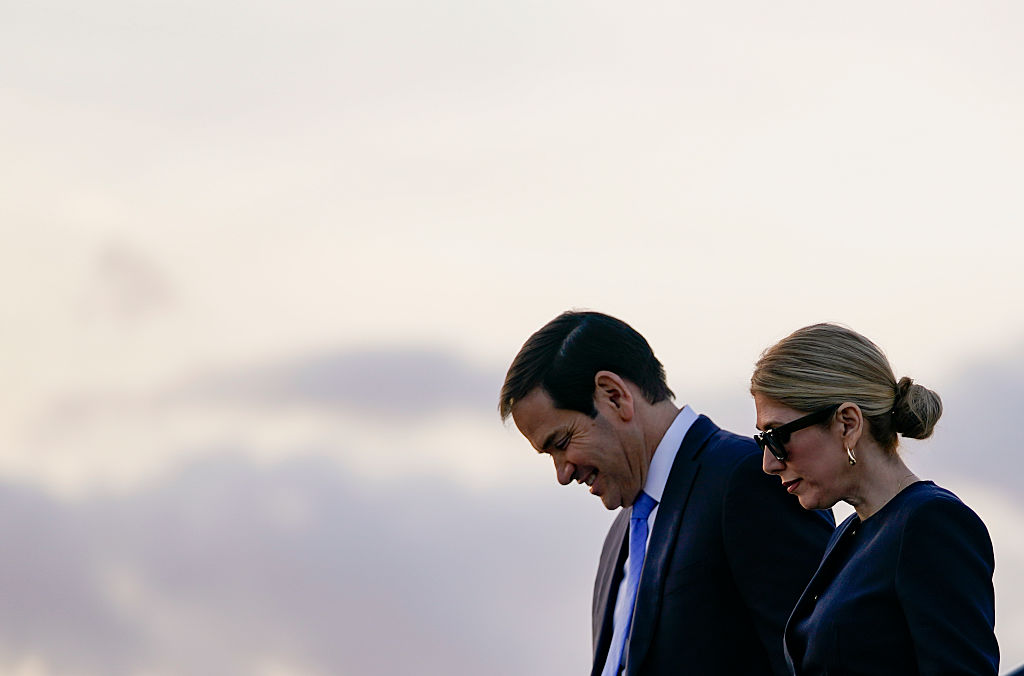
Marco Rubio won’t give up his Pop-Tarts for MAHA

Secretary of State Marco Rubio has enough on his plate managing American foreign policy. Apparently, Robert F. Kennedy Jr.‘s sauerkraut won’t be joining it.

Rubio and his wife, Jeanette, offered a surprisingly candid glimpse into life inside the Trump administration during an appearance on “The Katie Miller Podcast,” covering everything from Cabinet members’ diets and pets to Pop-Tarts, UFOs and Rubio’s disastrous attempt at going keto.

Katie Miller is the wife of Deputy Chief of Staff and long-time Trump senior adviser Stephen Miller. Her podcast has become a behind-the-scenes look into Trump’s Cabinet members.

Asked whether he had embraced Kennedy’s Make America Healthy Again movement, Rubio said he supported it.

His wife immediately disagreed.

“He’s completely not,” Jeanette Rubio said, revealing her husband’s fondness for Pop-Tarts.

“The Pop-Tart is one of the great American innovations in history,” Rubio responded.

Rubio also singled out Kennedy’s commitment to a meat-and-sauerkraut-heavy diet, saying the health secretary travels with his own food.

“I’m not gonna travel the world with a cooler full of sauerkraut,” Rubio said.

Rubio has tried changing his eating habits. It apparently didn’t go well. He described attempting the keto diet as a “near-psychotic event” brought on by sugar withdrawal, joking that giving someone in his position that much irritability could have geopolitical consequences.

“You could end up bombing Paraguay,” Rubio joked.


Start your day with essential news from Salon.
Sign up for our free morning newsletter, Crash Course.


Then there is Defense Secretary Pete Hegseth‘s cat.

The Hegseths and Rubios are neighbors, Rubio revealed, and Hegseth’s cat routinely visits the secretary of state’s porch. Rubio, who prefers dogs, described the animal as “arrogant.”

The cross-Cabinet pet diplomacy apparently goes both ways: The Rubios’ goldendoodle has wandered into the Hegseth home.

Rubio’s unusually loose interview ranged well beyond his colleagues. He professed a fondness for Tupac Shakur and electronic dance music, discussed UFO sightings around U.S. military installations and admitted his ideal fall Saturday involves spending hours watching college football.

He also recalled spending roughly 90 minutes aboard Air Force One worried that another passenger sleeping on a couch might actually be dead. Rather than wake the person, Rubio said he kept watching for signs of breathing until the passenger finally stirred.

The interview offered an unusually personal look at an official better known for managing an increasingly complicated portfolio of international crises and national security issues.

It also established at least one clear boundary in American diplomacy: Rubio may travel the world on behalf of the president, but he won’t be doing it with a cooler full of fermented cabbage.

The post Marco Rubio won’t give up his Pop-Tarts for MAHA appeared first on Salon.com.

  •  

Machthaber: Kim Jong-Un

Wer regiert die Welt – und was treibt sie an? In unserem regelmäßigen Machthaber-Spezial geht es um die mächtigsten und umstrittensten Politikerinnen und Politiker unserer Zeit. Wir zeigen, wie sie denken, entscheiden – und was das für uns bedeutet. Eine Politikerin oder Politiker, ein Blick hinter die Kulissen der Macht.

Das Berlin Playbook als Podcast gibt es jeden Morgen ab 5 Uhr. Gordon Repinski und das POLITICO-Team liefern Politik zum Hören – kompakt, international, hintergründig.
Für alle Hauptstadt-Profis: Der Berlin Playbook-Newsletter bietet jeden Morgen die wichtigsten Themen und Einordnungen. Jetzt kostenlos abonnieren.

Mehr von Host und POLITICO Executive Editor Gordon Repinski: Instagram: @gordon.repinski | X: @GordonRepinski.

POLITICO Deutschland – ein Angebot der Axel Springer Deutschland GmbH
Axel-Springer-Straße 65, 10888 Berlin
Tel: +49 (30) 2591 0
information@axelspringer.de
Sitz: Amtsgericht Berlin-Charlottenburg, HRB 196159 B
USt-IdNr: DE 214 852 390
Geschäftsführer: Carolin Hulshoff Pol, Mathias Sanchez Luna

  •  

Machthaber: Wolodymyr Selenskyj

Wer regiert die Welt – und was treibt sie an? In unserem regelmäßigen Machthaber-Spezial geht es um die mächtigsten und umstrittensten Politikerinnen und Politiker unserer Zeit. Wir zeigen, wie sie denken, entscheiden – und was das für uns bedeutet. Eine Politikerin oder Politiker, ein Blick hinter die Kulissen der Macht.

Das Berlin Playbook als Podcast gibt es jeden Morgen ab 5 Uhr. Gordon Repinski und das POLITICO-Team liefern Politik zum Hören – kompakt, international, hintergründig. Für alle Hauptstadt-Profis: Der Berlin Playbook-Newsletter bietet jeden Morgen die wichtigsten Themen und Einordnungen. ⁠Jetzt kostenlos abonnieren.⁠

Mehr von Host und POLITICO Executive Editor Gordon Repinski:
Instagram: ⁠@gordon.repinski⁠ | X: ⁠@GordonRepinski⁠.

POLITICO Deutschland – ein Angebot der Axel Springer Deutschland GmbH
Axel-Springer-Straße 65, 10888 Berlin
Tel: +49 (30) 2591 0
⁠information@axelspringer.de⁠
Sitz: Amtsgericht Berlin-Charlottenburg, HRB 196159 B
USt-IdNr: DE 214 852 390
Geschäftsführer: Carolin Hulshoff Pol, Mathias Sanchez Luna

  •  

Week Ender archives: Can Europe quit American Big Tech? 

This week and next, the Brussels Playbook Week Ender podcast is away for the summer holiday. 

So, we thought we’d re-up this popular installment on Europe’s quest to become independent from U.S. tech. 

In this episode first released in June, Sarah Wheaton is joined by “The Tech Coup” author and former Member of the European Parliament Marietje Schaake and POLITICO’s Laurens Cerulus, as they look at what happens when the systems running Europe’s schools, ministries, banks, businesses and security are controlled elsewhere. They also discuss whether Brussels can build real alternatives or simply learn to manage its dependence better. 

The Brussels Playbook Podcast will be back to its regular schedule on Aug. 24. 

Questions? Comments? Send us a message to our WhatsApp here or at +32 491 05 06 29. 

  •  

Machthaber: Javier Milei

Wer regiert die Welt – und was treibt sie an? In unserem regelmäßigen Machthaber-Spezial geht es um die mächtigsten und umstrittensten Politikerinnen und Politiker unserer Zeit. Wir zeigen, wie sie denken, entscheiden – und was das für uns bedeutet. Eine Politikerin oder Politiker, ein Blick hinter die Kulissen der Macht.

Das Berlin Playbook als Podcast gibt es jeden Morgen ab 5 Uhr. Gordon Repinski und das POLITICO-Team liefern Politik zum Hören – kompakt, international, hintergründig. Für alle Hauptstadt-Profis: Der Berlin Playbook-Newsletter bietet jeden Morgen die wichtigsten Themen und Einordnungen. ⁠Jetzt kostenlos abonnieren.⁠

Mehr von Host und POLITICO Executive Editor Gordon Repinski:
Instagram: ⁠@gordon.repinski⁠ | X: ⁠@GordonRepinski⁠.

POLITICO Deutschland – ein Angebot der Axel Springer Deutschland GmbH
Axel-Springer-Straße 65, 10888 Berlin
Tel: +49 (30) 2591 0
⁠information@axelspringer.de⁠
Sitz: Amtsgericht Berlin-Charlottenburg, HRB 196159 B
USt-IdNr: DE 214 852 390
Geschäftsführer: Carolin Hulshoff Pol, Mathias Sanchez Luna

  •  

How an AIPAC endorsement became a liability

A woman wearing a keffiyeh carries a Palestinian flag that says “Freedom for Palestine” and a sign reading “Dump AIPAC.”
Pro-Palestinian Jewish American demonstrators rally in Manhattan on February 22, 2024. | Selcuk Acar/Anadolu via Getty Images

The American Israel Public Affairs Committee — better known by its short name, AIPAC — bills itself as a bipartisan advocate “for policies that strengthen the US-Israel partnership.” In 2026, it’s become something else: a major — and seemingly, losing — issue in Democratic politics. 

Progressive Democratic candidates in primaries across the country are explicitly calling out their opponents’ relationship with AIPAC, often using the connection as a rallying point to persuade voters about the problem of “dark money” in politics. Most recently, in Michigan, AIPAC spent about $30 million boosting Rep. Haley Stevens in her bid for the state’s Democratic Senate nomination. Her opponent, Abdul El-Sayed, drew attention to it again and again. She lost. 

As one of the biggest spenders in US elections, the group has gone well beyond its origins lobbying members of Congress to support its agenda. According to David Dayen, executive editor of the American Prospect, AIPAC is spending millions of dollars against candidates who speak out against Israel’s actions in Palestine — sometimes using advertisements that have nothing to do with Israel, and may appear unrelated to AIPAC.

Dayen spoke with Today, Explained co-host Noel King about the backlash surrounding AIPAC’s spending, the group’s complicated web of shell PACs,  and what it all means for the Democratic Party’s quickly evolving stance on Israel.

Below is an excerpt of their conversation, edited for length and clarity. There’s much more in the full podcast, so listen to Today, Explained wherever you get podcasts, including Apple Podcasts, Pandora, and Spotify

What is AIPAC?

AIPAC started out as a lobbying organization. It was inaugurated in the 1950s. It has historically been seen as one of the more powerful lobbying organizations in Washington. And its goal is to strengthen and maintain the relationship between the US and Israel.

They have annual conventions where pretty much everybody across the political spectrum attends and gives speeches. But something changed about five years ago. AIPAC was not content to just lobby members of Congress. They wanted to influence who actually got to Washington. And they began to engage in the use of super PACs to run advertising and other forms of political engagement in campaigns, and particularly in primary campaigns that determine who actually gets to a general election.  

Why did they want to influence who got to Washington? Maybe that sounds like an obvious question, but it wasn’t happening before, so why did it start happening?

One thing that happened is in 2018, we saw the rise of what is known as “The Squad,” and that included Alexandria Ocasio-Cortez, Ilhan Omar, and Rashida Tlaib — people who had very strident views, particularly about the US-Israel relationship. Those progressive Democrats were very successful in winning safe seat races. And I’m not in their head, but it could be that AIPAC wanted to try to provide a counterweight, and stop that from happening, and use their resources — very prodigious resources — to spend money in these campaigns and to make sure that doesn’t happen again.

Once upon a time, an endorsement from AIPAC was a powerful thing. It could be a huge benefit to a candidate. What exactly did it get you when AIPAC said, “This is our guy, this is our gal?

I mean, in practical terms, it probably got you $5,000 because that’s the limit on a corporate PAC. But because AIPAC was powerful and also a bipartisan organization, getting your name on the list of AIPAC endorsees was something that you could tout in your election. It was something that showed that you had a commitment to what has historically been an important bond between the US and Israel. 

It certainly wasn’t as controversial in the years before 2023 as it is today. After October 7, we saw what a lot of people have termed a genocide against the Palestinian people. The changing attitudes around the US-Israel relationship more broadly, where large numbers of Americans now view that relationship negatively, have changed what the meaning of an AIPAC endorsement really is.

I know that you’ve dug into the numbers. What do we know about how much money AIPAC is specifically spending this midterm cycle?

It’s a hard question to answer. If you go by the Federal Election Commission disclosures, AIPAC has raised about a hundred million dollars this election cycle, and has spent in independent expenditures — that’s TV ads and mailers and these kinds of things — about $28 million. 

But that is an undercount for a couple different reasons. When I say those numbers, I am going by the specific super PAC that AIPAC has created. It’s called United Democracy Project. United Democracy Project has sent money to other PACs — about $9 million worth.

Is this a lot of money?

I think the real innovation here is the transfer of money from, in this case, pro-Israel PACs, to these pop-up PACs, these shell PACs that are created specifically for a particular election and then funded through AIPAC and, in some cases, other other pro-Israel PACs. 

They are sort of laundering this money through to other PACs, so those other PACs run the ads and it doesn’t look like it’s coming from AIPAC. A perfect example was the first real major primary state of the cycle, which was Illinois.

There were four open seats in the Chicago area that are pretty strongly blue. A Democrat is going to win the general election. And so these primaries were highly contested. AIPAC set up two PACs, one called Elect Chicago Women and the other called Affordable Chicago Now. And millions of dollars went from AIPAC’s super PAC, which is called United Democracy Project, into these two pop-up PACs. 

And those two PACs then funded ads for four candidates in those four open seat races. Now, if you were watching that on television, you would say, “Hey, elect Chicago women. That sounds like a good idea. I’m gonna watch this ad” or “Affordable Chicago now. I like affordability.” The truth is that this money was coming from AIPAC into these ads and supporting candidates that were generally supportive of the US-Israel relationship. 

Now, those four races — AIPAC won two of them and they lost two of them. And it was really interesting, I think, where they were successful, and where they weren’t. In one race up in the Evanston area, it became a big issue that AIPAC actually was behind these ads from Elect Chicago Women and Affordable Chicago Now. 

The [AIPAC] candidate, a state senator named Laura Fine, actually was harmed, I think, in the election by this fact that this got out, and that this became a major issue in the campaign. And she ended up finishing third in that primary, despite having millions of dollars supporting her. There were other races where this wasn’t sort of as explicit a factor in the election itself, and those candidates were able to win. 

This all sounds quite shady and yet I wonder — how unusual is it for an interest group in politics to be doing something like this?

I think it’s pretty unusual. It’s not something I’ve seen a whole lot of. We saw it to a smaller degree in some other election cycles — two years ago, four years ago — but it has become a concerted strategy this time. 

And so there are these pop-up PACS that are specific to a campaign, but also some established PACs that have been around for a while are receiving money from AIPAC and affiliated groups and using that in campaigns. 

Emily’s List is a very well-known political organization that supports pro-choice women. They took [hundreds of thousands of dollars] from an organization called Democratic Majority for Israel that is not affiliated with AIPAC per se, but aligns on similar candidates. 

There are other examples of this, more obscure examples. Like there’s a PAC called Crush MAGA PAC. And it’s affiliated with a different, I’m gonna sound crazy when I say this, but Crush MAGA PAC is affiliated with a different pack called Save Democracy, and Save Democracy has received $100,000 from United Democracy Project, which is AIPAC Super PAC. So sometimes the layers here are two or three or even four PACs deep. 

And it can be really hard to untangle all this and figure out where the money has come from, because AIPAC certainly isn’t saying, “We’re funding that campaign.” They’re releasing disclosures as required by the Federal Election Commission, but they’re not saying where the money is earmarked for, if it’s for a specific race, if it’s for a specific candidate.

AIPAC at times has responded to criticism of it by appearing to conflate it with criticism of Israel or criticism of Jews. Last year, Sen. Bernie Sanders comes out with a statement. He denounces Benjamin Netanyahu’s government for what he says is the “extermination of Gaza.” He calls for an end to military aid to Israel. He says people are starving to death.

AIPAC attacks Sanders’s statement, calling it a hate-filled rant and blood libel, and pointing out that in his statement, he didn’t mention Hamas’s attack on Israel. So AIPAC is now public in a way that historically it has not been. And it is tying criticism of Israel to antisemitic sentiment. Does this help or hurt AIPAC’s cause, do you think?

It depends on the messenger, but the issue is that there’s a very straight line between how this money is being used, transferred, spent, concealed, and a broader critique that I think a lot of Democrats have about money in politics. And so when AIPAC decides, “Okay, we’re going respond to criticism that is rooted in what AIPAC believes, and the conditions in Israel and Gaza and the West Bank, et cetera,” to saying, you know, “Any criticism of what we’re doing is antisemitic — I think people who see this as a broader problem about money in politics see that as an extremely cynical take.”

I don’t think that really connects to one of the big reasons why people are really objecting to this, which is that they don’t want to see their politicians essentially bought.

But it’s additionally fraught because there are antisemitic tropes where, you know, a cabal of Jews is secretly controlling the government and finance, right? It feels triply complicated.

Look, I’m Jewish, and in having to cover this, I have to try to follow money from Jewish groups from one place to another, and that can certainly be uncomfortable. And it does add some weight to this issue. 

But I feel like we are talking here not about somebody’s religion, but about a policy. And it’s a twofold policy. One is the policy of the US government funding, to the tune of billions of dollars, the destruction of an entire region, and also the policy of allowing super PACs to dictate who ends up making decisions in Washington.

  •  

Machthaber: Mohammed bin Salman

Wer regiert die Welt – und was treibt sie an? In unserem regelmäßigen Machthaber-Spezial geht es um die mächtigsten und umstrittensten Politikerinnen und Politiker unserer Zeit. Wir zeigen, wie sie denken, entscheiden – und was das für uns bedeutet. Eine Politikerin oder Politiker, ein Blick hinter die Kulissen der Macht.

Das Berlin Playbook als Podcast gibt es jeden Morgen ab 5 Uhr. Gordon Repinski und das POLITICO-Team liefern Politik zum Hören – kompakt, international, hintergründig. Für alle Hauptstadt-Profis: Der Berlin Playbook-Newsletter bietet jeden Morgen die wichtigsten Themen und Einordnungen. ⁠Jetzt kostenlos abonnieren.⁠

Mehr von Host und POLITICO Executive Editor Gordon Repinski:
Instagram: ⁠@gordon.repinski⁠ | X: ⁠@GordonRepinski⁠.

POLITICO Deutschland – ein Angebot der Axel Springer Deutschland GmbH
Axel-Springer-Straße 65, 10888 Berlin
Tel: +49 (30) 2591 0
⁠information@axelspringer.de⁠
Sitz: Amtsgericht Berlin-Charlottenburg, HRB 196159 B
USt-IdNr: DE 214 852 390
Geschäftsführer: Carolin Hulshoff Pol, Mathias Sanchez Luna

  •  

How Ukraine is holding its own against Russia — and changing warfare as we know it

Two Ukrainian soldiers bend over a heavy bomber drone lit with red light from a helmet; behind them are dark clouds in a twilight sky.
Ukrainian soldiers prepare a “Baba Yaga” heavy bomber drone before a nighttime training flight on March 23, 2026. | Dmytro Smolienko/Ukrinform/Future Publishing via Getty Images

When the Russia-Ukraine conflict erupted into full-scale war in 2022, things looked grim for Ukraine. Its capital, Kyiv, was under threat almost immediately, and there were questions about how long the smaller country could hold out, even with US support. More than four years later, however, the dynamic is changing. US military support has waned, but not only has Ukraine held its own in years of grinding, attritional fighting, it increasingly has Russia on the defensive.

According to Marcus Walker, who covers Ukraine as South Europe Bureau Chief for the Wall Street Journal, “it’s certainly possible for the smaller country to survive and have a chance of winning only because it is more nimble and and better at improvising and for large periods of the war has had the edge in terms of innovation.” 

Walker, who, last month, reported on how the war is beginning to shift against Russian President Vladimir Putin, talked with Today, Explained co-host Noel King to explain how Ukraine has held on this long — and how it’s successfully improvising on the battlefield to press its advantage.

Below is an excerpt of their conversation, edited for length and clarity. There’s much more in the full podcast, including how Ukraine has recently gained a new ally on the American right who has Trump’s ear. You can listen to Today, Explained wherever you get podcasts, including Apple Podcasts, Pandora, and Spotify

You recently wrote that Ukraine has Russia on its back foot. How?

To understand what happened this year, we have to go back to the very beginnings of the war, which were in 2014 when Russia seized Crimea and the Eastern Donbas region in a smaller-scale war. And, at the time, Ukraine was a militarily weak country. Its army was pretty backward and had outdated equipment; although, it fought as hard as it could. The society was politically divided, especially over its relationship with Russia and with the West and with Europe. And Russia seems to have drawn the lesson that Ukraine would be a pushover when it launched its full scale invasion in 2022. And, at the time, now four and a half years ago, even most Western governments and intelligence services thought that Russia would win the war easily.

Instead, the very fact of Russian pressure on Ukraine had somehow welded Ukrainians together and created a stronger, more united society and state that shared — whatever the internal differences — at least the determination to have a country called Ukraine. And, in the meantime, they did a lot of reforms to their country and to their military. 

And so, when Russia launched a full scale invasion — thinking, “this will be easy,” — instead they found themselves in a full-scale war that they’ve been unable to win. On balance, Russia is really struggling to get any military result despite the investment of massive resources and the loss of incredible numbers of soldiers in trying to win this war. It just isn’t able to turn its advantage in numbers into victory. 

Right now, it’s hard to see Ukraine collapsing. However, Ukraine’s a long way from winning outright. And the outcome of this war is ultimately still open.

Ukraine must be doing something right on the battlefield. What is it doing right?

It has found ways to counteract Russia’s advantage in numbers, in manpower, and in equipment. And, above all, the asymmetric war that Ukraine has been fighting has come to rely heavily on drones, on its know-how, and on its skill at improvisation to develop a new form of drone warfare that other countries around the world have been trying to learn from, including the US military, including Middle Eastern countries, including Iran, and including other NATO countries in Europe — and, of course, the Russians, too. 

There is a constant arms race here in terms of drone technology and tactics. And both sides are now using incredible numbers of these often very tiny weapons — often 12 or 15 inches big with four little propellers — that can kill at ranges of 20 to 30 miles.

What is Ukraine using the drones to do, exactly?

They’re the most important tactical weapon at the front for killing Russian infantry. They are also using larger bomber drones with propellers or with wings to try and destroy Russian logistics, to blow up trucks transporting ammunition or other supplies on the supply roads far behind the front. They’re using long-range drones that can fly for a thousand miles or more to destroy Russian oil refineries deep inside Russia in an attempt to cut off the oil revenues that are vital for the Russian state and for Putin’s ability to finance the war. 

On the front line, drones are also doing all sorts of work that humans used to do, such as transporting ammunition, and food, and water to infantry soldiers on the front line. So, if you go to frontline areas now, or anywhere near them, you can see ground drones: little remote-control vehicles with big chunky wheels trundling along on their own with no human in sight. 

They also, for example, evacuate wounded Ukrainian soldiers. They will lie down on these ground drones and be ferried out, because that is better than having six men carry you out on a stretcher where, if you’re hit again, then you might have seven casualties.

How did Ukraine end up using drones in so many areas — and so successfully? Is this just weaponry evolving the way it tends to?

Obviously, in all wars, innovation happens very fast under the pressure of necessity. But there is something very particular about Ukraine. It is a country of people who like to improvise. It’s also a country with a large software sector, a large IT sector. And it’s a place where large parts of the military have a culture of, as we journalists sometimes put it, trying to MacGyver solutions. You take what you have, and you improvise. 

It so happened that the drone revolution started with consumer drones, the same kind of quadcopters that people were using to take pictures on holiday. And they worked out ways to attach a claw to them that can then drop a grenade or strap some explosives to it and crash the whole drone into a Russian vehicle. That was how it began at the start of this war in 2022. But, now, these things have become really a deadly fleet of flying killer robots that saturate the frontline area. 

Of course, the Russians are doing the same. So, on both sides of the front line, it has become extremely difficult and dangerous to move under a sky full of these killer robots.

I was reading this weekend that Ukraine has been using drones to target warehouses for this company called Wildberries. It’s kind of like Amazon for Russia. What’s the strategy there?

There are a couple of aspects to that. One is that Wildberries has also been selling a large amount of military gear, such as body armor or drone components. It’s more like an Amazon from which the soldiers can order a lot of gear to continue the war, so it is a way of disrupting military logistics. 

But, also, it strikes a blow to Russian civilian perceptions of the war, because, for years, Putin tried to tell the Russian population that this war is something happening far away, and it wouldn’t touch them directly. Now, it turns out that their equivalent of Amazon deliveries are not going to be arriving, because the warehouse burned down. 

At the same time, it’s a way of damaging the Russian economy, because Wildberries also owes a lot of money to banks. And so, if the company is in trouble, then it also causes trouble for the Russian banking system. And it hurts the tax revenues of the Russian government that pay for the war.

Is Russia showing evolution on the battlefield, as well?

Yes, they have. They have also come up with their own innovations. For example, in the last couple of years, since about 2024, they’ve been using large numbers of drones on fiber optic cables. That means the pilot that’s flying them is attached via a long thin plastic cable or fiber optic cable to a drone that carries a spool and is unspooling this cable as it flies. Now, what does that do? It means that electronic interference with the radio signal is no longer possible, because there is a physical connection between the pilot and the drone. So, that was an innovation that bypassed electronic warfare or the interception of the radio signal of the video feed that pilots need to fly their drones. 

They’ve had other innovations too. The Russians last year, for example, came up with a whole new class of medium-range drones — cheap, fixed-wing drones. The Ukrainians have now responded and made their own versions, which are better, but it really is a constant race of innovation and adaptation. And every time I come back and talk to military units here, everything’s changed. The tactics that worked last year no longer work. And the drones that work now didn’t exist three months ago.

Is there some possibility that Ukraine can win this war by not losing it?

Yes. Winning in war means achieving political war aims. And Ukraine’s aim is to survive as an independent nation state. It can do that. It can achieve that even if it loses currently about 20 percent of its territory that’s under Russian occupation. 

I think it’s hard to see how Russia can achieve its own central war aim, which was to reimpose political control over Ukraine to turn it into a kind of protectorate — really to take back control of the place that was once Russia’s largest colony. It’s very hard to see how the Russians can achieve that. The Russians seem to be counting on the West, on the US and the Europeans getting tired of supporting Ukraine, of sending financing and loans and weaponry. Putin seems to believe that, without this international support from the West, Kyiv won’t be able to carry this on forever.

  •  

Machthaber: Benjamin Netanjahu

Wer regiert die Welt – und was treibt sie an? In unserem regelmäßigen Machthaber-Spezial geht es um die mächtigsten und umstrittensten Politikerinnen und Politiker unserer Zeit. Wir zeigen, wie sie denken, entscheiden – und was das für uns bedeutet. Eine Politikerin oder Politiker, ein Blick hinter die Kulissen der Macht.

Das Berlin Playbook als Podcast gibt es jeden Morgen ab 5 Uhr. Gordon Repinski und das POLITICO-Team liefern Politik zum Hören – kompakt, international, hintergründig. Für alle Hauptstadt-Profis: Der Berlin Playbook-Newsletter bietet jeden Morgen die wichtigsten Themen und Einordnungen. ⁠Jetzt kostenlos abonnieren.⁠

Mehr von Host und POLITICO Executive Editor Gordon Repinski:
Instagram: ⁠@gordon.repinski⁠ | X: ⁠@GordonRepinski⁠.

POLITICO Deutschland – ein Angebot der Axel Springer Deutschland GmbH
Axel-Springer-Straße 65, 10888 Berlin
Tel: +49 (30) 2591 0
⁠information@axelspringer.de⁠
Sitz: Amtsgericht Berlin-Charlottenburg, HRB 196159 B
USt-IdNr: DE 214 852 390
Geschäftsführer: Carolin Hulshoff Pol, Mathias Sanchez Luna

  •  

Machthaber: Charles III.

Wer regiert die Welt – und was treibt sie an? In unserem regelmäßigen Machthaber-Spezial geht es um die mächtigsten und umstrittensten Politikerinnen und Politiker unserer Zeit. Wir zeigen, wie sie denken, entscheiden – und was das für uns bedeutet. Eine Politikerin oder Politiker, ein Blick hinter die Kulissen der Macht.

Das Berlin Playbook als Podcast gibt es jeden Morgen ab 5 Uhr. Gordon Repinski und das POLITICO-Team liefern Politik zum Hören – kompakt, international, hintergründig. Für alle Hauptstadt-Profis: Der Berlin Playbook-Newsletter bietet jeden Morgen die wichtigsten Themen und Einordnungen. ⁠Jetzt kostenlos abonnieren.⁠

Mehr von Host und POLITICO Executive Editor Gordon Repinski: Instagram: ⁠@gordon.repinski⁠ | X: ⁠@GordonRepinski⁠.

POLITICO Deutschland – ein Angebot der Axel Springer Deutschland GmbH
Axel-Springer-Straße 65, 10888 Berlin
Tel: +49 (30) 2591 0
⁠information@axelspringer.de⁠
Sitz: Amtsgericht Berlin-Charlottenburg, HRB 196159 B
USt-IdNr: DE 214 852 390
Geschäftsführer: Carolin Hulshoff Pol, Mathias Sanchez Luna

  •  
❌