 Login

Checksummer 64 V3
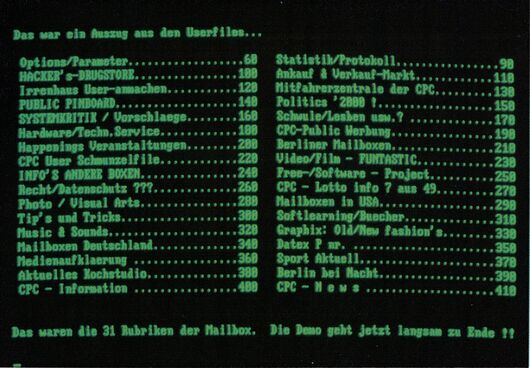
Der Checksummer 64 V3 überprüft jede Basic-Zeile direkt nach der Eingabe, erkennt Fehleingaben sowie Vertauschungen von Ziffern und erspart eine aufwendige Fehlersuche.


4 October, morning.—Once again during the night I was wakened by Mina. This time we had all had a good sleep, for the grey of the coming dawn was making the windows into sharp oblongs, and the gas flame was like a speck rather than a disc of light. She said to me hurriedly:—
"Go, call the Professor. I want to see him at once."
"Why?" I asked.
"I have an idea. I suppose it must have come in the night, and matured without my knowing it. He must hypnotise me before the dawn, and then I shall be able to speak. Go quick, dearest; the time is getting close." I went to the door. Dr. Seward was resting on the mattress, and, seeing me, he sprang to his feet.
"Is anything wrong?" he asked, in alarm.
"No," I replied; "but Mina wants to see Dr. Van Helsing at once."
"I will go," he said, and hurried into the Professor's room.
In two or three minutes later Van Helsing was in the room in his dressing-gown, and Mr. Morris and Lord Godalming were with Dr. Seward at the door asking questions. When the Professor saw Mina a smile—a positive smile ousted the anxiety of his face; he rubbed his hands as he said:—
"Oh, my dear Madam Mina, this is indeed a change. See! friend Jonathan, we have got our dear Madam Mina, as of old, back to us to-day!" Then turning to her, he said, cheerfully: "And what am I do for you? For at this hour you do not want me for nothings."
"I want you to hypnotise me!" she said. "Do it before the dawn, for I feel that then I can speak, and speak freely. Be quick, for the time is short!" Without a word he motioned her to sit up in bed.
Looking fixedly at her, he commenced to make passes in front of her, from over the top of her head downward, with each hand in turn. Mina gazed at him fixedly for a few minutes, during which my own heart beat like a trip hammer, for I felt that some crisis was at hand. Gradually her eyes closed, and she sat, stock still; only by the gentle heaving of her bosom could one know that she was alive. The Professor made a few more passes and then stopped, and I could see that his forehead was covered with great beads of perspiration. Mina opened her eyes; but she did not seem the same woman. There was a far-away look in her eyes, and her voice had a sad dreaminess which was new to me. Raising his hand to impose silence, the Professor motioned to me to bring the others in. They came on tip-toe, closing the door behind them, and stood at the foot of the bed, looking on. Mina appeared not to see them. The stillness was broken by Van Helsing's voice speaking in a low level tone which would not break the current of her thoughts:—
"Where are you?" The answer came in a neutral way:—
"I do not know. Sleep has no place it can call its own." For several minutes there was silence. Mina sat rigid, and the Professor stood staring at her fixedly; the rest of us hardly dared to breathe. The room was growing lighter; without taking his eyes from Mina's face, Dr. Van Helsing motioned me to pull up the blind. I did so, and the day seemed just upon us. A red streak shot up, and a rosy light seemed to diffuse itself through the room. On the instant the Professor spoke again:—
"Where are you now?" The answer came dreamily, but with intention; it were as though she were interpreting something. I have heard her use the same tone when reading her shorthand notes.
"I do not know. It is all strange to me!"
"What do you see?"
"I can see nothing; it is all dark."
"What do you hear?" I could detect the strain in the Professor's patient voice.
"The lapping of water. It is gurgling by, and little waves leap. I can hear them on the outside."
"Then you are on a ship?" We all looked at each other, trying to glean something each from the other. We were afraid to think. The answer came quick:—
"Oh, yes!"
"What else do you hear?"
"The sound of men stamping overhead as they run about. There is the creaking of a chain, and the loud tinkle as the check of the capstan falls into the rachet."
"What are you doing?"
"I am still—oh, so still. It is like death!" The voice faded away into a deep breath as of one sleeping, and the open eyes closed again.
By this time the sun had risen, and we were all in the full light of day. Dr. Van Helsing placed his hands on Mina's shoulders, and laid her head down softly on her pillow. She lay like a sleeping child for a few moments, and then, with a long sigh, awoke and stared in wonder to see us all around her. "Have I been talking in my sleep?" was all she said. She seemed, however, to know the situation without telling, though she was eager to know what she had told. The Professor repeated the conversation, and she said:—
"Then there is not a moment to lose: it may not be yet too late!" Mr. Morris and Lord Godalming started for the door but the Professor's calm voice called them back:—
"Stay, my friends. That ship, wherever it was, was weighing anchor whilst she spoke. There are many ships weighing anchor at the moment in your so great Port of London. Which of them is it that you seek? God be thanked that we have once again a clue, though whither it may lead us we know not. We have been blind somewhat; blind after the manner of men, since when we can look back we see what we might have seen looking forward if we had been able to see what we might have seen! Alas, but that sentence is a puddle; is it not? We can know now what was in the Count's mind, when he seize that money, though Jonathan's so fierce knife put him in the danger that even he dread. He meant escape. Hear me, ESCAPE! He saw that with but one earth-box left, and a pack of men following like dogs after a fox, this London was no place for him. He have take his last earth-box on board a ship, and he leave the land. He think to escape, but no! we follow him. Tally Ho! as friend Arthur would say when he put on his red frock! Our old fox is wily; oh! so wily, and we must follow with wile. I, too, am wily and I think his mind in a little while. In meantime we may rest and in peace, for there are waters between us which he do not want to pass, and which he could not if he would—unless the ship were to touch the land, and then only at full or slack tide. See, and the sun is just rose, and all day to sunset is to us. Let us take bath, and dress, and have breakfast which we all need, and which we can eat comfortably since he be not in the same land with us." Mina looked at him appealingly as she asked:—
"But why need we seek him further, when he is gone away from us?" He took her hand and patted it as he replied:—
"Ask me nothings as yet. When we have breakfast, then I answer all questions." He would say no more, and we separated to dress.
After breakfast Mina repeated her question. He looked at her gravely for a minute and then said sorrowfully:—
"Because my dear, dear Madam Mina, now more than ever must we find him even if we have to follow him to the jaws of Hell!" She grew paler as she asked faintly:—
"Why?"
"Because," he answered solemnly, "he can live for centuries, and you are but mortal woman. Time is now to be dreaded—since once he put that mark upon your throat."
I was just in time to catch her as she fell forward in a faint.
This to Jonathan Harker.
You are to stay with your dear Madam Mina. We shall go to make our search—if I can call it so, for it is not search but knowing, and we seek confirmation only. But do you stay and take care of her to-day. This is your best and most holiest office. This day nothing can find him here. Let me tell you that so you will know what we four know already, for I have tell them. He, our enemy, have gone away; he have gone back to his Castle in Transylvania. I know it so well, as if a great hand of fire wrote it on the wall. He have prepare for this in some way, and that last earth-box was ready to ship somewheres. For this he took the money; for this he hurry at the last, lest we catch him before the sun go down. It was his last hope, save that he might hide in the tomb that he think poor Miss Lucy, being as he thought like him, keep open to him. But there was not of time. When that fail he make straight for his last resource—his last earth-work I might say did I wish double entente. He is clever, oh, so clever! he know that his game here was finish; and so he decide he go back home. He find ship going by the route he came, and he go in it. We go off now to find what ship, and whither bound; when we have discover that, we come back and tell you all. Then we will comfort you and poor dear Madam Mina with new hope. For it will be hope when you think it over: that all is not lost. This very creature that we pursue, he take hundreds of years to get so far as London; and yet in one day, when we know of the disposal of him we drive him out. He is finite, though he is powerful to do much harm and suffers not as we do. But we are strong, each in our purpose; and we are all more strong together. Take heart afresh, dear husband of Madam Mina. This battle is but begun, and in the end we shall win—so sure as that God sits on high to watch over His children. Therefore be of much comfort till we return.
VAN HELSING.
4 October.—When I read to Mina, Van Helsing's message in the phonograph, the poor girl brightened up considerably. Already the certainty that the Count is out of the country has given her comfort; and comfort is strength to her. For my own part, now that his horrible danger is not face to face with us, it seems almost impossible to believe in it. Even my own terrible experiences in Castle Dracula seem like a long-forgotten dream. Here in the crisp autumn air in the bright sunlight——
Alas! how can I disbelieve! In the midst of my thought my eye fell on the red scar on my poor darling's white forehead. Whilst that lasts, there can be no disbelief. And afterwards the very memory of it will keep faith crystal clear. Mina and I fear to be idle, so we have been over all the diaries again and again. Somehow, although the reality seems greater each time, the pain and the fear seem less. There is something of a guiding purpose manifest throughout, which is comforting. Mina says that perhaps we are the instruments of ultimate good. It may be! I shall try to think as she does. We have never spoken to each other yet of the future. It is better to wait till we see the Professor and the others after their investigations.
The day is running by more quickly than I ever thought a day could run for me again. It is now three o'clock.


Editor’s note, October 4, 8 am ET: We’re bringing you some of our best-loved Your Mileage May Vary columns while Sigal Samuel is on parental leave. The one below was originally published last year.
This unconventional advice column offers you a unique framework for thinking through moral dilemmas. It’s based on value pluralism: the idea that each of us has multiple values that are equally valid but that often conflict with each other. Submit your own question here.
My partner and I did IVF recently and luckily we ended up with several embryos. One of those will be implanted in me so I hopefully get pregnant. But which one?
My fertility clinic is encouraging me to do PGT-A testing, which would screen for things like Down syndrome and would also let me see the sex of each embryo so I could potentially choose whichever I want. (And to be honest, I really want a girl!) I’m also hearing about these new companies that can test embryos for all kinds of things — like how smart the kid might be, how tall they’ll get, and whether they’ll have a lower chance of getting breast cancer, diabetes, mental illness, stuff like that.
I don’t know how to feel about any of this. On the one hand, it feels weirdly eugenics-y to do so much tinkering with embryos, and I can’t help feeling a little pressured into overmedicalizing everything with these expensive tests. But then again, if I could do something to make my baby healthier and happier, don’t I kind of have to do everything in my power? What does a parent owe their child?
Dear Expecting,
This is such an exciting — and also confusing — time. You’re about to have your first kid, and that comes with all sorts of fears and insecurities and hopes and dreams. You want to do the right thing — no, the best thing! — for your child. It’s a beautiful impulse. Unfortunately, it makes it easy for companies to prey on you.
So let me walk you through what these companies can and can’t really provide. After we talk about the science, we can talk about the ethics.
The simpler test you mentioned, PGT-A, has been around since the 1990s. It can indeed screen for conditions like Down syndrome and let you see the sex of each embryo. Mind you, that doesn’t predict what gender your child will ultimately end up identifying with — more on that soon.
The newer testing you mentioned is called polygenic testing. The conditions it screens for are complex ones, influenced by thousands of genes. We’re talking about everything from breast cancer to depression. Some companies even offer screenings not for disease prevention, but for genetic enhancement — so you can select for a taller kid or a kid with higher IQ.
Polygenic testing companies claim to predict each embryo’s risk for each condition, and the potential reduction of risk you’ll get if you choose one embryo over another. As the statistical geneticist Sasha Gusev explains, it’s very, very easy to be misled by this claim. If the company claims to lower absolute risk of Type 2 diabetes by 12 percent, you might think this means, “The chance of my kid ever developing diabetes just went down by 12 percent — great!” But really what it means is that, all else equal, a kid who would’ve developed diabetes is likely now at the high end of pre-diabetes instead, or just develops diabetes a few years later. The same holds true for other conditions, like breast cancer. Sure, if your kid is going to develop diabetes or breast cancer, you’d rather they develop it later — but it’s not the bill of perfect health customers might imagine.
“Typical risk reduction estimates tend to exploit statistical assumptions to overstate their benefits and lead to confusion,” Gusev writes.
Fill out this anonymous form! Newsletter subscribers will get my column before anyone else does and their questions will be prioritized for future editions. Sign up here!
It’s also important to note that there’s a difference between a physical disease like cancer, which is straightforwardly and universally negative, and a complex mental health condition like depression. For one thing, polygenic scores don’t perform as well in psychiatry, as the psychologist Eric Turkheimer notes. Plus, most mental health conditions come in mild to moderate to severe forms, and it’s not clear that we should want to get rid of mild or moderate manifestations.
“Sure, it would be nice if no one ever got depressed, but what would that actually mean?” Turkheimer writes. “People are going to be sad, and the most modern models of psychiatric disorders view most of them as extremes on continuous dimensions of normal behavior. I don’t think we want some kind of genetic version of Soma.”
To give a personal example: I have generalized anxiety with some obsessive tendencies. Is that a major pain in the butt sometimes? You bet. But if I could wave a magic wand and get rid of it, would I? No. In my experience, this trait is linked to another trait I deeply value: my creativity. The same thing that propels me down rabbit holes of worry also propels me down rabbit holes of getting super curious about some topic, researching it into the wee hours of the morning, and then writing a novel or children’s book about it.
That brings me to one other scientific issue: pleiotropy. It’s a fancy term for a simple truth, which is that genes can have an effect on more than one trait. When it comes to behavioral polygenic testing, we actually know very little about which genes cause what — a gene that’s correlated with depression or anxiety may also be correlated with a bunch of other things. So, if everyone were to start selecting embryos to try to protect their kids from depression or anxiety, what would happen? We don’t know!
Pleiotropy is a scientific issue, but it’s also a moral issue, because in trying to protect your kid from a negative outcome, you could also be accidentally barring them from a positive one.
And that’s just the tip of the moral iceberg.
Another issue is the potential psychological harm that can result from commodifying our kids — treating them like consumer objects with selectable parts. Let’s say you use polygenic testing to try to select for high IQ. Even if the company’s predictor is right 80 percent of the time, that means it’s wrong 20 percent of the time. What happens if it’s wrong about your kid, and they end up with a low IQ instead of a high one? How will your kid feel? Unless you hide the truth from them, they’ll know that they are not what you wanted, that they failed to live up to the vision you went out of your way to chase.
The same goes for sex selection via good old PGT-A. I know you really want a girl. But what would happen if you select for a girl, and then your child grows up and turns out to be trans? They may feel an extra sense that they’re letting you down by not conforming to the gender expectations you had for them.
Then there are the ethical questions around unequal access. Polygenic testing isn’t cheap. (One company, Orchid, charges $2,500 per screened embryo. Test 10 embryos and that’ll cost you $25,000.) So, at least in the short term, that raises the specter of entrenching a caste system, where the gap between rich and poor expands dramatically as the rich get smarter and stronger.
Technologies tend to get cheaper over time, so maybe everyone will ultimately be able to afford polygenic testing. But that raises another problem: implicit coercion. If more and more of us make ourselves smarter and stronger, we may create a society in which everyone feels pressure to alter their child’s biology — even if they don’t want to. To refuse embryo selection would mean to put a child at a huge professional disadvantage, or to face moral condemnation for making “suboptimal” kids when optimization is possible. Society may no longer offer health insurance benefits or accommodations for kids with disabilities (or even non-enhanced IQ), reasoning that “it was the parents’ choice.”
Some philosophers, like Julian Savalescu, already argue that parents have a “moral obligation to create children with the best chance of the best life.” Polygenic testing companies love that argument; Orchid founder Noor Siddiqui tells parents that “the responsible decision” is to “protect their children” from disease, using language like, “What if you could have stopped it…but chose not to?” And we generally live in a culture that’s obsessed with optimization.
So it’s no wonder that you find yourself asking, “If I could do something to make my baby healthier and happier, don’t I kind of have to do everything in my power?”
It’s a view that will be very appealing to utilitarians, who believe the right action is the action that maximizes well-being or happiness. But maximizing principles can be dangerous. If we’re laser-focused on maximizing one value, however noble it may be, that can lead us to overlook a host of other important values. Think about diversity, for example; polygenic testing could lead to a less diverse world.
And it’s not even clear how to maximize well-being given that each embryo will have some downsides: How would you choose between one embryo with a slightly elevated risk for schizophrenia, another with a moderately elevated risk for cancer, and a third with a high risk for Alzheimer’s? You’d have to decide how to rank the importance of each condition, which would require a dizzying bit of moral math: How much weight do you put on the longevity associated with each condition, how much on patient-reported quality of life for each condition, and how much on your own ability to cope with each — and society’s ability (which will change over the years)? Plus, even if the screening does end up optimizing life for your individual child, it could have negative effects on the population level, for the reasons we covered above.
As the Nobel laureate Herbert Simon pointed out, many problems contain way more variables and way too much uncertainty for maximizing along a single axis to be feasible or even desirable. So it often makes sense to just go with an option that’s “good enough.” He coined the term “satisficing” — a portmanteau of “satisfying” and “sufficing” — to describe opting for this good enough choice.
What would satisficing look like in the context of embryos? If there’s a very serious condition that runs in your family — like Tay-Sachs or the BRCA mutation that markedly increases cancer risk — then I do think there’s a strong case for screening for that. These conditions are debilitating and can lead to early death. Nobody wants them. Genetic testing that lets us prevent them is an awesome gift.
Then there are conditions that can include suffering, like autism, but can also be very compatible with a happy life. Mental health conditions in particular are heavily socially constructed — a lot of the associated suffering comes about because society constructs a certain biological reality as a problem and doesn’t support the people who have it. In these cases, if you want to give your child a “good enough” or even “optimized” life, remember that you don’t have to achieve that by biological means; working to change the social environment can be just as important, and it doesn’t carry the societal risks associated with polygenic testing.
Ultimately, when considering what counts as a “good enough” life, each parent will draw the line in a slightly different place. And there’s a part of that that can’t be boiled down to objective facts about disease, because this is also about how well-resourced the parent feels — emotionally, socially, and financially — to deal with a certain condition. What feels manageable to one parent may feel crushingly hard to another.
So, I can’t tell you exactly which screenings to do and which to forgo. What I do want to tell you is to resist being bullied or shamed by others, especially those with a profit incentive to push you in a certain direction.
As the epidemiologist Abby Lippman has noted, genetic testing is supposed to offer parents more choice, but it too often has the opposite effect. When someone like Orchid’s Siddiqui says about a disease, “What if you could have stopped it…but chose not to?” — well, that language preys on parents’ worst fears and insecurities. It holds parents hostage while pretending to be giving them more autonomy.
You are nobody’s hostage. You are a moral agent free to look at the many different relevant factors, weigh them all in the balance, and then make the choice that works well enough for your family.
Vox Members got to read this story first. Support independent journalism and get exclusive access to stories like this by becoming a Vox Member today.

Think about what you’re wearing right now. Did you pick it out? Or was it chosen for you by an algorithm you haven’t even considered?
You may think it’s the former, but with the state of the fashion industry, it’s likely the latter. There was a time when taste was decided by designers at luxury fashion houses, à la Karl Lagerfeld at Chanel, or Anna Wintour-type magazine editors (think of the famous cerulean sweater monologue from The Devil Wears Prada). Now, in the era of fast fashion, our clothing options are often dictated by computers.
Amy Odell writes the Back Row newsletter and hosts a podcast with the same name. She told Vox that what’s known as fast fashion has been kicked into hyperdrive by companies like Shein.
“I’ve also heard it called instant fashion,” she says. “The way it works is that they use algorithms to track trends and what people are interested in, and then they make a few hundred of a very large number of different items and they test demand.” She says this model has allowed companies like Shein to introduce around 4,700 new apparel styles per day. (For comparison, fast-fashion brand Zara produces around 20,000 a year.)
Some are trying to claw back their personal style by hitting the thrift store instead. Traditionally, it’s where people go to find less expensive clothes. But fashion journalist Hannah Marriott says it can be so much more than that.
“For the last probably a hundred years, [the thrift store] has had lots of moments where it’s been cool within countercultures,” Marriott told Vox. “Whether it’s grunge, or the surrealists in the 1920s, or the Rolling Stones in the 1960s, secondhand clothing was cool because of the stigma.”
So how did thrifting go from stigmatized to chic? And are thrift stores still thrifty now that they’re more mainstream, especially in an era of ultra-cheap Shein clothing? We find out that and more on the latest episode of Explain It to Me, Vox’s weekly call-in podcast.
Below is an excerpt of my conversation with Marriott, edited for length and clarity. You can listen to the full episode on Apple Podcasts, Spotify, or wherever you get your podcasts. If you’d like to submit a question, send an email to askvox@vox.com or call 1-800-618-8545.
There’s sometimes this stigma that’s attached to buying secondhand clothes. How has its perception changed over time?
Secondhand clothing used to be something that there was a real sense that if you couldn’t buy new, you would buy secondhand. At the same time, it has had lots of moments where it’s been cool within countercultures.
People within countercultures — whether it’s grunge, or the surrealists in the 1920s, or the Rolling Stones in the 1960s — secondhand clothing was cool because of the stigma. It’s also been a really important resource for people on lower incomes for a long time.
I think it was a gradual shift by various things that happened in the pandemic, including this absolute influx of apps [like the RealReal and Depop] that got very, very popular during that time, particularly among younger Gen Z consumers.
Thrifting became a social currency on social media platforms, especially on TikTok. It’s a vast ecosystem at the moment, and all of them have slightly different business models, slightly different fees that they charge, and slightly different audiences that they’re reaching. The stigma has really gone away, and it’s almost reversed.
What does that ecosystem look like?
There are different layers to it. There are consignment places like the RealReal where they take quite a big cut, but they will promote your items for you. I think those sites tend to work best if you’ve actually got designer clothes that have quite a big margin, particularly handbags.
“I think maybe this is a reaction to 30 years of fast fashion just getting faster and faster and faster.”
Then there are other sites that are a bit more laid-back: eBay maybe skews a bit older, Depop skews a bit younger and trendier. There’s Vinted, which I know from the UK, but is making inroads into the US now. There’s ThreadUp as well. Poshmark.
It’s an absolutely vast ecosystem at the moment, and all of them have slightly different business models, slightly different fees that they charge, and slightly different audiences that they’re reaching.
One of the biggest secondhand shops here in the US is still Goodwill. Can you walk me through how Goodwill has adapted and changed to the secondhand boom?
Neighborhood thrift stores of that kind are the sort of stores that people on lower incomes do rely on more. It’s less trend-led than something like Depop. And it is somewhere that people have often been going for decades to get clothes that they can afford.
Goodwill undeniably has put its prices up. Inflation is such an issue for everyone, so I’m sure that there would be an element of prices going up anyway, but a lot of shoppers feel strongly that they’ve gone up a lot — that you can’t find bargains anymore, that the bargains get sent online to either their website or are bought by resellers who sell them for an inflated price online.
It’s hard to get to the bottom of exactly how true all of that is, especially because Goodwill is run as 150 autonomous [nonprofits], and each of them set their own prices. But what I would say is you are seeing things like the Goodwill branch in Connecticut charging $75 bucks to go on a thrift tour coach to get early access to a Goodwill store, and then you get to go to another store. You used to be able to buy 10 things in Goodwill for $75.
It’s so interesting that thrifting used to be this edgy original thing, but it’s really gone mainstream. Has it sold out?
I remember when I was much younger, people would say, “Ooh, you got that secondhand.” I just don’t think anyone would ever say that now because that’s kind of how we shop.
But I still think it is great if you find something original that you love that no one else has, and I still think you’re more likely to find it secondhand or in certain other under-the-radar brands that aren’t fast fashion.
I think maybe this is a reaction to 30 years of fast fashion just getting faster and faster and faster. I think we’re all feeling a bit tired of that business model, so we’re trying to find other ways to shop and express ourselves.
Hello October!
I hope you had a good week, despite the general levels of angst that seems to float about these days over the economy, AI, and so much more!
I’m not quite ready to crawl into a cave because there’s a lot of optimism out there. For instance, our neighbors have been starting families and their young are full of life, curiosity and hope. I also find solace in people doing good things in the culinary world.
Food and Wine magazine released its 2026 Best New Chefs list, and I contributed the write up on Kiln, a two-Michelin star restaurant in San Francisco. I wasn’t prepared to enjoy the 20-course tasting menu but it was super flavorful and not fussy. Chef John Wesley is also a remarkable person with incredible talent. Moreover, FW’s picks includes The Paper Bridge, a Vietnamese restaurant in Portland, OR, owned by Quynh Nguyen, a Hanoi-native, and Carlo Renardi, her American husband. Check out the BNC 2026 listing to see what may be near you!
If you subscribe to , its new issue #35 celebrates women at the forefront of home cooking. Yours truly is in the issue (contributors were asked: “What tastes like home?”). CB selected Cooking Thai as an outstanding fall cookbook and included Pim’s kabocha squash coconut custard dessert recipe.
And, my local Bookshop Santa Cruz announced that our book sold very well last month. 🥳 You may still get signed copies there or at Omnivore Books in SF.

What to cook right now? Some dishes are evergreen like my Vietnamese fish salad (gỏi cá), which Gail recently made with cod cheeks and reported stellar results, including the leftovers!
On the other hand, certain dishes are seasonally appropriate. October is part of the shoulder season. Summer warmth lingers in the day while autumn cool creeps in as the golden light fades. The two recipes I’m sharing this week help you straddle and enjoy the best of both seasons and make the most of what you’ve got.
First up is a premium take on pad gaprao, the go-to stir-fry for many people in Thailand. The Thais eat it about once a week, according to an article that Pim found while we were writing Cooking Thai. (Sorry, pad Thai!) I asked her for a recipe and she returned with a masterful one featuring juicy, seared beef steak cubes that are shot through with the garlicky, punchy heat that makes Thai food sultry and exciting. Lots of basil functions as a seasoning, not a garnish.

Pim cheekily named her recipe Bougie Pad Gaprao because the typical rendition uses ground meat. If you have the book, the main recipe is on page 233 followed by three (3) variations on page 234. For those of you who don’t yet have the book, I’ve shared our recipe and pro tips — including smart basil swaps — on my website. Pad gaprao is on rotation at our house. It comes together fast so get the 🆓❣️ pad gaprao recipe to experience Asian basil are at its peak.
While there’s a hurry to savor summer herbs, we’re also looking to hibernate a bit with cozy soup. There’s plenty of time to simmer for hours during winter’s depth. For now, I’m still into quickies and hacks.
This week, I needed to deal with leftover rotisserie chicken. The store bought bird saved my cooking life last Sunday when I was too tired to cook from scratch. Its comforting roasted flavor, convenience and affordability rescued me. But what to do with the leftovers? Yes, you can make a sandwich or salad but those dishes often blatantly remind you that you’re still eating the same bird. Day-after rotisserie chicken can be dry as a cotton ball and hard to swallow.

Not wanting to discard more than half of the bird, I transformed its flesh and all the scraps into a Vietnamese-Chinese noodle soup. It took about 45 minutes and transported me to a family friend’s Chinese barbecue shop in San Diego. Mr. and Mrs. Tan owned the shop that my parents frequented. While the adults talked, I scarfed down Mrs. Tan’s specialty — mì vịt tiềm (“mee VEET tiam”), a braised duck Vietnamese egg noodle soup with a rich, spiced broth. It’s a specialty of the Chinese diaspora in Vietnam, particularly the one in Chợ Lớn, Saigon’s Chinatown neighborhood.

Mrs. Tan gave my mom her recipe, which I used to create the recipe for my first cookbook, Into the Vietnamese Kitchen. That twenty year old recipe on page 220 remains my favorite iteration but it’s time consuming to prepare. Who wants to roast duck or go find one? When traffic is perfect, the closest Chinese barbecue shop is 45 minutes away! And nowadays, what’s sold at those shops as roast duck is anemic.
Wanting a cozy shortcut and aiming to use up my rotisserie chicken, I cooked up this shortcut version with chicken. This 45-minute Mì Gà Tiềm hack transforms the chicken into a remarkably fun and special treat. The flesh moistened up, but most importantly, the results made me forget that we were eating humble leftovers. Rory dreaded eating rotisserie chicken dishes but he perked up when I served him a bowl of this noodle soup.

When you make this shortcut Mì Gà Tiềm (“mee GAH tiam”), you’ll realize its many virtues.
It uses every bit of the bird for a potent broth. Use your roast chicken leftovers, if you want. Rotisserie chicken isn’t the only game in town. 😆
If you don’t have enough meat, at least turn the leftover scraps into tasty broth. Add mushroom, tofu and napa cabbage and you have quick and easy soup for lunch.
Use Chinese egg noodles, rice noodles, soba, or ramen. Instant ramen is fine.
Employ fresh or dried mushrooms, depending on the time used.
Below you’ll find the recipe in text and a downloadable PDF. Plus you’ll have all my recipe development notes for you to tinker with.
Ok, the clock is running and you’re hungry. Let’s make this noodle soup!
Support Pass the Fish Sauce as much as you can. Become paid subscriber for this recipe and access to 225+ others, along with class discounts and much, much more.


Friends,
The last time Kansas elected a Democrat to the Senate was 1932. Yet on Friday, Democratic Senate candidate Adam Hamilton received his second endorsement from a Republican former Kansas governor in less than a month, in his race against Republican incumbent Senator Roger Marshall.
The top Senate Republican super PAC is so concerned that Marshall could lose the race that it’s diverting funds to Kansas from North Carolina, where it’s canceled its remaining ads against Democrat Roy Cooper — basically conceding North Carolina (by the way, a Democrat hasn’t won statewide federal office in North Carolina in nearly two decades).
To say it’s not looking good for Republicans is an understatement.
Trump is an albatross around the necks of every Republican running for Congress or governor. He’s also posing problems for plenty of Republican candidates for state office.
Why?
It’s not that Americans have suddenly discovered that Trump is a despicable human being. His personality has been on national display for more than a decade.
It’s not that Trump’s hold over his MAGA base has significantly weakened. Polls show self-identified MAGAs are still firmly in his camp.
It’s not that most Americans have become angry that the major beneficiaries of Trump’s tax cuts are big corporations and the very rich, or that the burdens of his spending cuts disproportionately fall on the poor (as less nutrition assistance and Medicaid), or that his mass deportations are violent and cruel. There’s no evidence that these policies are suddenly swaying voters.
And it’s not that voters have become any more aware of Trump’s lies. He continues to say the U.S. is experiencing a “golden age” with a “roaring economy” that’s doing “better than any other country” in the world, and that any negative public perception is due to a “public relations” problem.
No, the real problem for Trump and Republicans is Americans are hurting, and they know it’s because of Trump and Republicans.
A new AP-NORC poll shows a record low 26 percent of Americans approve of Trump’s handling of the economy, while just 17 percent approve of how he’s handling the cost of living. These are comparable to George W. Bush’s ratings during the 2008 financial crisis and George H.W. Bush’s just before he was swept out of office. The Conference Board’s Consumer Confidence Index fell to 81.9 in September, its lowest since April 2014.
In Kansas, for example, Trump’s tariffs have caused China, Canada, and Mexico to retaliate by sharply cutting demand for wheat, sorghum, and soybeans. As a result, Kansas grain silos are so swollen that grain brokers have been forced to reroute human-grade grain into dog food.
At the same time, tariffs on foreign-produced aluminum and steel have driven up the prices of farm machinery and replacement parts. Trump’s decision to lift certain foreign beef import restrictions has hurt the beef sales of local cattle ranchers.
Trump’s war in Iran has choked off shipping of sulfur and phosphate in the Persian Gulf, causing nitrogen and phosphate fertilizer prices to surge by over 100 percent. The blockage has also caused diesel prices to soar, making farmers pay $200 per acre just to fuel their tractors.
These higher costs and lower crop sales have resulted in the closure of roughly 700 Kansas farms over the past year. Many remaining farmers are barely holding on.
This explains why Kansas’s former Republican governor Mike Hayden endorsed Democrat Adam Hamilton over Republican incumbent Roger Marshall in Friday’s Wichita Eagle:
“Sen. Marshall time and again has chosen to back the tariffs and the war, despite what is happening back in Kansas. Kansans need a senator willing to stand up and say this isn’t working.”
There it is, folks.
Americans can bear Trump’s awful personality. Some might succumb to his MAGA cult. They might believe many of his lies.
But they can’t abide what Trump’s policies are doing to them and their families.
Forget the rip-roaring stock market. When it comes to voting, kitchen-table economics — the financial realities average people talk about over the kitchen table, such as the prices they’re paying and the money they’re earning — are more potent than anything else.
I continue to warn against complacence. It’s still vitally important that we vote, and that we encourage everyone we know — especially those who share our values — to vote. And it’s crucially important to remain vigilant against Trump’s interference in our elections.
But with a little more than four weeks to go, I’m breathing a wee bit easier. I hope you are, too.


My thanks to WorkOS for sponsoring this last week, once again, at DF.
SSO is table stakes for enterprise deals, but building it into your app yourself means writing SAML controllers, parsing XML assertions, and handling IdP-specific quirks for each provider. Learn how SAML flows work, the tradeoffs between building or buying, and best practices for security, routing, and UX.
Or, skip the hassle and add SSO with WorkOS. Read their developer’s guide to learn more — everything from how SSO works to why WorkOS is the fastest way to add it.
Chance Miller, 9to5Mac:
In a statement to 9to5Mac, Apple said:
We have identified an issue affecting a small number of iPhone 18 Pro Max users on the AT&T network that may cause a device to lose service and be unable to make calls. We released iOS 27.0.1 earlier this week and strongly encourage all iPhone 18 Pro Max users to update now, and are also issuing a carrier settings update today. These updates together are meant to help prevent this issue from occurring.
The carrier settings update for the iPhone 18 Pro Max will download automatically over the next 14 days. However, users can manually trigger the download by going to Settings, choosing General, then About.
Apple explains that the software updates will help prevent future issues for iPhone 18 Pro Max users on AT&T. The software updates will not restore service on devices that have already lost it.
Apple says that iPhone 18 Pro Max users who have already lost service will need a hardware replacement. Those users should contact Apple Support or AT&T, or visit an Apple Store or AT&T location.
As we reported this morning, iPhone 18 Pro Max users affected by this problem can’t connect to AT&T’s network for calls, texts, and data. Instead, those users see “SOS” in their iPhone’s status bar. The connectivity issues aren’t impacting every iPhone 18 Pro Max user on AT&T.
I’ve heard from a handful of DF readers about this, and the readers experiencing the problem have all found each other in various forums over the last two weeks. The following all seem to be true:
It’s only a problem for AT&T customers. No such problems on Verizon or T-Mobile.
It’s only the 18 Pro Max, not the regular 18 Pro. The salient fact here is that the only iPhone 18 Pro models that use Qualcomm cellular modems, rather than Apple’s own C2 modem, are 18 Pro Max devices in the U.S.. So the problem seems to be something related to the Qualcomm modem and AT&T’s network.
It is not a problem for all 18 Pro Max devices on AT&T’s network. “A small number” is all Apple will say, but anecdotally it seems clear that it’s not most 18 Pro Max devices on AT&T. But it still seems like many. It’s not exceedingly rare.
Pretty unusual that once a device is affected and loses service, the device must be replaced. Yet, the 27.0.1 iOS update contains a fix (or fixes) that should help devices that haven’t yet lost service from losing service. I’d love to understand how a software update can prevent existing devices from being affected, but a software update cannot restore service to existing devices that have already been affected.
Something else I’m curious about is whether it’s related to AT&T customers, or AT&T’s network — are iPhone 18 Pro Maxes that are connected to MVNO carriers whose backend is provided by AT&T similarly affected? E.g. US Mobile customers on US Mobile’s “Dark Star” service? I’d love to hear from anyone who knows.

For many people, using AI chatbots is incredible at first. It makes them feel productive, confident, maybe even smarter. But later, there’s a hangover. Perhaps there are problems with their memory, or certain skills, like writing or coding, don’t seem to be as sharp as they once were. Maybe they feel like they can’t solve problems or make decisions or remember facts as well as they could before they had the help of AI.
Susette Brooks, a marketing director living in Philadelphia, said she started using AI tools reluctantly but ultimately relented. She let AI write some of her emails, which lightened her workload, but then the dulling effects sank in. “I felt my writing and thinking decline as it was happening,” said Brooks, who has an MFA in nonfiction writing. “I had a harder time recalling information and synthesizing ideas.”
When you use external tools to reduce the cognitive effort required to do a task, you’re doing something called cognitive offloading. If you’ve ever used a calculator to do a math problem or used a calendar to remember an appointment, you’ve engaged in cognitive offloading. Tools like Claude and ChatGPT can do math problems and remember your appointments, but they can also write your term papers or create your work presentations. This is cognitive offloading at a scale we’ve never seen before.
Cognitive offloading isn’t necessarily bad. It’s actually what makes it possible for humans to be so productive. But as you outsource more and more cognitive tasks, you can start to become forgetful or see certain skills, like writing, start to decline.
There’s a term for this: de-skilling. This is an old economics term that has emerged as a bit of a buzzword used to describe the perceived downward spiral of competency that’s accompanied the proliferation of AI tools. And it certainly sounds bad, especially if you’re a novice who needs to build skills. De-skilling can affect your critical thinking, your writing abilities, and your creative process. It can also affect your recall, as relying too heavily on AI tools can make it harder to remember things.
Young people, at least, are worried about the long-term consequences of frictionless thinking. A recent survey by Gallup and researchers from the University of Pennsylvania found that 68 percent of Gen Z adults in the United States are concerned that offloading too many cognitive tasks is robbing them of important skill-building. About the same percentage of those surveyed worry that AI discourages them from critical thinking and social learning. Some 37 percent of US adults under 30 say that AI will have a negative effect on them personally, according to a Pew Research Center study published in June. And yet, more than half of Gen Z Americans use AI on a weekly basis.
The paradox of AI is that, even if we feel like using these tools is bad for us, saving time and avoiding the friction of thinking is too tempting. We’re hardwired to seek out the path of least resistance, according to Daniel Willingham, a psychology professor at the University of Virginia, because cognitive activity is so taxing, and may or may not get you to the right solution. Memory, on the other hand, is efficient and effective — you know that something worked in the past, and it will work again.
“Our mind is really set up to save you from having to think,” Willingham told me. “Thinking is what you do when you’re in trouble.”
The good news is that experts say it’s possible to use AI in a way that helps you save time and protects your cognitive abilities instead of diminishing them. Here’s their advice.
Derek Salyers, a content creator in Ohio, started using AI to get more done, faster. But over time, two things happened. First, the work got worse. “A lot of what I was putting out became AI slop, for lack of a better term,” Salyers told me. And then, his brain got worse, too.
“When you get used to the AI making the decision, you stop pausing to actually think about things,” Salyers said. “And if you were never really present with it, you don’t remember it later. I wasn’t forgetting things because my memory got worse; I was forgetting because I was never really thinking in the first place.”
This effect is showing up in classrooms, too. One study of nearly 1,000 high school students found that those using ChatGPT scored 48 percent higher on a math test than their peers who didn’t have access to the AI tool. But when they were tested again without the chatbot, their scores were 17 percent lower than the students in the control group who had never had ChatGPT access. Similarly, researchers at the University of California Irvine looked at longitudinal data from online tests starting in 2015, and found that students spent less time and performed better on the text-based questions after the introduction of ChatGPT. (ChatGPT is very good at helping with text-based questions.) But when those students were later given offline tests, without the ability to use AI help, they performed worse.
All of these students, it appears, were offloading the cognitive work to AI, which provided short-term gains. But in the long term, their thinking skills suffered.
Your basic cognitive abilities, like your working memory and selective attention, are quite resilient.
Evan Risko is a psychology professor at the University of Waterloo in Canada who co-authored the foundational paper on cognitive offloading a decade ago. He recently told me there’s not a lot of research into what’s going on in our brains when we’re cognitive offloading, but scientists are gaining a pretty clear picture of the pros and cons of doing it. The advantages vary depending on the task, but in general, cognitive offloading allows us to extend our imperfect memory systems, which you’ve probably done if you’ve ever set a reminder for yourself. The downside, Risko said, comes in offloading mental processes that are important. “Then we risk compromising our cognitive performance,” he said.
Your basic cognitive abilities, like your working memory and selective attention, are quite resilient. But as Risko and his colleagues explained in a paper this year — bluntly titled “Is AI making us stupid?” — other skills, like doing arithmetic and flying planes, are learned behaviors. You first have to acquire them and then, in order to retain them, you have to practice. AI use can compromise both the acquisition and retention of these skills — and people might not even realize this is happening to them, because AI makes them believe they’re more capable than they really are.
“People may have difficulty realizing that their skills are decaying or that they are failing to learn when using AI tools because the output and their performance with AI is at a high level,” said Brooke Macnamara, a psychology professor at Purdue University who co-authored the “Is AI making us stupid?” paper. “They may not realize that if the AI tool were unavailable how low their independent performance might be.”
The most important step to preserving your cognitive performance is to ask yourself if you should be using AI for a given task at all.
“Just because AI is a tool that’s available to us and it can accomplish a lot of tasks for us, it doesn’t mean that we should always use it,” Anjali Singh, a human-AI interaction researcher at the University of Texas at Austin, told me. Writing, for example, is something that a lot of people are now using AI for. But offloading that work means that you lose out on the independent thinking and reasoning that goes into expressing your thoughts. You also miss the chance to improve your writing skills if you don’t actually write.
“We keep outsourcing these kinds of skills to AI over time and do not engage in those activities ourselves, then the de-skilling occurs,” Singh told me. “And that is I think probably one of the main reasons people could be feeling that they’re getting dumber as they’re using AI over time.”
“We are not getting these moments to reflect.”
Anjali Singh, Univeristy of Texas
It might seem counterintuitive, but it’s actually best to use AI for things you’re already pretty good at, the tasks you’re fully capable of performing yourself. A recent working paper by MIT economist David Autor and his colleagues (note: Several of them work for Google, who funded the study) describes how giving AI tools to 133 patent lawyers and then taking away those tools led to different outcomes, depending on the lawyers’ level of experience. All lawyers saw performance gains while using the AI tools, but those gains disappeared for the younger lawyers when the tools went away. Experienced lawyers, however, performed better afterward than their counterparts who never had access to AI tools.
A similar effect showed up in a recent experiment by Middlebury College researchers. In the first session, more than 200 undergraduates learned about an unfamiliar topic and then wrote an analytical essay, some with the help of an off-the-shelf AI tool. They performed a similar test a week later, except this time none of the students had access to AI. The students who had AI access improved across the board, but what’s telling is that there appeared to be two types of AI users: augmentation users, who used AI to improve their work, and automation users, who just had AI do the work for them. The augmentation group performed better than everyone.
“Using AI to deepen or develop one’s own thinking on or understanding of a topic, rather than letting AI do all of the thinking, seems like the best way to use these tools,” Lauren Richmond, a cognitive science professor at Stony Brook University in New York, told me.
If you, like me, have ever fallen down a rabbit hole while trying to understand the geopolitical nuances that led to the outbreak of World War I and ended up staring blankly at a mountain of text feeling more confused than when you started, you know that using AI to learn doesn’t always go as planned. You may have also had the experience of writing prompts or asking questions and then receiving a long, overly detailed response. That can initially seem satisfying, but it’s often too much text to digest at once, so maybe you ask another question — and get back another wall of text.
Older ways of accessing information, like reading books or even using Google to do research, happened more slowly, and that gave us time to process the information, Singh from UT Austin said. But that’s gone now. “We are not getting these moments to reflect,” she said.
If you find yourself drowning in content, that’s also a sign that you’re probably not expert enough in the material, or you’re not being intentional enough about your approach.
It starts in the settings. Here, you should explain that you’re trying to build skills, not offload them, and instruct the AI to challenge you and engage with you. If you’re using ChatGPT, you can plug in custom instructions by going into the personalization tools. Claude has similar options called Instructions for Claude.
If you’re explicitly trying to learn something new, you might also try some of the tools these companies have designed for this. OpenAI has study mode in ChatGPT. Anthropic offers Claude for Education. Google has Gemini for Students. Instead of simply providing answers, these tools act more like tutors, by asking questions, working through problems, and encouraging you to come up with solutions on your own.
Something that’s both tempting and dangerous about AI is how fast it can do work. Vibe coding an app can take minutes, rather than days of manual coding. That’s very appealing if you have too much on your plate and want to get through it all quickly.
“The workload was so heavy and crazy, you have no time to think,” Joei Chen, a former brand director at a tech company, told me. “So you just throw stuff into AI and say, ‘What do you think?’”
At the same time, creating more code does not necessarily lead to more finished software, according to a recent Wharton School study. That increased productivity also doesn’t necessarily lead to happier workers. And the faster you move, the more critical thinking you’re going to offload. “Your boss asks you, ‘What does Claude think of this?’” Chen said, so AI “inadvertently becomes the final boss.”
Slowing down and forcing yourself to do more critical thinking is an easy way to hold onto some agency — not to mention some brain power. One easy way to do this is to make your interactions with AI more collaborative than transactional. For example, if you are going to use AI to help you write something, ask for five options of a draft instead of one, and then read each of them yourself and decide which is the best.
“Ask for feedback, hints, examples, explanations, advice, practice questions.”
Evan Risko, University of Waterloo
“Just the simple act of comparing things stimulates a great deal of the critical thinking processes that we kind of care about,” said Advait Sarkar, an AI researcher at the University of Cambridge, “and has beneficial effects for things like developing your judgment, your own awareness of what you don’t already know, and stimulating your recall.”
The word that came up again and again as I talked to experts about how to use AI without getting dumber was metacognition, or thinking about thinking. A lot of AI users let metacognition take a back seat to whatever content is flowing freely from a chatbot. And it can happen fast.
While letting AI do all of the thinking for you is tempting, Matt Beane, an associate professor at the University of California Santa Barbara and author of The Skill Code: How to Save Human Ability in an Age of Intelligent Machines, told me that approaching AI this way “is your worst enemy.” To counteract this, you have to introduce more friction.
“You must be very aggressive about how you experiment with it,” Beane said. Risko, the cognitive offloading expert, echoed this advice. “Ask for feedback, hints, examples, explanations, advice, practice questions,” he said.
The best test for judging whether you’re offloading too much thinking to AI and the technology is chipping away at your skillset: Stop using AI and use your brain, and see what happens. You don’t have to stop forever, but you should, for example, spend a day writing emails without AI’s help to see if you’re as fluent as you used to be. Or revert to using Google for research and confirm that you can still find facts without a chatbot finding them for you. Build an app with your own code and see if it flows naturally.
You might be troubled to find that AI made you worse at something. But you’re not actually dumber than you were before, and you can rebuild your lost skills the old-fashioned way: read, write, do arithmetic. If something requires thinking, go ahead and think.

In October 2024, students at Cornell University received a campus crime alert about a reported sexual assault. At the time, it was just a campus story. Nearly two years later, on September 16, the victim, known only as “Jane Doe,” filed a civil lawsuit that brought national attention to her story. People across the country are asking what happened and why criminal charges never followed.
Doe alleges that seven men drugged and sexually assaulted her at the Chi Phi fraternity house two years ago. Her lawsuit also accuses the university, fraternity and sorority organizations, and a local bar of failing to protect her.
The lawyers for several of the men have denied the allegations and any wrongdoing. Cornell says its disciplinary actions led to suspensions and expulsions for some of the young men, and that the Chi Phi fraternity remains barred from campus.
Doe went to campus police in November 2024, and the district attorney’s office reviewed her account and declined to bring charges. Tompkins County District Attorney Matthew Van Houten has said that what she described to Cornell police didn’t meet the state’s requirements for criminal charges.
Van Houten reopened the investigation late last month while continuing to defend his original decision to not pursue charges, but it’s now out of his hands: On Thursday, New York Gov. Kathy Hochul named the state attorney general, Letitia James, as special prosecutor to investigate the allegations, saying she had “lost faith” in Van Houten.
To break down why Van Houten didn’t pursue the case at the time and what should have happened instead, Today, Explained co-host Noel King spoke with Lauren Hersh, a former Brooklyn prosecutor who led the office’s sex trafficking unit and CEO of World Without Exploitation, about how authorities handled Jane Doe’s allegations, the limits of New York’s consent laws, and what needs to change.
Hersh also explains where she believes the case should go next and what a special prosecutor can do to investigate (the interview took place prior to James’s appointment).
Below is an excerpt of Hersh’s conversation with Noel edited for length and clarity. There’s much more in the full podcast, so listen to Today, Explained wherever you get podcasts, including Apple Podcasts, Pandora, and Spotify.
I want to start with what we know in 2024. A young woman who we know as “Jane Doe” goes to the Cornell campus police and says she had gone to a frat house while under the influence of alcohol.
At the frat house, she was given more alcohol and ketamine. Several men had sex with her while she was intoxicated. This is what she tells Cornell campus police. What, in your view, is supposed to happen next?
There are a number of things that could happen. What I would say about these cases is there is no perfect scenario of what is supposed to happen, because what is critically important is we listen to the desire of the survivor.
We want to take this at her pace. We want to be guided by her wishes. We want her to decide if she is ready to go forward, if she wants to speak to campus police, the Title IX office, if she wants to speak to the local law enforcement. There are a lot of variables here, but for me, what is critically important is that we’re listening to the survivor and what she ultimately wants to happen.
In the present day, the district attorney who was involved has said that his office reviewed Jane Doe’s statement at the time and found at the time that what she described didn’t meet the legal definition of a crime.
I think people want to understand, Lauren, how is that possible?
To be really candid with you, Noel, this is an area that seems super unclear to me because the role of the district attorney in that moment is to investigate.
When you first get a case file, you first get a victim statement, and especially with facts as horrific as these facts are, or our understanding of this six-page document that the DA read — I would never say that this is a clear-cut case where there’ll be a conviction at the end. We never know that.
What I can say with 100 percent certainty is if you get a document like that, as a prosecutor, that is a significant investigative lead. And so, as a prosecutor, what I believe to be good practice is starting to pull the layers back, trying to understand what transpired here. Interviewing the victim. That feels critical. That never happened. We now know that there are all these text messages that were shared between these boys, and the prosecutor’s now saying, “I didn’t know about the text messages.”
It’s my understanding that there were a lot of boys on that particular text thread. And so a good investigator would have gone to that fraternity house and tried to interview some of those boys, tried to understand what were the contemporaneous statements made at that time. Were there any text messages? Was there any social media activity? And I believe that had they done that in a timely fashion, they likely would have come up with these text messages at that time and not two years later.
What you’re saying is interesting because the DA has come out publicly and defended himself by saying, essentially, the details of this lawsuit, which was filed in September of this year, are different from the details in the young woman’s 2024 statement to the police.
He has used that in his defense, right? “Here’s what I knew at the time versus what this young woman is saying today.” I think I hear you saying that maybe that’s not an excuse?
You’re asking about the inconsistent statements, and I find it troubling that the DA is leading with this notion that the victim has inconsistent statements because that feels to me like here we are making excuses and blaming the victim.
To my knowledge, the DA has not yet interviewed this victim. Perhaps he’s talking about the civil complaint, which I would think is written in a way where she has worked with her lawyer to put this together. And the initial statement, the initial six-page document that the DA read, my understanding is that it is basically a summary of a conversation.
Inconsistencies come in all shapes and sizes, so it’s hard to know exactly what we’re talking about here, but it is very common for there to be some inconsistencies. That is not a dealbreaker, despite the fact that this prosecutor wants the public to believe that it is.
What do you make of the prosecutor speaking publicly in the way that he is at this moment?
I find it rather confusing. I’m not really understanding why he is doing a media tour rather than sitting in his office doing the work, interviewing this particular victim, interviewing witnesses, seeing what evidence actually exists.
It seems to me that the DA has gotten to a conclusion before he’s done the work in actually investigating the case, and it is deeply troubling. And I think the governor should consider appointing a special prosecutor because I am not certain, based on this media tour, that this DA is able to give this particular survivor a full and fair investigation of the facts.
Drugs and alcohol are central to this case, right? The young woman admits she had been drinking and she was using ketamine. Under New York law, how does that affect whether or not someone is believed to be capable of consenting to sex?
New York law is actually really problematic here. It’s a place where I believe we are desperate for a legislative fix. I think that there have been a lot of advocates who’ve been championing a correction to this voluntary intoxication loophole for a lot of years, and we’ve not been able to get it.
New York law makes it very, very hard to prosecute a person when the victim is voluntarily intoxicated, but not unconscious, and this new law would allow the prosecutors the ability to bring cases when the victim is so severely intoxicated but not physically helpless and where a reasonable person should have known the victim’s condition.
In this particular case, based on what we’re hearing, she was in a condition where a reasonable person should have known her condition. And so in this particular instance, the DA is right. This is a very, very hard case to prove in this moment, but I’m a big believer. We don’t not prosecute cases because they’re hard cases. But at the same time, we know that a change to the law is critically important.
You clearly want more investigation here. What questions do you want asked? Who do you want to be [interviewed]?
Before I say who and how and what that investigation looks like, I think it’s really important to say that when two years have passed and the DA did not investigate these cases immediately, we have a big problem on our hands.
The fact that the DA did not investigate this from the moment he found out about this, it’s really problematic because as we know, evidence disappears, memories fade. When you’re dealing on a college campus with a specific culture, there may be a narrative that takes hold. And so it’s important to talk about the time lapse and how that harms the case.
That said, I still believe that the investigation is critically important. I don’t believe that this DA is the right person to do the investigation. I think a special prosecutor should be appointed. And then I think that the prosecutor and law enforcement should be interviewing everybody who was in that fraternity on that night. Anybody who saw this victim before, saw this victim after. Were there any statements in the immediate aftermath of her leaving that fraternity? Was there an outcry witness? We know that some text messages have come to light. Are there other text messages? I suspect that there are.
I’d want to interview as many of those boys as possible to understand what was going on because some of those text messages that have come to light — one says, “Free pussy” — don’t sound like a mindset that is engaging in consensual sex.
I think it is critically important that we understand all of the correspondence of that night. I think we want to see what is out there that helps us get closer to understanding what transpired that night.
I’ve seen two lines of thinking about this. One is that this is a horrific incident that never should have happened, but it is in some ways singular. But I’ve seen another line of thinking that says, “No, this is a systemic failure. This kind of thing goes on on college campuses, and the steps that follow the outcomes are often the same.”
I wonder if you think this is a systemic failure, and if you think it is, what would need to be done to fix this problem?
That’s a big question. I do think it’s a systemic failure. I also think it’s a cultural failure. And the reason that I would say this is because I don’t think this is isolated to this specific college campus. I think that sexual assault is happening across the country on college campuses everywhere.
In terms of additional systemic failures, I’ve been working with the Epstein survivors for the last year and a half, so I’ve seen so many systemic failures, so many prosecutorial failures, so much failure with law enforcement. I think that this is yet another example of prosecutorial failure.
I think the law enforcement failed this young person — the fact that there’s no investigation that happened immediately in the aftermath of this incident, no investigation. We just continue to fail survivors all over the place, and we have to start doing better.

The post-war "peace dividend" owed its existence to three factors: industrial capacity, political freedom and pent-up demand.
Political freedom: the war's orgy of capital destruction of the majority of the wealth (and thus the power) of the world's oligarchs;
Demand: Making up for years of neglect and privation during the war required new production of infrastructure and consumption goods.
In Capital in the 21st Century, Thomas Piketty and his students analyzed painstakingly assembled records of 300 years' worth of capital flows, showing that wealth tends to pool in the hands of the already-wealthy. This creates mounting instability, thanks to the misrule of a shrinking class of increasingly powerful hereditary, unaccountable oligarchs whose whims and follies trump the material and political needs of the vast majority:
https://memex.craphound.com/2014/06/24/thomas-pikettys-capital-in-the-21st-century/
That instability eventually reaches a breaking point in which the old order collapses in spectacular fashion, and that collapse destroys vast amounts of capital stock. Since this breaking point arrives as a result of oligarchy, in which nearly all the world's wealth has been hoarded by a tiny number of people, those aristocrats are disproportionately impoverished by the conflagration. If 90% of the wealth is in the hands of 1% of the people, a war or disaster that wipes out most capital will mostly destroy the wealth of the 1%. The poor suffer terribly, but they start with nothing – and end with nothing.
We are clearly steaming into one of these situations. The wealthy squandered two generations preventing the world from tackling the climate emergency, and now the inevitable has arrived. California is on track to see a 12 inch sea-level rise in the next month:
https://www.theguardian.com/us-news/2026/sep/30/california-kelvin-wave-sea-level-rise
That's just the overture to the American run of this year's "Super El Nino," a blockbuster whose out-of-town previews have been slaying massive crowds all over the world:
https://www.theguardian.com/world/2026/oct/03/bangkok-thailand-floods-breaking-point-stagnant-lakes
Also right on schedule: the misrule of oligarchs has elevated a con-man to the presidency, who trumps every other president for both corruption and incompetence. From oil to dollars, telecoms infrastructure to the internet itself, Donald Trump is doing everything in his power to end the American empire:
https://pluralistic.net/2026/05/16/technopoly/#trumpismo-is-praxis-question-mark-exclamation-point
A post-American world is on the horizon. What that world will look like is undecided. The US was always a wildly defective trusted third party, but it retained its status as the world's platform for generations thanks to the absence of credible alternatives. Now – as Mark Carney told the Davos crowd last year – the old system has "ruptured":
What will replace the dollar?
https://pluralistic.net/2026/02/11/post-dollar-world/#de-dollarization
What will replace oil?
https://pluralistic.net/2025/10/11/cyber-rights-now/#better-late-than-never
What will replace the internet?
https://pluralistic.net/2026/01/01/39c3/#the-new-coalition
No one knows. No one can know, because this is all up for grabs. The future isn't something that happens to us. The future is something that we make. And despite the horrible death toll that's locked in by waves of climate shocks – presided over by the dying, fumbling "drink bleach" guy – it's conceivable that the future we get will be a good one, if not an easy one.
A post-oligarch, post-American world could be a post-austerity world, one where we recognize that the limiting factor on public investment isn't money, but resources: energy, material, labor, expertise:
https://www.youtube.com/watch?v=FATQ0Yf0Fhc
Just as the post-war world led to the "30 glorious years" by mobilizing people and material to rebuild a shattered world and shattered lives, a post-American world might be one in which we find full, meaningful employment for all of us, all of our children, and all of their children:
https://en.wikipedia.org/wiki/Trente_Glorieuses
As seas rise, we're going to have jobs for every person who is willing, building sea defenses and moving whole coastal cities inland. Two generations of neoliberalism has left us with massive shortages of housing stock, crumbling highways, inadequate schools and hospitals. That means we need to build lots more of these, and they can be built with state-of-the-art climate hardening, including geothermal heat, "passive home" designs, modern insulation, and heat-pumps. The rights-of-way for the interstate system would make dandy railbeds for arrow-straight, all electric high-speed rail powered by solar, wind and tides.
All of this has the potential to yield a second peace-dividend prosperity. A post-oligarch world can recover industrial capacity by diverting it away from destructive activity (data centers, luxury housing) to essential functions (climate defenses, decent housing for everyday people). A post-oligarch world can recover democratic excellence by removing the malign influence that morbid wealth exerts on our policy choices: for example, if we don't like the quality of public schools, we can fix them by giving schools more resources, not by letting billionaire dilettantes privatize and starve them in the name of "school choice":
Finally, a post-oligarch society can provide us with an even more inclusive version of post-war prosperity: we can use the wages we earn by building a better world to acquire new homes, induction tops, EVs and ebikes, and beautiful heirloom computers that are built to last for generations, upgraded and maintained by their users:
https://www.edn.com/as-moores-law-slows-open-hardware-rises/
This is a world of material abundance and prosperity. Just as the post-war world made millions of people comfortable, educated and happy by putting them to work clearing the rubble and building something better, a post-oligarch, post-American world can offer everyone all the hard, rewarding work we want, performing the essential work of care and rebuilding. We'll find that work by helping hundreds of millions of climate refugees, who will find work helping each other. This is all economically valuable, environmentally sustaining work that we have labor, energy and expertise for. It's just that all that labor, energy and expertise is being misallocated by the ultra-wealthy who don't even believe that the majority of us exist, and who want to bet the planet and our species on a bizarre scheme to feed so many words to the world-guessing machines that they wake up and become gods:
https://pluralistic.net/2026/05/13/vibe-governance/#k-hole
Nearly a century ago, John Maynard Keynes published "Economic Possibilities for our Grandchildren," where he extrapolated from rising productivity to predict a fifteen-hour work-week within two generations:
http://www.econ.yale.edu/smith/econ116a/keynes1.pdf
That dream was destroyed by war and greed. Today, we are submerged in an ocean of debt. I'm not talking about the (fictional) "national debt" that is just a measure of all the dollars the government has spent into existence without taxing out of existence:
https://pluralistic.net/2024/10/21/we-can-have-nice-things/#public-funds-not-taxpayer-dollars
I'm talking about fiscal debt: the solar we didn't build, the carbon we emitted instead; the rail we didn't build, the wildly inefficient aviation we substituted; the walkable, livable, transit-oriented cities we didn't build, the car-choked disasters we built instead. Oligarchic opposition to universal healthcare left us sick, with un- or undertreated illnesses and missed opportunities for prevention that left us with overlapping, population-scale health crises. All of this is debt that must be repaid: we can't walk away from it through bankruptcy. We must build the transit, cities, and systems of care – the infrastructure – our species needs to carry on human civilization. We can't keep hitting snooze on this, lest we are finally awoken by seawater lapping at our pillows.
The world we're in today is awful and terrifying. It's awful because of the climate ruptures we're living through. It's terrifying because we didn't just fail to avert this crisis – we did nothing to prepare for it, either.
As Piketty foretold, the misrule of oligarchs has led to an orgy of destruction, and while poor people will get the worst of it, oligarchs will pay the most, because they own nearly everything, which means they own everything that will be destroyed, too. None of that is good, and it would be better if we hadn't gotten into this situation in the first place.
But after a forest fire, the canopy opens; and when it does, the seedlings that were overshadowed for centuries by the old growth can sprout in the ashes and the sun. We can't afford to continue living under oligarchy, and as oligarchs' greed and folly drives the old system beyond its breaking point, we must seize the opportunity to build a better successor.

The Enshittification of Mathematics https://rdcu.be/5uYGc2uo454a
Zack Polanski to call for three-year cap on private rent rises https://www.bbc.co.uk/news/articles/cq74e4jg9leno
AI ‘godfather’ Yann LeCun: Anthropic CEO Dario Amodei is ‘deluded,’ ‘crazy,’ and doesn’t understand cybersecurity https://fortune.com/2026/10/01/yann-lecun-anthropic-ceo-dario-amodei-deluded-crazy-cybersecurity/
Court Agrees with EFF: Utah’s VPN Law Demands a Technical Impossibility https://www.eff.org/deeplinks/2026/10/court-agrees-eff-utahs-vpn-law-demands-technical-impossibility
#25yrago Leak: RIAA's anti-P2P strategy https://web.archive.org/web/20011019060035/https://www.dotcomscoop.com/riaa1003.html
#25yrsago Infoseek founder: my brain-scanner can find all the terrorists https://web.archive.org/web/20011009025805/http://www.theregister.co.uk/content/55/22020.html
#25yrsago Copyrighting every possible phone number as a touch-tone tune https://web.archive.org/web/20011007073546/http://www.theage.com.au/entertainment/2001/10/04/FFX0PGT0CSC.html
#20yrsago What happens to password-locked data when you die? https://web.archive.org/web/20061106235805/http://news.com.com/Taking+passwords+to+the+grave/2100-1025_3-6118314.html
#20yrsago Audio of activist lawyer talk on Broadcast Flag and Chilling Effects https://web.archive.org/web/20061005074245/http://uscpublicdiplomacy.com/index.php/events/events_detail/1859/
#20yrsago David Suzuki: Steal my research – that’s what it’s for! https://web.archive.org/web/20061020144546/http://www.davidsuzuki.org/about_us/Dr_David_Suzuki/Article_Archives/weekly09290601.asp
#20yrsago Interdisciplinary DRM blog from my USC students https://uscpubd510.blogspot.com/search?updated-max=2006-08-24T14:59:00-07:00&max-results=7&start=91&by-date=false
#15yrsag Inquisitor’s Apprentice: tenement sorcerers versus the robber barons in an alternate Gilded Age New York https://memex.craphound.com/2011/10/04/inquisitors-apprentice-tenement-sorcerers-versus-the-robber-barons-in-an-alternate-gilded-age-new-york/
#15yrsago Context: Further Selected Essays on Productivity, Creativity, Parenting, and Politics in the 21st Century https://memex.craphound.com/2011/10/03/context-further-selected-essays-on-productivity-creativity-parenting-and-politics-in-the-21st-century/
#15yrsago Unicode’s “right-to-left” override obfuscates malware’s filenames https://krebsonsecurity.com/2011/09/right-to-left-override-aids-email-attacks/
#15yrsago HOWTO carve a pumpkin by hammering cookie-cutters into it https://web.archive.org/web/20200916004345/https://www.foodnetwork.com/fn-dish/shopping/cookie-cutter-pumpkin-carving
#15yrsago Shell funded warring militias in the Niger Delta https://web.archive.org/web/20111006003453/http://blog.platformlondon.org/2011/10/03/counting-the-cost-corporations-and-human-rights-abuses-in-the-niger-delta/
#10yrsago Sen Mitch McConnell blames Obama for bill that Obama vetoed and McConnell repeatedly voted for https://www.loweringthebar.net/2016/10/congress-blames-veto.html
#10yrsago Polish women go on strike over extreme anti-abortion law https://www.bbc.com/news/world-europe-37540139
#10yrsago Survivors of CIA torture describe homebrew electric chair used at Afghan black site https://www.hrw.org/news/2016/10/03/interview-new-cia-torture-claims
#10yrsago Visualizing the latent emotional and bureaucratic labor in our material world https://xkcd.com/1741/
#10yrsago Meth, Hitler and the Reich: the true, untold story of the Nazis’ dependence on coke, meth and oxy https://www.theguardian.com/books/2016/sep/25/blitzed-norman-ohler-adolf-hitler-nazi-drug-abuse-interview
#10yrsago Flying Saucers are Real! Anthology of the lost saucer-craze https://memex.craphound.com/2016/10/03/flying-saucers-are-real-anthology-of-the-lost-saucer-craze/
#10yrsago The malware that’s pwning the Internet of Things is terrifyingly amateurish https://web.archive.org/web/20161004061621/http://motherboard.vice.com/read/internet-of-things-malware-mirai-ddos
#10yrsago California’s 40-year-old ban on property tax raises has made the rich a lot richer https://web.archive.org/web/20161001034224/https://www.latimes.com/business/hiltzik/la-fi-hiltzik-prop-13–20160929-snap-story.html
#10yrsago The Wells Fargo fraud came to light because of union organizers https://web.archive.org/web/20161005123132/https://prospect.org/article/first-and-foremost-wells-fargo-scandal-about-workers
#10yrsago “Power Poses” are bullshit https://web.archive.org/web/20161007215414/https://www.wbur.org/npr/496093672/power-poses-co-author-i-do-not-believe-the-effects-are-real
#10yrsago Martin Shkreli offers a bailout to ailing 4chan https://arstechnica.com/information-technology/2016/10/4chan-cashflow-problem-martin-shkreli-wants-to-join-board/
#10yrsago Ghosts: Raina Telgemeier’s upbeat tale of death, assimilation and cystic fibrosis https://memex.craphound.com/2016/10/04/ghosts-raina-telgemeiers-upbeat-tale-of-death-assimilation-and-cystic-fibrosis/
#10yrsago Yahoo secretly built a tool to scan all email in realtime for US spies https://www.reuters.com/article/idUSKCN1241YT/
#10yrsago How to: Criticize technology https://www.cjr.org/tow_center_reports/constructive_technology_criticism.php
#10yrsago Johnson & Johnson says people with diabetes don’t need to worry about potentially lethal wireless attacks on insulin pumps https://www.reuters.com/article/us-johnson-johnson-cyber-insulin-pumps-e-idUSKCN12411L/
#5yrsago USPS pilots postal banking https://pluralistic.net/2021/10/04/avoidance-is-evasion/#check-cashing
#5yrsago The Pandora Papers https://pluralistic.net/2021/10/04/avoidance-is-evasion/#transparency
#5yrsago Savage Love A-Z https://pluralistic.net/2021/10/04/avoidance-is-evasion/#ggg
#5yrsago Hope, Not Optimism https://pluralistic.net/2021/10/03/hope-not-optimism/
#1yrago When your ISP pays you https://pluralistic.net/2025/10/03/we-dont-care-we-dont-have-to/#were-the-phone-company
#1yrago Blue Bonds https://pluralistic.net/2025/10/04/fiscal-antifa/#post-trump

https://www.epl.ca/blogs/post/elbows-up-with-cory-doctorow/
Virtual: How to govern technology in a multipolar digital world (Connecting Current), Oct 6
https://connectingcurrent.tech/how-to-govern-technology-a-multipolar-digital-world/
South Bend: An Evening With Cory Doctorow (Notre Dame), Oct 6
https://franco.nd.edu/events/2026/10/06/an-evening-with-cory-doctorow/
Hudson, OH: Hudson Library, Oct 7
https://engagedpatrons.org/EventsExtended.cfm?SiteID=3850&EventID=596952&PK=
Calgary: Wordfest, Oct 8
https://wordfest.com/2026/show/wordfest-presents-cory-doctorow-2026/
Winnipeg: McNally Robinson, Oct 9
https://www.mcnallyrobinson.com/event-18991/An-Evening-with-Cory-Doctorow
Paris: Slow Tech Summit, Oct 15
https://slowtechsummit.com/
Vancouver: Read, Resist, Repair, Rejoice (Vancouver Writers Festival), Oct 19
https://writersfest.bc.ca/festival-event-2026/01
Victoria: Munro's Books, Oct 20
https://www.munrobooks.com/events/6113620261020
Vancouver: Life After AI (Vancouver Writers Festival), Oct 22
https://writersfest.bc.ca/festival-event-2026/46
Ottawa: Life After AI (Ottawa Writers Festival), Oct 24
https://writersfestival.org/event/life-after-ai
Kilkenny (Kilkenomics), Nov 6-8
https://kilkenomics.com/
Vancouver: Enshittification (Sid Williams Theatre Society), Nov 10
https://www.sidwilliamstheatre.com/events/cory-doctorow-talks-enshittification/
Vancouver: BC Policy Solutions Gala, Nov 12
https://bcpolicy.ca/gala/
Montreal: World Science Fiction Convention, Sep 2-6
https://montreal2027.ca/en
AI, Work, and Power (Software Engineering Daily)
AI, Work, and Power https://softwareengineeringdaily.com/podcasts/cory-doctorow-on-ai-work-and-power/
AI, Corporate Power, and the Fight for Worker Control (Plutopia)
https://plutopia.io/cory-doctorow-ai-corporate-power-and-the-fight-for-worker-control/
How to Think About AI—Before It’s Too Late (Daniel Solove)
https://www.youtube.com/watch?v=_0xR3uEgGcc
Could Tech Bosses Destroy Life As We Know It? (Politics JOE)
https://www.youtube.com/watch?v=PL4VktU0SgY
"Canny Valley": A limited edition collection of the collages I create for Pluralistic, self-published, September 2025 https://pluralistic.net/2025/09/04/illustrious/#chairman-bruce
"Enshittification: Why Everything Suddenly Got Worse and What to Do About It," Farrar, Straus, Giroux, October 7 2025
https://us.macmillan.com/books/9780374619329/enshittification/
"Picks and Shovels": a sequel to "Red Team Blues," about the heroic era of the PC, Tor Books (US), Head of Zeus (UK), February 2025 (https://us.macmillan.com/books/9781250865908/picksandshovels).
"The Bezzle": a sequel to "Red Team Blues," about prison-tech and other grifts, Tor Books (US), Head of Zeus (UK), February 2024 (thebezzle.org).
"The Lost Cause:" a solarpunk novel of hope in the climate emergency, Tor Books (US), Head of Zeus (UK), November 2023 (http://lost-cause.org).
"The Internet Con": A nonfiction book about interoperability and Big Tech (Verso) September 2023 (http://seizethemeansofcomputation.org). Signed copies at Book Soup (https://www.booksoup.com/book/9781804291245).
"Red Team Blues": "A grabby, compulsive thriller that will leave you knowing more about how the world works than you did before." Tor Books http://redteamblues.com.
"Chokepoint Capitalism: How to Beat Big Tech, Tame Big Content, and Get Artists Paid, with Rebecca Giblin", on how to unrig the markets for creative labor, Beacon Press/Scribe 2022 https://chokepointcapitalism.com
"Unauthorized Bread": a middle-grades graphic novel adapted from my novella about refugees, toasters and DRM, FirstSecond, April 20, 2027
"Enshittification, Why Everything Suddenly Got Worse and What to Do About It" (the graphic novel), Firstsecond, 2027
"The Memex Method," Farrar, Straus, Giroux, 2027
Today's top sources:
Currently writing:
"The Post-American Internet," a sequel to "Enshittification," about the better world the rest of us get to have now that Trump has torched America. Fourth draft completed. Submitted to editor.
A Little Brother short story about DIY insulin PLANNING

This work – excluding any serialized fiction – is licensed under a Creative Commons Attribution 4.0 license. That means you can use it any way you like, including commercially, provided that you attribute it to me, Cory Doctorow, and include a link to pluralistic.net.
https://creativecommons.org/licenses/by/4.0/
Quotations and images are not included in this license; they are included either under a limitation or exception to copyright, or on the basis of a separate license. Please exercise caution.
Blog (no ads, tracking, or data-collection):
Newsletter (no ads, tracking, or data-collection):
https://pluralistic.net/plura-list
Mastodon (no ads, tracking, or data-collection):
Bluesky (no ads, possible tracking and data-collection):
https://bsky.app/profile/doctorow.pluralistic.net
Medium (no ads, paywalled):
Tumblr (mass-scale, unrestricted, third-party surveillance and advertising):
https://mostlysignssomeportents.tumblr.com/tagged/pluralistic
"When life gives you SARS, you make sarsaparilla" -Joey "Accordion Guy" DeVilla
READ CAREFULLY: By reading this, you agree, on behalf of your employer, to release me from all obligations and waivers arising from any and all NON-NEGOTIATED agreements, licenses, terms-of-service, shrinkwrap, clickwrap, browsewrap, confidentiality, non-disclosure, non-compete and acceptable use policies ("BOGUS AGREEMENTS") that I have entered into with your employer, its partners, licensors, agents and assigns, in perpetuity, without prejudice to my ongoing rights and privileges. You further represent that you have the authority to release me from any BOGUS AGREEMENTS on behalf of your employer.
ISSN: 3066-764X

Matt here! Quick note on email delivery of these looooooonger emails: some email clients will truncate them after a certain length. If you suspect that you’re missing part of the day, you can always check the archive at substack to read the whole thing.
3 October.—Let me put down with exactness all that happened, as well as I can remember it, since last I made an entry. Not a detail that I can recall must be forgotten; in all calmness I must proceed.
When I came to Renfield's room I found him lying on the floor on his left side in a glittering pool of blood. When I went to move him, it became at once apparent that he had received some terrible injuries; there seemed none of that unity of purpose between the parts of the body which marks even lethargic sanity. As the face was exposed I could see that it was horribly bruised, as though it had been beaten against the floor—indeed it was from the face wounds that the pool of blood originated. The attendant who was kneeling beside the body said to me as we turned him over:—
"I think, sir, his back is broken. See, both his right arm and leg and the whole side of his face are paralysed." How such a thing could have happened puzzled the attendant beyond measure. He seemed quite bewildered, and his brows were gathered in as he said:—
"I can't understand the two things. He could mark his face like that by beating his own head on the floor. I saw a young woman do it once at the Eversfield Asylum before anyone could lay hands on her. And I suppose he might have broke his neck by falling out of bed, if he got in an awkward kink. But for the life of me I can't imagine how the two things occurred. If his back was broke, he couldn't beat his head; and if his face was like that before the fall out of bed, there would be marks of it." I said to him:—
"Go to Dr. Van Helsing, and ask him to kindly come here at once. I want him without an instant's delay." The man ran off, and within a few minutes the Professor, in his dressing gown and slippers, appeared. When he saw Renfield on the ground, he looked keenly at him a moment, and then turned to me. I think he recognised my thought in my eyes, for he said very quietly, manifestly for the ears of the attendant:—
"Ah, a sad accident! He will need very careful watching, and much attention. I shall stay with you myself; but I shall first dress myself. If you will remain I shall in a few minutes join you."
The patient was now breathing stertorously and it was easy to see that he had suffered some terrible injury. Van Helsing returned with extraordinary celerity, bearing with him a surgical case. He had evidently been thinking and had his mind made up; for, almost before he looked at the patient, he whispered to me:—
"Send the attendant away. We must be alone with him when he becomes conscious, after the operation." So I said:—
"I think that will do now, Simmons. We have done all that we can at present. You had better go your round, and Dr. Van Helsing will operate. Let me know instantly if there be anything unusual anywhere."
The man withdrew, and we went into a strict examination of the patient. The wounds of the face was superficial; the real injury was a depressed fracture of the skull, extending right up through the motor area. The Professor thought a moment and said:—
"We must reduce the pressure and get back to normal conditions, as far as can be; the rapidity of the suffusion shows the terrible nature of his injury. The whole motor area seems affected. The suffusion of the brain will increase quickly, so we must trephine at once or it may be too late." As he was speaking there was a soft tapping at the door. I went over and opened it and found in the corridor without, Arthur and Quincey in pajamas and slippers: the former spoke:—
"I heard your man call up Dr. Van Helsing and tell him of an accident. So I woke Quincey or rather called for him as he was not asleep. Things are moving too quickly and too strangely for sound sleep for any of us these times. I've been thinking that to-morrow night will not see things as they have been. We'll have to look back—and forward a little more than we have done. May we come in?" I nodded, and held the door open till they had entered; then I closed it again. When Quincey saw the attitude and state of the patient, and noted the horrible pool on the floor, he said softly:—
"My God! what has happened to him? Poor, poor devil!" I told him briefly, and added that we expected he would recover consciousness after the operation—for a short time, at all events. He went at once and sat down on the edge of the bed, with Godalming beside him; we all watched in patience.
"We shall wait," said Van Helsing, "just long enough to fix the best spot for trephining, so that we may most quickly and perfectly remove the blood clot; for it is evident that the hæmorrhage is increasing."
The minutes during which we waited passed with fearful slowness. I had a horrible sinking in my heart, and from Van Helsing's face I gathered that he felt some fear or apprehension as to what was to come. I dreaded the words that Renfield might speak. I was positively afraid to think; but the conviction of what was coming was on me, as I have read of men who have heard the death-watch. The poor man's breathing came in uncertain gasps. Each instant he seemed as though he would open his eyes and speak; but then would follow a prolonged stertorous breath, and he would relapse into a more fixed insensibility. Inured as I was to sick beds and death, this suspense grew, and grew upon me. I could almost hear the beating of my own heart; and the blood surging through my temples sounded like blows from a hammer. The silence finally became agonising. I looked at my companions, one after another, and saw from their flushed faces and damp brows that they were enduring equal torture. There was a nervous suspense over us all, as though overhead some dread bell would peal out powerfully when we should least expect it.
At last there came a time when it was evident that the patient was sinking fast; he might die at any moment. I looked up at the Professor and caught his eyes fixed on mine. His face was sternly set as he spoke:—
"There is no time to lose. His words may be worth many lives; I have been thinking so, as I stood here. It may be there is a soul at stake! We shall operate just above the ear."
Without another word he made the operation. For a few moments the breathing continued to be stertorous. Then there came a breath so prolonged that it seemed as though it would tear open his chest. Suddenly his eyes opened, and became fixed in a wild, helpless stare. This was continued for a few moments; then it softened into a glad surprise, and from the lips came a sigh of relief. He moved convulsively, and as he did so, said:—
"I'll be quiet, Doctor. Tell them to take off the strait-waistcoat. I have had a terrible dream, and it has left me so weak that I cannot move. What's wrong with my face? it feels all swollen, and it smarts dreadfully." He tried to turn his head; but even with the effort his eyes seemed to grow glassy again so I gently put it back. Then Van Helsing said in a quiet grave tone:—
"Tell us your dream, Mr. Renfield." As he heard the voice his face brightened, through its mutilation, and he said:—
"That is Dr. Van Helsing. How good it is of you to be here. Give me some water, my lips are dry; and I shall try to tell you. I dreamed"—he stopped and seemed fainting, I called quietly to Quincey—"The brandy—it is in my study—quick!" He flew and returned with a glass, the decanter of brandy and a carafe of water. We moistened the parched lips, and the patient quickly revived. It seemed, however, that his poor injured brain had been working in the interval, for, when he was quite conscious, he looked at me piercingly with an agonised confusion which I shall never forget, and said:—
"I must not deceive myself; it was no dream, but all a grim reality." Then his eyes roved round the room; as they caught sight of the two figures sitting patiently on the edge of the bed he went on:—
"If I were not sure already, I would know from them." For an instant his eyes closed—not with pain or sleep but voluntarily, as though he were bringing all his faculties to bear; when he opened them he said, hurriedly, and with more energy than he had yet displayed:—
"Quick, Doctor, quick. I am dying! I feel that I have but a few minutes; and then I must go back to death—or worse! Wet my lips with brandy again. I have something that I must say before I die; or before my poor crushed brain dies anyhow. Thank you! It was that night after you left me, when I implored you to let me go away. I couldn't speak then, for I felt my tongue was tied; but I was as sane then, except in that way, as I am now. I was in an agony of despair for a long time after you left me; it seemed hours. Then there came a sudden peace to me. My brain seemed to become cool again, and I realised where I was. I heard the dogs bark behind our house, but not where He was!" As he spoke, Van Helsing's eyes never blinked, but his hand came out and met mine and gripped it hard. He did not, however, betray himself; he nodded slightly and said: "Go on," in a low voice. Renfield proceeded:—
"He came up to the window in the mist, as I had seen him often before; but he was solid then—not a ghost, and his eyes were fierce like a man's when angry. He was laughing with his red mouth; the sharp white teeth glinted in the moonlight when he turned to look back over the belt of trees, to where the dogs were barking. I wouldn't ask him to come in at first, though I knew he wanted to—just as he had wanted all along. Then he began promising me things—not in words but by doing them." He was interrupted by a word from the Professor:—
"How?"
"By making them happen; just as he used to send in the flies when the sun was shining. Great big fat ones with steel and sapphire on their wings; and big moths, in the night, with skull and cross-bones on their backs." Van Helsing nodded to him as he whispered to me unconsciously:—
"The _Acherontia Aitetropos of the Sphinges_—what you call the 'Death's-head Moth'?" The patient went on without stopping.
"Then he began to whisper: 'Rats, rats, rats! Hundreds, thousands, millions of them, and every one a life; and dogs to eat them, and cats too. All lives! all red blood, with years of life in it; and not merely buzzing flies!' I laughed at him, for I wanted to see what he could do. Then the dogs howled, away beyond the dark trees in His house. He beckoned me to the window. I got up and looked out, and He raised his hands, and seemed to call out without using any words. A dark mass spread over the grass, coming on like the shape of a flame of fire; and then He moved the mist to the right and left, and I could see that there were thousands of rats with their eyes blazing red—like His, only smaller. He held up his hand, and they all stopped; and I thought he seemed to be saying: 'All these lives will I give you, ay, and many more and greater, through countless ages, if you will fall down and worship me!' And then a red cloud, like the colour of blood, seemed to close over my eyes; and before I knew what I was doing, I found myself opening the sash and saying to Him: 'Come in, Lord and Master!' The rats were all gone, but He slid into the room through the sash, though it was only open an inch wide—just as the Moon herself has often come in through the tiniest crack and has stood before me in all her size and splendour."
His voice was weaker, so I moistened his lips with the brandy again, and he continued; but it seemed as though his memory had gone on working in the interval for his story was further advanced. I was about to call him back to the point, but Van Helsing whispered to me: "Let him go on. Do not interrupt him; he cannot go back, and maybe could not proceed at all if once he lost the thread of his thought." He proceeded:—
"All day I waited to hear from him, but he did not send me anything, not even a blow-fly, and when the moon got up I was pretty angry with him. When he slid in through the window, though it was shut, and did not even knock, I got mad with him. He sneered at me, and his white face looked out of the mist with his red eyes gleaming, and he went on as though he owned the whole place, and I was no one. He didn't even smell the same as he went by me. I couldn't hold him. I thought that, somehow, Mrs. Harker had come into the room."
The two men sitting on the bed stood up and came over, standing behind him so that he could not see them, but where they could hear better. They were both silent, but the Professor started and quivered; his face, however, grew grimmer and sterner still. Renfield went on without noticing:—
"When Mrs. Harker came in to see me this afternoon she wasn't the same; it was like tea after the teapot had been watered." Here we all moved, but no one said a word; he went on:—
"I didn't know that she was here till she spoke; and she didn't look the same. I don't care for the pale people; I like them with lots of blood in them, and hers had all seemed to have run out. I didn't think of it at the time; but when she went away I began to think, and it made me mad to know that He had been taking the life out of her." I could feel that the rest quivered, as I did, but we remained otherwise still. "So when He came to-night I was ready for Him. I saw the mist stealing in, and I grabbed it tight. I had heard that madmen have unnatural strength; and as I knew I was a madman—at times anyhow—I resolved to use my power. Ay, and He felt it too, for He had to come out of the mist to struggle with me. I held tight; and I thought I was going to win, for I didn't mean Him to take any more of her life, till I saw His eyes. They burned into me, and my strength became like water. He slipped through it, and when I tried to cling to Him, He raised me up and flung me down. There was a red cloud before me, and a noise like thunder, and the mist seemed to steal away under the door." His voice was becoming fainter and his breath more stertorous. Van Helsing stood up instinctively.
"We know the worst now," he said. "He is here, and we know his purpose. It may not be too late. Let us be armed—the same as we were the other night, but lose no time; there is not an instant to spare." There was no need to put our fear, nay our conviction, into words—we shared them in common. We all hurried and took from our rooms the same things that we had when we entered the Count's house. The Professor had his ready, and as we met in the corridor he pointed to them significantly as he said:—
"They never leave me; and they shall not till this unhappy business is over. Be wise also, my friends. It is no common enemy that we deal with. Alas! alas! that that dear Madam Mina should suffer!" He stopped; his voice was breaking, and I do not know if rage or terror predominated in my own heart.
Outside the Harkers' door we paused. Art and Quincey held back, and the latter said:—
"Should we disturb her?"
"We must," said Van Helsing grimly. "If the door be locked, I shall break it in."
"May it not frighten her terribly? It is unusual to break into a lady's room!"
Van Helsing said solemnly, "You are always right; but this is life and death. All chambers are alike to the doctor; and even were they not they are all as one to me to-night. Friend John, when I turn the handle, if the door does not open, do you put your shoulder down and shove; and you too, my friends. Now!"
He turned the handle as he spoke, but the door did not yield. We threw ourselves against it; with a crash it burst open, and we almost fell headlong into the room. The Professor did actually fall, and I saw across him as he gathered himself up from hands and knees. What I saw appalled me. I felt my hair rise like bristles on the back of my neck, and my heart seemed to stand still.
The moonlight was so bright that through the thick yellow blind the room was light enough to see. On the bed beside the window lay Jonathan Harker, his face flushed and breathing heavily as though in a stupor. Kneeling on the near edge of the bed facing outwards was the white-clad figure of his wife. By her side stood a tall, thin man, clad in black. His face was turned from us, but the instant we saw we all recognised the Count—in every way, even to the scar on his forehead. With his left hand he held both Mrs. Harker's hands, keeping them away with her arms at full tension; his right hand gripped her by the back of the neck, forcing her face down on his bosom. Her white nightdress was smeared with blood, and a thin stream trickled down the man's bare breast which was shown by his torn-open dress. The attitude of the two had a terrible resemblance to a child forcing a kitten's nose into a saucer of milk to compel it to drink. As we burst into the room, the Count turned his face, and the hellish look that I had heard described seemed to leap into it. His eyes flamed red with devilish passion; the great nostrils of the white aquiline nose opened wide and quivered at the edge; and the white sharp teeth, behind the full lips of the blood-dripping mouth, champed together like those of a wild beast. With a wrench, which threw his victim back upon the bed as though hurled from a height, he turned and sprang at us. But by this time the Professor had gained his feet, and was holding towards him the envelope which contained the Sacred Wafer. The Count suddenly stopped, just as poor Lucy had done outside the tomb, and cowered back. Further and further back he cowered, as we, lifting our crucifixes, advanced. The moonlight suddenly failed, as a great black cloud sailed across the sky; and when the gaslight sprang up under Quincey's match, we saw nothing but a faint vapour. This, as we looked, trailed under the door, which with the recoil from its bursting open, had swung back to its old position. Van Helsing, Art, and I moved forward to Mrs. Harker, who by this time had drawn her breath and with it had given a scream so wild, so ear-piercing, so despairing that it seems to me now that it will ring in my ears till my dying day. For a few seconds she lay in her helpless attitude and disarray. Her face was ghastly, with a pallor which was accentuated by the blood which smeared her lips and cheeks and chin; from her throat trickled a thin stream of blood; her eyes were mad with terror. Then she put before her face her poor crushed hands, which bore on their whiteness the red mark of the Count's terrible grip, and from behind them came a low desolate wail which made the terrible scream seem only the quick expression of an endless grief. Van Helsing stepped forward and drew the coverlet gently over her body, whilst Art, after looking at her face for an instant despairingly, ran out of the room. Van Helsing whispered to me:—
"Jonathan is in a stupor such as we know the Vampire can produce. We can do nothing with poor Madam Mina for a few moments till she recovers herself; I must wake him!" He dipped the end of a towel in cold water and with it began to flick him on the face, his wife all the while holding her face between her hands and sobbing in a way that was heart-breaking to hear. I raised the blind, and looked out of the window. There was much moonshine; and as I looked I could see Quincey Morris run across the lawn and hide himself in the shadow of a great yew-tree. It puzzled me to think why he was doing this; but at the instant I heard Harker's quick exclamation as he woke to partial consciousness, and turned to the bed. On his face, as there might well be, was a look of wild amazement. He seemed dazed for a few seconds, and then full consciousness seemed to burst upon him all at once, and he started up. His wife was aroused by the quick movement, and turned to him with her arms stretched out, as though to embrace him; instantly, however, she drew them in again, and putting her elbows together, held her hands before her face, and shuddered till the bed beneath her shook.
"In God's name what does this mean?" Harker cried out. "Dr. Seward, Dr. Van Helsing, what is it? What has happened? What is wrong? Mina, dear, what is it? What does that blood mean? My God, my God! has it come to this!" and, raising himself to his knees, he beat his hands wildly together. "Good God help us! help her! oh, help her!" With a quick movement he jumped from bed, and began to pull on his clothes,—all the man in him awake at the need for instant exertion. "What has happened? Tell me all about it!" he cried without pausing. "Dr. Van Helsing, you love Mina, I know. Oh, do something to save her. It cannot have gone too far yet. Guard her while I look for him!" His wife, through her terror and horror and distress, saw some sure danger to him: instantly forgetting her own grief, she seized hold of him and cried out:—
"No! no! Jonathan, you must not leave me. I have suffered enough to-night, God knows, without the dread of his harming you. You must stay with me. Stay with these friends who will watch over you!" Her expression became frantic as she spoke; and, he yielding to her, she pulled him down sitting on the bed side, and clung to him fiercely.
Van Helsing and I tried to calm them both. The Professor held up his little golden crucifix, and said with wonderful calmness:—
"Do not fear, my dear. We are here; and whilst this is close to you no foul thing can approach. You are safe for to-night; and we must be calm and take counsel together." She shuddered and was silent, holding down her head on her husband's breast. When she raised it, his white night-robe was stained with blood where her lips had touched, and where the thin open wound in her neck had sent forth drops. The instant she saw it she drew back, with a low wail, and whispered, amidst choking sobs:—
"Unclean, unclean! I must touch him or kiss him no more. Oh, that it should be that it is I who am now his worst enemy, and whom he may have most cause to fear." To this he spoke out resolutely:—
"Nonsense, Mina. It is a shame to me to hear such a word. I would not hear it of you; and I shall not hear it from you. May God judge me by my deserts, and punish me with more bitter suffering than even this hour, if by any act or will of mine anything ever come between us!" He put out his arms and folded her to his breast; and for a while she lay there sobbing. He looked at us over her bowed head, with eyes that blinked damply above his quivering nostrils; his mouth was set as steel. After a while her sobs became less frequent and more faint, and then he said to me, speaking with a studied calmness which I felt tried his nervous power to the utmost:—
"And now, Dr. Seward, tell me all about it. Too well I know the broad fact; tell me all that has been." I told him exactly what had happened, and he listened with seeming impassiveness; but his nostrils twitched and his eyes blazed as I told how the ruthless hands of the Count had held his wife in that terrible and horrid position, with her mouth to the open wound in his breast. It interested me, even at that moment, to see, that, whilst the face of white set passion worked convulsively over the bowed head, the hands tenderly and lovingly stroked the ruffled hair. Just as I had finished, Quincey and Godalming knocked at the door. They entered in obedience to our summons. Van Helsing looked at me questioningly. I understood him to mean if we were to take advantage of their coming to divert if possible the thoughts of the unhappy husband and wife from each other and from themselves; so on nodding acquiescence to him he asked them what they had seen or done. To which Lord Godalming answered:—
"I could not see him anywhere in the passage, or in any of our rooms. I looked in the study but, though he had been there, he had gone. He had, however——" He stopped suddenly, looking at the poor drooping figure on the bed. Van Helsing said gravely:—
"Go on, friend Arthur. We want here no more concealments. Our hope now is in knowing all. Tell freely!" So Art went on:—
"He had been there, and though it could only have been for a few seconds, he made rare hay of the place. All the manuscript had been burned, and the blue flames were flickering amongst the white ashes; the cylinders of your phonograph too were thrown on the fire, and the wax had helped the flames." Here I interrupted. "Thank God there is the other copy in the safe!" His face lit for a moment, but fell again as he went on: "I ran downstairs then, but could see no sign of him. I looked into Renfield's room; but there was no trace there except——!" Again he paused. "Go on," said Harker hoarsely; so he bowed his head and moistening his lips with his tongue, added: "except that the poor fellow is dead." Mrs. Harker raised her head, looking from one to the other of us she said solemnly:—
"God's will be done!" I could not but feel that Art was keeping back something; but, as I took it that it was with a purpose, I said nothing. Van Helsing turned to Morris and asked:—
"And you, friend Quincey, have you any to tell?"
"A little," he answered. "It may be much eventually, but at present I can't say. I thought it well to know if possible where the Count would go when he left the house. I did not see him; but I saw a bat rise from Renfield's window, and flap westward. I expected to see him in some shape go back to Carfax; but he evidently sought some other lair. He will not be back to-night; for the sky is reddening in the east, and the dawn is close. We must work to-morrow!"
He said the latter words through his shut teeth. For a space of perhaps a couple of minutes there was silence, and I could fancy that I could hear the sound of our hearts beating; then Van Helsing said, placing his hand very tenderly on Mrs. Harker's head:—
"And now, Madam Mina—poor, dear, dear Madam Mina—tell us exactly what happened. God knows that I do not want that you be pained; but it is need that we know all. For now more than ever has all work to be done quick and sharp, and in deadly earnest. The day is close to us that must end all, if it may be so; and now is the chance that we may live and learn."
The poor, dear lady shivered, and I could see the tension of her nerves as she clasped her husband closer to her and bent her head lower and lower still on his breast. Then she raised her head proudly, and held out one hand to Van Helsing who took it in his, and, after stooping and kissing it reverently, held it fast. The other hand was locked in that of her husband, who held his other arm thrown round her protectingly. After a pause in which she was evidently ordering her thoughts, she began:—
"I took the sleeping draught which you had so kindly given me, but for a long time it did not act. I seemed to become more wakeful, and myriads of horrible fancies began to crowd in upon my mind—all of them connected with death, and vampires; with blood, and pain, and trouble." Her husband involuntarily groaned as she turned to him and said lovingly: "Do not fret, dear. You must be brave and strong, and help me through the horrible task. If you only knew what an effort it is to me to tell of this fearful thing at all, you would understand how much I need your help. Well, I saw I must try to help the medicine to its work with my will, if it was to do me any good, so I resolutely set myself to sleep. Sure enough sleep must soon have come to me, for I remember no more. Jonathan coming in had not waked me, for he lay by my side when next I remember. There was in the room the same thin white mist that I had before noticed. But I forget now if you know of this; you will find it in my diary which I shall show you later. I felt the same vague terror which had come to me before and the same sense of some presence. I turned to wake Jonathan, but found that he slept so soundly that it seemed as if it was he who had taken the sleeping draught, and not I. I tried, but I could not wake him. This caused me a great fear, and I looked around terrified. Then indeed, my heart sank within me: beside the bed, as if he had stepped out of the mist—or rather as if the mist had turned into his figure, for it had entirely disappeared—stood a tall, thin man, all in black. I knew him at once from the description of the others. The waxen face; the high aquiline nose, on which the light fell in a thin white line; the parted red lips, with the sharp white teeth showing between; and the red eyes that I had seemed to see in the sunset on the windows of St. Mary's Church at Whitby. I knew, too, the red scar on his forehead where Jonathan had struck him. For an instant my heart stood still, and I would have screamed out, only that I was paralysed. In the pause he spoke in a sort of keen, cutting whisper, pointing as he spoke to Jonathan:—
"'Silence! If you make a sound I shall take him and dash his brains out before your very eyes.' I was appalled and was too bewildered to do or say anything. With a mocking smile, he placed one hand upon my shoulder and, holding me tight, bared my throat with the other, saying as he did so, 'First, a little refreshment to reward my exertions. You may as well be quiet; it is not the first time, or the second, that your veins have appeased my thirst!' I was bewildered, and, strangely enough, I did not want to hinder him. I suppose it is a part of the horrible curse that such is, when his touch is on his victim. And oh, my God, my God, pity me! He placed his reeking lips upon my throat!" Her husband groaned again. She clasped his hand harder, and looked at him pityingly, as if he were the injured one, and went on:—
"I felt my strength fading away, and I was in a half swoon. How long this horrible thing lasted I know not; but it seemed that a long time must have passed before he took his foul, awful, sneering mouth away. I saw it drip with the fresh blood!" The remembrance seemed for a while to overpower her, and she drooped and would have sunk down but for her husband's sustaining arm. With a great effort she recovered herself and went on:—
"Then he spoke to me mockingly, 'And so you, like the others, would play your brains against mine. You would help these men to hunt me and frustrate me in my designs! You know now, and they know in part already, and will know in full before long, what it is to cross my path. They should have kept their energies for use closer to home. Whilst they played wits against me—against me who commanded nations, and intrigued for them, and fought for them, hundreds of years before they were born—I was countermining them. And you, their best beloved one, are now to me, flesh of my flesh; blood of my blood; kin of my kin; my bountiful wine-press for a while; and shall be later on my companion and my helper. You shall be avenged in turn; for not one of them but shall minister to your needs. But as yet you are to be punished for what you have done. You have aided in thwarting me; now you shall come to my call. When my brain says "Come!" to you, you shall cross land or sea to do my bidding; and to that end this!' With that he pulled open his shirt, and with his long sharp nails opened a vein in his breast. When the blood began to spurt out, he took my hands in one of his, holding them tight, and with the other seized my neck and pressed my mouth to the wound, so that I must either suffocate or swallow some of the—— Oh my God! my God! what have I done? What have I done to deserve such a fate, I who have tried to walk in meekness and righteousness all my days. God pity me! Look down on a poor soul in worse than mortal peril; and in mercy pity those to whom she is dear!" Then she began to rub her lips as though to cleanse them from pollution.
As she was telling her terrible story, the eastern sky began to quicken, and everything became more and more clear. Harker was still and quiet; but over his face, as the awful narrative went on, came a grey look which deepened and deepened in the morning light, till when the first red streak of the coming dawn shot up, the flesh stood darkly out against the whitening hair.
We have arranged that one of us is to stay within call of the unhappy pair till we can meet together and arrange about taking action.
Of this I am sure: the sun rises to-day on no more miserable house in all the great round of its daily course.
3 October.—As I must do something or go mad, I write this diary. It is now six o'clock, and we are to meet in the study in half an hour and take something to eat; for Dr. Van Helsing and Dr. Seward are agreed that if we do not eat we cannot work our best. Our best will be, God knows, required to-day. I must keep writing at every chance, for I dare not stop to think. All, big and little, must go down; perhaps at the end the little things may teach us most. The teaching, big or little, could not have landed Mina or me anywhere worse than we are to-day. However, we must trust and hope. Poor Mina told me just now, with the tears running down her dear cheeks, that it is in trouble and trial that our faith is tested—that we must keep on trusting; and that God will aid us up to the end. The end! oh my God! what end?... To work! To work!
When Dr. Van Helsing and Dr. Seward had come back from seeing poor Renfield, we went gravely into what was to be done. First, Dr. Seward told us that when he and Dr. Van Helsing had gone down to the room below they had found Renfield lying on the floor, all in a heap. His face was all bruised and crushed in, and the bones of the neck were broken.
Dr. Seward asked the attendant who was on duty in the passage if he had heard anything. He said that he had been sitting down—he confessed to half dozing—when he heard loud voices in the room, and then Renfield had called out loudly several times, "God! God! God!" after that there was a sound of falling, and when he entered the room he found him lying on the floor, face down, just as the doctors had seen him. Van Helsing asked if he had heard "voices" or "a voice," and he said he could not say; that at first it had seemed to him as if there were two, but as there was no one in the room it could have been only one. He could swear to it, if required, that the word "God" was spoken by the patient. Dr. Seward said to us, when we were alone, that he did not wish to go into the matter; the question of an inquest had to be considered, and it would never do to put forward the truth, as no one would believe it. As it was, he thought that on the attendant's evidence he could give a certificate of death by misadventure in falling from bed. In case the coroner should demand it, there would be a formal inquest, necessarily to the same result.
When the question began to be discussed as to what should be our next step, the very first thing we decided was that Mina should be in full confidence; that nothing of any sort—no matter how painful—should be kept from her. She herself agreed as to its wisdom, and it was pitiful to see her so brave and yet so sorrowful, and in such a depth of despair. "There must be no concealment," she said, "Alas! we have had too much already. And besides there is nothing in all the world that can give me more pain than I have already endured—than I suffer now! Whatever may happen, it must be of new hope or of new courage to me!" Van Helsing was looking at her fixedly as she spoke, and said, suddenly but quietly:—
"But dear Madam Mina, are you not afraid; not for yourself, but for others from yourself, after what has happened?" Her face grew set in its lines, but her eyes shone with the devotion of a martyr as she answered:—
"Ah no! for my mind is made up!"
"To what?" he asked gently, whilst we were all very still; for each in our own way we had a sort of vague idea of what she meant. Her answer came with direct simplicity, as though she were simply stating a fact:—
"Because if I find in myself—and I shall watch keenly for it—a sign of harm to any that I love, I shall die!"
"You would not kill yourself?" he asked, hoarsely.
"I would; if there were no friend who loved me, who would save me such a pain, and so desperate an effort!" She looked at him meaningly as she spoke. He was sitting down; but now he rose and came close to her and put his hand on her head as he said solemnly:
"My child, there is such an one if it were for your good. For myself I could hold it in my account with God to find such an euthanasia for you, even at this moment if it were best. Nay, were it safe! But my child——" For a moment he seemed choked, and a great sob rose in his throat; he gulped it down and went on:—
"There are here some who would stand between you and death. You must not die. You must not die by any hand; but least of all by your own. Until the other, who has fouled your sweet life, is true dead you must not die; for if he is still with the quick Un-Dead, your death would make you even as he is. No, you must live! You must struggle and strive to live, though death would seem a boon unspeakable. You must fight Death himself, though he come to you in pain or in joy; by the day, or the night; in safety or in peril! On your living soul I charge you that you do not die—nay, nor think of death—till this great evil be past." The poor dear grew white as death, and shock and shivered, as I have seen a quicksand shake and shiver at the incoming of the tide. We were all silent; we could do nothing. At length she grew more calm and turning to him said, sweetly, but oh! so sorrowfully, as she held out her hand:—
"I promise you, my dear friend, that if God will let me live, I shall strive to do so; till, if it may be in His good time, this horror may have passed away from me." She was so good and brave that we all felt that our hearts were strengthened to work and endure for her, and we began to discuss what we were to do. I told her that she was to have all the papers in the safe, and all the papers or diaries and phonographs we might hereafter use; and was to keep the record as she had done before. She was pleased with the prospect of anything to do—if "pleased" could be used in connection with so grim an interest.
As usual Van Helsing had thought ahead of everyone else, and was prepared with an exact ordering of our work.
"It is perhaps well," he said, "that at our meeting after our visit to Carfax we decided not to do anything with the earth-boxes that lay there. Had we done so, the Count must have guessed our purpose, and would doubtless have taken measures in advance to frustrate such an effort with regard to the others; but now he does not know our intentions. Nay, more, in all probability, he does not know that such a power exists to us as can sterilise his lairs, so that he cannot use them as of old. We are now so much further advanced in our knowledge as to their disposition that, when we have examined the house in Piccadilly, we may track the very last of them. To-day, then, is ours; and in it rests our hope. The sun that rose on our sorrow this morning guards us in its course. Until it sets to-night, that monster must retain whatever form he now has. He is confined within the limitations of his earthly envelope. He cannot melt into thin air nor disappear through cracks or chinks or crannies. If he go through a doorway, he must open the door like a mortal. And so we have this day to hunt out all his lairs and sterilise them. So we shall, if we have not yet catch him and destroy him, drive him to bay in some place where the catching and the destroying shall be, in time, sure." Here I started up for I could not contain myself at the thought that the minutes and seconds so preciously laden with Mina's life and happiness were flying from us, since whilst we talked action was impossible. But Van Helsing held up his hand warningly. "Nay, friend Jonathan," he said, "in this, the quickest way home is the longest way, so your proverb say. We shall all act and act with desperate quick, when the time has come. But think, in all probable the key of the situation is in that house in Piccadilly. The Count may have many houses which he has bought. Of them he will have deeds of purchase, keys and other things. He will have paper that he write on; he will have his book of cheques. There are many belongings that he must have somewhere; why not in this place so central, so quiet, where he come and go by the front or the back at all hour, when in the very vast of the traffic there is none to notice. We shall go there and search that house; and when we learn what it holds, then we do what our friend Arthur call, in his phrases of hunt 'stop the earths' and so we run down our old fox—so? is it not?"
"Then let us come at once," I cried, "we are wasting the precious, precious time!" The Professor did not move, but simply said:—
"And how are we to get into that house in Piccadilly?"
"Any way!" I cried. "We shall break in if need be."
"And your police; where will they be, and what will they say?"
I was staggered; but I knew that if he wished to delay he had a good reason for it. So I said, as quietly as I could:—
"Don't wait more than need be; you know, I am sure, what torture I am in."
"Ah, my child, that I do; and indeed there is no wish of me to add to your anguish. But just think, what can we do, until all the world be at movement. Then will come our time. I have thought and thought, and it seems to me that the simplest way is the best of all. Now we wish to get into the house, but we have no key; is it not so?" I nodded.
"Now suppose that you were, in truth, the owner of that house, and could not still get it; and think there was to you no conscience of the housebreaker, what would you do?"
"I should get a respectable locksmith, and set him to work to pick the lock for me."
"And your police, they would interfere, would they not?"
"Oh, no! not if they knew the man was properly employed."
"Then," he looked at me as keenly as he spoke, "all that is in doubt is the conscience of the employer, and the belief of your policemen as to whether or no that employer has a good conscience or a bad one. Your police must indeed be zealous men and clever—oh, so clever!—in reading the heart, that they trouble themselves in such matter. No, no, my friend Jonathan, you go take the lock off a hundred empty house in this your London, or of any city in the world; and if you do it as such things are rightly done, and at the time such things are rightly done, no one will interfere. I have read of a gentleman who owned a so fine house in London, and when he went for months of summer to Switzerland and lock up his house, some burglar came and broke window at back and got in. Then he went and made open the shutters in front and walk out and in through the door, before the very eyes of the police. Then he have an auction in that house, and advertise it, and put up big notice; and when the day come he sell off by a great auctioneer all the goods of that other man who own them. Then he go to a builder, and he sell him that house, making an agreement that he pull it down and take all away within a certain time. And your police and other authority help him all they can. And when that owner come back from his holiday in Switzerland he find only an empty hole where his house had been. This was all done _en règle_; and in our work we shall be _en règle_ too. We shall not go so early that the policemen who have then little to think of, shall deem it strange; but we shall go after ten o'clock, when there are many about, and such things would be done were we indeed owners of the house."
I could not but see how right he was and the terrible despair of Mina's face became relaxed a thought; there was hope in such good counsel. Van Helsing went on:—
"When once within that house we may find more clues; at any rate some of us can remain there whilst the rest find the other places where there be more earth-boxes—at Bermondsey and Mile End."
Lord Godalming stood up. "I can be of some use here," he said. "I shall wire to my people to have horses and carriages where they will be most convenient."
"Look here, old fellow," said Morris, "it is a capital idea to have all ready in case we want to go horsebacking; but don't you think that one of your snappy carriages with its heraldic adornments in a byway of Walworth or Mile End would attract too much attention for our purposes? It seems to me that we ought to take cabs when we go south or east; and even leave them somewhere near the neighbourhood we are going to."
"Friend Quincey is right!" said the Professor. "His head is what you call in plane with the horizon. It is a difficult thing that we go to do, and we do not want no peoples to watch us if so it may."
Mina took a growing interest in everything and I was rejoiced to see that the exigency of affairs was helping her to forget for a time the terrible experience of the night. She was very, very pale—almost ghastly, and so thin that her lips were drawn away, showing her teeth in somewhat of prominence. I did not mention this last, lest it should give her needless pain; but it made my blood run cold in my veins to think of what had occurred with poor Lucy when the Count had sucked her blood. As yet there was no sign of the teeth growing sharper; but the time as yet was short, and there was time for fear.
When we came to the discussion of the sequence of our efforts and of the disposition of our forces, there were new sources of doubt. It was finally agreed that before starting for Piccadilly we should destroy the Count's lair close at hand. In case he should find it out too soon, we should thus be still ahead of him in our work of destruction; and his presence in his purely material shape, and at his weakest, might give us some new clue.
As to the disposal of forces, it was suggested by the Professor that, after our visit to Carfax, we should all enter the house in Piccadilly; that the two doctors and I should remain there, whilst Lord Godalming and Quincey found the lairs at Walworth and Mile End and destroyed them. It was possible, if not likely, the Professor urged, that the Count might appear in Piccadilly during the day, and that if so we might be able to cope with him then and there. At any rate, we might be able to follow him in force. To this plan I strenuously objected, and so far as my going was concerned, for I said that I intended to stay and protect Mina, I thought that my mind was made up on the subject; but Mina would not listen to my objection. She said that there might be some law matter in which I could be useful; that amongst the Count's papers might be some clue which I could understand out of my experience in Transylvania; and that, as it was, all the strength we could muster was required to cope with the Count's extraordinary power. I had to give in, for Mina's resolution was fixed; she said that it was the last hope for _her_ that we should all work together. "As for me," she said, "I have no fear. Things have been as bad as they can be; and whatever may happen must have in it some element of hope or comfort. Go, my husband! God can, if He wishes it, guard me as well alone as with any one present." So I started up crying out: "Then in God's name let us come at once, for we are losing time. The Count may come to Piccadilly earlier than we think."
"Not so!" said Van Helsing, holding up his hand.
"But why?" I asked.
"Do you forget," he said, with actually a smile, "that last night he banqueted heavily, and will sleep late?"
Did I forget! shall I ever—can I ever! Can any of us ever forget that terrible scene! Mina struggled hard to keep her brave countenance; but the pain overmastered her and she put her hands before her face, and shuddered whilst she moaned. Van Helsing had not intended to recall her frightful experience. He had simply lost sight of her and her part in the affair in his intellectual effort. When it struck him what he said, he was horrified at his thoughtlessness and tried to comfort her. "Oh, Madam Mina," he said, "dear, dear Madam Mina, alas! that I of all who so reverence you should have said anything so forgetful. These stupid old lips of mine and this stupid old head do not deserve so; but you will forget it, will you not?" He bent low beside her as he spoke; she took his hand, and looking at him through her tears, said hoarsely:—
"No, I shall not forget, for it is well that I remember; and with it I have so much in memory of you that is sweet, that I take it all together. Now, you must all be going soon. Breakfast is ready, and we must all eat that we may be strong."
Breakfast was a strange meal to us all. We tried to be cheerful and encourage each other, and Mina was the brightest and most cheerful of us. When it was over, Van Helsing stood up and said:—
"Now, my dear friends, we go forth to our terrible enterprise. Are we all armed, as we were on that night when first we visited our enemy's lair; armed against ghostly as well as carnal attack?" We all assured him. "Then it is well. Now, Madam Mina, you are in any case _quite_ safe here until the sunset; and before then we shall return—if—— We shall return! But before we go let me see you armed against personal attack. I have myself, since you came down, prepared your chamber by the placing of things of which we know, so that He may not enter. Now let me guard yourself. On your forehead I touch this piece of Sacred Wafer in the name of the Father, the Son, and——"
There was a fearful scream which almost froze our hearts to hear. As he had placed the Wafer on Mina's forehead, it had seared it—had burned into the flesh as though it had been a piece of white-hot metal. My poor darling's brain had told her the significance of the fact as quickly as her nerves received the pain of it; and the two so overwhelmed her that her overwrought nature had its voice in that dreadful scream. But the words to her thought came quickly; the echo of the scream had not ceased to ring on the air when there came the reaction, and she sank on her knees on the floor in an agony of abasement. Pulling her beautiful hair over her face, as the leper of old his mantle, she wailed out:—
"Unclean! Unclean! Even the Almighty shuns my polluted flesh! I must bear this mark of shame upon my forehead until the Judgment Day." They all paused. I had thrown myself beside her in an agony of helpless grief, and putting my arms around held her tight. For a few minutes our sorrowful hearts beat together, whilst the friends around us turned away their eyes that ran tears silently. Then Van Helsing turned and said gravely; so gravely that I could not help feeling that he was in some way inspired, and was stating things outside himself:—
"It may be that you may have to bear that mark till God himself see fit, as He most surely shall, on the Judgment Day, to redress all wrongs of the earth and of His children that He has placed thereon. And oh, Madam Mina, my dear, my dear, may we who love you be there to see, when that red scar, the sign of God's knowledge of what has been, shall pass away, and leave your forehead as pure as the heart we know. For so surely as we live, that scar shall pass away when God sees right to lift the burden that is hard upon us. Till then we bear our Cross, as His Son did in obedience to His Will. It may be that we are chosen instruments of His good pleasure, and that we ascend to His bidding as that other through stripes and shame; through tears and blood; through doubts and fears, and all that makes the difference between God and man."
There was hope in his words, and comfort; and they made for resignation. Mina and I both felt so, and simultaneously we each took one of the old man's hands and bent over and kissed it. Then without a word we all knelt down together, and, all holding hands, swore to be true to each other. We men pledged ourselves to raise the veil of sorrow from the head of her whom, each in his own way, we loved; and we prayed for help and guidance in the terrible task which lay before us.
It was then time to start. So I said farewell to Mina, a parting which neither of us shall forget to our dying day; and we set out.
To one thing I have made up my mind: if we find out that Mina must be a vampire in the end, then she shall not go into that unknown and terrible land alone. I suppose it is thus that in old times one vampire meant many; just as their hideous bodies could only rest in sacred earth, so the holiest love was the recruiting sergeant for their ghastly ranks.
We entered Carfax without trouble and found all things the same as on the first occasion. It was hard to believe that amongst so prosaic surroundings of neglect and dust and decay there was any ground for such fear as already we knew. Had not our minds been made up, and had there not been terrible memories to spur us on, we could hardly have proceeded with our task. We found no papers, or any sign of use in the house; and in the old chapel the great boxes looked just as we had seen them last. Dr. Van Helsing said to us solemnly as we stood before them:—
"And now, my friends, we have a duty here to do. We must sterilise this earth, so sacred of holy memories, that he has brought from a far distant land for such fell use. He has chosen this earth because it has been holy. Thus we defeat him with his own weapon, for we make it more holy still. It was sanctified to such use of man, now we sanctify it to God." As he spoke he took from his bag a screwdriver and a wrench, and very soon the top of one of the cases was thrown open. The earth smelled musty and close; but we did not somehow seem to mind, for our attention was concentrated on the Professor. Taking from his box a piece of the Sacred Wafer he laid it reverently on the earth, and then shutting down the lid began to screw it home, we aiding him as he worked.
One by one we treated in the same way each of the great boxes, and left them as we had found them to all appearance; but in each was a portion of the Host.
When we closed the door behind us, the Professor said solemnly:—
"So much is already done. If it may be that with all the others we can be so successful, then the sunset of this evening may shine on Madam Mina's forehead all white as ivory and with no stain!"
As we passed across the lawn on our way to the station to catch our train we could see the front of the asylum. I looked eagerly, and in the window of my own room saw Mina. I waved my hand to her, and nodded to tell that our work there was successfully accomplished. She nodded in reply to show that she understood. The last I saw, she was waving her hand in farewell. It was with a heavy heart that we sought the station and just caught the train, which was steaming in as we reached the platform.
I have written this in the train.
Piccadilly, 12:30 o'clock.—Just before we reached Fenchurch Street Lord Godalming said to me:—
"Quincey and I will find a locksmith. You had better not come with us in case there should be any difficulty; for under the circumstances it wouldn't seem so bad for us to break into an empty house. But you are a solicitor and the Incorporated Law Society might tell you that you should have known better." I demurred as to my not sharing any danger even of odium, but he went on: "Besides, it will attract less attention if there are not too many of us. My title will make it all right with the locksmith, and with any policeman that may come along. You had better go with Jack and the Professor and stay in the Green Park, somewhere in sight of the house; and when you see the door opened and the smith has gone away, do you all come across. We shall be on the lookout for you, and shall let you in."
"The advice is good!" said Van Helsing, so we said no more. Godalming and Morris hurried off in a cab, we following in another. At the corner of Arlington Street our contingent got out and strolled into the Green Park. My heart beat as I saw the house on which so much of our hope was centred, looming up grim and silent in its deserted condition amongst its more lively and spruce-looking neighbours. We sat down on a bench within good view, and began to smoke cigars so as to attract as little attention as possible. The minutes seemed to pass with leaden feet as we waited for the coming of the others.
At length we saw a four-wheeler drive up. Out of it, in leisurely fashion, got Lord Godalming and Morris; and down from the box descended a thick-set working man with his rush-woven basket of tools. Morris paid the cabman, who touched his hat and drove away. Together the two ascended the steps, and Lord Godalming pointed out what he wanted done. The workman took off his coat leisurely and hung it on one of the spikes of the rail, saying something to a policeman who just then sauntered along. The policeman nodded acquiescence, and the man kneeling down placed his bag beside him. After searching through it, he took out a selection of tools which he produced to lay beside him in orderly fashion. Then he stood up, looked into the keyhole, blew into it, and turning to his employers, made some remark. Lord Godalming smiled, and the man lifted a good-sized bunch of keys; selecting one of them, he began to probe the lock, as if feeling his way with it. After fumbling about for a bit he tried a second, and then a third. All at once the door opened under a slight push from him, and he and the two others entered the hall. We sat still; my own cigar burnt furiously, but Van Helsing's went cold altogether. We waited patiently as we saw the workman come out and bring in his bag. Then he held the door partly open, steadying it with his knees, whilst he fitted a key to the lock. This he finally handed to Lord Godalming, who took out his purse and gave him something. The man touched his hat, took his bag, put on his coat and departed; not a soul took the slightest notice of the whole transaction.
When the man had fairly gone, we three crossed the street and knocked at the door. It was immediately opened by Quincey Morris, beside whom stood Lord Godalming lighting a cigar.
"The place smells so vilely," said the latter as we came in. It did indeed smell vilely—like the old chapel at Carfax—and with our previous experience it was plain to us that the Count had been using the place pretty freely. We moved to explore the house, all keeping together in case of attack; for we knew we had a strong and wily enemy to deal with, and as yet we did not know whether the Count might not be in the house. In the dining-room, which lay at the back of the hall, we found eight boxes of earth. Eight boxes only out of the nine, which we sought! Our work was not over, and would never be until we should have found the missing box. First we opened the shutters of the window which looked out across a narrow stone-flagged yard at the blank face of a stable, pointed to look like the front of a miniature house. There were no windows in it, so we were not afraid of being over-looked. We did not lose any time in examining the chests. With the tools which we had brought with us we opened them, one by one, and treated them as we had treated those others in the old chapel. It was evident to us that the Count was not at present in the house, and we proceeded to search for any of his effects.
After a cursory glance at the rest of the rooms, from basement to attic, we came to the conclusion that the dining-room contained any effects which might belong to the Count; and so we proceeded to minutely examine them. They lay in a sort of orderly disorder on the great dining-room table. There were title deeds of the Piccadilly house in a great bundle; deeds of the purchase of the houses at Mile End and Bermondsey; note-paper, envelopes, and pens and ink. All were covered up in thin wrapping paper to keep them from the dust. There were also a clothes brush, a brush and comb, and a jug and basin—the latter containing dirty water which was reddened as if with blood. Last of all was a little heap of keys of all sorts and sizes, probably those belonging to the other houses. When we had examined this last find, Lord Godalming and Quincey Morris taking accurate notes of the various addresses of the houses in the East and the South, took with them the keys in a great bunch, and set out to destroy the boxes in these places. The rest of us are, with what patience we can, waiting their return—or the coming of the Count.
3 October.—The time seemed terrible long whilst we were waiting for the coming of Godalming and Quincey Morris. The Professor tried to keep our minds active by using them all the time. I could see his beneficent purpose, by the side glances which he threw from time to time at Harker. The poor fellow is overwhelmed in a misery that is appalling to see. Last night he was a frank, happy-looking man, with strong, youthful face, full of energy, and with dark brown hair. To-day he is a drawn, haggard old man, whose white hair matches well with the hollow burning eyes and grief-written lines of his face. His energy is still intact; in fact, he is like a living flame. This may yet be his salvation, for, if all go well, it will tide him over the despairing period; he will then, in a kind of way, wake again to the realities of life. Poor fellow, I thought my own trouble was bad enough, but his——! The Professor knows this well enough, and is doing his best to keep his mind active. What he has been saying was, under the circumstances, of absorbing interest. So well as I can remember, here it is:—
"I have studied, over and over again since they came into my hands, all the papers relating to this monster; and the more I have studied, the greater seems the necessity to utterly stamp him out. All through there are signs of his advance; not only of his power, but of his knowledge of it. As I learned from the researches of my friend Arminus of Buda-Pesth, he was in life a most wonderful man. Soldier, statesman, and alchemist—which latter was the highest development of the science-knowledge of his time. He had a mighty brain, a learning beyond compare, and a heart that knew no fear and no remorse. He dared even to attend the Scholomance, and there was no branch of knowledge of his time that he did not essay. Well, in him the brain powers survived the physical death; though it would seem that memory was not all complete. In some faculties of mind he has been, and is, only a child; but he is growing, and some things that were childish at the first are now of man's stature. He is experimenting, and doing it well; and if it had not been that we have crossed his path he would be yet—he may be yet if we fail—the father or furtherer of a new order of beings, whose road must lead through Death, not Life."
Harker groaned and said, "And this is all arrayed against my darling! But how is he experimenting? The knowledge may help us to defeat him!"
"He has all along, since his coming, been trying his power, slowly but surely; that big child-brain of his is working. Well for us, it is, as yet, a child-brain; for had he dared, at the first, to attempt certain things he would long ago have been beyond our power. However, he means to succeed, and a man who has centuries before him can afford to wait and to go slow. _Festina lente_ may well be his motto."
"I fail to understand," said Harker wearily. "Oh, do be more plain to me! Perhaps grief and trouble are dulling my brain."
The Professor laid his hand tenderly on his shoulder as he spoke:—
"Ah, my child, I will be plain. Do you not see how, of late, this monster has been creeping into knowledge experimentally. How he has been making use of the zoöphagous patient to effect his entry into friend John's home; for your Vampire, though in all afterwards he can come when and how he will, must at the first make entry only when asked thereto by an inmate. But these are not his most important experiments. Do we not see how at the first all these so great boxes were moved by others. He knew not then but that must be so. But all the time that so great child-brain of his was growing, and he began to consider whether he might not himself move the box. So he began to help; and then, when he found that this be all-right, he try to move them all alone. And so he progress, and he scatter these graves of him; and none but he know where they are hidden. He may have intend to bury them deep in the ground. So that he only use them in the night, or at such time as he can change his form, they do him equal well; and none may know these are his hiding-place! But, my child, do not despair; this knowledge come to him just too late! Already all of his lairs but one be sterilise as for him; and before the sunset this shall be so. Then he have no place where he can move and hide. I delayed this morning that so we might be sure. Is there not more at stake for us than for him? Then why we not be even more careful than him? By my clock it is one hour and already, if all be well, friend Arthur and Quincey are on their way to us. To-day is our day, and we must go sure, if slow, and lose no chance. See! there are five of us when those absent ones return."
Whilst he was speaking we were startled by a knock at the hall door, the double postman's knock of the telegraph boy. We all moved out to the hall with one impulse, and Van Helsing, holding up his hand to us to keep silence, stepped to the door and opened it. The boy handed in a despatch. The Professor closed the door again, and, after looking at the direction, opened it and read aloud.
"Look out for D. He has just now, 12:45, come from Carfax hurriedly and hastened towards the South. He seems to be going the round and may want to see you: Mina."
There was a pause, broken by Jonathan Harker's voice:—
"Now, God be thanked, we shall soon meet!" Van Helsing turned to him quickly and said:—
"God will act in His own way and time. Do not fear, and do not rejoice as yet; for what we wish for at the moment may be our undoings."
"I care for nothing now," he answered hotly, "except to wipe out this brute from the face of creation. I would sell my soul to do it!"
"Oh, hush, hush, my child!" said Van Helsing. "God does not purchase souls in this wise; and the Devil, though he may purchase, does not keep faith. But God is merciful and just, and knows your pain and your devotion to that dear Madam Mina. Think you, how her pain would be doubled, did she but hear your wild words. Do not fear any of us, we are all devoted to this cause, and to-day shall see the end. The time is coming for action; to-day this Vampire is limit to the powers of man, and till sunset he may not change. It will take him time to arrive here—see, it is twenty minutes past one—and there are yet some times before he can hither come, be he never so quick. What we must hope for is that my Lord Arthur and Quincey arrive first."
About half an hour after we had received Mrs. Harker's telegram, there came a quiet, resolute knock at the hall door. It was just an ordinary knock, such as is given hourly by thousands of gentlemen, but it made the Professor's heart and mine beat loudly. We looked at each other, and together moved out into the hall; we each held ready to use our various armaments—the spiritual in the left hand, the mortal in the right. Van Helsing pulled back the latch, and, holding the door half open, stood back, having both hands ready for action. The gladness of our hearts must have shown upon our faces when on the step, close to the door, we saw Lord Godalming and Quincey Morris. They came quickly in and closed the door behind them, the former saying, as they moved along the hall:—
"It is all right. We found both places; six boxes in each and we destroyed them all!"
"Destroyed?" asked the Professor.
"For him!" We were silent for a minute, and then Quincey said:—
"There's nothing to do but to wait here. If, however, he doesn't turn up by five o'clock, we must start off; for it won't do to leave Mrs. Harker alone after sunset."
"He will be here before long now," said Van Helsing, who had been consulting his pocket-book. "_Nota bene_, in Madam's telegram he went south from Carfax, that means he went to cross the river, and he could only do so at slack of tide, which should be something before one o'clock. That he went south has a meaning for us. He is as yet only suspicious; and he went from Carfax first to the place where he would suspect interference least. You must have been at Bermondsey only a short time before him. That he is not here already shows that he went to Mile End next. This took him some time; for he would then have to be carried over the river in some way. Believe me, my friends, we shall not have long to wait now. We should have ready some plan of attack, so that we may throw away no chance. Hush, there is no time now. Have all your arms! Be ready!" He held up a warning hand as he spoke, for we all could hear a key softly inserted in the lock of the hall door.
I could not but admire, even at such a moment, the way in which a dominant spirit asserted itself. In all our hunting parties and adventures in different parts of the world, Quincey Morris had always been the one to arrange the plan of action, and Arthur and I had been accustomed to obey him implicitly. Now, the old habit seemed to be renewed instinctively. With a swift glance around the room, he at once laid out our plan of attack, and, without speaking a word, with a gesture, placed us each in position. Van Helsing, Harker, and I were just behind the door, so that when it was opened the Professor could guard it whilst we two stepped between the incomer and the door. Godalming behind and Quincey in front stood just out of sight ready to move in front of the window. We waited in a suspense that made the seconds pass with nightmare slowness. The slow, careful steps came along the hall; the Count was evidently prepared for some surprise—at least he feared it.
Suddenly with a single bound he leaped into the room, winning a way past us before any of us could raise a hand to stay him. There was something so panther-like in the movement—something so unhuman, that it seemed to sober us all from the shock of his coming. The first to act was Harker, who, with a quick movement, threw himself before the door leading into the room in the front of the house. As the Count saw us, a horrible sort of snarl passed over his face, showing the eye-teeth long and pointed; but the evil smile as quickly passed into a cold stare of lion-like disdain. His expression again changed as, with a single impulse, we all advanced upon him. It was a pity that we had not some better organised plan of attack, for even at the moment I wondered what we were to do. I did not myself know whether our lethal weapons would avail us anything. Harker evidently meant to try the matter, for he had ready his great Kukri knife and made a fierce and sudden cut at him. The blow was a powerful one; only the diabolical quickness of the Count's leap back saved him. A second less and the trenchant blade had shorne through his heart. As it was, the point just cut the cloth of his coat, making a wide gap whence a bundle of bank-notes and a stream of gold fell out. The expression of the Count's face was so hellish, that for a moment I feared for Harker, though I saw him throw the terrible knife aloft again for another stroke. Instinctively I moved forward with a protective impulse, holding the Crucifix and Wafer in my left hand. I felt a mighty power fly along my arm; and it was without surprise that I saw the monster cower back before a similar movement made spontaneously by each one of us. It would be impossible to describe the expression of hate and baffled malignity—of anger and hellish rage—which came over the Count's face. His waxen hue became greenish-yellow by the contrast of his burning eyes, and the red scar on the forehead showed on the pallid skin like a palpitating wound. The next instant, with a sinuous dive he swept under Harker's arm, ere his blow could fall, and, grasping a handful of the money from the floor, dashed across the room, threw himself at the window. Amid the crash and glitter of the falling glass, he tumbled into the flagged area below. Through the sound of the shivering glass I could hear the "ting" of the gold, as some of the sovereigns fell on the flagging.
We ran over and saw him spring unhurt from the ground. He, rushing up the steps, crossed the flagged yard, and pushed open the stable door. There he turned and spoke to us:—
"You think to baffle me, you—with your pale faces all in a row, like sheep in a butcher's. You shall be sorry yet, each one of you! You think you have left me without a place to rest; but I have more. My revenge is just begun! I spread it over centuries, and time is on my side. Your girls that you all love are mine already; and through them you and others shall yet be mine—my creatures, to do my bidding and to be my jackals when I want to feed. Bah!" With a contemptuous sneer, he passed quickly through the door, and we heard the rusty bolt creak as he fastened it behind him. A door beyond opened and shut. The first of us to speak was the Professor, as, realising the difficulty of following him through the stable, we moved toward the hall.
"We have learnt something—much! Notwithstanding his brave words, he fears us; he fear time, he fear want! For if not, why he hurry so? His very tone betray him, or my ears deceive. Why take that money? You follow quick. You are hunters of wild beast, and understand it so. For me, I make sure that nothing here may be of use to him, if so that he return." As he spoke he put the money remaining into his pocket; took the title-deeds in the bundle as Harker had left them, and swept the remaining things into the open fireplace, where he set fire to them with a match.
Godalming and Morris had rushed out into the yard, and Harker had lowered himself from the window to follow the Count. He had, however, bolted the stable door; and by the time they had forced it open there was no sign of him. Van Helsing and I tried to make inquiry at the back of the house; but the mews was deserted and no one had seen him depart.
It was now late in the afternoon, and sunset was not far off. We had to recognise that our game was up; with heavy hearts we agreed with the Professor when he said:—
"Let us go back to Madam Mina—poor, poor dear Madam Mina. All we can do just now is done; and we can there, at least, protect her. But we need not despair. There is but one more earth-box, and we must try to find it; when that is done all may yet be well." I could see that he spoke as bravely as he could to comfort Harker. The poor fellow was quite broken down; now and again he gave a low groan which he could not suppress—he was thinking of his wife.
With sad hearts we came back to my house, where we found Mrs. Harker waiting us, with an appearance of cheerfulness which did honour to her bravery and unselfishness. When she saw our faces, her own became as pale as death: for a second or two her eyes were closed as if she were in secret prayer; and then she said cheerfully:—
"I can never thank you all enough. Oh, my poor darling!" As she spoke, she took her husband's grey head in her hands and kissed it—"Lay your poor head here and rest it. All will yet be well, dear! God will protect us if He so will it in His good intent." The poor fellow groaned. There was no place for words in his sublime misery.
We had a sort of perfunctory supper together, and I think it cheered us all up somewhat. It was, perhaps, the mere animal heat of food to hungry people—for none of us had eaten anything since breakfast—or the sense of companionship may have helped us; but anyhow we were all less miserable, and saw the morrow as not altogether without hope. True to our promise, we told Mrs. Harker everything which had passed; and although she grew snowy white at times when danger had seemed to threaten her husband, and red at others when his devotion to her was manifested, she listened bravely and with calmness. When we came to the part where Harker had rushed at the Count so recklessly, she clung to her husband's arm, and held it tight as though her clinging could protect him from any harm that might come. She said nothing, however, till the narration was all done, and matters had been brought right up to the present time. Then without letting go her husband's hand she stood up amongst us and spoke. Oh, that I could give any idea of the scene; of that sweet, sweet, good, good woman in all the radiant beauty of her youth and animation, with the red scar on her forehead, of which she was conscious, and which we saw with grinding of our teeth—remembering whence and how it came; her loving kindness against our grim hate; her tender faith against all our fears and doubting; and we, knowing that so far as symbols went, she with all her goodness and purity and faith, was outcast from God.
"Jonathan," she said, and the word sounded like music on her lips it was so full of love and tenderness, "Jonathan dear, and you all my true, true friends, I want you to bear something in mind through all this dreadful time. I know that you must fight—that you must destroy even as you destroyed the false Lucy so that the true Lucy might live hereafter; but it is not a work of hate. That poor soul who has wrought all this misery is the saddest case of all. Just think what will be his joy when he, too, is destroyed in his worser part that his better part may have spiritual immortality. You must be pitiful to him, too, though it may not hold your hands from his destruction."
As she spoke I could see her husband's face darken and draw together, as though the passion in him were shrivelling his being to its core. Instinctively the clasp on his wife's hand grew closer, till his knuckles looked white. She did not flinch from the pain which I knew she must have suffered, but looked at him with eyes that were more appealing than ever. As she stopped speaking he leaped to his feet, almost tearing his hand from hers as he spoke:—
"May God give him into my hand just for long enough to destroy that earthly life of him which we are aiming at. If beyond it I could send his soul for ever and ever to burning hell I would do it!"
"Oh, hush! oh, hush! in the name of the good God. Don't say such things, Jonathan, my husband; or you will crush me with fear and horror. Just think, my dear—I have been thinking all this long, long day of it—that ... perhaps ... some day ... I, too, may need such pity; and that some other like you—and with equal cause for anger—may deny it to me! Oh, my husband! my husband, indeed I would have spared you such a thought had there been another way; but I pray that God may not have treasured your wild words, except as the heart-broken wail of a very loving and sorely stricken man. Oh, God, let these poor white hairs go in evidence of what he has suffered, who all his life has done no wrong, and on whom so many sorrows have come."
We men were all in tears now. There was no resisting them, and we wept openly. She wept, too, to see that her sweeter counsels had prevailed. Her husband flung himself on his knees beside her, and putting his arms round her, hid his face in the folds of her dress. Van Helsing beckoned to us and we stole out of the room, leaving the two loving hearts alone with their God.
Before they retired the Professor fixed up the room against any coming of the Vampire, and assured Mrs. Harker that she might rest in peace. She tried to school herself to the belief, and, manifestly for her husband's sake, tried to seem content. It was a brave struggle; and was, I think and believe, not without its reward. Van Helsing had placed at hand a bell which either of them was to sound in case of any emergency. When they had retired, Quincey, Godalming, and I arranged that we should sit up, dividing the night between us, and watch over the safety of the poor stricken lady. The first watch falls to Quincey, so the rest of us shall be off to bed as soon as we can. Godalming has already turned in, for his is the second watch. Now that my work is done I, too, shall go to bed.
3-4 October, close to midnight.—I thought yesterday would never end. There was over me a yearning for sleep, in some sort of blind belief that to wake would be to find things changed, and that any change must now be for the better. Before we parted, we discussed what our next step was to be, but we could arrive at no result. All we knew was that one earth-box remained, and that the Count alone knew where it was. If he chooses to lie hidden, he may baffle us for years; and in the meantime!—the thought is too horrible, I dare not think of it even now. This I know: that if ever there was a woman who was all perfection, that one is my poor wronged darling. I love her a thousand times more for her sweet pity of last night, a pity that made my own hate of the monster seem despicable. Surely God will not permit the world to be the poorer by the loss of such a creature. This is hope to me. We are all drifting reefwards now, and faith is our only anchor. Thank God! Mina is sleeping, and sleeping without dreams. I fear what her dreams might be like, with such terrible memories to ground them in. She has not been so calm, within my seeing, since the sunset. Then, for a while, there came over her face a repose which was like spring after the blasts of March. I thought at the time that it was the softness of the red sunset on her face, but somehow now I think it has a deeper meaning. I am not sleepy myself, though I am weary—weary to death. However, I must try to sleep; for there is to-morrow to think of, and there is no rest for me until....
Later.—I must have fallen asleep, for I was awaked by Mina, who was sitting up in bed, with a startled look on her face. I could see easily, for we did not leave the room in darkness; she had placed a warning hand over my mouth, and now she whispered in my ear:—
"Hush! there is someone in the corridor!" I got up softly, and crossing the room, gently opened the door.
Just outside, stretched on a mattress, lay Mr. Morris, wide awake. He raised a warning hand for silence as he whispered to me:—
"Hush! go back to bed; it is all right. One of us will be here all night. We don't mean to take any chances!"
His look and gesture forbade discussion, so I came back and told Mina. She sighed and positively a shadow of a smile stole over her poor, pale face as she put her arms round me and said softly:—
"Oh, thank God for good brave men!" With a sigh she sank back again to sleep. I write this now as I am not sleepy, though I must try again.
 Beef with Garlic Sauce is a savory, garlicky, saucy stir-fry that hits all the best notes of Chinese-American takeout. Tender beef, crisp vegetables, and a glossy brown sauce with just enough tang and a hit of garlic, it’s a one-pan meal with meat and vegetables that comes together in about 30 minutes! What Is Garlic […]
Friends,
Today, Heather and I take a hard look at the allegations over what occurred in a Cornell fraternity and explore why they’re sending tremors across America. Do they have anything to do with Trump’s toxic masculinity, the misogyny of his regime, and the male-dominant underpinnings of neofascism? With a culture of impunity fostered by Trump? We also look at the question of accountability in general and examine some of the other ways Trump and the manosphere — including the AI bros and the industry they’re hatching — are functioning with impunity.
Please pull up a chair, grab a cuppa, and join in the conversation.

This story appeared in Today, Explained, a daily newsletter that helps you understand the most compelling news and stories of the day. Subscribe here.
Hi readers, happy Friday! It’s been a big week for the AI debate — not the one about whether it will cause the robot apocalypse, though there’s still plenty to worry about there, but instead about whether the technology is conscious.
The folks at Anthropic, the AI company behind the large language model Claude, certainly seem to think it is — or at least, they’re extremely open to the possibility.
As the New York Times reported earlier in the week, the company has spent the last year grappling with the question by speaking with religious thinkers from many faith traditions in an effort to chart a moral course for the LLM (that is, to keep it from killing us all, so maybe it is all one big debate).
In the process, the Times reports, some of those thinkers observed that members of the Anthropic team were “relating to [Claude] like a conscious being” and even, according to it, a degree of “moral status.”
On the flip side of this debate is Pope Leo XIV, who decidedly does not seem to buy into AI consciousness arguments. His “Magnifica Humanitas” encyclical earlier this year argued that AI will never be able to replace humanity — and reportedly “alarmed” Anthropic’s co-founder, Christopher Olah.
Since then, Pope Leo has continued to emphasize the differences between humans and machines this week. “There is an ontological difference, even before an aesthetic one, between art and what a machine can generate through statistical calculation based on millions of images created by others,” he posted on Friday. “Algorithms lack the spark of humanity.”
Conscious or no (and that’s a no from me), it’s hard to argue that tech companies don’t want you to interact with their models like people. That includes OpenAI and Meta, both of whom introduced “cute” new AI agents — called Dots and Muse, respectively — last month.
As my colleague Adam Clark Estes reported this week, though, the promise of a companionable, always-there AI might not be the best idea in the world — especially for children. A new study, still under review, suggests that AI use may be causing loneliness in middle schoolers.
Adam spoke with the lead researcher on the study, UNC Chapel Hill professor Anne Maheux, who explained that “middle school students using AI for emotional intimacy and companionship developed greater loneliness over time.”
According to Maheux, one big point where AI chatbots fail compared to human beings is “friction,” or the complicated push-and-pull dynamic of any connection with a real human being. By contrast, chatbots are “sycophantic, highly agreeable, anthropomorphized,” she says, which can lead to kids “developing expectations or understandings of interactive relationships that are actually fundamentally at odds with a normal human relationship.”
People, in other words, still matter, no matter how much the AI companies want us to build our lives around machines instead.
➨ Why is horror so fun? It’s October, which means you might be planning a horror movie marathon or a trip to a haunted house/forest/corn maze/what have you in the near future. It’ll probably be a great time — but why? Terrifying yourself doesn’t intuitively sound like fun, but humans love to seek out frights, whether that means ghost stories or a rollercoaster. In 2024, Vox’s Unexplainable podcast spoke with some researchers trying to figure it out.


