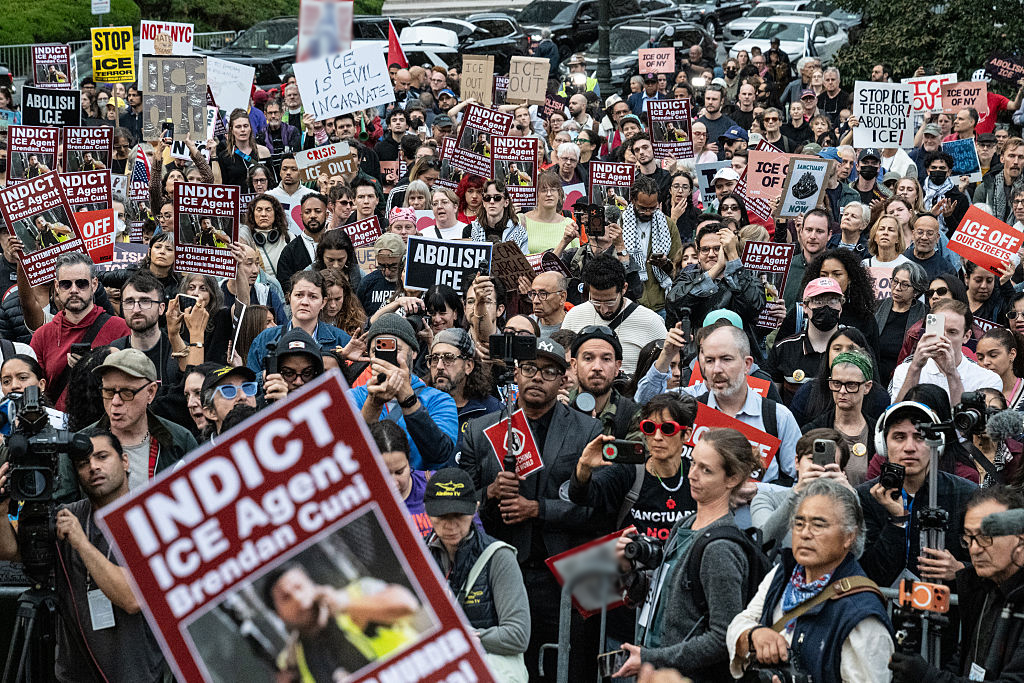
Newly released NYPD body-camera footage showing the aftermath of an immigration enforcement shooting in New York City has intensified scrutiny of federal agents who shot a man with his 5-year-old son in the car.
The footage shows officers arriving Thursday in Marble Hill to find Oscar Belgal, 28, wounded, handcuffed and seated on the ground. NYPD officers rendered aid and rushed him to a hospital. Police later located his unharmed son with a family member.
Mayor Zohran Mamdani condemned the shooting in an initial social media post, saying Immigration and Customs Enforcement agents had shot a New Yorker while his child was in the vehicle.
This afternoon in Marble Hill, a New Yorker was shot by an ICE agent in a residential neighborhood. Early reports indicate agents surrounded him and a 5-year-old child in his car before firing multiple rounds. We believe the child was physically unharmed.
This is an unconscionable and incredibly serious situation. I have called the President; when we speak I will demand that he ends all ICE enforcement actions in our city. I will not stand by while ICE agents terrorize our communities.
Our thoughts are with the injured New Yorker and his family tonight. We are praying for his recovery.
Get ICE out of our neighborhoods. Get ICE out of our hospitals. Get ICE off our streets. Get ICE away from our children.
ICE defended the operation, alleging that Belgal, a Dominican national with a criminal record, accelerated his vehicle toward federal agents who feared for their lives. The agency also accused him of gang involvement.
On October 8, at approximately 4:00 PM ET, ICE officers were conducting a targeted enforcement operation in the Bronx, New York, to arrest a criminal illegal alien from the Dominican Republic with a prior criminal conviction for grand larceny, and multiple prior arrests for assault, robbery, possession of drugs, and weapons possession. He has associations to the Trinitarios gang, the same gang who brutally shot a CBP officer last year.
This criminal illegal alien was arrested by the NYPD on December 7, 2023, but was released into the community a few days later by reckless Democrat sanctuary policies that put American lives at risk.
During the incident, an ICE officer discharged his weapon and the criminal illegal alien was injured.
ICE officers immediately rendered aid. The individual is alive and at a local hospital. The FBI and HSI are on the scene. The incident remains under investigation. More information will be shared as it becomes available.
When dangerous illegal aliens are released back onto the streets by radical sanctuary politicians, our officers are forced to make arrests at large in the community in unpredictable and dangerous environments. Our officers should not have to risk their lives, and innocent Americans should not have to face unnecessary danger, because sanctuary politicians refuse to cooperate with federal law enforcement.
— U.S. Immigration and Customs Enforcement (@ICEgov) October 9, 2026
NYPD Commissioner Jessica Tisch said at least one federal agent fired seven rounds, striking Belgal in the neck. Surveillance footage shows armed, plainclothes officers approaching his vehicle but does not capture the shooting itself.
The incident sparked demonstrations across the city, including a Friday march from Foley Square to federal immigration offices in Manhattan.
Belgal’s attorneys said he was transferred to New Jersey after the shooting before being returned to federal detention in Brooklyn. A judge has restricted his transfer and temporarily blocked his deportation while his legal challenge proceeds.
New York Attorney General Letitia Jamescalled for a “full and transparent investigation conducted without fear or favor.”
The Bronx district attorney’s office is investigating. ICE has not publicly released its own body-camera footage of the shooting.
Welcome to The Midterms, Actually. Every week I’ll be writing about two things: one big idea or trend I see forming across the 2026 primaries, and one thing I’m hearing from a voice on the ground. You can sign up here to get it in your inbox every week. Let’s get into it.
One big idea: Democrats’ Laken Riley vote is aging badly
Two things happened this week that reveal how quickly the politics of immigration enforcement are shifting.
First, Republican Sen. Jim Justice of West Virginia, a staunch ally of President Donald Trump, urged the administration to dial back its enforcement push. “Before you know it, you get people that get carried away in their job and whatever it may be, and all of a sudden, then you’re dragging people away that have lived on your street corner for 15 years,” Justice told Politico this week. “I don’t know that we need to be doing that stuff.” And he’s not the only red-state Republican who’s been pushing back on ICE lately, including some facing voters in tough races next month.
The second thing flew under the radar: Sen. Jon Ossoff, the Georgia Democrat running for reelection who has also been floated as a 2028 presidential candidate, struggled to explain himself when a reporter confronted him on camera about his vote for the Laken Riley Act in January 2025. Passed within days of Trump’s inauguration and signed nine days into his second term, the law requires ICE to detain undocumented immigrants who are merely arrested for or charged with theft-related crimes, before any conviction.
In the exchange with a reporter from Drop Site News, Ossoff talked about his Senate work investigating alleged ICE abuses, but didn’t directly address his vote after being asked if he regretted it. “Laken Riley was my constituent and what happened to her should happen to no American, to no person in this world,” Ossoff said. “I think that immigration enforcement should be focused on those who are convicted or charged with serious crimes.” He excused himself to walk into a meeting as the reporter pressed him on whether the law undermined due process.
In both cases, you see changing winds of electoral politics. Back in 2025, when Ossoff and 11 other Senate Democrats joined Republicans in supporting Trump’s immigration bill, they implicitly validated Trump’s premise on immigration enforcement: that not only was the border out of control, but that there also needed to be new efforts to step up interior enforcement through expanding agencies like ICE. In the year-plus since that vote, Trump has hired more ICE officers, launched sweeping raids in cities like Minneapolis, Chicago, and Los Angeles, and fueled a cauldron of chaos that’s led to shootings across the country. Politically, it has now put Democrats like Ossoff in a pickle, one that will matter more the closer we get to 2028.
How do you explain giving more immigration powers to a Stephen Miller-led White House? How can one argue you couldn’t have seen this coming?
In some ways, you can understand the political logic of the time. Ossoff, who is running in a state Trump carried, and many of the congressional Democrats who supported the Laken Riley law were in competitive races, and Democrats left the 2024 election thinking they had misread the electorate on the issue, particularly after Latino voters swung hard toward the right. But given what’s happened since, it’s clear many congressional Democrats made a familiar mistake: prioritizing political triangulation over standing on their values of protecting marginalized communities.
Take a look at some of the Democrats who have already had to walk back their votes. In the Democratic primary for Minnesota’s open Senate seat, Lt. Gov. Peggy Flanagan made US Rep. Angie Craig’s vote for the law a key focus of her campaign, calling it “disqualifying.” The attacks were so effective that Craig eventually expressed remorse, saying, “I wanted to be honest with the people of Minnesota. I will tell you when I get it wrong, and I got that one wrong.” Craig lost the August 11 primary to Flanagan.
Maryland’s April McClain Delaney, another congressional Democrat, also said she regretted her vote: “I will say that this was in the beginning of my term. And I never thought that ICE immigration and the horror of what has happened would happen.” (She survived her primary, defeating David Trone by 6 points.)
It’s easy to see where the buyer’s remorse is emanating from. Trump’s ICE is broadly unpopular. And as we’ve talked about on this Substack and in our reporting on America, Actually, Trump is doing worse and worse with Latino voters, with both prices and immigration enforcement driving the slide. A Hart Research poll for TelevisaUnivision of 1,500 Latino registered voters in battleground House districts (August 6–17) found 63 percent disapprove of Trump’s job performance and 62 percent disapprove of his handling of immigration enforcement and deportations. Sixty-four percent view ICE unfavorably.
When I recently talked to Stephanie Valencia of Equis Research, she said this:
The people who feel most regretful who voted for Trump in 2024 are most regretful because of immigration. They feel like there was a broken promise there. Like, they were told he was gonna focus on the border, which everybody agreed was chaos, and he was gonna focus on violent criminals and serious threats, and at the end of the day, he has not complied with that.
But while the shift in public opinion helps explain the elected officials’ political logic, it doesn’t change the material harm of their votes. Just this week, ICE announced plans to hire 5,000 more employees, most of them deportation officers, by the end of the year as enforcement continues to ramp up.
And these raids have a lasting effect on targeted communities, like in Maine, the Chicago area, and Texas. It’s the No. 1 issue that has come up in my conversations with local reporters. The chief architect of this chaos is the president, but make no mistake: Trump had help from shortsighted Democrats.
One thing I’m hearing
Maya Miller is a Report for America corps member covering democracy and government for the Gulf States Newsroom, a public radio collaboration that includes Louisiana’s WWNO and WRKF. She’s been reporting on Mississippi’s redistricting fight and what residents are saying about their representation and the upcoming midterms.
You’ve been reporting from redistricting hearings in Mississippi. What are residents most concerned about, and is there a conversation or moment that captures the mood?
Residents are most concerned about their representation. In Mississippi in particular, race and party are strongly intertwined, and Black residents worry that by being drawn into new districts, voters may elect a Republican candidate. There was a bit of secrecy around redistricting earlier this summer, with Gov. Tate Reeves, a Republican, canceling a special session to redraw judicial lines. So advocates created the People’s Hearings, a series of meetings held across the state to voice concerns and create a public record of testimonies from Mississippians. Quickly after, lawmakers decided to host their own public hearings, and at these hearings, hundreds of residents showed up, mostly to urge them not to redistrict.
“It seems to me that the threat of losing representation has made people more aware of the moving parts.”
At one hearing, I spoke to Joyce Arceneaux-Mathis, president of the Natchez NAACP. She’s frustrated that the state is going to spend millions on new maps when people are struggling with day to day expenses. And Ramona Sanders of Meridian, Mississippi, has a lot of concerns on whether mid-decade redistricting is illegal. While it’s not, she says that lawmakers are opening themselves up to legal action. I haven’t heard anything from voter advocacy groups that points to future lawsuits, but only time will tell, if and when lawmakers redraw the maps, if these maps are constitutional or not.
Redistricting is often covered as a fight over which party wins more seats. What would these changes mean for the communities you cover and their ability to have a voice in Congress?
One change that could happen is that residents who are Democrats might lose the state’s only Democrat leader. Out of four congressmen, there’s only one Democrat, Bennie Thompson, who represents District 2. His district spans much of the west, from the capital city of Jackson to most of the Mississippi Delta and southwest Mississippi. It’s a heavily Black district, somewhere around 63 percent Black. He’s held this seat for 33 years and has brought millions to the district for health care, infrastructure, and agriculture.
So residents are worried that Republicans are trying to edge him out and replace him with a more conservative leader who may not have the same concerns as the community.
How are these fights affecting people’s interest in the midterms? Are you hearing more determination to vote, more doubt that voting matters, or something else?
People are fired up. They’re incredibly engaged. I’m hearing from a lot of people who are more determined to vote in November than when I covered redistricting in Alabama in 2024. It seems to me that the threat of losing representation has made people more aware of the moving parts. So they’re attending hearings, participating in rallies, registering to vote and checking their registration, phoning a friend and making plans to be at the polls on November 3.
What is the national conversation about redistricting missing that becomes clear when you spend time in these communities?
I think the national conversation is missing the voice of the community. It’s one thing to report on the politics of redistricting, but there’s a layer of real concern from residents that shouldn’t be ignored. They’re worried about hospitals closing. They’re worried about public schools losing funding. They’re worried about the rising cost of groceries and gas. I find that talking to and listening to residents helps me understand a community more than calling up a lawmaker and asking them their thoughts. There’s a place for that side of the conversation, of course, but I’ve always tried to center people who will be most impacted in my reporting, and I feel that leads to a better story for our listeners.
A man wearing a "Latinos for America" t-shirt attends a Republican campaign event on October 10, 2022 at the University Drafthouse in Mcallen, Texas. (Photo by ALLISON DINNER/AFP via Getty Images) | Allison Dinner/AFP via Getty Images
Welcome to The Midterms, Actually. Every week I’ll be writing about two things: one big idea or trend I see forming across the 2026 primaries, and one thing I’m hearing from a voice on the ground. Let’s get into it. You can sign up here to get it in your inbox every week. Let’s get into it.
One big idea: Latinos didn’t come home. They’re just in motion.
In the last presidential election, President Donald Trump’s strong support with Latino voters ended up one of the biggest stories of the night. After years of Democrats telling themselves that the growing number of Hispanic Americans would help lead to a permanent liberal majority, their dreams were first dashed in 2016 (when many of those voters stayed home) and then buried in 2024 (when they, and other nonwhite voters, swung toward Trump).
But just as Democrats have at times been too confident that minority voters would fall in line, it now seems Republicans have replicated their mistake. Poll after poll shows a historic reversal among Latino voters in Trump’s second term, and these days even Republican members of Congress are beginning to call Trump out on his deportation efforts.
Why? It comes back to the numbers.
As Nate Cohn observed in the New York Times this week, Democrats now lead Republicans among Hispanic likely voters by 35 percentage points on the generic congressional ballot, 64-29 — a 28-point swing from 2024, when Kamala Harris carried Hispanic voters by just 7 points. The shift is a big reason the polling has Democrats in “blue wave” territory this November.
Last week on America, Actually I explored this shift in detail — by talking to Stephanie Valencia, co-founder and president of Equis, the research firm that has spent a decade digging into the Latino electorate. And the first thing she wanted us all to know: Get rid of the idea that Latinos will ever be permanently Democratic or permanently Republican. Part of the electoral power is that a larger section of the electorate defines itself more independently.
“Latinos often get given the title, the sleeping giant, which I just want to rid that out of everybody’s vocabulary. We should be called the swinging giant based on how much shift we have seen election to election. A third of Latinos consider themselves kind of independent or apolitical nonpartisan, and that’s that swinging middle that really is deciding every single election.”
Here are three more trends Valencia pointed out, which help explain why this all-important voting group has done such a drastic 180 on Trump in his second term.
1. It’s the economy (again)
As with all things in Trump’s second term, it starts with the fundamental problem of his second term: He has not delivered on lower prices. Equis found that Trump’s net approval with Latinos on cost of living sits at -52 — and his number on the economy (-45) is worse than his overall approval with the group (-31). Both are dramatically worse than where he sits with non-Latinos, who put him at -39 on cost of living and -25 on the economy. Among Latino men 18 to 39, cost of living hits a stunning -63.
Here’s what Valencia said:
“Latinos make up more of the wage workforce than any other racial subgroup. And so what that means is when wages are down and inflation is high, Latinos feel it more. We have less savings. We have less rates of home ownership. So the kind of safety nets that other people might have, we just don’t have.”
She also pointed this out:
“In Trump 1.0, his approval on the economy and the cost of living was actually better than his everyday approval… And he has been underwater with Latinos almost this entire term so far on the cost of living and the economy. It’s almost been a complete and total reversal.”
One of the arguments Trump made to Hispanic communities (and other groups also) was that he’d economically empower them, and that this was more important than prioritizing social causes that didn’t have a material benefit. That’s also been his fundamental flaw. From tariffs to rising gas prices, he has not only not delivered — people also feel worse off than before.
2. The immigration backlash
Valencia’s data was undeniable: More and more Latinos turned on Trump as he broadened his deportation efforts, which were broadly unpopular. But what I didn’t understand is why it took until Trump’s second term for people to realize those threats were legitimate, considering they were so front and center during his campaign. (They held up “Mass Deportation Now!” signs at the Republican National Convention!)
Here’s what Valencia said:
“I think this is really important for us as avid news consumers to understand what it is that the average voter, and especially that voter who’s coming in and out of elections, the kind of news they’re consuming. What they were seeing on mainstream media, perhaps even Fox News at the time, was a focus on Trump surrogates who said he’s gonna focus on serious criminals, securing the border, and violent criminals. And so that’s what people bought.”
“Fast-forward to 2026, the people who feel most regretful who voted for Trump in 2024 are most regretful because of immigration. They feel like there was a broken promise there. Like, they were told he was gonna focus on the border, which everybody agreed was chaos, and he was gonna focus on violent criminals and serious threats, and at the end of the day, he has not complied with that.”
There’s also an element of disbelief. When Trump said he would deport “bad people,” a lot of people thought he was only talking about people in other communities — or immigrants with criminal legal histories — not the more far-reaching immigration sweeps we’ve seen since he’s been in office. A striking ad from Rep. María Elvira Salazar (R-FL) this week where she directly criticizes Trump’s immigration policy explicitly made this distinction.
The Equis numbers track that shift almost perfectly. In December 2024, 65 percent of Latino Trump voters believed he would target only criminals and recent arrivals. Today, 62 percent of Latinos overall say he’s going after undocumented immigrants broadly — and among his own Latino voters, the share who say that has jumped from 26 percent to 37 percent. That perception is the whole ballgame: Latino Trump voters who still believe he’s targeting only criminals give him +84 net approval. Among those who’ve concluded he’s targeting everyone, it collapses to +31.
The backlash isn’t about the border. It’s about what’s happening in the interior — the raids, the family separations, the citizens and legal residents swept up.
Equis finds 68 percent of Latinos say Republicans promised to deport criminals and deported hardworking people instead — and 67 percent say Democrats promise immigration reform and never deliver. Forty-two percent say both parties broke their promises.
“I think it is a huge mistake for Democrats to assume or to rest on their laurels and think that because of what people are feeling around Trump and Republicans and the sense of disappointment and broken promises, that that is automatically going to translate to them as a party and as a brand. Right now, the Democratic brand has suffered a repeated set of blows among Latino voters. 20 years of comprehensive immigration reform that hasn’t been delivered. It’s a thing that comes up in almost every focus group.”
3. Meeting voters where they are
The third trend isn’t about persuasion at all. It’s about the fact that a lot of campaigns are still bad at the mechanics of reaching this electorate — and Valencia’s examples were almost comically basic.
Their testing found that more than 70 percent of Latinos who see an ad in Spanish come away thinking that candidate or party cares more about Latinos. That’s not a persuasion effect. That’s a respect effect, and it’s enormous for the price of one ad buy.
So how do campaigns blow it? Some examples, according to Valencia: translating English ads directly into Spanish, rather than tailoring them to the language and culture; and assuming English speakers and Spanish speakers are separate categories when voters often shift between media in both languages.
The deeper error is the monolith problem — the group is still treated as a voting bloc that moves in unison, rather than a diverse set of people from varying countries of origin and contexts. And the fastest-moving division isn’t the country of origin at all. It’s age — an electorate replenishing itself faster than either party’s model of it.
“There are a million Latinos who turn 18 every single year, and an 18-year-old who turns 18 this year and will vote in this year’s election was born the year Barack Obama was elected president. … The era of politics for an 18-year-old today is chaos, Covid, and corruption. They do not remember the hopium of Obama and the beautiful coalition that we built. That is all ancient history to them.”
A million new voters a year, completely up for grabs. Nobody is inheriting these voters. Neither party owns them. Because as Valencia put it: Demographics have proven not to be destiny — effort and intention matter more.
What I’m hearing
This week I called Matthew Eadie, a reporter at Evanston Now, who has been covering an ICE stop in Evanston, Illinois that has since attracted national attention. On the morning of Sunday, September 20, federal agents stopped a man walking on Howard Street. He turned out to be a US citizen, and not the person they were looking for. Agents reportedly left him on the ground with injuries to his head, neck, and teeth. DHS says he “refused to identify himself. Now the community is demanding answers.”
What’s the community reaction been?
People are really furious. If you remember the fall here — Operation Midway Blitz, the heightened Border Patrol enforcement across the Chicago area, Gregory Bovino parading around the streets with camera crews, the protests at the Broadview processing center — people here were very aware of how impactful it was. It was also happening around the elections, so it was prominent news everywhere and everybody was talking about it.
Over the summer it really died down, and I don’t think people have paid much attention since. ICE has been around all year, but they haven’t been as flashy about it, which has been talked about nationally too. This was a flare-up, and it’s a reminder that it’s still going on even after Bovino left. There have been protests at Broadview this week unrelated to the Evanston incident. So either people are starting to pay more attention as the election gets closer, or the incidents are actually picking up again.
What are the unanswered questions you’re still chasing?
Who were they looking for? Were they actually looking for somebody? That’s been their story — a specific individual — and a lot of people I’ve talked to are really skeptical that’s the case. One witness at the scene told me he felt like they just picked him and drove up on him. Essentially what’s been called a“Kavanaugh stop” — if they’re suspicious of you, they can pretty much find a reason to detain you. And then they dropped it once they realized either that he was a US citizen, which he says he is, or that there were too many people around taking videos for it to be worth their time.
So: What happened in the lead-up, and who specifically were they looking for?
Afterward, the agents talked to Evanston police — that’s an Evanston police policy; they’re supposed to try to get information from ICE officers. I’ve FOIAed all the body cam footage. I want to see what those conversations were like, and what exactly the agents told police officers when they talked privately.
Part of what we’re trying to do is see the issues that play out from the bottom up rather than the way they get framed nationally. Beyond immigration, is there anything in your coverage that’s shaping local politics more than the national conversation reflects?
The national issues matter to everybody, but they hit communities in completely different ways. Evanston is affluent — college town, Northwestern, wealthier than most suburbs. Affordability is a buzzword that comes up everywhere, but people here talk about it differently.
This is an overwhelmingly progressive Democratic city. Some people in Evanston certainly need it to be more affordable for themselves. But you also have progressive voters saying we want to make Evanston more affordable and more inclusive for other people. Sometimes the affordability conversation gets framed as “life is too expensive for me and we need to make it cheaper for me,” which is true in a lot of places. In somewhere like Evanston, where there are a lot of affluent people who are also very progressive voters, it’s more: If we actually want to say we’re a progressive community, we have to show it. And showing it maybe means building affordable housing.
It’s also a city that passed reparations, which the federal government is challenging right now. That’s going to be a federal court case through the end of this year and probably into next year — the feds challenging the city’s reparations program. That’s something the city prides itself on. Those are big issues here that come out of the national conversation but sound different than how we hear them in national media.

 Login