Some parts of the country are seeing levels of flu activity typically associated with late fall or early winter. | Deb Cohn-Orbach/UCG/Universal Images Group via Getty Images
This story appeared in Today, Explained, a daily newsletter that helps you understand the most compelling news and stories of the day. Subscribe here.
Flu season is starting earlier than usual this year, which I know from reviewing federal data. But I also know it because I woke up with body aches and chills last night, mere days before I’d planned to get my flu vaccination (!).
Already, some parts of the country are seeing levels of flu activity typically associated with late fall or early winter. In Washington state, for instance, doctors are reporting seeing as much flu now as they usually would around Christmas.
Flu activity overall is still low, to be clear. But as of October 7, infections were rising in all 50 states. And flu is spreading before many people — like, say, me — have received their annual vaccine.
Epidemiologists don’t yet know why the flu arrived early this year, or why cases first started rising in Western states like Washington, California, and Nevada. It’s possible that a mutation is helping this year’s flu variants evade existing immunity, one virologist told NPR. International travel could play a role, too: Flu cases also spiked early in Japan and other parts of Asia.
We don’t need to know why the flu arrived early to take some basic precautions, though. So today, we’re talking through some practical tips for coping with an early flu season.
An early flu season doesn’t necessarily mean a worse season — but even a moderate season can do serious damage. Last year, influenza sent hundreds of thousands of people to the hospital and caused tens of thousands of deaths, including almost 200 among children.
The first and best way to avoid those kinds of harms is by getting the flu shot, which reduces the risk of serious illness by an average of 40 to 60 percent. In the US, people aged 6 months and older are typically told to get the vaccine by October’s end.
In light of the early onset, however (it takes two weeks to build up full immunity), you might instead want to get your shot ASAP.
There are some everyday precautions you can take, too — many of them familiar from the Covid-19 era. Wash your hands thoroughly with soap and warm water, for slightly longer than feels appropriate. Mask when you’re sick or might encounter someone else who is.
And don’t neglect the good habits that support your overall health: getting enough sleep, drinking a lot of water, and eating a balanced diet. (There’s very little evidence for trendier interventions, like supplements, saunas, cold plunges, or the infused herbal baths that my kooky former yoga teacher used to recommend.)
If you do get flu symptoms, reach out to your doctor early — especially if you’re older, pregnant, immunocompromised, or otherwise at higher risk for complications. Prescription antiviral medications, like Tamiflu, prevent the flu virus from spreading inside your body so that your immune system can clear it. But they work best within 48 hours of symptom onset.
To be clear, you needn’t take my word on any of this; I’m just another voice in the public health cacophony! Besides, recent polling suggests that my particular voice — that is, the voice of someone who works in media — is not quite as persuasive as it used to be. (Ditto medical websites and government health agencies.)
But if you have doubts or questions about vaccines, there is someone much closer to home you can consult: Ask your doctor (or nurse or pharmacist) about the flu shot’s risks and benefits. They’re best positioned to break the science down and apply it to your health. In hindsight, mine surely would have told me to stop delaying my shot for a more convenient weekend.
One link for later
➨ Get creative in the fight against inflation. The latest inflation numbers are out today, and they are pretty bad. The cost of many goods and services is rising more quickly than both consumers’ incomes and economists’ expectations. For me, this news brought to mind a question that Vox’s former personal finance columnist tackled a few years ago: Namely, am I cursed to keep spending more money on more things forever?! Her answer was essentially “yes,” but she offered a few ways to help offset those costs: things like moving to a cheaper area or pooling resources via initiatives like tool libraries and community gardens.
Today’s trivia: Which percussion instrument is famously played by Mississippi State University fans at home football games? (You can find this and other brain puzzles in Vox’s daily crossword. Look for the answer in tomorrow’s edition.)
Yesterday’s trivia: We asked you for the name of the 2025 Pixar film set in the “Communiverse.” That would be Elio, a movie you may well never have heard of: It had the worst opening weekend of any Pixar film, ever.
In theory, getting a donor liver in the United States when you need one should be an extremely equitable process: The sickest patients with the greatest chance to benefit from a donated organ should jump to the front of the line regardless of their gender, race, or other factors.
But in practice, things look quite different.
One study from 2020 showed that women were 8.6 percent more likely than men to die waiting for a liver transplant and 14.4 percent less likely to receive a deceased donor liver transplant compared to men. That gap may not seem enormous, but it still represents a significant disparity. As it turns out, it’s rooted in the very system that’s supposed to make the process fairer, a process that unintentionally ranks women lower on the waitlist for livers.
The system in question is known as the Model for End-Stage Liver Disease (MELD). The scoring model has been used since 2002 to rank candidates on the waiting list based on how likely they are to survive without a liver transplant in the short term. The higher your score, the reasoning goes, the sicker you are and the more urgently you need a liver transplant.
One of the values used to calculate the score is creatinine — a waste product made by muscles as they break down proteins or other compounds to release energy. In medicine, the creatinine levels in your blood are used to determine how well your kidneys are functioning because they process and remove creatinine.
And this is where the system designed for equity gets a little less than equitable for some patients.
Creatinine levels are affected by muscle mass, and women typically have lower muscle mass than men. A man and woman experiencing the same level of kidney dysfunction will therefore have different levels of creatinine in the body. The MELD model doesn’t take this difference into account — and so lower levels of creatinine in a woman’s blood can make her seem healthier than she is, bumping her farther down the liver waiting list.
(function(){function e(){window.addEventListener(`message`,function(e){if(e.data[`datawrapper-height`]!==void 0){var t=document.querySelectorAll(`iframe`);for(var n in e.data[`datawrapper-height`])for(var r=0,i;i=t[r];r++)if(i.contentWindow===e.source){var a=e.data[`datawrapper-height`][n]+`px`;i.style.height=a}}})}e()})();
In 2023, Dr. Ray Kim, a transplant hepatologist at Mayo Clinic in Arizona who developed the original system, debuted a new model called MELD 3.0. The model not only seeks to address the sex disparity in liver access but also improve the accuracy of scores for all patients. Among other changes, it takes into account the sex of the transplant candidate and uses it to adjust the MELD score by 1.33 points for women. This is meant to address the difference in creatinine levels between men and women and provide a more accurate understanding of how sick a female patient really is.
Simple fix, right? Even though MELD 3.0 took the sex disparity in liver access seriously and developed changes to combat it, early research on its efficacy found that even this new and improved system hasn’t yet brought men and women to parity on the liver waitlist.
And the problem may lie less with what MELD 3.0 did than with what it did not do, prompting the question: Are we focusing on the wrong problem?
Sex matters…but so does size
Before the MELD score, liver transplants were largely conducted on a first-come, first-served basis. Those who were added to the waiting list first, received livers first. If a really sick candidate was added to the waiting list late, say because of delayed diagnosis, they would almost certainly die while waiting for a liver to become available.
The original MELD fixed that problem by creating a measure of urgency that was easy to calculate. The initial model used three main blood test values — bilirubin, creatinine, and a measure of blood clotting time — and later improvements also took into account the sodium level.
Key takeaways
Women are more likely than men to die waiting for a liver transplant in part because the system used to rank candidates on the liver waiting list underestimates how sick women are.
In 2023, the liver transplant system adopted a new version of that scoring model, which adds 1.33 points to women’s scores to correct for differences in muscle mass between the sexes. Early research shows that the new model increased transplant rates for women, but the gains were transient.
Experts say that the score is only part of the problem. A donated liver has to physically fit inside the body receiving it, so smaller candidates end up waiting longer for a liver they can accept.
The organ allocation system currently has no way to prioritize smaller livers toward smaller patients, who are more often women. Fixing this is likely the key to ensuring equitable liver access for men and women.
Traditionally, the MELD model assigns a score between 6 and 40 to liver transplant candidates. MELD 3.0 adds 1.33 points to women’s scores to account for the differences in creatinine levels between the sexes. The new model also measures albumin, an additional biomarker, and adjusts for interactions between the different variables.
Sommer Gentry, a professor at NYU Grossman School of Medicine and contributor to the paper on MELD 3.0, said that using sophisticated algorithms with more biomarkers not only helps to better predict risk for women, but using a more accurate model also benefits the whole population. The researchers estimate that this fine-tuned MELD 3.0 model will reduce at least 20 waiting list deaths per year. Last year, around 800 liver transplant candidates died while waiting for a liver.
But creatinine is only one of the two main problems that create a disparity in liver access for women. The second, Gentry says, is body size, an issue that’s not addressed by MELD 3.0. A transplanted liver has to physically fit inside the body of a recipient, and women are typically smaller than men, so a very large liver cannot be offered to a small woman. But the reverse is not necessarily true because receiving a liver that is small for the potential recipient doesn’t typically harm the candidate.
“The smaller you are, the less likely you are to be offered something that’s actually going to work for you,” Gentry said, adding that women end up waiting longer to receive a liver that will actually fit their body.
Part of the conversation on sex disparity in liver access is based around which of the two problems — creatinine or body-size interventions — to fix first, and whether it is possible to create equity by addressing just one of the two, Gentry said. MELD 3.0 was an attempt to remove the former barrier.
“I think that some other papers are coming out that suggest that perhaps the other aspect of size matching is still a concern and still possibly not addressed by the resulting liver transplant system,” Gentry said.
Why is the new model still falling short?
Gentry believes that MELD 3.0 has increased liver transplant rates for female candidates since its adoption in 2023. But early research, however, suggests that the new model falls short of fixing the problem.
Studies done on MELD 3.0’s impact on liver transplant rates for women indicate that the model increased the number of liver transplants for female candidates — but the gains were short-lived.
An analysis published in July of nearly 10 million daily records from over 60,000 candidates on the US liver transplant registry found that rates of completed liver transplants for women increased in the period immediately after MELD 3.0 was implemented, but the increase was temporary. Women’s estimated odds of receiving a transplant drifted back to pre-MELD 3.0 levels by the end of the study period, 15 months after the new model was implemented. Women on the waiting list and women who had received a transplant also had higher scores in the three months right after MELD 3.0 took effect, but their scores later fell back to levels comparable to those of men.
Both the successes and shortfalls of MELD 3.0 demonstrate how rethinking existing policies and standards can help reduce inequities in organ access and healthcare.
The authors think that the early surge in liver transplant rates for women was a onetime catchup. MELD 3.0 pushed a group of women who had been stuck on the list — sicker than their old scores suggested — over the priority threshold all at once, leading them to receive liver transplants.
Notably, the one effect that did persist was that under MELD 3.0, women received more “organ offers” than before. Every time a deceased donor liver becomes available, the system generates a ranked list of the patients suitable to receive that organ. Under MELD 3.0, the number of times an available liver was offered to a female candidate increased, probably because their (more accurate) MELD 3.0 scores better reflected how sick they were. But they’re not necessarily receiving those livers, presumably because of organ size issues.
These findings suggest that revising the MELD criteria alone may not be enough to eliminate the sex disparity, especially if the body-size disadvantage is part of the problem.
The authors say that a patient’s sex is merely a poor proxy for the real issue — we don’t have allocation systems in place to ensure that candidates with smaller body sizes also have the same robust access to livers.
Toward liver donation equity for all
If we could figure out how to better address questions of body size in organ donation, the benefits could be enormous. According to Gentry, body-size disparity affects the organ allocation system in general. Similar issues arise with heart and lung transplants too, where the size of the organ relative to body size has to be taken into consideration during organ allocation.
She says that a size-aware organ allocation system would therefore benefit patients on the waiting list across the board. Whether an available organ is the right fit for the potential recipient should be weighed heavily in allocation algorithms, rather than just a list of ranked waitlisted candidates.
“That should be a larger consideration in sorting the patients who will be offered a certain organ — to ask if this organ is especially suited to one kind of patient over another,” Gentry said.
Under such a system, she said, smaller livers could be offered first to the smallest candidates on a ranked list of those who are also sickest. The assumption is that a smaller candidate will have to wait longer for a viable liver that fits them, even if they have a very high MELD score.
For such a policy to be instituted, the Organ Procurement and Transplantation Network – a nonprofit that oversees the distribution of donor organs — would have to approve it. And before such a system could be presented to the regulatory organization, more research is required.
It is often the case in medicine that our definition of what counts as a healthy body is measured against the average white male. This too often lowers access and quality of care for both women and people of other races. For example, the standards for creatinine levels in blood reduced access to kidney transplants for Black transplant candidates for years until recent efforts were made to start correcting it.
In that sense, both the successes and shortfalls of MELD 3.0 demonstrate how rethinking existing policies and standards can help reduce inequities in organ access and healthcare. The conversations and critiques that followed its rollout have exposed a clear gap in organ allocation strategies, one that disadvantages a large group of patients. Closing that gap, not just in liver transplantation but across the board, could bring us a step closer to equity while also making more efficient use of the organs available to save lives.
“There’s no mechanism right now, if a small liver is available, for offering it preferentially to the small women who might not be able to accept lots of other organs that are becoming available,” Gentry said. While fixing the model to rank women more accurately on the liver waiting list is a start, including body-size considerations in the organ allocation system might be the real bottleneck to address.
The 1975 film “Jaws,” in which a local government hires a shark hunter to protect the town’s tourism industry, delighted me as a 10-year-old. But other than its infamous opening sequence, I don’t recall being scared. My younger sister, however, developed a years-long fear of deep water, even our 11-foot-deep pool. Maybe I’d just cultivated too much shark knowledge, well aware that these apex predators are docile and do not hunt humans like they do in Peter Benchley’s novel. The book and the film — I consumed both and can report that Steven Spielberg’s adaptation is better — only instilled in me a deeper love and respect for sharks. They are still my favorite fish to observe in aquariums or the ocean.
Outside of the movies, shark bounties are uncommon these days. That’s why news this week that Greenland was planning to cull 1,000 Greenland sharks was so alarming to many online. Officials in the Avannaata municipality on the island nation’s west coast approved the plan, offering fishers 300 Danish kroner, or about $45, per shark heart. The government complained that hungry sharks are eating too much Atlantic cod and Greenland halibut, cutting into what humans can bring home and damaging their gear. Lars Erik Gabrielsen, mayor of Avannaata, told The Guardian, “We need to safeguard the income of fishermen and the catch so that we can continue to eat the foods that we have relied on for generations.”
Conservationists and shark lovers were outraged at the proposal. Nick Dulvy, a professor and marine conservationist at Simon Fraser University in British Columbia, called it a “disaster” and said that biologically, the sharks are “the most sensitive species in the ocean to overfishing.” Marine ecologist Spencer Roberts, whose advocacy work includes calling out shark poaching, posted on X that “There is a psychotic sense of entitlement spreading around the world that imagines humans own the fish in the sea and demands retaliatory killing of predators who rely on these fish. Even centuries-old sages of the Arctic Ocean are not safe from this deranged human delusion.”
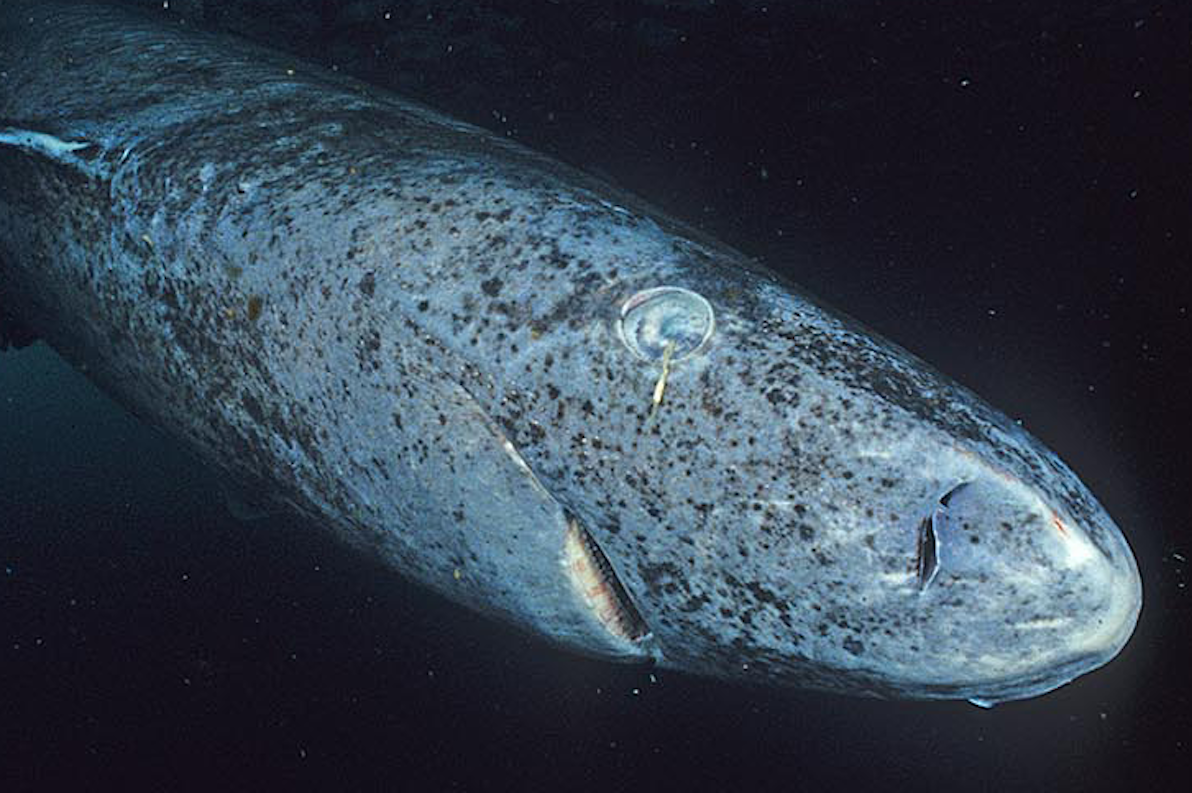
Indeed, the Greenland shark (Somniosus microcephalus) is bizarre and misunderstood, basically being the couch potato of the depths of the North Atlantic and Arctic Ocean, where waters are just above freezing. Known as an abyssal species, it slothfully trawls the shadows like some mournful Lovecraftian being, possessing an especially sluggish metabolism, which isn’t surprising considering its size. Greenland sharks weigh in at one ton and reaching up to 23 feet in length. The maximum lifespan can average 400 years, the longest lifespan of any known vertebrate, meaning there are apparently Greenland sharks that are older than the United States. If that doesn’t blow you out of the water, I don’t know what will. Humans are famously bad at mentally fathoming deep time, so thinking about these ghostly rotund things hiding in the dark of the ocean, outliving empires like an ichthyological Ozymandias, fills me with even more awe than most sharks do.
In a rare spot of good news, the local government dropped the plan after national officials questioned its legality, but a future cull hasn’t been ruled out. Still, it’s worth upholding this turnaround as an example of why speaking out on animal rights can be successful. We don’t need to just sit back and watch the extinction of any species that doesn’t directly benefit us, while of course recognizing that fishers have to eat too. Some have proposed reimbursing fishers or using acoustic deterrents instead of mass slaughter.
But it’s more than just Greenland sharks at risk, with an estimated 79 million sharks dying in fisheries in 2019. At least 25 million of those species are threatened. As coral reefs struggle to survive, many sharks are losing their main food source, but humans are to blame for that one. These animals can be dangerous, same as a grizzly bear or elephant, but people tend to value sharks a lot less. This is in spite of their critical role in a healthy environment. Sharks aren’t monsters, they evolved to fill very specific roles in the ocean — a huge block in the Jenga of life — and if they go, our oceans would dramatically tumble in ways that would negatively impact humans too.
“Jaws” is a fantastic film if you can suspend your disbelief about a great white being the menace of the seas. That’s really us, but it doesn’t have to be.
Scientists in the US and Europe are exploring whether an experimental surgery can treat Alzheimer’s disease. | Fiordaliso/Getty Images
The videos are astonishing. In one scene, a senior Chinese woman appears lost in the wilderness of dementia, unable to answer basic questions; in the next, she seems to be lucidly chatting and shucking beans for dinner. By all appearances, years of cognitive decline had been rapidly reversed after the patient underwent an experimental new surgery.
The only problem is: No one is sure if it’s real.
It’s difficult to take any video at face value in the age of AI, and this experimental procedure happened in China, a country with a recent history of controversial sciencetouting extraordinary but questionable claims. In the past few years, researchers there have published several papers reporting promising results from a procedure that purports to attack Alzheimer’s disease in a peculiar way: by connecting vessels from the lymph nodes in the neck to nearby veins in an attempt to drain the brain of harmful waste. But these have been small studies that did not include a control group. The doctor who first pioneered the surgery there has reportedly been placed under arrest, and the Chinese government has sought to stop most physicians from performing any more of these operations.
Is that because it’s a scam? Or because it’s dangerous? Or could it be because there have not yet been proper randomized trials, tested against a placebo, to assess the procedure’s safety and efficacy? There are new studies being planned in China to more rigorously evaluate the surgery.
But scientists elsewhere in the world have a lot of questions. And now, a small group of researchers in the US and Europe are endeavoring to find the answers. Within the next few years, we should know whether this surgery really could be the miracle that the viral videos make it appear to be — or another much-hyped treatment that ultimately fizzles out.
Dr. Adnan Siddiqui, a neurosurgeon at the University at Buffalo who is leading an initial US-based study of this procedure, previously helped develop a new treatment for severe stroke patients. This gave doctors a valuable new technique for treating patients during an emergency, and he told me he saw it rapidly change the standard of care around the world. In an interview, he cautioned that a lot more work needs to be done to assess this proposed new Alzheimer’s treatment — but at the same time, he’s optimistic.
“The whole world’s paradigm changed in literally a blink of an eye. It can happen. And I’m hoping this might be that second home run,” he said. In “2027, we’ll start getting clear signals in one direction or the other. By 2028, 2029, we would know whether this is real or not.”
Why this Alzheimer’s surgery really might work
The promise of this controversial new procedure lies in the lymphatic system, which is essentially the body’s drainage system. According to scientists’ best current theories about Alzheimer’s, the brain’s filtration system gets worse as we age, and as a result, plaque made up of amyloid proteins as well as tangles of tau proteins can accumulate in people’s brains and eventually lead to neurological damage, leading to the severe memory loss of Alzheimer’s disease. Researchers have found evidence that those amyloid and tau proteins also accumulate, not just in the brains, but also in the lymph nodes in older people.
So could a minimally invasive surgery to improve the brain’s drainage have such a dramatic impact on Alzheimer’s disease?
Siddiqui, who also runs the Jacobs Institute at the University of Buffalo, which is focused on new technology for vascular and neurological disease, had been interested in the lymphatic system’s role in Alzheimer’s before he ever heard about this experimental work out of China from a colleague years ago. The colleague had gone to see Dr. Qingping Xie, the surgeon who started performing lymphatic surgery on Alzheimer’s patients about six years ago. To investigate further for himself, Siddiqui went to South Korea to meet a plastic surgeon, Dr. Joon Pio Hong, who was performing a new “more refined” version of the same basic procedure, as Siddiqui put it. But as in China, these were not proper randomized experiments. There was no placebo.
So Siddiqui wanted to see if he could test it himself. After performing proof of concept operations in 2025 with a new microrobotic tool (for a rare disorder involving constricted blood vessels in the brain), he and his colleagues decided to take an even bigger swing: testing this new technology to perform the lymphatic surgery for Alzheimer’s.
The researchers applied to the US Food and Drug Administration and received approval late last year for five initial procedures; over the summer, they got the green light to perform the procedure on 15 patients. Several operations have already been performed, and Siddiqui told me he had four more lined up next week.
Sign up for the Good Medicine newsletter
Our political wellness landscape has shifted: new leaders, shady science, contradictory advice, broken trust, and overwhelming systems. How is anyone supposed to make sense of it all? Vox’s senior correspondent Dylan Scott has been on the health beat for a long time, and every week, he’ll wade into sticky debates, answer fair questions, and contextualize what’s happening in American health care policy. Sign up here.
The mechanism makes superficial sense: If Alzheimer’s is the byproduct of amyloid and tau building up in the brain because the body gets worse at filtering them out, bypassing a clogged “drain” in the lymphatic system could help to clear the proteins and relieve symptoms. It is, by a different method, the same therapeutic target as recent breakthrough drugs that slow down the cognitive decline of an Alzheimer’s patient.
But instead of an injection, the procedure involves a small incision in the neck, allowing surgeons to connect lymph nodes to a vein. The hope is that creating this new drainage route will help the brain clear amyloid and tau more effectively and “hopefully bypass whatever plugs that might be there in the system,” Siddiqui said.
This first round of US surgeries are part of what’s called an early feasibility study. “You’re just trying to prove that it’s definitely safe and definitely doable and maybe effective,” Siddiqui said. They’re measuring not only the patients’ cognitive performance but other data points — such as changes to their gait — for any sign of benefit or harm.
If results are promising, a second feasibility study will involve a larger number of patients — 50 or so. After that, if the evidence suggests they should move forward, the scientists would start to introduce placebos. In the case of surgery, that means some patients would receive “sham” surgeries that wouldn’t actually do anything. Then investigators would compare the experiences of the two groups: the people who received the fake surgery and the people who got the real thing.
If the latter group improves significantly more than the former, that would allow scientists to say definitively: Yes, this surgery actually works to treat Alzheimer’s.
“Obviously, this is exactly the kind of disease where there’s so much hype and so much hope,” Siddiqui told me. So it is essential to build out the careful research to substantiate it.
But let’s not get ahead of the science
Siddiqui has been in this position before — and he’s seen it go both ways. There was the new stroke treatment that proved successful and has since become the standard around the world. But he was also an early investigator of a multiple sclerosis treatment, somewhat similar to the Alzheimer’s surgery. After initial promise, it failed when the randomized trials began.
“I wouldn’t be a neurosurgeon if I was not an eternal optimist,” he said. “However, I’m a clinical trialist, and I always respect placebo.”
Placebos are essential, but they are also tricky. If somebody thinks they have received an active treatment in a study, they tend to think they’re going to benefit. This goes for surgical treatments as well. So following patients’ and their symptoms after the intervention is essential to seeing just how much of the effects can be attributed to the treatment and how much could be placebo effect. The latter of which could also be reinforced by loved ones who are desperate to see their parent or spouse get better.
Alzheimer’s is also a complicated disease that we still don’t totally understand. While scientists think there is a relationship between amyloid and tau proteins and Alzheimer’s disease, other factors, such as inflammation and vascular health, could also have a role. Some prior drug candidates have successfully cleared amyloid plaque, but patients didn’t get better. Some people have amyloid build-up in their brains but never develop Alzheimer’s disease.
Dr. Bohdan Pomahac, division chief of plastic and reconstructive surgery at Yale School of Medicine, is overseeing studies designed to establish more of the basics of how these proteins pass through the lymphatic system. This research includes investigating whether obstruction actually occurs in Alzheimer’s patients, and if so, where exactly those blockages usually are. Only after they do this work, he said, would his team be comfortable proposing surgeries to relieve the blockage and see if that helps improve Alzheimer’s patients’ symptoms.
He told me about having seen Xie, the procedure-pioneering Chinese surgeon, speak during a plastic surgery conference a few years ago. (Plastic surgeons are experts in the kind of microsurgery necessary for the procedure, and several are involved in the ongoing Alzheimer’s trials.)
“I think most people, including myself at the time, dismissed it as, ‘This is some sort of a charlatan.’” Pomahac said. “But he kept coming back to conferences every year and started to show more and more videos. We were not sure. Is it actors? You couldn’t tell what’s going on.”
Which is why he is dedicated to doing more of the foundational research to understand Alzheimer’s first. “Rushing to the operating room makes no sense in my mind at this point,” Pomahac said. “I think there’s a lot of work that needs to be done to really identify the site of surgery and what type of intervention would be most effective.”
Even if you set this surgery aside, this is an exciting moment for Alzheimer’s science. And although waiting any longer is excruciating for those watching loved ones with the disease progress, progress’ velocity by all accounts is increasing.
“We are finally doing the kinds of rigorous studies that will give us some degree of confidence that there’s something real here or not,” Siddiqui told me. “We’re not quite there yet.” But in just a year or two, we should know much more.
Products containing kratom from the brand Feel Free on sale at a tobacco store in Huntington, New York. | Alejandra Villa Loarca/Newsday RM via Getty Images
They have fun names like Feel Free, Smurphs, and Hazy Tabz. They come in colorful packages and in gummy form. They’re widely available at gas stations, corner stores, and smoke shops across the country.
The drugs are called Kratom and 7-OH. The first, kratom, is derived from the leaves of a coffee-like plant in Southeast Asia. When taken in small doses, kratom causes a low-key buzz. In higher doses, the high is described as euphoric. It operates like an opioid — a chemical in kratom called mitragynine binds to opioid receptors in the brain, which leads to that euphoric high. It also can lead to addiction and overdose.
Social media is full of videos of people trying to kick the drug, with harrowing stories of dependence and withdrawal.
7-OH is a highly concentrated compound derived from kratom, which dials up both the high and the danger. The drug has caught the attention of US Health Secretary Robert F. Kennedy Jr., who warned in a press conference last year that 7-OH was “marketed for children.”
“They’re gummy bears, they’re bright colors, they’re candy-flavored,” Kennedy said. “This is really a sinister, sinister industry.” In August, federal agencies announced they were taking steps to effectively ban 7-OH nationwide.
To break down the increasing prevalence of both kratom and 7-OH, what the drugs do, and what to do about them, Today, Explained spoke with Mattha Busby, a freelance journalist who covers drugs and drug policy and who wrote about kratom earlier this year.
As Busby explains, kratom and 7-OH are “definitely in the zeitgeist. It’s in the news and for good reason. To have these 7-OH gummies just in gas stations is a really potentially problematic thing. Without the drug education alongside it, this drug has just popped up out of nowhere.”
Busby also talked with Today, Explained co-host Sean Rameswaram about the business interests behind the drugs, why they’re a complicated topic for the Make America Healthy Again movement, and how industry lobbyists have teamed up with several Trump administration officials to try to sway the results of regulatory decisions.
Below is an excerpt of their conversation, edited for length and clarity. There’s much more in the full podcast, so listen to Today, Explained wherever you get podcasts, including Apple Podcasts, Pandora, and Spotify.
Is there an important distinction between kratom and 7-OH? Is 7-OH found in kratom?
7-OH is found in relatively small quantities within kratom, but this businessman, Vince Saunders, who is the self-styled American shaman out of Kansas City,basically figured out how to extract the 7-OH and blow it up into entire pills.
I’ve never tried 7-OH and I’m not interested, just for the record, since I’ve been talking about how I don’t mind kratom, but these 7-OH tablets are uber, uber strong. I think the large number of people that are taking it are using it instead of opioids. And maybe it’s better, maybe it’s not.
Is 7-OH something you can also easily find at your neighborhood gas station?
Yeah. It’s much the same as the kratom formulations, so you’re talking gummies, little shots, capsules, and the brand names for the 7-OH companies are perhaps even more kind of out there — 7-OHeaven is one.
It’s certainly not heaven when you’re going into withdrawals.
And do we know that people are? Are people becoming addicted to 7-OH?
People are becoming addicted to kratom and 7-OH. I think the whole thing, the concern originally sprung up with the Feel Free tonics that are like a mix of kava and kratom. And people just got habituated into drinking several of them per day and realized that it’s very unpleasant if they don’t continue to do that on a daily basis.
We have a federal government that loves to police drugs of all sorts. What are they doing about 7-OH?
It’s this MAHA dilemma, right? Because their ethos is very “natural medicines and freedom.” The idea that this Feel Free tonic, whose owner JW Ross recently gave, or a company related to him recently gave, like $500,000 to the MAHA PAC, and he’s been photographed next to RFK Jr. — he’s perhaps predictably come out on the side of the kratom industry, which is lobbying for a ban of 7-OH.
RFK Jr. called it sinister and said that it targets children, which it appears to do in some cases with the gummies. There’s kratom gummies too and clearly gummies are an easier way, especially for older people, to ingest the medicine or substance, so we shouldn’t just blame the gummies here.
But clearly, when you’ve just got packets of these gummies that are called like 7-OHeaven just on the shelf or indeed behind the counter at the gas station, there’s going to be concern about that.
There are other MAGA figures like Homeland Security Secretary Markwayne Mullin, who’s got a million-dollar investment in the parent company of Feel Free. There’s definitely this nexus of figures in the government that have got some interest, potentially, or relationships with the kratom industry. And indeed the department when I was writing my Wired story reminded us and readers that everything he’s done is ethical and I’m sure it has been.
We usually think of liberal drug policies as a lefty thing. Markwayne Mullin’s about as right as they come. Are kratom and 7-OH making friends across the political spectrum because there’s a big business opportunity here?
You look at Trump’s executive order on psychedelics and then rescheduling cannabis, and it seems that the right has really seized the mantle and is looking at it from a more libertarian perspective of, “Hey, what happens in a man’s head is his own business.”
They’re also being probably more business friendly than people on the left would be, so it’s a really interesting moment, especially with RFK Jr. as health secretary.
Trump has spoken at length about the opioid crisis in the United States and how it’s tearing our communities apart and whatnot. Here we have readily accessible opioids at our gas stations.
Yes, they’re not killing nearly as many people as prescription drugs are. However, they’re a lot easier to get than prescription drugs. Help me understand this administration’s position in relation to what could be a real terror for some people.
They are in the process of banning 7-OH. Last month, the Department of Justice set out an emergency scheduling, so that’s open for comments at the moment. When they ban something, it doesn’t just happen overnight.
I think by the beginning of next year, it’s quite possible that these 7-OH products won’t be in gas stations and indeed some states have already taken action.
And just to get ahead of any confusion here, 7-OH may be banned from gas stations and probably other convenience stores, but not kratom?
Exactly.
Why one and not the other? Obviously 7-OH is stronger, but you could take a lot of kratom and it might feel like taking a little 7-OH, no?
Absolutely. You just need to take a lot and it’s in powder form. So you need to consume a prodigious quantity of it or drink a bunch of these seltzers.
I think that they’re not going to ban kratom because there’s an obvious recognition of the good it does for people that are recovering from opiate addictions and that they do have a kind of natural off-ramp, [which] is very unlikely to kill you even though you might take a huge amount. Whereas, if you’re taking like 26 different medications, including a bunch of opioids for your chronic pain, you might die.
Who do you think wins the argument at the end of the day? We have some strong lobbying forces involved here. You’ve got a lot of people who have come to enjoy or depend on these substances that are, as we’ve established many times now, readily available all over the country.
Do you think we see fewer or more kratom products in our gas stations and convenience stores in the years to come?
The kratom advocates are a lot more eloquent and suited and booted than the 7-OH folks. What I see is that 7-OH will be forced underground and that kratom will continue its long and illustrious ascent in American culture.
We do really have a gas station culture in this country, and I wonder if these substances being so available in them is a particularly American thing. You live in the UK. Are gas station drugs a US thing?
It’s an American thing for sure. But you guys take a lot of drugs!
I had that question in mind while reading the new book The Opposite of Happiness: How Bad Feelings Make and Break Us, by eminent researcher George Loewenstein. The field is not exactly known for its facility with human emotions, but Loewenstein is a co-founder of behavioral economics, the subdiscipline that studies the many ways that people depart from the ideal of the perfectly rational actor. He’s spent a career investigating how psychology and emotion shape our judgments, and his latest book offers a sweeping account of how suffering structures human life.
That might sound very bleak, like the opposite of a fun read. But the book itself isn’t distressing — it’s a bracing, useful, and even comforting lens on what it means to be alive. It emerged from a period of profound suffering in his own life, one where, he writes, he “thought about suicide constantly.” Writing it, he told me in a recent interview, was “kind of a silver lining for my own misery.”
In Loewenstein’s own words, The Opposite of Happiness is not a self-help book. To him, understanding is its own reward. Though he adamantly refuses to dispense life advice, I still think the book offers much that can help us live more wisely, a little less at war with our emotions.
“Misery is inescapable,” Loewenstein writes. “It’s not some malfunction or a bug in the system. It is the system.” Negative emotions are “more powerful, persistent, and pervasive than positive ones.” That is because, he argues, unpleasant feelings — hunger, pain, anger, loneliness — are how evolution motivated us to do the things we need to survive and pass on our genes. They still heavily shape our conscious experience, however mismatched they may feel to our modern circumstances.
Some version of that insight, that dissatisfaction is woven into the human condition, has been known to humans for eons, of course, captured in philosophical teachings like Buddhism’s Four Noble Truths. The father of economics himself observed that people work hard to earn riches, only to discover the result offers no lasting contentment.“It is this deception which rouses and keeps in continual motion the industry of mankind,” Adam Smith wrote in The Theory of Moral Sentiments. “It is this which first prompted them to cultivate the ground, to build houses, to found cities and commonwealths, and to invent and improve all the sciences and arts.”
Loewenstein puts this understanding into the language of modern psychology, speaking to a current of anxiety and unhappiness running through American life today. It also points to enduring questions about what the purpose of human progress and prosperity is, anyway.
Many of us could particularly benefit from the concept of negative “meta-emotions,” or the judgmental feelings we have about our negative feelings. “At the heart of so many of our miseries is not the fact that we feel bad, but the belief that we should feel otherwise,” he writes. That line immediately rang true to me — merely acknowledging to myself that it’s not a big deal if I feel terrible from work stress, or my cat’s deteriorating health, or whatever else happens to be weighing on me, helps to lighten the load. What if we really tried to wryly embrace the reality that it’s extremely normal for life to suck sometimes? The reward might not be happiness, exactly (an elusive and poorly understood state anyway, Loewenstein points out), but a little less misery.
I recently spoke with Loewenstein about his book — he had a gentle, faintly melancholic air, and took a surprisingly generous interest in some of the choices I was weighing in my own life. Part of our conversation, condensed and edited for clarity, is below.
Americans seem pretty unhappy right now. There has been endless discourse about that. Do you think that your book adds something to that conversation?
I do — I was just an expert on the Meta case that recently settled. I was an expert on the side that was against Meta. I think one of the causes of declining mental health is, in fact, social media. It really exacerbates the types of social comparisons that lead to envy and loss of self-esteem. I would like to think that I provide some new insights into how these modern technologies help to exacerbate the mental health crisis.
One analysis of that, based on what I’ve learned from your book, might be: We as humans are so guided by negative emotions, and often those emotions are relational in nature and have to do with how we compare to other people. Social media is then quite naturally going to tap into and amplifying negative emotions that we’re easily manipulated by.
That’s right. I think of it in two ways. One is there’s kind of a mismatch between the circumstances in which we evolved and the modern environment. And the other is that in the capitalist economy, there are, especially in the internet age, all these entities that are trying to exploit our evolutionary programming for their own good and not for our good.
The premise of the book, as you write, is that “misery is inescapable. It’s not some malfunction or a bug in the system. It is the system” — it’s like our default state. Can you unpack what that means?
I agree with everything you said until “default.” Different people have different set points, and there are some happy people around. I happen to be a glass-half-empty person. My natural state is a little bit below zero. But there are very few people who don’t experience some form of misery frequently and intensely.
The evolutionary function of most negative emotions is pretty obvious, whereas the evolutionary function of happiness is sort of murky. And misery is so dominant that all it takes is a little bit of misery, a little bit of negative emotion, to wipe out any positive emotion. You go out to a really nice dinner at a fancy restaurant with your significant other, and you say something thoughtless and they get offended or they say something thoughtless and you get offended. All of a sudden you can’t even taste the food or appreciate the beautiful surroundings.
Paul Rozin at the University of Pennsylvania referred to this as the “roach effect”: If you drop a roach into a vat of fine French wine, you don’t want to drink the wine. But if you take a roach, you can add as much wine as you want to it and you’re not going to want to eat the roach.
One of the strongest positive emotions is relief — which is interesting and not a coincidence, because it’s relief from negative emotions. It’s telling that maybe the strongest positive emotion involves the elimination of negative emotions.
You can think of misery as a stick trying to get you to do things that evolution thought were good for you; the stick is very immediate, and you know exactly what it’s telling you. If you are hungry, it’s time to eat. If you’re in pain, you’re injured, you’ve got to do something about it. But the carrot is different. The carrot, which is positive emotions, you have to think ahead, Oh, if I did this, then I would experience this positive emotion. It requires a kind of second-order thinking, whereas misery is just immediate. Evolution figured out probably very rapidly, probably when we were single-cell protozoa or something, that sticks are a way better way to get an organism to do what it needs to do than carrots.
How confident are you that the evidence base we have about the psychology of negative emotions generalizes to humanity as a whole and that it’s not culturally biased?
“What I’d really like people to get out of the book is insight — into their own negative feelings, their own types of misery, and other people’s negative feelings.”
Emotion researchers have looked across cultures, and they tend to observe the same basic emotions in a very, very wide range of cultures. What does vary across cultures is what induces the emotions. For example, shame — something that we would be unashamed of, somebody in a different country might be very ashamed of, and vice versa. A lot of these emotions are self-conscious emotions. They have to do with how we interpret the world and whether we’re living up to some kind of standard. Often we get it from culture, from religion, things like that.
But I think the emotions themselves are not universal, but pretty close to universal. My guess is that all 12 negative emotions that I write about are manifested in pretty much all different cultures, from those that have very little connection to Western civilization to advanced economies.
Another timely thread that your book is in conversation with is this idea that American culture has become intolerant of ordinary negative emotions in a way that’s maladaptive. Suzanne O’Sullivan’s recent book The Age of Diagnosis, for example, covered our obsession with medical labels and how they might make us prone to thinking that feeling bad means that there’s something medically wrong with us. What do you think about that? Have we gotten bad at feeling bad?
It is striking to me how it seems like all the young people I meet talk about their therapist, and a lot of them talk about the drugs that they take. Young people also talk about anxiety and depression almost like one word, “anxiety-and-depression.” In my generation, anxiety and depression were two entirely different things.
I think it’s good that younger generations are more comfortable talking about these things and getting help. I do worry that it can be, to some degree, pathologizing. There’s an awful lot of self-focus there. And I kind of worry that if you are dealing with your mental health problems by taking drugs, that it reduces your motivation to figure out things like how to reorganize your life to feel better. But I don’t want to sound too much like a dinosaur.
There’s a contingent of people who might read your book and think, “Yes, isn’t it terrible that humans are built to be unhappy and our evolved instincts don’t serve us well anymore? And that’s why we should engineer humans in such a way that we don’t feel this way all the time.” Someone with a strong utilitarian philosophy might think that if your life sums up to more negative feelings than positive ones, then it’s not even worth living. But that’s not really the vibe that I get from you.
No, yeah. And one of the things I talk about in the book are what psychologists call meta-emotions. These are emotions that one experiences about emotions. I think the single best example is envy. If you envy your friend — almost everyone has friends that they envy, but they’re still your friends. But you might feel that you’re not supposed to envy your friend, and you feel guilty — the guilt is a meta-emotion. Or you can also have meta-emotions about a lack of emotion. So something bad happens to someone, or even somebody dies, and you don’t feel all that bad, and you feel guilty because you’re not grieving.
I think all the societal focus on happiness creates a kind of a meta-meta-emotion, which is that we think we’re supposed to be happy. And then we feel ashamed and guilty about the fact that we aren’t happy — we feel like we failed. That compounds and adds another level of depth to our misery. So I think it can be liberating at some level to understand that misery just is a constant in human existence.
I also think that my book is militantly anti-self-help. There’s no self-help in it whatsoever. But I don’t think it’s a depressing book to read, and it wasn’t particularly depressing to write, though some of the stories that I wrote about were a bit wrenching.
A goal for policy: Less misery
I asked Loewenstein whether all the social and economic progress humans have made over the last few centuries have made us better off psychology. He said: “I don’t think social progress makes us happier, but I do think that certain types of social progress can make us less miserable,” he said. He continued:
“A lot of people in this country are dealing with huge financial anxiety. They’re in debt, like credit card debt or student debt. Not only does that make people miserable day to day, but it destroys relationships and makes parenting much more difficult. And I think the societies that have the highest measures of happiness, which you can equally well interpret as the lowest levels of misery, are societies like the Scandinavian countries that have really robust safety nets.
“I think maybe the central focus of public policy should be to mitigate all sorts of different types of miseries. Living in one of the richest countries on earth, that should be in our power to do. … There are good ways to use your social wealth, and there are terrible ways. We tend to err on the terrible side.”
I like that — but what, then, ought people to do with the information that you’re presenting?
What I’d really like people to get out of the book is insight — into their own negative feelings, their own types of misery, and other people’s negative feelings. To me, insight is valuable in its own right.
The reason I read sad novels is not because they make me happy, but because I feel like I gained some kind of insight into people and into the world. Tess of the d’Urbervilles is the saddest book you could ever imagine, but it’s very meaningful to read, and it definitely feels like you’re a different person after you read it. I love novels, but I have no skill as a fiction writer. So this book was almost like a surrogate for me. Instead of writing a novel, I wrote this book.
I think the lack of self-help drives some people crazy. I did a podcast where the podcaster kept asking me questions about how reading the book would improve somebody’s life. And I kept saying it’s not a self-help book.
I’m just very skeptical of self-help talks and books and things like that. And I know that there’s certain things you are supposed to do to feel good, like you’re supposed to wake up and think of three things that you should be thankful for. And maybe if I did that, maybe I would get happier, but I’ve never been able to actually get myself to do that.
But you do have some insights that people could apply in their lives, like the idea that striving intentionally for happiness or meaning doesn’t really work, and that meaning often comes to us in unforeseeable spontaneous moments. On one hand, that implies a kind of randomness, and maybe there’s not a lot we can do about it. On the other hand, I can predict that I’m more likely to feel a deep sense of meaning in some scenarios than others, and I can put myself into those situations more, like choosing to be social on a weeknight.
A lot of the time the good things in life are just surprising, and sometimes you have to get dragged kicking and screaming into things that ultimately end up being the most fulfilling things in your life. So much of parenting is trying to get your kids to do things that they don’t want to do that you are absolutely convinced that if they started to do them, they would end up loving.
You argue, drawing from economist and philosopher Adam Smith, that human beings are constantly striving to achieve the next thing because we imagine it’ll satisfy us, though it never does. That helpful delusion is what leads us to build cities and cure diseases and all the rest.
Adam Smith is best known for the invisible hand, which is the idea that each person single-mindedly pursuing their own well-being inadvertently promotes the public good. But if you read Adam Smith’s other book, The Theory of Moral Sentiments, he didn’t believe at all that people pursue their own personal interest. He believed that people are driven by this illusion that the next raise, the next accomplishment, will bring happiness, and it never does. I love that contradiction between the conventional interpretation of the invisible hand and what Adam Smith really believed.
So civilization is powered by this dissatisfaction that never resolves itself. But I don’t think you would say the lesson we ought to take from the book is that we’ll always revert back to being miserable, so there’s no point in doing anything.
That’s absolutely not the point of the book. Misery evolved for good reasons, and the whole point of misery is that we’re supposed to take actions to lessen our miseries. That’s what we should be doing, because who wants to be miserable?
After the Covid-19 pandemic — which many people, including many scientists, genuinely believe started with the virus escaping from a Chinese laboratory — the worst-case scenario was obvious: What if this is another lab leak that seeds a global outbreak?
That’s not likely, for a number of reasons (the facility is very isolated, plague is not nearly as infectious as Covid, it’s easily treated if caught early). But that doesn’t mean our work with such dangerous pathogens has gotten any safer; in fact, it may be betting less so. The anxiety about the Russian outbreak is a window into two trend lines that do worry global health experts: In the six years since the Covid-19 outbreak, the world has been building even more bioresearch facilities, some in places where that kind of work has never been done before; meanwhile oversight of the science and the security measures at those facilities is struggling to keep up.
Every day, humanity is playing with fire, studying and tinkering with deadly viruses, bacteria, and parasites in laboratories all over the world. And despite the recent debates over rogue AIs or AI-assisted humans intentionally developing bioweapons to wipe out humanity, the Russian incident is a reminder that a simple accident — human error — could pose as much of a threat as malice. While it is hard to confirm the details, local reporting suggests the worker may have been infected after breaking a test tube. And if that’s true, this would, of course, not be the first time that a mistake at a highly secure lab has put people’s lives at risk.
“We are rolling back any progress we made post-Covid, in ways that are going to have long-term effects on our ability to respond to any kind of outbreak.”
Gregory Koblentz, co-founded the Global BioLabs project
Even if this Russian plague threat fizzles out as expected, one day, we may not be so lucky.
“We are rolling back any progress we made post-Covid, in ways that are going to have long-term effects on our ability to respond to any kind of outbreak, whether it’s natural or deliberate or an accident,” Gregory Koblentz, who studies global biosecurity at George Mason University and co-founded the Global BioLabs project, told me.
But there are clear things that can be done, before our luck runs out.
Countries are building more high-level biolabs, but oversight is falling behind
One of the side effects of the pandemic was a biological laboratory building boom that followed in its wake. Global BioLabs, the research initiative Koblentz helps run, has sought to create a comprehensive survey of high-level labs around the world. Take Biosafety Lab, Level 4 facilities, for example; these are built to handle the most dangerous pathogens in existence, like ebola and smallpox. Global BioLabs noted in its 2023 report that “the number of BSL4 labs is rapidly increasing.”
This is not the first time that a public health emergency has led to a biolab buildout: The post-9/11 anthrax scares and the first SARS outbreak in the early 2000s both led to countries constructing new facilities. In the late 1990s, there were fewer than 10 BSL4 labs in the world; by the late 2010s, there were almost 40.
But the pandemic accelerated construction once again. In 2021, there were 59 BSL4 labs either in operation, under construction or actively being planned worldwide; by 2023, 10 more facilities had been completed or were in the works, according to Global BioLabs.
Part of the reason for the buildout is a harsh lesson of the pandemic: Developing countries realized they could not depend on wealthier countries to also prioritize their needs during a serious crisis. So they wanted the capacity to handle deadly biological material themselves in case, for instance, they have a local outbreak and want to be able to safely identify the cause. India alone is planning four new BSL4 facilities; at least five countries — including Brazil, Kazakhstan, Saudi Arabia, Singapore, and Spain— have started building or recently opened their first BSL4 lab. As a result, this construction is happening in places with less institutional experience doing this kind of work, where government oversight and stability have been weaker.
“The more facilities that are working on this raises concerns about whether all this work is necessary,” Koblentz said. “And do they have the appropriate biosafety and biosecurity management systems in place?”
That could raise the risks of unsound safety protocols — and ultimately of more high-stakes accidents. On top of that, according to the 2023 Global BioLabs report, about 75 percent of the existing operational BSL4 labs in the world are located in city centers, having at least 50,000 people living within 2.5 miles of the lab, “where dense populations could exacerbate the impact of an accidental release.”
And yet, even as lab construction takes off, national and international standards for governing these facilities and the research conducted there remain lax. There is no global organization that inspects or regulates these sites. One key voluntary group — the International Experts Group of Biosafety and Biosecurity Regulators — has actually gone defunct in recent years, Koblentz said. And national laws are patchy: Only one of the 27 countries with a BSL4 lab has comprehensive national legislation regulating “dual-use” gain-of-function research, in which scientists can tinker with pathogens to make them more transmissible or more virulent — and better understand how they work.
The WHO’s pandemic treaty initially included stronger biosecurity protections, but those were watered down during the debate over the document — and either way, the treaty has still not been finalized. The US has of course also withdrawn from that and other international efforts to improve pandemic preparedness, further examples of the failure to forge more global cooperation in the wake of Covid.
We need a more transparent approach to dangerous — but potentially life-saving — science
It could be easy to say we should simply stop studying dangerous viruses or enhancing them, even in highly controlled laboratory settings — but the situation is not that simple. Scientists do this kind of work to prepare for the next pandemic, to better understand how the viruses and bacteria that pose the biggest threat to humanity actually function, so that we can beat them back as quickly as possible.
If you told somebody on the street that scientists are tinkering with a virus to see how it could become more dangerous, they would probably want the scientists to stop. But if you told them those scientists are doing work that could lead to faster therapeutics or vaccines during the next pandemic and avoid the need for lockdown and save millions of lives, they might be more open to this kind of research.
“The real question is: ‘What are the risks and what are the benefits?’” Beth Cameron, senior adviser to the Brown Pandemic Center at Brown University, told me. “We need to have a more rational conversation about what we’re actually talking about,” she said about these sorts of threats that are poised to have, as she puts it, “large-scale societal consequences.”
And some of those are still circulating today. The reason Russia has this Siberian lab dedicated to plague research is because plague is still endemic in Russia.
“The dangerous pathogens are there already,” Koblentz said. The question is, he said: “How do you do it safely and securely?”
A starting point would be individual labs adopting new safety protocols, such as those from the International Organization for Standardization that were introduced shortly before the pandemic, Koblentz said. Additionally, as countries are building out their lab facilities, they need to develop strong oversight standards at the same time; the buildings may be flashy and have state-of-the-art equipment, but governments also need to address the mundane work of how to inspect and maintain safety once work begins as an equally important part of the process.
“If this is their first lab, in some cases, they don’t have very strong national legal and regulatory mechanisms for biosafety and biosecurity. They might not have the human capital,” Koblentz said. The regulatory side of the project unfortunately gets “short shrift,” he said.
Ideally, the world would have an international mechanism for auditing these sites, Koblentz said, something like an International Atomic Energy Agency but for biosecurity. There would be more transparent debates about what kind of research is done at high-security labs and whether it is truly important.
Better worldwide biosecurity will also likely require the US once again becoming a global health leader. The withdrawal from multinational groups like the WHO and cuts to government science funding have left everyone more vulnerable. Politics has consequences — including for our risks of a biosecurity catastrophe.
“Our level of preparedness for an outbreak, whether it is a lab accident or a natural outbreak of plague or anything else has been dramatically reduced in the last two years,” Koblentz said. “We’ve got a whole lot of problems that are self-inflicted at this point because of what the Trump administration is doing.”
The pandemic should have been a lesson in how important biosecurity really is. Instead, we’re unlearning its lessons in less than a decade. The Russian plague incident could be an essential wake-up call.
People stroll along the river in Irkutsk, Russia, where the recent death of a lab technician prompted quarantines. | Hao Jianwei/Xinhua via Getty Images
This story appeared in Today, Explained, a daily newsletter that helps you understand the most compelling news and stories of the day. Subscribe here.
The death of a 28-year-old lab tech halfway around the world is not typically the sort of thing the White House monitors.
But when that tech dies of severe pneumonia…while working at a Siberian plague research lab…foreign governments (and pretty much everyone in my timeline) tend to pay more attention.
The World Health Organization says that there’s little cause for concern, to be clear. Testing has turned up no connection between the woman’s work and her cause of death.
And even if she did contract pneumonic plague, that’s hardly a doomsday scenario. The plague comes in three flavors — bubonic, septicemic, and pneumonic — and they all crop up from time to time, particularly in places like Central Asia and Africa. If caught early, pneumonic plague is typically curable with common antibiotics. A man in Arizona caught the disease from his cat in 2025, for instance, but didn’t spread it to anyone else.
Of course, the real fear (and the reason so many people are talking about this today, I suspect) is that Russia has, at various times in its history, worked to develop more deadly and contagious forms of plague for use as a biological weapon.
There’s no evidence linking that program to this lab or this death in Siberia. Still, the general threat of biological warfare is so ominous and urgent that now seems like a worthwhile time to understand it a bit better.
Go a little deeper
In her very recent and slightly spooky book, Biological War: A Scenario, journalist Annie Jacobsen lays out how world governments and health authorities are poised to respond to the hypothetical leak of a weaponized pneumonic plague from a Russian lab. At the risk of being euphemistic here, let me say that she concludes things would not go well.
But wait! There’s even more doom and gloom where that thought experiment came from. AI chatbots have made it hypothetically possible for more-or-less ordinary people to grasp the research and techniques they’d need to hack together their own biological weapons.
Just last month, the AI giant Anthropic disclosed five cases where scientists had tried to use its software on research that could have been used in weapons development. And while the company apparently shut those attempts down, their mere existence is fairly frightening.
Can anything be done about these risks, now that they’re here? My colleague Noel King asked Jacobsen that very question in early September. Jacobsen essentially said that the public needs to demand policies aimed at avoiding the “nightmare scenario,” whether that’s an inadvertent lab leak or terrorist attack. Such policies might include things like independent testing of AI models or stricter licensing requirements for high-risk labs.
But it’s unclear what authority could rein in bad state-level actors. And it’s hard to imagine a public upswell for such niche scientific regulations, particularly at a moment when we don’t lack for other doomsday threats. For now, I suppose, I’ll take (partial, provisional) solace in the fact that this Russian situation doesn’t look like one of them.
One link for later
➨ Curtail your catastrophizing. Catastrophizing is a common thought pattern where you assume the worst possible scenario. (For instance, perhaps you read about a quarantine in Russia and began to fear for the end of the world!) Catastrophic thinking can help prepare us for difficult or frightening situations, but it can also be a major source of stress. Try interrogating your doomsday thoughts and noting when the worst case doesn’t come to pass.
Today’s trivia: Between 1968 and 1973, the British government forcibly removed the native inhabitants from which Indian Ocean island? (You can find this and other brain puzzles in Vox’s daily crossword. Look for the answer in tomorrow’s edition.)
Yesterday’s trivia: Last week we asked you what musical note is equivalent to a G sharp. That would be A flat.
In the moody alcoves of a lobby bar in Chicago in 2021 over French 75s, Dr. Louise King, a gynecologic surgeon, and Katie L. Watson, a bioethics professor, found themselves in conversation about a topic that had long frustrated them both: Female surgeons are consistently underpaid compared to male surgeons, even after accounting for specialty, rank, age, and other factors.
What troubled them even more was how the pay gap compounded in King’s own field. Surgeons who perform procedures that are specifically for women, like gynecological surgeries, are paid less for their services than surgeons who perform comparable surgeries for the male anatomy. Gynecologic surgeons are also predominantly women. Over the course of the conversation, Watson termed this situation “double discrimination,” a phrase that captures the overlapping dilemma of lower pay for surgeries in a specialty that is overwhelmingly female and also serves a primarily female patient population.
Key takeaways
Doctors are paid less for gynecologic surgeries than for similar surgeries on men. That pay gap has barely improved in the last 20 years.
The value of each procedure is largely set by a committee of doctors that relies on self-reported, and sometimes inaccurate, surveys in which doctors report the skill and time their own procedures require.
When doctors are paid less to treat women’s health concerns, hospitals allocate fewer resources to those services, leading to worse outcomes for women
Experts say the gap can be closed by reconsidering how gynecologic surgeries are valued and removing sex-specific billing codes.
That term, which has since entered the medical literature, stuck because the problem it describes has been well documented for decades. In 1997, a group of gynecologic surgeons published a paper in the journal Gynecologic Oncology with a title that gets straight to it — “Is Adam worth more than Eve?” Dr. Barbara A. Goff, now chair of Obstetrics and Gynecology at University of Washington Medicine, and colleagues found that doctors are paid around 44 percent more for performing male-specific procedures than analogous female-specific ones.
In the three decades since, the problem hasn’t been fixed. To the contrary, it has been effectively institutionalized, built into the systems and codes that determine how surgeons bill for procedures of all kinds. Today, gynecologic or female-specific procedures are in large part still reimbursed at lower rates than male-specific procedures even when they take similar time and skill.
Those disparities have consequences that extend beyond the compensation of individual doctors. When gynecological procedures don’t bring in as much money to hospitals, those same hospitals are disincentivised to offer women’s health services. That can lead to worse care for women and, crucially, fewer training opportunities for the surgeons who do that work.
But this historically persistent inequality is not a foregone conclusion.
How healthcare services are billed changes all the time as procedures get reevaluated, new ones get added, and medical societies and experts push for revisions. In fact, one of the biggest changes in how maternity care is billed and reimbursed is set to take effect early next year, splitting up services for prenatal care, delivery, postpartum care, and more. While this is a long-overdue fix for obstetrics, gynecologic surgery — which covers most of a woman’s life outside of childbearing years — continues to be left out of the conversation.
And although real change will require concerted efforts, King and Watson — and other advocates who have spent years documenting this disparity — have a fairly clear sense of how to start fixing it.
How surgical procedures are valued
The work of deciding how much a medical procedure is worth starts well above the head of any given doctor, medical practice, or hospital. In the United States, the Centers for Medicare and Medicaid Services, a federal agency that administers healthcare and health insurance policies, sets rates for different procedures based on a metric called relative value units (RVUs). An RVU is supposed to take into account how long a procedure takes, the skill it requires, and the intensity of work it demands. Both Medicare and private insurers consider these figures when they’re settling on reimbursement levels. If a procedure has a higher RVU, it is valued more highly, and makes more money.
In a recent study, cheekily titled “Price and Prejudice,” researchers from the Mount Sinai Health System found that out of 55 pairs of sex-specific procedures that they evaluated in 2023, 75 percent had lower RVUs for procedures on female patients. On average, RVUs for male-specific procedures were 30 percent higher, and when those procedures were performed in a hospital or surgical center, surgeons were paid around 26 percent more.
For example, doctors will often perform biopsies — taking a small sample of tissues, cells, or fluids — on both male and female genitalia to diagnose problems. In 2023, researchers found that Medicare’s standard national rate for reimbursing surgeons was $121.32 for a penile biopsy but only $65.74 for a vaginal biopsy.
Loading interactive graphic…
.ag-root{--ag-m: #3b3fb6;--ag-f: #e2552c;--ag-m-ink: #3b3fb6;--ag-f-ink: #c74d2a;--ag-bg: transparent;--ag-knock: #ffffff;--ag-card: #f5f4f1;--ag-ink: #16161d;--ag-ink-2: #4a4a55;--ag-ink-3: #686872;--ag-rule: #16161d;--ag-grid: #e4e3df;--ag-track: #ebeae6;--ag-focus: #1a73e8;--ag-head: var(--ag-host,Georgia,"Times New Roman",serif);--ag-ui: -apple-system,BlinkMacSystemFont,"Segoe UI","Helvetica Neue",Helvetica,Arial,sans-serif;--ag-head-weight: 700;--ag-head-track: -0.01em;--ag-ease: cubic-bezier(.2,.8,.2,1);container-type: inline-size;container-name: ag;display: block;position: relative;width: 100%;max-width: 760px;margin: 2.25em auto;padding: 14px 0 10px;border-top: 3px solid var(--ag-rule);background: var(--ag-bg);color: var(--ag-ink);font-family: var(--ag-ui);font-size: 16px;line-height: 1.4;text-align: left;-webkit-font-smoothing: antialiased;-webkit-text-size-adjust: 100%;box-sizing: border-box}.ag-root.ag-root{font-family: var(--ag-ui);font-size: 16px;line-height: 1.4;font-style: normal;font-weight: 400;letter-spacing: normal;word-spacing: normal;text-transform: none;text-indent: 0;text-align: left;color: var(--ag-ink)}.ag-root.ag-root i,.ag-root.ag-root em{font-style: normal}.ag-root.ag-root .ag-ft em{font-style: italic}.ag-root.ag-root *,.ag-root.ag-root *::before,.ag-root.ag-root *::after{box-sizing: border-box;letter-spacing: inherit;font-family: inherit;text-transform: inherit}.ag-root[data-ag-palette="teal"]{--ag-m: #00829b;--ag-f: #d4661a;--ag-m-ink: #007a91;--ag-f-ink: #b85a1a}.ag-root[data-ag-palette="violet"]{--ag-m: #5b3fb0;--ag-f: #c4661c;--ag-m-ink: #5b3fb0;--ag-f-ink: #b35e1c}.ag-root[data-ag-style="feature"]{--ag-head: "Bricolage Grotesque","Helvetica Neue",Arial,sans-serif;--ag-ui: "Instrument Sans","Helvetica Neue",Arial,sans-serif;--ag-head-weight: 800;--ag-head-track: -0.025em}.ag-root[data-ag-style="minimal"]{--ag-head: var(--ag-ui);--ag-head-weight: 650;--ag-head-track: -0.015em}.ag-root[data-ag-mode="dark"]{--ag-bg: #141417;--ag-knock: #141417;--ag-card: #1f1f24;--ag-ink: #ededf2;--ag-ink-2: #b9b9c4;--ag-ink-3: #8b8b97;--ag-rule: #ededf2;--ag-grid: #2c2c33;--ag-track: #26262c;--ag-focus: #8ab4f8;--ag-m: #6f73e8;--ag-f: #e5603a;--ag-m-ink: var(--ag-m);--ag-f-ink: var(--ag-f);color-scheme: dark}.ag-root[data-ag-mode="dark"][data-ag-palette="teal"]{--ag-m: #1e9db3;--ag-f: #dd7430;--ag-m-ink: #1e9db3;--ag-f-ink: #dd7430}.ag-root[data-ag-mode="dark"][data-ag-palette="violet"]{--ag-m: #8a6ee6;--ag-f: #cf7f22;--ag-m-ink: #8a6ee6;--ag-f-ink: #cf7f22}@media (prefers-color-scheme: dark){.ag-root[data-ag-mode="auto"]{--ag-bg: #141417;--ag-knock: #141417;--ag-card: #1f1f24;--ag-ink: #ededf2;--ag-ink-2: #b9b9c4;--ag-ink-3: #8b8b97;--ag-rule: #ededf2;--ag-grid: #2c2c33;--ag-track: #26262c;--ag-focus: #8ab4f8;--ag-m: #6f73e8;--ag-f: #e5603a;--ag-m-ink: var(--ag-m);--ag-f-ink: var(--ag-f);color-scheme: dark}.ag-root[data-ag-mode="auto"][data-ag-palette="teal"]{--ag-m: #1e9db3;--ag-f: #dd7430;--ag-m-ink: #1e9db3;--ag-f-ink: #dd7430}.ag-root[data-ag-mode="auto"][data-ag-palette="violet"]{--ag-m: #8a6ee6;--ag-f: #cf7f22;--ag-m-ink: #8a6ee6;--ag-f-ink: #cf7f22}}.ag-root[data-ag-mode="dark"]{padding-left: 16px;padding-right: 16px}@media (prefers-color-scheme: dark){.ag-root[data-ag-mode="auto"]{padding-left: 16px;padding-right: 16px}}.ag-root.ag-root .ag-x,.ag-root.ag-root p,.ag-root.ag-root h2,.ag-root.ag-root h3,.ag-root.ag-root button,.ag-root.ag-root select,.ag-root.ag-root input,.ag-root.ag-root ul,.ag-root.ag-root li,.ag-root.ag-root label,.ag-root.ag-root table{margin: 0;padding: 0;border: 0;background: none;box-shadow: none;font: inherit;color: inherit;letter-spacing: normal;text-transform: none;text-decoration: none;line-height: inherit;min-height: 0;width: auto;max-width: none;float: none}.ag-root.ag-root svg,.ag-root.ag-root .ag-pt-svgwrap svg{display: block;max-width: none;height: auto;overflow: visible}.ag-root.ag-root button{cursor: pointer;-webkit-appearance: none;appearance: none;border-radius: 0}.ag-root.ag-root :focus{outline: none}.ag-root.ag-root :focus-visible{outline: 2px solid var(--ag-focus);outline-offset: 2px;border-radius: 4px}.ag-root.ag-root .ag-sr{position: absolute !important;width: 1px !important;height: 1px !important;padding: 0 !important;margin: -1px !important;overflow: hidden !important;clip: rect(0 0 0 0) !important;white-space: nowrap !important;border: 0 !important}.ag-root.ag-root [hidden]{display: none !important}.ag-root.ag-root .ag-hed{font-family: var(--ag-head);font-size: 23px;line-height: 1.12;font-weight: var(--ag-head-weight);letter-spacing: var(--ag-head-track);color: var(--ag-ink);text-wrap: balance}.ag-root.ag-root .ag-dek{font-size: 15px;line-height: 1.4;color: var(--ag-ink-2);margin-top: 6px;text-wrap: pretty}@container ag (max-width: 480px){.ag-root.ag-root .ag-hed{font-size: 22px}.ag-root.ag-root .ag-dek{font-size: 14px}}.ag-root.ag-root .ag-ft{margin-top: 14px;padding-top: 12px;border-top: 1px solid var(--ag-grid);font-size: 12px;line-height: 1.45;color: var(--ag-ink-3)}.ag-root.ag-root .ag-method{margin-bottom: 8px;font-size: 12.5px;line-height: 1.5;color: var(--ag-ink-2);text-wrap: pretty}.ag-root.ag-root .ag-method b{font-weight: 600;color: var(--ag-ink)}.ag-root.ag-root .ag-ft-row{display: flex;flex-wrap: wrap;align-items: baseline;gap: 2px 14px}.ag-root.ag-root .ag-ft em{font-style: italic}.ag-root.ag-root .ag-credit{color: var(--ag-ink-3);white-space: nowrap}.ag-root.ag-root .ag-about-btn{margin-left: auto;padding: 4px 0;font-size: 12px;font-weight: 500;color: var(--ag-ink-2);display: inline-flex;align-items: center;gap: 6px;white-space: nowrap}.ag-root.ag-root .ag-about-btn::after{content: "";width: 5px;height: 5px;margin-top: -3px;border-right: 1.5px solid currentColor;border-bottom: 1.5px solid currentColor;transform: rotate(45deg)}.ag-root.ag-root .ag-about-btn:hover{color: var(--ag-ink)}.ag-root.ag-root .ag-ft-end{margin-left: auto;display: flex;align-items: center;gap: 14px}.ag-root.ag-root .ag-logo{flex: none;align-self: center;width: 31px;height: 15px;background-color: var(--ag-ink);-webkit-mask: url("data:image/png;base64,iVBORw0KGgoAAAANSUhEUgAAAIQAAABACAQAAABxNBeOAAANcUlEQVR42tXbedRcZX0H8M+9d94kJITERBIoYASBtiyCpQcKLYgoHkpVVJCKylZ7WpYCttjWhUJdEE9BkKIeWpFTgZMeKBL2IOeAbMq+SAQEArIECCQEQhID78y9T/+Y5x1muffOwKE13Plv5j6/53m+v32ZxCW2kJhnhkJitKeQ4QXLrTVmgX+VKQSbWGAMmbnmIJcOrM018IJnZC51kkxunXjGZCZ7l+8KcmGETyG40ofMNVkm66KVashkxsx1oIdKKLYE9/q0ucY0rKPPFfGg9Z+W4OKR6M10bx8UTcFZxqzDz5jUh0cCopB7r8QkSaUqJRKTsKNmFxBNwdeRaIyshP/vT4KNrI6CX68Wy2wQV9Q/Ga7vgNsUnM26CkK3MVtuKcLQNbliRHATN0WKuYbbHC2Tj7DD7xCIINGybCQgpttgROrBkg71NQ6OamLdlogUz4+kQuuZMZJq6MBaSJ1gscaIsvQ7BSLBsyNIRCExa2QgNkYuc5+z1p2IYZiNaAMxCo/fObI0bB/3OF4+ktq9DYFIhipRbrJdMOYa16/b8tANRIhAjCLyc0akvJN5CsFJ1vmnF4jnB2TkzQOR4ACkrnHHui4P/ZC8y6tDQ6qm4AKGZAqJxFRPC4LdY3D1NnkSrG/pUCBagmuGXq2BTwkKN40oZesYGA8MzUFbgjuH2pIUNyoEf/H2koeJw/9saOKVCxbLaqHIJHZRKNwjXUflIelNGtM+IIZnGwlmWH+ok/17icSpiiFAJP1HeiuuNYThDWlka2km3MB3ojmszz9ftVmN5qcS77FW4eHKZD2RafSpTLusk7xBALIus52NoIQTb0wyw7TXmdtv+58dyahONtPTNYi3HG0KzjCuodW3Po1VjfYzxXSp1dYoYibSGDlDzeSRznSpV+TxfKHm7LlNHWRvW1pf02MucbZXe5nawEFDJaJtJfasNIGJxGzLFZ42rU8ekg7wG/mYky3wmCUWud8ST7rSyfY2tYdvwyKghn39h3st9YIHnW+fkni5e0XiK17qu8/dNhsUmg+MULlsCfavjCQaOF4Q/HPfO+3LzXCwK70caV1uV7PM9D6Xx28e902bREDr3XPiML8cON0Cc0qhSLGBq2Is1JIrFFpeE9xpvf5XtxkSRUyEVEdUAJFITLFYYZlZXZdJJdjQiZ6KVMYV/rNn7d2aURqXOa6Wswl2cUuUz2a8VK6lJXjIpgNrE6lpbon7Dt7nC/0aNNeqkWLLEyuAmFCv4Ftdb7Sd7TGejRLV0lJ40lSpRqfC+U+CpjyCcZkZpVC05eoETUGrRHrHBXeZ0mN22yp5Wfx1UNVz9wyawaeGKkdT8L0KIFKJ2xVe8XuSjh6zvZvj2qJD49geqBIf78QwRbzO7AEoGtjIQkFRGe+MC77TY2ca+FoFDO3PK4NW9Z6RgLiw1KBl2FMQfL8jBxkOt7oLhLbEvWR2l+pk2KcnmBsX/NzkHs42sLPHBWtrwr5CS8u2HUZk2F2ra//Bz5rBiywcGlu2BNdViu3lCmttKZHGo3y7s6obyv/ugTLDx/reGo9176wLhv290uO9qlk1v4sVUzxW4w0LoT8YaODcoQ40F9xboRbbGo/ZaRal4ZweWXgdyk91OdP2zp8d2Lkp+FAXraPj94td7Y4aW1YovGoeUhnOsMr8SuhaCpcOAvHNkYB4wqSBbCPD2YKmHToR3zklmlkIVpnTs76B4wZ2bincoxGvc5IguMIHTQZH1shuM7rvyRLbCA6SWqoohaIl+MQgEEeNFGSvGCjgphIbe1lwGRGGb5UaqJbg+j7VauCUkp3HBfuB0wXPOrAnmD6lEoqW4I5I9za30bFBeckON/fbuwZdtrsOiHGbl1zlREHhTzEpivp4Bbf+pc/rNHBBqWrcbmOpHwluMi9CkETdn2xxBZfbZ9waBwq2wxj+diCcGhes8Ptlxm7XoXFE+/c/6msGJNb3lML1sa23ldXyUkq5YI8+r9OuXwya1PvMwoWCi0wpAe+va2XiYCxzftwrw36e6Hvvwb6bdI6zpdZQKPKOEes/VPDnmCRxU8UR293T3hZRgjGP95izpuBes012teACyYDDTiSmeabCCDYFpzhSMLdTE8kw0zF+6jeWW+IGx5pWFggkmGXFSLHlp3v4k8jcp3CHtANKs5JTN5VUQjbx2659xwW32sB0Nwpu77jiQVU+rWKnQrDYuJMH3LSYP08tbWl0gMgsHimkOqYvhN5XEPwlMjM8J690VsGNfdfKsFsHhkJTsNCYOe4W5G6oyDsy7KSoYFvbu02NuUl3uJ12VUCS6oz91qHmsin4RhcQKa5VeCDOwXypxvPkgvtKOHt4XNMG8Ed4j0cErwkerJnESP2qgnEthf0rUvqBilZakqwuHakoMqeLL8FO9pL4rqZgmr8Tagt0G1pvIArZDrSkUl/yebu4xVZx4mpKTLvLZKJwJRXN5USrAsIwrC/fwPeHRhItwSUdrDOcp/AbU2Ux+2zV+pymrQc68dfKvSZ4yodxgDWRSi54siR8e1059qgxl2cM7cDUAPHVkYC4MV4glXi31YIvxvjh6prMMBfcIDikK8B+3WcE882I8cjE5XLBY5USkWCaZ0vNe0twy8h9+xptrXefi7pWfFuw1DukQysaLcFfWeK6PgvzXsE99sUmrhK6IpBccP+QYuzFpScuBCvNfnNQDKbDVUA8bUqUh3dYGsfEJuOTtasLwcbOEmwf441EQ2ZH+4PjvNi3viwg72fd0RWsG4x33lCT530jjZSttGEMXI8RvGTjWGc6fYjHeAZba7nHzL69D7VoIGFv0zq3RtNT7FjhQifm+BpvDojNhraCC0HLlkhN8pDgTKJ/vq5GIlqChUQHe79P2MRsW9nPDyzpuLzByxxfc5l2Xe3JUoNZFry9xa3gQrAzOECwxhaxYjDmsZpwrBlrmZNi5hg0re46dl4hRR+oFe8Ml5TCXwhW22gUK5GWzMOs8eLQxl9BNEPH4SKPSxWYUWuc2qXA9nDZl+1tgee1LPGIlkJWwrkg9bL7KiOFCaq/KD1xIjfN7pFJ/yet4KbgMIk9FcZtL4nX2Nx4rTTl/rDjdtt9rtkm19RAWgoLhwj3sFjix6OYy/JGyGiDp3MEX5C4wiJpbL1NqjFMBZ7zRKTdloBXveg1e9Y0kxOXDgGiwANWSUvOnGFv0+TDlKN8g2dHkp31zLWv4LSeQ4XaMbRHre0cOFfEnsYfV5wkaFjtMuSx/tgoUaAgscIvS9UnUdjY+4crRzkQz4wExDRHGHOdWzvywBqv1gLxQN+eiWBL8ypykxyXWyqTSGMvK1cMzFxkghdr5OWzwyd+G29SIlLsZS5O7RjHgBVWdPL8sudXA3QKu0i1KtpFnInMOLa2nRmWW+SJ2AmfgKHlUPsJpVzP8FFzvRDN+RuKLfcc+U8sd/ZUFlIqK1PljrCB/6owlS3B1TFo29nCTv3ztxbYrkMnldjCa+7s6ngMGsx/rOzV1vK63QouRmgGH9CzQQOnxsLKaCVfGh4uhb3QkttRgsMjCC3NCPIq+0ZKGW72vDmVBaVc4Unr9RVoDAu0Rm0F5woPGeshnuGDlccJlvTVIdqg55Xh8VngI52qVeiqYK3xBzGoP0ywDy6uYEFbtr7YJxNt8zl12ETMUyNN131+gHhissdLS+wtwe19wtiQOLJUMdrJ93SJWZaWpPXNqDYNM61xPhKHVCplIbfSuzunnZicOtijJSWiN9QKnhC3/nGO6kJdU/CTPguRYUHJ8dtt3N06WUmzopm/A86z2sxYAHilUo5zwW3W60xXMOZEwel1c1ejtIKbgn8oMUCJxMzS0m1T8O99lW9mWD5w+PZQwBFRYu6uKPM0BYfaQfC5TufrokrlaN/mZtuD2Q5yh+C8+smc4a3gQuEFM0uJZPhMSY+rKfhqn2lN7DcAePsqX4veYraXK7icC67yhJ91tW/qvV0uaLrD7ZYJgp9I66f4hreC6/P8LLrE8YE1R/WsyTC/b5+24fx6J6nfzNpKcW8POs7rOPBU4ue1ktwN0oVxVmdIkHVk7TxBYaWNSlsuE/Z4kuv7oGgKDu8p0CXmWNl1zSKOAx3VmWxgA8sqgRgXHNpldTK8f0iZsTCuGQdZho6oZkNawc1YiMlqPc80VwvyDpWm4G+6gGjgy51jT+j2r+3RV828sYtGPww/LJnbO7dmRKi9y7hju4zmECD+RMt4HPvq/TQ1rbV5pTy8foXUqZ3hsSI2hSb+ODuGd1oml2tFENY61QYDAdrnYpNn0JxePTCpm0itb1EpFBNDavfaNY6ejJRHbFkbQ5w3QobfFry9/KIjEa3e2TWXddn4V5xjm5JR01Tq2jhtV3SGCIPgYlNKhDvFPI9G9/r6irZyrXDCQE+9JtZOBNN9zzSh5PeAEzwiGSGFaSdGH3GYPc0G/+M0zxmzva/EUt9Kd7vcJZ6OfaswcL7pfuzjfUnhvzkznlRJGjfXD3yy7/vF5vuhJfGNN5J0vCXPRI64qT+zm21tq2GV1Ppetsiv3ekuT3ZS6aKCLXzGIbYz1SoPW2i+52tmrtsX/ajD7GSGtZ52l5+63uq6Oe//BeYA3+6agCy9AAAAAElFTkSuQmCC") center / contain no-repeat;mask: url("data:image/png;base64,iVBORw0KGgoAAAANSUhEUgAAAIQAAABACAQAAABxNBeOAAANcUlEQVR42tXbedRcZX0H8M+9d94kJITERBIoYASBtiyCpQcKLYgoHkpVVJCKylZ7WpYCttjWhUJdEE9BkKIeWpFTgZMeKBL2IOeAbMq+SAQEArIECCQEQhID78y9T/+Y5x1muffOwKE13Plv5j6/53m+v32ZxCW2kJhnhkJitKeQ4QXLrTVmgX+VKQSbWGAMmbnmIJcOrM018IJnZC51kkxunXjGZCZ7l+8KcmGETyG40ofMNVkm66KVashkxsx1oIdKKLYE9/q0ucY0rKPPFfGg9Z+W4OKR6M10bx8UTcFZxqzDz5jUh0cCopB7r8QkSaUqJRKTsKNmFxBNwdeRaIyshP/vT4KNrI6CX68Wy2wQV9Q/Ga7vgNsUnM26CkK3MVtuKcLQNbliRHATN0WKuYbbHC2Tj7DD7xCIINGybCQgpttgROrBkg71NQ6OamLdlogUz4+kQuuZMZJq6MBaSJ1gscaIsvQ7BSLBsyNIRCExa2QgNkYuc5+z1p2IYZiNaAMxCo/fObI0bB/3OF4+ktq9DYFIhipRbrJdMOYa16/b8tANRIhAjCLyc0akvJN5CsFJ1vmnF4jnB2TkzQOR4ACkrnHHui4P/ZC8y6tDQ6qm4AKGZAqJxFRPC4LdY3D1NnkSrG/pUCBagmuGXq2BTwkKN40oZesYGA8MzUFbgjuH2pIUNyoEf/H2koeJw/9saOKVCxbLaqHIJHZRKNwjXUflIelNGtM+IIZnGwlmWH+ok/17icSpiiFAJP1HeiuuNYThDWlka2km3MB3ojmszz9ftVmN5qcS77FW4eHKZD2RafSpTLusk7xBALIus52NoIQTb0wyw7TXmdtv+58dyahONtPTNYi3HG0KzjCuodW3Po1VjfYzxXSp1dYoYibSGDlDzeSRznSpV+TxfKHm7LlNHWRvW1pf02MucbZXe5nawEFDJaJtJfasNIGJxGzLFZ42rU8ekg7wG/mYky3wmCUWud8ST7rSyfY2tYdvwyKghn39h3st9YIHnW+fkni5e0XiK17qu8/dNhsUmg+MULlsCfavjCQaOF4Q/HPfO+3LzXCwK70caV1uV7PM9D6Xx28e902bREDr3XPiML8cON0Cc0qhSLGBq2Is1JIrFFpeE9xpvf5XtxkSRUyEVEdUAJFITLFYYZlZXZdJJdjQiZ6KVMYV/rNn7d2aURqXOa6Wswl2cUuUz2a8VK6lJXjIpgNrE6lpbon7Dt7nC/0aNNeqkWLLEyuAmFCv4Ftdb7Sd7TGejRLV0lJ40lSpRqfC+U+CpjyCcZkZpVC05eoETUGrRHrHBXeZ0mN22yp5Wfx1UNVz9wyawaeGKkdT8L0KIFKJ2xVe8XuSjh6zvZvj2qJD49geqBIf78QwRbzO7AEoGtjIQkFRGe+MC77TY2ca+FoFDO3PK4NW9Z6RgLiw1KBl2FMQfL8jBxkOt7oLhLbEvWR2l+pk2KcnmBsX/NzkHs42sLPHBWtrwr5CS8u2HUZk2F2ra//Bz5rBiywcGlu2BNdViu3lCmttKZHGo3y7s6obyv/ugTLDx/reGo9176wLhv290uO9qlk1v4sVUzxW4w0LoT8YaODcoQ40F9xboRbbGo/ZaRal4ZweWXgdyk91OdP2zp8d2Lkp+FAXraPj94td7Y4aW1YovGoeUhnOsMr8SuhaCpcOAvHNkYB4wqSBbCPD2YKmHToR3zklmlkIVpnTs76B4wZ2bincoxGvc5IguMIHTQZH1shuM7rvyRLbCA6SWqoohaIl+MQgEEeNFGSvGCjgphIbe1lwGRGGb5UaqJbg+j7VauCUkp3HBfuB0wXPOrAnmD6lEoqW4I5I9za30bFBeckON/fbuwZdtrsOiHGbl1zlREHhTzEpivp4Bbf+pc/rNHBBqWrcbmOpHwluMi9CkETdn2xxBZfbZ9waBwq2wxj+diCcGhes8Ptlxm7XoXFE+/c/6msGJNb3lML1sa23ldXyUkq5YI8+r9OuXwya1PvMwoWCi0wpAe+va2XiYCxzftwrw36e6Hvvwb6bdI6zpdZQKPKOEes/VPDnmCRxU8UR293T3hZRgjGP95izpuBes012teACyYDDTiSmeabCCDYFpzhSMLdTE8kw0zF+6jeWW+IGx5pWFggkmGXFSLHlp3v4k8jcp3CHtANKs5JTN5VUQjbx2659xwW32sB0Nwpu77jiQVU+rWKnQrDYuJMH3LSYP08tbWl0gMgsHimkOqYvhN5XEPwlMjM8J690VsGNfdfKsFsHhkJTsNCYOe4W5G6oyDsy7KSoYFvbu02NuUl3uJ12VUCS6oz91qHmsin4RhcQKa5VeCDOwXypxvPkgvtKOHt4XNMG8Ed4j0cErwkerJnESP2qgnEthf0rUvqBilZakqwuHakoMqeLL8FO9pL4rqZgmr8Tagt0G1pvIArZDrSkUl/yebu4xVZx4mpKTLvLZKJwJRXN5USrAsIwrC/fwPeHRhItwSUdrDOcp/AbU2Ux+2zV+pymrQc68dfKvSZ4yodxgDWRSi54siR8e1059qgxl2cM7cDUAPHVkYC4MV4glXi31YIvxvjh6prMMBfcIDikK8B+3WcE882I8cjE5XLBY5USkWCaZ0vNe0twy8h9+xptrXefi7pWfFuw1DukQysaLcFfWeK6PgvzXsE99sUmrhK6IpBccP+QYuzFpScuBCvNfnNQDKbDVUA8bUqUh3dYGsfEJuOTtasLwcbOEmwf441EQ2ZH+4PjvNi3viwg72fd0RWsG4x33lCT530jjZSttGEMXI8RvGTjWGc6fYjHeAZba7nHzL69D7VoIGFv0zq3RtNT7FjhQifm+BpvDojNhraCC0HLlkhN8pDgTKJ/vq5GIlqChUQHe79P2MRsW9nPDyzpuLzByxxfc5l2Xe3JUoNZFry9xa3gQrAzOECwxhaxYjDmsZpwrBlrmZNi5hg0re46dl4hRR+oFe8Ml5TCXwhW22gUK5GWzMOs8eLQxl9BNEPH4SKPSxWYUWuc2qXA9nDZl+1tgee1LPGIlkJWwrkg9bL7KiOFCaq/KD1xIjfN7pFJ/yet4KbgMIk9FcZtL4nX2Nx4rTTl/rDjdtt9rtkm19RAWgoLhwj3sFjix6OYy/JGyGiDp3MEX5C4wiJpbL1NqjFMBZ7zRKTdloBXveg1e9Y0kxOXDgGiwANWSUvOnGFv0+TDlKN8g2dHkp31zLWv4LSeQ4XaMbRHre0cOFfEnsYfV5wkaFjtMuSx/tgoUaAgscIvS9UnUdjY+4crRzkQz4wExDRHGHOdWzvywBqv1gLxQN+eiWBL8ypykxyXWyqTSGMvK1cMzFxkghdr5OWzwyd+G29SIlLsZS5O7RjHgBVWdPL8sudXA3QKu0i1KtpFnInMOLa2nRmWW+SJ2AmfgKHlUPsJpVzP8FFzvRDN+RuKLfcc+U8sd/ZUFlIqK1PljrCB/6owlS3B1TFo29nCTv3ztxbYrkMnldjCa+7s6ngMGsx/rOzV1vK63QouRmgGH9CzQQOnxsLKaCVfGh4uhb3QkttRgsMjCC3NCPIq+0ZKGW72vDmVBaVc4Unr9RVoDAu0Rm0F5woPGeshnuGDlccJlvTVIdqg55Xh8VngI52qVeiqYK3xBzGoP0ywDy6uYEFbtr7YJxNt8zl12ETMUyNN131+gHhissdLS+wtwe19wtiQOLJUMdrJ93SJWZaWpPXNqDYNM61xPhKHVCplIbfSuzunnZicOtijJSWiN9QKnhC3/nGO6kJdU/CTPguRYUHJ8dtt3N06WUmzopm/A86z2sxYAHilUo5zwW3W60xXMOZEwel1c1ejtIKbgn8oMUCJxMzS0m1T8O99lW9mWD5w+PZQwBFRYu6uKPM0BYfaQfC5TufrokrlaN/mZtuD2Q5yh+C8+smc4a3gQuEFM0uJZPhMSY+rKfhqn2lN7DcAePsqX4veYraXK7icC67yhJ91tW/qvV0uaLrD7ZYJgp9I66f4hreC6/P8LLrE8YE1R/WsyTC/b5+24fx6J6nfzNpKcW8POs7rOPBU4ue1ktwN0oVxVmdIkHVk7TxBYaWNSlsuE/Z4kuv7oGgKDu8p0CXmWNl1zSKOAx3VmWxgA8sqgRgXHNpldTK8f0iZsTCuGQdZho6oZkNawc1YiMlqPc80VwvyDpWm4G+6gGjgy51jT+j2r+3RV828sYtGPww/LJnbO7dmRKi9y7hju4zmECD+RMt4HPvq/TQ1rbV5pTy8foXUqZ3hsSI2hSb+ODuGd1oml2tFENY61QYDAdrnYpNn0JxePTCpm0itb1EpFBNDavfaNY6ejJRHbFkbQ5w3QobfFry9/KIjEa3e2TWXddn4V5xjm5JR01Tq2jhtV3SGCIPgYlNKhDvFPI9G9/r6irZyrXDCQE+9JtZOBNN9zzSh5PeAEzwiGSGFaSdGH3GYPc0G/+M0zxmzva/EUt9Kd7vcJZ6OfaswcL7pfuzjfUnhvzkznlRJGjfXD3yy7/vF5vuhJfGNN5J0vCXPRI64qT+zm21tq2GV1Ppetsiv3ekuT3ZS6aKCLXzGIbYz1SoPW2i+52tmrtsX/ajD7GSGtZ52l5+63uq6Oe//BeYA3+6agCy9AAAAAElFTkSuQmCC") center / contain no-repeat}.ag-root.ag-root .ag-about{margin-top: 8px;padding-left: 10px;border-left: 2px solid var(--ag-grid);display: grid;gap: 6px;font-size: 12.5px;line-height: 1.5;color: var(--ag-ink-2)}.ag-root.ag-root .ag-about a{color: inherit;text-decoration: underline;text-decoration-color: var(--ag-ink-3);text-underline-offset: 2px}.ag-root.ag-root .ag-about a:hover{text-decoration-color: currentColor}.ag-root.ag-root .ag-sw{display: inline-block;width: 10px;height: 10px;border-radius: 50%;flex: none;vertical-align: baseline}.ag-root.ag-root .ag-sw-m{background: var(--ag-m)}.ag-root.ag-root .ag-sw-f{background: var(--ag-f)}.ag-root.ag-root .ag-num{font-variant-numeric: tabular-nums}.ag-root.ag-root .ag-btn{display: inline-flex;align-items: center;justify-content: center;gap: 8px;min-height: 44px;padding: 10px 18px;border-radius: 999px;background: var(--ag-ink);color: var(--ag-knock);font-size: 15px;font-weight: 650;line-height: 1;transition: transform .15s var(--ag-ease),opacity .15s}.ag-root.ag-root .ag-btn:hover{opacity: .88}.ag-root.ag-root .ag-btn:active{transform: scale(.97)}.ag-root.ag-root .ag-btn[disabled]{opacity: .35;cursor: default}.ag-root.ag-root .ag-btn-ghost{background: transparent;color: var(--ag-ink);box-shadow: inset 0 0 0 1.5px var(--ag-grid)}.ag-root.ag-root .ag-btn-ghost:hover{box-shadow: inset 0 0 0 1.5px var(--ag-ink-3);opacity: 1}.ag-root.ag-root .ag-icon-btn{display: inline-flex;align-items: center;justify-content: center;width: 44px;height: 44px;flex: none;border-radius: 50%;color: var(--ag-ink);box-shadow: inset 0 0 0 1.5px var(--ag-grid);transition: box-shadow .15s}.ag-root.ag-root .ag-icon-btn:hover{box-shadow: inset 0 0 0 1.5px var(--ag-ink-3)}.ag-root.ag-root .ag-icon-btn svg{width: 18px;height: 18px}.ag-root.ag-root .ag-axis-cap{display: flex;justify-content: space-between;gap: 12px;font-size: 12px;color: var(--ag-ink-3)}.ag-root.ag-root .ag-bar-track{position: relative;height: 16px}.ag-root.ag-root .ag-bar{position: absolute;left: 0;top: 0;bottom: 0;width: 0;border-radius: 0 4px 4px 0;transition: width .9s var(--ag-ease)}.ag-root.ag-root .ag-bar-m{background: var(--ag-m)}.ag-root.ag-root .ag-bar-f{background: var(--ag-f)}.ag-root.ag-root .ag-bar-guess{background: repeating-linear-gradient(135deg,color-mix(in srgb,var(--ag-f) 55%,transparent) 0 2px,transparent 2px 7px);box-shadow: inset 0 0 0 1.5px var(--ag-f);transition: none}.ag-root.ag-root .ag-q-stage{margin-top: 12px}.ag-root.ag-root .ag-q-prog{display: flex;align-items: center;gap: 6px;margin-bottom: 8px;font-size: 12px;color: var(--ag-ink-3);font-weight: 600}.ag-root.ag-root .ag-q-prog span{margin-left: 6px}.ag-root.ag-root .ag-ink-m{color: var(--ag-m-ink)}.ag-root.ag-root .ag-ink-f{color: var(--ag-f-ink)}.ag-root.ag-root .ag-q-chart{margin-top: 10px;display: grid;gap: 8px}.ag-root.ag-root .ag-q-row{display: grid;grid-template-columns: 1fr;gap: 5px}.ag-root.ag-root .ag-q-row-hd{display: flex;justify-content: space-between;align-items: baseline;gap: 10px;font-size: 13px;color: var(--ag-ink-2)}.ag-root.ag-root .ag-q-row-hd b{font-weight: 650;color: var(--ag-ink);font-size: 15px;font-variant-numeric: tabular-nums}.ag-root.ag-root .ag-q-lab{display: inline-flex;align-items: center;gap: 6px;font-weight: 600}.ag-root.ag-root .ag-q-guess-tick{position: absolute;top: -5px;bottom: -5px;width: 2px;margin-left: -1px;background: var(--ag-ink);opacity: 0;transition: opacity .3s .6s}.ag-root.ag-root .ag-q-guess-tick.is-on{opacity: 1}.ag-root.ag-root .ag-q-guess-lab{position: absolute;top: 100%;margin-top: 7px;transform: translateX(-50%);white-space: nowrap;font-size: 12px;font-weight: 600;color: var(--ag-ink-2);opacity: 0;transition: opacity .3s .7s}.ag-root.ag-root .ag-q-guess-lab.is-on{opacity: 1}.ag-root.ag-root .ag-q-guess-lab.is-end{transform: translateX(-100%)}.ag-root.ag-root .ag-q-guess-lab.is-start{transform: none}.ag-root.ag-root .ag-range{display: block;width: 100%;height: 40px;margin-top: 2px;background: transparent;-webkit-appearance: none;appearance: none;cursor: grab;touch-action: pan-y}.ag-root.ag-root .ag-range:active{cursor: grabbing}.ag-root.ag-root .ag-range::-webkit-slider-runnable-track{height: 4px;border-radius: 2px;background: var(--ag-grid)}.ag-root.ag-root .ag-range::-moz-range-track{height: 4px;border-radius: 2px;background: var(--ag-grid)}.ag-root.ag-root .ag-range::-webkit-slider-thumb{-webkit-appearance: none;width: 28px;height: 28px;margin-top: -12px;border-radius: 50%;background: var(--ag-knock);border: 2px solid var(--ag-f);box-shadow: 0 1px 4px rgba(0,0,0,.18)}.ag-root.ag-root .ag-range::-moz-range-thumb{width: 24px;height: 24px;border-radius: 50%;background: var(--ag-knock);border: 2px solid var(--ag-f);box-shadow: 0 1px 4px rgba(0,0,0,.18)}.ag-root.ag-root .ag-range:focus-visible{outline: none}.ag-root.ag-root .ag-range:focus-visible::-webkit-slider-thumb{outline: 2px solid var(--ag-focus);outline-offset: 2px}.ag-root.ag-root .ag-q-hint{font-size: 12px;color: var(--ag-ink-3)}.ag-root.ag-root .ag-fade-in{animation: ag-in .5s var(--ag-ease) both}@keyframes ag-in{from{opacity: 0;transform: translateY(8px)}to{opacity: 1;transform: none}}.ag-root.ag-root .ag-q-end{text-align: left}.ag-root.ag-root .ag-q-recap{margin: 12px 0 4px;display: grid;gap: 6px}.ag-root.ag-root .ag-q-recap-row{display: grid;grid-template-columns: minmax(0,1fr) auto;gap: 2px 12px;font-size: 13px;color: var(--ag-ink-2);align-items: center}.ag-root.ag-root .ag-q-recap-row .ag-num{color: var(--ag-ink);font-weight: 600}.ag-root.ag-root .ag-q-mini{grid-column: 1 / -1;position: relative;height: 8px;border-radius: 4px;background: var(--ag-track)}.ag-root.ag-root .ag-q-mini i{position: absolute;top: -2px;width: 12px;height: 12px;margin-left: -6px;border-radius: 50%;border: 2px solid var(--ag-knock)}.ag-root.ag-root .ag-q-mini i.ag-g{background: var(--ag-knock);border: 2px solid var(--ag-ink-2);width: 12px;height: 12px}.ag-root.ag-root .ag-q-cta{display: flex;flex-wrap: wrap;gap: 10px;margin-top: 12px}.ag-root.ag-root a.ag-btn{text-decoration: none;color: var(--ag-knock)}.ag-root.ag-root .ag-pt-svgwrap{position: relative;margin-top: 8px;touch-action: manipulation}.ag-root.ag-root .ag-pt-svgwrap svg:focus-visible{outline: 2px solid var(--ag-focus);outline-offset: 4px}.ag-root.ag-root .ag-pt-dot{transition: transform .9s var(--ag-ease),opacity .5s,r .15s;cursor: pointer}.ag-root.ag-root .ag-pt-dot.is-m{fill: var(--ag-m)}.ag-root.ag-root .ag-pt-dot.is-f{fill: var(--ag-f)}.ag-root.ag-root .ag-pt-dot{stroke: var(--ag-knock);stroke-width: 2px}.ag-root.ag-root .ag-pt-dot.is-on{stroke: var(--ag-ink);stroke-width: 2.5px}.ag-root.ag-root .ag-pt-dim .ag-pt-dot:not(.is-on):not(.is-hit){opacity: .45}.ag-root.ag-root .ag-pt-grid{stroke: var(--ag-grid);stroke-width: 1px}.ag-root.ag-root .ag-pt-zero{stroke: var(--ag-ink);stroke-width: 1.5px}.ag-root.ag-root .ag-pt-tick{fill: var(--ag-ink-3);font-size: 11px;font-family: var(--ag-ui);font-variant-numeric: tabular-nums}.ag-root.ag-root .ag-pt-card{margin-top: 14px;min-height: 88px;padding-top: 14px;border-top: 1px solid var(--ag-grid);display: grid;gap: 8px}.ag-root.ag-root .ag-pt-empty{font-size: 14px;color: var(--ag-ink-3);align-self: center;justify-self: center;text-align: center}.ag-root.ag-root .ag-ex-ctl{display: grid;gap: 10px;margin-top: 16px}.ag-root.ag-root .ag-ex-head{display: grid;grid-template-columns: minmax(0,40%) minmax(0,1fr) 66px;gap: 14px;align-items: end;margin-top: 18px;padding-bottom: 6px;border-bottom: 1px solid var(--ag-grid)}.ag-root.ag-root .ag-ex-legend{display: flex;flex-wrap: wrap;gap: 4px 12px;font-size: 12px;color: var(--ag-ink-2)}.ag-root.ag-root .ag-ex-legend span{display: inline-flex;align-items: center;gap: 5px}.ag-root.ag-root .ag-ex-axis{position: relative;height: 16px;font-size: 11px;color: var(--ag-ink-3);font-variant-numeric: tabular-nums}.ag-root.ag-root .ag-ex-axis span{position: absolute;bottom: 0;transform: translateX(-50%);white-space: nowrap}.ag-root.ag-root .ag-ex-axis span:first-child{transform: none}.ag-root.ag-root .ag-ex-axis span:last-child{transform: translateX(-100%)}.ag-root.ag-root .ag-ex-pcth{font-size: 11px;color: var(--ag-ink-3);text-align: right;line-height: 1.2}.ag-root.ag-root .ag-ex-list{list-style: none}.ag-root.ag-root .ag-ex-row{border-bottom: 1px solid var(--ag-grid)}.ag-root.ag-root .ag-ex-btn{display: grid;grid-template-columns: minmax(0,40%) minmax(0,1fr) 66px;gap: 14px;align-items: center;width: 100%;padding: 7px 0;text-align: left;transition: background .15s}.ag-root.ag-root .ag-ex-btn:hover{background: color-mix(in srgb,var(--ag-card) 70%,transparent)}.ag-root.ag-root .ag-ex-names{display: grid;gap: 1px;font-size: 13px;line-height: 1.3;min-width: 0}.ag-root.ag-root .ag-ex-names span{display: flex;gap: 6px;align-items: baseline;min-width: 0}.ag-root.ag-root .ag-ex-names span>i{overflow: hidden;text-overflow: ellipsis;white-space: nowrap;font-style: normal}.ag-root.ag-root .ag-ex-names .ag-sw{width: 8px;height: 8px;transform: translateY(-1px)}.ag-root.ag-root .ag-ex-names .is-f{color: var(--ag-ink-2)}.ag-root.ag-root .ag-ex-track{position: relative;height: 22px}.ag-root.ag-root .ag-ex-track::before{content: "";position: absolute;left: 0;right: 0;top: 50%;height: 1px;background: var(--ag-track)}.ag-root.ag-root .ag-ex-gl{position: absolute;top: 0;bottom: 0;width: 1px;background: var(--ag-track)}.ag-root.ag-root .ag-ex-bar{position: absolute;top: 50%;height: 3px;margin-top: -1.5px;border-radius: 2px;opacity: .45;transition: left .7s var(--ag-ease),width .7s var(--ag-ease)}.ag-root.ag-root .ag-ex-bar.is-m{background: var(--ag-m)}.ag-root.ag-root .ag-ex-bar.is-f{background: var(--ag-f)}.ag-root.ag-root .ag-ex-dot{position: absolute;top: 50%;width: 13px;height: 13px;margin: -6.5px 0 0 -6.5px;border-radius: 50%;box-shadow: 0 0 0 2px var(--ag-knock);transition: left .7s var(--ag-ease)}.ag-root.ag-root .ag-ex-dot.is-m{background: var(--ag-m)}.ag-root.ag-root .ag-ex-dot.is-f{background: var(--ag-f)}.ag-root.ag-root .ag-ex-pct{text-align: right;font-size: 14px;font-weight: 650;font-variant-numeric: tabular-nums;display: flex;justify-content: flex-end;align-items: center;gap: 5px}.ag-root.ag-root .ag-ex-pct .ag-sw{width: 7px;height: 7px}.ag-root.ag-root .ag-ex-detail{padding: 4px 0 14px;display: grid;gap: 8px;animation: ag-in .35s var(--ag-ease) both}.ag-root.ag-root .ag-cpt{color: var(--ag-ink-3);font-size: 12px;font-weight: 400;margin-left: 6px;white-space: nowrap;font-variant-numeric: tabular-nums}.ag-root.ag-root .ag-flag{font-size: 12px;color: var(--ag-ink-2);border-left: 2px solid var(--ag-grid);padding: 2px 0 2px 10px}.ag-root.ag-root .ag-ex-none{padding: 24px 0;text-align: center;color: var(--ag-ink-3);font-size: 14px}.ag-root.ag-root .ag-ex-row.is-enter{animation: ag-in .45s var(--ag-ease) both}@container ag (max-width: 540px){.ag-root.ag-root .ag-ex-head{grid-template-columns: minmax(0,1fr) 60px}.ag-root.ag-root .ag-ex-head .ag-ex-legend{grid-column: 1 / -1}.ag-root.ag-root .ag-ex-btn{grid-template-columns: minmax(0,1fr) 60px;gap: 4px 12px;padding: 10px 0}.ag-root.ag-root .ag-ex-names{grid-column: 1 / -1}}.ag-root.ag-root .ag-cpt{color: var(--ag-ink-3);font-size: 12px;font-weight: 400;font-style: normal;margin-left: 6px;white-space: nowrap;font-variant-numeric: tabular-nums;letter-spacing: 0}.ag-root.ag-root .ag-cpt-wrap{position: relative;display: inline-block}.ag-root.ag-root .ag-cpt-btn{padding: 2px 0;margin-left: 6px;line-height: 1.2;cursor: help;text-decoration: underline dotted;text-decoration-color: var(--ag-ink-3);text-underline-offset: 3px}.ag-root.ag-root .ag-cpt-btn:hover,.ag-root.ag-root .ag-cpt-wrap.is-open .ag-cpt-btn{color: var(--ag-ink);text-decoration-color: currentColor}.ag-root.ag-root .ag-tip{position: absolute;left: 0;bottom: calc(100% + 6px);z-index: 5;width: max-content;max-width: min(260px,72vw);padding: 8px 10px;border-radius: 6px;background: var(--ag-ink);color: var(--ag-knock);font-size: 13px;font-weight: 500;line-height: 1.35;white-space: normal;text-align: left;box-shadow: 0 4px 14px color-mix(in srgb,var(--ag-ink) 18%,transparent);display: none;pointer-events: none}.ag-root.ag-root .ag-cpt-wrap.is-open .ag-tip{display: block;animation: ag-fade .15s linear both}@keyframes ag-fade{from{opacity: 0}to{opacity: 1}}.ag-root.ag-root .ag-tip-k{display: block;margin-bottom: 2px;font-size: 11px;font-weight: 500;opacity: .7}.ag-root.ag-root .ag-pair{display: grid;gap: 4px}.ag-root.ag-root .ag-pair-row{display: flex;justify-content: space-between;align-items: baseline;gap: 12px}.ag-root.ag-root .ag-pair-name{font-size: 15px;font-weight: 500;line-height: 1.3;min-width: 0}.ag-root.ag-root .ag-pair-val{font-size: 15px;font-weight: 600;white-space: nowrap}.ag-root.ag-root .ag-find{position: relative}.ag-root.ag-root .ag-find svg{position: absolute;left: 0;top: 50%;width: 15px;height: 15px;margin-top: -7.5px;color: var(--ag-ink-3);pointer-events: none}.ag-root.ag-root .ag-find input{display: block;width: 100%;min-height: 40px;padding: 8px 0 8px 24px;border-radius: 0;background: transparent;border-bottom: 1px solid var(--ag-grid);font-size: 16px;color: var(--ag-ink);-webkit-appearance: none;appearance: none;transition: border-color .2s}.ag-root.ag-root .ag-find input:hover{border-bottom-color: var(--ag-ink-3)}.ag-root.ag-root .ag-find input:focus-visible{outline: none;border-bottom-color: var(--ag-ink)}.ag-root.ag-root .ag-find input::placeholder{color: var(--ag-ink-3);opacity: 1}.ag-root.ag-root .ag-find input::-webkit-search-cancel-button{-webkit-appearance: none}.ag-root.ag-root.ag-root .ag-q-btn{min-height: 42px;padding: 10px 20px;border-radius: var(--ag-r);background: transparent;color: var(--ag-ink);box-shadow: inset 0 0 0 1px var(--ag-ink);font-size: 15px;font-weight: 500;transition: background-color .2s,color .2s,transform .15s}.ag-root.ag-root.ag-root .ag-q-btn:hover{background: var(--ag-ink);color: var(--ag-knock)}.ag-root.ag-root .ag-pt-find{margin-top: 10px;max-width: 340px}.ag-root.ag-root .ag-pt-hits{list-style: none;margin-top: 6px;display: grid;gap: 0}.ag-root.ag-root .ag-pt-hits:empty{display: none}.ag-root.ag-root .ag-pt-hit{display: block;width: 100%;padding: 6px 0;text-align: left;font-size: 14px;font-weight: 500;line-height: 1.3}.ag-root.ag-root .ag-pt-hit:hover{text-decoration: underline;text-underline-offset: 3px;text-decoration-color: var(--ag-grid)}.ag-root.ag-root .ag-pt-none{padding: 6px 0;font-size: 13px;color: var(--ag-ink-3)}.ag-root.ag-root .ag-pt-finding .ag-pt-dot:not(.is-hit):not(.is-on){opacity: .15}.ag-root.ag-root .ag-pt-dot.is-hit{stroke: var(--ag-ink);stroke-width: 2px}.ag-root.ag-root .ag-pt-cap{margin-top: 6px}.ag-root.ag-root .ag-pt-cap>span{display: inline-flex;align-items: baseline;gap: 5px;font-weight: 500;white-space: nowrap}@container ag (max-width: 340px){.ag-root.ag-root .ag-pt-cap{font-size: 11px;gap: 6px}.ag-root.ag-root .ag-pt-cap>span{gap: 3px}}.ag-root.ag-root .ag-arrow{font-weight: 400;color: var(--ag-ink-3)}.ag-root.ag-root .ag-pt-card{margin-top: 12px;min-height: 0;padding-top: 12px;border-top: 1px solid var(--ag-grid);display: grid;gap: 8px}.ag-root.ag-root .ag-pt-empty{font-size: 14px;color: var(--ag-ink-3)}.ag-root.ag-root .ag-ex-ctl{display: flex;flex-wrap: wrap;gap: 12px 32px;align-items: end;margin-top: 16px}.ag-root.ag-root .ag-ex-ctl .ag-find{flex: 1 1 220px}.ag-root.ag-root .ag-ex-sels{display: flex;gap: 20px;flex-wrap: wrap}.ag-root.ag-root .ag-mini{display: grid;gap: 2px}.ag-root.ag-root .ag-mini-k{font-size: 12px;color: var(--ag-ink-3)}.ag-root.ag-root .ag-mini-v{position: relative;display: block}.ag-root.ag-root .ag-mini-v::after{content: "";position: absolute;right: 2px;top: 50%;width: 6px;height: 6px;margin-top: -5px;border-right: 1.5px solid var(--ag-ink-2);border-bottom: 1.5px solid var(--ag-ink-2);transform: rotate(45deg);pointer-events: none}.ag-root.ag-root .ag-mini-sel{display: block;min-height: 40px;padding: 8px 20px 8px 0;background: transparent;border-bottom: 1px solid var(--ag-grid);font-size: 15px;font-weight: 500;color: var(--ag-ink);-webkit-appearance: none;appearance: none;cursor: pointer;border-radius: 0}.ag-root.ag-root .ag-mini-sel:hover{border-bottom-color: var(--ag-ink-3)}.ag-root.ag-root .ag-mini-sel:focus-visible{outline: none;border-bottom-color: var(--ag-ink)}.ag-root.ag-root .ag-ex-head{margin-top: 24px}.ag-root.ag-root .ag-ex-names .ag-ex-n{overflow: hidden;text-overflow: ellipsis;white-space: nowrap;font-style: normal;min-width: 0}.ag-root.ag-root .ag-ex-names .ag-cpt{margin-left: 0;flex: none;font-size: 11px}.ag-root.ag-root .ag-ex-names .is-f{color: inherit}.ag-root.ag-root .ag-ex-pct{font-weight: 600}.ag-root.ag-root .ag-ex-detail{padding: 4px 0 12px;gap: 8px}.ag-root.ag-root .ag-ex-detail .ag-pair-name,.ag-root.ag-root .ag-ex-detail .ag-pair-val{font-size: 15px}.ag-root.ag-root .ag-ex-pager{display: flex;justify-content: space-between;align-items: center;gap: 12px;margin-top: 8px}.ag-root.ag-root .ag-ex-count{font-size: 13px;color: var(--ag-ink-3);font-variant-numeric: tabular-nums}.ag-root.ag-root .ag-ex-pbtns{display: flex;gap: 8px}.ag-root.ag-root .ag-icon-btn[disabled]{opacity: .3;cursor: default}@container ag (max-width: 480px){.ag-root.ag-root .ag-ex-sels{width: 100%}.ag-root.ag-root .ag-ex-sels .ag-mini{flex: 1 1 0;min-width: 0}.ag-root.ag-root .ag-mini-sel{width: 100%}}.ag-root.ag-root .ag-stat{display: block;text-wrap: pretty}.ag-root.ag-root .ag-stat-num{font-family: var(--ag-head);font-weight: 600;font-size: 30px;line-height: 1.05;letter-spacing: -0.025em;font-variant-numeric: tabular-nums;color: var(--ag-ink);margin-right: 8px}.ag-root.ag-root .ag-stat-cap{font-size: 15px;font-weight: 500;line-height: 1.35;color: var(--ag-ink-2)}.ag-root.ag-root .ag-stat-cap span{white-space: nowrap}.ag-root.ag-root .ag-stat-num.ag-ink-m{color: var(--ag-m-ink)}.ag-root.ag-root .ag-stat-num.ag-ink-f{color: var(--ag-f-ink)}.ag-root.ag-root .ag-stat.is-small .ag-stat-num{font-size: 24px}.ag-root.ag-root .ag-stat.is-small .ag-stat-cap{font-size: 14px}.ag-root.ag-root .ag-mu-ctl{display: flex;gap: 6px;align-items: stretch;margin-top: 14px}.ag-root.ag-root .ag-select-wrap{position: relative;flex: 1 1 auto;min-width: 0}.ag-root.ag-root .ag-select{display: block;-webkit-appearance: none;appearance: none;cursor: pointer;font-size: 16px}.ag-root.ag-root .ag-select-wrap .ag-select{position: absolute;inset: 0;width: 100%;height: 100%;opacity: 0;min-height: 0}.ag-root.ag-root .ag-select-face{display: flex;align-items: center;min-height: 40px;height: 100%;padding: 6px 34px 6px 12px;border-radius: var(--ag-r);background: transparent;box-shadow: inset 0 0 0 1px var(--ag-grid);transition: box-shadow .2s;font-size: 15px;font-weight: 500;line-height: 1.3}.ag-root.ag-root .ag-select-wrap:hover .ag-select-face{box-shadow: inset 0 0 0 1px var(--ag-ink-3)}.ag-root.ag-root .ag-select-wrap:has(.ag-select:focus-visible) .ag-select-face{outline: 2px solid var(--ag-focus);outline-offset: 2px}.ag-root.ag-root .ag-select-wrap::after{content: "";position: absolute;right: 14px;top: 50%;width: 6px;height: 6px;margin-top: -5px;border-right: 1.5px solid var(--ag-ink-2);border-bottom: 1.5px solid var(--ag-ink-2);transform: rotate(45deg);pointer-events: none}.ag-root.ag-root .ag-mu-ctl .ag-icon-btn{width: 40px;height: auto;min-height: 40px}.ag-root.ag-root .ag-mu-ctl .ag-icon-btn svg{width: 14px;height: 14px}.ag-root.ag-root .ag-mu-sum{margin-top: 14px}@container ag (max-width: 480px){.ag-root.ag-root .ag-mu-ctl{gap: 4px}.ag-root.ag-root .ag-mu-ctl .ag-icon-btn{width: 32px}.ag-root.ag-root .ag-select-face{font-size: 14px;padding-left: 10px;padding-right: 28px}.ag-root.ag-root .ag-select-wrap::after{right: 11px}}.ag-root.ag-root .ag-mu-strip-wrap{margin-top: 12px}.ag-root.ag-root .ag-mu-strip-lab{font-size: 13px;color: var(--ag-ink-3)}.ag-root.ag-root .ag-mu-strip{position: relative;height: 48px;margin-top: 2px}.ag-root.ag-root .ag-mu-strip::before{content: "";position: absolute;left: 0;right: 0;top: 31px;height: 1px;background: var(--ag-grid)}.ag-root.ag-root .ag-mu-zero{position: absolute;top: 15px;bottom: 0;width: 0;border-left: 1.5px dashed var(--ag-ink-2);margin-left: -0.75px}.ag-root.ag-root .ag-mu-zero-lab{position: absolute;top: 0;transform: translateX(-50%);font-size: 11px;font-weight: 500;line-height: 1;color: var(--ag-ink-2);white-space: nowrap}.ag-root.ag-root .ag-mu-tick{position: absolute;top: 23px;width: 2px;height: 16px;margin-left: -1px;padding: 0;border-radius: 1px;opacity: .45;transition: height .25s var(--ag-ease),top .25s var(--ag-ease),width .25s var(--ag-ease),opacity .2s}.ag-root.ag-root .ag-mu-tick.is-m{background: var(--ag-m)}.ag-root.ag-root .ag-mu-tick.is-f{background: var(--ag-f)}.ag-root.ag-root .ag-mu-tick::after{content: "";position: absolute;inset: -8px -3px}.ag-root.ag-root .ag-mu-tick:hover{opacity: .9}.ag-root.ag-root .ag-mu-tick.is-on{opacity: 1;top: 16px;height: 30px;width: 4px;margin-left: -2px;box-shadow: 0 0 0 2px var(--ag-knock);z-index: 2}.ag-root.ag-root .ag-mu-pair{margin-top: 14px;padding-top: 12px;border-top: 1px solid var(--ag-grid);display: grid;gap: 10px}.ag-root.ag-root .ag-mu-side{display: grid;gap: 4px}.ag-root.ag-root .ag-mu-line{display: flex;justify-content: space-between;align-items: baseline;gap: 12px}.ag-root.ag-root .ag-mu-name{font-size: 15px;font-weight: 500;line-height: 1.3;min-width: 0}.ag-root.ag-root .ag-mu-val{font-size: 15px;font-weight: 600;white-space: nowrap}.ag-root.ag-root .ag-mu-pair .ag-bar-track{height: 12px}.ag-root.ag-root .ag-q-prog{display: block;margin: 0 0 8px;font-size: 12px;font-weight: 500;color: var(--ag-ink-3)}.ag-root.ag-root .ag-q-lab{display: inline-flex;align-items: baseline;flex-wrap: wrap;font-size: 15px;font-weight: 500;line-height: 1.3}.ag-root.ag-root .ag-q-row-hd b{font-weight: 600}.ag-root.ag-root .ag-q-foot{display: flex;flex-wrap: wrap;align-items: center;justify-content: space-between;gap: 10px 16px;margin-top: 6px}.ag-root.ag-root .ag-q-foot.is-result{margin-top: 26px}.ag-root.ag-root .ag-q-endline{font-size: 17px;font-weight: 500;line-height: 1.35;color: var(--ag-ink);text-wrap: pretty}.ag-root.ag-root .ag-q-endnum{font-family: var(--ag-head);font-weight: 600;font-size: 30px;letter-spacing: -0.025em}.ag-root.ag-root .ag-q-hint{display: flex;flex-wrap: wrap;align-items: center;gap: 4px;font-size: 12px;color: var(--ag-ink-3)}.ag-root.ag-root .ag-q-ring{display: inline-block;width: 10px;height: 10px;border-radius: 50%;box-shadow: inset 0 0 0 2px var(--ag-ink-2)}.ag-root.ag-root .ag-q-cta{display: flex;flex-wrap: wrap;align-items: center;gap: 10px 18px;margin-top: 12px}.ag-root.ag-root .ag-q-link{font-size: 15px;font-weight: 500;color: var(--ag-ink);text-decoration: underline;text-decoration-color: var(--ag-grid);text-underline-offset: 4px}.ag-root.ag-root .ag-q-link:hover{text-decoration-color: currentColor}.ag-root.ag-root{--ag-ui: "Geist","Helvetica Neue",Arial,sans-serif;--ag-head-weight: 600;--ag-head-track: -0.02em;--ag-r: 8px}.ag-root.ag-root[data-ag-mode="light"]{--ag-card: #f3f3f6;--ag-grid: #e2e2e8;--ag-track: #ececf1}@media (prefers-color-scheme: light){.ag-root.ag-root[data-ag-mode="auto"]{--ag-card: #f3f3f6;--ag-grid: #e2e2e8;--ag-track: #ececf1}}.ag-root.ag-root[data-ag-style="editorial"]{--ag-head-weight: 700}.ag-root.ag-root[data-ag-style="feature"]{--ag-head-weight: 700}.ag-root.ag-root.ag-root{font-family: var(--ag-ui)}.ag-root.ag-root.ag-root .ag-hed{letter-spacing: var(--ag-head-track)}.ag-root.ag-root.ag-root .ag-mu-name{font-weight: 500}.ag-root.ag-root.ag-root .ag-q-row-hd b,.ag-root.ag-root.ag-root .ag-mu-val,.ag-root.ag-root.ag-root .ag-pair-val,.ag-root.ag-root.ag-root .ag-ex-pct{font-weight: 600}.ag-root.ag-root.ag-root .ag-dek{text-wrap: pretty}.ag-root.ag-root.ag-root .ag-btn,.ag-root.ag-root.ag-root .ag-icon-btn,.ag-root.ag-root.ag-root .ag-select-face{border-radius: var(--ag-r)}.ag-root.ag-root.ag-root .ag-bar{border-radius: 0 2px 2px 0}.ag-root.ag-root.ag-root .ag-btn{font-weight: 600}.ag-root.ag-root.ag-root .ag-btn{transition: transform .15s var(--ag-ease),background-color .2s}.ag-root.ag-root.ag-root .ag-btn:hover{opacity: 1;background: color-mix(in srgb,var(--ag-ink) 82%,var(--ag-knock))}.ag-root.ag-root.ag-root .ag-btn:active,.ag-root.ag-root.ag-root .ag-icon-btn:active{transform: translateY(1px)}.ag-root.ag-root.ag-root .ag-icon-btn{transition: box-shadow .2s,background-color .2s,transform .15s}.ag-root.ag-root.ag-root .ag-icon-btn:hover{background: var(--ag-card)}.ag-root.ag-root.ag-root .ag-btn-ghost{background: none;box-shadow: none;padding-left: 4px;padding-right: 4px;font-weight: 500;text-decoration: underline;text-decoration-color: var(--ag-grid);text-underline-offset: 4px}.ag-root.ag-root.ag-root .ag-btn-ghost:hover{background: none;text-decoration-color: currentColor}.ag-root.ag-root.ag-root .ag-q-prog span{margin-left: 0;font-weight: 500}.ag-root.ag-root.ag-root .ag-q-mini{background: none;height: 12px}.ag-root.ag-root.ag-root .ag-q-mini::before{content: "";position: absolute;left: 0;right: 0;top: 50%;height: 1px;background: var(--ag-grid)}.ag-root.ag-root.ag-root .ag-q-mini i{top: 0}.ag-root.ag-root.ag-root .ag-range::-webkit-slider-thumb{box-shadow: 0 1px 3px color-mix(in srgb,var(--ag-ink) 22%,transparent)}.ag-root.ag-root.ag-root .ag-range::-moz-range-thumb{box-shadow: 0 1px 3px color-mix(in srgb,var(--ag-ink) 22%,transparent)}@media (prefers-reduced-motion: reduce){.ag-root.ag-root *,.ag-root.ag-root *::before,.ag-root.ag-root *::after{transition: none !important;animation: none !important}}
(window.AG = window.AG || {}).data = [{"id":1,"cat":"Biopsies & lesions","mName":"Biopsy penis","mCpt":"54100","m":121.32,"fName":"Biopsy vagina","fCpt":"57100","f":65.74,"pct":59.42},{"id":2,"cat":"Biopsies & lesions","mName":"Remove penis lesion","mCpt":"54110","m":624.88,"fName":"Remove vaginal lesion","fCpt":"57135","f":191.8,"pct":106.06},{"id":3,"cat":"Biopsies & lesions","mName":"Biopsy scrotum","mCpt":"55120","m":356.83,"fName":"Biopsy vulva","fCpt":"56605","f":59.98,"pct":142.44},{"id":4,"cat":"Biopsies & lesions","mName":"Biopsy prostate","mCpt":"55705","m":265.34,"fName":"Biopsy endometrium","fCpt":"58110","f":40.33,"pct":147.22},{"id":5,"cat":"Biopsies & lesions","mName":"Removal of scrotal lesion","mCpt":"55120","m":356.83,"fName":"Removal of vulvar lesion","fCpt":"56440","f":184.01,"pct":63.91},{"id":6,"cat":"Biopsies & lesions","mName":"Excision penile lesion","mCpt":"54115","m":428.0,"fName":"Excision vaginal lesion","fCpt":"57100","f":65.74,"pct":146.74},{"id":7,"cat":"Biopsies & lesions","mName":"Laser penis","mCpt":"54057","m":98.95,"fName":"Laser vulva","fCpt":"56501","f":136.57,"pct":-31.95},{"id":8,"cat":"Genitals & other","mName":"Distal hypospadias repair","mCpt":"54328","m":934.61,"fName":"Revision of cervix","fCpt":"57700","f":365.3,"pct":87.59},{"id":9,"cat":"Biopsies & lesions","mName":"Destruction penile lesions simple","mCpt":"54050","m":108.1,"fName":"Destruction vulvar lesions simple","fCpt":"56501","f":136.57,"pct":-23.27},{"id":10,"cat":"Genitals & other","mName":"Resection of scrotum","mCpt":"55150","m":496.11,"fName":"Simple complete vulvectomy","fCpt":"56620","f":598.11,"pct":-18.64},{"id":11,"cat":"Genitals & other","mName":"Revision of scrotum","mCpt":"55180","m":690.96,"fName":"Extensive vulva surgery (partial radical)","fCpt":"56630","f":976.63,"pct":-34.26},{"id":12,"cat":"Genitals & other","mName":"Drain prostate abscess","mCpt":"52700","m":443.92,"fName":"Drain ovarian abscess open","fCpt":"58820","f":347.01,"pct":24.51},{"id":13,"cat":"Genitals & other","mName":"Excision hydrocele","mCpt":"55040","m":339.89,"fName":"Excision Bartholins gland","fCpt":"56740","f":321.25,"pct":5.64},{"id":14,"cat":"Genitals & other","mName":"Penis/scrotoplasty","mCpt":"54360","m":721.8,"fName":"Perineoplasty","fCpt":"56810","f":276.86,"pct":89.11},{"id":15,"cat":"Genitals & other","mName":"Excision of sperm cord lesion","mCpt":"55520","m":465.95,"fName":"Excision of Bartholins","fCpt":"56740","f":321.25,"pct":36.76},{"id":16,"cat":"Prostate & uterus","mName":"Interstitial prostate","mCpt":"55875","m":780.08,"fName":"Interstitial cervix","fCpt":"55920","f":463.24,"pct":50.97},{"id":17,"cat":"Urinary tract","mName":"Insert tandem male","mCpt":"53444","m":792.62,"fName":"Insert tandem female","fCpt":"57155","f":286.01,"pct":93.94},{"id":18,"cat":"Urinary tract","mName":"Reconstruction of male urethra","mCpt":"54352","m":1408.35,"fName":"Reconstruction of female urethra","fCpt":"53430","f":975.27,"pct":36.34},{"id":19,"cat":"Urinary tract","mName":"Revise remove sling male","mCpt":"53448","m":1271.79,"fName":"Revise remove sling female","fCpt":"57287","f":754.33,"pct":51.08},{"id":20,"cat":"Urinary tract","mName":"Male sling insert uro/neck sph","mCpt":"53445","m":757.72,"fName":"Female insert mesh pelvic floor add on","fCpt":"57267","f":252.12,"pct":100.13},{"id":21,"cat":"Urinary tract","mName":"Reconstruct urethra male","mCpt":"53415","m":1126.07,"fName":"Revise urethra female","fCpt":"57220","f":353.11,"pct":104.51},{"id":22,"cat":"Urinary tract","mName":"Total urethrectomy male","mCpt":"53215","m":926.14,"fName":"Total urethrectomy female","fCpt":"53210","f":776.7,"pct":17.55},{"id":23,"cat":"Genitals & other","mName":"Partial removal of penis","mCpt":"54120","m":633.01,"fName":"Partial vaginectomy","fCpt":"57106","f":546.94,"pct":14.59},{"id":24,"cat":"Genitals & other","mName":"Removal of penis","mCpt":"54125","m":825.49,"fName":"Complete vaginectomy","fCpt":"57110","f":919.02,"pct":-10.72},{"id":25,"cat":"Genitals & other","mName":"Exploratory laparotomy male","mCpt":"49000","m":778.05,"fName":"Exploratory laparotomy female","fCpt":"58960","f":1009.84,"pct":-25.93},{"id":26,"cat":"Testes & ovaries","mName":"Excise lesion testis","mCpt":"54512","m":538.47,"fName":"Ovarian cystectomy","fCpt":"58925","f":781.44,"pct":-36.82},{"id":27,"cat":"Testes & ovaries","mName":"Removal of testis","mCpt":"54530","m":511.02,"fName":"Oophorectomy","fCpt":"58940","f":567.27,"pct":-10.43},{"id":28,"cat":"Testes & ovaries","mName":"Suspension/relocation of testes","mCpt":"54680","m":787.54,"fName":"Ovarian transposition","fCpt":"58825","f":722.81,"pct":8.57},{"id":29,"cat":"Testes & ovaries","mName":"Laparoscopic orchiectomy","mCpt":"54690","m":655.38,"fName":"Laparoscopic BSO","fCpt":"58661","f":662.83,"pct":-1.13},{"id":30,"cat":"Testes & ovaries","mName":"Laparoscopic orchiopexy","mCpt":"54692","m":755.01,"fName":"Laparoscopic ovarian transposition","fCpt":"58825","f":722.81,"pct":4.36},{"id":31,"cat":"Testes & ovaries","mName":"Removal of epididymis","mCpt":"54861","m":569.64,"fName":"Removal of fallopian tubes","fCpt":"58700","f":814.31,"pct":-35.36},{"id":32,"cat":"Testes & ovaries","mName":"Vas deferens vasectomy","mCpt":"55250","m":230.43,"fName":"Essure hysteroscopy","fCpt":"58565","f":466.97,"pct":-67.83},{"id":33,"cat":"Testes & ovaries","mName":"Orchiectomy with staging","mCpt":"54530 + 38770","m":1320.25,"fName":"Oophorectomy with staging","fCpt":"58950","f":1169.79,"pct":12.08},{"id":34,"cat":"Testes & ovaries","mName":"Extensive testis surgery","mCpt":"54535","m":744.5,"fName":"Removal of ovaries extensive","fCpt":"58943","f":1188.42,"pct":-45.93},{"id":35,"cat":"Testes & ovaries","mName":"Reduce testis torsion","mCpt":"54600","m":454.43,"fName":"Reduce ovarian torsion","fCpt":"58920","f":728.24,"pct":-46.3},{"id":36,"cat":"Genitals & other","mName":"Remove penis and LN","mCpt":"54135","m":1503.24,"fName":"Vaginectomy and LN","fCpt":"57109","f":1751.97,"pct":-15.28},{"id":37,"cat":"Testes & ovaries","mName":"Revise vas deferens/spermatic ducts","mCpt":"54901","m":1056.94,"fName":"Revise fallopian tubes","fCpt":"58740","f":917.67,"pct":14.11},{"id":38,"cat":"Prostate & uterus","mName":"TURP","mCpt":"52601","m":727.22,"fName":"Hysteroscopic myomectomy","fCpt":"58561","f":360.9,"pct":67.33},{"id":39,"cat":"Prostate & uterus","mName":"Remove prostate","mCpt":"55801","m":1093.2,"fName":"Hysterectomy","fCpt":"58150","f":1028.82,"pct":6.07},{"id":40,"cat":"Prostate & uterus","mName":"Extensive prostate surgery","mCpt":"55845","m":1355.49,"fName":"Extensive TAH","fCpt":"58285","f":1440.21,"pct":-6.06},{"id":41,"cat":"Prostate & uterus","mName":"Subtotal prostatectomy","mCpt":"55821","m":837.69,"fName":"Abdominal trachelectomy","fCpt":"57530","f":381.57,"pct":74.82},{"id":42,"cat":"Prostate & uterus","mName":"Prostatectomy","mCpt":"55840","m":1165.38,"fName":"TAH","fCpt":"58150","f":1028.82,"pct":12.45},{"id":43,"cat":"Prostate & uterus","mName":"Prostatectomy LND","mCpt":"55845","m":1355.49,"fName":"TAH BSO LND","fCpt":"58200","f":1362.6,"pct":-0.52},{"id":44,"cat":"Prostate & uterus","mName":"Perineal approach prostatectomy","mCpt":"55815","m":1751.97,"fName":"Radical vaginal hysterectomy","fCpt":"58285","f":1440.21,"pct":19.53},{"id":45,"cat":"Prostate & uterus","mName":"Radical prostatectomy perineal approach","mCpt":"55810","m":1301.27,"fName":"Radical vaginal hysterectomy","fCpt":"58285","f":1440.21,"pct":-10.14},{"id":46,"cat":"Urinary tract","mName":"Removal of bladder and LN","mCpt":"51575","m":1809.92,"fName":"Anterior exenteration (no code for anterior only)","fCpt":"58240","f":2967.84,"pct":-48.47},{"id":47,"cat":"Urinary tract","mName":"Cystectomy complete with conduit","mCpt":"51596","m":2344.32,"fName":"Pelvic exenteration","fCpt":"58240","f":2967.84,"pct":-23.48},{"id":48,"cat":"Biopsies & lesions","mName":"Biopsy penis","mCpt":"54100","m":121.32,"fName":"Biopsy vulva","fCpt":"56605","f":59.98,"pct":67.67},{"id":49,"cat":"Biopsies & lesions","mName":"Biopsy prostate","mCpt":"55700","m":129.11,"fName":"Biopsy endometrium","fCpt":"58100","f":63.71,"pct":67.84},{"id":50,"cat":"Biopsies & lesions","mName":"Destruction penile lesions extensive","mCpt":"54065","m":172.83,"fName":"Destruction vulvar lesions extensive","fCpt":"56515","f":216.88,"pct":-22.61},{"id":51,"cat":"Prostate & uterus","mName":"TURP","mCpt":"52601","m":727.22,"fName":"Hysteroscopy","fCpt":"58558","f":233.48,"pct":102.79},{"id":52,"cat":"Genitals & other","mName":"Drain prostate abscess","mCpt":"55720","m":453.07,"fName":"Drain ovarian abscess","fCpt":"58820","f":347.01,"pct":26.51},{"id":53,"cat":"Genitals & other","mName":"Excision varicocele","mCpt":"55530","m":354.12,"fName":"Excision Bartholins","fCpt":"56740","f":321.25,"pct":9.73},{"id":54,"cat":"Genitals & other","mName":"Excision hydrocele","mCpt":"55500","m":395.8,"fName":"Excision Bartholins","fCpt":"56740","f":321.25,"pct":20.79},{"id":55,"cat":"Genitals & other","mName":"Scrotoplasty","mCpt":"55175","m":367.68,"fName":"Perineoplasty","fCpt":"56810","f":276.86,"pct":28.18}];
window.AG.copy = {"shared":{"method":"Percent difference is the gap between the two payments divided by their average. Because neither the male nor female procedure serves as the baseline to compare against, the average is used, yielding a single figure for each pair. Negative values mean the procedure on women pays more.","source":"Source: Penn et al., Journal of Women\u2019s Health (2025), Table 3.","credit":"Graphic: Anusha Subramanian/Vox","logoLabel":"Vox","aboutButton":"About the data","about1":"Amounts are Medicare\u2019s 2023 national reimbursement rates when the procedure is done in a hospital or surgical center.","about2":"Researchers matched each procedure on male anatomy with a comparable one on female anatomy. Some procedures appear in more than one pair. CPT codes are the billing codes listed in the study. Look any code up in Medicare\u2019s Physician Fee Schedule tool.","difference":"pay difference","srHigherMale":"higher for the male procedure","srHigherFemale":"higher for the female procedure","paysMoreFemale":"Pays more for female","paysMoreMale":"Pays more for male","noMatches":"No matching procedures","cptPrefix":"CPT"},"pattern":{"hed":"Medicare often reimburses more for procedures on men","dek":"Percent difference in 2023 Medicare reimbursement rates among pairs of comparable male and female procedures. Each dot is one pair.","findPlaceholder":"Find a procedure or code","emptyCard":"Tap or hover over a dot to see the pair","moreHits":"and {n} more, highlighted on the chart"},"quiz":{"hed":"Can you guess what Medicare pays?","dek":"Drag the slider to estimate what Medicare pays for the second procedure.","round":"Round {i} of {n}","submit":"Submit","next":"Next pair","seeResult":"See the result","yourGuess":"Your guess {amount}","endLede":"{n} of {total}","endText":"matched pairs pay the surgeon more for the procedure on male anatomy.","legendMale":"Male","legendFemale":"Female","legendGuess":"Your guess","playAgain":"Play again with new pairs","seeAll":"See all 55 pairs"},"matchup":{"hed":"Similar procedures, different pay","dek":"What Medicare paid a surgeon for matched procedures in 2023","stripLabel":"Where this pair falls among all 55","noDifference":"No difference"},"explorer":{"hed":"Every matched pair, side by side","dek":"What Medicare paid a surgeon for each procedure in 2023","searchPlaceholder":"Search a procedure or code","legendMale":"Male procedure","legendFemale":"Female procedure","pctHeader":"% diff.","count":"{from}\u2013{to} of {n} pairs","countFiltered":"{from}\u2013{to} of {n} matching pairs","sortGap":"Sorted by largest difference","sortStudy":"Sorted in the study\u2019s order","sortPay":"Sorted by highest payment","essureFlag":"Essure was taken off the U.S. market in 2018."}};
(function () {
var AG = (window.AG = window.AG || {});
AG.components = AG.components || {};
if (AG.__core) return;
AG.__core = true;
AG.CATEGORIES = ["Biopsies & lesions", "Testes & ovaries", "Prostate & uterus", "Urinary tract", "Genitals & other"];
var P = function (d) { return ''; };
AG.icons = {
prev: P("M168.49,199.51a12,12,0,0,1-17,17l-80-80a12,12,0,0,1,0-17l80-80a12,12,0,0,1,17,17L97,128Z"),
next: P("M184.49,136.49l-80,80a12,12,0,0,1-17-17L159,128,87.51,56.49a12,12,0,1,1,17-17l80,80A12,12,0,0,1,184.49,136.49Z"),
shuffle: P("M240.49,175.51a12,12,0,0,1,0,17l-24,24a12,12,0,0,1-17-17L203,196h-2.09a76.17,76.17,0,0,1-61.85-31.83L97.38,105.78A52.1,52.1,0,0,0,55.06,84H32a12,12,0,0,1,0-24H55.06a76.17,76.17,0,0,1,61.85,31.83l41.71,58.39A52.1,52.1,0,0,0,200.94,172H203l-3.52-3.51a12,12,0,0,1,17-17Zm-95.62-72.62a12,12,0,0,0,16.93-1.13A52,52,0,0,1,200.94,84H203l-3.52,3.51a12,12,0,0,0,17,17l24-24a12,12,0,0,0,0-17l-24-24a12,12,0,0,0-17,17L203,60h-2.09a76,76,0,0,0-57.2,26A12,12,0,0,0,144.87,102.89Zm-33.74,50.22a12,12,0,0,0-16.93,1.13A52,52,0,0,1,55.06,172H32a12,12,0,0,0,0,24H55.06a76,76,0,0,0,57.2-26A12,12,0,0,0,111.13,153.11Z"),
search: P("M232.49,215.51,185,168a92.12,92.12,0,1,0-17,17l47.53,47.54a12,12,0,0,0,17-17ZM44,112a68,68,0,1,1,68,68A68.07,68.07,0,0,1,44,112Z")
};
AG.pairSep = " vs. ";
AG.reduced = function () {
return !!(window.matchMedia && window.matchMedia("(prefers-reduced-motion: reduce)").matches);
};
AG.h = function (tag, attrs, kids) {
var svg = /^(svg|g|circle|line|text|path|rect|tspan)$/.test(tag);
var el = svg ? document.createElementNS("http://www.w3.org/2000/svg", tag) : document.createElement(tag);
attrs = attrs || {};
for (var k in attrs) {
var v = attrs[k];
if (v == null || v === false) continue;
if (k === "text") el.textContent = v;
else if (k === "html") el.innerHTML = v;
else if (k.slice(0, 2) === "on") el.addEventListener(k.slice(2), v);
else if (k === "class" && svg) el.setAttribute("class", v);
else if (k === "class") el.className = v;
else el.setAttribute(k, v === true ? "" : v);
}
(kids || []).forEach(function (c) {
if (c == null || c === false) return;
el.appendChild(typeof c === "string" ? document.createTextNode(c) : c);
});
return el;
};
AG.money = function (v, opts) {
var round = opts && opts.round;
return v.toLocaleString("en-US", {
style: "currency", currency: "USD",
minimumFractionDigits: round ? 0 : 2, maximumFractionDigits: round ? 0 : 2
});
};
AG.pct = function (p) {
var a = Math.abs(p);
return (a >= 10 ? a.toFixed(0) : a.toFixed(1)) + "%";
};
AG.pctExact = function (p) { return (p 0 ? "m" : "f"; };
AG.byId = function (id) {
for (var i = 0; i 0 ? "higher for the male procedure" : "higher for the female procedure";
};
AG.t = function (key, vars) {
var parts = key.split("."), v = AG.copy || {};
for (var i = 0; i < parts.length && v != null; i++) v = v[parts[i]];
if (typeof v !== "string") v = key;
return v.replace(/\{(\w+)\}/g, function (m, k) { return vars && k in vars ? vars[k] : m; });
};
AG.tx = function (tag, key, attrs, vars) {
var el = AG.h(tag, attrs || {});
var s = AG.t(key, vars);
if (/ rr.right) dx = rr.right - tr.right;
if (tr.left + dx < rr.left) dx = rr.left - tr.left;
tip.style.transform = "translateX(" + Math.round(dx) + "px)";
}
var openedAt = 0;
function show(on) {
if (on && !wrap.classList.contains("is-open")) openedAt = Date.now();
wrap.classList.toggle("is-open", on);
btn.setAttribute("aria-expanded", String(on));
if (on) place();
}
btn.addEventListener("mouseenter", function () { show(true); });
wrap.addEventListener("mouseleave", function () { show(false); });
btn.addEventListener("focus", function () { show(true); });
btn.addEventListener("blur", function () { show(false); });
btn.addEventListener("click", function (e) {
e.stopPropagation();
var open = wrap.classList.contains("is-open");
show(!open || Date.now() - openedAt < 400);
});
btn.addEventListener("keydown", function (e) { if (e.key === "Escape") show(false); });
return wrap;
};
AG.pairRows = function (d) {
var h = AG.h;
return h("div", { class: "ag-pair" }, [["m", d.mName, d.mCpt, d.m], ["f", d.fName, d.fCpt, d.f]].map(function (x) {
return h("div", { class: "ag-pair-row" }, [
h("p", { class: "ag-pair-name" }, [h("span", { class: "ag-ink-" + x[0], text: x[1] }), AG.cpt(x[2])]),
h("p", { class: "ag-num ag-pair-val", text: AG.money(x[3]) })
]);
}));
};
document.addEventListener("click", function () {
var open = document.querySelectorAll(".ag-cpt-wrap.is-open");
for (var i = 0; i < open.length; i++) { open[i].classList.remove("is-open"); open[i].firstChild.setAttribute("aria-expanded", "false"); }
});
AG.stat = function (d, opts) {
var h = AG.h, s = AG.side(d);
var num = opts && opts.exact ? AG.pctExact(d.pct).replace("\u2212", "") : AG.pct(d.pct);
return h("p", { class: "ag-stat" + (opts && opts.small ? " is-small" : "") }, [
h("span", { class: "ag-stat-num", text: num }),
AG.tx("span", "shared.difference", { class: "ag-stat-cap" }),
h("span", { class: "ag-sr", text: " (" + AG.t(s === "m" ? "shared.srHigherMale" : "shared.srHigherFemale") + ")" })
]);
};
AG.onVisible = function (el, fn) {
if (!("IntersectionObserver" in window)) return fn();
var io = new IntersectionObserver(function (es) {
if (es.some(function (e) { return e.isIntersecting; })) { io.disconnect(); fn(); }
}, { threshold: 0.2 });
io.observe(el);
};
AG.axisEnds = function (extraClass) {
var h = AG.h;
return h("div", { class: "ag-axis-cap " + (extraClass || "") }, [
h("span", { class: "ag-ink-f" }, [h("span", { class: "ag-arrow", "aria-hidden": "true", text: "\u2190" }), AG.tx("span", "shared.paysMoreFemale")]),
h("span", { class: "ag-ink-m" }, [AG.tx("span", "shared.paysMoreMale"), h("span", { class: "ag-arrow", "aria-hidden": "true", text: "\u2192" })])
]);
};
AG.header = function (o) {
return AG.h("div", { class: "ag-hd" }, [
AG.tx("h2", o.hed, { class: "ag-hed" }),
o.dek ? AG.tx("p", o.dek, { class: "ag-dek" }) : null
]);
};
AG.footer = function () {
var h = AG.h;
var about = h("div", { class: "ag-about", hidden: true, id: "ag-about-" + Math.random().toString(36).slice(2, 8) }, [
AG.tx("p", "shared.about1"), AG.tx("p", "shared.about2")
]);
var btn = AG.tx("button", "shared.aboutButton", { class: "ag-about-btn", type: "button", "aria-expanded": "false", "aria-controls": about.id });
btn.addEventListener("click", function () {
var open = about.hidden;
about.hidden = !open;
btn.setAttribute("aria-expanded", String(open));
});
return h("div", { class: "ag-ft" }, [
AG.tx("p", "shared.method", { class: "ag-method" }),
h("div", { class: "ag-ft-row" }, [
AG.tx("p", "shared.source", { class: "ag-source" }),
AG.tx("p", "shared.credit", { class: "ag-credit" }),
h("div", { class: "ag-ft-end" }, [btn, AG.ta(h("span", { class: "ag-logo", role: "img" }), "aria-label", "shared.logoLabel")])
]),
about
]);
};
AG.mount = function (root) {
var name = root.getAttribute("data-ag");
var fn = AG.components[name];
if (!fn || !AG.data) return;
root.setAttribute("data-ag-mounted", "");
if (root.parentElement) root.style.setProperty("--ag-host", getComputedStyle(root.parentElement).fontFamily);
root.innerHTML = "";
fn(root);
if (typeof CustomEvent === "function") root.dispatchEvent(new CustomEvent("ag:mounted", { bubbles: true }));
};
AG.mountAll = function () {
var run = function () {
var roots = document.querySelectorAll(".ag-root[data-ag]:not([data-ag-mounted])");
for (var i = 0; i 0; }).length;
var sorted = AG.data.slice().sort(function (a, b) { return a.pct - b.pct; });
var sel = null, entered = false, landed = false, pos = {};
root.appendChild(AG.header({ hed: "pattern.hed", dek: "pattern.dek" }));
var findIn = AG.ta(h("input", { type: "search", "aria-label": "Find a procedure on the chart", autocomplete: "off" }), "placeholder", "pattern.findPlaceholder");
var hits = h("ul", { class: "ag-pt-hits", "aria-label": "Matching pairs" });
root.appendChild(h("div", { class: "ag-pt-find" }, [h("div", { class: "ag-find", html: AG.icons.search }, [findIn]), hits]));
var wrap = h("div", { class: "ag-pt-svgwrap" });
var svg = h("svg", { role: "img", tabindex: "0", "aria-label": "Beeswarm chart. " + nM + " of 55 pairs pay more for the male procedure. Use arrow keys to step through pairs." });
wrap.appendChild(svg);
root.appendChild(wrap);
root.appendChild(AG.axisEnds("ag-pt-cap"));
var card = h("div", { class: "ag-pt-card", "aria-live": "polite" });
root.appendChild(card);
root.appendChild(h("div", { class: "ag-sr" }, [h("table", {}, [
h("caption", { text: "Table 3, facility payments, 2023" }),
h("tr", {}, ["Male procedure", "Payment", "Female procedure", "Payment", "Percent difference"].map(function (t) { return h("th", { text: t }); }))
].concat(AG.data.map(function (d) {
return h("tr", {}, [d.mName, AG.money(d.m), d.fName, AG.money(d.f), AG.pctExact(d.pct)].map(function (t) { return h("td", { text: t }); }));
})))]));
root.appendChild(AG.footer());
function drawCard() {
card.innerHTML = "";
if (!sel) { card.appendChild(AG.tx("p", "pattern.emptyCard", { class: "ag-pt-empty" })); return; }
var d = sel;
card.appendChild(AG.pairRows(d));
card.appendChild(AG.stat(d, { small: true }));
}
var circles = {};
function layout() {
var W = wrap.clientWidth;
if (!W) return;
var narrow = W < 520;
var r = narrow ? 5.5 : 7, gap = 1.5, D = 2 * r + gap;
var padL = r + 4, padR = r + 4;
var sx = function (p) { return padL + ((p - LO) / (HI - LO)) * (W - padL - padR); };
var placed = [];
AG.data.slice().sort(function (a, b) { return Math.abs(a.pct) - Math.abs(b.pct) || a.id - b.id; }).forEach(function (d) {
var x = sx(d.pct), cands = [0];
placed.forEach(function (p) {
var dx = Math.abs(x - p.x);
if (dx < D) { var dy = Math.sqrt(D * D - dx * dx); cands.push(p.y + dy, p.y - dy); }
});
cands.sort(function (a, b) { return Math.abs(a) - Math.abs(b); });
for (var i = 0; i = D * D - 0.01; });
if (ok) { placed.push({ x: x, y: y, d: d }); pos[d.id] = { x: x, y: y }; break; }
}
});
var maxY = Math.max.apply(null, placed.map(function (p) { return Math.abs(p.y); }));
var annH = 8, axisH = 22;
var cy = annH + maxY + r + 6;
var H = cy + maxY + r + 6 + axisH;
svg.setAttribute("width", W); svg.setAttribute("height", H); svg.setAttribute("viewBox", "0 0 " + W + " " + H);
svg.style.width = W + "px"; svg.style.height = H + "px";
var old = svg.querySelector(".ag-pt-axes"); if (old) old.remove();
var axes = h("g", { class: "ag-pt-axes" });
TICKS.forEach(function (t) {
var x = sx(t);
axes.appendChild(h("line", { class: t === 0 ? "ag-pt-zero" : "ag-pt-grid", x1: x, x2: x, y1: annH - 4, y2: H - axisH + 2 }));
axes.appendChild(h("text", { class: "ag-pt-tick", x: x, y: H - 6, "text-anchor": "middle", text: t === 0 ? "0" : (t < 0 ? "\u2212" : "") + Math.abs(t) + "%" }));
});
svg.insertBefore(axes, svg.firstChild);
var dots = svg.querySelector(".ag-pt-dots");
if (!dots) { dots = h("g", { class: "ag-pt-dots" }); svg.appendChild(dots); }
AG.data.forEach(function (d, i) {
var c = circles[d.id];
if (!c) {
c = h("circle", { class: "ag-pt-dot is-" + AG.side(d), r: r, cx: 0, cy: 0, "data-id": d.id });
c.style.transform = "translate(" + sx(0) + "px," + cy + "px)";
c.style.opacity = "0";
circles[d.id] = c; dots.appendChild(c);
}
c.setAttribute("r", r);
var place = function () {
c.style.transform = "translate(" + pos[d.id].x + "px," + (cy + pos[d.id].y) + "px)";
c.style.opacity = "";
};
if (entered) { if (landed) c.style.transitionDelay = "0s"; place(); }
c.__place = place;
c.__at = SWEEP * (d.pct - sorted[0].pct) / (sorted[sorted.length - 1].pct - sorted[0].pct);
});
svg.__cy = cy;
}
function enter() {
entered = true;
var reduced = AG.reduced();
AG.data.forEach(function (d) {
var c = circles[d.id];
c.style.transitionDelay = reduced ? "0s" : Math.round(c.__at) + "ms";
c.__place();
});
setTimeout(function () { landed = true; for (var k in circles) circles[k].style.transitionDelay = "0s"; }, reduced ? 0 : SWEEP + 950);
}
function select(d) {
sel = d;
for (var k in circles) circles[k].classList.toggle("is-on", sel && +k === sel.id);
svg.classList.toggle("ag-pt-dim", !!sel);
if (sel) circles[sel.id].parentNode.appendChild(circles[sel.id]);
drawCard();
}
function nearest(evt) {
var b = svg.getBoundingClientRect(), x = evt.clientX - b.left, y = evt.clientY - b.top, best = null, bd = 22 * 22;
AG.data.forEach(function (d) {
var p = pos[d.id]; if (!p) return;
var dd = (p.x - x) * (p.x - x) + (svg.__cy + p.y - y) * (svg.__cy + p.y - y);
if (dd < bd) { bd = dd; best = d; }
});
return best;
}
svg.addEventListener("pointermove", function (e) { if (e.pointerType === "mouse") { var d = nearest(e); if (d && d !== sel) select(d); } });
svg.addEventListener("click", function (e) { var d = nearest(e); select(d || null); });
function outside(e) {
if (!document.contains(root)) return document.removeEventListener("click", outside, true);
if (!sel || (e.target.closest && e.target.closest(".ag-pt-svgwrap, .ag-pt-card, .ag-pt-find"))) return;
select(null);
}
document.addEventListener("click", outside, true);
svg.addEventListener("keydown", function (e) {
var i = sel ? sorted.indexOf(sel) : -1;
if (e.key === "ArrowRight" || e.key === "ArrowUp") { select(sorted[Math.min(sorted.length - 1, i + 1)]); e.preventDefault(); }
else if (e.key === "ArrowLeft" || e.key === "ArrowDown") { select(sorted[Math.max(0, i -1; }) : [];
for (var k in circles) {
var hit = match.some(function (d) { return d.id === +k; });
circles[k].classList.toggle("is-hit", hit);
if (hit) circles[k].parentNode.appendChild(circles[k]);
}
svg.classList.toggle("ag-pt-finding", !!q);
if (match.length === 1) select(match[0]);
hits.innerHTML = "";
if (!q) return;
if (!match.length) { hits.appendChild(AG.tx("li", "shared.noMatches", { class: "ag-pt-none" })); return; }
match.slice(0, 3).forEach(function (d) {
var b = h("button", { type: "button", class: "ag-pt-hit" }, [
h("span", { class: "ag-ink-m", text: d.mName }), " vs. ", h("span", { class: "ag-ink-f", text: d.fName })
]);
b.addEventListener("click", function () { select(d); });
hits.appendChild(h("li", {}, [b]));
});
if (match.length > 3) hits.appendChild(AG.tx("li", "pattern.moreHits", { class: "ag-pt-none" }, { n: match.length - 3 }));
}
findIn.addEventListener("input", find);
drawCard();
layout();
if ("ResizeObserver" in window) {
var lastW = 0;
new ResizeObserver(function () { if (wrap.clientWidth !== lastW) { lastW = wrap.clientWidth; layout(); } }).observe(wrap);
}
AG.onVisible(wrap, function () { setTimeout(enter, 120); });
};
})();
window.AG.mountAll();
While the data quality of the underlying surveys has improved over the years, it is still not very high, said Dr. Miriam Laugesen, a tenured associate professor of health policy and management at Columbia University Mailman School of Public Health. Because the committee’s process isn’t transparent, it is often unclear what evidence its valuations rest on. This leads to distortions of all kinds, she said.
“It’s not a government process; It’s not a federal advisory committee,” Laugesen said. “It’s just a committee that was put together by the [AMA]. It’s pretty unusual in terms of how policy is made.”
In particular, King said that the surveys have a very low response rate from some specialties and are only sent to a small subset of doctors. She has never received a committee survey in the 17 years that she has practiced.
The American College of Obstetricians and Gynecologists (ACOG) has a core seat on the committee that determines RVUs. But most ACOG members are general OB-GYNs, who split their time between obstetrics and gynecology and typically operate relatively rarely. The surgeons who perform the bulk of gynecologic operations are subspecialists – gynecologic oncologists, urogynecologists, and minimally invasive gynecologic surgeons — who complete an additional fellowship after residency. They mainly belong to their own societies and don’t have a seat at the table when RVUs are being determined.
“From a purely cynical or economic standpoint, [ACOG] has no reason to advance billing for gynecology. It doesn’t represent a large portion of the practices of their members,” said King, adding that ACOG has been heroic in its efforts to obtain reimbursement equity for its own members. (One unintended possible result of that advocacy is that pushing for a smaller pay gap for services related to pregnancy has in turn sent the message that women’s bodies are literally worth less, and are less deserving of care when they’re not engaged in the god-given duty of reproduction.)
The result is that doctors in specialties like OB-GYN who operate infrequently are answering the surveys about complicated surgical procedures that gynecologic surgeons perform more frequently. King said that her surgical schedule aligned more closely with those of general surgeons. For example, she operates two to three times a week whereas, according to her, an average OB-GYN will likely operate once a month.
“So they’re not the right people to be answering these surveys. They [the survey committee and ACOG] don’t target the surveys to people who operate a lot,” she said.
Part of the problem with using surveys to determine a key foundation of medical reimbursements is that the data is self-reported by doctors. This is especially relevant when more objective avenues may be available. One of those avenues is the American College of Surgeons’ National Surgical Quality Improvement Program, which is an initiative that collects and manages key surgical data to track quality and improvement in surgical fields, including the actual time spent performing surgical procedures, making it a more definitive measure than self-reported surveys.
Dr. Shitanshu Uppal, a gynecologic oncologist and division chief for gynecology oncology services at the University of Michigan, and his colleagues analyzed 901,917 surgeries using both the National Surgical Quality Improvement Program as well as the self-reported surveys used to determine RVUs. They found that median RVUs per hour vary widely between specialties. Gynecology had the third-lowest median RVUs per hour of all the specialties studied. In effect, that means that gynecological surgeons are paid less for every hour that they work.
The researchers also found that compared to the operating times logged for real surgeries in the Surgical Quality Improvement Program, surgeons in certain specialties tended to report longer procedure times in the self-reported surveys sent out by the RVUs committee. Specialties that reported longer operating times were more likely to be awarded higher RVUs, leading to greater hourly rates of reimbursement.
According to Uppal’s analysis, urologists — a profession most often associated with procedures on men because their work routinely concerns the prostate and the testicles — reported times that exceeded the baseline data by a median of 20 minutes. By contrast, estimates from gynecologists only exceeded the actual time by a median of five minutes, meaning that urologists tended to overestimate their time spent in surgery by four times as many minutes. Generally, urologists earn much more than general OB-GYNs, who in turn earn more than other subspecialties like gynecologic surgery. Despite having access to reliable electronic records of operating time, Uppal and his colleagues note, the AMA committee still continues to use self-reported operating times, which influences their RVU recommendations, ultimately cementing disparities in female-specific procedures.
“The system that they have now developed over time,” King said, “now creates discrimination because of its complexity.” She added that this is how systemic discrimination is perpetuated, even if systems or rules appear seemingly neutral.
How low reimbursement rates make women’s lives worse
The US healthcare system has never been especially good at putting its money where its mouth is when it comes to women’s health. Experts have been sounding the alarm on sex-based disparities in medical billing for a long time — long enough that governing authorities like the committee responsible for RVUs and ACOG have had time to respond to the concerns.
Over the years, the gap between male-specific procedure reimbursements and female-specific reimbursements has decreased slightly. But researchers of the Price and Prejudice study showed that between 2003 and 2023, there were no statistically significant improvements to the pay disparities. Comparing a smaller set of procedures across 1997, 2015, and 2023, they found that the gap had narrowed only minimally.
One common justification that ACOG provides for the pay gap is that obstetrics and gynecologic services see a higher-than-average share of patients on Medicaid, which pays doctors less than other insurers. King agreed this is a real factor, but it doesn’t explain why Medicare itself values procedures on women lower in the first place. And as her account of double discrimination makes clear, undervaluing gynecology ultimately affects women everywhere for the worse.
“I have patients who are waiting for surgery with me for a year at a time. I mean, that’s crazy.”
Dr. Louise King
Lower reimbursements in gynecologic surgery disproportionately affect female surgeons because they represent a majority of this specialty. It’s not just the surgeons’ salaries that are affected. Hospitals and facilities work on a revenue-based model — if gynecologic surgeries are not bringing in enough money, institutions tend to allocate fewer resources to those procedures. That, in turn, can limit access to operating rooms, surgical staff, and operating times.
“I have patients who are waiting for surgery with me for a year at a time. I mean, that’s crazy,” King said. As a minimally invasive gynecologic surgeon, she surgically treats women with endometriosis, fibroids, cysts, or other such conditions.
It also affects the training that gynecologic surgeons receive. When there aren’t enough resources to operate regularly, opportunities to train residents are rarer than they should be. The result is that low reimbursement rates have contributed to a workforce of low-volume gynecologic surgeons who are sometimes not as well-trained as other surgeons who operate frequently.
The relationship between volume of surgeries performed and patient outcomes is well-documented in other fields. Research shows that surgeons who operate infrequently have worse outcomes, including more complications before, after, and during surgeries, compared to surgeons who operate regularly.
Low-volume gynecologic surgeons — who perform a particular procedure less than 12 times a year — have significantly higher rates of causing bowel and urinary tract injuries in their patients. Especially in benign gynecological surgery (procedures not related to cancer), having surgeons who operate frequently also increases the number of minimally invasive procedures performed, which is related to better patient outcomes.
Payment reform is an uphill battle, but not a lost cause
It takes multiple years and pressure from different entities to update or add new RVUs for procedures — but crucially, it is not impossible. The first few steps to creating a sustainable system might look like submitting gynecology-related procedure codes for reevaluation to the AMA committee or prompting a congressional report on the matter.
For example, for years there has only been one billing code for endometriosis, regardless of the complexity of surgery or technique used. This disincentivizes surgeons from taking on complicated surgical cases of endometriosis because of the low reimbursement rate. Reevaluating that rate or diversifying the various surgical approaches that different cases require would help affected women get the care they deserve.
Medicare’s payment system also has what’s called a budget neutrality rule, which dictates that significantly increased payments for any given procedure must be offset by cuts elsewhere. The AMA itself believes that reforming this rule would make it easier to work toward reimbursement equity for female-specific procedures.
Experts have suggested creating gynecology-specific conversion factors to bring parity to a system that naturally undervalues these procedures, while others think that eliminating sex-specific billing codes whenever possible is the right move. For example, the code for genitalia biopsies is different for men and women. This means that those procedures can be reimbursed differently even though they are essentially similar. Adopting one sex-neutral code for any genitalia biopsies would avoid this. While the reform required for this would be substantial, researchers believe that it would narrow the billing gap significantly.
Authorities often justify lower RVUs for female-specific procedures by pointing to training: Gynecologists spend fewer years learning to operate than urologists and other higher-paid surgical specialists, according to King.
Historically, surgeons who operated on the female pelvis trained in ways that were more closely aligned with general surgeons than OB-GYNs. When obstetrics and gynecology merged into one specialty in the 1900s, the training for gynecologic surgery was truncated.
“General OB-GYNs will train for four years and of that four years about 18 months is devoted to surgical training in gynecology,” said King, contrasting the new training period to those of general surgeons, which is in years.
She believes that training periods should be increased for gynecologic surgeons. That change would secure better reimbursement for the speciality, while also producing better trained surgeons who would be more attuned to advances in minimally invasive surgery that will ultimately improve the outcomes for their female patients. In some cases, the experience gained during a two-year fellowship in gynecologic surgery was equivalent to 19 years in practice.
In their initial work on double discrimination, Watson and King argued that failing to implement solutions for parity is tantamount to saying that female patients deserve less well-trained surgeons than male patients.
As with most women’s health issues, it is unclear if this systemic disparity in medical reimbursement is the result of conscious misogyny or a by-product of ignorance. But that question of origins matters little when its consequences have been enshrined in medical policy, with lasting consequences for the practice of medicine more generally. We have allowed this wage gap to persist, even as many have sounded the alarm for decades. It is long past time to heed their warnings.
October 7, 2026, 5:50 pm ET: This story was originally published on October 2 and has been updated to include the sourcing on the RVU gap resulting from training for gynecologic surgery.
After moving to West Virginia last year, Steve Kuo signed up for a new insurance plan that would cost him $500 a month. But there was one upside: He knew he was entitled to a free preventive visit. He wanted to take advantage of it, so he made an appointment at a clinic near his new home.
But then when he got there, they asked about his medical history and he mentioned prior kidney problems. When he received a bill a few weeks later, he had been charged twice for the same appointment: Once as that free preventive visit, once as an “office sick visit” because of the kidney conversation. He was flummoxed — and very annoyed, as he shared on social media. “No copayment means no copayment, exactly as stated in the insurance guidelines,” Kuo told me over email. “What is written and agreed upon should be honored.”
He is far from alone. On Reddit, I easilyfoundmore thana dozenexamples in just the past year of people getting a surprise bill for what they thought was going to be a free visit.
One woman posted a nearly $1,000 bill she’d received for what she thought was going to be a preventive gynecology visit. Another woman said that she ended up facing roughly $3,000 bills because she was given an ultrasound (which she said she didn’t request) at a preventive visit, and then her blood draw was sent to an out-of-network lab. Another person lamented that they had been billed $170 for an office visit because they had briefly mentioned back stiffness.
It’s not supposed to be like this. Americans don’t get much when it comes to our healthcare, but most of us are supposed to be entitled to at least one thing: Once every year, no matter your health insurance, you can go to the doctor with the goal of preventing future health problems by discussing important vaccinations, cancer screenings, and cardiovascular health screenings. The Affordable Care Act made that the law in 2010.
But more than 15 years later, people all over the country are walking into their doctor’s office, thinking they’re entitled to that one free visit every year, and walking out being billed for a sick visit, blood labs, and more. Researchers estimate that Americans spend tens of millions, maybe hundreds of millions of dollars every year on services that are supposed to be free under the ACA.
Dr. Yalda Jabbarpour, a family physician in the Washington, DC, area and medical director of the Robert Graham Center for Policy Studies, told me she still deals all the time with people’s confusion about what a preventive visit really means.
“Every single time I’m in the clinic, this issue comes up with a patient. And it’s sad that it comes up,” Jabbarpour told me. “In my mind, the blame is not to be put on the patient. The blame is not to be put on the physician. Really, this points to a bigger system issue that we need to solve.”
How could a seemingly simple promise of one free annual doctor’s visit result in a situation so convoluted that patients and doctors are still struggling with it nearly two decades later? And how might we fix it?
Patients are getting surprise bills from their doctors — and they’re pissed off
The goal of the ACA was to expand coverage and make sure health insurance would be comprehensive to actually help people stay healthy. As part of that project, the authors of the law added a mandate for insurers to cover those services, including an annual wellness exam. The problem is, they did not define what the parameters of that preventive visit actually were, said Alex Hoagland, a healthcare economist at the University of Toronto.
“It didn’t establish a clear definition of…all the diagnosis codes and procedure codes and how frequently you get that combination within a year,” he said. “They don’t define what actually is preventive care and what’s not.”
Do’s and don’t’s for a preventive visit:
Topics that should be free to talk about: routine vaccinations, many cancer screenings, screenings for diabetes and cardiovascular health, contraception.
Topics that could lead to you getting charged: chronic pain, prior medical problems, other physical and mental health symptoms (including depression).
If you are a first-time visitor at a doctor’s office, you may also be charged a “new patient” fee.
That has left each insurer to define a preventive visit on their own — and that’s where the perverse incentives that leave patients in a lurch begin. Preventive visits are supposed to be reserved strictly for screenings and talking about other preventive measures you can take to protect your long-term health, but you may get billed for an “office visit” or a “sick visit” if you talk about any specific symptom you’re experiencing, the same as if you had come in because you had the flu.
Health insurers have an incentive to keep the definition of preventive care as narrow as possible, so they have to pay fewer claims without any contribution from the patient. At the same time, doctors want to be paid for the actual services that they are providing. If somebody does bring up a bigger health problem during a preventive visit, then the doctor reasonably wants to be paid accordingly.
“I know, particularly in the healthcare space, it’s really popular to blame one party or another, and here I don’t think it’s a matter of corporate greed or physician incompetence or whatever,” Hoagland said. “It’s just a natural mismatch of incentives.”
So the reality is that “one free doctor’s visit” sounds straightforward, but, in practice, it’s much more complicated. You as the patient might think of it as one visit, but in our fee-for-service healthcare system, where providers bill based on each specific thing they do, it’s not. The conversation about your vaccination may be free — but asking about your back pain is not. If you get blood tests ordered, that’s another line item. The list goes on. “It’s not like you walk into a doctor’s office and it’s just one thing that happens, right?” said Sabrina Corlette, co-director of the Center on Health Insurance Reforms at Georgetown University. “It’s multiple different things that are happening when you go into a doctor’s office.”
Part of the problem may be that it’s one free visit. We Americans are consumers at heart: Tell us we’re going to get something for free and we want to take advantage of it. But having just one free visit may also lead to people bringing a laundry list of questions to that preventive visit, because they think of it as their only chance to ask everything of their doctor.
That makes it easy for the discussion to tip over into a sick visit — and not only does that lead to a surprise bill, it can also crowd out the conversation about prevention that the visit is supposed to be focused on.
“What ends up happening a lot…is that a patient comes in for their annual visit, and in their mind, that is their time to bring up every single thing that’s been happening during the year, because they see it as the free visit to bring up everything that’s happened during the year. For some patients, that takes up the entire visit,” Jabbarpour told me. “They leave, and it’s like, ‘Oh my god, we forgot to do all the screening things: the vaccinations, the cancer screenings, and the cardiovascular risk screening.’ And then something happens down the line because you never address those screenings.”
A 2021 study by Hoagland and Paul Shafer, both of Boston University at the time, estimated that Americans with employer-sponsored insurance had in 2018 alone paid between $75 million and $219 million in medical bills that should have been free. They were more likely to be charged for things like contraception or cholesterol and diabetes screenings, with individuals sometimes paying hundreds of dollars for those services.
Hoagland told me he had been billed for preventive visits because he has type 1 diabetes and the system automatically categorized his appointment as a diabetic visit. Earlier this year, he co-authored a study that found people with chronic conditions were more likely to be charged for preventive care. Corlette said that she too had recently been charged for what was supposed to be a preventive visit after she mentioned an issue as an aside. And these are folks who study health care for a living.
“It was literally maybe a 10-second conversation where I would ask the doctor a question about something,” she said. “And that triggered it.”
Colonoscopies are another dramatic example of how this issue plays out in real life; Corlette told me the procedure was one of the first services where this fuzzy line between prevention and treatment under the ACA became obvious. People go under for what is supposed to be a preventive colonoscopy. But then their doctor finds a polyp and decides to remove it — good clinical practice, but as a result, their patient could end up being charged thousands of dollars because the colonoscopy was no longer preventive once that polyp was snipped.
“All of a sudden, that would trigger what the patient thought was a preventive service into a cost-sharing obligation,” Corlette said. “Colonoscopies can be thousands of dollars. That was when we were first like, ‘Oh, yeah, this is a more complicated area than I think the lawmakers that drafted this provision originally envisioned.’”
How the US could fix our preventive visit headaches
The ACA’s preventive visit promise was clearly well-intentioned and it’s worth remembering that, if you look in the aggregate, more Americans are getting more free preventive care than they did before the law was passed. The problem, as much as anything, is expectations: People think they’re entitled to a free visit and are understandably frustrated when they get billed for it.
“The difference is before the Affordable Care Act, maybe they anticipated some kind of cost-sharing,” Hoagland said. “But after, they expect it to be free.”
Sign up for the Good Medicine newsletter
Our political wellness landscape has shifted: new leaders, shady science, contradictory advice, broken trust, and overwhelming systems. How is anyone supposed to make sense of it all? Vox’s senior correspondent Dylan Scott has been on the health beat for a long time, and every week, he’ll wade into sticky debates, answer fair questions, and contextualize what’s happening in American health care policy. Sign up here.
It doesn’t have to be this way. Corlette’s team at Georgetown University recently released a proposal that Americans be entitled to three primary care and two urgent care visits every year with no cost-sharing. This approach has two virtues, she told me: It will help people feel like they are actually getting value from their insurance — the very complaint that Steve Kuo raised — and, because we know primary care helps prevent problems down the road, it should also improve people’s health in the long term. Take the pressure off that one free visit and let people see the doctor a few times a year without worrying about being charged.
“In employer-based insurance, a lot of people feel like, ‘What the hell am I getting for my premium each month?’” Corlette said. “We wanted people to feel like they’re getting good value, and we wanted to get to better population health.”
Hoagland also endorsed the idea of at least one free physician’s visit every year, no matter what’s discussed. In the long term, Jabbarpour said she’d like to see copays eliminated entirely for primary care.
But any payment reforms are not going to happen immediately. What can we do right now?
For one, doctor offices could make an effort to be as transparent as possible. Jabbarpour’s MedStar system has started calling people a couple of days before their appointment with a brief script that tells the patient that they could be charged if the conversation with their doctor touches on additional medical problems. If your doctor’s office doesn’t proactively bring it up, ask when you schedule your appointment or when they call you to confirm it. Worst-case scenario, ask your provider what they consider preventive care when your visit begins. You might also want to educate yourself on what services are generally considered preventive and should be available for free: Your insurer may make that information available on their website, or KFF has a database you can peruse.
It’s not a perfect solution. “What ends up happening is patients come in, and they say, ‘I know I’m not supposed to talk to you about anything else, so I’m not going to tell you about anything else.’ And you don’t want that to happen,” Jabbarpour said. You should ask your doctor directly: What do you consider to be preventive care? Establish boundaries at the start. That way, you can at least be aware if you are going to get charged because the conversation crossed the line to discussing an active health problem.
And if you want to see the underlying laws change, start organizing. Contact your state and federal reps and ask them what they are doing to ensure this stops happening. Things could be different: Jabbarpour said she hopes to one day work in a health system where the cost of a single primary care visit isn’t so high-stakes, where doctors and their patients can manage their health according to their particular needs, rather than worry about how to bill for one specific conversation that covers the whole range of somebody’s health — like primary care is supposed to do.
“I think some patients can be managed by seeing us once every year, once every two years, and some patients need to see us monthly,” Jabbarpour told me. “To put all patients in the same box and say you can only see your primary care physician once a year if you want it paid for, it makes zero sense.”

 Login