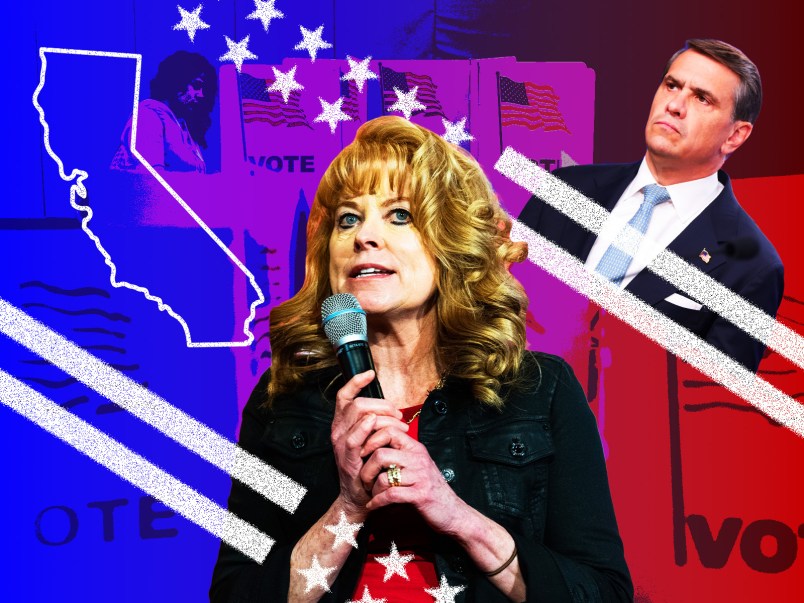
Gambling on Some Light Election Denialism In Pennsylvania
Happy Thursday!
The Republican nominee in the Pennsylvania gubernatorial race is engaged in a delicate balancing act as she attempts to appeal to President Trump and his base of supporters while also trying to win over undecided voters or those who elected the state’s Democratic incumbent. For a Republican in a swing state in 2026, that means finding your election denialism equilibrium.
This article was originally published by Votebeat, a nonprofit news organization covering local election administration and voting access.
Votebeat is a nonprofit news organization reporting on voting access and election administration across the U.S.
This news analysis was originally distributed in Votebeat’s free weekly newsletter. Sign up to get future editions, including the latest reporting from Votebeat bureaus and curated news from other publications, delivered to your inbox every Saturday.
A 2004 paper on the history of presidential election betting markets kicks off with a partial quote from the transcendentalist Henry David Thoreau’s 19th-century essay “Civil Disobedience”: “All voting is a sort of gaming, like checkers or backgammon, with a slight moral tinge to it, a playing with right and wrong, with moral questions; and betting naturally accompanies it.”
Not everyone agrees with that last part. And the rapid rise of online prediction markets such as Kalshi and Polymarket are bringing that tension to the fore.
Prediction markets are websites that sell contracts that allow users to wager on event outcomes. Political examples could include which party will control the U.S. House or Senate after the midterms, for example. Typically, there are fixed payouts and the price of the contract reflects the market’s expectation of the odds of the outcome.
It isn’t yet entirely clear who regulates prediction markets and how, and markets have regularly clashed with state officials trying to rein them in. When it comes to elections, most states have laws prohibiting election betting in some form or fashion, according to a Pew Research Center analysis released in June. But many such laws predate modern prediction markets and haven’t necessarily been tested in court recently.
Kalshi recently pushed back on Wisconsin election officials after they issued an advisory about a state law dating back to the 19th century that says voters can’t cast ballots in races they’ve bet on. A Kalshi staffer said on social media the Wisconsin advisory meant election officials were engaged in “active voter suppression.”
However the legal situation shakes out, betting on elections is happening. An NBC News analysis found nearly $200 million in trading volume on midterm election outcomes on prediction markets Kalshi and Polymarket, and election officials say they are concerned about how the odds on such sites could influence public trust in election outcomes — particularly when election results differ from those the markets had favored — and about creating incentives for manipulation.
“I think it is something that we are going to have to wrestle with going into the November election and forward,” said Dean Logan, the registrar-recorder and county clerk for Los Angeles County, California, the country’s single most populous election jurisdiction, during a webinar organized by the Partnership for Large Election Jurisdictions this month.
Logan said in the Los Angeles mayoral primary in June, “early election returns differed from market expectations, and that resulted in suspicion and questioning of normal ballot processing and canvassing procedures in California.” The bottom line, he said, is that “elections administration right now is very much affected by perception and misinformation, and in our field we have to be prepared to respond to that.”
‘This is all bad’
Prediction markets say their odds reflect the wisdom of the crowds and can be more accurate than polling. And these markets have been pretty good at predicting elections in the past. For example, the 2004 paper that quoted Thoreau, by economics professors Paul Rhode and Koleman Strumpf, analyzed data on election gambling between 1868 and 1940 and found that the historical markets “did a remarkable job forecasting elections in an era before scientific polling.”
But prediction markets differ from polls in important ways. Polls are representative samples of just the voters who live in the state or district in question; prediction markets are open to anyone, and the more money a person bets, the more influence they have on the odds.
And election officials, already worried about low public trust in elections, are concerned the odds on these markets could be manipulated to influence public perception of a contest or create new financial incentives to shape outcomes. Kalshi and Polymarket did not respond to requests for comment.
Jim Allen, the elections director of Delaware County, Pennsylvania, which had already banned election workers from directly betting on elections, earlier this year added a ban on using prediction markets to do so. He likened it to referees betting on the outcome of a basketball game.
The new language, he said during the PLEJ webinar, “kicked off a conversation at our poll worker training. There was one person out of 383 precincts, one person who stood up and they said, ‘Well, what if we just want to make a minor bet on what turnout will be? That’ll keep things interesting.’ And we said, ‘No, this is all bad.’”
Carrie Levine is Votebeat’s editor-in-chief and is based in Washington, D.C. Contact Carrie at clevine@votebeat.org.
Votebeat is a nonprofit news organization covering local election integrity and voting access. Sign up for their newsletters here.
PARIS — Former Prime Minister Gabriel Attal is trying to jump-start his presidential prospects by taking advantage of his rivals enjoying France’s cherished August break.
Attal, a former prime minister who now leads President Emmanuel Macron’s centrist political party Renaissance, is betting that by keeping a busy schedule during the holiday and meeting with people across the country — including those at vineyards, markets and ports as well as vacationers in picturesque seaside towns — he can show voters what sets him apart from the field.
“It’s a rather bourgeois assumption to think that all French people take time off or go on vacation,” said a representative for Attal’s team who, like others in this story, was granted anonymity to speak candidly about campaign dynamics. “There’s no way he’s going to suspend his campaign over the summer.”
Advertisement
But political reality is also forcing Attal to campaign in August for the vote in April of next year. If he wants a real shot at catching up in the polls, there’s little time to waste.
Surveys have consistently shown the 37-year-old trailing Edouard Philippe, his main ideological rival for centrist and center-right votes. Given the contest goes to a two-candidate runoff if nobody wins a majority in the first round, the two men have tentatively agreed that only one of them should be on the ballot so they don’t split their shared voter base — which could cost both of them a spot in the second round.
Philippe, far-right front-runner Marine Le Pen, far-left firebrand Jean-Luc Mélenchon and conservative candidate Bruno Retailleau are all among the presidential hopefuls taking long summer breaks, only interrupting their time off for the occasional op-ed or statement on major events like the wildfires that ravaged southwest France.
Edouard Philippe speaks at a rally in northern Paris on July 5, 2026. | Simon Wohlfahrt/AFP via Getty Images
Their reasoning for slowing down during the peak holiday season is straightforward: Voters want to rest and recharge, so candidates shouldn’t harass them with politics and should instead enjoy one last bit of respite before the race enters its decisive stretch.
“We shouldn’t bother the French people while they’re on vacation,” said a Retailleau adviser.
Attal is betting otherwise that a summer spent campaigning can help close the gap in the polls.
“A campaign is about winning over the French one by one … [Attal] wants to show that he’s more determined than the others,” added his adviser.
The right track
It’s unclear for now to what extent Attal’s summer work will reap dividends with voters, as most pollsters who would investigate that question have themselves set out-of-office messages.
But the absence of other candidates on the campaign trail has given Attal an opportunity to dominate headlines, and he’s used it to make a play for right-wing voters.
Advertisement
At the start of the month, Attal, a member of parliament who represents a Paris suburb, gave an interview to the right-wing weekly Le Journal du Dimanche in which he called for lower immigration, a sweeping streamlining of France’s administrative procedures and more effective enforcement of criminal sentences.
He then traveled to western France, where, in front of cameras, he confronted a group of French gens du voyage — a legal classification for traditionally itinerant communities, including Roma and Manouche, and long a target of the French right — who had occupied land without authorization.
The encounter can be seen below in a report from CNEWS, in French.
French municipalities are required to provide designated stopping sites for traveling communities, but those obligations are not always met — or the sites provided are insufficient — sometimes resulting in unauthorized occupations of public or private land.
For both Attal and Philippe, making inroads on the right will be crucial. Macron’s 2022 reelection was buoyed by older, more affluent voters who had traditionally backed conservatives.
But Philippe begins that contest with a built-in advantage.
Advertisement
He is a former member of the conservative party Les Républicains and has always identified as a man of the right. Attal, who started his political career in the youth wing of the center-left Socialists, has resisted the label.
One conservative minister in the current French government, who has not endorsed a candidate for 2027, readily described Philippe as belonging to his political camp. Attal, the minister said, has a “very flexible” ideological spine.
Sarah Paillou and Anthony Lattier contributed to this report.
LONDON — Nigel Farage billed it as a “people vs the establishment” by-election. But before he wins back the seat he resigned in July, there’s the small matter of convincing Clacton’s voters he can help them with their shabby beachfront stairs.
POLITICO analysis of the Reform UK leader’s digital campaign messages shows that Farage has run a twin-track strategy in the seaside seat as polls open Thursday. The two key themes of the digital air war have been painting Farage as a champion for local residents — as well as an insurgent leader harried by the “establishment” machine.
Farage and his party have spent more than £10,000 pushing those messages via ads on Meta’s platforms — which include Facebook and Instagram — in the campaign so far.
It’s a similar amount to that spent by the party in the crunch Makerfield by-election in June, where Reform unsuccessfully attempted to halt Andy Burnham’s march on Downing Street by denying the Labour candidate a Westminster seat.
But in Clacton, Farage’s chief opponent is Count Binface, a satirical candidate who sports a silver cape, wears a rubbish receptacle on his head, and claims to be from outer space.
The Reform leader triggered the special election in a bid to bolster his personal standing amid questions about his finances, including whether he broke parliamentary rules by not declaring a £5 million donation from a crypto-entrepreneur. Britain’s other mainstream parties refused to field candidates in the contest as a result, leaving Farage running against independents and comedy characters.
In his paid ad content, the Reform leader makes no mention of his Count Binface, whose policies include capping the price of ice cream and holding a referendum on returning Pluto’s planetary status.
Farage speaks during a press conference on a plan to deport foreign prisoners in London on Aug. 10, 2026. | Dan Kitwood/Getty Images
Instead, a spate of campaign videos have been pushed out showing Farage as having his finger on the pulse of local concerns.
Tackling low-level crime, housing problems, shabby infrastructure and veterans’ issues all get mentions in the paid ads targeted specifically at users living in the area.
One Meta ad suggests he is the only candidate to have visited forgotten areas of the constituency. A further clip shows a local resident giving Farage a positive review of his work — and is presented as proof that opposition complaints he has neglected the patch since his 2024 general election victory in the seat are “cobblers.”
With over 7 million followers across the leading social media platforms — making him by far the most-followed U.K. party leader — Farage has also been churning out election content across TikTok, Instagram and X.
Even with that reach, the Reform UK leader appears to be the only candidate running in Clacton who has used paid Meta features to bolster his online campaign.
Almost £1,000 has been spent on videos of Farage urging local supporters to request the party deliver and install an “I’m with Nigel” garden sign. Meanwhile, around £500 went to ads asking voters to return their postal votes and “send a message to the establishment.”
The largest single sum — between £4,000-£4,500 — was spent on an almost five-minute campaign video in which Farage waxes lyrical about the connection he’s made with local constituents, while claiming his party’s surging success has resulted in the powers-that-be using “foul means” to hamper him.
“Rather than being judged by the political class and the mainstream media, I am going to let you, the voters in the Clacton constituency, make a decision,” he said. “I want you to be my judge, not the political elite.”
Farage also used the same piece of campaign content to try and take on questions about his funding head-on. In the clip, the Reform leader argued that the furor over a £5m donation he received from crypto-entrepreneur Christopher Harborne before the 2024 election — now the subject of a House of Commons investigation — amounts to merely a failure to fill out a parliamentary form.
The Clacton candidate also argues in the same clip that the murder of a senior Reform figure proves such funding is needed for his personal security. “Surely in the wake of the death of the elderly Ann Widdecombe, you can see that I am going to need money to protect myself for the rest of my life,” he said.
With a result due in the early hours of Friday, Farage does not have long to wait to find out whether his online spend has paid off.

 Login
Login