❌

Reading view

How Trump’s ‘Grand Conspiracy’ Investigation Failed to Become the New QAnon
In Rough Edges, Mike Rothschild writes about fringe groups, conspiracy theories and how the Internet broke our brains. This column is part of TPM Cafe, TPM’s home for opinion and news analysis.

People love a grand conspiracy. The bigger the scheme is, the more people get drawn into it. And the more details and players that are involved, the more believable it seemingly becomes. After all, who would go to the trouble of making up something so complicated? It must be true.

And nobody loves a conspiracy more than President Trump. He and his inner circle especially seem to have fallen in love with what has literally been dubbed “The Grand Conspiracy.” It’s a hopelessly complex, entirely unevidenced theory claiming that a high-ranking group of political figures have been plotting in the shadows for years to stop Donald Trump from making America great again through investigations, indictments and impeachments. It has all the hallmarks of the type of grandiose schemes that Trump supporters especially fall for: countless players, sprawling plots, intricate secrets, and a total lack of evidence that it actually took place.

Despite lacking cogent answers to foundational questions such as “what it is” and “who is doing it,” revenge for the Grand Conspiracy has been a driving force in the administration, prompting an investigation that has trundled along over the last year and a half, involving dozens of officials looking for some reason to indict the president’s enemies.

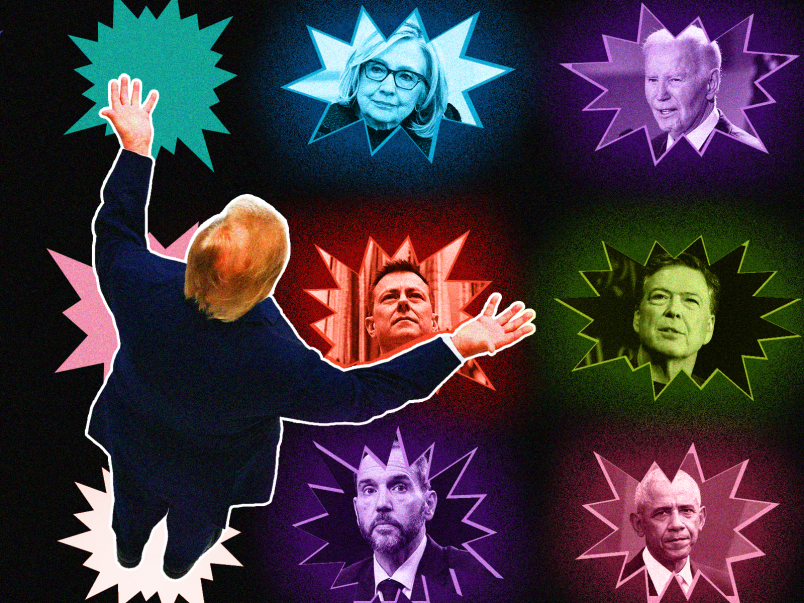
And there are many, many enemies. They include a greatest hits of Trump’s obsessions and grievances, from former special counsel Jack Smith to minor players like former FBI agent Peter Strzok, and even former President Barack Obama himself. According to Grand Conspiracy believers, they are all powerful Deep State figures who supposedly worked together in a single, years-long scheme to destroy Trump and undo the will of the people. 

Precisely what these conspirators have actually done remains unclear — even, seemingly, to the prosecutors themselves, who, per the Wall Street Journal, complained to the Justice Department that they weren’t getting much guidance from the local U.S. attorney. The probe is now being run out of Washington, where it continues to baffle those assigned to move it forward. 

In the last few weeks, there have been a host of indications that DOJ efforts to prosecute these figures — and tie them all together into one grand scheme — are falling apart. And, as the Grand Conspiracy prosecution flails at DOJ, the claims also aren’t doing much in the court of public opinion, where Republicans are looking for anything they can find to shore up their crumbling midterm prospects.
  •  

Why Current Polling Averages May, in Fact, Understate Democratic Support

This article is part of Cafe, TPM’s home for opinion and news analysis.

Significant polling errors most often result when late-deciding voters break differently from historical patterns. That’s likely to happen this year, and not in a way that favors Republicans. 

Start with the observation that the current midterm environment is utterly unlike any in recent history. The CNN average of recent polls pegs the proportion of voters who disapprove of Trump at 65 percent, and a recent You/Gov Economist poll found that of those who disapprove, 84 percent of them disapprove of him “strongly.” We’ve had no recent midterm cycle in which most American voters strongly disapprove of the president. 

If we look at the distribution of Trump disapprovers, the implications for Republicans become even more ominous. Let’s say that Trump’s most loyal MAGA voters make up 30 percent of the electorate and assume, plausibly, that most of them associate largely with Americans of similar views. Since this group is largely devoid of Trump disapprovers, the upshot is that an overwhelming majority of voters not in this group — some 70 percent of the electorate — are Trump disapprovers. And since there are also almost no undecided voters among Trump loyalists, the portion of the electorate that describes itself as “undecided” also must consist almost entirely of Trump disapprovers.

To see how this may matter, consider the observation that most of us are more heavily influenced than we realize by the behavior and beliefs of peers. (This was the core premise of my 2019 book, Under the Influence: Putting Peer Pressure to Work.) As decades of careful studies have shown, peer behavior strongly influences almost everything we do and think — what we eat, how much we exercise, whether and how much we smoke and drink, how much we weigh, and which candidates we support.

Now imagine the decision facing an undecided voter. She’s almost surely not a Trump loyalist, and virtually all of her close friends and relatives are likely to disapprove of Trump, a majority of them strongly. They’re unhappy about gas prices, the cost of groceries, corruption, the war in Iran, the behavior of ICE, and more. Herself a likely Trump disapprover, she’s almost surely unhappy about many of these things as well. Late deciders in past elections often tended to break toward candidates who share their political identity. If this year’s late decider is a conservative, that would predict she’d vote Republican. But given everything we know about human behavior, casting that vote would be difficult in the current environment. It would mean bucking the views of almost everyone she knows and cares about.

How much might all this matter? A recent generic ballot poll estimated that 8 percent of likely voters remain undecided. If these voters would have split 4D-4R in a normal midterm environment, a 6D-2R split in today’s climate would hardly seem unlikely. And that four percentage point swing would almost surely be more than enough to erase any pro-R polling bias from other sources.

But there’s more. Peer influences shape not only the decision about whom to vote for but also the decision about whether to vote at all. This influence will of course cause current polling averages to further understate Democratic strength.

In a recent interview with MS NOW host Jen Psaki, former Obama adviser David Plouffe was understandably reluctant even to discuss the possibility that current polls might be understating Democratic strength. Acknowledging this possibility could of course encourage some people to slack off, thinking the prize already in hand. 

But understating Democratic prospects also entails risk. As we’ve seen, Republican seats are vulnerable in many areas that earlier Democrats would never have thought to contest. There’s reason to believe that the playing field may yet warrant further expansion. 

  •  
❌