❌

Reading view

2025 Endeavour Award Winner

Image representing the H.M. Bark Endeavour, the ship of James CookThe winner of the 2025 Endeavour Award has been announced. The award recognizes “a distinguished science fiction or fantasy book written by a Pacific Northwest author or authors and published in the previous year.”

The winner was selected by a panel of judges and announced at the Endeavour Writers Conference on October 10, 2026 in Milwaukie OR. The winning author receives a grant of $1,000 and an etched trophy.

For more information, see the official website.

  •  

Pluralistic: Adversarial interoperability is a team sport (21 Oct 2026)


Today's links

  • Adversarial interoperability is a team sport: Vibe-coded jailbreaks are fun, but don't solve the problem.
  • Hey look at this: Delights to delectate.
  • Object permanence: Labour Whip's pro-Iraq war threats; LoC's emulators; Kevin Mitnick plays CIA stooge; ICE: "The warrant is coming out of my balls"; WIPO's secret trademark meeting; Linking isn't libel (in Canada); Make: singing busts; Tory minister kills Turing's Law; Trump hotels rebrand as "Scion".
  • Upcoming appearances: Vancouver, Ottawa, Vienna, Kilkenny, Courtenay, Vancouver, Oxford, Sheffield, Virtual, Oxford, Montreal.
  • Recent appearances: Where I've been.
  • Latest books: You keep readin' em, I'll keep writin' 'em.
  • Upcoming books: Like I said, I'll keep writin' 'em.
  • Colophon: All the rest.


A medieval engraving of an Italianate city; floating in the middle is a giant skull (anterior view). Surrounding the skull is a series of 17th C European machine parts, being worked by tiny engravings of 17th C rude mechanicals. A strangely erotic, massive flower looms out of the right; standing amid its proudly thrusting stamen is a 17th C swordsman.

Adversarial interoperability is a team sport (permalink)

Enshittification is particularly galling because (in theory, at least), digital technology should be really hard to enshittify.

That's because the only digital computer we know how to build is the "Turing-complete, universal von Neumann machine," which is to say, a calculating engine capable of computing every valid program. In some deep, important, foundational sense, every computer is the same as every other computer. Sure, they vary in terms of speed, storage and RAM, but given enough time and electricity, every computer can run every program.

This has profound implications for enshittification. Say a tech boss takes away a feature you value (as when Sonos pushed an update that removed nearly all the functionality from its "smart" speakers), or adds a feature you hate (like when Chamberlain blocked third-party apps from controlling its garage doors so it could force its customers to view seven ads before they could open or close their garages). At that point, a programmer can write an "interoperable" program that restores the good feature or blocks the bad one.

This program can be costlessly and instantaneously distributed to every affected technology user, and those users will likely pay something for it. After all, enshittification is a way to shift value away from technology users to tech companies, which makes the case for you paying for disenshittification technology that wrestles that value back.

All of that means that, in a state of nature, companies that are contemplating enshittification need to worry that their greed will tempt new companies to enter the market and poach their customers and suppliers. This alone might be enough to frighten companies off from enshittificatory gambits, and if companies press ahead regardless, then they open market opportunities for better companies that can costlessly, instantaneously usurp the original manufacturer's relationship with their entire affected customer base.

That's how it should work. But in 1998, Bill Clinton signed the Digital Millennium Copyright Act, and Section 1201 of the DMCA establishes a felony (punishable by a five-year prison sentence and a $500,000 fine) for reverse-engineering and modifying technology without the manufacturer's permission. Then, the US Trade Rep spent the next 25 years making sure that every US trading partner had an identical (or even worse!) "anticircumvention" law:

https://pluralistic.net/2025/05/26/babyish-radical-extremists/#cancon

The result is a grotesquely asymmetrical digital world, in which companies are free to use the flexibility of digital computers to downgrade or brick your digital devices, but where you commit a crime if you avail yourself of a countermeasure to get more out of something you own. This is the core technological factor at play in enshittification.

Enter AI. Thanks to vibe-coding, everyday people are rolling their own software for their devices and building the tools to shatter the digital locks that manufacturers use to block disenshittification. An excellent article by 404 Media's Jason Koebler runs down some of these hacks, including drop-in replacements for smart TV software that blocks the endless ads and surveillance that have made TVs all but unusable:

https://www.404media.co/reverse-engineer-anything-is-the-new-wild-west-of-ai/

These AI tools mix several techniques to disenshittify users' devices. One major component is automating the installation of existing alternative firmware for these devices that have been (possibly illegally) created by hobbyists and uploaded to various code repositories. Installing these alternative OSes is typically a gnarly task, requiring the user to do a lot of complex, fiddly, highly technical work to bypass their devices' digital locks.

In a world without anticircumvention law, a company that sold alternative OSes could hire a ton of programmers and UX developers to smooth over this process, but this is beyond the reach of a typical hobbyist or even a community of hobbyists, especially if they must operate in the shadows, under the threat of civil and criminal liability.

There's a useful analogy here to the trajectory of desktop versions of GNU/Linux. The first time I tried to install Linux (on an original iMac, in the late 1990s), the installation process included a multi-week post-installation wrangle that saw me (often unsuccessfully) compiling key modules from source code and then painstakingly configuring them to get the computer's graphics and I/O working reliably.

Fast forward 30+ years and installing Linux is trivial, thanks to highly capitalized companies like Canonical (makers of Ubuntu, the flavor of Linux I've used for nearly 20 years now). Installing Ubuntu today merely requires that you download the OS to a thumbdrive, reboot your computer using the drive as a startup disk, and click "install." Canonical's installer automatically hunts down the correct software for your hardware and configures it. Canonical writes and contributes to a lot of parts of the Linux OS, but the most important work it does is the fiddly, painstaking, labor- and capital-intensive work of perfecting that installer so it Just Works.

Much of what a vibe-coded jailbreaking tool does is stand in for Canonical, but for hobbyist OSes for smart TVs and speakers and many other devices. These LLMs patiently research every weird error and peccadillo and parse through message boards and logfiles detailing other hobbyists' struggles to get the code working and methodically apply and adapt those solutions until your device Just Works.

Some of these vibe-coded interop tools go farther than that. According to Koebler's coverage, some device owners had their coding assistants scratch-build entirely new, heavily customized OSes for their devices, complete with bypasses that allow this new code to be installed despite the manufacturer's countermeasures which are designed to prevent this. Delightfully, many of these users have created software that revives their bricked, discontinued devices. This poses the possibility of a world in which manufacturers no longer have the last word in your use of your own property: the mere fact that the manufacturer lost interest in a device and killswitched it does not mean that you must consign that valuable device to a landfill to become immortal, toxic e-waste.

All of this is good news. Some of the most sophisticated jailbreaking tools (such as those on the super viral "Reverse Engineer Anything" Github page) run locally, on your own computer, without invoking the "frontier models" that the big, awful AI companies have created:

https://github.com/morluto/rea

This is good even if you're just modifying your own devices to get them to more closely conform to your own use-case. LLMs are genuinely good at coming up with the abstruse and obscure configuration lines and other incantations to get your technology working. Recently, I used a local model to fine-tune the power-management on my new laptop in ways that go beyond the options that are exposed through user-friendly graphic interfaces. The LLM spat out a grub "GRUB_CMDLINE_LINUX_DEFAULT" line that (again) Just Worked.

The last time I had to do this, I spent days painstakingly trouble-shooting options by trial-and-error. Using a chatbot to fill in the gaps left by decisions about which configuration options to place within reach of regular users and which to reserve for power-users has made my computer much more useful to me for the things I want to do, like writing and making collages.

The reality is that it's just not practical for technology developers to turn every conceivable function of your computer into a simple-to-use, accessible tool. A large part of technology design is about leaving things out (or, as my favorite Eno Oblique Strategy goes, "Be the first person to not do something that no one else has ever thought of not doing before"). No matter how thoughtful and diligent a technology designer is, they will never fully anticipate the needs and exigencies of their users. That's why the motto of the disability rights movement is "Nothing about us without us."

The users of technology know more about their use-cases than can ever be captured through a requirements gathering exercise and user testing. One of the best and proudest legacies of technology is the lineage of "user-friendly" programming tools that let nontechnical people design their own applications that exactly met their needs, from Hypercard to Visual Basic to Scratch, a lineage that vibe-coding tools are arguably part of:

https://pluralistic.net/2026/09/25/other-people/#right-there

But these tools are not perfect (nothing is). For all that Hypercard lets you do many things that would otherwise require a skilled programmer, it was also always limited relative to, say, writing MacOS code in Objective C. Your Hypercard program might do exactly what you needed it to, but slowly, and sometimes unreliably, and with serious limitations, such as a relatively low ceiling for the number of records you could add to a database.

Vibe-coded personal apps aren't necessarily subject to these limitations, but they come with some significant risks. Vibe-code can have serious security vulnerabilities that expose the user to things like identity theft or sextortion. It's conceivable that a vibe-coded garage-door opener app might make it possible for attackers to open your garage door when you're not home (or worse, when you are!). Depending on your risk-tolerance and expertise, these might be acceptable prices, or they might be too high.

But it's important to clearly identify the problem here: if the alternative OS you install on your smart TV exposes you to privacy-invading hack attacks, the problem is the defect in that software. The problem isn't that you had the temerity to rip out the manufacturer's own software and replace it with code of your choosing. You bought that TV, it's yours, and you don't owe the manufacturer an obligation to expose yourself to its own, built-in, intentional surveillance and invasive ads.

Here's a parallel: you have the right to put any shoelaces in your running shoes. Sure, Nike might prefer you to lace up your Jordans with its expensive OEM laces, but that's Nike's problem, not yours. Now, Nike might argue that by using no-name laces, you run the risk of having a lace break while you're running, which could also break your ankle. That's certainly a possibility: shoelaces do break, and Nike might be justifiably proud of the quality of its laces. But if your generic laces snap (and so does your ankle), the problem is that the shoelaces you chose were defective. The problem is not that you chose someone else's laces.

Your stuff is yours. You can put anyone's milk on your cereal, not just the milk that Kellogg's endorses. If the milk you choose is sour and you have to pour your cereal down the toilet, that's too bad, but it doesn't mean that Kellogg's should have the right to shame you for having the temerity to choose the milk you preferred, and it certainly doesn't militate for DMCA-style enforcement to coerce you into using Kellogg's official milk in the name of protecting you from food wastage.

I raise this because there's a live debate over this subject, which is well represented in the latest 404 Media podcast:

https://www.youtube.com/watch?v=UbG1qwxMtU0

In the podcast, Koebler and his 404 co-founder Joseph Cox express misgivings about various possible uses of "slop interop." Koebler discusses the fact that John Deere sells the same physical tractor at many different price-points, depending on which software a farmer chooses, and raises the possibility that a farmer might vibe-code software that replicates the high-end functionality without paying for it. Koebler discusses two possible downsides to this: first, that the vibe-coded software might be defective and expose the farmer to risk; and second, a question about whether it's fair or just for a farmer to get those additional functions of their tractor without paying for them.

I think the first objection is entirely legitimate. The software you run on your expensive tractor should be secure, both for your own benefit and for the security of our food supply. That's actually a pretty good reason to ditch John Deere's own software, which is very insecure:

https://pluralistic.net/2022/05/08/about-those-kill-switched-ukrainian-tractors/

But I think the second question – whether it's legit to get this functionality without paying John Deere for it – is spurious. Sure, if John Deere provides you with that functionality, then they can send you the bill for it. But if you provide yourself with that functionality, using software you procured independently of John Deere, then John Deere has no right to get paid for it, and they certainly shouldn't have the right to stop you.

That tractor is yours. The fact that John Deere manufactured it is irrelevant. If you pay a contractor to build a house for you and later on pay a different contractor to add another bathroom to it, you don't owe the first contractor anything. It's your house (and if that bathroom has a leaky toilet, that's a matter between you and the second contractor, and not a reason to force you to only use your original contractor).

The law defines a narrow slice of functions that manufacturers get to control: those ideas that a patent examiner deems "novel, useful and nonobvious." It's legit (and good) for commercial operators to copy and improve the ideas of their rivals and competitors. It's why skilled tradespeople cluster together in the same geographic area.

Take Clerkenwell, the neighborhood in London where precision machining was invented by the jewelers and machinists who clustered there during the Longitude rewards. The reason all those competitors sought such close promixity to one another was because they wanted to copy the new techniques their rivals were developing (even if that meant that their rivals would be able to copy them):

https://en.wikipedia.org/wiki/Longitude_rewards

If you're old enough to remember the advent of spreadsheets and the rollout of Visicalc, Lotus 1-2-3 and Excel, you'll know that every time a software vendor invented a new spreadsheet feature, all the other ones immediately copied it. This wasn't bad for spreadsheets: it was good for spreadsheets, just as copying your competitors was good for precision machining in Clerkenwell.

Everything from GNU/Linux (a feature-for-feature clone of AT&T Unix) to SAMBA (a plug-compatible clone of Microsoft's SMB) to iWork (file-compatible, feature compatible clones of MS Office's apps) came about through this "adversarial interoperability." What's more, the heyday of this kind of adversarial interop was also the heyday of disenshittification, the era in which any anti-feature installed by your existing vendor could be countered by a disenshittifying patch from a new one:

https://www.eff.org/deeplinks/2019/06/adversarial-interoperability-reviving-elegant-weapon-more-civilized-age-slay

The question of whether vibe-coded software is any good is separate from the question of whether it's good to replace the software in your devices, even if you replace it with software that has features that the manufacturer would normally charge a premium for. You are under no obligation to arrange your commercial affairs to the financial benefit of manufacturers, and anyone who claims to be surprised that someone they sold a device to used it to benefit themselves at the manufacturer's expenses is either disingenuous…or unserious. You bought it, it's yours.

But just as this vibe-coded adversarial interop has drawn both valid and spurious criticism, it's also drawn excitement that is partially justified and partially overblown.

When it comes to reviving bricked devices or rooting out the surveillance and ads from your smart TV, vibe-coded interop tools are genuinely exciting. These are the kinds of enshittification that can truly be remediated with individual jailbreaks.

But the real, meaty examples of enshittification can't be addressed on an individual level – they require systemic fixes. If you jailbreak your iPhone so that it can use alternative app stores, that fact is not sufficient to cause those alternative app stores to come into existence. If we want to stop Apple from levying a $100b "app tax" on the digital economy, it's not enough for individuals to vibe-code their own iPhone patches. We need to repeal the law that bans jailbreaking iPhones, so that a would-be alternative app store can raise capital and pay programmers and tech support staff and salespeople to assemble rival catalogs of software and help customers figure out how to get up their phones to use it.

The same goes for jailbreaking your printer so it accepts generic ink. Sure, this may work for you if you're up for refilling your own cartridges, and I'm sure that you can find someone on Alibaba who will sell you ink by the gallon. But the mere fact that a few users have secretly and privately jailbroken their inkjets won't conjure up a generic inkjet cartridge manufacturing sector. For that to happen, we need to make jailbreaking printers legal, not just possible.

Indeed, if we want to improve the quality of all that jailbreaking code the chatbots are writing and circulating, we need to be able to put those jailbreaks in public repositories for public inspection and public critique. It's possible for some of the code produced by an LLM to be slop, and for other code to be fine, and for yet a third tranche of code to be remediable slop that can be made robust and reliable through auditing and refactoring. You can't figure out which is which if you have to keep that vibe code a secret on pain of a long prison-sentence.

I think there's good cause to be excited at the prospect of getting your devices working better, or just working at all. I think that even if the code stops working after a while, that's still fine – either you got more use out of your device than you would have without the new code, or maybe you just make more code that runs for a while for you, and then you do it again.

These individual improvements to your devices and technology are worth celebrating. But they are no substitute for systemic intervention. If we're going to have a new, good internet, a post-American internet that truly disenshittifies America's defective tech exports and replaces them with robust, transparent digital public goods, we need to make reverse-engineering legal again. Once we fix our policy, then we can fix our code:

https://pluralistic.net/2026/01/01/39c3/#the-new-coalition


Hey look at this (permalink)


A shelf of leatherbound history books with a gilt-stamped series title, 'The World's Famous Events.'

Object permanence (permalink)

#25yrsago Secret recording of Labour Whip demanding support for Iraq invasion https://www.theguardian.com/politics/2001/oct/22/uk.september11

#25yrsago LoC launches emulator-based digital file preservation https://web.archive.org/web/20011217002337/http://www.techreview.com/magazine/oct01/innovation5.asp

#25yrsago Kevin Mitnick to play CIA lackey https://web.archive.org/web/20011111105016/http://www.theregister.co.uk/content/55/22395.html

#15yrsago ACLU Tennessee brings suit against ICE officers who broke into house and said, “We don’t need a warrant, we’re ICE, the warrant is coming out of my balls.” https://web.archive.org/web/20111025092605/http://www.aclu.org/blog/immigrants-rights/we-dont-need-warrant-were-ice/

#15yrsago WIPO’s secret, corporate-run trademark enforcement meeting https://web.archive.org/web/20220121054715/https://craphound.com/PROGRAMManilaEdited10212011-FINAL.pdf

#15yrsago Canada’s Supreme Court: Linking isn’t libel https://web.archive.org/web/20111026134334/http://www.bbc.co.uk/news/world-us-canada-15374238

#15yrsago HOWTO recreate the Haunted Mansion’s singing busts https://www.youtube.com/watch?v=zRtiiMW47i4

#10yrsago Facebook’s crackdown on publishers feeds has sites paying celebs to repost https://digiday.com/media/facebook-thirsty-publishers-turn-celebrities-worm-news-feed/

#10yrsago Internet-destroying outages were caused by “amateurish” IoT malware https://krebsonsecurity.com/2016/10/hacked-cameras-dvrs-powered-todays-massive-internet-outage/

#10yrsago Tory minister’s filibuster kills Turing’s law and pardons for 65,000 persecuted gay men https://www.theguardian.com/law/2016/oct/21/chris-bryant-commons-plea-gay-pardon-law

#10yrsago Trump hotels, faced with massive declines in bookings, rebrand as “Scion Hotels” https://web.archive.org/web/20161023182616/http://www.travelandleisure.com/hotels-resorts/trump-scion-hotels


Upcoming appearances (permalink)

A photo of me onstage, giving a speech, pounding the podium.


A screenshot of me at my desk, doing a livecast.

Recent appearances (permalink)


A grid of my books with Will Stahle covers..

Latest books (permalink)


A cardboard book box with the Macmillan logo.

Upcoming books (permalink)

  • "The Post-American Internet," a geopolitical sequel of sorts to Enshittification, Farrar, Straus and Giroux, 2027
  • "Unauthorized Bread": a middle-grades graphic novel adapted from my novella about refugees, toasters and DRM, FirstSecond, April 20, 2027

  • "Enshittification, Why Everything Suddenly Got Worse and What to Do About It" (the graphic novel), Firstsecond, 2027

  • "The Memex Method," Farrar, Straus, Giroux, 2027


Colophon (permalink)

Today's top sources:

Currently writing:

  • “Once Is Enemy Action,” a science fiction novel about the origins of modern technofascism. Today's words: 533 (27469 total).
  • "The Post-American Internet," a sequel to "Enshittification," about the better world the rest of us get to have now that Trump has torched America. Fourth draft completed. Submitted to editor.

  • A Little Brother short story about DIY insulin PLANNING


This work – excluding any serialized fiction – is licensed under a Creative Commons Attribution 4.0 license. That means you can use it any way you like, including commercially, provided that you attribute it to me, Cory Doctorow, and include a link to pluralistic.net.

https://creativecommons.org/licenses/by/4.0/

Quotations and images are not included in this license; they are included either under a limitation or exception to copyright, or on the basis of a separate license. Please exercise caution.


How to get Pluralistic:

Blog (no ads, tracking, or data-collection):

Pluralistic.net

Newsletter (no ads, tracking, or data-collection):

https://pluralistic.net/plura-list

Mastodon (no ads, tracking, or data-collection):

https://mamot.fr/@pluralistic

Bluesky (no ads, possible tracking and data-collection):

https://bsky.app/profile/doctorow.pluralistic.net

Medium (no ads, paywalled):

https://doctorow.medium.com/

Tumblr (mass-scale, unrestricted, third-party surveillance and advertising):

https://mostlysignssomeportents.tumblr.com/tagged/pluralistic

"When life gives you SARS, you make sarsaparilla" -Joey "Accordion Guy" DeVilla

READ CAREFULLY: By reading this, you agree, on behalf of your employer, to release me from all obligations and waivers arising from any and all NON-NEGOTIATED agreements, licenses, terms-of-service, shrinkwrap, clickwrap, browsewrap, confidentiality, non-disclosure, non-compete and acceptable use policies ("BOGUS AGREEMENTS") that I have entered into with your employer, its partners, licensors, agents and assigns, in perpetuity, without prejudice to my ongoing rights and privileges. You further represent that you have the authority to release me from any BOGUS AGREEMENTS on behalf of your employer.

ISSN: 3066-764X

  •  

NYC’s Fastest Bike Messenger (1985)

For CBS News in 1985, Charles Kuralt profiled bike messenger David Leopold.

I don’t go slow. I don’t stop for red lights. I go against traffic. I disobey every traffic law there is.

Great street footage of NYC from 40 years ago. You might think that Leopold ended up as a stain on the pavement. In 2010, CBS News did a follow-up on him:

See also Leopold on David Letterman from 1985.

Tags: Charles Kuralt · cycling · NYC · video

  •  

Clearing Up Some Misconceptions About FDR’s Court-Packing Plan

This article is part of Cafe, TPM’s home for opinion and news analysis.

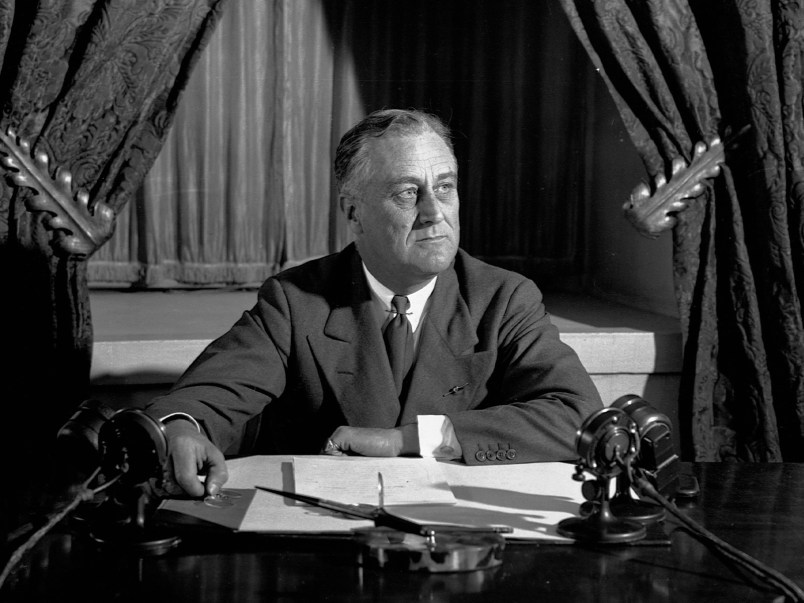
The Overton window on expanding — or packing or unpacking — the Supreme Court is now wide enough that it’s worth revisiting one inevitable part of the conversation: FDR’s Court-packing proposal in 1937. Misconceptions about the events abound in popular discussions.

Here’s the short version of the story you’ve probably heard: In 1935 and early 1936, the conservative-dominated Supreme Court handed down several decisions whose doctrines threatened important parts of FDR’s New Deal economic policies. After his overwhelming reelection in November 1936, he decided to pack the Supreme Court with six new justices, using the excuse that the sitting justices over the age of 75 weren’t able to handle the Court’s work effectively. Announced in January 1937, the Court-packing plan came as a surprise to political Washington, and immediately met strong resistance. FDR slogged on but the plan suffered several severe blows, including a letter from Chief Justice Charles Evans Hughes endorsed by liberal justice Louis Brandeis saying that the Court was completely up to date with its work. Other developments undercut the urgency for the president and his allies, including a decision favoring New Deal economic policies in March 1937 in which swing justice Owen Roberts cast the deciding vote and the retirement in May of conservative justice Willis Van Devanter. When the plan was formally interred in a mid-summer Senate vote, a New York journalist called Roberts’s vote the “switch in time that saved the nine,” and the phrase — and Roberts’s vote — have come to dominate today’s understanding of the episode.  

That version isn’t completely inaccurate and it isn’t a caricature, but it does contain some misconceptions, the most important of which is probably the focus on the captivating “switch in time” phrase. If we think that the story of the Court packing plan has some lessons for us today, it’s important to clear up these misconceptions. Historians have written books about the events surrounding the Court-packing plan and this essay won’t be able to explore all the ins-and-outs of a complicated set of events. Even more, the story has many moving parts, most of which are connected to others, so you can pick pretty much any place to start.

Was the Court-packing plan a surprise?

Yes and no. After one important decision in May 1935 going against the New Deal, FDR held a press conference and said that the Court wanted to take the country back to the horse-and-buggy days. Almost from the start of his first term FDR groused about the possibility that the Supreme Court would stand in the way of what he thought were programs needed to recover from the economic crisis the nation faced. Ideas about “doing something” about the Court floated around Washington starting in 1933, leaked from the administration to favored reporters and discussed at Georgetown dinner parties.

Still, FDR hadn’t directly targeted the Supreme Court during his 1936 reelection campaign. Instead, he regularly attacked the American Liberty League, an advocacy organization founded and funded by wealthy opponents of the New Deal. The League produced a series of pamphlets designed as templates for legal briefs laying out the constitutional arguments against a host of New Deal programs. When FDR went after the League, he was really taking on reactionary legal arguments he feared the Supreme Court would adopt. So, in the guise of the American Liberty League, the Supreme Court was part of the 1936 presidential campaign.

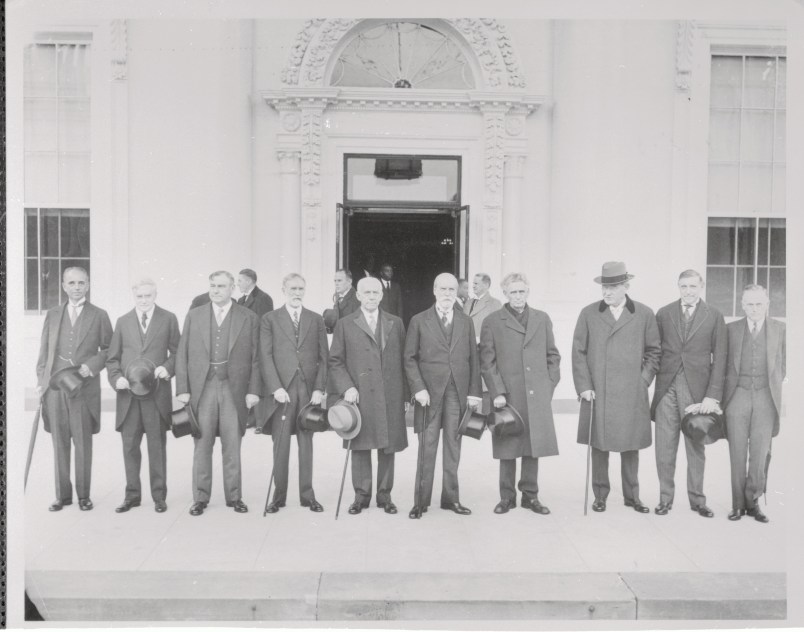
Supreme Court Justices visit the White House in the early 1930s. (Getty Images)

Supreme Court reform of some sort was in the air after FDR’s massive victory in November 1936. The development of the Court-packing plan was a closely held secret within the administration. The content of the announcement on February 5, 1937, was something of a surprise. But no one was surprised that FDR wanted to move some sort of Court reform through Congress.

Was there a switch in time?

No, but maybe yes. On June 1, 1936, the Supreme Court held a New York statute setting a minimum wage for women workers unconstitutional by a vote of 5-4, with Justice Roberts in the majority. Then, on March 29, 1937, the Court held an essentially identical Washington state statute constitutionally permissible by a vote of 5-4, with Roberts in the majority. Coming less than two months after the Court-packing plan’s announcement, Roberts’s “new position” is the switch in time.

Owen Roberts in the 1930s. (Photo by Harris & Ewing/Interim Archives/Getty Images)

It’s been known for decades, though, that Roberts actually cast his deciding vote in mid-December 1936, before the Court-packing plan was announced. Justice Harlan Fiske Stone was absent because he was recovering from a near-fatal illness. The justices divided four-to-four, with Roberts voting to uphold the Washington statute. Stone’s vote was necessary for the new majority but everyone knew that he’d vote to uphold the Washington statute (he’d joined the dissent in the New York case).  The case was essentially over when the Court took its initial vote. The formal vote was delayed until February 6, 1937, the day after the Court-packing plan was announced. Justice Felix Frankfurter later reported that Roberts came up with a lame explanation for his switch, saying that New York’s lawyers hadn’t explicitly asked the Supreme Court to overrule a controlling precedent but Washington’s lawyers did. (The excuse was lame because New York’s lawyers had indeed asked the Court to overrule the precedent, though in a short and somewhat cryptic paragraph.)  Whatever the reason, it didn’t come “in time” — that is, it didn’t come as a response to the February 5, 1937, unveiling of the Court-packing plan.

Remember, though, that Court reform was in the air. Maybe Roberts was picking up what we’d now call “vibes” about a threat to the Court, and maybe the lameness of his explanation was just a cover story for a change induced by the general atmosphere of threats to the Court as an institution.

Was the plan doomed from the start?

No. Vote counters knew that the House of Representatives would accept the plan. All the action was in the Senate, where there was fierce opposition from conservative Republicans and some Democrats, and unease among other Democrats. 

An adept politician, FDR held an ace in his hand, and everyone knew it. He promised one of the seats on an expanded Supreme Court to Senate majority leader Joseph Robinson of Arkansas. Robinson found the offer irresistible. He called in all the chits he had with his colleagues, putting together a potential majority for the plan one vote at a time. Political observers at the time weren’t sure what the outcome would be but they were inclined to think that Robinson could pull off a victory for FDR.

The final vote was scheduled for mid-July in an exceptionally hot (and un-airconditioned) Washington. Robinson held a meeting–social gathering where he continued to lobby wavering colleagues. The combination of heat and stress gave Robinson a fatal heart attack. The possibility of a majority for the Court-packing plan in the Senate always depended on personal ties between Robinson and other senators, and, with his passing on, the plan failed. 

Did FDR lose the battle but win the war? How?

Yes, yes, and maybe no. FDR lost the battle over expanding the Court but reached his main war goal — having a Court that wouldn’t completely obstruct his favored programs. As with almost all successful military campaigns, the path to the goal wasn’t straight. The war wasn’t over on March 29 when the nation learned that Roberts had voted to uphold Washington’s minimum wage law. FDR’s legal team worried that Roberts wasn’t going to be a reliable ally going forward — and indeed he wasn’t: a careful modern statistical study shows that Roberts reverted to his conservatism within a year.

The war wasn’t over on May 18, either, the day Justice Willis Van Devanter announced his intention to retire even though the retirement seemingly gave FDR the opportunity to replace a conservative with a reliable supporter of the New Deal. 

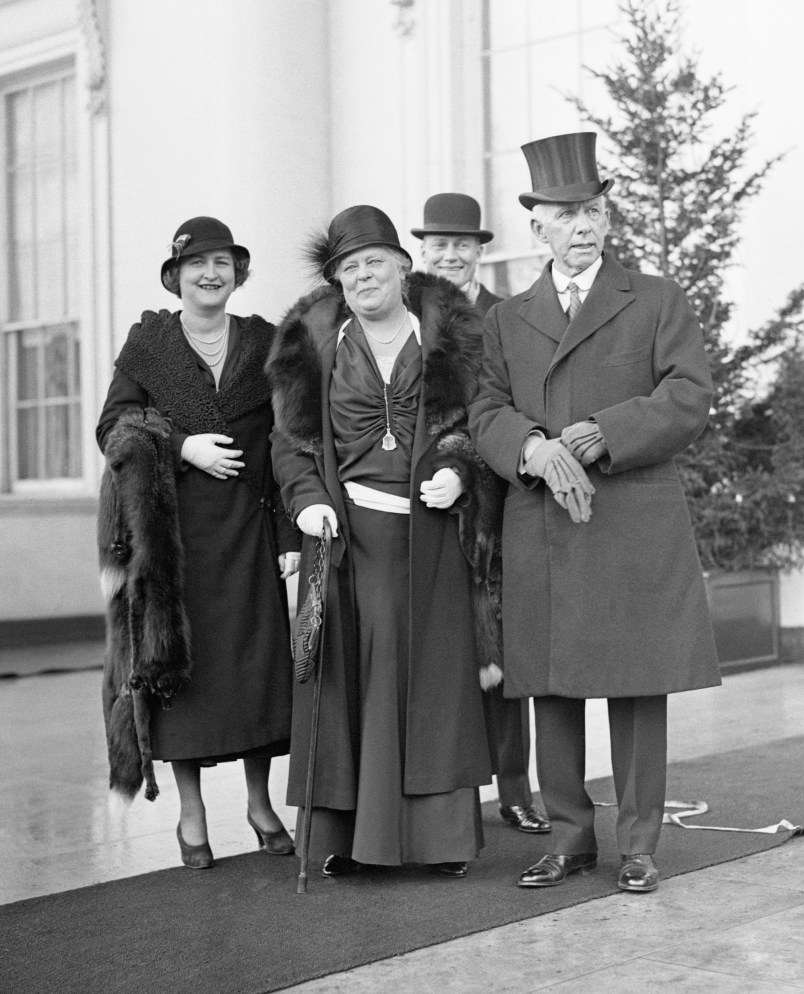
Justice Willis Van Devanter at the White House with family in 1932. (Getty Images)

Van Devanter had wanted to leave the Court for years, mostly so that he could take care of his medically compromised wife. The obstacle was financial. Van Devanter was something of a penny-pincher, once complaining that he had been overcharged five cents for a package of seeds. With some reason, he worried that his financial condition would deteriorate if he left the Court. As the statutes stood at the beginning of 1937, lower court judges could either retire from the bench and continue to receive their judicial salaries or they could resign and take their pensions. The rules for Supreme Court justices were different. They had to resign, not retire — they could take their pensions, but not their salaries. And that mattered because judicial salaries for retired lower court judges couldn’t be reduced, but judicial pensions for them and for Supreme Court justices could be — and they were, as part of the austerity programs Herbert Hoover and FDR pursued at the Great Depression’s outset. That was what worried Van Devanter, because the statutes didn’t give him the retirement option. He would have to resign and be at the mercy of congressional decisions about judicial pensions. 

Hatton Sumners, the chair of the House Judiciary Committee, had long thought that treating Supreme Court justices worse than lower court judges was silly. Some lawyers worried that “retirement” required that the judge be available to serve as needed — something now known as “senior status” — and that the Constitution didn’t allow that for Supreme Court justices. Sumners disagreed. In 1936 he introduced a bill to eliminate the difference. It failed. The next year, with Supreme Court reform on the table, he tried again. With some misgivings, and aware of the important role Sumners would play in shepherding the Court-packing plan through the House, FDR’s lawyers decided that Sumners’s bill wouldn’t undermine support for Court-packing.  The House passed the bill on February 10, the Senate on February 26, and FDR signed it on March 1, whereupon Van Devanter decided to leave the Court.

Why wasn’t the ability to appoint a justice enough to get FDR to abandon the politically costly Court-packing campaign? The answer: Senator Joe Robinson, to whom FDR has promised a court seat. Despite that promise, Robinson wasn’t a full-throated New Dealer and FDR’s lawyers worried that he might end up as unreliable as they feared Roberts would be. FDR took his time filling the vacancy Van Devanter created, with the excuse that Robinson was still needed to push the Court-packing plan through the Senate. A month after Robinson died, FDR nominated Senator Hugo Black to the Court, giving him a reasonably solid five-to-four majority. The next year conservative Justice George Sutherland, who like Van Devanter had wanted to leave the Court for several years, retired, and FDR nominated Solicitor General Stanley Reed to succeed him. 

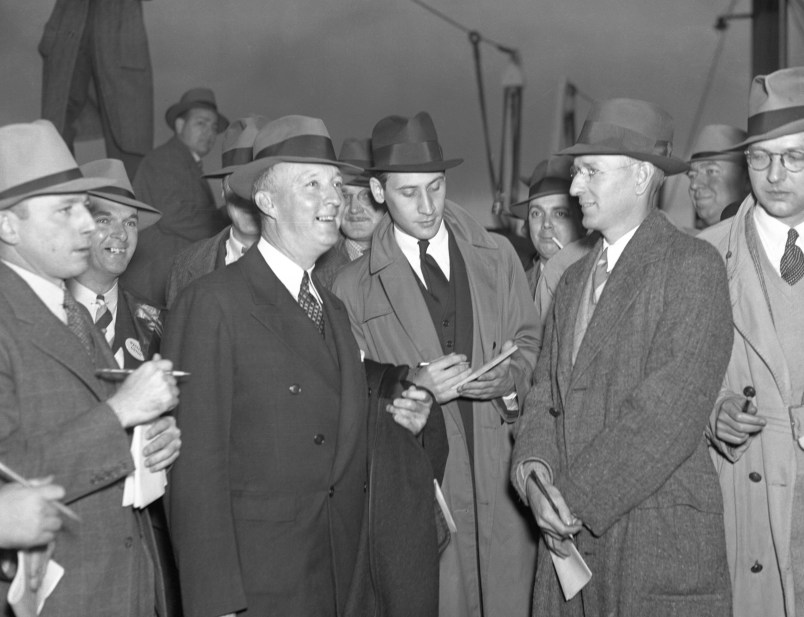
Journalists interview the new Supreme Court Justice Hugo Black as he arrives in Norfolk, VA. (Photo by Bettmann Archive/Getty Images)

By then the war really was over. The Supreme Court didn’t invalidate any major New Deal programs after 1937, although it did sometimes interpret major statutes — especially the National Labor Relations Act — in ways less friendly to labor than FDR’s labor allies would have liked. Democrats suffered severe losses in the 1938 midterm elections, mostly because the nation was in a severe economic recession induced by FDR’s too-rapid return to the orthodoxy of balanced budgets — but maybe the Court-packing episode made it easier for some voters to abandon the Democratic Party.

In the even longer sweep, the conservative war against legal liberalism continued. Liberals liked to describe a “New Deal settlement” that coupled judicial deference to legislatures on matters of economic policy with judicial activism on civil rights and civil liberties. Recent scholarship has made the case that conservatives never really accepted the so-called settlement, making some tactical concessions while biding their time — which came toward the end of the 20th century.

Did 1937 set a “precedent” for Court expansion?

Maybe yes, but a lot depends on how you describe the precedent. Focus on the politics of Court size and the answer is that the 1937 episode might have created what the British call a constitutional “convention” against changing the size of the Supreme Court simply to affect predicted outcomes — but that kind of convention can itself be changed when politicians think that it stands in the way of getting something important done. And focus on the politics of the federal courts more generally and the answer is that changing their powers to advance partisan goals is standard practice.

The Court’s size has been fixed at nine since 1869. Before that the Court grew to accommodate national growth — a “good government” reason for changing its size. Sometimes the timing of expansion was affected by partisan concerns. And in the decade of the Civil War, Congress expanded the Court, shrank it, and expanded it again mostly for partisan reasons but with some real “good government” explanation as well. 

FDR’s Court-packing plan was packaged in “good government” terms — too many of the Court’s justices were old and unable to keep up a work pace adequate to needs. That was a fig-leaf covering the partisan motivation and FDR and his allies quickly abandoned it. The fig-leaf that’s offered in today’s discussions is “thirteen circuits, thirteen justices,” but no one really thinks that there’s a strong good-government reason for having one justice for each circuit. The Court-packing plan’s failure might be understood as establishing a convention against changing the Court’s size unless there’s a real “good government” reason for doing so. 

Unwritten constitutional conventions like that are always up for grabs. One problem is distinguishing between practices that persist because no one cares enough to challenge them and practices that persist because people think they ought to follow them. The complicated politics that account for the failure of FDR’s Court-packing plan — Robinson’s death, Roberts’s change in vote, Sumners’s bill and Van Devanter’s retirement — weaken the case for saying that 1937 shows that there’s a convention against changing the Court’s size to affect predicted outcomes. Since then, the issue of the Court’s size didn’t matter enough for anyone to try to do something about it — until now. So maybe having a Court with nine members results from a practice rather than a convention.

Even more, conventions can be fragile — certainly they’re not as robust as provisions written into the constitutional text. A scholar writing in 1925 offered an example. From Washington’s presidency to the early 20th century American presidents stayed on American soil (broadly defined, it turns out). U.S. presidents stayed on the U.S. side of the Mexican border when they met their Mexican counterparts on the bridge connecting El Paso and Juarez. In 1914 Woodrow Wilson reluctantly declined an invitation to England to celebrate the anniversary of the treaty ending the war of 1812. Within five years he went to Versailles, and the convention disappeared. 

The picture is much more clear when we look at the politics of the federal courts generally. Congress has adjusted their powers for good government reasons, of course, but it also has routinely tinkered with the federal courts to change predicted outcomes. When Congress feared that the national courts would rule against workers seeking compensation for injuries, it shunted those cases to state courts. When Congress feared that state courts would treat Blacks badly, they allowed the cases to be shifted into the federal courts. The list goes on and on. Seen in that light, changing the Court’s size is just another example of treating the federal courts as one of the many tools politicians can use to achieve their goals.

Lessons from the past?

One of the first things graduate students in history are told is that they should be wary about drawing lessons from the foreign country that is the past. If lessons are to be drawn, though, they should be drawn on the basis of as full an understanding as possible of what really happened — an understanding informed by the story I’ve told, and of course by the even more complete story that can be found in the historical record.

  •  

BREAKING: JD Vance Makes Jaw-Dropping Defense of Putin

Ben Parker and Michael Weiss dissect Steve Witkoff’s praise of Vladimir Putin as a “humanitarian” and JD Vance’s defense of the Trump envoy, exposing the weakness and incompetence behind the administration’s Russia diplomacy. They examine how Trump’s desperation for a deal with Putin is leading to concessions on sanctions, undermining Ukraine, and rewarding Russian aggression.

Plus, Michael explains how Russia’s growing cooperation with Iran threatens U.S. interests and why Trump’s approach is putting America’s global standing at risk.

Join now

Read more

💾

  •  

The Beginning of the End

(Photo illustration by Sarah Rogers/The Bulwark | Photos: JVL, Shutterstock)

1. Ball Is Life

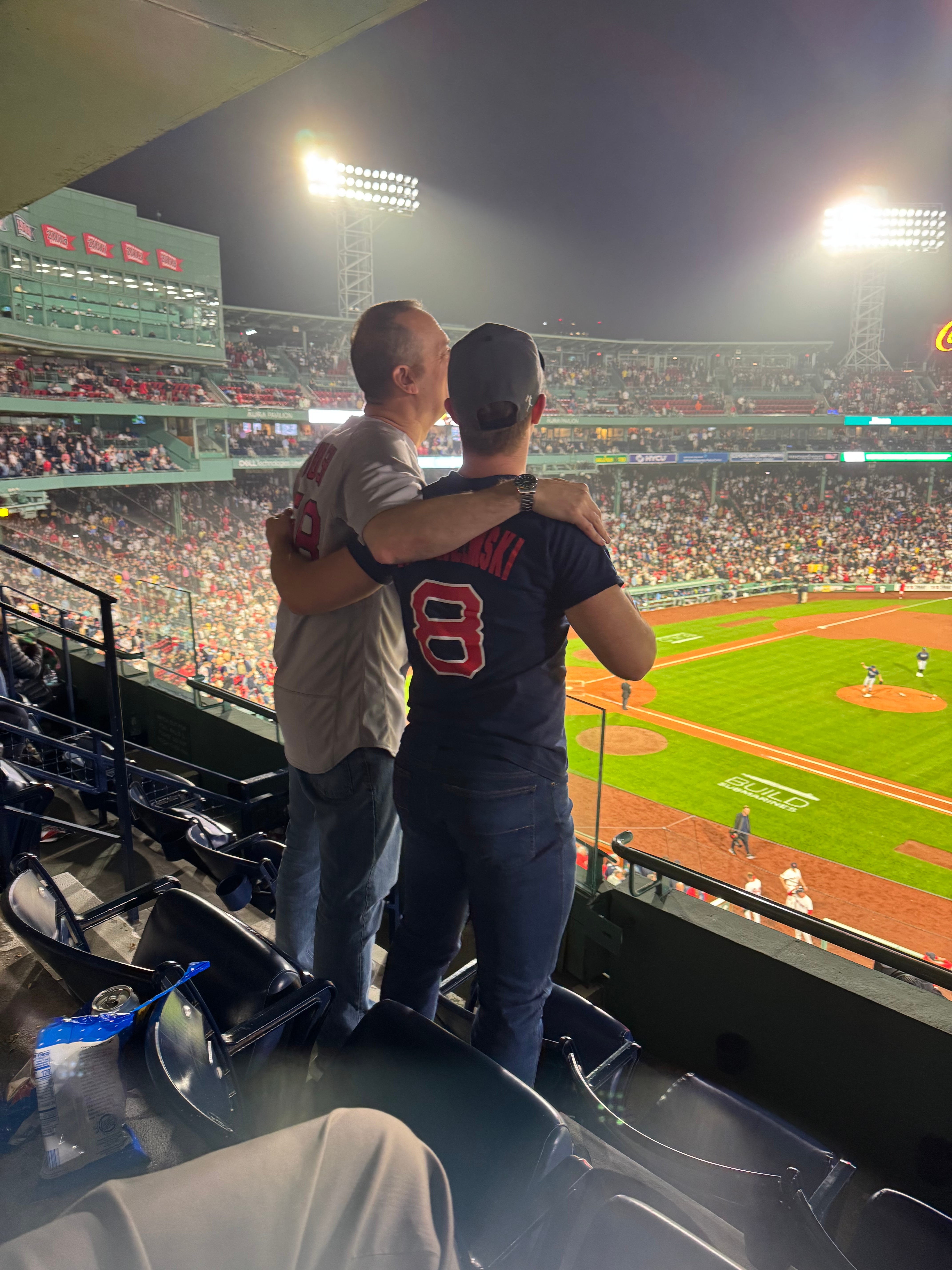
I took Flash to the ballpark for the first time when he was about 16 months old. We had a minor league team down the road from our house. One Saturday afternoon, he woke up from his nap and we caught two innings in the middle of a day game. We left as soon as he got bored.

For several years, that was his experience of baseball. We would show up in the middle of the game and stay for ten minutes, or an hour, and leave when he was ready.

We made it to the end of a game for the first time when he was 5 and the conclusion of the ninth inning confused him. “Baseball is over?” he asked. In that moment I realized that, from his perspective, baseball was like the sea. It was always there. He showed up at the ballpark and baseball was happening; he left the ballpark and baseball was happening. In his imagination, baseball never stopped. The players were always there, playing, and we just visited baseball. It never occurred to him that baseball was a finite thing with a beginning, a middle, and an end.

This realization made him a little sad.

The Bulwark is reader-supported—which makes all our independent journalism possible. To receive new posts and support our work, consider becoming a free or paid subscriber.


Two Saturdays ago, Flash pitched in college for the first time. It was just fall ball; a friendly. Nothing important. The coach gave him an inning of work. He did a nice job. My heart was happy and proud. But also confused. And a little sad.

Because I realized that unless he gets drafted after college, this was the last “first time” of his baseball journey. And the last first time of my baseball journey with him.

I remember all of the first times. That first game with his chubby cheeks. The first catch in our front yard. The first time I took him to a field where he could run the bases.

As he got older, we were at the minor league park all the time. I remember the first time he caught a foul ball and the first time he worked up the nerve to talk to one of the players. Over the years he became friendly with a bunch of them. Baseball was the only thing he wanted to do. And because he saw these guys up close, and knew them, he assumed that it was normal. That becoming a ballplayer was something anyone could just decide to do; like going to law school.

Flash hanging with the boys.

I kept him out of the maw of organized baseball for as long as possible. I didn’t want to get sucked into the Kids’ Sports Industrial Complex. When he was 10, I finally relented and let him join Little League.

His first pitch of his first-ever game.

The firsts kept piling up. First travel-team game. First home run. First complete game. First immaculate inning. First middle school game. First no hitter. First high school varsity game. First showcase.

First varsity start as a freshman.

For seventeen years, baseball was a thing Flash and I did together. It was always there. Like the sea.

As I watched him throw his first college pitch I realized that this constant in our lives isn’t actually constant. It has a beginning, a middle, and an end. Some day baseball with Flash will be over.

And my soul was sorrowful unto death.


2. Tides Are Real

I know that’s too narrow a view. In the most important ways, baseball really is like the sea. It really is always there. What changes is our relationship to it.

Because there have also been a bunch of other baseball firsts for me and Flash. Our first major league game. Our first World Series game. Our first post-COVID game. Our first trip to Cooperstown. Our first night at Fenway.

Someday, God willing, there will be new kinds of firsts. For the two of us, then for him with his own kids, me with my grandkids. And then for him and his grandkids. I’ll pass away, but that stuff about the rhythm of baseball binding together the generations? It’s true. All of it.

Here’s a funny thing: I’ve never played a single game of baseball. Not once. Never even threw, or caught, a baseball until I was in college. I have no personal connection to the game. For me, it’s inextricably linked with Flash. For me, the joy of baseball has been walking with my little boy as he grew.

Someday his part in playing the game of baseball will end. But I’ll still get to walk with him.

Once I realized that, I understood that sadness has no place here. Only gratitude.

Thanks for letting me share this with you. It means a lot to me.

Leave a comment


3. Real Sadness

This piece is a reminder that there is a season for true grief. And that the only way through is together:

On the last Sunday afternoon of September, Rhenda Strub was bundled up against the autumn chill for one final day at the ballpark, eating Cracker Jack and sweet and spicy pickles. . . .

After she lost her 27-year-old son, Wyatt, to muscular dystrophy three years ago, she retreated to his room and spent countless hours alone quilting and watching baseball games on television. The constancy of baseball helped to structure her days, but the loneliness only added to her grief.

So at the beginning of this season, Ms. Strub bought two season tickets to the Mariners in Section 120, on the first base side, thinking she would regularly go with her loved ones to T-Mobile Park. But her husband doesn’t like crowds, and the rest of her family has busy lives.

So she wrote a post on Facebook — with some trepidation, she said, because the “internet can be a cruel place” — asking strangers if they wanted to attend games with her. . . .

By the end of this baseball season, Ms. Strub had attended games with about 30 strangers and found that the people she connected with needed her as much as she needed them. She built an online community, bringing together the people she had met in a private Facebook group, calling the project “Strangers to Friends.”

If she couldn’t attend a game — she had to miss a few when her husband, Mike, had brain surgery — she handed off her tickets to strangers who had reached out to her but didn’t know each other.

She said she was “gobsmacked” by the reaction to her post.

“I have made so many friends this summer,” she said. “I have friends that will be my friends for the rest of my life.”

I needed to read this piece, this week. I hope you’ll read it, too. It made me think of you guys in our Bulwark world and how we help each other.

The Bulwark is reader-supported—which makes all our independent journalism possible. To receive new posts and support our work, consider becoming a free or paid subscriber.

  •  

The case for going to concerts alone — and why it isn’t sad

Early on a Tuesday evening, I arrived at a local dive bar for a show by Dream Syndicate. There’s no opening act (or rather, as Steve Wynn will later joke, the Dream Syndicate are opening for the Dream Syndicate) and a blissfully early 7 p.m. start time. I greeted the door woman, bought a bottle of water, grabbed a bar stool against the far wall, and opened the book in progress on my phone until the show started.

At the end of September, I walked into the Majestic Theatre to see the Michael Shannon/Jason Narducy R.E.M. tribute. It’s a GA venue that holds a little over 1,000. When the doors opened, I headed for the barrier for no other reason than the volume at that proximity helps drown out what jamband fans refer to as “chompers” — people who view concerts as suitable background for their conversations. Delightfully, I found myself standing with four other women. We killed time before the show talking about what other concerts we’d been to recently, and took turns watching each other’s spot when someone needed a bathroom run. (There was no line at the women’s room for that show, a big reason I wanted to be close so I didn’t run the risk of standing near a dude needing to explain R.E.M. to me, like the guy at the bar where I was eating dinner before the show.)

A few weeks earlier, I pulled up at Trinosophes, a coffee shop / artistic consortium that regularly hosts more experimental / less mainstream musicians — Marisa Anderson played a gorgeous show there earlier this year — to see BASIC, an amazing trio that’s a mix of minimalist jazz and experimental rock. I paid the dude at the counter, who was in the middle of pulling a shot of espresso, and then decided to kill some time at People’s Records, the record store attached to the space, along with other show attendees and a couple of musicians in the opening act. I sat in exactly the corner of the room that sounds the best for my damaged hearing and thoroughly enjoyed the sets. 

We absolutely need to abolish the concept that going to a concert alone is any kind of abnormal or undesirable behavior.

What all of these concert activities have in common is that I attended them by myself. And this should absolutely not be news of any kind, but recently a leading music magazine posted a news story that announced: “Going to concerts alone is a top-tier human experience.” The story wasn’t actually about that, but was rather a mashup of reporting on how Phoebe Bridgers’ recent phone-free concerts meant that when an attendee spotted a celebrity at the show, they couldn’t report to a gossip publication that this person was supposedly standing alone in the line for the bar (while there are actually many reasons you could be at the bar by yourself despite arriving with an entourage of a dozen people). 

But the writer’s reasoning for why it was okay to be going to a show without a date or a friend(s) actually didn’t make a believable case for it. They offered an awkward and overly exaggerated blather about how solo concertgoing means that you can better participate in “the oneness of things,” which made you wonder if the person writing it had actually been to a concert, much less attended one on their own. And I didn’t realize we had to justify or defend this, or that it was anything out of the ordinary.


Want more from culture than just the latest trend? The Swell highlights art made to last.
Sign up here


What they got wrong is that the “top tier human experience” is simply going to concerts, full stop. (As Neil Young once said, “Live music is better/bumperstickers should be issued.”) The idea that going to see one of the most important concert tours of the year by oneself is “sad” is so idiotic that it should never have been entertained as any kind of news story. And we absolutely need to abolish the concept that going to a concert alone is any kind of abnormal or undesirable behavior.

I’m biased. I’ve been going to concerts alone since I was 14 years old. This wasn’t necessarily by choice, but rather that I wanted to do something important and no one else I knew wanted to do it, and I wasn’t going to let that minor detail stop me. And as I have moved through my life, sometimes I had a friend or companion to go to shows with me, and sometimes — as it happens to normal people in the course of normal life — I did not. If I only attended a concert when I had someone to go with, I would have missed out on far too much. This is a stupid requirement, clearly determined by people for whom live music is just another thing you can do on a given evening, and these are not people anyone who genuinely loves music should be taking direction from.  

The first time I went to a concert by myself (which was my second concert), I was dropped off at the venue by my mom (who later would explain that she allowed it because she thought it would “get it out of my system.”) It was not difficult to follow the letters and numbers on my ticket to find my seating location, and when I sat down, the women on one side of me immediately and excitedly introduced themselves, while the two dudes on the other side of me managed to tell me within the first two minutes that they’d be glad to buy me a beer “if you don’t have your ID on you,” wink wink. Everyone was excited to see Bruce Springsteen, even if we were roughly a million miles away from the stage in the upper reaches of the New Haven Coliseum. 

Everyone except me had concert stories to tell. Everyone talked about what other concerts they were going to, what radio stations (and which DJ’s specifically) you could count on to be Springsteen-friendly or provide the best info, and everyone swapped information about what other bands were going on tour based on what they had read or heard. I was dropped off when the doors opened, and I thought it would be a long and painful wait until the concert started, but instead I had a dozen new best friends within 15 minutes. 

When the concert was over, the girls sitting next to me gave me their phone numbers and told me to call if I was ever going to a show in Hartford. This was an experience that would repeat itself in different formats forever all across the United States, Canada, and multiple European countries, and still happens now if you want that to be your experience. You can also decide you are going to rock up when you feel like it and occupy your time reading a book and not talk to anybody. Or you can limit your socialization to the time-honored tradition of watching someone’s space while they run to the bathroom. This is all incredibly normal, accepted behaviour which anyone who attends a concert regularly already understands.

If I only attended a concert when I had someone to go with, I would have missed out on far too much. This is a stupid requirement, clearly determined by people for whom live music is just another thing you can do on a given evening, and these are not people anyone who genuinely loves music should be taking direction from.  

Let’s be honest: while as a teenager I dreamed of the day when I could attend every concert my heart desired with every friend who also loved the band in question, the reality always shook out differently. As an adult, it remains challenging to coordinate schedules and availability, not to mention alignment with other critical details like preferred arrival times and seating/standing location. Sometimes it is far, far easier and more convenient if each person manages their own tickets and concert experience. If you want to hang with your pals, then coordinate a post-show meet-up at the bar or the diner or on the way to the subway. There is absolutely nothing about concert attendance that requires accompaniment!

Admittedly, times have changed, and yes, everyone has a small computer in their pocket and myriad ways to occupy their time before the show starts. And these days, a concert isn’t one of the only ways you’re going to meet people who share similar interests as you. But I hear from younger friends who are going to shows by the likes of Harry Styles or Taylor Swift, and I witnessed myself very recently at a Bikini Kill show locally (where I was one of the older people in the front GA section), the kids are still doing the same thing that I did in 1978: they talk to each other, they swap social handles, they exchange important information. It is all still happening if you are open to the experience, and it should reassure anyone who is hesitant about buying a ticket to a concert if they don’t know anyone else who wants to come with them.


The only way going solo can have a negative impact on you is during the ticket-buying process for reserved seating events. That’s because these days, Ticketmaster will not let you buy one of a pair or will tell you you have to select an adjoining seat (even if there is no adjoining seat at that moment, a thing that has happened to me and countless of my pals). Buying a single ticket used to be the way to game yourself to the best possible seat, as there would always be a leftover hanging around; even if I was going to a show with friends, we still might try for individual tickets as a way to better optimize our chances for a better seat. Thank you, Ticketmaster, for continuing to find ways to make this process painful!

(Caryn Rose) Going solo

The only real downside to solo concert attendance is if you are a single woman and a man in your vicinity has decided it is his solemn responsibility to interrogate anyone who doesn’t look like him to determine their worthiness, e.g., the kind of guys who would talk to whatever man I brought with me to a show and, despite them telling him, “She’s the fan, I just came with because I was interested in checking them out,” there is no way we could possibly be worthy of the space we were occupying. (But that is a completely different essay.)

I’d argue that it is actually an expression of supreme self-love and self-awareness that you’re comfortable enough with yourself to be absolutely content going to a concert as a party of one. Honestly, no one should be waiting for another person to do anything they want to do (except, I dunno, tandem bike riding). But what we absolutely should stop doing is paying attention to other people living their lives the way they want to live them, and that includes making a decision to go to a concert without an entourage. Buy the ticket. Go to the show. I’ll see you there.

The post The case for going to concerts alone — and why it isn’t sad appeared first on Salon.com.

  •  

This Democrat’s accountability plan has Trump fuming

Sen. Elissa Slotkin, a white woman wearing a red jacket and a white shirt, speaks into two microphones on stands.
Sen. Elissa Slotkin (D-MI) at a news conference in the US Capitol on June 18, 2026. | Tom Williams/CQ-Roll Call, Inc via Getty Images

The 2026 midterms are less than two weeks away, which means we’ll soon have a better idea of what the next two years of American politics could look like. If Democrats win at least one chamber of Congress — and they’re comfortable favorites to control the House — they’ll enter 2027 with oversight power for the first time in Donald Trump’s second term. If they win the Senate, too, they’ll have even more power. 

Whatever the outcome, Michigan Sen. Elissa Slotkin wants her party to hit the ground running. In an interview with Vox’s Astead Herndon at the University of Chicago’s Institute of Politics, she explained that the key divide in the Democratic Party is no longer “moderate versus progressive.” 

“Particularly in the era of Trump, I think it is fight versus flight,” she said. “Regardless of your persuasion, do you believe that we need to think differently about how we exercise power and oversight in the era of Trump and if we don’t, we’re at risk of losing our country as we know it?” 

Slotkin, who says she’s on “Team Fight,” discusses what that Day 1 Democratic agenda should look like, how she plans to hold the Trump administration accountable, whether she’s considering a presidential bid, and more.

Below is an excerpt of the conversation, edited for length and clarity. There’s much more in the full show, so listen to America, Actually wherever you get your podcasts or watch it on Vox’s YouTube channel.

How does Congress reassert its role so that people believe in the kind of checks and balances that Trump has washed away?

When I think about, hopefully, Democrats doing well in a few short weeks here, the election is the end of one phase, but a much more important phase then comes into focus, and that’s what you do with the power that you’ve won.

If we manage to win the House and especially the House and the Senate, there’s three things that we need to do. One, we need to pick two or three big pieces of legislation that speak directly to people’s pocketbooks and go hard on those — I would say housing and healthcare. 

Number two, we do have to have accountability for the unbelievable corruption that we are living under right now. But you can’t just make that your whole personality. You have to pick signature cases, and you have to go after people and projects that are super egregious. 

Everyone knows the East Wing of the White House, and people feel that in a way that’s different from a nameless contract at the Pentagon or whatever. So you need to pick those signature cases and go hard on accountability, not just Trump. Because of course, there will be moments of, “Let’s go after Trump himself.” As someone who voted to impeach him twice, he’s still there, right?

But the people around Donald Trump who are doing his bidding and enabling this have no such immunity. They have no immunity the way the president does. And to me, he couldn’t do any of this stuff without all of those people saluting and supporting it. So you go after the people who do his bidding. 

Third, we have to Trump-proof the government going forward so that no president of any party can ever abuse the system the way he did, because we figured out under Trump that a lot of the stuff that we thought were laws were actually just norms, standards, habits, expectations, good citizens.

And shame was required.

Shame was required. And when you have a president who has no shame, they just walk all over that. And then even for things that were laws, the penalties, the teeth are not there. So you make an ad that plays during a football game, a political ad paid for by US taxpayer dollars, your dollars. The penalty is like, you have to pay a fine.

Well, if they have the money and they have all the keys to the government, they’re going to pay that fine and not worry about it. So how do we get teeth in the things that were laws and strengthen those other laws going forward?

You mentioned Trump-proofing the government. At this point, he has stacked the courts with a lot of favorable folks. He controls the Republican Party, has installed people who do his bidding on each of those levels.

Is that possible? It does seem a little hard to figure out how the government becomes Trump-proof when it’s beyond an individual at this point.

One of the things I think is changing about politics is that there is a groundswell of energy around certain issues that is not partisan. The groundswell going on in the Midwest about data centers or Flock cameras or AI in general is not like, “I’m a Democrat, I’m a Republican.” It is organized and grassroots. 

Data centers went zero to 60 faster than any issue I’ve seen out there. And I think harnessing that outrage — and that outrage also, I think, is growing on the corruption side — so how do you harness that for an ethics package? 

And look, I don’t agree with Sen. Josh Hawley of Missouri on almost anything, but he has a bill to get rid of corporate PACs and money in politics. Working with strange bedfellows, I think there is still a lot we can do because of that upward pressure.

The other piece I was going to ask about — you mentioned the impeachment efforts, and I feel like one of the things that came from those was a lack of belief from the public about the effectiveness of those efforts.

Let’s say Democrats were to take back the House and possibly the Senate. Should impeachment be a focus of a potentially incoming Democratic House?

I will say, because I still see him on the floor, that if Sen. Mitch McConnell had done the right thing, then Donald Trump would have been impeached after January 6, but he did not. And his legacy, along with his health issues, will be how he is remembered.

I am into effectiveness, and if we have the House but not the Senate, I don’t have a ton of faith that my Republican colleagues are going to have any more strength. I want to look at these signature cases and not just focus on the president, but on the people who enabled him. 

I want young people coming out of school to say, “Should I go work for the Trump administration? That sounds fun. I might get an opportunity.” I want them to be like, “Lord, that might be buying myself a ton of problems that I don’t want, and so let me avoid participating in that.” I want that deterrence message sent.

I have to ask about [2028]. A number of Democrats have said already that they’re thinking about running for president. Is that something you’re thinking about?

I have been open that I’m looking at it. It does not need to be me. I just need someone who understands the mission. And if that person comes out of the big process, I will be the first gal to get on whatever team they’re on and help them win in the parts of the country that I know well.

But I think what is clear to me is that the American public is looking for something different — that generational shift. And I think that there’s hopefully going to be lots of opportunities for lots of people who you might not be thinking of who haven’t been sitting waiting their turn who are going to get in the mix. And I think that’s a good thing.

I wanted to ask about something on the 2028 front. One thing that we have heard consistently over the last year, and I think this is a consequence of Democratic trauma from 2024 and also 2016 — people’s fears about sexism when women run. I’ve heard so many people, including women voters, tell me they think it needs to be a white guy.

I find it to be a kind of depressing takeaway of those elections. It’s wrong, and I know it’s wrong because this very question is what we’ve been digging into as I’ve traveled around the country. What I think is happening is right now, is the public is so in search of something different from the traditional. If you’re a good communicator, if you’re exciting, if you’ve got big ideas, you can surmount what are thought of as traditional deficiencies or traditional weaknesses.

So if you’re a woman, if you’re African American, if you’re Muslim American, if you’re whatever, those things forever have been thought of as negatives. But if you’re the right person with the right energy, you can surmount that. I think we’re seeing that around the country already.

  •  

Alles über den C 64


Da erfahrungsgemäß aller Anfang schwer ist und dies auch, vielleicht sogar besonders, für den Bereich »Computer« gilt, haben wir für Sie Bücher zusammengestellt, die sich an den Einsteiger wenden, ihm eine Hilfe darstellen, um sich mit der Materie vertraut zu machen und auch später noch als Nachschlagewerk dienen....
  •  
❌