❌

Reading view

The case for going to concerts alone — and why it isn’t sad

Early on a Tuesday evening, I arrived at a local dive bar for a show by Dream Syndicate. There’s no opening act (or rather, as Steve Wynn will later joke, the Dream Syndicate are opening for the Dream Syndicate) and a blissfully early 7 p.m. start time. I greeted the door woman, bought a bottle of water, grabbed a bar stool against the far wall, and opened the book in progress on my phone until the show started.

At the end of September, I walked into the Majestic Theatre to see the Michael Shannon/Jason Narducy R.E.M. tribute. It’s a GA venue that holds a little over 1,000. When the doors opened, I headed for the barrier for no other reason than the volume at that proximity helps drown out what jamband fans refer to as “chompers” — people who view concerts as suitable background for their conversations. Delightfully, I found myself standing with four other women. We killed time before the show talking about what other concerts we’d been to recently, and took turns watching each other’s spot when someone needed a bathroom run. (There was no line at the women’s room for that show, a big reason I wanted to be close so I didn’t run the risk of standing near a dude needing to explain R.E.M. to me, like the guy at the bar where I was eating dinner before the show.)

A few weeks earlier, I pulled up at Trinosophes, a coffee shop / artistic consortium that regularly hosts more experimental / less mainstream musicians — Marisa Anderson played a gorgeous show there earlier this year — to see BASIC, an amazing trio that’s a mix of minimalist jazz and experimental rock. I paid the dude at the counter, who was in the middle of pulling a shot of espresso, and then decided to kill some time at People’s Records, the record store attached to the space, along with other show attendees and a couple of musicians in the opening act. I sat in exactly the corner of the room that sounds the best for my damaged hearing and thoroughly enjoyed the sets. 

We absolutely need to abolish the concept that going to a concert alone is any kind of abnormal or undesirable behavior.

What all of these concert activities have in common is that I attended them by myself. And this should absolutely not be news of any kind, but recently a leading music magazine posted a news story that announced: “Going to concerts alone is a top-tier human experience.” The story wasn’t actually about that, but was rather a mashup of reporting on how Phoebe Bridgers’ recent phone-free concerts meant that when an attendee spotted a celebrity at the show, they couldn’t report to a gossip publication that this person was supposedly standing alone in the line for the bar (while there are actually many reasons you could be at the bar by yourself despite arriving with an entourage of a dozen people). 

But the writer’s reasoning for why it was okay to be going to a show without a date or a friend(s) actually didn’t make a believable case for it. They offered an awkward and overly exaggerated blather about how solo concertgoing means that you can better participate in “the oneness of things,” which made you wonder if the person writing it had actually been to a concert, much less attended one on their own. And I didn’t realize we had to justify or defend this, or that it was anything out of the ordinary.


Want more from culture than just the latest trend? The Swell highlights art made to last.
Sign up here


What they got wrong is that the “top tier human experience” is simply going to concerts, full stop. (As Neil Young once said, “Live music is better/bumperstickers should be issued.”) The idea that going to see one of the most important concert tours of the year by oneself is “sad” is so idiotic that it should never have been entertained as any kind of news story. And we absolutely need to abolish the concept that going to a concert alone is any kind of abnormal or undesirable behavior.

I’m biased. I’ve been going to concerts alone since I was 14 years old. This wasn’t necessarily by choice, but rather that I wanted to do something important and no one else I knew wanted to do it, and I wasn’t going to let that minor detail stop me. And as I have moved through my life, sometimes I had a friend or companion to go to shows with me, and sometimes — as it happens to normal people in the course of normal life — I did not. If I only attended a concert when I had someone to go with, I would have missed out on far too much. This is a stupid requirement, clearly determined by people for whom live music is just another thing you can do on a given evening, and these are not people anyone who genuinely loves music should be taking direction from.  

The first time I went to a concert by myself (which was my second concert), I was dropped off at the venue by my mom (who later would explain that she allowed it because she thought it would “get it out of my system.”) It was not difficult to follow the letters and numbers on my ticket to find my seating location, and when I sat down, the women on one side of me immediately and excitedly introduced themselves, while the two dudes on the other side of me managed to tell me within the first two minutes that they’d be glad to buy me a beer “if you don’t have your ID on you,” wink wink. Everyone was excited to see Bruce Springsteen, even if we were roughly a million miles away from the stage in the upper reaches of the New Haven Coliseum. 

Everyone except me had concert stories to tell. Everyone talked about what other concerts they were going to, what radio stations (and which DJ’s specifically) you could count on to be Springsteen-friendly or provide the best info, and everyone swapped information about what other bands were going on tour based on what they had read or heard. I was dropped off when the doors opened, and I thought it would be a long and painful wait until the concert started, but instead I had a dozen new best friends within 15 minutes. 

When the concert was over, the girls sitting next to me gave me their phone numbers and told me to call if I was ever going to a show in Hartford. This was an experience that would repeat itself in different formats forever all across the United States, Canada, and multiple European countries, and still happens now if you want that to be your experience. You can also decide you are going to rock up when you feel like it and occupy your time reading a book and not talk to anybody. Or you can limit your socialization to the time-honored tradition of watching someone’s space while they run to the bathroom. This is all incredibly normal, accepted behaviour which anyone who attends a concert regularly already understands.

If I only attended a concert when I had someone to go with, I would have missed out on far too much. This is a stupid requirement, clearly determined by people for whom live music is just another thing you can do on a given evening, and these are not people anyone who genuinely loves music should be taking direction from.  

Let’s be honest: while as a teenager I dreamed of the day when I could attend every concert my heart desired with every friend who also loved the band in question, the reality always shook out differently. As an adult, it remains challenging to coordinate schedules and availability, not to mention alignment with other critical details like preferred arrival times and seating/standing location. Sometimes it is far, far easier and more convenient if each person manages their own tickets and concert experience. If you want to hang with your pals, then coordinate a post-show meet-up at the bar or the diner or on the way to the subway. There is absolutely nothing about concert attendance that requires accompaniment!

Admittedly, times have changed, and yes, everyone has a small computer in their pocket and myriad ways to occupy their time before the show starts. And these days, a concert isn’t one of the only ways you’re going to meet people who share similar interests as you. But I hear from younger friends who are going to shows by the likes of Harry Styles or Taylor Swift, and I witnessed myself very recently at a Bikini Kill show locally (where I was one of the older people in the front GA section), the kids are still doing the same thing that I did in 1978: they talk to each other, they swap social handles, they exchange important information. It is all still happening if you are open to the experience, and it should reassure anyone who is hesitant about buying a ticket to a concert if they don’t know anyone else who wants to come with them.


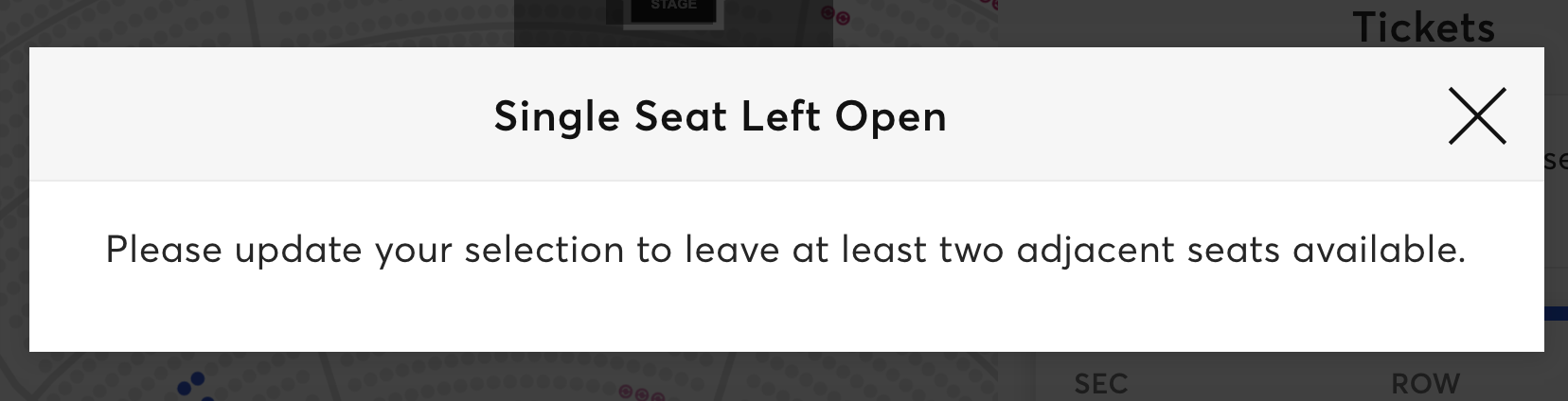
The only way going solo can have a negative impact on you is during the ticket-buying process for reserved seating events. That’s because these days, Ticketmaster will not let you buy one of a pair or will tell you you have to select an adjoining seat (even if there is no adjoining seat at that moment, a thing that has happened to me and countless of my pals). Buying a single ticket used to be the way to game yourself to the best possible seat, as there would always be a leftover hanging around; even if I was going to a show with friends, we still might try for individual tickets as a way to better optimize our chances for a better seat. Thank you, Ticketmaster, for continuing to find ways to make this process painful!
(Caryn Rose) Going solo

The only real downside to solo concert attendance is if you are a single woman and a man in your vicinity has decided it is his solemn responsibility to interrogate anyone who doesn’t look like him to determine their worthiness, e.g., the kind of guys who would talk to whatever man I brought with me to a show and, despite them telling him, “She’s the fan, I just came with because I was interested in checking them out,” there is no way we could possibly be worthy of the space we were occupying. (But that is a completely different essay.)

I’d argue that it is actually an expression of supreme self-love and self-awareness that you’re comfortable enough with yourself to be absolutely content going to a concert as a party of one. Honestly, no one should be waiting for another person to do anything they want to do (except, I dunno, tandem bike riding). But what we absolutely should stop doing is paying attention to other people living their lives the way they want to live them, and that includes making a decision to go to a concert without an entourage. Buy the ticket. Go to the show. I’ll see you there.

The post The case for going to concerts alone — and why it isn’t sad appeared first on Salon.com.
  •  

Eminem’s Kid Rock collab shows the risk of cozying up to MAGA

He might look like something found in the dumpster at a Lynyrd Skynyrd concert. He might shamelessly plunder the sonics of decades of deep-fried and gravy-smothered hits. But despite everything about his presentation and performance, Kid Rock is not actually southern. 

If he were, he might have done the friendly thing and warned Eminem off of collaborating on “Heal My Faith,” a song on his recent Christian album “Halfway 2 Jesus.” He might have stopped his longtime friend and fellow Michigander from irreparable reputational damage. Instead, he let Slim Shady learn a hard lesson that true southerners know: You lay down with dogs, you wake up with fleas. 

“Heal My Faith” is genial to the point of being unmemorable, a bit of cringy Christian pablum that encourages loving someone even when you’re outside of the pit. It’s student-athlete core, a mish-mash of choirs, electric guitar noises over pounding drums that all sound like keyboard presets. Kid Rock’s contributions are entirely lifted from inspirational T-shirts, table scraps from rejected Jelly Roll songs. The result is that “Heal My Faith” offers very little to chew on — until Eminem shows up.

The boilerplate praise chug of the song has one upside: It forces the “Rap God” to slow down. Left to his own devices, middle-aged Eminem has been the hip-hop equivalent to masturbatory guitarists, his late-stage work full of technically impressive displays of chops that nonetheless lack the fun and melody of his radio hits. Hearing him enter the song with a flow that’s not indebted to a J.J. Fad outro offered a glimmer of hope. But it was short-lived.

On “Heal My Faith,” the rapper who first gained mainstream attention by lighting the pop chart’s sacred cows afire wonders why we can’t all just get along. It’s shocking stuff from the rapper who famously mused about dropping an “awfully hot coffee pot” on Donald Trump in a freestyle at the BET Hip Hop Awards in 2017. Now, Slim Shady seems to be saying, “We might believe in fundamentally opposed directions for this country. We might differ on the idea of extending dignity to all people, but can’t we put that aside for the sake of a new single you can buy?” 

You don’t need to hear it. You’ve already heard it. It’s the realm of purple state campaign ads and Earthbound Trading Co. bumper stickers. It’s junk, and Eminem seems to know it.

How else can you explain a verse that is 90% throat-clearing and preemptive dodges of the backlash he knows is coming? Eminem spends bar after bar defending his decision to even appear on the song, touting his decades-long friendship with Kid Rock and their intertwined history in the music industry.

He talks about their shared roots in Detroit’s music scene, and how their paths crossed again and again. He details an early CD release party at length, where the more established Kid Rock showed up to lend support to the emerging rapper. It isn’t until the closing lines of his verse that Eminem turns to God and the brotherhood of man.

“Liberal and evangelical can agree,” he raps. “It’s God first, home of the free.”

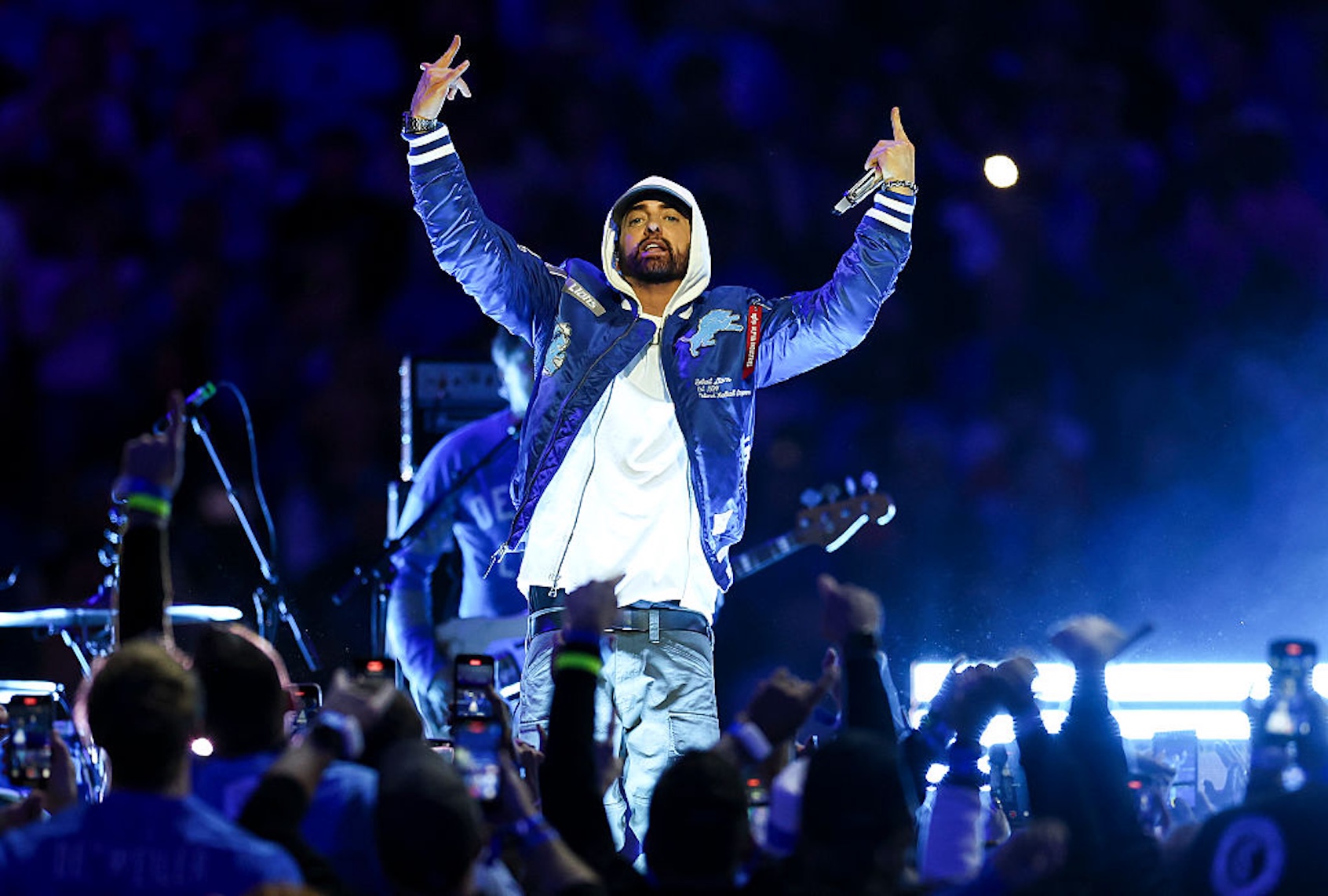
Reputation-wise, the collaboration does far more for Kid Rock than it does for Eminem. The former has long been fully consumed by Trump World, becoming more of a standby entertainer for MAGA events than a rock star. Eminem, on the other hand, once told fans who supported Trump to stop streaming his music. 

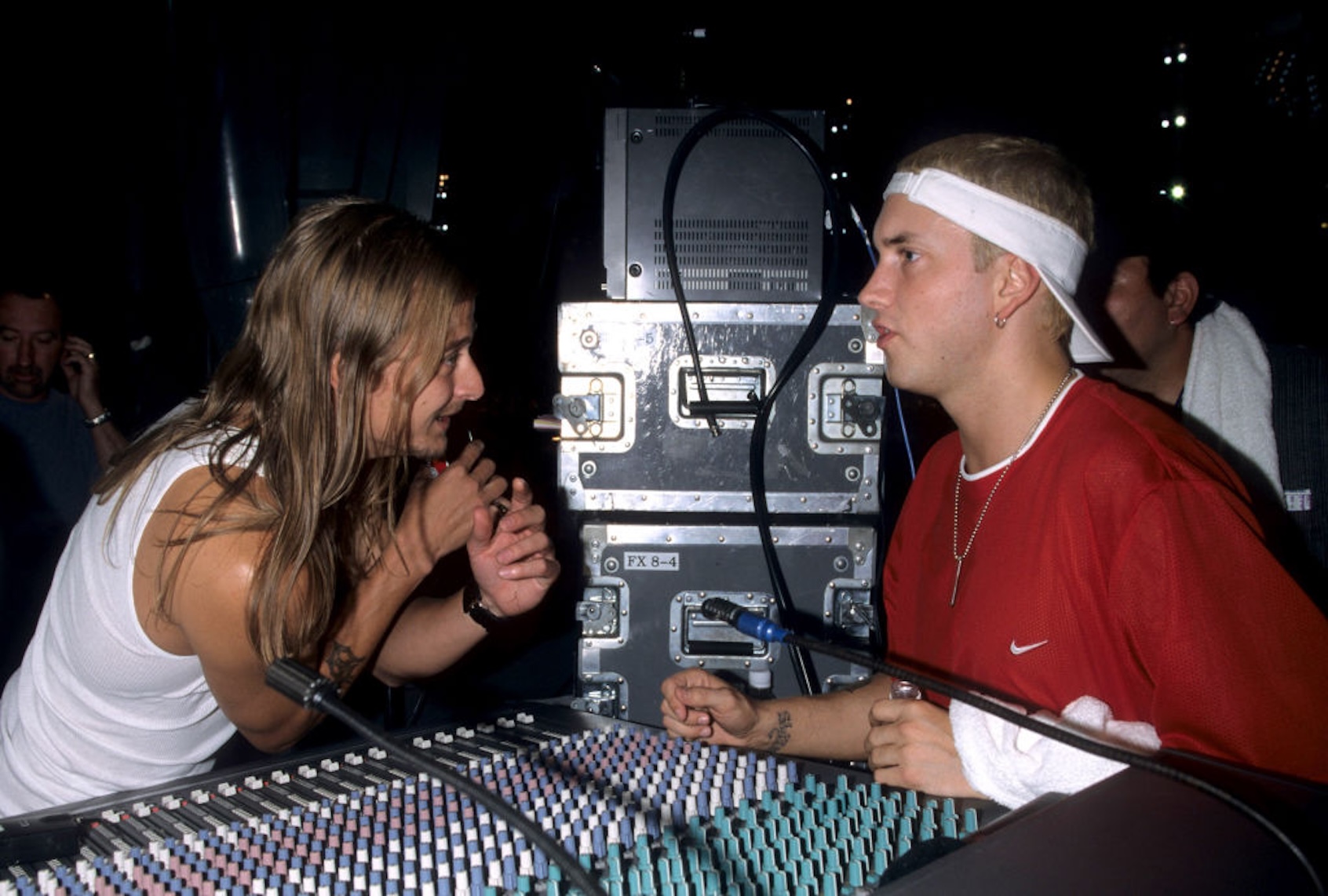
A photo of two men talking backstage

(Ke.Mazur/WireImage) Kid Rock and Eminem during Experience Music Project Opening Gala at Experience Music Project in Seattle, Washington.

Rock told Billboard that he hadn’t planned to “drag [Eminem] into my political world,” but he had to have known  that was impossible. The nod from a supposed Trump critic removes a small bit of the stain on Kid Rock, but it also transfers directly to his collaborator.

Eminem might have been hoping to build a bridge with this collaboration, but at least according to his Instagram comments, his fans aren’t ready to get over it. One commenter assured him that it’s okay to cut off a friendship “over moral differences.” Another said Eminem’s line in the sand against Trump must have been “brushed back into the beach.” The rapper’s newfound neutrality, one wrote, still amounted to “choosing a side.”


Want more sharp takes on politics? Sign up for our free newsletter, Standing Room Only, written by Amanda Marcotte, now also a weekly show on YouTube or wherever you get your podcasts.


You can’t feel too bad for Eminem, who’s had plenty of opportunities to see that who you rap with is who you are. After all, more than a year after her breakout single “What I Want,” which she recorded with the controversial country music star Morgan Wallen, the pop singer Tate McRae is still being confronted by fans and interviewers with questions about the pair’s collaboration. 

Wallen, who’s been given about as many second chances as gold records, has never explicitly identified himself as a supporter of the MAGA movement. But his history of using slurs on camera, the general nastiness of his dejected young man music and a massive social media tiff with “Saturday Night Live” have solidified him as an anti-woke warrior in the popular conception. 

“It’s crazy to think that one song could define a whole person,” McRae told W Magazine earlier this month.“There are many aspects of my personality that three-quarters of my audience has no idea about. You hope one day you figure out a way to show all aspects of it.”

There’s little chance that Eminem will face such questions in the future, if only because his career as a hitmaker is basically over. He was something exciting and fresh when he pantsed the pop culture landscape in the late 1990s, but joking about how much everything sucks is a young man’s game. Coming from an older man, it just sounds bitter and out-of-touch. 

Different listeners draw the start of his decline and the end of his relevancy at different points. Most agree that the zeitgeist of rap started to shift away from the stubbornly anachronistic rapper sometime around the end of the aughts. In 2013, he released a well-received album seemingly purpose-built to cap on his career, and then he just kept going. The 23-year-old McRae, on the other hand, will have her past decisions dug up by what remains of the music press after each new chart smash. Eminem may well be staring down a future where his regrettable decision to record contemporary worship dreck with Kid Rock generated his last real headlines. 

It’s something the culturally savvy clown of Eminem’s early career would have been smart enough to avoid. 

The post Eminem’s Kid Rock collab shows the risk of cozying up to MAGA appeared first on Salon.com.

  •  

JD Vance is America’s worst insult comedian

Theories abound as to why JD Vance, once a promising Yale Law graduate with a best-selling memoir, went MAGA. Some argue that it was always a mistake to confuse the vice president’s cosmopolitanism for intellectual sophistication, pointing out that “Hillbilly Elegy” is a bad book that panders to ugly right-wing stereotypes about his working class family of origin. Others suggest he is an empty shell who will become whatever it takes to gain money and power, as evidenced by his constantly shifting attitudes about race and religion. The truth likely falls in the “why not both?” arena. After all, empty and insecure people have often been drawn to far-right ideologies. 

But there is one under-appreciated possibility for the MAGA turn of a man who once called Donald Trump “America’s Hitler”: that he finally found an audience willing to laugh at his unfunny jokes.

Vance is clearly embroiled in a lifelong struggle with a common ailment of self-serious men who consider themselves profound geniuses. He longs to be the funniest guy in the room, but he is unable to understand how humor works. But the vice president has discovered what second-rate talents that end up as the “comic” relief on Fox News learned long ago: The right-wing crowd doesn’t care if you’re not funny just as long as you’re cruel. 

Vance is taking full advantage of MAGA’s lack of discernment in the last weeks of the midterm campaign. During a stop in Texas supporting the Republican Senate candidate, state Attorney General Ken Paxton, Vance responded to a fan by saying, “I love you, too, sir. And in a totally platonic way, to be clear. I’m the vice president, not James Talarico.” The audience roared with laughter, apparently unable to realize that calling Paxton’s Democratic opponent “gay” is less witty than if Vance had made fart noises with his armpit. 

The vice president can’t stop with tedious jokes about Talarico, who is leading in statewide polls. On his way to Texas, Vance falsely accused Talarico of having “a weird focus on transgender kids and drag queens,” topics that he and Trump bring up every chance they get. Vance added, “typically people who say stuff like that tend to have some pretty unusual search histories.” 

But Vance isn’t content to simply dabble in homophobia and transphobia. Racism is also his forte. During a North Carolina rally on Monday, he called non-white congresswomen “crazies” and mispronounced the name of Rep. Ilhan Omar, D-Minn. When a protester jumped up to demand that the Trump administration release the Epstein files, Vance suggested, apparently taking note of the young man’s darker skin, that the protester was in the U.S. because of “illegal border crossings.” 

At another event, Vance called Dr. Abdul El-Sayed, Michigan’s Democratic candidate for Senate, a “little weasel” who should “shut his mouth and show a little gratitude.” This was not out of character; the vice president often demands that people of color bow and scrape before white people for graciously allowing them to exist. But this time he got rebuked by the far funnier El-Sayed, who responded that Vance “had a cute little rally” with the “five people who like him.”

But the vice president’s lack of wit was perhaps best illustrated at an Ohio rally in support of GOP gubernatorial candidate Vivek Ramaswamy, when he suggested that Dr. Amy Acton, the Democratic nominee, has a substance abuse problem. “I did promise Amy that I would meet her at a bar later. I understand she’s into that sort of thing,” Vance said, pausing for laughter that even the MAGA audience could barely muster. 

Vance’s implication can be traced to a Republican ad that paints Acton as an alcoholic after a 2019 incident in which the police were called during a loud fight with her husband. The call was reported not violent by officers, and her campaign claims the situation is being blown out of proportion. (Acton has also been hit with ads featuring insults from her mother, Donna Arthur, with whom she has been estranged since 1978 after Arthur refused to support her when she accused her stepfather of molesting and raping her between the ages of nine and 12. According to the New York Times, Acton’s stepfather entered a not-guilty plea and was indicted by a grand jury, then went on the run from Ohio before standing trial.) 

Vance’s stream of insults ring particularly noxious when considering that he spent the summer portraying himself as a heartfelt Catholic convert whose salvation has imbued him with a newfound sense of Christian grace.

Vance’s stream of insults ring particularly noxious when considering that he spent the summer portraying himself as a heartfelt Catholic convert whose salvation has imbued him with a newfound sense of Christian grace. In an obvious effort to soft-launch a 2028 presidential campaign, the vice president published “Communion: Finding My Way Back to Faith” in June, and strived mightily to convince interviewers they were beholding a humble servant of Jesus Christ. 

Vance told USA Today that “my faith tells me to fight against” the blind pursuit of ambition and instead “focus on the good” and “make wise decisions and moral decisions.” In an excerpt published in the Wall Street Journal, he wrote that he’s learned “to love all parts of our Christian communion,” including those “who voted for me and those who didn’t.” He went on “The View” with this gentle Christian message, claiming regret over “boneheaded” insults in the past, such as when he described childless women as being “miserable,” “sociopathic” and “cat ladies. The hosts weren’t having it, though, pointing out that there is nothing of Christian communion in the administration’s attacks on Black people and immigrants, and leaving a visibly uncomfortable vice president to pretend not to know what they were talking about. 


Want more sharp takes on politics? Sign up for our free newsletter, Standing Room Only, written by Amanda Marcotte, now also a weekly show on YouTube or wherever you get your podcasts.


Vance may be able to wriggle around his very un-Christian insults and falsehoods about Democratic politicians by calling politics a “dirty business,” as he did in the Wall Street Journal. But it’s impossible to square his claims of grace and salvation with the utter nastiness he unleashes on immigrants, most of whom are Christians themselves. He has yet to apologize for falsely accusing Haitian immigrants — most of whom are Catholic, like himself — of stealing people’s dogs and cats to eat them. Shortly after publishing “Communion,” Vance accused immigrants of making America “dirtier and poorer and less safe and less prosperous.” (This is also flat-out false, as immigration has been proven to boost the economy, and the country is objectively cleaner than it was decades ago, when a thick cloud of smog hung over many American cities.)

Through it all, Vance seems to be hoping that the crowd that sees his “Christian charity” face isn’t the same one showing up to hoot at his lame “no homo” jokes about the devout Talarico. This behavior was on display during his recent CBS town hall event, where he tucked away the bad insult comedy and put on his choir boy mask. The dishonesty and hypocrisy reached stratospheric levels when audience members, including a Catholic nun, challenged Vance on his support for mass deportations and his racist lies about immigrants. 

“To the extent that my rhetoric has been imperfect here,” Vance said, “that’s on me.” Then he framed the administration’s widespread abuses as reasonable, even compassionate, restrictions on immigration. 

His comments came mere hours after he falsely blamed the riots in France on immigrants, posing on X that “liberals imported the third world into France and other countries” while “ignor[ing] fundamental questions of assimilation and compatibility.” No doubt Vance would deflect and deny if he were confronted on it, but there’s no way to interpret his words except as a claim that people of different backgrounds cannot live together without violence — a frequent insinuation of his that is never slowed by the fact that his own wife and children are Indian-American. 

This is ultimately why — despite the undeniable ugliness of Vance’s insults of Democrats, immigrants, queer people and single women — his humor rarely generates the outrage he’s clearly trolling for. Vance tends to come across as more of a pathetic striver than an effective bully. Verbal jabs work a lot better if the would-be roaster has a sense of self- confidence, or at least the ability to fake it. Whether he’s speaking of love or hate, Vance never really seems to be talking with any conviction at all, beyond the hope that whatever he’s saying will win him more power. 

The post JD Vance is America’s worst insult comedian appeared first on Salon.com.

  •  

Melania Trump turns her back on women with an executive order

On Monday, alongside First Lady Melania Trump, President Donald Trump signed an executive order establishing the Women’s Health Division at the National Institutes of Health and a White House Women’s Health Task Force. According to the White House, the aim is to support policy reforms to ensure that women’s research is well-funded and that women have access to “stage-specific prevention, diagnoses, treatment, and care.” 

At first glance, the action is in line with what women have long been advocating for. But in reality, the order is a startling setback, reversing an order signed by Joe Biden pushing for women’s research while advancing the Trump administration’s fertility-focused, pronatalist agenda.

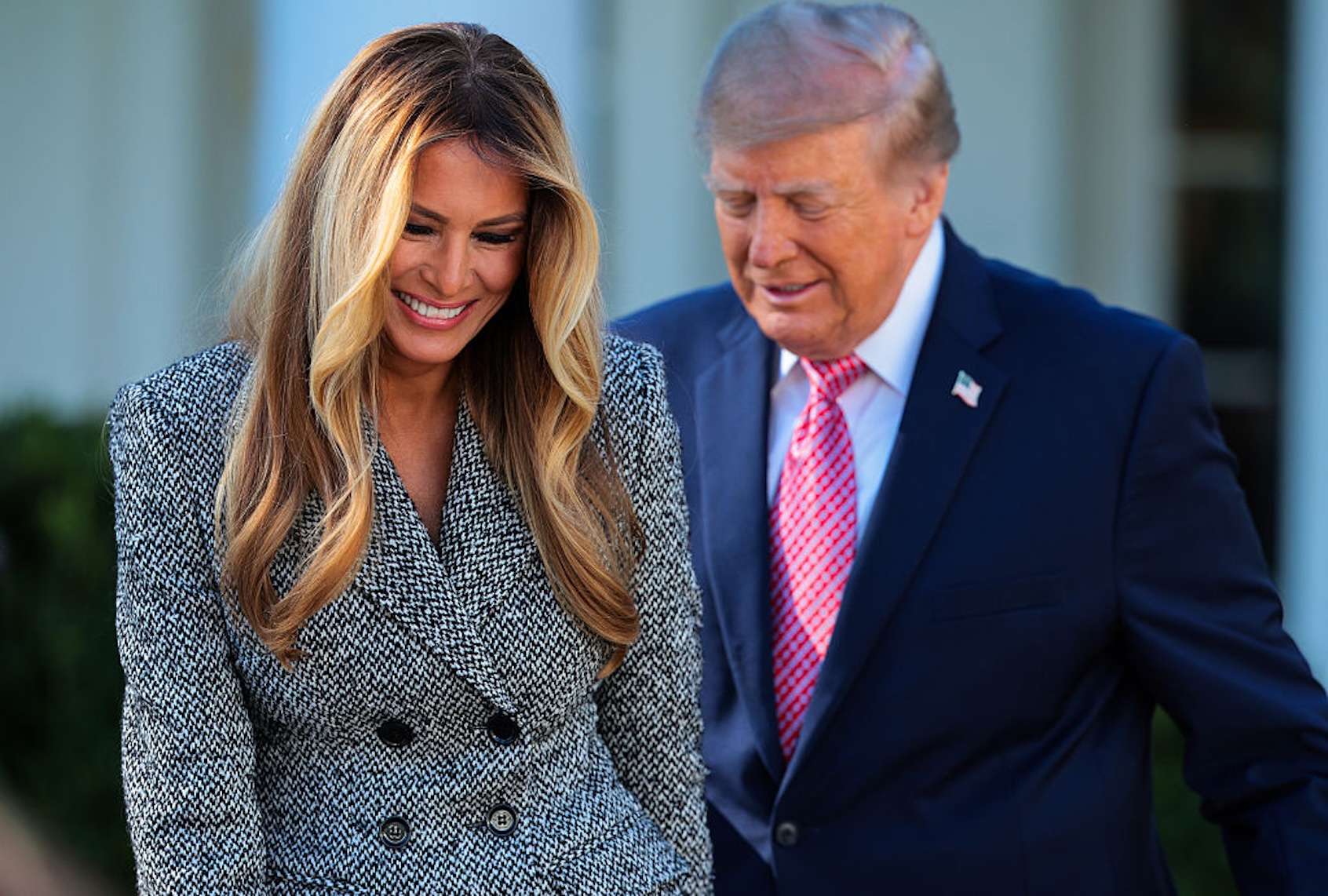
Melania Trump is a key part of this effort. In addition to championing the executive order, she also signed it — a purely symbolic act, as the formal role of first ladies is ceremonial. (In an historic first, she also signed an executive order with her husband in 2025 that expanded resources for the foster care system.) But symbolism matters, and Melania Trump is lending her signature and voice to an action masquerading as a boon for women.

In speaking at the signing ceremony, held in the Rose Garden at the White House, the first lady called the event “a transformative moment for women in America. Beginning today, we will change the reality of women’s health.”

That remains to be seen. The White House Women’s Task Force established by Donald Trump promises to work towards creating a federal government that recognizes and works to rectify medical conditions that affect women throughout their lives by enacting “necessary policy and regulatory reforms to ensure timely and state-specific prevention, diagnosis, treatment, and care for women.”

For many women who have faced systematic gaslighting from doctors who claim that our real physical symptoms are solely psychological, or a lack of funding and real-life effects of diseases largely affecting women being severely behind in clinical trials or lacking funding, this sounds like a good thing. As the order reads, “despite considerable advances in biomedical science, many diseases and conditions that disproportionately or uniquely affect women have not received the level of research, clinical attention, and treatment that other diseases and conditions have received.” 

That is fundamentally true. Medical conditions that solely or disproportionately affect women, such as endometriosis and autoimmune diseases, have for decades been denied funding or excluded from clinical trials. Even conditions that affect men and women have routinely left girls and women out of clinical trials, failing to collect vital information about the different ways that diseases present and progress.This includes cardiovascular disease, in which women may experience different heart attack signs and symptoms compared to men and, consequently, often misattribute heart attack symptoms. The result is significant, often deadly, delays in seeking treatment. 

The same disparity exists in medication research, with women experiencing adverse reactions to medications about twice as often as men because girls and women are not included in clinical studies where medication effectiveness and dosage is studied. This all trickles down into mainstream medicine, where women have for decades been denied care, diagnoses and medication. But the solution that Donald Trump is offering is not going to fix it. 

While the goals of this task force are legitimate, the president has routinely cut and downscaled women’s healthcare funding and initiatives as Melania Trump has stood idly by. 

While the goals of this task force are legitimate, namely to advance and coordinate research on women’s health through all phases of life, to increase inclusion of women and girls in clinical trials, and develop accountability for grant recipients, the president has routinely cut and downscaled women’s healthcare funding and initiatives as Melania Trump has stood idly by. 

During his second administration, the president has cut Medicare, which provided vital healthcare for women, and shut down data-collection contracts for the Women’s Health Initiative study. (He reversed this decision days later.) As part of his efforts at targeting scientific grants connected to diversity, equity and inclusion, the president has further defunded women’s healthcare. 

But perhaps the most glaring example of the administration’s neglect came in June when Trump cancelled millions of dollars in grants under the Teen Pregnancy Prevention Program. This change affected thousands of universities, community organizations, public health departments and Planned Parenthood clinics that provide vital gynecological care to women in states where abortion is currently illegal — and where Trump and the GOP’s continued fight against abortion access is costing women their lives. 

The Department of Health and Human Services, which oversees the grants, issued new funding criteria mandating abstinence-only sex education with an increased emphasis on marriage and fertility tracking, which advocates warn will increase the rate of teen pregnancy. But that may be the point.

Since his return to office in January 2025, Trump has worked to reverse the decline in U.S. birth rates, even calling himself the “fertilization president” at a Women’s History Month celebration in March 2025. Many of his allies have claimed that the decline in teen pregnancy rates is a “crisis” rather than a societal success. With this context, women’s healthcare advocates argue that Trump is trying to raise the birthrate by increasing the number of teen pregnancies. 

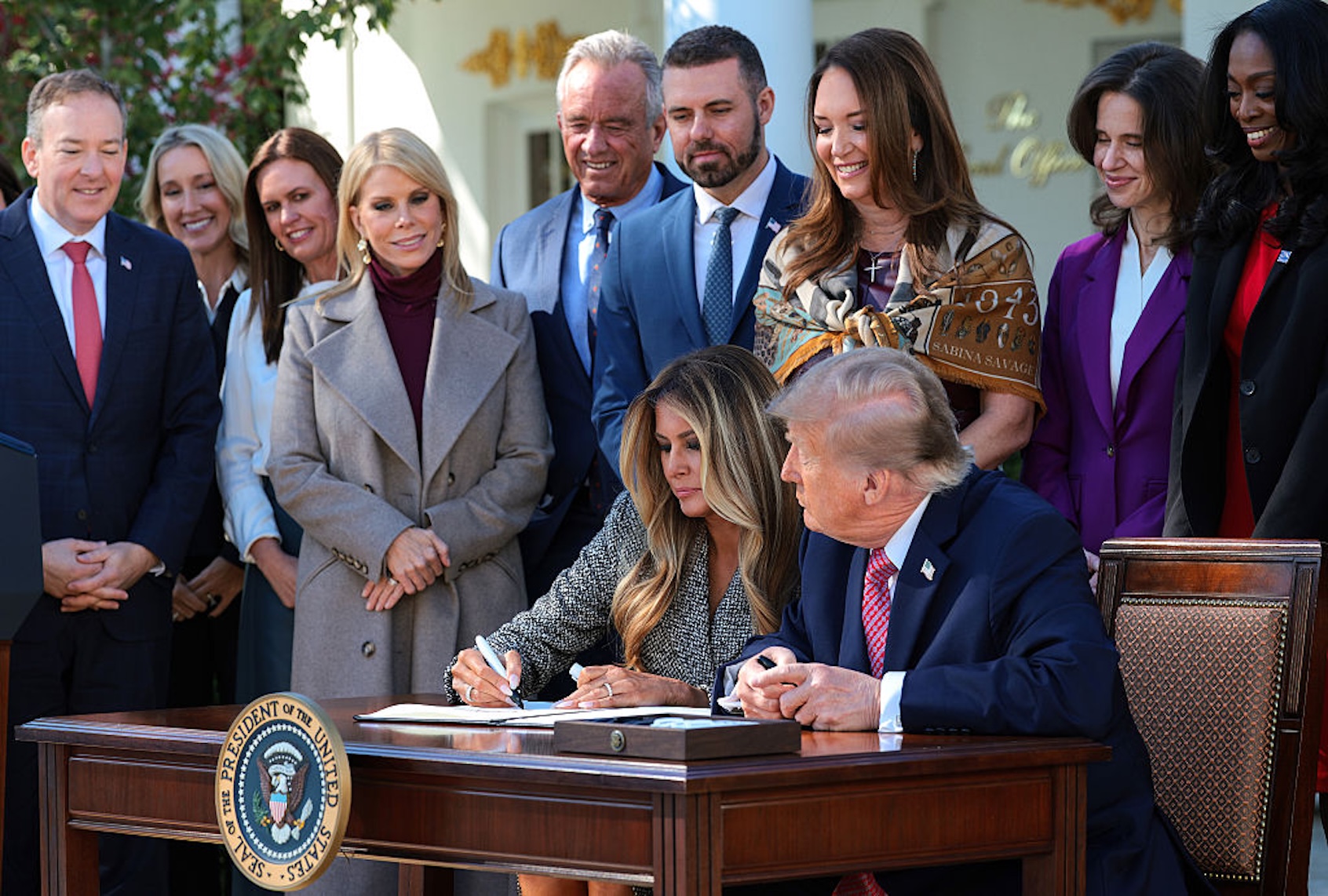
(Chip Somodevilla/Getty Images) President Donald Trump and First Lady Melania Trump sign an executive order establishing the Women’s Health Division at the National Institutes of Health and a White House Women’s Health Task Force on Oct. 19, 2026.

The president’s latest executive order advances this pronatalist agenda. The White House touts TrumpRx.gov as “delivering massive savings on some of the most commonly used fertility medications in the country to help families grow,” and hails the work of Moms.gov “to support new and expecting mothers, bringing together information intended to help families navigate pregnancy and early parenthood.” 

Although Melania Trump has not spoken publicly about the Moms.gov portal, she did publish an op-ed in the Washington Post around the same time Trump launched the platform earlier this year on Mother’s Day, writing that America’s strength is tied to how mothers mold their children’s and family’s moral character. “America can restore the honor of motherhood after years in which feminism often placed career above family, with consequences to our nation,” she wrote. 

With these words in mind, it comes as no shock that the order makes no mention of protecting access to abortion or contraception. As scholars and advocates like Dr. Karen Leader responded online to an X post from the official HHS account, writing, “‘Reproductive health’ without access to legal abortion is a death sentence for women.” Another person replied, “You might ask @FLOTUS to address the many preventable deaths of women who are bleeding out in parking lots or have sepsis or ectopic pregnancies due to republican draconian abortion laws.” 


Want more sharp takes on politics? Sign up for our free newsletter, Standing Room Only, written by Amanda Marcotte, now also a weekly show on YouTube or wherever you get your podcasts.


Even the people Trump has assigned to the new task force have a proven track record of supporting cuts to women’s healthcare and using medicine as tools to police and restrict women’s bodies. Led by White House chief of staff Susie Wiles, it will include HHS Secretary Robert F. Kennedy Jr., who has in the past supported cuts to Medicaid coverage and maternal health initiatives and medical abortion restrictions, as well as championing vaccine skepticism.

In a move that is especially galling, Pete Hegseth, who was accused of sexual assault and reached a financial settlement with the accuser, will also serve on the task force. During his time in office, the defense secretary has led a sustained attack on women’s healthcare and diversity in the military. In September 2026, the Pentagon released (and then temporarily rescinded) guidance as part of Hegseth’s “Health and Human Performance Optimization” initiative, which includes regularly screening female service members for fatigue and irregular menstrual cycles. 

Women service members 35 and older who report significant symptoms of perimenopause or menopause are required to undergo testing to determine if these symptoms impact their station or quality of life. In response, advocates and medical professionals voiced concern that this policy could lead to unwanted and unwarranted tracking of women’s menstrual cycles, compromising medical privacy and potentially opening the door to use period tracking as a way to police miscarriages and abortions.

Instead of advancing women’s healthcare, the president’s executive order and task force should be seen for what it is: a cynical ploy for votes ahead of the November midterms. Taken together, the actions represent a last ditch attempt to save the support of women — and especially white women — for Trump’s allies amid growing criticism of the president. 

It makes sense that the first lady, who herself defended abortion rights in her 2024 memoir “Melania” and urged Congress to hold public hearings for Epstein survivors, would be Trump’s choice to share the news. Once again, Melania Trump is willingly being used as a political prop to show that Trump values and respects women, despite the fact that he routinely fires the women in his Cabinet and press office, continues making sexist and predatory remarks to reporters, and most importantly, has named hostile men as many members of a task force dedicated to women’s health. 

Women have long been medically disenfranchised, and Trump is trying to argue that he and the first lady care about women’s health. But for a president that has fought against abortion rights, opposed the release of the Epstein files and even defended the “Cornell 7,” many American women will remain unconvinced of his motives. Rather than reassured, they will also be rightly skeptical of the first lady who continues to stand by his side.

The post Melania Trump turns her back on women with an executive order appeared first on Salon.com.

  •  
❌