❌

Normal view

Pluralistic: CARDiac, syntax coloring, view source and vibe code (03 Jul 2026)


Today's links


An insanely complex machine made up of many gears, troughs, water wheels, springs, screws, etc. It is housed in a brick building whose facade has been broken away. Three human figures labor to power the machine, turning cranks.

CARDiac, syntax coloring, view source and vibe code (permalink)

In the mid-1970s, my dad – then a budding computer scientist, subsequently a math teacher – brought home my first computer: the CARDiac, a Turing-complete, all-cardboard papercraft computer that you could write and execute programs on:

https://en.wikipedia.org/wiki/CARDboard_Illustrative_Aid_to_Computation

CARDiac stands for "CARDboard Illustrative Aid to Computation," and it was created in 1968 at Bell Labs as a way to teach high schoolers how computers worked. I wasn't anywhere near high school age (I think I was in third grade?) but the CARDiac was revelatory. The year before, I'd had access to a teletype terminal and acoustic coupler that let me operate a PDP machine at the University of Toronto, and I'd been endlessly fascinated with the possibilities. I wrote simple BASIC programs, chatted with ELIZA, and messaged other system users, one keystroke at a time, all on paper (the terminal didn't have a screen, just a printer, and we fed it 1,000' rolls of paper towels my mom brought home from her kindergarten classroom, which I then rolled back up so she could put them back in the bathroom for the kids to dry their hands on).

Interacting with a computer in real-time was captivating, but it wasn't until I assembled and used the CARDiac that it all snapped into place. With the CARDiac, you composed simple programs with pencil and paper, then followed instructions that directed you to move paper tokens in and out of various slots representing memory cells and an accumulator. All an electronic computer does is repeat these crude mechanical operations, millions of times per second, using microscopic transistors. None of that action can be observed with the naked eye, of course. If you had a very sensitive multimeter and a very good microscope, it's conceivable that you could indirectly watch this intricate dance, but only on very early processors, and only if you drastically slowed down their operations.

Much later, I learned a word for what I got from the CARDiac: legibility. Together, the CARDiac and I made a working digital computer, with me standing in for the physics that propels electrons down the endless labyrinth of a microchip, like a pinball triggering various blooping, beeping bumpers. Though the computing we performed was sub-trivial (adding one and one was a major undertaking!), the physical performance of that computing imbued me with Fingerspitzengefühl ("fingertip feeling"):

https://en.wikipedia.org/wiki/Fingerspitzengef%C3%BChl

This stood me in great stead in the years to come. To this day, when I think about my computer, I sometimes imagine those little cardboard tokens, shuffling in and out of the slits in my paper CARDiac. There's something very reassuring about this imagery. No matter how many levels of abstraction sit between me and the nanoscale transistors ranked in their billions beneath my fingertips, they are all undertaking those familiar operations I painstakingly performed on my child's desk all those years ago.

(This is one of the things that makes Science Comics Computers: How Digital Hardware Works such an amazing kids' book! By illustrating how a computer's operations are built up from simple boolean logic that can be represented as physical switches, the comic performs that same legibilizing magic that I got from the CARDiac:)

https://pluralistic.net/2025/11/05/xor-xand-xnor-nand-nor/#brawniac

Not long after my CARDiac experience, my dad brought home an Apple ][+, which came with a schematic that revealed the inner workings of the machine in ways that I found visually striking, if significantly less accessible than the CARDiac:

https://downloads.reactivemicro.com/Apple%20II%20Items/Hardware/II_&_II+/Schematic/Apple%20II%20Schematics.pdf

(For me, at least. For the legendary hardware hacker Andrew "bunnie" Huang, it was the start of a journey that turned him into one of the world's virtuoso reverse-engineers and science communicators):

https://pluralistic.net/2026/01/09/quantity-break/#so-many-chips

The Apple ][+ did very little when you took it out of the box. It came with a few floppies' worth of demo programs, and we bought a few more down at the local computer store, but most of the programs I ended up using with that machine were ones I typed in myself, from magazines I bought at the corner store (I spent half my magazine budget on Cracked, Mad and Crazy, the other half on computer magazines full of BASIC program listings).

Typing in a program, keystroke by keystroke, was another Fingerspitzengefühl-generating exercise. I wasn't much of a typist, so it was slow going, and of course I made a lot of typos. What's more, BASIC had already fragmented into several dialects by this point, so even a correctly typed program could fail to run until it had been adapted for the BASIC that shipped with the computer. Getting a program to run on my computer required me to hone my typing skills, but even more so, my problem solving skills.

After months of this, I (re-)invented the debugger, from first principles, coming up with lots of little tricks and gimmicks (many of them horribly inefficient) for identifying and solving my programs' errors. In later years, I had lots of opportunity to work with real debuggers, created and maintained by trained programmers who'd forgotten more than I would ever know about writing code, and my own cack-handed efforts to build my own version of their tools conferred a confidence and intuitive understanding that I could not have achieved otherwise. Figuring out the need for a debugger and then rolling my own (crude, inefficient) one made all debuggers more legible to me.

I think that "legibility" is an underrated trait. If a system is legible to you, then you have a superior basis for understanding it, improving it, and making it work again when it breaks down.

There's an old joke that goes, "physics is applied math; chemistry is applied physics, and biology is applied chemistry" (I've also heard versions that start with "math is applied philosophy" and carry on to "sociology is applied biology," etc). While this isn't entirely true, there's something profound in it: we understand and manipulate our complex reality by wrapping it in abstractions that package up a writhing, shuffling, vibrating machine inside a smooth, serene membrane with a sturdy and easily grasped handle. You could do chemistry using the tools of physics, but it would take hours to perform the kind of calculations a chemist does in seconds (just as it takes an eternity to add one and one with a CARDiac).

Nevertheless, there are times when it is useful for a biologist to think about chemical processes, and for a chemist to think about interactions at the level of physics, and for a physicist to do math. The membrane and the handle are essential, but sometimes you have to decap the sealed package and inspect and manipulate its internals directly. Problem solving, improvement and maintenance all require the ability to move up and down the stack of abstractions to figure out where to stick your probes and stage your interventions.

This is where legibility comes in. Interacting with physical processes improves your mental model. In Broad Band (a magisterial history of women in computing), Claire Evans talks about how the first programmers were women who did the "unskilled" labor of physically cabling components together, developing powerful Fingerspitzengefühl, with such high-fidelity, trans-abstraction mental models of the machines' operations that they became the world's best programmers and debuggers:

https://pluralistic.net/2021/02/13/data-protection-without-monopoly/#broad-band

My early adventures in programming were so powerful and instructive because nearly all the programs I interacted with on my Apple ][+ were written in BASIC (not just the ones I keyed in, but also the demo software and much of the packaged software we bought). That meant that I could get a listing of any program I was using, peeling open the membrane to look at the machinery underneath. I could even laboriously trace the operations of that program using my toy debugger. This, too, was legibility: the ability to flip between the effects of the running code, and the instructions themselves (and then to mentally map those instructions onto the movement of cardboard tokens in my CARDiac).

This affordance was repeated later on the early web, thanks to the "View Source" function that came built into every browser, acting as a velcro tab for the membrane that separated rendered web pages from their underlying instructions. In my early years as a web developer, I copied, pasted, adapted, probed and traced HTML in ways that would have been instantly recognizable to the younger me, keying in those BASIC programs and ripping apart the commercial software on my computer.

I read somewhere that the Bell Labs scientists who created the CARDiac were worried that, thanks to transistorization, the next generation of programmers wouldn't understand the physical, material processes that unfolded when their programs ran, and that this would mean a loss of legibility and intuition and Fingerspitzengefühl. I can't track down the reference now, but it stuck with me, because the CARDiac is such a perfect way of preserving those virtues.

Modern computer science curriculum includes some chip design for just this reason (just as chemists study physics and biologists study chemistry). But there are plenty of programmers – better programmers than I ever was or will be – who taught themselves and never had a CARDiac or gave much thought to chip design. They work at different layers of abstraction and in different ways to solve different problems. Maybe they could improve their art by tinkering with FPGAs, but there's always something even the most skilled artisan can do to round out and incrementally improve their craft.

In the same way, there are plenty of programmers – better ones than I ever was or will be – whose journey started at higher abstraction layers than a teletype terminal or a CARDiac. Maybe they started with a browser's View Source, teasing apart other people's Javascript to create weird Myspace customizations. Maybe they tweaked a programmable block in Minecraft. Maybe they modded a Scratch game. Or maybe they recorded macros using Applescript or Hypercard or Visual Basic to automate a routine task, only to later open up the source code generated by the macro recorder to make fine adjustments.

Whether you're pasting source from Stack Overflow or recording a macro in Excel, you are just one operation away from unwrapping the membrane and exposing the code beneath it. And with the modern internet, with Wikipedia, with endless tutorial videos, you are one further operation from penetrating the high level code to get at the code beneath it, and the code beneath that, and the code beneath that, all the way down to the bare metal.

Which brings me to vibe coding. As I've written, there's a world of difference between writing code for production and writing "personal software" that solves a problem you have. Whatever deficits that code has (due to the fact that you're not a skilled programmer) are offset by the fact that you're the one making the tool (which means your needs aren't lossily filtered through a programmer's understanding of those needs):

https://pluralistic.net/2026/06/15/vernacular/#hypercardian

There's nothing wrong with code that solves your problem, even if you don't know how that code works, even if it breaks in a couple of years, even if no one else could maintain, extend or debug that code. Personal software is fundamentally different from software made to be used and maintained by others:

https://pluralistic.net/2026/07/02/canonization/#operate-iterate-improve

Higher-level abstractions are necessary. Moving tokens between the slits in a CARDiac is a powerful exercise, but eventually you want to do something more substantial than adding one and one, and so you need to package up the mechanics of computing inside a membrane with an easily grasped handle (knowing that you can always open the membrane if need be).

The more automated code you generate – macros, pasted Javascript, Minecraft blocks – the greater the likelihood that you will be failed by a readymade, prefab component. At that point, you have means, motive and opportunity to open the membrane and start tinkering with the internals, and every time you do, you have a better chance of making a realization that improves your grasp on the whole system.

Automated code – whether from an LLM, View Source, Stack Overflow, or a macro recorder – is the top of a funnel. Many – most – of the people who enter the funnel won't slip further down the abstraction chute. They'll solve their problem (a virtue unto itself!) and move on. But the more people we put at the top of the funnel, the more chances our civilization gets to produce another skilled artisan who understands and can improve, iterate and repair the code the rest of us use.


Hey look at this (permalink)


A shelf of leatherbound history books with a gilt-stamped series title, 'The World's Famous Events.'

Object permanence (permalink)

#20yrsago What real elections can learn from reality TV voting https://henryjenkins.org/2006/07/democracy_big_brother_style_1.html

#20yrsago Veteran print journo on neglected demographics http://citmedia.org/blog/2006/07/03/guest-posting-is-media-performance-democracys-critical-issue/

#10yrsago One of the copyright’s scummiest trolls loses his law license https://fightcopyrighttrolls.com/2016/07/03/prendas-hansmeier-stipulates-to-suspension-of-his-law-license/

#10yrsago Macedonia’s Colorful Revolutionaries defy the state by splashing paint on government buildings and monuments https://globalvoices.org/2016/07/03/defying-police-harassment-the-macedonian-colorful-revolutionaries-continue-to-chant-freedom/

#10yrsago Trump and Brexit are like lotto tickets: the more unrealistic, the better https://www.irishtimes.com/news/world/europe/fintan-o-toole-brexit-and-the-politics-of-the-fake-orgasm-1.2707398

#10yrsago Low income US households get $0.08/month in Fed housing subsidy; 0.1%ers get $1,236 https://web.archive.org/web/20160702151008/https://www.thenation.com/article/who-benefits-most-from-housing-subsidies-the-wealthy/

#5yrsago The future is symmetrical https://pluralistic.net/2021/07/03/beautiful-symmetry/#fibrous-growth

#1yrago Trump's not gonna protect workers from forced labor https://pluralistic.net/2025/07/03/states-rights-trumps-wrongs/#mamdani


Upcoming appearances (permalink)

A photo of me onstage, giving a speech, pounding the podium.


A screenshot of me at my desk, doing a livecast.

Recent appearances (permalink)


A grid of my books with Will Stahle covers..

Latest books (permalink)


A cardboard book box with the Macmillan logo.

Upcoming books (permalink)

  • "The Post-American Internet," a geopolitical sequel of sorts to Enshittification, Farrar, Straus and Giroux, 2027
  • "Unauthorized Bread": a middle-grades graphic novel adapted from my novella about refugees, toasters and DRM, FirstSecond, April 20, 2027

  • "Enshittification, Why Everything Suddenly Got Worse and What to Do About It" (the graphic novel), Firstsecond, 2027

  • "The Memex Method," Farrar, Straus, Giroux, 2027


Colophon (permalink)

Today's top sources:

Currently writing: "The Post-American Internet," a sequel to "Enshittification," about the better world the rest of us get to have now that Trump has torched America. Fourth draft completed. Submitted to editor.

  • A Little Brother short story about DIY insulin PLANNING

This work – excluding any serialized fiction – is licensed under a Creative Commons Attribution 4.0 license. That means you can use it any way you like, including commercially, provided that you attribute it to me, Cory Doctorow, and include a link to pluralistic.net.

https://creativecommons.org/licenses/by/4.0/

Quotations and images are not included in this license; they are included either under a limitation or exception to copyright, or on the basis of a separate license. Please exercise caution.


How to get Pluralistic:

Blog (no ads, tracking, or data-collection):

Pluralistic.net

Newsletter (no ads, tracking, or data-collection):

https://pluralistic.net/plura-list

Mastodon (no ads, tracking, or data-collection):

https://mamot.fr/@pluralistic

Bluesky (no ads, possible tracking and data-collection):

https://bsky.app/profile/doctorow.pluralistic.net

Medium (no ads, paywalled):

https://doctorow.medium.com/

Tumblr (mass-scale, unrestricted, third-party surveillance and advertising):

https://mostlysignssomeportents.tumblr.com/tagged/pluralistic

"When life gives you SARS, you make sarsaparilla" -Joey "Accordion Guy" DeVilla

READ CAREFULLY: By reading this, you agree, on behalf of your employer, to release me from all obligations and waivers arising from any and all NON-NEGOTIATED agreements, licenses, terms-of-service, shrinkwrap, clickwrap, browsewrap, confidentiality, non-disclosure, non-compete and acceptable use policies ("BOGUS AGREEMENTS") that I have entered into with your employer, its partners, licensors, agents and assigns, in perpetuity, without prejudice to my ongoing rights and privileges. You further represent that you have the authority to release me from any BOGUS AGREEMENTS on behalf of your employer.

ISSN: 3066-764X

Pluralistic: The difference between "today's task" and "accretive work" (02 Jul 2026)


Today's links


A village revel in a sleepy wood, with many Renaissance peasants having a debauch. In the background is a hulking mainframe computer.

The difference between "today's task" and "accretive work" (permalink)

One thing I've learned about paradoxes: often the answer to the riddle of "how can this one thing have such a contradictory set of features and effects?" is "it's not one thing, it's two things*."

That's the idea that set me on the path to writing about "reverse centaurs" and AI. I was hearing from experienced programmers whom I knew to be reliable narrators of their own experience who described how AI was letting them write the best code of their lives; and from equally experienced and reliable coders who described a nightmare of tech debt: "I work in aviation, and I just don't think anyone should ever fly again, those things are now unsafe at any altitude, thanks to the code I had to sign off on":

https://pluralistic.net/2025/09/11/vulgar-thatcherism/#there-is-an-alternative

For so long as I thought of both of these groups as doing the same thing and getting wildly different outcomes, this was a paradox. But as soon as I realized that the former group were "centaurs" (workers who get to decide and direct their adoption of automation) and the latter were reverse centaurs (workers who were conscripted to serve as peripherals for automation systems), it all snapped into place. It only looked like they were doing the same thing – they were actually engaged in fundamentally different activities, which is why they were having such different experiences.

The same goes for vibe coding. Plenty of people I knew had gotten real value out of vibe coding personal utilities that made things better for them in a way that I instantly recognized from a life spent around people who'd been able to adapt and customize the systems they used to make their lives better:

https://pluralistic.net/2024/01/25/today-in-tabs/#unfucked-rota

Vibe coding can be seen as part of a lineage that includes shell scripting, Applescript, Hypercard and Visual Basic: ways for technical novices to directly create personal software, without having to ask a programmer to interpret their needs (and without having to pay every time they wanted to do something new with their computers):

https://pluralistic.net/2026/06/15/vernacular/#hypercardian

But if that's so, how to make sense of the seeming paradox of all that tech debt? For a tech company, code is a liability, not an asset:

https://pluralistic.net/2026/01/06/1000x-liability/#graceful-failure-modes

AI's pitch to bosses is that they can fire most of their workers in order to terrorize the remainder into tolerating a working life wherein they are made to mark the AI's homework, at superhuman speed, and to assume the blame when it goes wrong. This is obviously a terrible way to write code:

https://pluralistic.net/2024/04/23/maximal-plausibility/#reverse-centaurs

But it's also obviously going to produce terrible code:

https://pluralistic.net/2025/05/27/rancid-vibe-coding/#class-war

So is vibe code a way of empowering people to have the personal, vernacular tools that they design and adapt as they see fit? Or is it a way to shovel technological asbestos into the walls at scale, filling up our high-tech society with ghastly, lethal technical debt we'll be digging our way out of for generations?

Again: the paradox falls away once you realize that personal software you write for yourself is fundamentally different from "production code" that other people have to use, maintain and improve.

In an essay inspired by some thoughts on AI and mathematical theorem proving, Kellan Elliott-McCrea crystallizes this distinction in a really sharp way, bringing in Alex Kontorovich's idea of mathematical "canonization":

By canonization, I mean the process of taking a local, one-off formalization and turning it into library mathematics: general, reusable, coherent, efficient, and compatible with the rest… Canonization often changes the picture itself: the definitions, the abstractions, the API, and sometimes even the statement…

https://laughingmeme.org/2026/06/30/canonization-and-the-overhang.html

Elliott-McCrea posits that making code that is "socially constructed in a way that leaves the team prepared to operate on it, iterate it, and improve it" is the difference between "I got it working" and "something the future can build on."

He's not claiming that "I got it working" is worthless. There's plenty of space for "disposable and single use software." Sure, to a trained software engineer, this might be "bad code" but doing today's task has value, even if the code that performs that task isn't "accretive."

Canonization is accretive. To canonize code is to make it "legible to systems of humans and non-humans operating on it." Free/open source software is the backbone of the canon: "decades of…intelligible, build-on-able work, sitting in public repos."

My "reverse centaurs" thesis isn't just a way to understand how programmers who seem to be doing the same thing can have such different effects. It's also about how the way that the capital was raised for AI requires that it produce as many reverse centaurs as possible, because the only way to recoup the farcical sums associated with AI production is to fire millions of workers and replace them with defective chatbots backstopped by the jobspocalypse's terrorized survivors, who can be made to endlessly toil away at marking the AI's homework because there are so many other workers who'll take their jobs if they refuse.

The point being that while centaurs are good and reverse centaurs are bad, the AI bubble requires the production of reverse centaurs, to the exclusion of centaurs.

In a similar vein, Elliott-McCrea describes how the imperatives of the AI industry are devouring its seed-corn – consuming the canon without putting anything new back in it. In the same way that AI can do endless theorem-proving but is essentially useless for creating "library mathematics: general, reusable, coherent, efficient, and compatible with the rest," AI can write a lot of running code, but the AI industry is further devaluing the already undervalued work of cleanup and canonization. As Elliott-McCrea writes, "the social production of knowledge [is] the seed corn."


Hey look at this (permalink)


A shelf of leatherbound history books with a gilt-stamped series title, 'The World's Famous Events.'

Object permanence (permalink)

#20yrsago Sen. Stevens’ hilariously awful explanation of the Internet https://web.archive.org/web/20060704034735/http://blog.wired.com/27BStroke6/?entry_id=1512499

#20yrsago Best music of 1900s-1920s as MP3s https://web.archive.org/web/20060703112442/http://www.foldedspace.org/weblog/2006/06/in_the_good_old_summertime.html

#15yrsago “No Endorsement” — aligning the interests of creators and fans https://locusmag.com/feature/cory-doctorow-no-endorsement/

#15yrsago Peruvian TV station owners held out for bribes that were 100X larger than those received by judges https://web.archive.org/web/20110705085927/http://fsi.stanford.edu/publications/how_to_subvert_democracy_montesinos_in_peru/

#10yrsago Paralyzed, partially deaf-blind teen with brain tumor beaten bloody by TSA https://wreg.com/news/disabled-st-jude-patient-sues-airport-and-tsa-after-bloody-scuffle-with-airport-police/

#10yrsago China’s “ultra-unreal” literary movement takes inspiration from breathtaking corruption https://lithub.com/modern-china-is-so-crazy-it-needs-a-new-literary-genre/

#10yrsago London luxury property prices plummet after Brexit vote https://www.standard.co.uk/news/london/london-house-prices-slashed-after-brexit-vote-a3285731.html

#5yrsago Biden admin orders an end to surprise billing https://pluralistic.net/2021/07/02/spoil-the-surprise/#surprise-billing

#1yrago Tessa Hulls's "Feeding Ghosts" https://pluralistic.net/2025/07/02/filial-piety/#great-leap-forward


Upcoming appearances (permalink)

A photo of me onstage, giving a speech, pounding the podium.


A screenshot of me at my desk, doing a livecast.

Recent appearances (permalink)


A grid of my books with Will Stahle covers..

Latest books (permalink)


A cardboard book box with the Macmillan logo.

Upcoming books (permalink)

  • "The Post-American Internet," a geopolitical sequel of sorts to Enshittification, Farrar, Straus and Giroux, 2027
  • "Unauthorized Bread": a middle-grades graphic novel adapted from my novella about refugees, toasters and DRM, FirstSecond, April 20, 2027

  • "Enshittification, Why Everything Suddenly Got Worse and What to Do About It" (the graphic novel), Firstsecond, 2027

  • "The Memex Method," Farrar, Straus, Giroux, 2027


Colophon (permalink)

Today's top sources:

Currently writing: "The Post-American Internet," a sequel to "Enshittification," about the better world the rest of us get to have now that Trump has torched America. Fourth draft completed. Submitted to editor.

  • A Little Brother short story about DIY insulin PLANNING

This work – excluding any serialized fiction – is licensed under a Creative Commons Attribution 4.0 license. That means you can use it any way you like, including commercially, provided that you attribute it to me, Cory Doctorow, and include a link to pluralistic.net.

https://creativecommons.org/licenses/by/4.0/

Quotations and images are not included in this license; they are included either under a limitation or exception to copyright, or on the basis of a separate license. Please exercise caution.


How to get Pluralistic:

Blog (no ads, tracking, or data-collection):

Pluralistic.net

Newsletter (no ads, tracking, or data-collection):

https://pluralistic.net/plura-list

Mastodon (no ads, tracking, or data-collection):

https://mamot.fr/@pluralistic

Bluesky (no ads, possible tracking and data-collection):

https://bsky.app/profile/doctorow.pluralistic.net

Medium (no ads, paywalled):

https://doctorow.medium.com/

Tumblr (mass-scale, unrestricted, third-party surveillance and advertising):

https://mostlysignssomeportents.tumblr.com/tagged/pluralistic

"When life gives you SARS, you make sarsaparilla" -Joey "Accordion Guy" DeVilla

READ CAREFULLY: By reading this, you agree, on behalf of your employer, to release me from all obligations and waivers arising from any and all NON-NEGOTIATED agreements, licenses, terms-of-service, shrinkwrap, clickwrap, browsewrap, confidentiality, non-disclosure, non-compete and acceptable use policies ("BOGUS AGREEMENTS") that I have entered into with your employer, its partners, licensors, agents and assigns, in perpetuity, without prejudice to my ongoing rights and privileges. You further represent that you have the authority to release me from any BOGUS AGREEMENTS on behalf of your employer.

ISSN: 3066-764X

Pluralistic: Technocarcinization (01 Jul 2026)


Today's links


Two crabs dance with their claws entwined; one has the Google logo on its back, the other, the Apple logo. Their audience is a much larger crab, bearing the Meta logo. The scene is set on a dune.

Technocarcinization (permalink)

"Carcinization" is a curious biological phenomenon: given enough time, across many environments, many species will evolve into crabs. The body-type of a crab, with its low center of gravity, sideways gait (useful for evading predators), ease of concealment and protected organs is suitable to many different environments:

https://en.wikipedia.org/wiki/Carcinisation

Lately, I've watched the American Big Tech platforms as they underwent their own form of technocarcinization, which is when every tech company turns into Facebook.

A 2x2 grid. The vertical axis is labeled 'more surveillant.' The horizontal axis is labeled 'more control-freaky.' The top right quadrant has the Google logo. The top left, the Facebook and Instagram logos. The bottom left has the Apple logo. The bottom right has a Free Software Foundation Gnu.

For a long time, it seemed to me that you could make sense of the tech platforms by placing them into one of four quadrants on a 2×2 grid, in which one axis denoted "control freakishness" and the other, "surveillance."

Each quadrant had its own canonical company. The most surveillant/least controlling company (top left) was Google. They would let you roam the whole wide internet and exert no control over your conduct, but would spy on you wherever you went. The least surveillant/most controlling company was Apple, who imprisoned you in its manicured walled garden, but promised never to spy on you. The non-spying/non-controlling option is free/open source tech (of course), which doesn't care what you do, and doesn't watch you do it. And the most spying, most controlling company was Facebook, a company whose products did everything they could to imprison you within their virtual walls, from which vantage they could effect maximal surveillance.

I've used this comparison many times over the years. I included in my 2023 book The Internet Con, along with the joke that Tiktok's position on the grid was so far up and to the right (maximum surveillance and control) that we'd had to put its logo on the back cover. Enough people took this joke seriously and wrote in to complain that they'd gotten a misprint without the logo that we added it to the paperback:

https://www.versobooks.com/products/3035-the-internet-con

The grid was useful, until technocarcinization started to push all the tech companies into that top right quadrant. Apple is no longer the company that protects you from surveillance – they're the company that spies on you, having secretly added a total surveillance system to the iPhone to target ads to you:

https://pluralistic.net/2022/11/14/luxury-surveillance/#liar-liar

Apple can't even claim to protect you from third-party surveillance. Sure, they block Facebook from spying on you, but they have barred ICE Block, an app that tells you if there are ICE chuds hunting in your neighborhood, looking to kidnap you and send you to a concentration camp. Apple declared ICE mercenaries to be a "protected class":

https://pluralistic.net/2025/10/06/rogue-capitalism/#orphaned-syrian-refugees-need-not-apply

And thanks to Apple's control-freakery – which prevents you from overriding Apple's decisions about your own devices – once Apple decides to spy on you or sell you out to fascist goons, there's nothing you can do about it:

https://locusmag.com/feature/cory-doctorow-neofeudalism-and-the-digital-manor/

Then there's Google, the company that ran a free-range livestock operation in which you could roam wherever you liked, because they could always find you when it was time for the slaughter. For years now, Google has been moving inexorably to the kind of control-freak nonsense that you used to only find in one of Apple's crystal prisons.

For example, every year or two, Google floats a proposal to use secure hardware in your device to rat you out if you've got an ad-blocker, privacy blocker, or other aftermarket add-on that lets you choose how you experience the digital world:

https://pluralistic.net/2023/08/02/self-incrimination/#wei-bai-bai

It's an idea they just can't quit, despite the fact that it's fucking abominable and everyone hates it:

https://pluralistic.net/2026/06/12/compelled-speech/#quishing

Google used to pride itself in its ability to send you to the open web, viewing search as a conduit to other peoples' resources. Now, with AI search summaries, Google is harvesting the open web and then eating the seed corn, keeping searchers inside of Google's walled garden:

https://pluralistic.net/2026/06/29/arsonist-firefighters/#im-feeling-lucky

Google also took the idea of a free/open browser and ran with it, rehabilitating some discarded Apple code and turning it into Chrome, the internet's most dominant browser – by far. Now, Google is nerfing that browser's plug-in architecture in a way that blocks all kinds of user-tunable options, including and especially ad-blocking:

https://protonprivacy.substack.com/p/google-is-finally-killing-ublock

And Google has also announced that they're going to turn Android into an iPhone, making it both technically challenging and radioactively illegal for you to install software of your choosing on your own property:

https://arstechnica.com/gadgets/2025/08/google-will-block-sideloading-of-unverified-android-apps-starting-next-year/

Google is adopting every one of Apple's worst practices, and Apple is adopting all of Google's worst practices, and so they're both turning into Facebook: technocarcinization!

What's driving this technocarcinization? Well, the obvious answer is that the more Facebooklike a company becomes, the more ways there are for it to rip you off. Surveillance can be monetized by selling your data, by ad targeting, and by surveillance-based pricing and wage-suppression:

https://pluralistic.net/2026/01/21/cod-marxism/#wannamaker-slain

Control lets platforms block competing products, extract massive junk fees to the businesses they connect you to, and control repair and end-of-life, forcing you to replace hardware by blocking parts and independent service:

https://pluralistic.net/2026/01/10/markets-are-regulations/#carney-found-a-spine

It turns out that "if you're not paying for the product, you're the product" is only half-right. The other half is, "even if you pay for the product, you're the product." Pay, don't pay: companies will productize anyone they can. And thanks to our enshittogenic policy environment – where the worst ideas of the worst people make the most money – you can always be productized:

https://pluralistic.net/2025/09/10/say-their-names/#object-permanence

This is independent of the kind of person running the company. Facebook is run by Mark Zuckerberg, a cringe halfwit whose only successful idea was to offer Harvard bros a way of nonconsensually rating the fuckability of female undergrads. Everything he's done since was an acquisition (Whatsapp, Insta) or a flop (metaverse, Libra), or both (Oculus). Zuck owns the majority of the voting stock in the company, which means he has total control over its actions. He can ignore or fire his board members at will. He is the move fast/break things guy, whose every foolish whim can become policy that impacts billions of people.

By contrast, Google and Apple are no longer run by their flamboyant founders, who were every bit as prone to folly as Zuck. They were constrained by their shareholders, which meant that the blast-radius of Steve Jobs's worst ideas (like treating his otherwise curable cancer with green juice) were confined to his own person.

Today, Apple and Google are run by bloodless business sociopaths who go to enormous lengths to project an air of sober adulthood. And yet, these people – who would never be caught dead bow-hunting their own livestock or climbing into an MMA cage – have steered their companies into Facebook's quadrant on our enshittification 2×2.

I think this shows just how much the enshittification of tech is a matter of the policy environment, not the personalities of the people involved. Sure, the worst people imaginable run these companies, but the reason they're able to yield to their most venal impulses and succeed is because the world has been re-arranged to make sociopathy and greed into fitness factors. We get technocarcinization because the most fit organism for a landscape without consequences is a zuckerbergian techno-crab:

https://pluralistic.net/2023/07/28/microincentives-and-enshittification/

What can we do about it? Well, we're going to have to remake the landscape to punish (rather than reward) enshittification:

https://pluralistic.net/2026/01/01/39c3/#the-new-coalition

And in the meantime, there is one inhabitant of the 2×2 that hasn't drifted up and to the right: free and open source software. It's still snugly nestled in the low-surveillance/low-control box, and if you live in that box, your life will be much, much better for it.

There's no better time to make the switch: with RAM and storage prices through the ceiling and OSes growing ever-more bloated with AI and spyware (but I repeat myself), this is the moment to rehabilitate that old computer with Linux:

https://www.fosslinux.com/158206/linux-on-older-hardware-revival-guide.htm

The alternative is to be tormented by crabs no matter what you're trying to do or where you're trying to get to.


Hey look at this (permalink)


A shelf of leatherbound history books with a gilt-stamped series title, 'The World's Famous Events.'

Object permanence (permalink)

#15yrsago Print-on-demand and donations - report on DIY publishing business models https://www.publishersweekly.com/pw/by-topic/columns-and-blogs/cory-doctorow/article/47858-with-a-little-help-heuristics.html

#15yrsago Brazil rises up for free speech in 40 national demonstrations https://globalvoices.org/2011/06/30/brazil-freedom-march/

#10yrsago Grandad builds miniature backyard Disneyland https://abcnews.com/Lifestyle/grandpa-builds-disneyland-inspired-backyard-theme-park-grandkids/story?id=40276633

#10yrsago Elizabeth Warren on monopolies in America, including Apple, Google, and Amazon https://washingtonmonthly.com/2016/06/30/elizabeth-warrens-consolidation-speech-could-change-the-election/

#10yrsago White House plan to use data to shrink prison populations could be a racist dumpster fire https://www.wired.com/2016/06/white-house-mission-shrink-us-prisons-data/

#10yrsago Even if Moore's Law is "running out," there's still plenty of room at the bottom https://www.technologyreview.com/2016/05/13/245938/moores-law-is-dead-now-what/

#10yrsago Black-hat hacker handles are often advertisements https://www.wired.com/beyond-the-beyond/2016/07/web-semantics-modern-german-black-hat-hacker-handles/

#10yrsago Spotify threatens to report Apple to competition regulators over App Store rejection https://web.archive.org/web/20160630220301/https://www.recode.net/2016/6/30/12067578/spotify-apple-app-store-rejection

#10yrsago Researchers find over 100 spying Tor nodes that attempt to compromise darknet sites https://www.defcon.org/html/defcon-24/dc-24-speakers.html#Noubir

#5yrsago Exxon lobbyist confesses to his crimes https://pluralistic.net/2021/07/01/basilisk-tamers/#exxonknew

#5yrsago When the Sparrow Falls https://pluralistic.net/2021/07/01/basilisk-tamers/#rage-against-the-machine


Upcoming appearances (permalink)

A photo of me onstage, giving a speech, pounding the podium.


A screenshot of me at my desk, doing a livecast.

Recent appearances (permalink)


A grid of my books with Will Stahle covers..

Latest books (permalink)


A cardboard book box with the Macmillan logo.

Upcoming books (permalink)

  • "The Post-American Internet," a geopolitical sequel of sorts to Enshittification, Farrar, Straus and Giroux, 2027
  • "Unauthorized Bread": a middle-grades graphic novel adapted from my novella about refugees, toasters and DRM, FirstSecond, April 20, 2027

  • "Enshittification, Why Everything Suddenly Got Worse and What to Do About It" (the graphic novel), Firstsecond, 2027

  • "The Memex Method," Farrar, Straus, Giroux, 2027


Colophon (permalink)

Today's top sources:

Currently writing: "The Post-American Internet," a sequel to "Enshittification," about the better world the rest of us get to have now that Trump has torched America. Fourth draft completed. Submitted to editor.

  • A Little Brother short story about DIY insulin PLANNING

This work – excluding any serialized fiction – is licensed under a Creative Commons Attribution 4.0 license. That means you can use it any way you like, including commercially, provided that you attribute it to me, Cory Doctorow, and include a link to pluralistic.net.

https://creativecommons.org/licenses/by/4.0/

Quotations and images are not included in this license; they are included either under a limitation or exception to copyright, or on the basis of a separate license. Please exercise caution.


How to get Pluralistic:

Blog (no ads, tracking, or data-collection):

Pluralistic.net

Newsletter (no ads, tracking, or data-collection):

https://pluralistic.net/plura-list

Mastodon (no ads, tracking, or data-collection):

https://mamot.fr/@pluralistic

Bluesky (no ads, possible tracking and data-collection):

https://bsky.app/profile/doctorow.pluralistic.net

Medium (no ads, paywalled):

https://doctorow.medium.com/

Tumblr (mass-scale, unrestricted, third-party surveillance and advertising):

https://mostlysignssomeportents.tumblr.com/tagged/pluralistic

"When life gives you SARS, you make sarsaparilla" -Joey "Accordion Guy" DeVilla

READ CAREFULLY: By reading this, you agree, on behalf of your employer, to release me from all obligations and waivers arising from any and all NON-NEGOTIATED agreements, licenses, terms-of-service, shrinkwrap, clickwrap, browsewrap, confidentiality, non-disclosure, non-compete and acceptable use policies ("BOGUS AGREEMENTS") that I have entered into with your employer, its partners, licensors, agents and assigns, in perpetuity, without prejudice to my ongoing rights and privileges. You further represent that you have the authority to release me from any BOGUS AGREEMENTS on behalf of your employer.

ISSN: 3066-764X

Wissen über Laminieren von Croissantteigen

23 May 2026 at 08:04

Ein gutes Croissant erkennt man nicht nur an der Form oder an der Farbe – sondern vor allem an seiner Krume. Feine, gleichmäßige Schichten, eine splitternde Kruste und ein butteriges Aroma entstehen nicht zufällig. Genau hier beginnt die Kunst des Laminierens.

Bereits der Grundteig entscheidet später über Erfolg oder Frust. Croissantteige müssen intensiv ausgeknetet werden, damit sich ein stabiles Klebergerüst entwickeln kann. Knetzeiten von 15–20 Minuten sind dabei keine Seltenheit. Die ideale Teigtemperatur liegt zwischen 24–25°C. Wird der Teig zu kalt geführt, entwickelt er sich nur langsam – wird er zu warm, leidet später die Tourierung.

Nach dem Kneten folgt eine Teigreife von etwa 60 Minuten. Anschließend sollte der Teig mehrere Stunden gut durchkühlen. Viele der besten Ergebnisse entstehen sogar bei Kühlzeiten von 12–15 Stunden. Der Vorteil: Der Teig entspannt sich, entwickelt Aroma und lässt sich später deutlich sauberer laminieren.

Ein entscheidender Punkt ist die Butter. Sie bestimmt später die Qualität und Definition der Butterschichten. In der Regel werden etwa 25-35 % Butter bezogen auf das Teiggewicht einlaminiert. Dabei darf jedoch die bereits im Grundteig enthaltene Butter nicht vergessen werden. Je höher die Gesamtbuttermenge, desto sensibler reagiert der Teig beim Tourieren und Backen.


Butter trifft Teig – der Einfluss der Tourierung auf perfekte Croissants


Je nach gewünschter Größe und Charakteristik des Croissants sollte die Anzahl und Art der Touren angepasst werden. Oft wird angenommen, dass viele Touren zu einer stärkeren und deutlicheren Schichtung führen – tatsächlich ist eher das Gegenteil der Fall. Mit jeder zusätzlichen Tour werden die Butter- und Teigschichten dünner. Dadurch steigt die Gefahr, dass die Schichten beim Ausrollen miteinander verschmelzen und sich im Ofen nicht mehr sauber voneinander trennen können. Weniger Touren sorgen daher für kräftigere, klar abgegrenzte Schichten, während mehr Touren meist zu einer feineren, dichteren Krume und einem größeren Volumen führen.

Die Wahl der Tourierung sollte deshalb immer an das gewünschte Endprodukt angepasst werden:

1.) Zwei einfache Touren – für markante Croissantschichten


Ein Croissant, das mit zwei einfachen Touren in Brieffalttechnik hergestellt wird, besitzt insgesamt neun Butterschichten. Diese vergleichsweise geringe Schichtanzahl sorgt für besonders kräftige, klar voneinander abgegrenzte Lagen und eine ausgeprägt knusprige Kruste.

Im Gegensatz zu mehrfach tourierten Teigen bleiben die Butter- und Teigschichten auch bei dünnem Ausrollen deutlich sichtbar. Dadurch eignet sich diese Methode besonders für Croissants mit markanter Schichtung sowie für Mini-Viennoiseries, bei denen die Struktur optisch stark zur Geltung kommen soll.Bei Verwendung einer Teigausrollmaschine kann die zweite Tour direkt nach der ersten durchgeführt werden.

Auch der Butteranteil spielt bei dieser Tourierung eine wichtige Rolle. Da bei zwei einfachen Touren nur neun Butterschichten entstehen, verteilt sich die Butter auf vergleichsweise dicke Lagen. Bereits moderate Butteranteile zeigen daher eine starke Wirkung auf Schichtung und Knusprigkeit. Bewährt haben sich etwa 25–30 % Butter bezogen auf die Teigmenge.

Während niedrigere Butteranteile eine etwas rustikalere und knusprigere Struktur fördern, sorgen etwa 28–30 % für eine besonders ausgewogene Balance aus Aroma, Saftigkeit und klarer Schichtung.

Auch Laugencroissants werden häufig mit zwei einfachen Touren hergestellt, da die klar abgegrenzten Schichten nach dem Laugenbad besonders schön sichtbar bleiben und für eine splitternde, aromatische Kruste sorgen.


2.) Eine doppelte und eine einfache Tour – der Klassiker


Ein Croissant, das mit einer doppelten Tour (Buchfaltung) und anschließend einer einfachen Tour (Brieffaltung) hergestellt wird, besitzt insgesamt zwölf Butterschichten. Diese Tourierung gilt als die klassischste und universellste Methode in der Croissant-Herstellung, da sie eine besonders ausgewogene Balance zwischen Volumen, Schichtung und Zartheit erzeugt.

Die Reihenfolge der Touren spielt dabei eine wichtige Rolle: Zuerst wird die doppelte Tour, anschließend die einfache Tour durchgeführt. Dadurch entsteht beim späteren Ausrollen eine deutlich gleichmäßigere Teigstruktur. Idealerweise wird bereits bei der letzten Tour die gewünschte Teigbreite erreicht, sodass der tourierte Teig vor dem Formen nur noch auf die benötigte Länge ausgerollt werden muss. Das schont die Schichten und sorgt für ein gleichmäßigeres Backergebnis.

Die zwölf Butterschichten sorgen für eine feine und gleichmäßige Innenstruktur, ohne dass die einzelnen Lagen zu dünn werden. Dadurch entsteht ein stabiles Verhältnis zwischen Teig und Butter, was diese Methode besonders fehlertolerant macht und das Risiko von Butteraustritt oder verschmierten Schichten deutlich reduziert.

Auch beim Butteranteil zeigt sich diese Methode besonders flexibel. Bewährt haben sich etwa 28–32 % Butter bezogen auf die Teigmenge. Durch die gleichmäßige Verteilung der Butter entstehen Croissants mit feiner Schichtung, lockerem Volumen und ausgewogenem Aroma.

Das eigentliche Spiel der Butterschichten entscheidet später über die Krume. Viele Schichten erzeugen eine feinere, gleichmäßigere Porung. Weniger Schichten führen dagegen zu einer gröberen und oft spektakuläreren Wabenstruktur. Genau deshalb sollte die Anzahl der Touren immer mit der Buttermenge abgestimmt werden. Denn je weniger Schichten vorhanden sind, desto geringer sollte auch die laminierte Buttermenge ausfallen. Ansonsten steigt die Gefahr, dass die Butter beim Backen ausläuft.


3.) Zwei doppelte Touren – für voluminöse und gefüllte Croissants

Ein Croissant, das mit zwei doppelten Touren im Buchfaltverfahren hergestellt wird, besitzt insgesamt sechzehn Butterschichten. Durch die höhere Anzahl an Schichten entsteht eine besonders feine und gleichmäßige Struktur mit großem Volumen und einer sehr lockeren Krume.

Bei Verwendung einer Teigausrollmaschine kann die zweite doppelte Tour direkt nach der ersten durchgeführt werden. Auch bei dieser Methode sollte bereits bei der letzten Tour möglichst die gewünschte Teigbreite erreicht werden. Der tourierte Teig muss anschließend nur noch in die Länge ausgerollt werden, wodurch die feinen Butter- und Teigschichten geschont werden und die Struktur besonders gleichmäßig bleibt.

Die sechzehn Butterschichten sorgen für eine sehr feine Laminierung und ein üppiges Volumen. Gleichzeitig werden die einzelnen Schichten etwas dichter, wodurch diese Tourierung besonders stabil wird. Aus diesem Grund eignet sich diese Methode hervorragend für gefüllte Croissants und Viennoiserie-Produkte mit höherem Gewicht oder viel Volumen.

Besonders häufig wird diese Tourierung bei Croissants mit Cremefüllungen eingesetzt – etwa bei Karamell-Vanille-Croissants, exotischen Croissants oder anderen gefüllten Varianten. Auch Produkte wie Pain au Chocolat, dänisches Gebäck oder fruchtgefüllte Plunder profitieren von der stabilen und voluminösen Struktur dieser Tourierung. Häufig wird dabei mit einer etwas stärkeren Endteigdicke von etwa 4 mm gearbeitet, um ausreichend Stand und Volumen zu erzeugen.

Beim Butteranteil haben sich etwa 30–35 % Butter bezogen auf die Teigmenge bewährt. Durch die höhere Anzahl an Schichten verteilt sich die Butter besonders fein im Teig und sorgt für eine zarte, saftige Krume mit guter Frischhaltung.

4.) Drei einfache Touren – für maximales Volumen

Ein Croissant, das mit drei einfachen Touren in Brieffalttechnik hergestellt wird, besitzt insgesamt siebenundzwanzig Butterschichten. Damit entstehen von allen klassischen Tourierungsarten die meisten Butterlagen, wodurch ein besonders feines und voluminöses Croissant erzeugt wird.

Bei Verwendung einer Teigausrollmaschine können die ersten beiden einfachen Touren direkt hintereinander durchgeführt werden. Anschließend sollte der Teig etwa 30 Minuten ruhen, bevor die dritte Tour erfolgt. Auch bei dieser Methode empfiehlt es sich, bereits bei der letzten Tour die gewünschte Teigbreite zu erreichen, damit der tourierte Teig später nur noch in die Länge ausgerollt werden muss.

Durch die hohe Anzahl an Schichten wird der Teig extrem fein laminiert. Das Ergebnis sind sehr dünne, zarte Teiglagen mit einem besonders lockeren Volumen. Gleichzeitig bleiben die Lufteinschlüsse im Inneren kleiner und dichter verteilt, wodurch beim Anschnitt eine gleichmäßige und stabile Krume entsteht.

Diese Methode ist in Frankreich deutlich weniger verbreitet als die klassischen Varianten mit zwei Touren, bietet jedoch einige interessante Vorteile. Durch die vielen dünnen Butterlagen bleibt das Croissant besonders lange knusprig und weicht deutlich langsamer durch. Vor allem die Frischhaltung profitiert von der fein verteilten Butter im Teig.

Aus diesem Grund eignet sich diese Tourierung besonders für Croissants mit höherem Butteranteil oder für Produkte, bei denen eine längere Knusprigkeit und Haltbarkeit gewünscht wird.

Beim Butteranteil haben sich etwa 32–38 % Butter bezogen auf die Teigmenge bewährt. Durch die vielen dünnen Schichten kann die Butter besonders gleichmäßig verteilt werden, ohne dass die Croissants schwer oder fettig wirken.


Wichtig:

Besonders wichtig beim Laminieren: Sowohl der Grundteig als auch die Butterplatte sollten möglichst dünn und gleichmäßig ausgerollt werden. Dadurch lässt sich die Butter deutlich einfacher und sauberer eintourieren. Zusätzlich empfiehlt es sich, die Eckkanten beim Ausrollen sauber abzuschneiden. Das erleichtert die weitere Aufarbeitung enorm und sorgt für gleichmäßige Butter- und Teigschichten bis in den Randbereich.

Die richtige Formgebung – Teigstärke, Dreiecksgröße und Einfluss auf das Croissant

Je nach gewünschtem Endprodukt gibt es bei Croissants deutliche Unterschiede in Form, Größe und Tourierung. Neben der Anzahl der Touren spielen auch Teigstärke sowie die Abmessungen der Teigdreiecke eine entscheidende Rolle für das spätere Backergebnis. Während kleinere Croissants meist mit stärker ausgeprägter Schichtung und geringerem Gewicht hergestellt werden, benötigen großvolumige Croissants breitere und längere Teigdreiecke.

Als grobe Richtlinie wird der tourierte Teig häufig auf etwa 3,5 mm Dicke ausgerollt. Die Dreiecke besitzen dabei meist eine Breite von 9–10 cm und eine Länge von 28–30 cm. Diese Maße ermöglichen ein ausgewogenes Verhältnis zwischen Volumen, Schichtung und einer gleichmäßigen Formgebung. Je nach gewünschter Optik und Gewicht können diese Richtwerte jedoch individuell angepasst werden.


Gare

Auch die Endgare wird häufig unterschätzt. Croissants sollten möglichst nicht über 28°C gegärt werden. Wird die Gare zu warm geführt, beginnt die Butter zwischen den Schichten weich zu werden und verliert ihre stabilisierende Wirkung. Die Folge sind flache Croissants mit wenig Volumen und unsauberen Schichten. Dauer der Endgare ca. 2,5-3 Std, bei 75% Luftfeuchtigkeit und 27°C

Backen

Mindestens genauso entscheidend ist das Backen selbst. Ein hohes Anbacken sorgt für Stabilität und garantiert, dass das Croissant seine Form behält – 200-205C^fallend auf 170-180°C haben sich als richtwert bewiesen. Wird zu kühl gebacken, fallen Croissants während des Backens oft sichtbar zusammen – ein klassisches Zeichen für zu niedrige Anfangshitze. Die Backzeit sollte je nach Größe etwa 17–18 Minuten betragen.

Besonders gute Ergebnisse liefern Heißluftöfen. Durch die gleichmäßigere Hitzeverteilung entstehen stabilere Croissants mit besserer Krustenbildung und schönerer Ausbundentwicklung. Wichtig bleibt dabei jedoch immer die Balance zwischen kräftigem Anbacken und ausreichender Backzeit.


Eistreich und Glanzstreiche – für perfekte Farbe und Glanz bei Croissant

Der richtige Eistreich entscheidet maßgeblich über die spätere Optik von Croissants, Plundergebäck und anderen Viennoiserie-Produkten. Eine ausgewogene Mischung sorgt nicht nur für eine gleichmäßige Bräunung, sondern auch für einen feinen Glanz und eine attraktive Oberfläche nach dem Backen.

Zutaten

  • 50 g Vollei
  • 50 g Eigelb
  • 50 g Milch
  • 5g Honig
  • 1 Prise Salz

Herstellung

Alle Zutaten in ein hohes Gefäß geben und etwa 30 Sekunden mit dem Stabmixer gut vermischen. Durch das Mixen verbinden sich die Zutaten zu einer homogenen Masse, die sich später besonders gleichmäßig auftragen (sprühen) lässt.

Anschließend die Mischung durch ein feines Sieb passieren. Dadurch werden Eifäden und mögliche Klümpchen entfernt, was einen sauberen und gleichmäßigen Auftrag ermöglicht.

Der fertige Eistreich sollte bis zur Verwendung im Kühlschrank gelagert werden.

Wirkung der Eistreich

Der Anteil an Eigelb sorgt für eine kräftige Farbgebung und einen schönen Glanz, während die Milch die Bräunung unterstützt und den Auftrag geschmeidiger macht. Dadurch entsteht nach dem Backen eine gleichmäßige, goldbraune Oberfläche ohne Fleckenbildung.

Besonders wichtig ist ein dünner und gleichmäßiger Auftrag. Zu viel Eistreich kann die feinen Teig-Butterschichten verkleben und das Ofentriebverhalten negativ beeinflussen.

Glanzstreiche mit Sirup

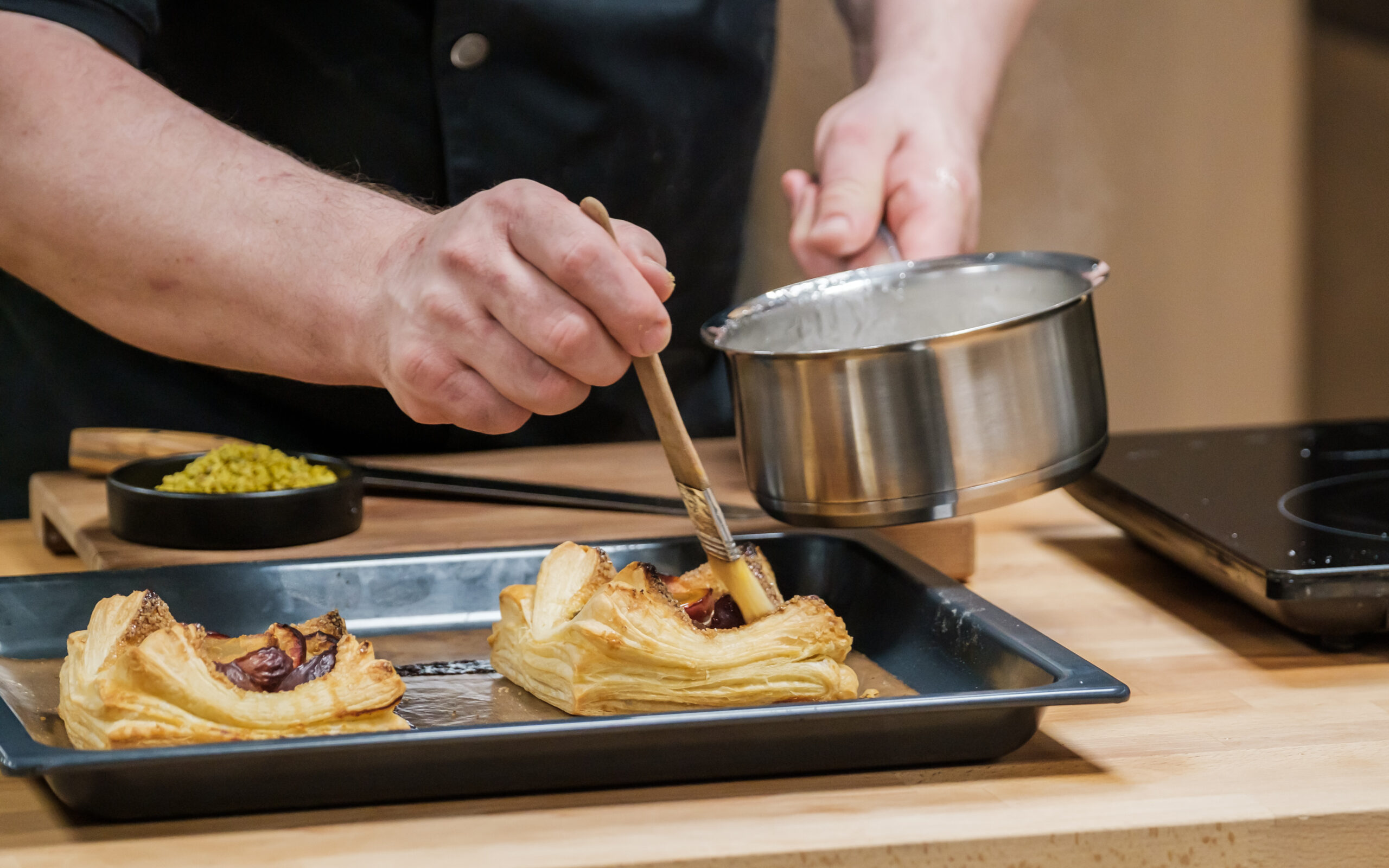
Um Croissants und Plundergebäck nach dem Backen zusätzlichen Glanz zu verleihen, eignet sich ein einfacher Zuckersirup hervorragend. Dieser wird direkt nach dem Backen dünn auf das heiße Gebäck aufgetragen.

Zutaten

  • 100 g Wasser
  • 100 g Zucker

Herstellung

Wasser und Zucker in einen Topf geben und unter ständigem Rühren erhitzen, bis sich der Zucker vollständig gelöst hat. Sobald die Mischung aufkocht, den Topf vom Herd nehmen und den Sirup auf Raumtemperatur abkühlen lassen.

Der fertige Sirup kann im Kühlschrank gelagert und bei Bedarf verwendet werden.

Der dünn aufgetragene Sirup sorgt für einen attraktiven Glanz und schützt die Oberfläche zusätzlich vor dem Austrocknen. Gleichzeitig bleiben Croissants und Plundergebäck länger frisch und wirken optisch hochwertiger. Besonders bei gefüllten oder dekorierten Viennoiserie-Produkten verleiht die Glanzstreiche ein professionelles Finish.


Keyfacts zum Laminieren von Croissantteigen

  • Knetzeit: 15–20 Minuten für ein stabiles Klebergerüst
  • Optimale Teigtemperatur: 24–25°C
  • Teigreife nach dem Kneten: ca. 60 Minuten
  • Anschließend mehrere Stunden bis 15 Stunden gut durchkühlen
  • Buttermenge: ca. 25 % vom Teiggewicht oder 50 % der Mehlmenge je nach Laminierung
  • Butter im Grundteig zusätzlich berücksichtigen
  • Grundteig und Butterplatte möglichst dünn ausrollen
  • Eckkanten beim Ausrollen abschneiden für gleichmäßige Schichten
  • Mehr Schichten = feinere Krume
  • Weniger Schichten = größere Wabenstruktur
  • Weniger Touren benötigen meist auch weniger laminierte Butter
  • Endgare nicht über 28°C
  • Kräftiges Anbacken sorgt für stabile Croissants
  • Zu niedrige Backtemperatur führt oft zum Zusammenfallen
  • Backzeit: ca. 17–18 Minuten
  • Heißluftöfen liefern meist stabilere und gleichmäßigere Ergebnisse


Spring 2026 Book Tour news!

By: David
15 April 2026 at 12:05

May 5th marks the release of The Great Book of Chocolate which is now available for pre-order from your local independent book seller as well as Bookshop, Amazon, and Barnes & Noble online. And I’m going on book tour! Due to global events, travel has become more challenging, especially internationally.

  • If you can’t make it to an event, and I’m not coming to where you live, and you’d like a personalized, signed copy of a book, you can order one from Kitchen Arts & Letters (before May 4th), Omnivore Books (before May 11th) or Now Serving LA (before May 14th), and they will send you a copy. Should you have questions, please contact the shops.

Note that a number of events are ticketed, which helps support the bookstores, and at places where books can be pre-purchased, that ensures that you’ll get a book. If you do have questions about events, please contact the venue directly as they are best equipped to answer your questions.

Hope you can make it!

May 4: Chat and booksigning with Matt Rodbard of Taste Live at Rizzoli Bookstore, New York City – tickets here

May 5: Booksigning at Williams-Sonoma, Columbus Circle, New York City – tickets here

May 6: Booksigning at Williams-Sonoma, Short Hills, New Jersey – tickets here

May 9: Markethall Foods, Oakland, CA – more info here (I’ll be signing books Noon to 1:30pm)

May 11: Omnivore Books, in conversation with Kate Leahy, San Francisco, CA – more info here.

May 12: Dandelion Chocolate, San Francisco, CA – tickets here

May 14: Now Serving LA, Los Angeles, CA, in conversation with Clémence de Lutz of Petitgrain boulangerie – tickets here

May 16: Friends & Family Bakery, with Roxana Jullapat, Los Angeles, CA – tickets here.

Note that this event is open to all, but books can be prepurchased from their website prior to event, and pastry boxes inspired by The Great Book of Chocolate and Ready for Dessert will also be available for pre-purchase. Prepurchasing a book ensures that you’ll get a book and also supports small, local businesses. Check the event page for details!

May 30: Booksigning at La Trésorerie Rive Gauche (48, rue de Grenelle, 7th, Paris), 3pm to 4:30pm. Copies of The Great Book of Chocolate and My Paris Kitchen will be available for sale and signing.

You can purchase or order the book at your local bookstore or online retailer from one of these links:

Amazon | Bookshop.org | Now Serving | Barnes & Noble | Omnivore | Book Larder | Kitchen Arts & Letters | Bold Fork | Books are Magic | Amazon France | Powell’s | RJ Julia | Strand | Smith & Son Paris | Amazon UK | Politics and Prose | Vivienne Culinary Books | Book Passage | Elliot Bay | Village Books | East End Books | Indigo Canada

Events will be published and updated here as they are announced. Please note that events on this page are subject to change and revision. It’s suggested that you contact the venue before an event to confirm the time and date, as well as if a ticket or purchase is required, if you can bring books purchased elsewhere to be signed, or if you have any other questions or need additional information.

Deine Stimme für “Baking Next Level”!

13 November 2025 at 18:50

🥖 Baking next Level Roggen ist für den Deutschen Kochbuchpreis nominiert! 🎉

Was für eine Freude – mein Buch „Baking next Level Roggen“ wurde beim Deutschen Kochbuchpreis 2025 in der Kategorie „Brot“ nominiert!
Damit tritt es gegen fünf weitere großartige Brotbackbücher an – und ich freue mich riesig, dass die Leidenschaft für Roggenbrot auf diese Weise gewürdigt wird.

Doch das ist noch nicht alles:
Neben der Jurywertung gibt es auch den Publikumspreis, bei dem ihr mitentscheiden könnt! 💪

🗳 Jetzt abstimmen & unterstützen

👉 Abstimmung läuft bis zum 24. November
➡ Zum Voting: kochbuchpreis.de/voting

Jede Stimme zählt – und vielleicht holen wir gemeinsam den Publikumspreis nach Hause!
Teilt den Link gern mit Freunden, Familie oder eurer Back-Community – je mehr Stimmen, desto besser.

📲 Bleibt dran auf Instagram

Der Deutsche Kochbuchpreis postet regelmäßig Updates auf @kochbuecher.
Ich werde natürlich auch auf meinem Kanal Einblicke, Roggenpower und ein paar Überraschungen teilen – schaut also vorbei und helft mit, das Roggenbrot auf die große Bühne zu bringen!

Danke euch allen für die großartige Unterstützung, das viele Feedback und die Begeisterung für echtes, handwerkliches Brotbacken.
Egal, wie das Voting ausgeht – dass Baking next Level Roggen so viele Menschen inspiriert, ist für mich schon der größte Gewinn. ❤

Euer
Dietmar

„Der Countdown läuft”

19 October 2025 at 16:33

🏆 Hauptverlosung – Wichtige Infos

Ihr Lieben,
bald ist es soweit – die Hauptverlosung steht vor der Tür! 🎉
Am Sonntag 2. November um 19:00 Uhr findet die Ziehung live auf meinem Facebook-Account statt.

Wir haben uns bewusst für eine Live-Verlosung entschieden, um eine ehrliche und transparente Ziehung zu ermöglichen.
So kann jede und jeder, der möchte, den Ablauf direkt mitverfolgen und sicher sein, dass alles fair und offen abläuft.

Keine Sorge, wenn ihr keinen Facebook-Account habt – alle Gewinnerinnen und Gewinner werden selbstverständlich im Anschluss auf unserem Blog bekannt gegeben, damit niemand etwas verpasst.

Die enorme Beteiligung hat uns wirklich überwältigt – damit hätten wir nie gerechnet!
Damit alles fair bleibt, werden alle gezogenen Lose nach der Ziehung nochmals sorgfältig überprüft.

Dabei achten wir besonders auf:

  • Wurden beide Fotos korrekt eingereicht (ein Teigfoto und ein Foto des fertigen Produkts)?
  • Wurden die Rezept-Kriterien eingehalten?
  • Wurde das vorgeschlagene Rezept tatsächlich gebacken?

Da einige Teilnehmerinnen und Teilnehmer mehrere Posts eingereicht haben, erhöht sich dadurch natürlich auch die Chance auf einen Gewinn.


Trotzdem möchten wir klarstellen:
👉 Pro Person wird nur ein Gewinn vergeben.
Sollte es also passieren, dass jemand zufällig mehrmals gezogen wird (bei der großen Anzahl an Losen kann das durchaus vorkommen), wird selbstverständlich nur ein Gewinn pro Person ausgegeben – so bleibt es für alle fair.

Und nicht vergessen: Ihr habt noch 12 Tage für den Endspurt! Nutzt die Zeit, um eure Einträge abzuschicken – wir drücken euch die Daumen!

Wir freuen uns schon riesig auf die Ziehung und sind gespannt, wer diesmal das Glück auf seiner Seite hat!
Vielen Dank für eure wunderbare Teilnahme!

Bitte in hier keine Ergebnisse in den Kommentaren posten!!!!

Paris book launch and booksigning of ready for dessert!

By: David
24 September 2025 at 17:29

I’ll be at AXS design, one of my favorite shops in Paris, celebrating the release of Ready for Dessert on Sept 30th from 5:30 to 7pm.

AXS is filled with treasures, including French dinnerware, glasses and linens, and lots more. They were kind enough to lend me some of their beautiful items for the photos in book, so I’m thrilled they’re hosting the book launch and signing. Books will be available for purchase and I’ll be on hand to personalize them for you.

Thanks to Comté for providing samples of French cheese for the event.

See you there!

paris book event – june 29, 2025

By: David
1 June 2025 at 18:10
The Sweet Life in Paris

Join me and my friend Jane Bertch in Paris on Sunday, June 29th, for a booksigning event from 3pm to 4:30pm at La Cuisine Paris at 78 Quai de l’Hôtel de Ville (4th).

I’ll be signing paperback copies of my books L’Appart and The Sweet Life in Paris, and Jane will be signing copies of her memoir of opening a cooking school in Paris, The French Ingredient.

Note that books are in limited supply and you are welcome to bring books you’ve purchased elsewhere. Please note that the venue is not able to take credit card payments on-site.

Stop by and say hi!

Teigfestigkeit

20 April 2025 at 15:52

Warum dein Brotteig zu weich oder zu fest wird – und was du dagegen tun kannst

Oft werde ich angeschrieben mit Fragen wie: “Warum ist mein Teig so klebrig?”, “Warum ist er so fest geworden?”, oder “Stimmt die Rezeptur überhaupt?” – diese Unsicherheit ist völlig normal. Tatsächlich gibt es viele Gründe, warum ein Teig nicht wie gewünscht ausfällt, und die liegen oft nicht am Rezept selbst. In diesem Beitrag erkläre ich dir, woran es wirklich liegen kann – und wie du ganz einfach gegensteuern kannst.

Du freust dich aufs Backen, hast alles vorbereitet – und trotzdem ist dein Weizenteig viel zu weich, klebt an den Fingern oder ist so fest, dass er kaum aufgehen will? Keine Sorge: Das passiert selbst erfahrenen Hobbybäckerinnen und Hobbybäckern.

In diesem Beitrag zeige ich dir die häufigsten Ursachen für unpassende Teigkonsistenzen – speziell bei Brotteigen und Weizenteigen für Brot und Kleingebäck – und gebe dir hilfreiche Tipps, wie du diese Probleme ganz leicht in den Griff bekommst.


1. Mehl ist nicht gleich Mehl Auch wenn auf der Packung “Weizenmehl Typ 550/700” oder “Roggenmehl 960/997” steht – Mehl ist nicht gleich Mehl. Je nach Hersteller, Mahlgrad und Lagerung nimmt es unterschiedlich viel Wasser auf. Das hat direkten Einfluss auf die Teigkonsistenz.

Tipp:

Starte mit 10–15 % weniger Flüssigkeit als im Rezept angegeben.

Beim ersten Versuch eines neuen Rezepts: Gib die Flüssigkeit nach und nach dazu, bis der Teig geschmeidig, elastisch und nicht mehr klebrig ist.

Wenn du regelmäßig dasselbe Mehl verwendest, notiere dir die optimale Wassermenge – das spart beim nächsten Mal Zeit und Frust.


2. Backrezepte sind ein Leitfaden, aber keine exakte Wissenschaft. Faktoren wie Raumtemperatur, Luftfeuchtigkeit, Mehlsorte oder das eingesetzte Knetsystem beeinflussen die Teigentwicklung enorm. Wer sich stur an Milliliter- und Grammangaben klammert, erlebt schnell Enttäuschung.

Tipp:

  • Beobachte deinen Teig und verlasse dich nicht nur auf die Waage.
  • Ein guter Brotteig ist glatt, elastisch, dehnbar – aber nicht zu klebrig.
  • Brötchenteig darf etwas fester sein, damit er Form und Ofentrieb behält.

3. Ungenaue Messmethoden Volumenangaben wie “1 Tasse Mehl” sind zu ungenau. Je nachdem, wie das Mehl geschöpft wurde, können sich schnell 30–50 g Unterschied ergeben – das reicht, um den Teig zu feucht oder zu trocken werden zu lassen.

Tipp:

  • Nutze immer eine digitale Küchenwaage – auch für Flüssigkeiten.
  • Faustregel: 100 ml Wasser entsprechen 100 g.
  • Kleine Ungenauigkeiten summieren sich – besonders bei Teigen mit langer Gärzeit.

4. Knetzeit – zu kurz oder zu lang Weizenmehl benötigt Energie beim Kneten, um ein stabiles Glutengerüst zu entwickeln. Nur so kann der Teig beim Backen stabil aufgehen. Zu langes Kneten, insbesondere mit der Maschine, macht ihn dagegen gummiartig.

Tipp:

  • Fenstertest: Ein kleines Teigstück dünn ausziehen – wird es durchsichtig? Dann ist der Teig optimal geknetet.
  • Beim maschinellen Kneten: Lieber mehrmals kontrollieren als zu lange kneten lassen.
  • Brötchenteige eher mittelfest kneten, Brotteige dürfen elastischer sein.
  • Roggenhaltige Teige nur kurz mischen: Zu langes Kneten macht sie weich.

5. Falsche Reifezeiten! Ein zu kurzer oder zu langer Reifeprozess bringt den Teig aus dem Gleichgewicht. Überreifer Teig fällt zusammen, unreifer Teig hat unkontrollierten Ofentrieb.

Tipp:

  • Reifezeit nach Volumen beurteilen, nicht nach Zeit: Hat sich der Teig sichtbar vergrößert, ist er bereit.
  • Fingertest: Leicht eindrücken – bleibt die Delle, passt der Gärzustand.
  • Gehzeiten sind Richtwerte, kein Dogma – beobachte deinen Teig.

6. Überreife Sauerteige oder Vorteige – ein häufig unterschätzter, aber sehr wichtiger Punkt: Überreife und zusammengefallene Sauer- oder Vorteige können gebundenes Wasser nicht mehr halten. Das führt zu weichen, instabilen Teigen. Zudem erschwert der hohe Säuregehalt insbesondere bei Weizenteigen die Teigentwicklung erheblich. Der Teig löst sich schlecht von der Kesselwand. Bei Roggenteigen zeigt sich der Fehler oft erst bei der Endgare durch flache, breitgelaufene Brote.

Tipp:

  • Sauerteige nicht zu lange reifen lassen.
  • Weizenvorteige besser kühl führen. Eine längere Reifezeit im Kühlschrank schadet kaum.
  • Werden überreife Vorteige verwendet, halte zu Beginn etwas Wasser zurück. Gib es erst dazu, wenn sich der Teig von der Kesselwand löst.

Fazit: Deine Hände sind die beste Anleitung Die perfekte Teigkonsistenz lernst du nicht durch exakte Grammangaben, sondern durch Fühlen, Beobachten und Ausprobieren. Je öfter du backst, desto besser wird dein Gespür für Teige.

Extra-Tipp: Führe ein Teig-Tagebuch und notiere dir:

  • verwendetes Mehl
  • Teigkonsistenz und Teiggefühl
  • was besonders gut funktioniert hat
  • und natürlich: das Backergebnis

Das macht dich Schritt für Schritt zum Teigprofi!

7hauben Backkurs – Viennoiserie

9 October 2024 at 09:44

Es ist endlich soweit! Mit großer Freude darf ich euch meinen zweiten Onlinekurs bei 7 Hauben vorstellen. Nachdem mein erster Kurs zur Vollkornbäckerei auf so viel Begeisterung gestoßen ist, lade ich euch jetzt ein, in die Welt der Viennoiserie einzutauchen.

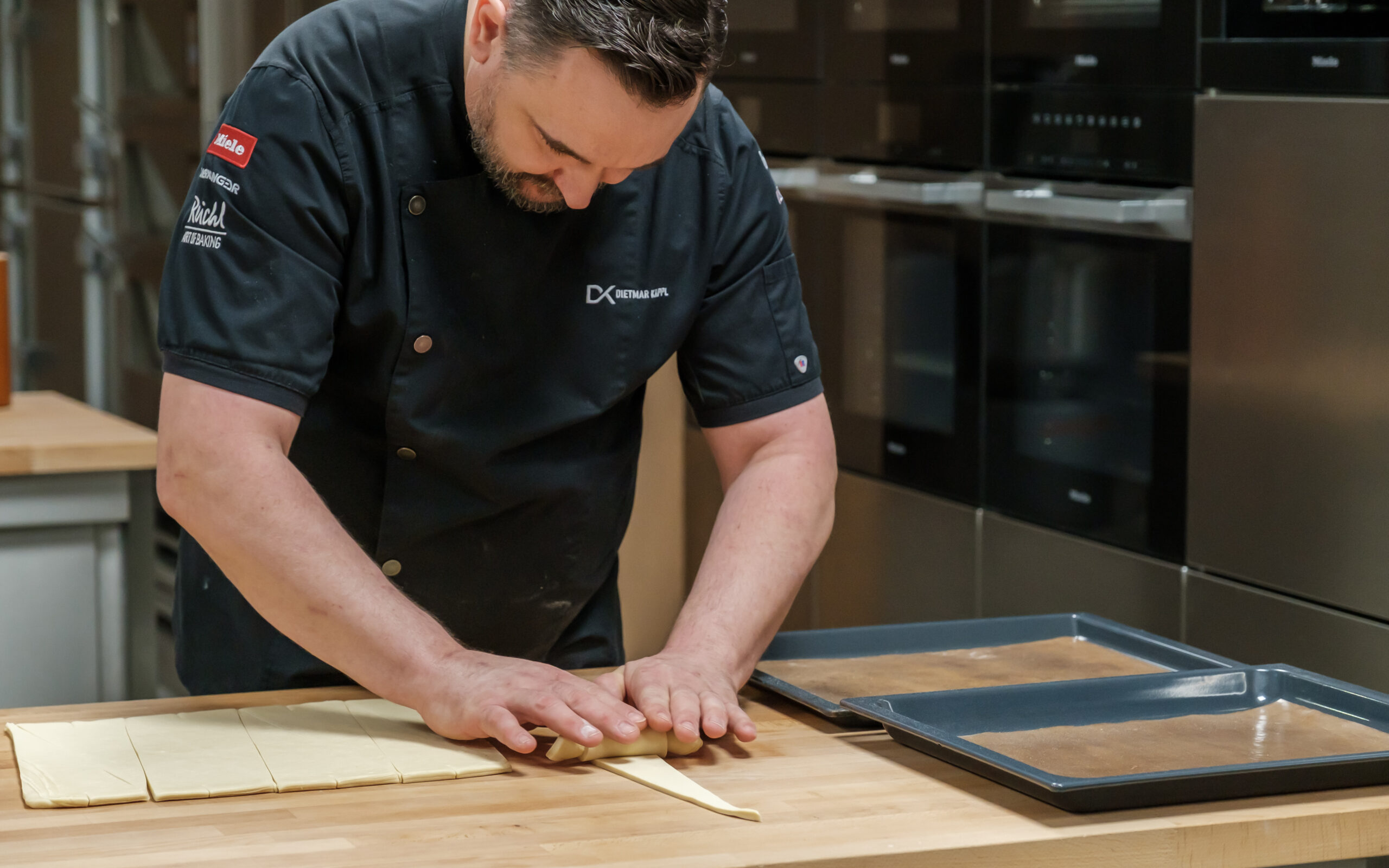
Im neuen Viennoiseriekurs dreht sich alles um feine Gebäcke, die für ihren zarten, buttrigen und unnachahmlichen Geschmack bekannt sind. Ich zeige dir, wie du Croissant-Teig meisterhaft von Hand laminierst, um das perfekte Buttermuster zu erzeugen. Aber das ist längst nicht alles!

Was erwartet dich im Kurs?

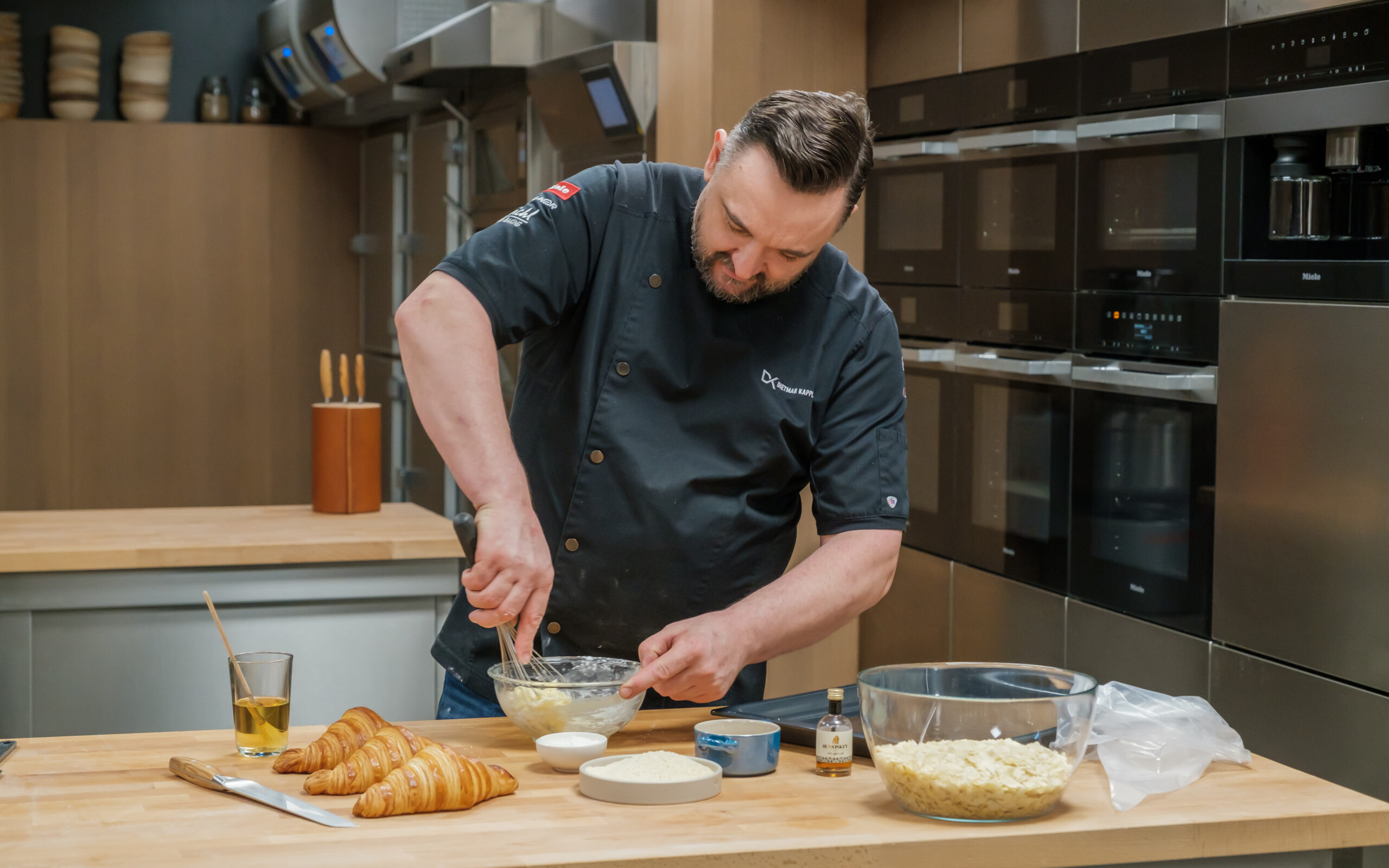
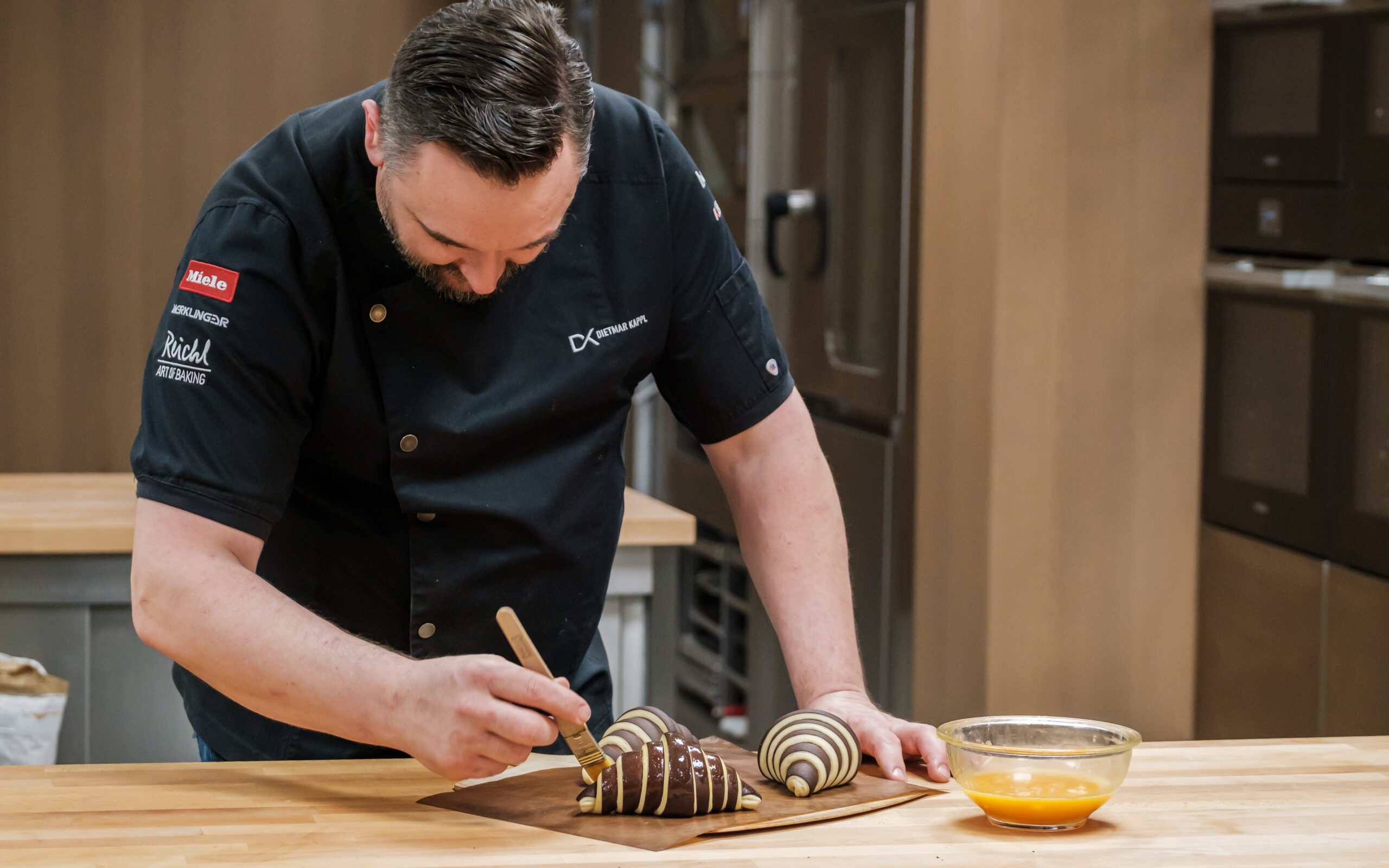
  • Croissant-Variationen: Lerne, wie du klassische und kreative Croissants in verschiedenen Formen herstellst, die garantiert alle begeistern.
  • Swiss, Cruffins und New York Rolls: Diese innovativen Gebäckideen sind der neue Trend am Backhimmel – und du kannst sie bald selbst backen!
  • Französischer Blätterteig: Ich verrate dir meine besten Tipps, wie du den perfekten französischen Blätterteig zubereitest – schichtreich, buttrig und luftig. Das Besondere daran: Die Butter wird außen und der Teig innen laminiert, für ein besonders zartes Ergebnis.
  • Französische Brioche: Ein Klassiker, der durch seine lockere, weiche Konsistenz überzeugt.
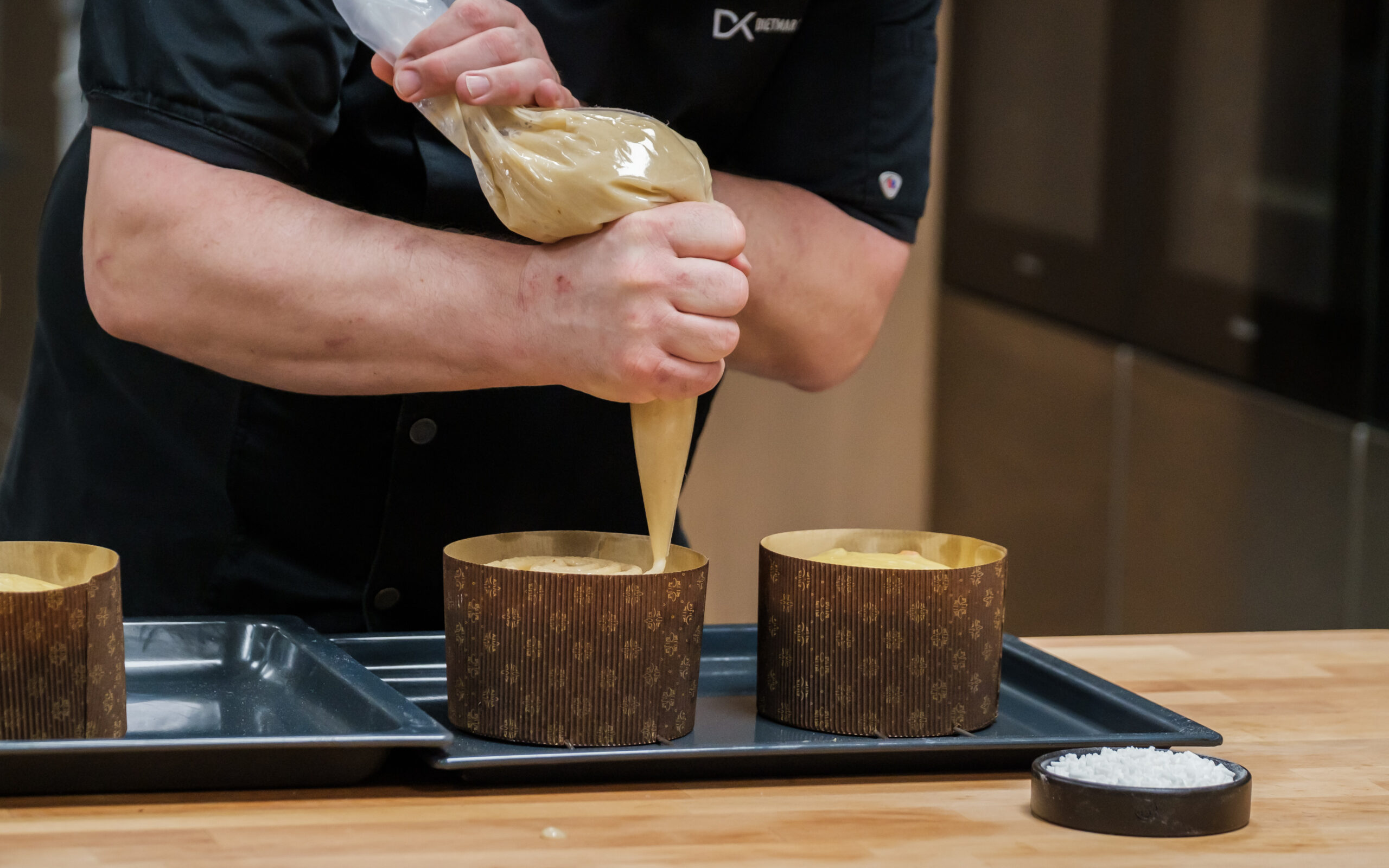
  • Panettone – die Königsklasse: Dieses anspruchsvolle italienische Festtagsgebäck ist das Highlight des Kurses. Schritt für Schritt zeige ich dir, wie du Panettone perfekt hinbekommst – von der Teigführung bis zum Backen.

Tipps und Tricks zur Hand-Laminierung

Im Kurs lernst du, wie du Croissant-Teige und französischen Blätterteig von Hand laminierst – ganz ohne Maschine. Das richtige Laminieren verleiht deinem Teig die perfekte Textur und sorgt für das unverwechselbare Buttermuster. Ich zeige dir alles Wichtige: von der richtigen Teigtemperatur bis hin zur perfekten Laminierung.

Ich freue mich schon sehr, dich auf dieser kulinarischen Reise zu begleiten und bin gespannt, welche köstlichen Meisterwerke du erschaffen wirst!

Klick dich rein – du wirst begeistert sein!

❌