Newly released NYPD body-camera footage showing the aftermath of an immigration enforcement shooting in New York City has intensified scrutiny of federal agents who shot a man with his 5-year-old son in the car.
The footage shows officers arriving Thursday in Marble Hill to find Oscar Belgal, 28, wounded, handcuffed and seated on the ground. NYPD officers rendered aid and rushed him to a hospital. Police later located his unharmed son with a family member.
Mayor Zohran Mamdani condemned the shooting in an initial social media post, saying Immigration and Customs Enforcement agents had shot a New Yorker while his child was in the vehicle.
This afternoon in Marble Hill, a New Yorker was shot by an ICE agent in a residential neighborhood. Early reports indicate agents surrounded him and a 5-year-old child in his car before firing multiple rounds. We believe the child was physically unharmed.
This is an unconscionable and incredibly serious situation. I have called the President; when we speak I will demand that he ends all ICE enforcement actions in our city. I will not stand by while ICE agents terrorize our communities.
Our thoughts are with the injured New Yorker and his family tonight. We are praying for his recovery.
Get ICE out of our neighborhoods. Get ICE out of our hospitals. Get ICE off our streets. Get ICE away from our children.
ICE defended the operation, alleging that Belgal, a Dominican national with a criminal record, accelerated his vehicle toward federal agents who feared for their lives. The agency also accused him of gang involvement.
On October 8, at approximately 4:00 PM ET, ICE officers were conducting a targeted enforcement operation in the Bronx, New York, to arrest a criminal illegal alien from the Dominican Republic with a prior criminal conviction for grand larceny, and multiple prior arrests for assault, robbery, possession of drugs, and weapons possession. He has associations to the Trinitarios gang, the same gang who brutally shot a CBP officer last year.
This criminal illegal alien was arrested by the NYPD on December 7, 2023, but was released into the community a few days later by reckless Democrat sanctuary policies that put American lives at risk.
During the incident, an ICE officer discharged his weapon and the criminal illegal alien was injured.
ICE officers immediately rendered aid. The individual is alive and at a local hospital. The FBI and HSI are on the scene. The incident remains under investigation. More information will be shared as it becomes available.
When dangerous illegal aliens are released back onto the streets by radical sanctuary politicians, our officers are forced to make arrests at large in the community in unpredictable and dangerous environments. Our officers should not have to risk their lives, and innocent Americans should not have to face unnecessary danger, because sanctuary politicians refuse to cooperate with federal law enforcement.
— U.S. Immigration and Customs Enforcement (@ICEgov) October 9, 2026
NYPD Commissioner Jessica Tisch said at least one federal agent fired seven rounds, striking Belgal in the neck. Surveillance footage shows armed, plainclothes officers approaching his vehicle but does not capture the shooting itself.
The incident sparked demonstrations across the city, including a Friday march from Foley Square to federal immigration offices in Manhattan.
Belgal’s attorneys said he was transferred to New Jersey after the shooting before being returned to federal detention in Brooklyn. A judge has restricted his transfer and temporarily blocked his deportation while his legal challenge proceeds.
New York Attorney General Letitia Jamescalled for a “full and transparent investigation conducted without fear or favor.”
The Bronx district attorney’s office is investigating. ICE has not publicly released its own body-camera footage of the shooting.
Diese Situation kennt wohl jeder Besitzer eines Heimcomputers zur Genüge: Da tippt man in stundenlanger Arbeit ein ellenlanges Listing ein, lehnt sich nach dem letzten »RETURN« einen Augenblick erleichtert zurück, gibt das magische Wort »RUN« ein – und natürlich läuft das Programm nicht so, wie es eigentlich sollte.
Dragon Con was held at multiple hotels and AmericasMart in downtown Atlanta GA from September 3-7, 2026. The Dragon Awards ceremony was held Sunday at 4:00 p.m. (See page 6 for the winners.) A fan-focused event with great attendance, Dragon Con also offered more than 30 event tracks, several of interest to SFF industry professionals. Panels included “Afrofuturism: Building the Future Now” with Afua Richardson, Dedren Snead (m), and Marcus Williams; “Not Quite the End of the World: Cozy Urban Fantasy” with Jarod K. Anderson, Delilah S. Dawson, C.B. Lee, F.T. Lukens, Carol Malcolm (m), and Tao Wong; and much more. Lauded SFF artists such as Tony DiTerlizzi and William Stout were also present, and guests included well-known SFF authors such as Kevin J. Anderson, Matt Dinniman, Sherrilyn Kenyon, K.A. Linde, Timothy Zahn, and more.
Dungeon Crawler Carl cosplayers with Matt Dinniman
A few professional editors and publishers were also in attendance, such as John G. Hartness, Anne Sowards, and Toni Weisskopf. The greatest challenge for industry professionals was finding each other amidst the crowds, but with an Art Show, Masquerade, and a dearth of vendors, exhibits, and workshops, the convention was full of enthusiasm and a sense of community.
My thanks to Sunnny for sponsoring this week at DF. How can B2B software be so friggin’ delicious? Find out when early access launches on Monday, October 19.
Benjamin Mayo (on X, of course), commenting on Apple promoting behind-the-scenes footage showing that the embroidered “Welcome Home” logo for next week’s keynote/experience was stitched by hand:
There needs to be a name for this phenomenon where every
published piece of art by a company is now accompanied by a
proof-of-human video.
I agree, and I think Mayo coined the term right there. It’s always been fun to see footage of talented artists and craftspeople making things by hand. But in the age of AI it’s a differentiator — not just that you aren’t lazily generating your art via prompts, but that you understand that heart comes from the human hand.
Audiophiles following the news cycle know by now that after seven years, AudioQuest has released a new DragonFly USB DAC. The DragonFly Copper (US$250, CAD$345) was spoken of at High End Vienna 2026 and started shipping in September, replacing the Cobalt at the flagship. As usual with a new Dragonfly, the forums and review sites lit up within days of the announcement (see sites like this, or this
President Donald Trump lashed out at the Nobel Peace Prize committee and its 2026 winner, South African human rights jurist Navi Pillay, declaring Friday night that he deserved eight prizes for his foreign policy accomplishments.
“I know nothing about this woman, and neither does anyone else!” Trump wrote in a lengthy Truth Social post. “I don’t know what the woman has done.”
Pillay, a former United Nations high commissioner for human rights, received the prize Friday for her decades of work advancing international law and accountability for atrocities.
“In actuality, I should have won 8 Nobel Peace Prizes, not just 1,” Trump wrote, listing conflicts involving India and Pakistan, Israel and Hamas, and six other pairs of countries or parties he claims to have brought to peace.
His assertion that he has settled eight wars is disputed, with some conflicts unresolved and his role in others contested.
Trump also accused Pillay of hating Israel, apparently referring to her leadership of a U.N. commission that concluded Israel committed genocide in Gaza. Israel rejects those findings.
Pillay’s career includes challenging apartheid in South Africa and serving on the International Criminal Tribunal for Rwanda, where she helped establish legal precedents recognizing sexual violence as an act of genocide.
Trump called the Nobel decision an “indelible stain on Norway” and accused the committee of being “Radical Ideologues who are Anti-Democracy, and Enemies of Civilization!” The committee operates independently of Norway’s government.
The president renewed his complaints Saturday morning, listing his diplomatic achievements and asking why neither he nor the United States received the award.
In mid-September, Chinese scientists announced a breakthrough in extracting hydrogen and fresh water from the ocean with about 15% better energy efficiency than older techniques. Their research, published in Nature Energy on Sept. 15, underscores that China continues to dominate in the renewable energy race, generating so much that the country can’t even use it all. As Reuters reported in August, “China turned away enough clean energy to power Mexico for a year in the six months through June as its grids hit their limits.” At the Fortune Leaders Forum in Macau on Sept. 8, Youyuan Huang, executive vice chairman of BTR New Material Group, the world’s top maker of battery anode materials, said “China’s grid is a very strong and stable one . . . but we’ve installed too much green energy.”
Boy, the U.S. could sure use some of that excess juice. Currently, this country is embroiled in a self-inflicted energy crisis, largely a result of President Donald Trump’s war against Iran, that is sending deep ripple effects across the globe as oil prices spike. In the U.S. alone, diesel prices have risen around 70% since before the war began on Feb. 28, hitting a record $6.52 on Sept. 22, and in the last two months, at least 16 trucking companies, both large and small, have been bankrupted. The world’s richest nations are trying to staunch the bleeding, recently vowing to release up to 100 million barrels of diesel and crude oil within four months. But on Monday, Amin Nasser, CEO of Aramco, the world’s largest oil company, cautioned that this is little more than a Band-Aid and that long-term supply issues remain. Until the Strait of Hormuz “fully reopens and confidence returns, the crude reality is that pressure at both ends of the barrel will intensify,” Nasser said at the Energy Intelligence Forum in London.
Some “crude reality” would be another nice-to-have for those helming U.S. policy. The rising fury against the war and high energy prices threatens to clobber Republicans in the midterm elections. So the Trump administration is frantically trying to drive down diesel prices, first by floating the idea of banning exports. This tactic, criticized as “unwise” by some oil executives, has been abandoned for now, but at a Monday rally in Nebraska — where Trump also seemed to promote the idea of Iran attacking two California cities — he signed an executive order promoting the use of red-dyed diesel. Normally reserved for agriculture operations, red diesel is exempt from highway fuel taxes, but experts caution that expanding its use probably won’t help much because major fuel suppliers are unlikely to go along with it. For one, the taxes are only deferred, meaning companies could end up paying them later. But red dye, when used, can also gum up tanks and fuel systems. “We do not expect most reputable diesel retailers and fuel marketers to do this,” the Society of Independent Gasoline Marketers of America and the National Association of Truck Stop Owners said in a note to their members, citing “limited upside.”
On Friday, Trump announced his latest bid to reduce prices: buying oil from Russia. Shortly afterward, the Treasury Department issued a temporary license allowing Russian diesel to be supplied to the global market. Though details were scarce, this undermines the president’s own sweeping Russia sanctions law he signed last month. Regardless, it doesn’t look like it will do much to lower prices. “It’s kind of shuffling deck chairs on the Titanic,” Michael Lynch of the Energy Policy Research Foundation, told the Associated Press. “If we get diesel from Russia, basically it means that their existing customers are not going to get it and they’ll have to go somewhere else, and that will keep the price basically where it is now.”
With diminishing options — besides the obvious one of ending the Iran war immediately, which Trump can do whenever he wishes — the administration’s primary strategy is to blame everyone else. On Monday, he repeated claims on social media that Ukraine is most at fault for high oil prices thanks to their continued attacks on Russian oil refineries, and that “What’s driving up gasoline is no longer the Strait of Hormuz.” The president also said the closure of oil refineries in “blue states” is part of the problem.
With diminishing options — besides the obvious one of ending the Iran war immediately, which Trump can do whenever he wishes — the administration’s primary strategy is to blame everyone else.
Energy Secretary Chris Wright has also spread these claims, appearing Oct. 4 on “Face the Nation” to blame Ukraine and California Gov. Gavin Newsom, the latter for closing two refineries. (In fact, Newsom had nothing to do with the refinery closures.) Wright insisted that fuel prices will drop soon, as Trump has been claiming for months now. He also said that Trump was warned before attacking Iran that it might create an energy crisis — “he was well aware of the risk to energy flows that were coming out of the Persian Gulf region” — but the president insisted it would all be worth it to stop Iran from getting a nuclear weapon.
Wright has been especially busy lately trying to instill a sense of optimism around the energy sector, dismissing climate change as a non-issue while laundering Trump’s vision of “energy dominance.” All of this is remarkably myopic. Half of it is an artificial war against renewable energy projects, including the cancellation of almost $8 billion in Biden-era clean energy grants, and using specious claims about “national security” to cancel offshore wind projects. The other half is accelerating oil, gas and coal extraction while slashing protections for endangered species threatened by drilling in the Gulf of Mexico. But here’s the rub: Neither approach has made fuel cheaper, and it doesn’t seem that will change any time soon.
There’s little wonder why: Wright founded Liberty Energy in 2011, one of the fossil fuel giants that led that decade’s fracking boom, and he has attacked renewable energy projects almost as enthusiastically as Trump, saying they can never fully meet increasing energy demands. China and other countries have conclusively proved that false, but it’s not an either-or situation. Despite being the world’s No. 1 renewable energy producer, China is also rapidly expanding its coal industry. “The growth of renewable electricity is not incompatible with maintaining, and sometimes developing, fossil-fuel capacity,” science and technology historian Jean-Baptiste Fressoz explains in his 2025 book “More and More and More: An All-Consuming History of Energy.”
In other words, human energy consumption is rising so fast that we’re continuing to grow all energy sectors rather than entirely replacing fossil fuels with renewables. (That’s not great news for the climate, of course.) But only the U.S. is leaning quite so hard into 19th-century fossil fuels instead of 21st-century solutions.
Why would the Trump administration push so hard for retrograde technology? Perhaps it’s time to admit that the president actually has no interest in driving down consumer prices or the cost of living, let alone ending the war, whether it hurts his party’s electoral chances or not. Trump is deeply invested in oil and gas companies, which have enjoyed obscene profits throughout the conflict. As Reuters reported in late September, “The five largest Western oil companies — BP, Chevron, ExxonMobil, Shell and TotalEnergies — are expected to report combined third-quarter profits of around $53 billion, according to RBC Capital Markets estimates, up from $48 billion in the second quarter and more than double year-earlier levels.”
Trump has caught plenty of these profits, with an August report from the Joint Economic Committee finding that the president “owned as much as $45.6 million in oil and gas company stocks in 2025, a portfolio that is now worth as much as $61.1 million given the surge in oil and gas stocks driven by Trump’s war in Iran.”
No wonder Trump continues to hint that the Iran war will heat up again after the midterms: He has a vested interest in keeping it going and inflating gas prices, so maybe it makes sense to call his bluff here. After all, truckers may be dropping more than $1,000 every time they fill up, or losing their jobs entirely, but the ultra-rich aren’t feeling much stress from all this. They are well positioned to buy up bankrupt trucking companies and jack up prices, further consolidating their monopolistic or oligarchic power. It’s the classic “shock doctrine,” in which corporations exploit disaster conditions, created intentionally or not.
It would be more sensible to follow China’s lead on renewable energy, just as it would probably be smart to retreat on Iran rather than get entrenched in another forever war. But that just wouldn’t generate such spectacular windfall profits for Trump or those in his orbit. The solution is to nail these people to the consequences of their decision. They don’t want to end this crisis, so we must make them.
Larry bittet zum letzten Tanz: Publisher Assemble Entertainment hat über Steam bekannt gegeben, dass die beiden Spiele Wet Dreams Don't Dry (Test auf GG) und Wet Dreams Dry Twice (Test auf GG<
The American presidency is one of the most stressful jobs there is. Presidents famously age during their terms, often starting off looking hale and hearty and, by the time they’re finished, appearing tired, more lined and a whole lot grayer than when they started. So it’s understandable they would need to recharge by getting away from Washington from time to time.
Donald Trump has made a habit of this, regularly jetting to his Mar-a-Lago estate in Florida, and his golf club in Bedminster, New Jersey, for extended periods of time in lieu of Camp David, the famous presidential getaway nestled in Maryland’s Catoctin Mountains. Now, according to a recent report by the Washington Post, he is seeking to create a permanent official presidential retreat in Florida at his Trump International Golf Club in West Palm Beach.
This would be an unprecedented move, even though it isn’t unusual for presidents to crave time away from Washington. According to the White House Historical Association, many of the early presidents left the White House in the summer because they believed that the white fog that formed on the nearby marshes was a deadly white gas; they wanted to get away for their health. In fact, James K. Polk is the only president to have stayed in the White House for each of the three summers he was president, and since he died shortly after leaving office, his fate was attributed at the time to those white gases.
Presidents, of course, have to keep working wherever they are. Some have wanted to escape Washington’s notorious humid summers, while others longed to flee the cold and create a “winter White House” in warmer climes. Harry Truman reportedly liked his Key West winter home so much that he called it the “Little White House” and spent 175 days of his presidency there. Richard Nixon was also fond of Florida, but he also frequently jetted back to his native California, as did Ronald Reagan. George W. Bush spent as much time as possible at the West Texas ranch he bought just before assuming the presidency.
The first official presidential retreat was the Old Soldiers Home, which was commandeered by President James Buchanan as a summer getaway since its location in leafy Northwest Washington was cooler and quieter than the White House. It was subsequently used by Abraham Lincoln and his family, and he was said to have written the Emancipation Proclamation there. Some subsequent presidents enjoyed the retreat as well, but it was soon out of fashion as they began to travel further afield for their vacations.
From 1880 until 1977, when President Jimmy Carter sold off the last one, there was always a presidential yacht for the chief executive to unwind on and entertain guests, but there wasn’t another official presidential retreat until 1942, when President Franklin Roosevelt visited a Works Progress Administration project in Maryland called Camp Hi-Catoctin and selected it as the location for a future presidential retreat he dubbed Shangri-La. Roosevelt used the property to relax, but he also saw it as a perfect place for high-level diplomacy. His successor, Harry Truman, made it a permanent federal facility and then, after he took office in 1953, Dwight Eisenhower renamed it Camp David in honor of his young grandson. Since then, the property has been the site of many meetings with foreign leaders, including the diplomatic negotiations hosted in 1978 by Carter between Egyptian President Anwar Sadat and Israeli Prime Minister Menachem Begin that culminated in the Camp David Accords.
Its location — just a 30-minute helicopter ride but many spiritual miles away from the White House — makes it a convenient spot for important domestic matters to be dealt with outside the bustle of the White House. Richard Nixon famously fired his trusted aides H.R. Haldeman and John Ehrlichman at Camp David in 1973, while 12 years earlier John F. Kennedy received counsel there from Eisenhower after the Bay of Pigs disaster.
While some presidents have clearly enjoyed Camp David more than others, Trump has made no secret of his deep dislike of it. He has used it only rarely, and the one time he has been known to propose having any high-level talks there was in 2019 when he inexplicably invited Taliban leadership to join him there just days before the anniversary of Sept. 11, a meeting which was mercifully cancelled after the group killed an American in a car bomb attack in Kabul.
Even on his official trips, if he’s unable to return home Trump will sleep at one of his own hotels, a move that is always profitable for him personally since the government pays for much of the huge entourage trailing the president.
Trump only wants to visit his own properties. According to the independent watchdog Citizens for Responsibility and Ethics in Washington (CREW), as of June the president has spent 37% of his second term at his own properties, with Mar-a-Lago receiving the most visits. Even on his official trips, if he’s unable to return home Trump will sleep at one of his own hotels, a move that is always profitable for him personally since the government pays for much of the huge entourage trailing the president. In fact, one of the perks Trump has given himself is that his various winter and summer retreats are also his commercial properties, and his visits not only promote the properties, they also provide opportunities for paying customers to have access to the president. His behavior has become so commonplace that few even remark anymore that the president lives a good part of the time at clubs with members who pay hundreds of thousands of dollars to spend time in his presence.
The grift will apparently continue even after he leaves office. Trump recently announced that his proposed presidential library in Miami will double as a hotel, making it yet another profit center for the family. (He is also being sued by various interested parties who are upset that he was given the valuable land, worth a reported $330 million, for only $10 by Florida Gov. Ron DeSantis, with the understanding it would be used for a nonprofit organization.) Now he has big, unprecedented plans for the new Camp David.
According to the Washington Post, “a parcel” of his West Palm beach golf resort will “be designated a permanent, official sanctuary for foreign leaders and future U.S. presidents, designed to host international summits and house presidents when they take vacations in Florida.” Trump’s generosity is such that he also plans to throw in complimentary members for presidents. It’s obvious that there is a lot of money to be made, which will be accompanied by ongoing access to him and his family. If foreign dignitaries were there to meet with the president and take in some golf, you can imagine that Trump would be at the club next door waiting to hold court. As Rick Reilly, author of “Commander in Cheat: How Golf Explains Trump,” told the Post, “I suppose he wants to make a power play with these people and show them who is the king of America.”
Trump claims there would be no cost to the government, since he plans to pay for the housing himself. But as we’ve seen with the rapidly increasing costs to American taxpayers for his ballroom money pit at the White House, that’s unlikely to be the case. Taxpayers will almost certainly be on the hook for many millions, if only for the enhanced security that would be necessary. After all, this is the golf course where a would-be assassin was caught last year hiding in the bushes.
Trump leases the land for the golf course from Palm Beach County, which is seriously considering his proposal. If it is approved, the only course of action for the administration that follows Trump is to offload it — just as the federal government did with Mar-a-Lago after the socialite Marjorie Merriweather Post left it to the government when she died in 1973 to serve as a winter White House. Eight years later, citing exorbitant annual maintenance costs, the government returned the property to the Post Foundation, which put it for sale in 1985 before it was bought by Trump.
No name has been chosen for the property. But I don’t think there’s any mystery about what it’s going to be, do you?
CNN and Politico have been banned from traveling with the press pool on Trump trips. | Oliver Contreras/AFP via Getty Images
On his first day back in office in January 2025, President Donald Trump signed an executive order “restoring freedom of speech and ending federal censorship.” More than a year and a half later, his administration is instead busy using government power to go after speech it dislikes.
Last year, Federal Communications Commission chair Brendan Carr urged broadcasters to take action against Jimmy Kimmel over his comments following Charlie Kirk’s killing, and in September, Kimmel said the FCC again intervened to stop Kimmel’s late-night show from airing an interview with James Talarico, Democratic Senate candidate for Texas.
Also last month, Trump barred three news outlets — CNN, MS NOW, and Politico — from the White House over their coverage. That ban was quickly blocked by a federal judge, but both CNN and Politico have since been banned from traveling with the press pool on Trump trips.
Outside of the White House, the fight over free speech is also raging on college campuses. In states like Texas, Republican lawmakers have restricted when students can protest and given governor-appointed university boards more say over what gets taught. In 2025, 15 states passed laws that restrict what can be taught or weaken protections for free expression on college campuses.
To break down what all of this means for the state of free speech in the US — and the future of our First Amendment rights — Today, Explained co-host Noel King spoke with Greg Lukianoff, president and CEO of the Foundation for Individual Rights and Expression (FIRE).
Below is an excerpt of their conversation, edited for length and clarity. There’s much more in the full podcast, so listen to Today, Explained wherever you get podcasts, including Apple Podcasts, Pandora, and Spotify.
How would you describe the kind of status of free speech on campus these days?
The status of free speech is in great peril, both on and off campus. I’ve been doing this for 25 years, and it’s about as bad as I’ve ever seen it.
When it comes to the Charlie Kirk backlash cases, we saw about 90 of them. It’s a remarkably high number. We saw an ex-cop go to jail for 37 days just for forwarding a Trump meme in response to a request to go to a candlelight vigil for Charlie Kirk. It’s not good.
If you look at the last two years, we’ve done so many episodes about free speech concerns. There was Jimmy Kimmel; there’s CNN being banned from the White House.
It really does seem like we’re at a moment where so many different types of people claim that their speech is being restricted in so many different types of ways. What is happening in the country?
My worry is I’m very much a small-L liberal. I come from an old ACLU background. That’s where I interned in law school. I went to law school to do First Amendment law. I hyper-specialize in it. This is my passion.
For most of my 25-year career, you could rely on a civil libertarian aspect of the left and a libertarian aspect of the right that would often agree on almost nothing except for things like freedom of speech. And right now, I think we’ve become all culture war all the time, and we have more of a progressive left and more of a populist right.
The only way that you show you believe in freedom of speech is by saying, “I hate that guy, but I think you should have freedom of speech.” If you’re saying, “I think my side should have freedom of speech,” that’s just self-interest. That doesn’t even count.
All the worst people in history wanted free speech for their side. So I’m afraid we’re losing — or maybe even, I hate to say this dramatically, but maybe even have lost it as a shared value as a society.
Well, that’s quite grim.
Yeah. I’m feeling a little grim.
The Trump administration came into office with a promise. And I remember it sounding something like this: “The woke left went too far. They canceled people. They restricted speech. They got out of control. President Trump is going to come back in, and we are going to restore sanity to the country. And as part of sanity, that will include your right to freely express yourself.”
How do you square the promise versus what we’ve seen?
I think Trump is constantly frustrating everyone around him by being Trump. I think there probably were people in the administration who were like, “Yeah, we’re going to be pro-free speech.” And then Trump decides to declare — I mean, I think the recent White House press pool case is hysterical in a lot of ways because he had to get his team to give a sort of constitutional justification for why he was kicking out the press pool. But on Truth Social, he’s like, “It’s because of their viewpoint,” which is, by the way, something you can’t do under the Constitution.
“I’m hopeful for the long-term future of free speech, but in the short term, I’m worried.”
His instincts are very authoritarian. They’re very top-down. So maybe there were people in the administration who, in their heart of hearts, are good on free speech, but Trump isn’t. And it’s the reason why when it came to the new administration, there were a lot of people on the right, but also people on the sort of heterodox left who were like, “Oh, this is going to be good for free speech.”
I was like, “Don’t kid yourself, guys. This is going to be bad.” Although I will say, it’s even worse than I was expecting.
President Trump at some point will be out of office. And what happens then? What do you think? Is there an optimistic scenario where we’re like, “Okay, we’re kind of tired of this crap. Let’s just go back to the way it was in the ’90s”?
It has been cyclical, to a degree. American society gets out of whack, and usually one of the things that does bring us together is that we were lucky enough to have…I’ll just say it, we have a brilliant Constitution. It is unusually clever about human nature, and the Constitution itself — you can have whatever opinion you want about the founders, but it is something to be proud of. And a lot of times those values kind of bring us back together.
That’s my hope. But another thing I will say about Trump: He has played havoc with my ability to predict anything. So what it’s going to look like over the event horizon of 2028, I hope it will be better, and we will fight like hell to make sure it’s better here at FIRE, but will it be better? I’m not sure, and it definitely won’t be better if we think of free speech as something that belongs to my side, not yours.
One of the reasons why I do have hope for free speech in the long term is that free speech works really well. It’s how you know what your fellow citizens think. It’s how you get ideas out there. It’s how you actually be your authentic self.
Societies that actually have freedom of speech are always going to have advantages, real and serious advantages, over ones that don’t. So I’m hopeful for the long-term future of free speech, but in the short term, I’m worried.
Francesca Hong, a representative in the Wisconsin State Assembly, poses for a photo with a supporter in Racine, Wisconsin, on July 19, 2026. | Sara Stathas for the Washington Post via Getty Images
The Wisconsin gubernatorial race was one of the most closely watched Democratic primaries in the country this year, pitting a democratic socialist, state Rep. Francesca Hong, against Milwaukee Democrat David Crowley, who received the endorsement of the state’s sitting Democratic governor, Tony Evers.
Hong lost the race, setting up Crowley to face Republican Rep. Tom Tiffany in the general election this fall. But she’s already back on the campaign trail, this time trying to help Democrats win a trifecta in the state: the governor’s race and both legislative chambers.
Unifying the state’s voters to achieve that won’t be easy, though. Hong spoke with America, Actually host Astead Herndon about her own loss, Evers’s role in it, and whether or not the voters who felt so passionate about her own campaign would find enough to love in Crowley’s campaign — in particular on the increasingly important issue of data centers.
Astead and Hong also talked about what Wisconsin means for the Democrats nationally, and what lessons the party should take from her race, including her loss.
“I said this, and I will continue to say it — the person who is most electable is the person who ended up getting the most votes, and that was Crowley this time around,” Hong said. “But I think there’s a disservice when you have the most powerful Democrat in the state choosing to ignore a lot of voters and people who were inspired and energized and coming out to participate in politics for the first time through our campaign. I think it was shortsighted to use electability almost as a fear tactic.”
Below is an excerpt of Astead’s conversation with Hong, edited for length and clarity. There’s much more in the full show, so listen to America, Actually wherever you get your podcasts or watch it on Vox’s YouTube channel.
Part of the reason we wanted to come here was because we saw you were getting back on the campaign trail, and specifically around that idea of energizing Wisconsin toward a trifecta.
Now, just tell me the difference in terms of the importance of Democrats winning it all — not only the governor’s mansion, but both houses of the state legislature — versus just the governor’s mansion. How does that change the possibilities of what the party could do?
For the last 16 years, a Republican majority in the state legislature has meant that passing the types of policies that we know can drastically improve the lives of everyday folks here in Wisconsin stalled. And we have a historic opportunity to flip the assembly and the state Senate and hold the governor’s mansion and the entire executive branch to a Democratic majority, meaning the opportunity to pass the policies that the majority of our state supports — things like increasing minimum wage, things like legalizing marijuana, codifying abortion.
We also need to repeal Act 10 [which dramatically restricted collective bargaining rights for public-sector employees]. Wisconsin is where workers’ rights, things like unemployment insurance, Social Security were born, and we moved backwards with the Republican majority. That’s all on the table with the Democratic trifecta.
It also, though, raises the political standard of what Democrats would have to do to achieve that, and some of it goes through these more rural communities.
Why do we think the party has fallen behind in more rural communities, and what could be done to reverse that?
I think it’s important to look at what’s happened in the rural communities when we’ve seen manufacturing jobs leave the state, when we’ve seen fewer and fewer supports for our small farmers.
And so much of this — what connects it — is actually the growth of massive wealth and corporate control and corporate greed, and more people feeling the impacts of that. There’s an opportunity right now to say, ‘Hey, Republicans have been in the legislature, they’ve been in power, and things have not improved for you or your community … Now’s the opportunity to make sure that we’re actually able to see our shared Wisconsin values of working hard and taking care of our kids be reflected back in Madison through laws.’
So much of your campaign was focused on data centers, stopping data centers. Should I think of that as a rural issue?
I think the issue around data centers is an everyone issue. It’s a democracy issue. It’s people wanting to feel like there are folks who care about what happens to communities, and that they have control and an actual say in what happens in their communities.
To that point, is it a mistake for David Crowley, the Democratic nominee, to have not gone as far as you did and say, “We won’t be building more data centers for a period of time”?
He’s fighting for communities and community control when it comes to data centers.
But it’s not a moratorium.
But it’s not a moratorium. It isn’t, but he’s also committed to 100 percent renewable energy, clean energy to power data centers.
And achieving that is going to be incredibly difficult, and it is going to be the developers having to pay their own way, and these are things that he’s committed to that we know can slow down the growth and development of data centers.
Have you had time to reflect on your primary loss? If you had to diagnose, why do you think you lost?
I’m still doing a lot of reflection. But I think that I want to continue to look forward. And what I’ve learned from our election is that it’s so important to continue to stay grounded in becoming accessible to people. I think that as an organizer and an elected official, it’s my responsibility to continue to go to the people and remain very in touch with what’s going on on the ground.
I have a couple more questions about the nature of the loss. Evers’s endorsement changed that race, so much so that your opponent David Crowley was able even to win in some smaller communities, like places where you were pitching yourself as the voice of more rural communities.
Does that disprove any of this thesis around, say, data centers? If that was the top priority for Wisconsin voters, wouldn’t you be the nominee?
I think it wasn’t all rural communities. It wasn’t all suburban communities. We saw certain demographics but also ZIP codes where we outperformed David significantly.
And I think that where the governor’s endorsement played a bigger role was areas where he was also more popular.
Did it surprise you when Evers endorsed Crowley?
I was disappointed.
Why?
I was disappointed because I was getting a lot of feedback from folks who hadn’t committed to any candidate yet that this felt like the governor was putting his thumb on the scale.
I wanted to ask about electability, because it seemed as if Evers’s endorsement was about a fear that maybe you couldn’t win in November.
So much of the primary concern was around the DSA label, even campaigning with folks like Hasan Piker. In retrospect, was any of that a mistake?
We knew going in that we would have to encourage new voters to come out, folks who typically do not come out for primaries, quote-unquote low-propensity voters. And we knew that we would have to campaign in places where folks weren’t expecting to see a gubernatorial candidate. And those included Twitch streams.
Those also included going to dive bars and bowling alleys and making sure that we were accessible and shaping our policies based on what the people were telling us they wanted to see happen and also what they wanted to see out of their governor. I think electability… I said this, and I will continue to say it — the person who is most electable is the person who ended up getting the most votes, and that was Crowley this time around.
But I think there’s a disservice when you have the most powerful Democrat in the state choosing to ignore a lot of voters and people who were inspired and energized and coming out to participate in politics for the first time through our campaign.
I think it was shortsighted to use electability almost as a fear tactic, when Democrats need to be inspiring and project a vision where everyone can see themselves in it as everyday working-class folks.
When you’ve got a party that has struggled with elitism to then cave to an establishment narrative … being more afraid of labels when I’m hearing from people on the ground that they’re interested in solutions and solving problems, maybe somebody who knows the hustle of the service industry and running restaurants and has worked across the aisle to pass bipartisan legislation. There are ways that we can maneuver around labels and what the loudest narrative might be.
I wish our governor hadn’t fed into that.
To be fair, to your point, the establishment label doesn’t fully fit even someone like Crowley, who comes from a working-class background. But am I hearing that you think Evers’s move made your life in the general election more difficult?
Is it harder to re-inspire if young people who are invested in the Hong campaign think that the establishment squashed them out?
We still had over 300,000 votes. We lost by fewer than 4,000 votes. I had more votes than Evers did during his primary. That’s not squashing our voices.
We’re still here, and it’s so important that people find avenuesto continue to exercise their voice and their new organizing power. And I’m definitely going to continue to work to make sure that we get results and that we win the trifecta, and that’s the most important thing we should be focusing on right now.
I hear why a trifecta matters in the state context, particularly the state policy.
If I’m someone, though, who’s not in Wisconsin, who’s just worried about Donald Trump running amok in Washington, why should I care if Democrats win the governor’s mansion and the state legislature? Does that matter for folks outside of the state?
Because we will start to see that when you feel government actually working and you see change happening in your lives, these are then voters who are going to continue to come out and vote for Democrats.
We’re a pivotal state when it comes to the federal elections as well. We’re actually in a swing district right now.
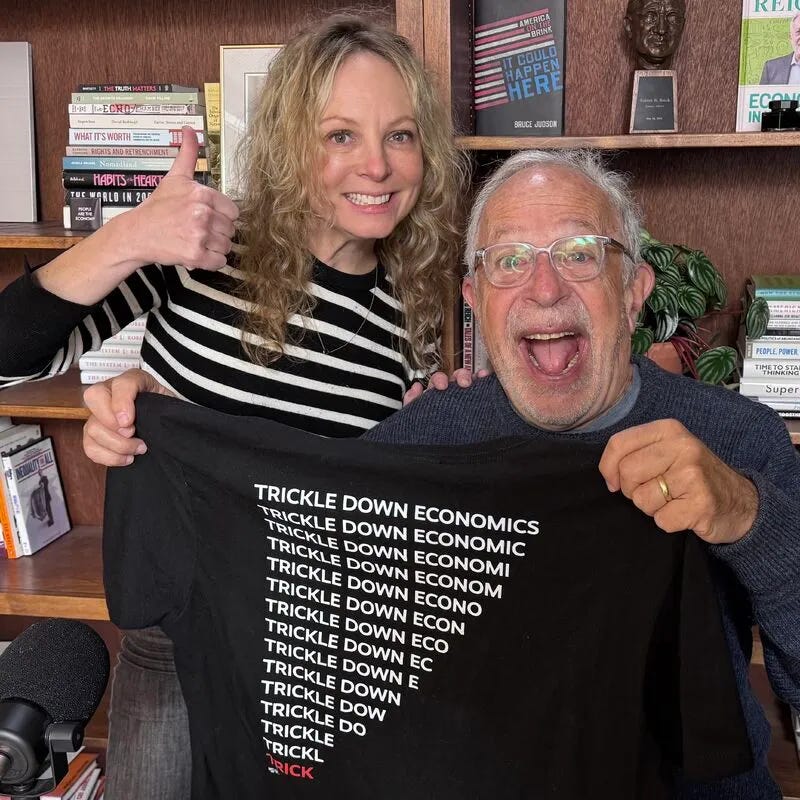
We have an opportunity, through Wisconsin, to actually start improving the brand for Democrats. And if we do that here, this trickles out to the rest of the country.
The premise being that delivering creates a connection for Democrats that is helpful in the presidential election, and it’s helpful in all these other ways too.
Yeah. We’re not going to be fighting every single midterm and presidential for our lives based on what’s happening in just one state.
But I think if we can start showing durable power for Democrats in a state like ours because of the policies that we’re prioritizing, and you have more folks coming out to vote for Democrats, that’s good for the health of democracy.
Today, Heather and I are joined by our colleague Vishal Shankar to review where the midterm elections now stand and the issues emerging from them. We take a deep dive into what Trump is doing to save — or, in reality, hurt — Republican Senate and House candidates, and what a Democratic Congress (if we get one) might realistically do.
Please pull up a chair, grab a cuppa, and join the conversation.
RR
P.S. Heather and I will be at UC Berkeley’s Zellerbach Hall at 6 p.m. on Wednesday, October 14 for a screening of The Work in Progress film followed by a Q&A. Please join us and invite your friends! Tickets ($5 for students) here.
Basic-Programme können nach drei Gesichtspunkten optimiert werden: strukturiert und lesbar, schnell sowie speicherplatzsparend. In diesem Beitrag wird der Aspekt der Laufgeschwindigkeit und ihrer Verbesserung behandelt.
Cruel enough that the United States is going to put someone to death by firing squad, but only sadists would want it broadcast livestream.
Yet that’s what Pete (“High Testosterone”) Hegseth is planning. He confirmed it yesterday when speaking to the conservative broadcaster Real America’s Voice, saying said people should be able to watch “because people need to understand that there’s serious consequences for these types of things.”
Nidal Hasan committed a terrible crime. The former U.S. Army Major and psychiatrist opened fire with a handgun at a medical facility at Fort Hood, Texas on November 5, 2009 as soldiers waited for medical checks before deployment, killing 13 and wounded 32 others. Twelve of those killed and 30 of the wounded were soldiers. Hasan was sentenced to death by a military jury in 2013 after being convicted of 13 counts of premeditated murder and 32 counts of attempted premeditated murder.
The execution will be the first by firing squad carried out by the U.S. military since 1945, when army private Eddie Slovik was executed for desertion during the second world war. The last US military execution of any kind took place in 1961, when John Bennett was hanged.
But live-streaming it?
The hanging of Rainey Bethea in Kentucky in 1936 is regarded as the country’s last public execution. It was witnessed by thousands.
A live-streamed execution could be watched by billions.
No surprise. The current president of the United States is all about spectacle; his secretary of defense (war) is brimming with performative bravado. Punishment isn’t enough. The punishment must be cruel — and must be seen far and wide.
Asked today whether he had personally authorized or approved the live-streaming of Hasan’s execution, Trump responded, “Did I approve? Absolutely.”
What will be the likely effect on those who will see this? Will they be revolted? Excited? Will the live-streaming of the execution by firing squad deter people from committing mass murder — or will it encourage them? Or just degrade our sense of being human?
What about its effect on those who are enemies of the U.S.? As Ned Price, a former deputy to the U.S. representative to the United Nations, posted on X: “You can take it from those of us who’ve spent years working on terrorism: the surest way to spawn more radicalized zealots is to glorify violence, embrace a cult of death, and create a martyr for the cause.
Besides, haven’t we witnessed enough senseless and degrading cruelty in the pursuit of the execution of Christa Pike in Tennessee?
Public executions have largely disappeared around the world because they’re so barbaric. Amnesty International recorded 17 in 2025, including 11 in Iran and six in Taliban-run Afghanistan.
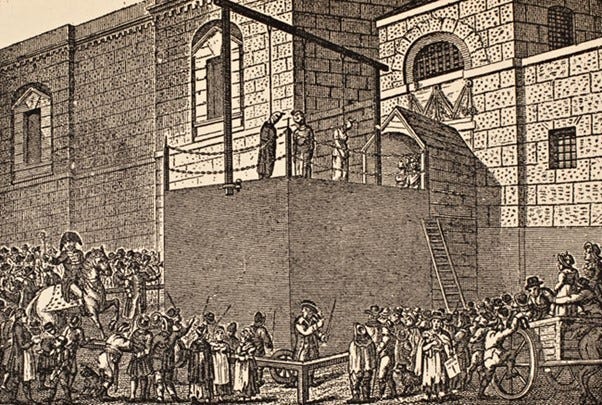
Historian Esther Cohen writes that during the later Middle Ages, governments often displayed their power in visual, theatrical forms: solemn royal or urban processions, festivals, and, most commonly, public executions of criminals. That was because other means of communication available to governments with their subjects were extremely limited — printing didn’t as yet exist, and preaching was the church’s prerogative.
Medieval public executions were intricate rituals displaying atonement, punishment and, most of all, the authority of the government to administer justice. They also inflicted considerable pain and suffering upon the condemned, so much so that one historian has termed them “spectacles of suffering.” The spectacles were meant to be visual representations of authority — displaying the full power of the law to all observers.
Making the criminal suffer achieved the dual purpose of cleansing his soul and deterring other potential criminals. Status was expressed by symbolic dress, worn at the procession preceding the execution, or by the form of inflicting death. Noblemen wore their livery of rank and office, while common criminals were often stripped to their shirts. People of rank were very rarely hung, for hanging was a shameful death; more often, people of nobility were beheaded, preferably with a sword.
Rulers took care to stage their public executions in a spectacular manner. The spectacle itself was its essence. “The Ritual of Public Executions,” from the 16th century, stated that the culprit was ‘to be dragged as a murderer, beheaded as a traitor, quartered for several other crimes, and his body hung on the gibbet as a thief and brigand.”
Trump and Hegseth are intent on extending such barbarism into the 21st century. Not only that, but they want to livestream the degrading spectacle, bringing it fully into the digital age. In this and countless other ways, they continue to degrade and demean America.
Defense Secretary Pete Hegseth speaks from a stage in Sparrows Point, Maryland, on October 6, 2026. | Win McNamee/Getty Images
This story appeared in The Logoff, a daily newsletter that helps you stay informed about the Trump administration without letting political news take over your life. Subscribe here.
Welcome to The Logoff: The Trump administration is planning a public killing.
What’s happening? On Thursday, the Pentagon announced that it would execute Nidal Hasan, a former Army major sentenced to death for a 2009 mass shooting on a military base, publicly and on livestream.
The execution, if it happens, would be unprecedented: The last widely reported public execution in the US was 90 years ago, in Kentucky, but to stream a death live would be something else entirely. Defense Secretary Pete Hegseth has promoted the announcement with something approaching glee, telling a reporter that “we’ll make sure that people are able to watch it.”
What’s the context? According to the Pentagon, Hasan will be executed via firing squad on December 3 — the first such execution by the military in more than 80 years.
Hasan, a former Army psychiatrist, was sentenced to death in 2013 by a military jury following a court-martial for the 2009 shooting, when he killed 13 people and wounded more than 30 at Fort Hood in Texas. The execution is set to be carried out at the same Army post.
Will the Pentagon go through with this? It’s unclear, for multiple reasons. The Pentagon’s announcement that Hasan’s death will be livestreamed has generated a great deal of bipartisan pushback, as well as condemnation by religious groups, though that is unlikely to stop the execution itself.
The head of the US Conference of Catholic Bishops decried the decision to livestream the execution as “a barbaric promotion of a culture of death,” and retiring Sen. Thom Tillis (R-NC) called it the decision “beyond disgusting.”
“Public executions are what oppressive dictatorships like Iran and Afghanistan do,” Tillis wrote in a post on X.
Hasan’s legal team could also delay the execution substantially — potentially for multiple years — by challenging his detention in federal court, though he has exhausted the military appeals process.
And with that, it’s time to log off…
The driest (non-polar) desert in the world, the Atacama in South America, was in full bloom late last month after record-setting rainfall. You can read more about the science behind the wildflowers here, or just enjoy some spectacular photos here (it’s a gift link). Either way, I hope it brings you some joy.
The Logoff will be off on Monday for Indigenous Peoples’ Day, so we’ll see you back here on Tuesday. Have a good long weekend!

 Login