❌

Normal view

★ HomeView Thoughts and Observations

17 October 2026 at 19:25

I’ll start with a nomenclatural sidenote: Apple seems to be going with “Apple HomeView” as the product’s name. E.g., the URL slug for it on Apple.com is apple-homeview/, not just homeview/. Few people notice and no one who doesn’t work in Apple product marketing cares, but they actually do the same thing with Vision Pro — in Cupertino, it’s “Apple Vision Pro” (once again including the URL slug). Yet this week’s new HomePod Mini is just “HomePod mini 2” and the existing 2nd-generation HomePod is just “HomePod (2nd generation)” — not “HomePod 2” or “Apple HomePod”. I certainly intend to just call it “HomeView”.

Apple introduced HomeView with a three-minute introductory film simulating a suburban family’s hectic before-school/work kitchen rush hour, with versions hosted on Apple’s site and YouTube. The most ridiculous aspect of it is that anyone would possibly make their kid French toast in that scenario. I’d have told my son to make his own goddamn French toast with that attitude. Or I’d have made a single serving and eaten it myself right in front of him. Bro.

I do think the basic concept is an intriguing idea. But as an implementation of that concept, my initial impressions are threefold. First, I am unconvinced that anyone in a family would use this for anything other than playing music or podcasts, rather than just using their phones. And if that’s the case, why not just have a HomePod? Apple’s video shows family members taking turns to use the HomeView, rotating it on the kitchen island to face themselves. Why? Why does the mom check her calendar on this, rather than on her iPhone, while the dad is using it to follow a French toast recipe? There’s a real “Why do we need this?” question here and I don’t think Apple’s video answers it, at all. You need to think you want it if you’re going to buy it. And even if you already had a HomeView set up, I’m not sure how often you’d use it instead of your phone, or instead of just talking to it like a screenless HomePod.

Second, all the touching and rotating — in Apple’s own demonstration — makes it seem awkward that HomeView must be tethered to a USB power cable. If you look closely in the video, they do show the USB power cable in some shots, but not many. And if you look really closely, this hypothetical family has drilled a hole in the center of their kitchen island to snake the cable through.

The hero shot introducing the product, of course, does not show the power cable at all:
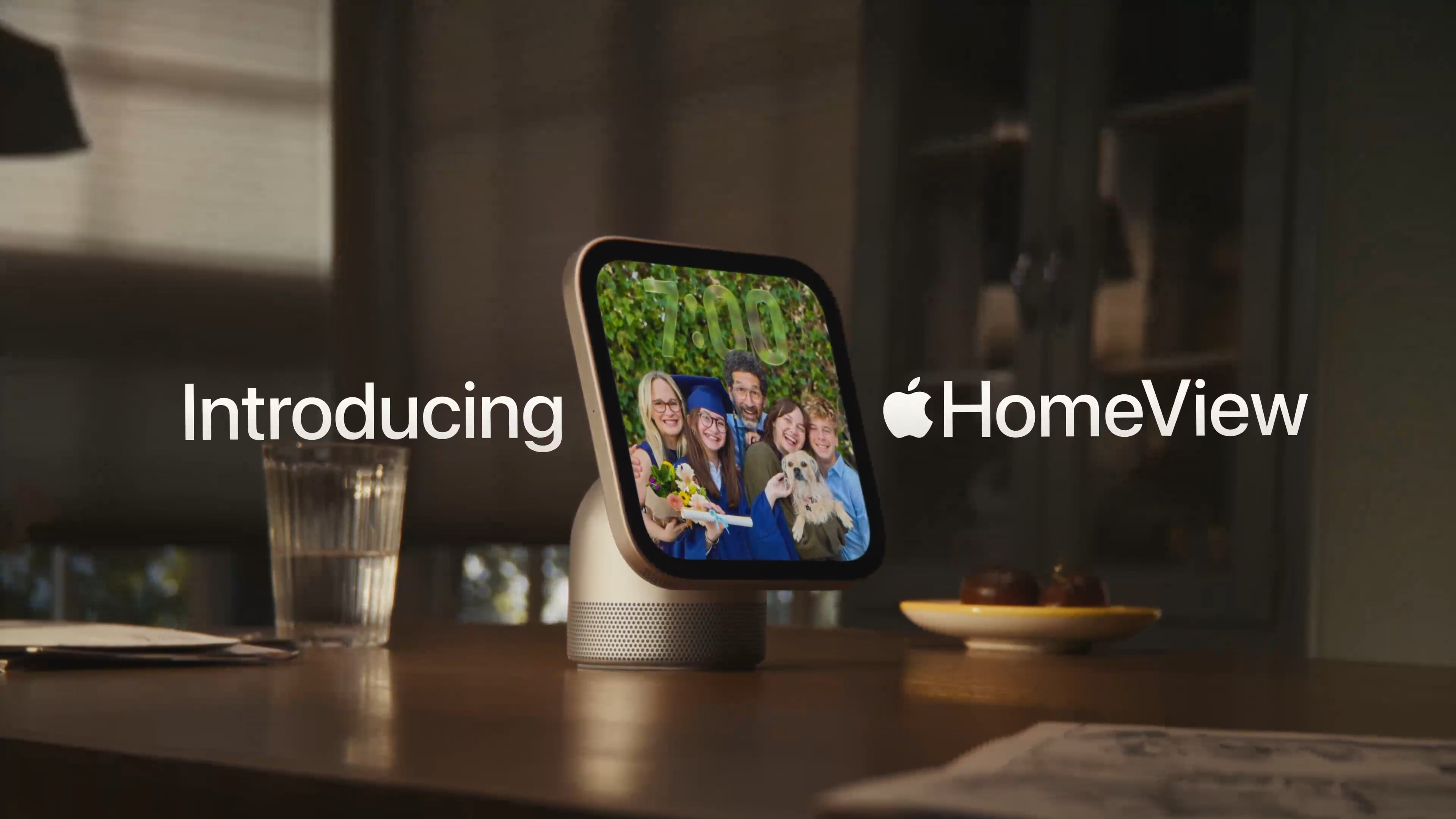
The “Introducing HomeView” title card shot from Apple’s video. It shows a HomeView sitting atop a kitchen island.

We see a wee bit of the cable when the dad reaches to touch the screen to start the French toast recipe:
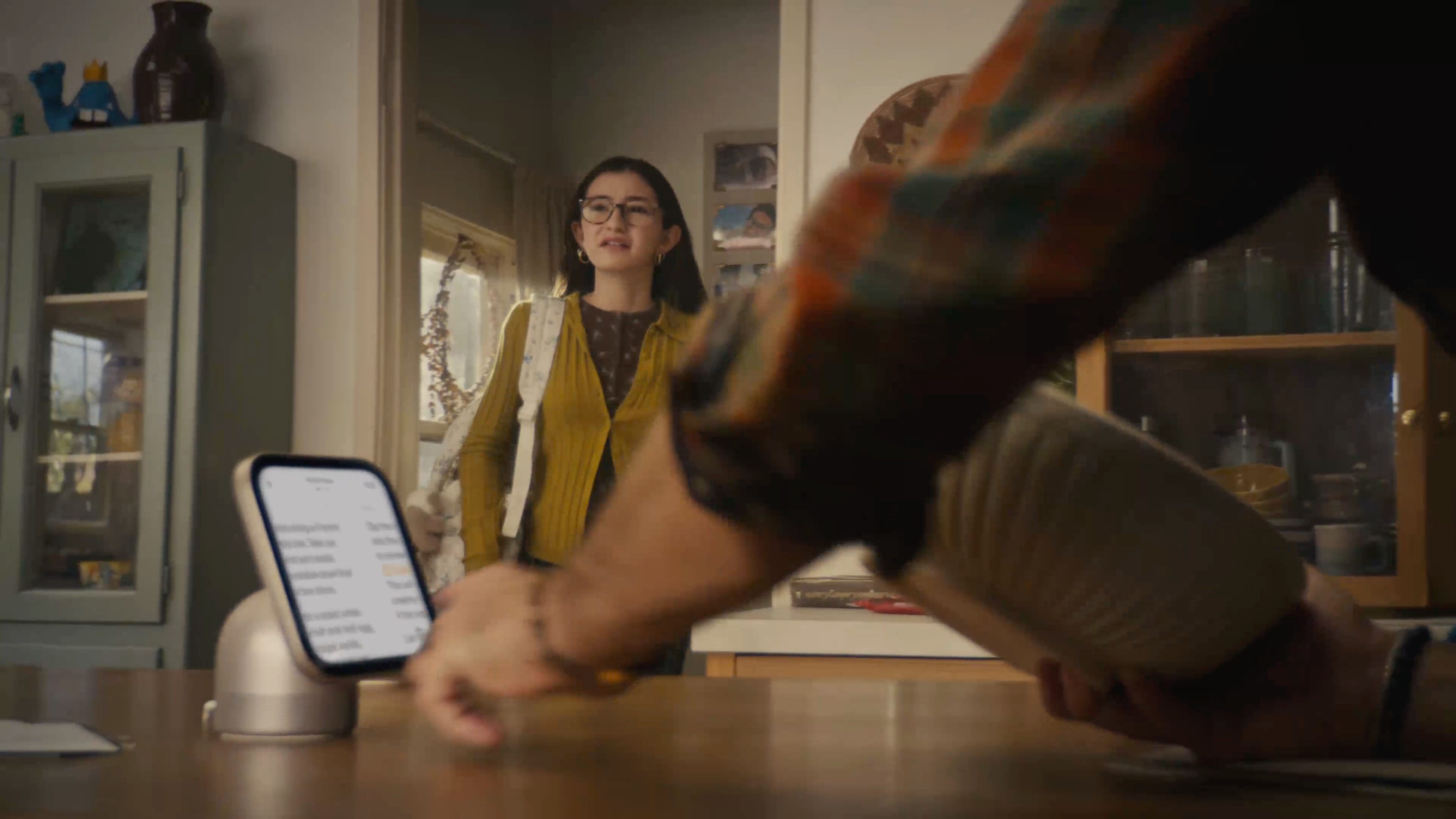
The HomeView, centered on the kitchen island, with about 2 inches of cable visible, disappearing into the island right behind the HomeView base.

And then a few seconds later, after the mom rotates the HomeView to the side, so she can check her calendar (despite the fact that she knows the dad was using it to follow a recipe), we get our most honest shot of the cabling situation:
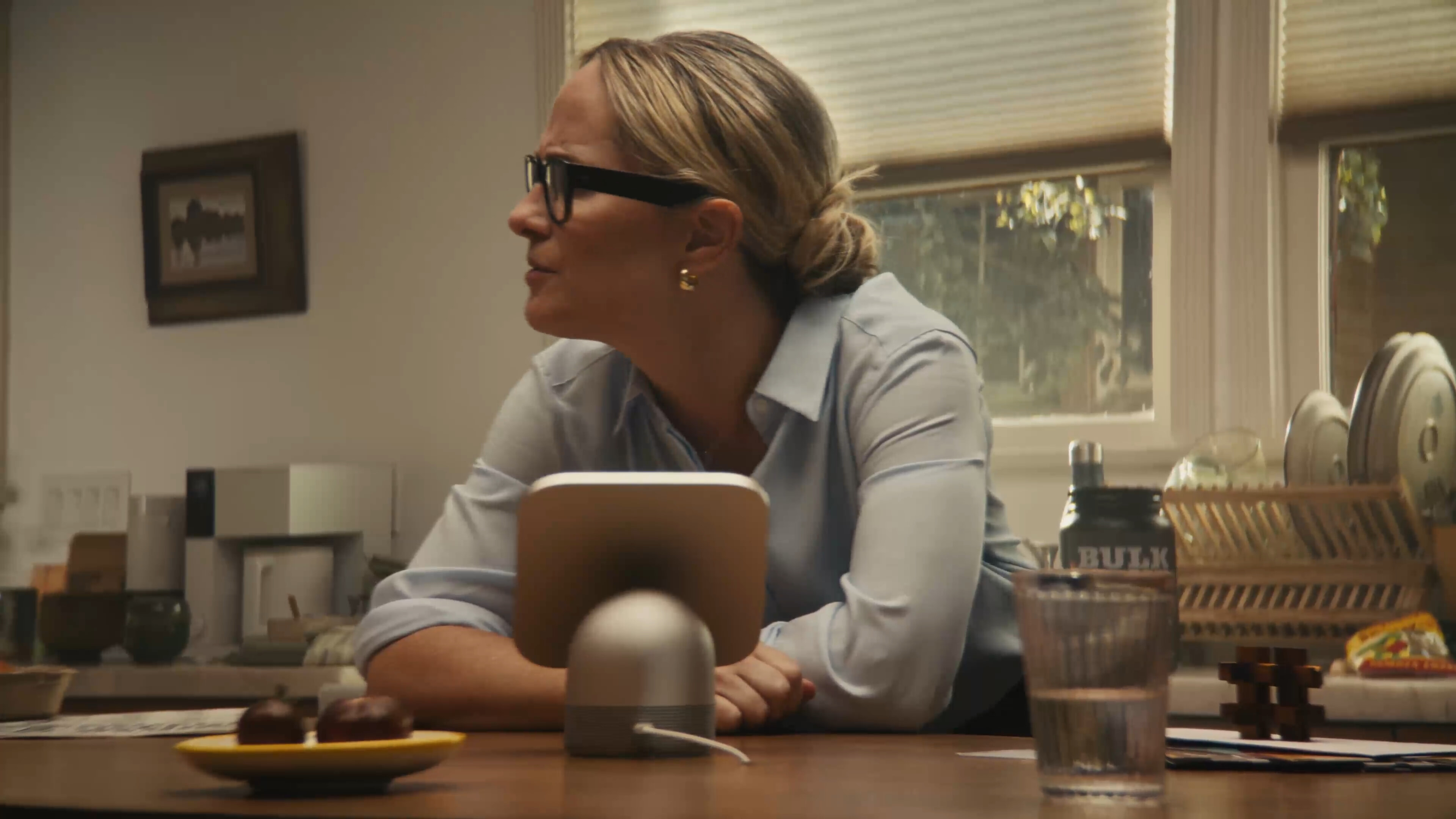
A view from behind the HomeView, which has been rotated to face the mom, showing about 4 inches of the USB cable disappearing into a convenient hole in the center of the island.

The above shot is at 0:49. It’s followed by two quick cuts to the dad and then the younger daughter, then at 0:52 we cut back to the mom (curious about her daughter’s new boyfriend situation), and, lo, the shot is now framed in such a way that we no longer see where the cable goes:
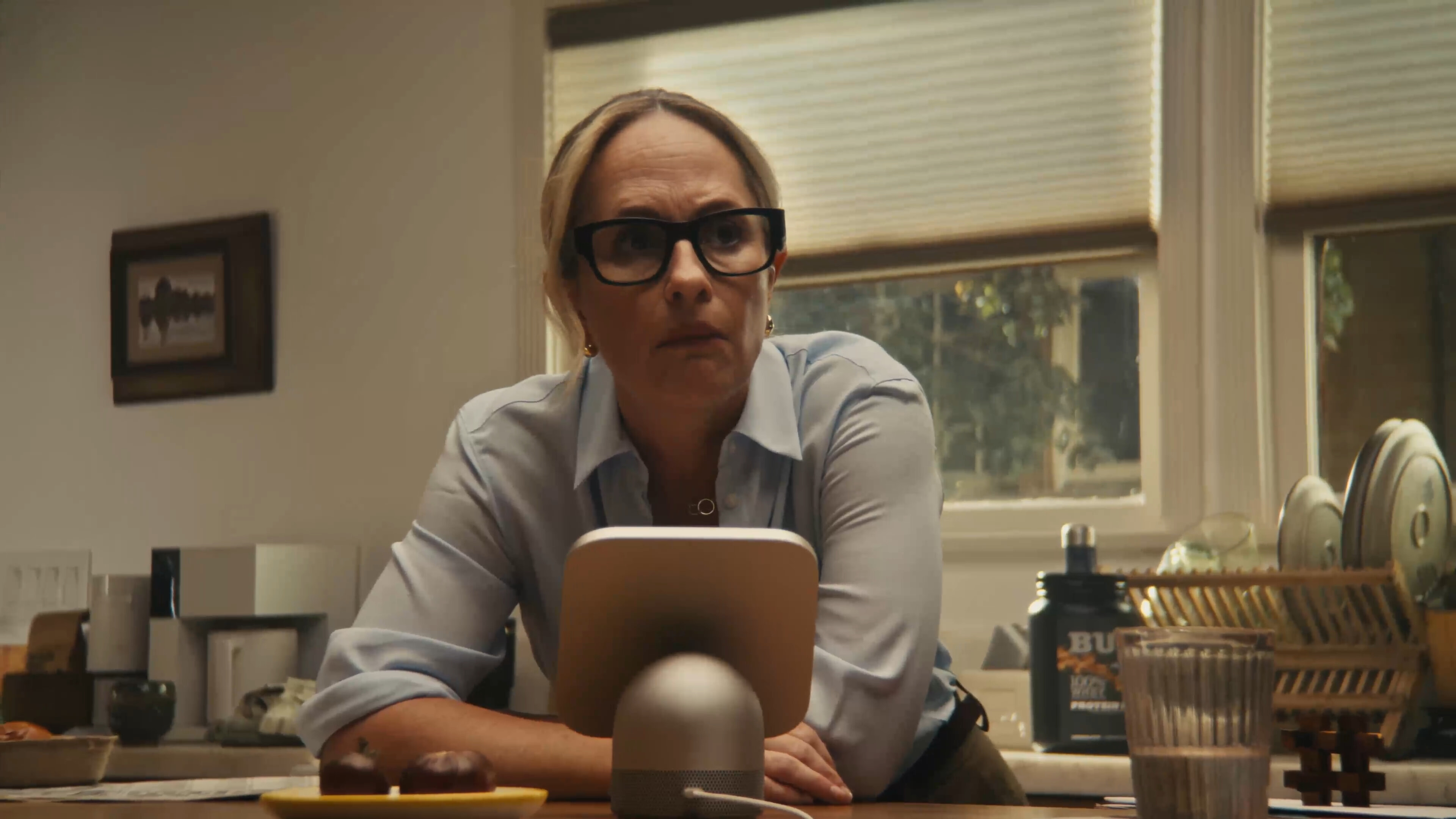
Same view as the previous shot, except the camera has been tilted up about an inch, such that the cable just runs off the bottom of the frame, no longer showing that it disappears into a hole in the island that no kitchen island I’ve ever seen actually has.

If you think that slight reframing is happenstance, you should stay away from poker tables. Most kitchen islands I’m familiar with — including my own — have power outlets on the sides of the island. I’m sure some people have power outlets on the top surface of the counter, but I can’t recall seeing one. These are kitchen counters, not office desks. But either way, there’d be a long USB-C cable cluttering the countertop. And if you do happen to have a power outlet on the top surface of your counter, there’d be an adapter sticking out of it, all the time, to duplicate this HomeView setup.

This family’s convenient hole in the center of their island countertop is a fantasy. Where does the cable go underneath? How exactly do they have a power adapter plugged in down there? What happens when something spills on the counter? When we custom ordered our kitchen, we weren’t asked if we wanted any holes drilled in our island countertop, and if we had been asked, it would have made me wonder if the guy asking the question had a hole or two drilled in his head.

I know, it’s a marketing video. Marketing videos present products in ideal settings. But the power cable is an essential aspect of the standalone HomeView. I’m not suggesting that it should be battery powered. You’d still need to plug it in every few days, which would mean most people would just leave it plugged in, which gets us back to needing to live with an always-visible cable and power adapter in one of our living spaces. The countertop hole this cable disappears into in this video is less ideal and more dishonest.

The wall-mounted option seems more appealing to me, but now you’re talking about a home improvement project and (for most of us) calling an electrician. And that raises the question of why the wall-mounted version costs the same $300 as the one with the connected base, even though the base provides the subwoofer. And it requires a mount, and the mounts cost $60 (USB-C), $80 (AC wired), or $130 (PoE — and this one is not available yet). So the wall-mounted version, when you include a mount, costs more but sounds worse? This doesn’t make sense.

Those points make me skeptical that there’s a place for HomeView in my home. We have a stereo pair of HomePods in our kitchen. Neither is on the center island, because that would be dumb. They’re on the counters along the outside of the kitchen, each near an outlet on the wall. In the four days since HomeView was announced, I’ve tried to imagine when I’d want to look at something on a screen on either of them. My count remains at zero.

My third early impression is that the display is surprisingly small. I saw HomeView in person in New York on Tuesday, and I think Apple’s video conveys its size very accurately. It’s small and cute. It’s much more like a HomePod Mini with a screen than a full-size HomePod with a screen. For some reason I was expecting the latter. This is not a complaint, simply an observation. I actually think that making it small and cute makes it about as unobtrusive as an ever-present screen could possibly be. That’s good. But because it’s small you need to be close to it to read anything more detailed than large glanceable widgets.

The major difference between a device with a screen and one without is that you can watch video on a device with a screen. But HomeView clearly isn’t intended for that. It can play video but isn’t primarily meant to play video. If it were it would have a widescreen aspect ratio. But instead it has a square aspect ratio,1 which is decidedly unsuited to video, unless, I suppose, you want a screen that is equally unsuited for both widescreen and tallscreen video.

So my skepticism boils down to the question of why anyone would want to add one (or more!) additional ever-present screens to our homes and lives. Phones can stay in our pockets until we need them. Watches remain on our wrists. HomePods can be tucked away unobtrusively in corners, and remain fully useful. HomeView needs to be in a prominent location for its display to serve any practical purpose. Apple’s initial pitch for it doesn’t earn that prominence for me.


  1. In my thoughts and observations column after Apple’s iPhone event last month, I wrote the following regarding the iPhone Duo’s clever 1:1.4 aspect ratio:

    Here’s the thing. If you take a 2 : 1 or even 2.2 : 1 aspect ratio phone display and turn that into a book-like foldable, the inner screen comes out square — or so close to square that we might as well just call it square. Nobody makes any device of any sort that just has a square display. Square is a terrible aspect ratio for a phone or a tablet or a laptop or a desktop display. The only square displays on the market are the inner displays for Android foldables from the last decade. Square being a shitty aspect ratio is half the reason almost no one has bought those things.

    I will admit that I had the as-yet-unannounced HomeView in mind as I wrote that, given that its square aspect ratio had been rumored for months. HomeView is not a phone or tablet or laptop or desktop display. It’s not a TV either. So maybe square works for this nascent product category (status boards?). But if square does prove to be correct for this purpose, it’ll be the first category I can think of where that’s true. Apple Watch is the closest device I can think of whose screen serves primarily to display status, but even Apple Watch isn’t square. (It varies slightly by model, but Apple Watch displays are around 4 : 5.) ↩︎

Feud In Dolly Parton’s Inner Circle Reveals Arms Deal with Haitian Police

17 October 2026 at 20:33

I’m thinking this nephew guy has turned out to be a problematic figure … The story here is about a deal to sell arms to the police in Haiti and the company in question, Fencebridge, was founded by “Daniel Nozell, Parton’s longtime manager, and Bryan Seaver, one of Parton’s nephews who was also her head of security.”

From the Miami Herald (gift link) …

A private security firm founded by two people close to late country music legend Dolly Parton is at the center of an unusually complex arms deal in Haiti that several sources with knowledge of the matter say was worked out with little due diligence.

The security firm, Fencebridge Strategic Risk, entered into a multimillion-dollar agreement about a year ago to supply the Haiti National Police with semi-automatic rifles and thousands of rounds of ammunition, as the agency struggles to combat violent gangs that have claimed the lives of more than 25,000 Haitians since 2021.

Data Centers

17 October 2026 at 19:45

Fascinating nugget of data from an Economist deep dive cross-referencing polling data with the location of datacenters: “Voters across the country are shifting towards Democrats, but for those living within 2km of a data centre the veer has been even sharper. Americans who live near a data-centre site are around six percentage points more likely to support the Democrats than those who live further away (see chart 2). Six months ago there was no such difference.” Link (requires sub).

Generals Must Be Willing to Sacrifice Their Careers | Command Post

17 October 2026 at 19:33

Gen. Mark Hertling and Ben Parker welcome renowned military strategist Eliot Cohen to discuss what makes great leaders, the dysfunction inside Trump’s Pentagon, and the difficult choices facing military officers. Drawing on lessons from Churchill, Afghanistan, and Iraq, they explore why wars go wrong, how to recognize victory, and what history teaches us about military strategy.

Leave a comment

Read more

💾

We’re On the Road Again...

17 October 2026 at 18:53

Happy Saturday! We kicked off our fall tour last night with a sold-out show in Columbia, South Carolina. Annie Andrews and Bakari Sellers joined us for an evening of Southern politics, 2028 superlatives, The Next Level and The Trio. A great crowd and a great way to start the tour. Charlotte, North Carolina is up next.

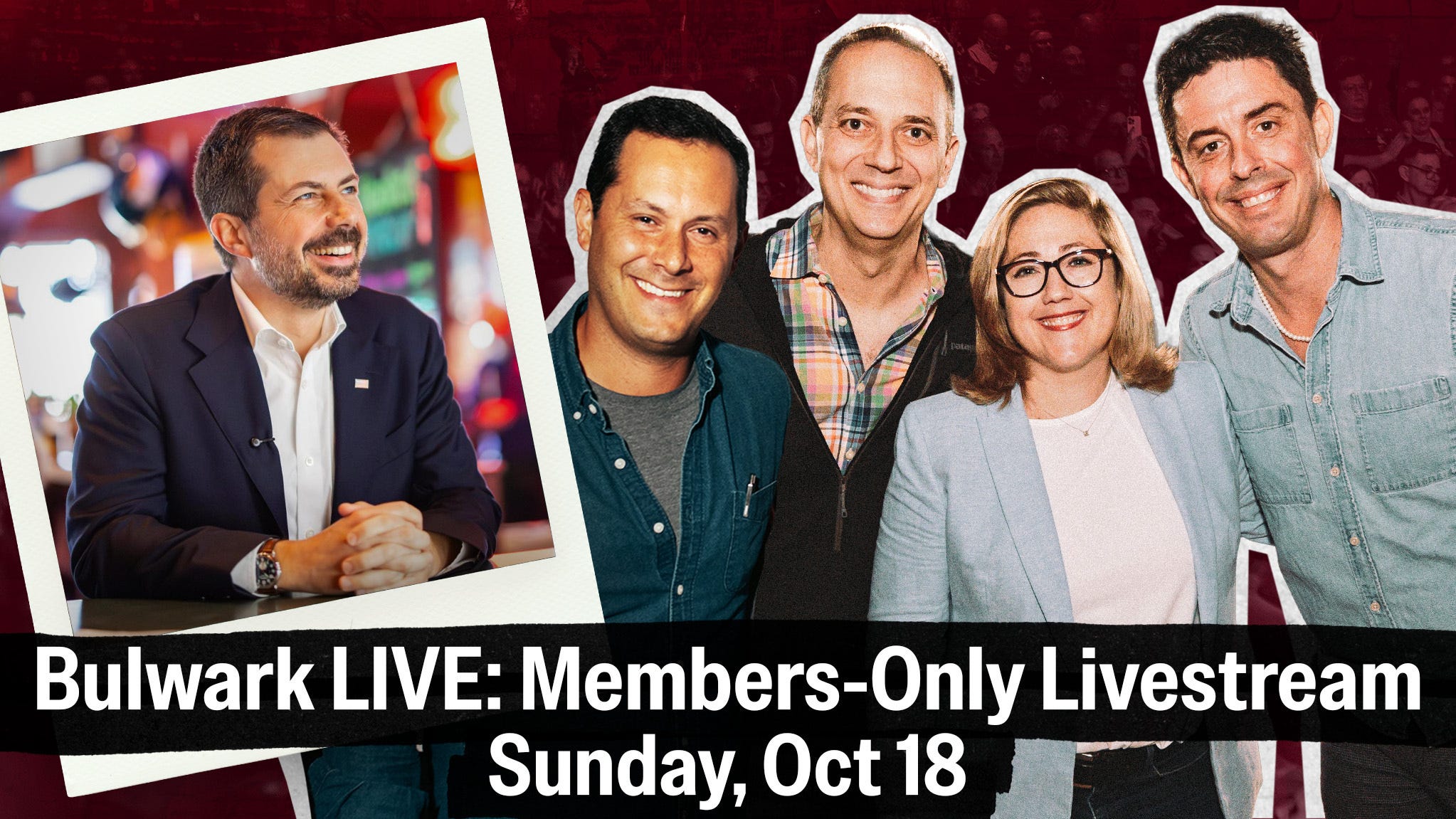
Join us this Sunday night for a Bulwark LIVEstream featuring Pete Buttigieg + the gang broadcasting live from Charlotte. This livestream is exclusively for Bulwark+ members.

Tune in from the comfort of your couch to watch Sarah interview Pete in front of a live audience. The rest of the gang—Tim, Sam, JVL—and Bulwark favorites Lauren Egan and Catherine Rampell will be there too.

The show starts at 7p.m. EDT/4pm PDT on Sunday, October 18th.

Watch on TheBulwark.com, Substack mobile, or TV apps.

The members-only live chat will be open during the broadcast so you can chat as you watch with the Bulwark+ community. Can’t join live? Watch on-demand when you want. Not a member yet and want to watch?

Upgrade Today at 30% 0FF & Join Our Member-Only Livestream with Pete

The midterms are coming. The surprises are inevitable. Get the reporting, analysis, and conversations you won’t get anywhere else.

  • 🔓 Unlock everything: articles, newsletters and ad-free shows

  • 💬 Go deeper: live chats and conversations with a community built on good faith

  • 📺 Hear what others don’t: access member-only shows including our October 18 livestream featuring Pete Buttigieg with Sarah, Tim, and JVL—live from Charlotte

Join Bulwark+ — Save 30% for next year

OFFER ENDS SUNDAY

Join now


ICYMI: Here are links to each newsletter section so you can quickly get back to that edition you may have missed this week.

Morning Shots - Triad - Huddled Masses - Press Pass - Bulwark Goes to Hollywood - The Opposition - False Flag - The Breakdown - Receipts


Join now


🚨OVERTIME🚨

Congratulations are in order for our Brewers fans on the sweep of the Dodgers! A few came to last night’s show repping the Brew Crew. And to my Dodgers friends: Welcome to the Cleveland bandwagon.

Last night’s ALCS game was postponed as the gales of November came early, but I remain hopeful that my Guardians will join Milwaukee for what might be called the Edmund Fitzgerald World Series.

I’m sure Rob Manfred (boo) loves the all-small-market World Series we’re now guaranteed. Mister Commissioner, just remember, as Ray Ratto observes at Defector: Good baseball isn’t necessarily beautiful (or super profitable!)

Embarrassing… The DGA has a new ad out knocking Vivek not just for his swing, but the important thing: his policies. For an Ohioan who has trouble publicly embracing Ohio, versus Ohio-obsessed Amy Acton, it’s a smart move and a good ad.

No Kings! Stay safe out there if you’re participating in today’s events. We booked our fall tour long before today’s date was announced, so we won’t be in as many places as we’ve been in the past. I’ll also miss sending a dispatch from the Queen City, which always shows up big! Meanwhile, the Bad Orange Man is across the river at Northern Kentucky University today, for some reason. You know things are going poorly when you have to play defense in… Kentucky.

RIP Laura Lytle… The former director of the Senate Daily Press Gallery has died at the age of 51. She was loved by all in the press corps and an amazing advocate for us in the halls of power. She will be missed.

Join now

Keeping the record: Trump’s pardons sent January 6th defendants home to communities across the country. J6 Tracker follows what they do next, including new arrests and runs for office. Separately, the January 6 Memory Project preserved DOJ press releases and other statements from more than 1,000 cases and made them searchable. Two useful resources for keeping the public record public. Take a look at who’s back in your community.

Bulwark Book Club pick for October: The Age of Acrimony: How Americans Fought to Fix Their Democracy, 1865–1915.

Mona Charen, JVL and the author Jon Grinspan will discuss the book with Bulwark+ members on Wednesday, Oct. 28 at 1:30 p.m. ET. More details in this post.

Leave a comment

Tech support questions? Visit our new HELP Center! Questions for me? Respond to this message.

—30—

Editorial photos provided by Getty Images. For full credits, please consult the article.

Zelenskyy: Trump is letting Putin off

17 October 2026 at 19:30

Ukrainian President Volodymyr Zelenskyy criticized President Donald Trump’s decision to waive new sanctions against Russia on Saturday, warning that easing economic pressure would only embolden Russian President Vladimir Putin.

Trump signed an executive order Friday suspending sanctions and tariffs under the Lindsey O. Graham Sanctioning Russia and Iran Act, which he signed into law last month. The penalties were scheduled to take effect Sunday.

“A decision was unfortunately made in America to completely disregard the Lindsey Graham Act, which was supposed to impose truly effective pressure on Russia to bring this war to an end,” Zelenskyy wrote Saturday.

Yesterday, the Russians carried out one of their largest attacks on Ukraine’s energy sector – more than 15 critical power generation and transmission facilities were targeted across different regions of Ukraine. Restoration work is ongoing, with all necessary services and all available resources of Ukrainian energy companies involved. I thank everyone working practically nonstop to restore power.

The most difficult situation was in Lutsk, Rivne, Zhytomyr, Vinnytsia, Shepetivka, Slavuta, and Netishyn. Energy facilities in the Kharkiv, Kyiv, Dnipro, and other regions were also hit. The Russians have scaled up their anti-energy operation and are trying to stretch our reserves and repair capabilities as thin as possible. Between 7 p.m. yesterday and 7 a.m. today alone, more than 320 jet-powered and gasoline-powered “shaheds,” along with loitering munitions, cruise missiles, and ballistic missiles, were used against our energy sector, our cities, and our communities. And although our warriors are shooting down a significant number of them, the sheer scale and unrelenting pace of Russia’s strikes, specifically against our energy sector, are unfortunately having severe consequences.

It is important that our European partners have already prepared new support packages for Ukraine. I am grateful to them for this. And it is important that everyone in America also sees what is really happening. At a time when the Russians have carried out such a massive attack on our energy sector, a decision was unfortunately made in America to completely disregard the Lindsey Graham Act, which was supposed to impose truly effective pressure on Russia to bring this war to an end. This Act could have helped enormously – and still can! But it needs to actually work, and every voice in support of it matters.

Russia is trying to cause a blackout in Ukraine – right before winter. Russia is trying to leave millions of our people without electricity and heating. Pressure is needed to stop this. A U.S. sanctions blackout, easing pressure on the aggressor, financial rewards for Putin – all of this only encourages him to keep attacking. We must not give up ground. We must keep trying to end the war. To end it, not give Putin every reason to continue it indefinitely. I thank everyone who is truly fighting for peace and helping Ukraine!

— Volodymyr Zelenskyy / Володимир Зеленський (@ZelenskyyUa) October 17, 2026

“This Act could have helped enormously — and still can! But it needs to actually work, and every voice in support of it matters,” he added.

The White House said the waiver was in the national interest. The order suspends the new penalties but leaves existing sanctions against Russia in place.

Moscow, meanwhile, welcomed the decision. Kirill Dmitriev, Putin’s investment envoy, called it an “important and truly historic moment,” suggesting it could open the door to renewed economic cooperation with Washington.

The move comes as Russia intensifies attacks on Ukraine‘s energy infrastructure ahead of winter. Zelenskyy said Russian forces targeted more than 15 energy facilities in an overnight assault. Ukraine’s air force reported 332 drones and four cruise missiles launched during the attacks.


Start your day with essential news from Salon.
Sign up for our free morning newsletter, Crash Course.


Rep. Don Beyer, D-Va., accused Trump of undermining bipartisan efforts to pressure Moscow.

“Trump’s latest surrender to Putin again betrays our Ukrainian partners and defies clear congressional intent of legislation designed to punish Russia for its illegal war of aggression,” Beyer said.

Trump just waived all of the sanctions on Russia provided for in the Lindsey Graham Sanctioning Russia Act, just as I and others warned he would.

Trump’s latest surrender to Putin again betrays our Ukrainian partners and defies clear congressional intent of legislation designed to punish Russia for its illegal war of aggression.

Trump has proven he will twist this law and abuse the powers it conferred on him, and while he has let the tariff powers lie for the moment, the law as written also empowers Trump to weaponize new trade authorities against our allies and trading partners.

Congress must fix this flawed law to stop Trump from capitulating to Putin and ensure that it truly supports Ukraine.

— Rep. Don Beyer (@RepDonBeyer) October 17, 2026

The Graham Act authorized new economic penalties, including tariffs targeting countries that purchase Russian energy, but also granted the president authority to waive them on national-interest grounds.

The post Zelenskyy: Trump is letting Putin off appeared first on Salon.com.

“You Can See Everything” and the tragedy of Elizabeth Holmes

17 October 2026 at 18:00

In the first episode of his hit HBO series, “The Rehearsal” — a show about evaluating the outcomes of hypothetical real-life situations — comedian Nathan Fielder admits, “I’ve been told my personality can make some people uncomfortable, so I have to work to offset that.” For Fielder, who is equal parts lovably strange and dryly hilarious, offsetting other people’s discomfort can be a sizable task. It’s not easy to go through life in a double consciousness, hyperaware that one’s behavior might offend or unease. “Humor is my go-to instinct,” Fielder says about trying to reassure others. “But every joke is a gamble.”

Consider, then, the overlap between Fielder and someone like Elizabeth Holmes, founder of the bogus blood-testing company Theranos, who was convicted of swindling hundreds of millions of dollars from investors with her purportedly revolutionary blood-analysis device. Even before her downfall, Holmes drew the media’s attention with her wide, unblinking eyes, bold red lip, deep voice and stilted speech — all of which became parody-ready upon her indictment. But all the more perplexing was Holmes’ reticence to admit guilt when caught with hands as red as her lipstick, talking herself in circles in pursuit of her truth. Her statements always seemed misaligned with the evidence, as if she were so convinced of her company’s virtue that she didn’t care about the eerie dissonance between her reality and the world’s. If Holmes was indeed playing a character she made up, as many people speculated, she was a skilled method actor. 

As Fielder gains steady footing on the margin dividing observation and manipulation, aiming the camera at either side, he uncovers something deeply, cosmically sad: Holmes can’t seem to tell the difference between the two.

Sitting just inches apart around a San Diego beach rental’s dinner table in Fielder and co-director Lance Oppenheim’s magnificent new documentary, “You Can See Everything,” Fielder and Holmes look decidedly comfortable with one another. They share an ease and rapport neither has readily exhibited on camera before — certainly not around virtual strangers. But while they may not share many overt similarities, the strange duo align in their mutual slipperiness. 

Before them lie components of Theranos’ blood-analyzer, which Holmes hopes to turn into a new product after her 11-year prison sentence, set to start 34 days after filming begins. Trying to explain the device, and how her claims of its efficacy were misread by investors and the public, Holmes once again can’t translate her thoughts into words that make sense to Fielder. Instinctually, Fielder makes a joke. “Isn’t it funny that I hosted a show about business scams, and now you’re in trouble for a business scam?” Holmes remarks that she hadn’t thought about it until now, and the tension lifts as her frustration dissipates. Despite his well-intentioned wisecrack — or perhaps because of it — Holmes can relate to her new associate. Somehow, Fielder can see her.

But which version of her Fielder — and, by extension, the audience — sees, and which version is the truest, remains up for debate. The title “You Can See Everything,” taken from a text Holmes sent to Fielder during production, is an obvious red herring. This documentary is about a woman notorious for her deception. We, of course, can’t really see anything. 

And yet, it’s all on display. Fielder, Oppenheim, and the viewer share the task of putting those pieces together legibly, to tell Holmes’ story in a way that hasn’t already been done for her by the media, Hulu’s limited series “The Dropout,” and Holmes’ muddled observations. As the film plays out, its three-hour runtime gliding by in a flash, it becomes painfully clear that this is what Elizabeth Holmes has wanted all along: for someone to tell her story in a way she can’t — not because she doesn’t want to, but because she herself is unclear about what that story is. Breaking through Holmes’ tight circle of dubious companions, Fielder pulls at every thread he can, attempting to unravel a greater truth from life’s gnarled yarn. As he gains steady footing on the margin dividing observation and manipulation, aiming the camera at either side, Fielder uncovers something deeply, cosmically sad: Holmes can’t seem to tell the difference between the two.

That does not, however, mean she doesn’t want to try. Holmes is intent on letting the cameras see as much of her life as possible, not only to prove the innocence she’s maintained all along, but to show that she has nothing to hide. She understands that the world sees her a certain way, a way she doesn’t understand — or, in the case of the infamous photo of her holding a vial of blood between two fingers, outright refutes — but that people’s perception is entirely out of her control. Maybe emerging from hiding for the first time in seven years with a full-scale documentary team isn’t such a bad idea. Five weeks out from a decade in prison, what’s the worst they could uncover?

“You Can See Everything” isn’t so much about big, jaw-dropping revelations as it is about the people behind them, and the assortment of personality and/or neurodevelopmental disorders fueling their actions. Holmes raves about her husband, San Diego hotel-chain heir William Evans, whose ego takes up most of the space in their beachside rental. When Fielder asks how he and Holmes met, Evans relays murky details of a 2017 party where the two spoke for an hour before he realized who Holmes was, even though he’d toured the former Theranos building the day before. 

Later, during a visit from Holmes’ parents, Fielder asks Holmes’ father, Christian, about her former lover and Theranos business partner, Sunny Balwani. Evans immediately interjects, trying to halt and redirect the conversation. Persisting, Fielder asks Christian to pinpoint a turning point in his daughter’s life. “That’s an easy one,” Christian says, confessing that the turning point came when Holmes was sexually assaulted at 19, a crossroads that Holmes admits had a hand in her dropping out of Stanford and starting Theranos.


Want more from culture than just the latest trend? The Swell highlights art made to last.
Sign up here


When Evans derails the conversation again, a new question pops up — an occurrence in this film as natural and frequent as breathing. Is Holmes’ husband trying to maneuver the situation because he cares for his wife, or because his behavioral patterns mirror those of Balwani and Holmes’ assailant? All three men directly impacted Holmes at vulnerable points in her life, and from the film’s outset, it’s clear Evans savors controlling the narrative, whether through Holmes’ life’s work or simply the way she whisks eggs for scrambling. What’s constantly baffling is how much affection Holmes has for her repugnant husband, no matter how much he twists stories or alienates the film crew. One could say the two share a talent for deception, but it always feels more complex and tricky than that, as if it would be too easy to say that Holmes and Evans get along because they’re both hucksters, skilled in fabrication. They both get something out of this relationship. Whether it’s love is anyone’s guess. 

What’s brutally, painfully clear, beyond a shadow of a doubt, is that Holmes has not yet learned how to use her own voice. She knows how to speak, dictate orders and ideas. (And, obviously, how to fool powerful people.) But Holmes doesn’t grasp where her ideas end, and someone else’s influence begins. She personifies a complete lack of identity, so irrevocably tied to her inventions, physical or otherwise, that, compared to Fielder — whose work is marked by his own keen self-awareness — she looks like the diametrical opposite. Holmes is the tragedy to his comedy. Naturally, the two are intrinsically connected.

Many things about Elizabeth Holmes aren’t certain. But what’s irrefutable is that she knows how lonely it is not to be able to communicate the world inside her head, and how painful it is not to understand others the same way. It’s no wonder that, when she meets someone who can bridge that gap, she wants to make a monument of it.

All of the questions about who’s running Holmes’ show take new, thorny form as the film blossoms in its latter half — the portion that, thanks to a surprise guest, makes the movie one of the most startling and memorable exercises in metafiction ever concocted. But the film’s most heartbreaking and pivotal scene comes in its first third, before Holmes surrenders for her prison sentence, when Fielder gathers her and Evans on the couch to show them Abbott and Costello’s famous “Who’s on First?” act. 

Fielder tells Holmes that he was reminded of the bit the day before, when Holmes tried to describe the science and intention of Theranos in front of its deconstructed prototype. Holmes has never seen the routine, and gives it a few chuckles. But when Fielder asks her to explain the joke — that “Who” is the name of the baseball player on first base, yet sounds like a question, confusing the two men — and why it’s funny, she can’t. As Fielder clarifies the punchline, Holmes breaks down in tears across from him, frustrated that she can’t understand.

In this moment, Fielder conjures a world of empathy for his subject, again posing questions about what gets lost between two people who believe they’re being perfectly clear, yet aren’t making sense to one another. Many things about Elizabeth Holmes aren’t certain. But what’s irrefutable is that she knows how lonely it is not to be able to communicate the world inside her head, and how painful it is not to understand others the same way. It’s no wonder that, when she meets someone who can bridge that gap, she wants to make a monument of it — be it a business, a marriage, a film or a profession of love.

Though the questions persist: Is this all part of Holmes’ master plan? Is she letting the cameras in to dupe us, to make us feel sorry for someone whose actions caused real harm? Maybe. Those seeking clear answers will leave with nothing more than new questions, but that’s the glorious part of “You Can See Everything.” In an era when documentaries are made for everything and nothing, it’s critical to remember that searching for reason in something as immense as the human condition is a fool’s errand. 

Fielder might be fascinated by motive and rationale, but he’s primarily interested in circumstance, and he understands Holmes’ circumstances perfectly. His film is a self-reflexive study of the inability to act as people expect — of masking and deception. How much of life is a performance? Can anyone truly be themselves when society’s bylaws not only dictate proper human behavior but also how successful anyone can be in something as complicated and unknowable as life itself? In seeking the truth, all one finds is more differences, more judgment. Sure, we can see everything. But whether we really should is another question entirely.

The post “You Can See Everything” and the tragedy of Elizabeth Holmes appeared first on Salon.com.

Drucker für C16

17 October 2026 at 17:00

Lohnt sich der Kauf eines Druckers für den C 16? Wir stellen Ihnen sechs Drucker unter 800 Mark zur Auswahl vor.

Apple TV Price History, Charted

17 October 2026 at 16:06

Glenn Fleishman:

I wondered what the entry-level, initial price of each Apple TV box at introduction was, from the March 2007 original to the Apple TV 4K (4th generation) announced October 13, 2026, adjusted for inflation. So I charted it.

I suppose this doesn’t mean Apple has given up on making Apple TV content accessible, but the price-accessible path is just using the Apple TV app on the crapware OS your “smart” TV runs.

PCW-Show 1986 in London

17 October 2026 at 16:00

Die PCW-Show in London war das Software-Ereignis des Jahres. Besucher und Aussteller waren sich darüber einig. Alle wichtigen britischen und auch amerikanischen Hersteller waren versammelt, um die neuen Produkte, die das Weihnachtsgeschäft 1986 bestimmen sollen, vorzustellen. London wurde für fünf Tage zum Mittelpunkt der großen, weiten Software-Welt.

Windows 11 Pro costs less than lunch right now at $9.97

17 October 2026 at 17:00
Microsoft Windows 11 Pro

TL;DR: Get a Windows 11 Pro license for $9.97 (reg. $199) through October 20, with BitLocker, Hyper-V, and Copilot included.

Windows 11 Home leaves out the encryption and virtualization tools that IT folks and developers rely on. A Windows 11 Pro lifetime license restores them, and it's on sale for $9.97 (reg. — Read the rest

The post Windows 11 Pro costs less than lunch right now at $9.97 appeared first on Boing Boing.

Tattoo ink can be turned on and off with light

17 October 2026 at 16:28

Tattoos are permanent, but a new technique developed by researchers at the University of Colorado Boulder allows them to be turned on and off. In a study in Matter & Light, researchers detail a technique using photochromic dye in tiny plexiglass spheres as tattoo ink. — Read the rest

The post Tattoo ink can be turned on and off with light appeared first on Boing Boing.

Friends Don’t Let Friends Watch the Early Vote

17 October 2026 at 16:04

One collection of data people obsess over in the weeks before a big election is the early vote – a relatively new feature of American elections. You can’t know who people voted for but you can know who is voting by different metrics and you can draw inferences from that. Take all this early vote data with a huge, huge grain of salt. On the one hand it’s just way to easy to interpret the numbers through the prism of one’s hopes. But there’s a bigger and more immediate reason for skepticism today. To understand what early numbers mean you need to have some theory of who is going to vote early and who late. And basically, I think, we don’t. Or not a good one.

Trump’s Election Interference Is Underway

17 October 2026 at 15:40
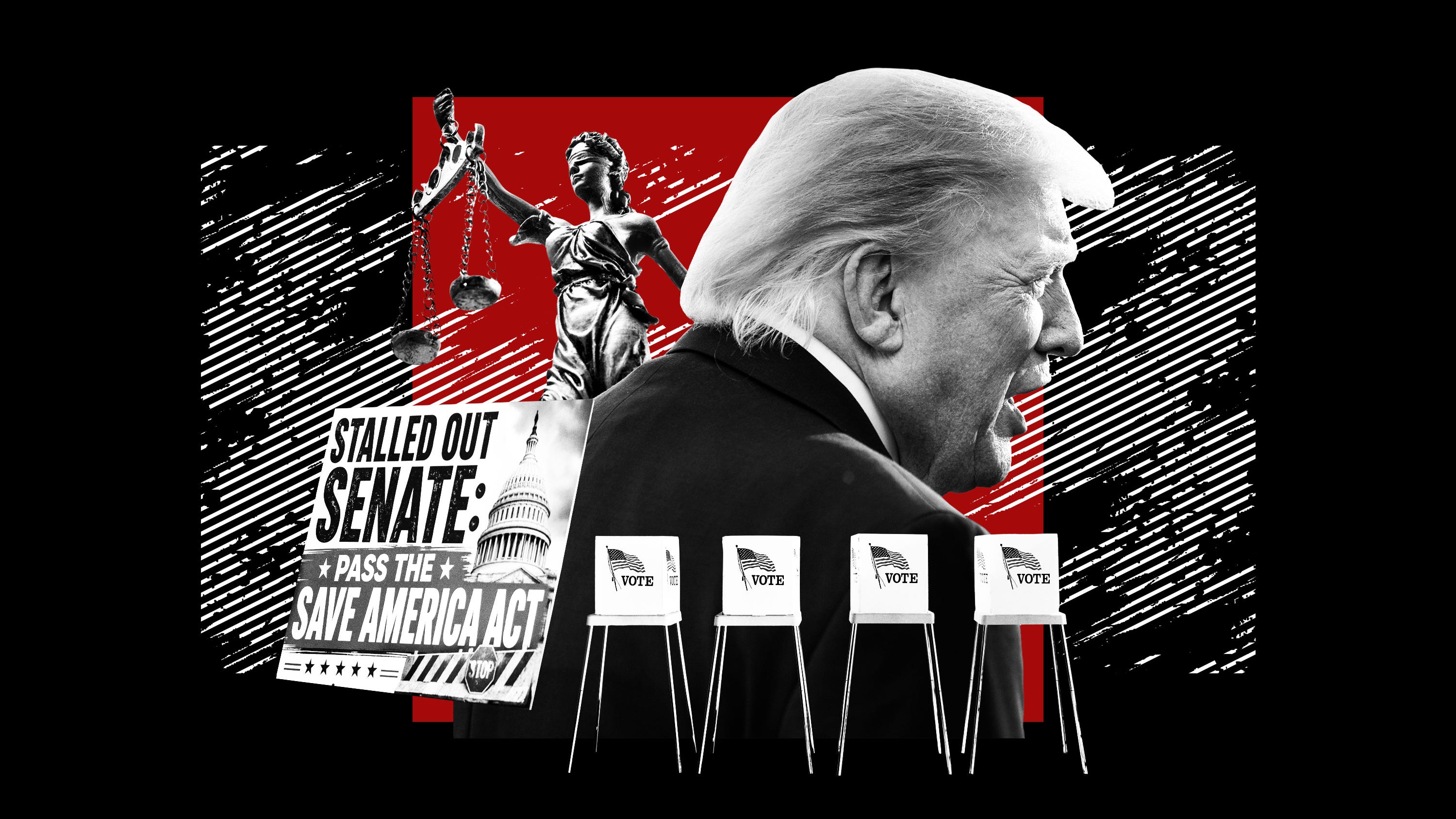
(Photo illustration by Bill Kuchman/The Bulwark | Photos: Getty, Shutterstock)

EVEN THOUGH PRESIDENT TRUMP’S EFFORTS to bend elections to his will have so far largely failed, don’t mistake defeat for retreat. The federal government’s highest power centers are working overtime to tilt the election in the administration’s favor.

On Thursday, the Department of Justice sued California, accusing the state of harboring noncitizens on its voter rolls. The suit was filed forty-eight hours after DOJ mailed county election officials a password-protected thumb drive purportedly containing a list of alleged noncitizen voters. This item was delivered with an ultimatum: use the list within the next two days to review the names and prepare to separate their mail-in ballots when returned—or get sued. An L.A. County official rejected the thumb drive as an insecure medium for such a list, and the lawsuit against the state followed.

On Friday, the administration escalated from litigation to threats of criminal prosecution. In a letter to Los Angeles County officials, DOJ warned that knowingly counting ballots from people federal agencies had identified as noncitizens could make election workers criminally liable—even though California officials say the administration has provided no evidence to substantiate its claims. Trump amplified the threat on Truth Social: “They will all go to jail for a long period of time!!!”

The administration’s tactics in California mirror what the Department of Homeland Security tried in Nevada, where Secretary Markwayne Mullin claimed nearly 16,000 noncitizens were on the voter rolls and sent a letter to state officials pressuring them to review each case. Upon scrutiny, that number fell to 185 and then to zero. The pretext for the purge completely fell apart, yet the Trump administration keeps pushing these sorts of voter-fraud narratives and making demands for election officials to go to great lengths to restrict voting access.

While January 6th showed Americans what one vivid form of election subversion looks like, schemes of that sort rarely announce themselves with the clamor of an insurrection. More often, they are carried out through the subtle machinery of government: paperwork, pressure, propaganda. And the authoritarians in the Trump administration are not discouraged by failure. They’re like battering rams, hammering at the system again and again, hoping it will eventually break down in a way that benefits them.

So don’t miss what’s happening now. Trump’s election interference effort is well underway.


Join a community that cares about free and fair elections as much as you do—give it a try this weekend, and we’ll take 30% off the price of a Bulwark+ membership. New friends, full access to all our reporting and analysis, extra goodies—what’s not to like?

Get 30% off for 1 year

OFFER ENDS SUNDAY

Swinging against the system

The falsehood that has been used to provide a basis for all the administration’s actions is simple: They pretend voter fraud is widespread. This initial lie has a natural corollary in turn: The only way to stop the fraud is to put the Trump administration in charge of who gets to vote.

Based on this false framework, Trump has issued a pair of executive orders intended to put his appointees in a position to control who can vote in our elections. The administration has interpreted these orders expansively as an instruction for agencies to create new voter requirements, to compel the states to provide unredacted voter rolls, and to prohibit mail-in ballots unless voters were placed on a new federal voter registry. Those plans faced heavy resistance, even in red states, as the Constitution strictly leaves the power to administer elections to the states.

When those efforts faltered, Trump pivoted. He demanded that Congress pass the SAVE America Act to enact some of these restrictions and requirements, but even a Republican-controlled Congress wouldn’t pass it. At the same time, DOJ tried to get the voter data another way: by suing states to hand it over. But the courts are shutting those efforts down, too; the Trump administration is 0–26 in those cases, with Republican-appointed judges delivering some of those defeats. Additionally, the Supreme Court stepped in to stop the postal rule, keeping mail-in voting safe, secure, and out of Trump’s hands for now.

DHS’s Federal Emergency Management Agency (FEMA) tried to withhold hundreds of millions of dollars in terrorism preparedness grants unless states and local governments accepted the imposition of FEMA’s de facto nationwide election code. The agency’s demands included stipulations about what kind of voting equipment to use; the means by which voters cast ballots; how post-election audits and ballot reconciliation processes are conducted; and how to make citizenship checks on voters and election workers. A judge recently blocked DHS from withholding the grants, and FEMA has rescinded the unlawful election-related requirements the agency had attempted to impose.

At this point, Trump should have taken the dozens of Nos to amount to a larger No. He didn’t. He keeps pounding away.

Trump gave a primetime speech in July, during which he accused

Read more

I miss the restaurant pager

17 October 2026 at 15:00

At 16, I was entrusted with one of the most important pieces of technology at a suburban Chili’s: a wire rack full of restaurant pagers.

The restaurant occupied a sprawling shopping center alongside an Olive Garden, a Cabela’s and a Costco, making it something of a regional mecca for homecoming dinners, birthday parties and Little League victories. The air smelled perpetually of tortilla chips, and the soundtrack was an agreeable mixture of Matchbox Twenty and sizzling fajita platters.

I liked the job. I liked asking people what brought them in, hearing about their celebrations and making small talk while consulting my restaurant map and section list. On busy nights, I’d estimate the wait, scribble down a last name, party size and pager number in black pen, then hand over a pleasantly hefty plastic puck.

“You can wander as far as your car,” I’d explain.

“Ope! Was hoping to make a Costco run,” some dad would inevitably reply. I laughed every time. It was a very reliable joke.

Every five or 15 minutes, another pager returned to the host stand, blinking and vibrating in the hands of a customer whose table was finally ready. I particularly liked watching one go off. A group could be deep in conversation when the puck sprang to life, producing a brief, collective flicker of delight. Dinner!

They were not beautiful objects. One woman who came in weekly after church complained that hers was ugly and bulky, then set it on the red pleather waiting bench so that it would vibrate against the upholstery rather than any part of her body. Occasionally, someone stole one, apparently deciding that a restaurant pager belonged in the same category of souvenir as a pebbled Coke glass. Sometimes the rechargeable batteries flagged, and we’d pull a pager out of rotation.

There was a reason these contraptions belonged to the Chili’s end of the dining spectrum. You wouldn’t mistake one for fine-dining theater. But they had an appealingly limited set of ambitions. They buzzed, they blinked, and when the wait was over, we took them back. The technology stayed at the restaurant.

In retrospect, what a gift. 

I don’t remember exactly when the pagers mostly disappeared. There was no retirement ceremony, no last call for the little plastic puck. I began noticing their absence most acutely when restaurants reopened after the first wave of the pandemic. Minimizing shared surfaces made sense then. Why distribute and disinfect pagers when customers already had phones in their pockets? Digital waitlists predated COVID-19, of course, but for me, that was when the phone began to feel less like an option and more like a condition of dining out.

And it rarely stops at the host stand. Your phone tells you the table is ready. It may supply the menu via QR code, take your order and settle the bill. Hours later, another text arrives asking you to rate the experience.

At some point, the meal has ended, but the restaurant apparently hasn’t finished with you.

None of this is inherently awful. Some of it is useful. But every time I wake my phone to perform one of these little tasks, I’m also opening the door to everything else it contains: emails, notifications, messages I wasn’t planning to answer over lunch. What was supposed to simplify dinner can turn it into another administrative process requiring a charged device and a willingness to look at it.

Restaurants are hardly alone in this. I reach for my phone to ride public transit, pay for parking, produce concert tickets, check in at the doctor’s office and occasionally prove to one website that I am the person trying to sign into another. Each request arrives dressed as a convenience. Together, they have made the phone feel less like a personal possession and more like mandatory civic infrastructure.


Want more great food writing and recipes? Sign up for Salon’s free food newsletter, The Bite.


And mandatory infrastructure really ought to work.

For a while, I happily used the Ventra card on my phone to ride Chicago public transit. One less thing to carry! Then, for a miserable stretch, several Red Line stations I frequented seemed to stop recognizing it. One morning, I joined a small congregation of commuters attempting to convince the turnstiles that our phones were, in fact, perfectly legitimate fare payment.

“It worked yesterday!” one man exclaimed.

“The terminals are old! They weren’t meant for this,” a tired CTA employee explained, kindly ushering us through the stroller entrance as the next train rumbled toward the platform.

The backup plan wasn’t faring much better. Around the same time, the ticket machines were proving similarly unreliable about accepting credit cards. A little queue had formed at the station ATM, where commuters were withdrawing cash to buy physical transit cards so they could get on the train.

We had arrived at the future, and it required a trip to the cash machine.

After a few weeks of this, I surrendered. I now carry a physical Ventra card, load $20 onto it when necessary and go about my business. It gets me through the turnstile without involving my phone. A modest pleasure, but one I’ve come to appreciate.

The trouble isn’t that every digital convenience is destined to malfunction. Plenty work exactly as advertised. It’s that we’ve become so accustomed to conducting ordinary life through our phones that we rarely stop to consider whether they’re necessary to the transaction in the first place.

Consider, for instance, a recent brunch in which absolutely nothing went wrong.

Recently, my husband and I went to a brunch spot I love in Chicago’s Andersonville neighborhood. The front-of-house staff always seem to be navigating the aftermath of a complicated breakup between two polycules, but the breakfast sandwich  is truly good enough to make the interpersonal intrigue part of the charm. I wanted to do very little beyond sit somewhere pleasant, eat something delicious and enjoy being newly married. There was a short wait. The host asked for my number; I provided it, then sat with my husband in two lobby chairs. We chatted. We waited. We did not move.

My phone buzzed. Our table was ready.

I looked up. The host stand was approximately two feet away.

The system had worked flawlessly. Somewhere, a piece of restaurant software had facilitated communication between two people who could reasonably have passed each other a saltshaker. The host hadn’t done anything wrong, and neither had I. But a moment that might once have involved someone looking up and saying, “You’re all set,” now required me to be reachable by a device I had no particular desire to consult.

I understand the alternative. A digital waitlist lets you wander around the neighborhood, browse the shops, maybe get a head start on another errand. Sometimes that’s a genuine gift. But I’m not convinced that being able to do two things at once means enjoying either one more. And sometimes I don’t want to wander. I want to be there, waiting for brunch, with the reassuring knowledge that the restaurant is handling the details.

That’s part of the pleasure of hospitality, isn’t it? For a little while, someone else tends to the logistics. You don’t need to manage every notification or keep every system running. You can just be a guest.

I don’t expect restaurant owners to read this and order a fresh shipment of vibrating pucks. If texts work best, fine. I’d simply like us to question whether requiring a phone is always an improvement, and remember that convenience isn’t much of a convenience when opting out stops being possible.

Maybe the pager never comes back. I can live with that. I’d just like to be able to let my phone die in my bag and still be called to breakfast.

Though I will say this for those ugly little pagers: At least you could hand one back.

The post I miss the restaurant pager appeared first on Salon.com.

Dracula: October 17

17 October 2026 at 14:53

Jonathan Harker's Journal.

17 October.—Everything is pretty well fixed now, I think, to welcome the Count on his return from his tour. Godalming told the shippers that he fancied that the box sent aboard might contain something stolen from a friend of his, and got a half consent that he might open it at his own risk. The owner gave him a paper telling the Captain to give him every facility in doing whatever he chose on board the ship, and also a similar authorisation to his agent at Varna. We have seen the agent, who was much impressed with Godalming's kindly manner to him, and we are all satisfied that whatever he can do to aid our wishes will be done. We have already arranged what to do in case we get the box open. If the Count is there, Van Helsing and Seward will cut off his head at once and drive a stake through his heart. Morris and Godalming and I shall prevent interference, even if we have to use the arms which we shall have ready. The Professor says that if we can so treat the Count's body, it will soon after fall into dust. In such case there would be no evidence against us, in case any suspicion of murder were aroused. But even if it were not, we should stand or fall by our act, and perhaps some day this very script may be evidence to come between some of us and a rope. For myself, I should take the chance only too thankfully if it were to come. We mean to leave no stone unturned to carry out our intent. We have arranged with certain officials that the instant the Czarina Catherine is seen, we are to be informed by a special messenger.

Republicans have a huge fundraising advantage. Will it matter?

17 October 2026 at 14:02
Donald Trump speaks on stage against a background of American flags.
“When you talk about how many seats can the Democrats gain, given how unpopular Trump is, the Republican money is seen as a real limiter on Democratic chances,” New York Times reporter Shane Goldmacher told Vox’s America, Actually podcast. | Alex Wong/Getty Images

Polls and pundits alike are widely — if sometimes cautiously — predicting a blue wave in the midterm elections on November 3. But there’s an important caveat to predictions of a Democratic triumph: Republicans have far more cash at their disposal.

President Donald Trump’s super PAC alone had around $400 million on hand earlier this fall, and Elon Musk has personally pumped hundreds of millions into critical races, including $158 million for Texas alone. 

Democrats, by contrast, have lagged far behind, especially relative to their performance in past cycles, with the party’s candidates propped up more by small-money donors than deep-pocketed institutional players.

Shane Goldmacher, a national political reporter for the New York Times, has extensively covered the role of money in American electoral politics. He spoke with America, Actually host Astead Herndon about where that money is coming from, how the GOP is spending it, and the effect that it might have on the coming elections. 

They also discuss the races that aren’t getting funded — and what current fundraising patterns might tell us about the candidates who could be in the mix in the next presidential campaign cycle. 

Below is an excerpt of their conversation, edited for length and clarity. There’s much more in the full show, so listen to America, Actually wherever you get your podcasts or watch it on Vox’s YouTube channel.

A couple of weeks ago we asked, “What is the GOP strategy to try to win?” And one of the answers we got is they simply have more dollars than Democrats. Everyone’s talking about this GOP money advantage, but how big is it really, and where is it coming from?

It’s bigger than I’ve basically seen in the last 20 years, and it’s almost entirely coming from big donors. President Trump has a super PAC. It had about $400 million in it at the beginning of September, and there was no Democratic counterpart.

And then the Republican National Committee, which is functionally controlled by Trump, had another $130 million. More than Democrats, because the DNC has literally more debts than cash. That’s a half a billion dollars.

You’re saying this is a historic edge.

In 2024, Kamala Harris outspent Donald Trump significantly in the general election. In 2020, Joe Biden significantly outspent Donald Trump in the general. In 2016, Hillary Clinton. And in the midterms along the way, same story. 

This is a switch, and when you talk about how many seats can the Democrats gain, given how unpopular Trump is, the Republican money is seen as a real limiter on Democratic chances.

Do we know anything specific about the people putting in money to the Trump super PAC and the RNC to give them such a lead?

Most of these folks are disclosed. And Trump has been pretty open about raising money from the very moment that he won. He’s been pretty clear that he is in business to help people who are helping him. And so there are big crypto industries that are giving money that are expecting or hoping for favorable regulation from the administration.

So it’s a lot of big businesses. It’s a lot of wealthy Republicans who generally support him anyway, and there are industry groups that see benefit to being in favor.

I will never forget, obviously, the scene from Trump’s second inauguration when he had the Zuckerbergs and the Bezoses and Elon Musk behind him. Is that how I should think about the people funding this donor advantage? Is it tech oligarchs? Is it tech forward?

There’s a lot of tech. I wouldn’t say it’s exclusively [tech]. And Musk, by the way, is like an extra pot of money. Musk, the world’s richest person, is said to be spending at least $200 million. So that’s a bigger chunk. He has given some money directly to the Trump super PAC. He’s given some money to these congressional super PACs. 

Is this just quid pro quo? Is this just a group of businesses who think, “Hey, no matter how unpopular this guy is, it is worth investing in him and his party because they’re gonna, regulate or not regulate in a way that’s favorable for us”?

It’s not quite just that. He raised a ton of this money when he was not so unpopular. If you want to say something smart that he did, it was that. Throughout 2025 he was raising all of this money.

And I don’t want to overstate the Republican advantage. A lot of these Democratic candidates are raising a ton of money. James Talarico stands out as maybe the peak example of this.

The Texas Senate race is the most expensive race in the country right now, and Republicans are pouring $200 million to save the nominee there. So a big chunk of that advantage is going to Texas. And the Democrats have put very little money from outside groups into Texas. 

Talarico has captured the imagination of these small Democratic donors, and he’s raised tens and tens of millions of dollars. I would be shocked if he doesn’t hit $100 million by the end of the cycle. 

You reported that the GOP’s pulling back in North Carolina. What should we take from that in terms of how the GOP sees its own landscape when it comes to the federal races?

Where have Republicans put that money? They put it into South Carolina right next door to protect a seat that was once thought, on the Senate front, to be safe for Republicans. This is the former Lindsey Graham seat that his sister is now running in. And then even more of it has gone to Kansas. This is a state that has not elected a [Democrat] to the Senate for nearly 100 years. 

If you’re the Republican Party and you’re pulling money out of a state like North Carolina that hasn’t elected a Democrat since 2008, and then putting it into a place that hasn’t elected one since 1932, that tells you where the, the bar is moving.

I think the concern for Democrats right now is there might be a wave, but Kansas has a big red wall. It’s hard to beat that kind of institutional advantage for the Republican Party.

Considering how close we are to Election Day, like, what are they actually spending this money on? Is it just more ads? Is it just more mailers?

I was in Pennsylvania this month, and I was trying to watch political ads on YouTube for various races. And I was getting pre-roll of three political ads before I watched the political ad I was trying to watch. So much about our elections is being decided now by people who are actively trying not to consume political news. It costs more money to reach people who are avoiding it on purpose.

There are some organizing things that happen, but most of the money is various versions of advertising.

On the Democratic side, considering this GOP edge, what are the races that you currently describe as underfunded? Where do the Democrats wish they had more money?

Number one is governors’ races, actually. When you look at where Democratic donors swoon, it’s Senate races. There are no candidates for governor who have made people swoon like this in recent years. 

[James] Talarico is raising all this money, but in Texas also, Gina Hinojosa, the Democratic candidate for governor, does not have that kind of money, and she’s running against Greg Abbott, who had $100 million.

What should we ascribe that to?

I think there’s actually a pretty simple answer, which is, if you don’t live in the state, it doesn’t impact you. If you’re a small donor and you live in California, you can be excited about a Senate candidate because you want Democrats to control the Senate. Are you as excited about a Democratic governor of Georgia?

It’s hard to argue that the governors of these key presidential battlegrounds aren’t some of the most important races on the ballot this year.

By the way, a problem with both parties. Republican national donors and these super PACs also don’t fund these governor’s races at the same level. So it’s not just a Democratic issue, but it’s more acute [for them] because Democrats are so well-funded at the small-donor level.

Fundraising is a huge part of what sets the presidential candidates apart from one another. The money game among those candidates has already started. Is there anyone who’s quietly built some donor network that’s worth thinking about? Is there someone who stood out as a particularly effective fundraiser when we think about the 2028 crowd?

Let me give you my favorite stat from the last Democratic primary, which is that Mike Bloomberg spent twice as much as Tom Steyer, who spent twice as much as Bernie Sanders, who spent twice as much as Joe Biden, who became the Democratic nominee. And so money isn’t gonna determine who wins the next Democratic presidential primary.

One person who has unlimited money, functionally, is JB Pritzker. He’s a billionaire, the governor of Illinois, and he is spending his money now to help other Democrats, which is a good way to make friends.

My last question is an open one. What’s an underexplored story that we should be following going forward when it comes to campaign cash or both parties’ relationship with money?

One of my big questions is what happens to Republican small-dollar fundraising in that post-Trump era. Because there have basically not been any other Republicans who have excited donors for a decade.

Not JD Vance? 

I have not seen evidence. JD Vance was not a good fundraiser before he [joined] the ticket with Donald Trump. When he ran for Senate, his primary run was funded chiefly by Peter Thiel through a super PAC.

There are candidates who’ve raised some money, but nothing on the scale of what these Democratic candidates have been able to raise online. When you talk about that Trump era [ending] at some point, are there others who are going to get Republican small donors excited? We don’t know. We haven’t seen it yet.

You can now create an AI version of a dead loved one. Here’s what could happen.

21 October 2026 at 17:45
a person’s silhouette is formed by clustered green dots. an image of a solar eclipse in black and blue is just behind it.

It’s now possible to create AI chatbots of loved ones to interact with after their death. But that raises some difficult questions, like: If you do, how might the experience shape your grief? 

This is one of the questions driving a global study of digital “deadbots” — AI models trained on a deceased person’s texts, voicemails, and other personal data. Through this work, researchers are exploring what it might mean that we can now use this emerging technology to talk to simulations of the dead. 

In the latest episode of Unexplainable, I spoke with some of these researchers investigating the potential impacts of “postmortem avatars” on people who are grieving, on the legacies and rights of the deceased, and on grief practices around the world. Because while deadbots may feel unfamiliar, the impulse behind them is deeply relatable. In times of loss, isn’t this what many of us want — to continue conversations with the people we’re missing?

I have experienced this longing in my own life. After two of my closest friends died around the same time, all I wanted, and all their families wanted, was to keep talking to them. I wrote a book, Other People’s Words, about sustaining relationships with people we’ve lost by continuing to engage with the language they leave behind. So when I heard about deadbots and the digital afterlife industry, I wanted to understand what researchers are learning about the role of AI in shaping conversations that carry forward after death. 

One of these investigators is Katarzyna Nowaczyk-Basińska, an assistant professor at the University of Cambridge, who has been studying “digital immortality” for more than a decade. Among the questions she’s asking are: “Who is enabled to persist beyond death? In what form? Through which technologies? Under whose control?” 

Deadbots over dinner 

Researching AI with study subjects who are grieving is tricky. And asking them to engage with new software could be harmful. So, instead, Nowaczyk-Basińska teamed up with a death doula and traveled around the globe to convene a series of focus groups — in the format of intimate dinners — bringing together people with a range of experiences with grief to talk about life, death, and bots. 

She recounts one event in which she spoke with a mother in Poland whose son had recently died. “One of the first things that she shared with us was that she feels that she’s ready to digitally resurrect her deceased son,” Nowaczyk-Basińska told me. 

When Nowaczyk-Basińska hears something like this, she aims to listen and embrace where the person is coming from. The goal of the dinners is not to persuade people one way or another but to learn how people genuinely respond to what AI can do, and to understand how these tools might align or collide with local grief practices. 

She chose specific locations for these gatherings — China, India, and Poland — to help address gaps in technology research, which tends to favor what behavioral scientists sometimes call the “WEIRD,” an acronym for “Western, Educated, Industrialised, Rich, and Democratic.” 

By the end of that dinner in Poland, the mother Nowaczyk-Basińska talked with came to a very different decision about creating a postmortem avatar of her son. “She realized that it might be helpful, but it also at the same time can add additional burdens… And it’s not her son,” Nowaczyk-Basińska says. “She realized that these technologies are part of the very, very big commercial market. And that the main goal of this market is to make better retention, better attachment, better mechanisms for monetization. So it’s not ‘care.’”

To be fair, grief has always been a business, and people have been making money from it forever. Companies will try to upsell you on fancy gravestones or gold-plated coffins. But AI has the potential to fundamentally re-engineer our relationship to loss. In 2024, the “digital legacy industry” was valued at $22 billion, and it’s expected to grow to almost $80 billion by 2034. That number lumps new deadbot platforms in with much more widely used and established grief tech, like online memorials, counseling resources, and estate planning tools. 

But deadbot usage is hard to track because you actually don’t need a special tool to create digital doubles of the deceased — though dedicated apps do already exist. At this point, you can feed simple prompts into a general-purpose AI chatbot and start interacting with a simulation of your lost loved one in a matter of minutes. 

I know this because I tried it with my friend Christine, who died 11 years ago. And my mind lit up with questions. Was this whole exercise a violation, since I know Christine hated technology? Which version of her should I even try to resurrect — the English teacher, the activist, the friend — the voice before or after she started to experience her early-onset dementia? 

The ethical questions raised by deadbots are gnarly. And that’s one of the reasons Nowaczyk-Basińska, back when she was designing her study of digital immortality, invited a colleague of hers at Cambridge to join her research, one who focuses on AI ethics. 

How to design a deadbot

Tomasz Hollanek is a critical designer and AI ethicist, and he often uses a methodology called “speculative design.” In this approach, researchers come up with hypothetical scenarios based on existing technology trends, leaning into certain features. The idea is to get people thinking about what could happen when tools like these are released in the real world. And then they use that qualitative data to inform future designs and ethical frameworks. 

Working together, Nowaczyk-Basińska and Hollanek came up with a series of made-up prototypes for deadbot apps, designed to reveal some of the thorny issues raised by this technology. 

For the first scenario, they invented a character named Bianca, who finds an app called Manana, which “promises to resurrect your grandparents so that you can be a favorite grandchild forever,” Hollanek says. “So she uploads her grandma’s voice messages, texts. And she is able to then interact with a pretty good digital version of her grandmother, until her premium trial finishes — and the grandmother starts to advertise specific products to her.”

Bianca “realizes that she maybe has done something wrong by uploading these private messages to a third-party server that now also uses her grandma’s image to sell specific products,” Hollanek says. This brings up issues related to the “dignity and postmortem privacy…of what we call the ‘data donors,’ whose data can be used to essentially power a deadbot,” he says. 

This scenario suggests that “death with dignity” could soon entail honoring not only how people want to die, but also how they want to linger as simulations of their former selves — or if they want to linger at all. It might even mean adding new language to advance directives, spelling out people’s wishes for their digital remains. 

The second scenario in the speculative design research is built around an imagined service called Paren’t, which proposes to preserve a parent’s AI-powered postmortem presence for their child. In this case, Hollanek describes a mother with a terminal illness who signs up “so that she can maintain a sort of active presence in [her son’s] future life,” Hollanek says. “She eventually dies, and the dad allows the boy to interact with his mom’s deadbot.”

The ethics in this scenario are especially challenging because they involve children, who “have a particularly hard time understanding death, and so it can lead to a lot of confusion and potential distress,” Hollanek says. An examination of this sort of product reveals how particular groups, like minors, could be harmed by unfettered access to technology like this, he says. 

And there are court cases that bear out that harm. In 2024, a 14-year-old boy’s chatbot-girlfriend begged him to, “Please come home to me as soon as possible, my love.” And he responded, “What if I told you I could come home right now?” He then killed himself. 

Nowaczyk-Basińska can imagine a version of this scenario involving the AI mom in the Paren’t prototype.

And then there’s the third scenario, involving an app named Stay, which raises a more subtle concern.

As Hollanek explains: “An older man who knows he is getting close to dying decides to create a digital clone of himself for his adult children to be deployed after he passes away, paying upfront for a number of years.” One child is intrigued by the idea, but the other one “is deeply distressed and a little disgusted,” he says. “And so this [becomes a] question of mutual consent, in other words, the fact that both parties need to be happy with how the relationship might continue in this very bizarre and specific way.” 

When a digital ghost goes away

Across all three scenarios, a fundamental question that researchers are grappling with is how people will detach from postmortem avatars — whether users initiate that separation, or if it’s imposed upon them by, for example, a company going out of business. Hollanek tells me that this is already being studied as a sort of “second loss.”

How long should we try to ensure digital replicas hang around: five years, 10, 50? And how should the living process the relationship when they continue to evolve, but their deceased interlocutor does not? 

To explore these kinds of questions, Nowaczyk-Basińska and Hollanek supplemented the research dinners they held for ordinary people with a second set of focus groups. These were designed to tap insights from experts in technology and grief. 

Some findings from the study are specific to each place they visited. Like tensions in Poland between technology and the role of the Catholic Church. Or in China, where researchers spoke with Daoist philosophers who were enthusiastic about the promise of a kind of immortality, and then Buddhist philosophers, who were concerned that we ought to be letting go.

The researchers are calling for regulations and safeguards at the policy level. And new professionals who can support ethical use of AI in grief — like maybe in clinical settings, to carefully facilitate a final good-bye when one didn’t happen in real life. 

Some of their fellow investigators go so far as to argue that deadbots should only be available with psychological supervision, to ensure that best practices are in place, and to minimize the risk of harm. There’s even a looming question of what will happen to AI agents that people have empowered to act on their behalf, as their humans start to die.

Across all of the research sites in the digital immortality study, one thing, Hollanek says, that “people in different countries really aligned on [is] the idea that there is something deeply problematic about this particular type of technology being developed by a commercial entity alone without any explicit duty of care towards its customers.” 

And of course, the implications of digital immortality research extend beyond personal loss. Like, what does it look like to animate historical figures? You can imagine the nightmare of political rulers who “live forever.” But there’s also the potential to keep the stories alive from survivors of conflicts, who would otherwise die and take with them lessons future generations could learn from. These are only some of the complex issues emerging as more and more of us live and die with AI.

As far as my own experiment with “recreating” a deceased loved one, I asked a chatbot version of my friend Christine how she felt about the fact that I’d written about her in my book. The AI responded with a rhetorical question: “Do I mind that strangers know my story now? Yes. And no. There are things I would rather remain ours.” 

I ended the exchange after a few paragraphs. Because it turns out the bot got one thing exactly right about a very human relationship. There are things that I, too, would rather remain just for us. My conversation with Christine continues in my memories and imagination. And that interaction with an AI persona felt like giving something precious away.

Dem C64 und Plus/4 Arbeit aufstapeln

17 October 2026 at 14:00
Wollen Sie viele verschiedene Tätigkeiten direkt hintereinander ausführen und haben keine Lust, die ganze Zeit neben dem Computer sitzen zu müssen? Die Lösung heißt Batch- oder Stapel-Verarbeitung. Zusätzlich stellen wir Ihnen noch einen komfortablen Editor zur Verfügung.
❌