 Login

Checksummer 64 V3
4 October 2026 at 20:00
Der Checksummer 64 V3 überprüft jede Basic-Zeile direkt nach der Eingabe, erkennt Fehleingaben sowie Vertauschungen von Ziffern und erspart eine aufwendige Fehlersuche.


4 October, morning.—Once again during the night I was wakened by Mina. This time we had all had a good sleep, for the grey of the coming dawn was making the windows into sharp oblongs, and the gas flame was like a speck rather than a disc of light. She said to me hurriedly:—
"Go, call the Professor. I want to see him at once."
"Why?" I asked.
"I have an idea. I suppose it must have come in the night, and matured without my knowing it. He must hypnotise me before the dawn, and then I shall be able to speak. Go quick, dearest; the time is getting close." I went to the door. Dr. Seward was resting on the mattress, and, seeing me, he sprang to his feet.
"Is anything wrong?" he asked, in alarm.
"No," I replied; "but Mina wants to see Dr. Van Helsing at once."
"I will go," he said, and hurried into the Professor's room.
In two or three minutes later Van Helsing was in the room in his dressing-gown, and Mr. Morris and Lord Godalming were with Dr. Seward at the door asking questions. When the Professor saw Mina a smile—a positive smile ousted the anxiety of his face; he rubbed his hands as he said:—
"Oh, my dear Madam Mina, this is indeed a change. See! friend Jonathan, we have got our dear Madam Mina, as of old, back to us to-day!" Then turning to her, he said, cheerfully: "And what am I do for you? For at this hour you do not want me for nothings."
"I want you to hypnotise me!" she said. "Do it before the dawn, for I feel that then I can speak, and speak freely. Be quick, for the time is short!" Without a word he motioned her to sit up in bed.
Looking fixedly at her, he commenced to make passes in front of her, from over the top of her head downward, with each hand in turn. Mina gazed at him fixedly for a few minutes, during which my own heart beat like a trip hammer, for I felt that some crisis was at hand. Gradually her eyes closed, and she sat, stock still; only by the gentle heaving of her bosom could one know that she was alive. The Professor made a few more passes and then stopped, and I could see that his forehead was covered with great beads of perspiration. Mina opened her eyes; but she did not seem the same woman. There was a far-away look in her eyes, and her voice had a sad dreaminess which was new to me. Raising his hand to impose silence, the Professor motioned to me to bring the others in. They came on tip-toe, closing the door behind them, and stood at the foot of the bed, looking on. Mina appeared not to see them. The stillness was broken by Van Helsing's voice speaking in a low level tone which would not break the current of her thoughts:—
"Where are you?" The answer came in a neutral way:—
"I do not know. Sleep has no place it can call its own." For several minutes there was silence. Mina sat rigid, and the Professor stood staring at her fixedly; the rest of us hardly dared to breathe. The room was growing lighter; without taking his eyes from Mina's face, Dr. Van Helsing motioned me to pull up the blind. I did so, and the day seemed just upon us. A red streak shot up, and a rosy light seemed to diffuse itself through the room. On the instant the Professor spoke again:—
"Where are you now?" The answer came dreamily, but with intention; it were as though she were interpreting something. I have heard her use the same tone when reading her shorthand notes.
"I do not know. It is all strange to me!"
"What do you see?"
"I can see nothing; it is all dark."
"What do you hear?" I could detect the strain in the Professor's patient voice.
"The lapping of water. It is gurgling by, and little waves leap. I can hear them on the outside."
"Then you are on a ship?" We all looked at each other, trying to glean something each from the other. We were afraid to think. The answer came quick:—
"Oh, yes!"
"What else do you hear?"
"The sound of men stamping overhead as they run about. There is the creaking of a chain, and the loud tinkle as the check of the capstan falls into the rachet."
"What are you doing?"
"I am still—oh, so still. It is like death!" The voice faded away into a deep breath as of one sleeping, and the open eyes closed again.
By this time the sun had risen, and we were all in the full light of day. Dr. Van Helsing placed his hands on Mina's shoulders, and laid her head down softly on her pillow. She lay like a sleeping child for a few moments, and then, with a long sigh, awoke and stared in wonder to see us all around her. "Have I been talking in my sleep?" was all she said. She seemed, however, to know the situation without telling, though she was eager to know what she had told. The Professor repeated the conversation, and she said:—
"Then there is not a moment to lose: it may not be yet too late!" Mr. Morris and Lord Godalming started for the door but the Professor's calm voice called them back:—
"Stay, my friends. That ship, wherever it was, was weighing anchor whilst she spoke. There are many ships weighing anchor at the moment in your so great Port of London. Which of them is it that you seek? God be thanked that we have once again a clue, though whither it may lead us we know not. We have been blind somewhat; blind after the manner of men, since when we can look back we see what we might have seen looking forward if we had been able to see what we might have seen! Alas, but that sentence is a puddle; is it not? We can know now what was in the Count's mind, when he seize that money, though Jonathan's so fierce knife put him in the danger that even he dread. He meant escape. Hear me, ESCAPE! He saw that with but one earth-box left, and a pack of men following like dogs after a fox, this London was no place for him. He have take his last earth-box on board a ship, and he leave the land. He think to escape, but no! we follow him. Tally Ho! as friend Arthur would say when he put on his red frock! Our old fox is wily; oh! so wily, and we must follow with wile. I, too, am wily and I think his mind in a little while. In meantime we may rest and in peace, for there are waters between us which he do not want to pass, and which he could not if he would—unless the ship were to touch the land, and then only at full or slack tide. See, and the sun is just rose, and all day to sunset is to us. Let us take bath, and dress, and have breakfast which we all need, and which we can eat comfortably since he be not in the same land with us." Mina looked at him appealingly as she asked:—
"But why need we seek him further, when he is gone away from us?" He took her hand and patted it as he replied:—
"Ask me nothings as yet. When we have breakfast, then I answer all questions." He would say no more, and we separated to dress.
After breakfast Mina repeated her question. He looked at her gravely for a minute and then said sorrowfully:—
"Because my dear, dear Madam Mina, now more than ever must we find him even if we have to follow him to the jaws of Hell!" She grew paler as she asked faintly:—
"Why?"
"Because," he answered solemnly, "he can live for centuries, and you are but mortal woman. Time is now to be dreaded—since once he put that mark upon your throat."
I was just in time to catch her as she fell forward in a faint.
This to Jonathan Harker.
You are to stay with your dear Madam Mina. We shall go to make our search—if I can call it so, for it is not search but knowing, and we seek confirmation only. But do you stay and take care of her to-day. This is your best and most holiest office. This day nothing can find him here. Let me tell you that so you will know what we four know already, for I have tell them. He, our enemy, have gone away; he have gone back to his Castle in Transylvania. I know it so well, as if a great hand of fire wrote it on the wall. He have prepare for this in some way, and that last earth-box was ready to ship somewheres. For this he took the money; for this he hurry at the last, lest we catch him before the sun go down. It was his last hope, save that he might hide in the tomb that he think poor Miss Lucy, being as he thought like him, keep open to him. But there was not of time. When that fail he make straight for his last resource—his last earth-work I might say did I wish double entente. He is clever, oh, so clever! he know that his game here was finish; and so he decide he go back home. He find ship going by the route he came, and he go in it. We go off now to find what ship, and whither bound; when we have discover that, we come back and tell you all. Then we will comfort you and poor dear Madam Mina with new hope. For it will be hope when you think it over: that all is not lost. This very creature that we pursue, he take hundreds of years to get so far as London; and yet in one day, when we know of the disposal of him we drive him out. He is finite, though he is powerful to do much harm and suffers not as we do. But we are strong, each in our purpose; and we are all more strong together. Take heart afresh, dear husband of Madam Mina. This battle is but begun, and in the end we shall win—so sure as that God sits on high to watch over His children. Therefore be of much comfort till we return.
VAN HELSING.
4 October.—When I read to Mina, Van Helsing's message in the phonograph, the poor girl brightened up considerably. Already the certainty that the Count is out of the country has given her comfort; and comfort is strength to her. For my own part, now that his horrible danger is not face to face with us, it seems almost impossible to believe in it. Even my own terrible experiences in Castle Dracula seem like a long-forgotten dream. Here in the crisp autumn air in the bright sunlight——
Alas! how can I disbelieve! In the midst of my thought my eye fell on the red scar on my poor darling's white forehead. Whilst that lasts, there can be no disbelief. And afterwards the very memory of it will keep faith crystal clear. Mina and I fear to be idle, so we have been over all the diaries again and again. Somehow, although the reality seems greater each time, the pain and the fear seem less. There is something of a guiding purpose manifest throughout, which is comforting. Mina says that perhaps we are the instruments of ultimate good. It may be! I shall try to think as she does. We have never spoken to each other yet of the future. It is better to wait till we see the Professor and the others after their investigations.
The day is running by more quickly than I ever thought a day could run for me again. It is now three o'clock.
Editor’s note, October 4, 8 am ET: We’re bringing you some of our best-loved Your Mileage May Vary columns while Sigal Samuel is on parental leave. The one below was originally published last year.
This unconventional advice column offers you a unique framework for thinking through moral dilemmas. It’s based on value pluralism: the idea that each of us has multiple values that are equally valid but that often conflict with each other. Submit your own question here.
My partner and I did IVF recently and luckily we ended up with several embryos. One of those will be implanted in me so I hopefully get pregnant. But which one?
My fertility clinic is encouraging me to do PGT-A testing, which would screen for things like Down syndrome and would also let me see the sex of each embryo so I could potentially choose whichever I want. (And to be honest, I really want a girl!) I’m also hearing about these new companies that can test embryos for all kinds of things — like how smart the kid might be, how tall they’ll get, and whether they’ll have a lower chance of getting breast cancer, diabetes, mental illness, stuff like that.
I don’t know how to feel about any of this. On the one hand, it feels weirdly eugenics-y to do so much tinkering with embryos, and I can’t help feeling a little pressured into overmedicalizing everything with these expensive tests. But then again, if I could do something to make my baby healthier and happier, don’t I kind of have to do everything in my power? What does a parent owe their child?
Dear Expecting,
This is such an exciting — and also confusing — time. You’re about to have your first kid, and that comes with all sorts of fears and insecurities and hopes and dreams. You want to do the right thing — no, the best thing! — for your child. It’s a beautiful impulse. Unfortunately, it makes it easy for companies to prey on you.
So let me walk you through what these companies can and can’t really provide. After we talk about the science, we can talk about the ethics.
The simpler test you mentioned, PGT-A, has been around since the 1990s. It can indeed screen for conditions like Down syndrome and let you see the sex of each embryo. Mind you, that doesn’t predict what gender your child will ultimately end up identifying with — more on that soon.
The newer testing you mentioned is called polygenic testing. The conditions it screens for are complex ones, influenced by thousands of genes. We’re talking about everything from breast cancer to depression. Some companies even offer screenings not for disease prevention, but for genetic enhancement — so you can select for a taller kid or a kid with higher IQ.
Polygenic testing companies claim to predict each embryo’s risk for each condition, and the potential reduction of risk you’ll get if you choose one embryo over another. As the statistical geneticist Sasha Gusev explains, it’s very, very easy to be misled by this claim. If the company claims to lower absolute risk of Type 2 diabetes by 12 percent, you might think this means, “The chance of my kid ever developing diabetes just went down by 12 percent — great!” But really what it means is that, all else equal, a kid who would’ve developed diabetes is likely now at the high end of pre-diabetes instead, or just develops diabetes a few years later. The same holds true for other conditions, like breast cancer. Sure, if your kid is going to develop diabetes or breast cancer, you’d rather they develop it later — but it’s not the bill of perfect health customers might imagine.
“Typical risk reduction estimates tend to exploit statistical assumptions to overstate their benefits and lead to confusion,” Gusev writes.
Fill out this anonymous form! Newsletter subscribers will get my column before anyone else does and their questions will be prioritized for future editions. Sign up here!
It’s also important to note that there’s a difference between a physical disease like cancer, which is straightforwardly and universally negative, and a complex mental health condition like depression. For one thing, polygenic scores don’t perform as well in psychiatry, as the psychologist Eric Turkheimer notes. Plus, most mental health conditions come in mild to moderate to severe forms, and it’s not clear that we should want to get rid of mild or moderate manifestations.
“Sure, it would be nice if no one ever got depressed, but what would that actually mean?” Turkheimer writes. “People are going to be sad, and the most modern models of psychiatric disorders view most of them as extremes on continuous dimensions of normal behavior. I don’t think we want some kind of genetic version of Soma.”
To give a personal example: I have generalized anxiety with some obsessive tendencies. Is that a major pain in the butt sometimes? You bet. But if I could wave a magic wand and get rid of it, would I? No. In my experience, this trait is linked to another trait I deeply value: my creativity. The same thing that propels me down rabbit holes of worry also propels me down rabbit holes of getting super curious about some topic, researching it into the wee hours of the morning, and then writing a novel or children’s book about it.
That brings me to one other scientific issue: pleiotropy. It’s a fancy term for a simple truth, which is that genes can have an effect on more than one trait. When it comes to behavioral polygenic testing, we actually know very little about which genes cause what — a gene that’s correlated with depression or anxiety may also be correlated with a bunch of other things. So, if everyone were to start selecting embryos to try to protect their kids from depression or anxiety, what would happen? We don’t know!
Pleiotropy is a scientific issue, but it’s also a moral issue, because in trying to protect your kid from a negative outcome, you could also be accidentally barring them from a positive one.
And that’s just the tip of the moral iceberg.
Another issue is the potential psychological harm that can result from commodifying our kids — treating them like consumer objects with selectable parts. Let’s say you use polygenic testing to try to select for high IQ. Even if the company’s predictor is right 80 percent of the time, that means it’s wrong 20 percent of the time. What happens if it’s wrong about your kid, and they end up with a low IQ instead of a high one? How will your kid feel? Unless you hide the truth from them, they’ll know that they are not what you wanted, that they failed to live up to the vision you went out of your way to chase.
The same goes for sex selection via good old PGT-A. I know you really want a girl. But what would happen if you select for a girl, and then your child grows up and turns out to be trans? They may feel an extra sense that they’re letting you down by not conforming to the gender expectations you had for them.
Then there are the ethical questions around unequal access. Polygenic testing isn’t cheap. (One company, Orchid, charges $2,500 per screened embryo. Test 10 embryos and that’ll cost you $25,000.) So, at least in the short term, that raises the specter of entrenching a caste system, where the gap between rich and poor expands dramatically as the rich get smarter and stronger.
Technologies tend to get cheaper over time, so maybe everyone will ultimately be able to afford polygenic testing. But that raises another problem: implicit coercion. If more and more of us make ourselves smarter and stronger, we may create a society in which everyone feels pressure to alter their child’s biology — even if they don’t want to. To refuse embryo selection would mean to put a child at a huge professional disadvantage, or to face moral condemnation for making “suboptimal” kids when optimization is possible. Society may no longer offer health insurance benefits or accommodations for kids with disabilities (or even non-enhanced IQ), reasoning that “it was the parents’ choice.”
Some philosophers, like Julian Savalescu, already argue that parents have a “moral obligation to create children with the best chance of the best life.” Polygenic testing companies love that argument; Orchid founder Noor Siddiqui tells parents that “the responsible decision” is to “protect their children” from disease, using language like, “What if you could have stopped it…but chose not to?” And we generally live in a culture that’s obsessed with optimization.
So it’s no wonder that you find yourself asking, “If I could do something to make my baby healthier and happier, don’t I kind of have to do everything in my power?”
It’s a view that will be very appealing to utilitarians, who believe the right action is the action that maximizes well-being or happiness. But maximizing principles can be dangerous. If we’re laser-focused on maximizing one value, however noble it may be, that can lead us to overlook a host of other important values. Think about diversity, for example; polygenic testing could lead to a less diverse world.
And it’s not even clear how to maximize well-being given that each embryo will have some downsides: How would you choose between one embryo with a slightly elevated risk for schizophrenia, another with a moderately elevated risk for cancer, and a third with a high risk for Alzheimer’s? You’d have to decide how to rank the importance of each condition, which would require a dizzying bit of moral math: How much weight do you put on the longevity associated with each condition, how much on patient-reported quality of life for each condition, and how much on your own ability to cope with each — and society’s ability (which will change over the years)? Plus, even if the screening does end up optimizing life for your individual child, it could have negative effects on the population level, for the reasons we covered above.
As the Nobel laureate Herbert Simon pointed out, many problems contain way more variables and way too much uncertainty for maximizing along a single axis to be feasible or even desirable. So it often makes sense to just go with an option that’s “good enough.” He coined the term “satisficing” — a portmanteau of “satisfying” and “sufficing” — to describe opting for this good enough choice.
What would satisficing look like in the context of embryos? If there’s a very serious condition that runs in your family — like Tay-Sachs or the BRCA mutation that markedly increases cancer risk — then I do think there’s a strong case for screening for that. These conditions are debilitating and can lead to early death. Nobody wants them. Genetic testing that lets us prevent them is an awesome gift.
Then there are conditions that can include suffering, like autism, but can also be very compatible with a happy life. Mental health conditions in particular are heavily socially constructed — a lot of the associated suffering comes about because society constructs a certain biological reality as a problem and doesn’t support the people who have it. In these cases, if you want to give your child a “good enough” or even “optimized” life, remember that you don’t have to achieve that by biological means; working to change the social environment can be just as important, and it doesn’t carry the societal risks associated with polygenic testing.
Ultimately, when considering what counts as a “good enough” life, each parent will draw the line in a slightly different place. And there’s a part of that that can’t be boiled down to objective facts about disease, because this is also about how well-resourced the parent feels — emotionally, socially, and financially — to deal with a certain condition. What feels manageable to one parent may feel crushingly hard to another.
So, I can’t tell you exactly which screenings to do and which to forgo. What I do want to tell you is to resist being bullied or shamed by others, especially those with a profit incentive to push you in a certain direction.
As the epidemiologist Abby Lippman has noted, genetic testing is supposed to offer parents more choice, but it too often has the opposite effect. When someone like Orchid’s Siddiqui says about a disease, “What if you could have stopped it…but chose not to?” — well, that language preys on parents’ worst fears and insecurities. It holds parents hostage while pretending to be giving them more autonomy.
You are nobody’s hostage. You are a moral agent free to look at the many different relevant factors, weigh them all in the balance, and then make the choice that works well enough for your family.
Vox Members got to read this story first. Support independent journalism and get exclusive access to stories like this by becoming a Vox Member today.
Think about what you’re wearing right now. Did you pick it out? Or was it chosen for you by an algorithm you haven’t even considered?
You may think it’s the former, but with the state of the fashion industry, it’s likely the latter. There was a time when taste was decided by designers at luxury fashion houses, à la Karl Lagerfeld at Chanel, or Anna Wintour-type magazine editors (think of the famous cerulean sweater monologue from The Devil Wears Prada). Now, in the era of fast fashion, our clothing options are often dictated by computers.
Amy Odell writes the Back Row newsletter and hosts a podcast with the same name. She told Vox that what’s known as fast fashion has been kicked into hyperdrive by companies like Shein.
“I’ve also heard it called instant fashion,” she says. “The way it works is that they use algorithms to track trends and what people are interested in, and then they make a few hundred of a very large number of different items and they test demand.” She says this model has allowed companies like Shein to introduce around 4,700 new apparel styles per day. (For comparison, fast-fashion brand Zara produces around 20,000 a year.)
Some are trying to claw back their personal style by hitting the thrift store instead. Traditionally, it’s where people go to find less expensive clothes. But fashion journalist Hannah Marriott says it can be so much more than that.
“For the last probably a hundred years, [the thrift store] has had lots of moments where it’s been cool within countercultures,” Marriott told Vox. “Whether it’s grunge, or the surrealists in the 1920s, or the Rolling Stones in the 1960s, secondhand clothing was cool because of the stigma.”
So how did thrifting go from stigmatized to chic? And are thrift stores still thrifty now that they’re more mainstream, especially in an era of ultra-cheap Shein clothing? We find out that and more on the latest episode of Explain It to Me, Vox’s weekly call-in podcast.
Below is an excerpt of my conversation with Marriott, edited for length and clarity. You can listen to the full episode on Apple Podcasts, Spotify, or wherever you get your podcasts. If you’d like to submit a question, send an email to askvox@vox.com or call 1-800-618-8545.
There’s sometimes this stigma that’s attached to buying secondhand clothes. How has its perception changed over time?
Secondhand clothing used to be something that there was a real sense that if you couldn’t buy new, you would buy secondhand. At the same time, it has had lots of moments where it’s been cool within countercultures.
People within countercultures — whether it’s grunge, or the surrealists in the 1920s, or the Rolling Stones in the 1960s — secondhand clothing was cool because of the stigma. It’s also been a really important resource for people on lower incomes for a long time.
I think it was a gradual shift by various things that happened in the pandemic, including this absolute influx of apps [like the RealReal and Depop] that got very, very popular during that time, particularly among younger Gen Z consumers.
Thrifting became a social currency on social media platforms, especially on TikTok. It’s a vast ecosystem at the moment, and all of them have slightly different business models, slightly different fees that they charge, and slightly different audiences that they’re reaching. The stigma has really gone away, and it’s almost reversed.
What does that ecosystem look like?
There are different layers to it. There are consignment places like the RealReal where they take quite a big cut, but they will promote your items for you. I think those sites tend to work best if you’ve actually got designer clothes that have quite a big margin, particularly handbags.
“I think maybe this is a reaction to 30 years of fast fashion just getting faster and faster and faster.”
Then there are other sites that are a bit more laid-back: eBay maybe skews a bit older, Depop skews a bit younger and trendier. There’s Vinted, which I know from the UK, but is making inroads into the US now. There’s ThreadUp as well. Poshmark.
It’s an absolutely vast ecosystem at the moment, and all of them have slightly different business models, slightly different fees that they charge, and slightly different audiences that they’re reaching.
One of the biggest secondhand shops here in the US is still Goodwill. Can you walk me through how Goodwill has adapted and changed to the secondhand boom?
Neighborhood thrift stores of that kind are the sort of stores that people on lower incomes do rely on more. It’s less trend-led than something like Depop. And it is somewhere that people have often been going for decades to get clothes that they can afford.
Goodwill undeniably has put its prices up. Inflation is such an issue for everyone, so I’m sure that there would be an element of prices going up anyway, but a lot of shoppers feel strongly that they’ve gone up a lot — that you can’t find bargains anymore, that the bargains get sent online to either their website or are bought by resellers who sell them for an inflated price online.
It’s hard to get to the bottom of exactly how true all of that is, especially because Goodwill is run as 150 autonomous [nonprofits], and each of them set their own prices. But what I would say is you are seeing things like the Goodwill branch in Connecticut charging $75 bucks to go on a thrift tour coach to get early access to a Goodwill store, and then you get to go to another store. You used to be able to buy 10 things in Goodwill for $75.
It’s so interesting that thrifting used to be this edgy original thing, but it’s really gone mainstream. Has it sold out?
I remember when I was much younger, people would say, “Ooh, you got that secondhand.” I just don’t think anyone would ever say that now because that’s kind of how we shop.
But I still think it is great if you find something original that you love that no one else has, and I still think you’re more likely to find it secondhand or in certain other under-the-radar brands that aren’t fast fashion.
I think maybe this is a reaction to 30 years of fast fashion just getting faster and faster and faster. I think we’re all feeling a bit tired of that business model, so we’re trying to find other ways to shop and express ourselves.
Hello October!
I hope you had a good week, despite the general levels of angst that seems to float about these days over the economy, AI, and so much more!
I’m not quite ready to crawl into a cave because there’s a lot of optimism out there. For instance, our neighbors have been starting families and their young are full of life, curiosity and hope. I also find solace in people doing good things in the culinary world.
Food and Wine magazine released its 2026 Best New Chefs list, and I contributed the write up on Kiln, a two-Michelin star restaurant in San Francisco. I wasn’t prepared to enjoy the 20-course tasting menu but it was super flavorful and not fussy. Chef John Wesley is also a remarkable person with incredible talent. Moreover, FW’s picks includes The Paper Bridge, a Vietnamese restaurant in Portland, OR, owned by Quynh Nguyen, a Hanoi-native, and Carlo Renardi, her American husband. Check out the BNC 2026 listing to see what may be near you!
If you subscribe to , its new issue #35 celebrates women at the forefront of home cooking. Yours truly is in the issue (contributors were asked: “What tastes like home?”). CB selected Cooking Thai as an outstanding fall cookbook and included Pim’s kabocha squash coconut custard dessert recipe.
And, my local Bookshop Santa Cruz announced that our book sold very well last month. 🥳 You may still get signed copies there or at Omnivore Books in SF.
What to cook right now? Some dishes are evergreen like my Vietnamese fish salad (gỏi cá), which Gail recently made with cod cheeks and reported stellar results, including the leftovers!
On the other hand, certain dishes are seasonally appropriate. October is part of the shoulder season. Summer warmth lingers in the day while autumn cool creeps in as the golden light fades. The two recipes I’m sharing this week help you straddle and enjoy the best of both seasons and make the most of what you’ve got.
First up is a premium take on pad gaprao, the go-to stir-fry for many people in Thailand. The Thais eat it about once a week, according to an article that Pim found while we were writing Cooking Thai. (Sorry, pad Thai!) I asked her for a recipe and she returned with a masterful one featuring juicy, seared beef steak cubes that are shot through with the garlicky, punchy heat that makes Thai food sultry and exciting. Lots of basil functions as a seasoning, not a garnish.
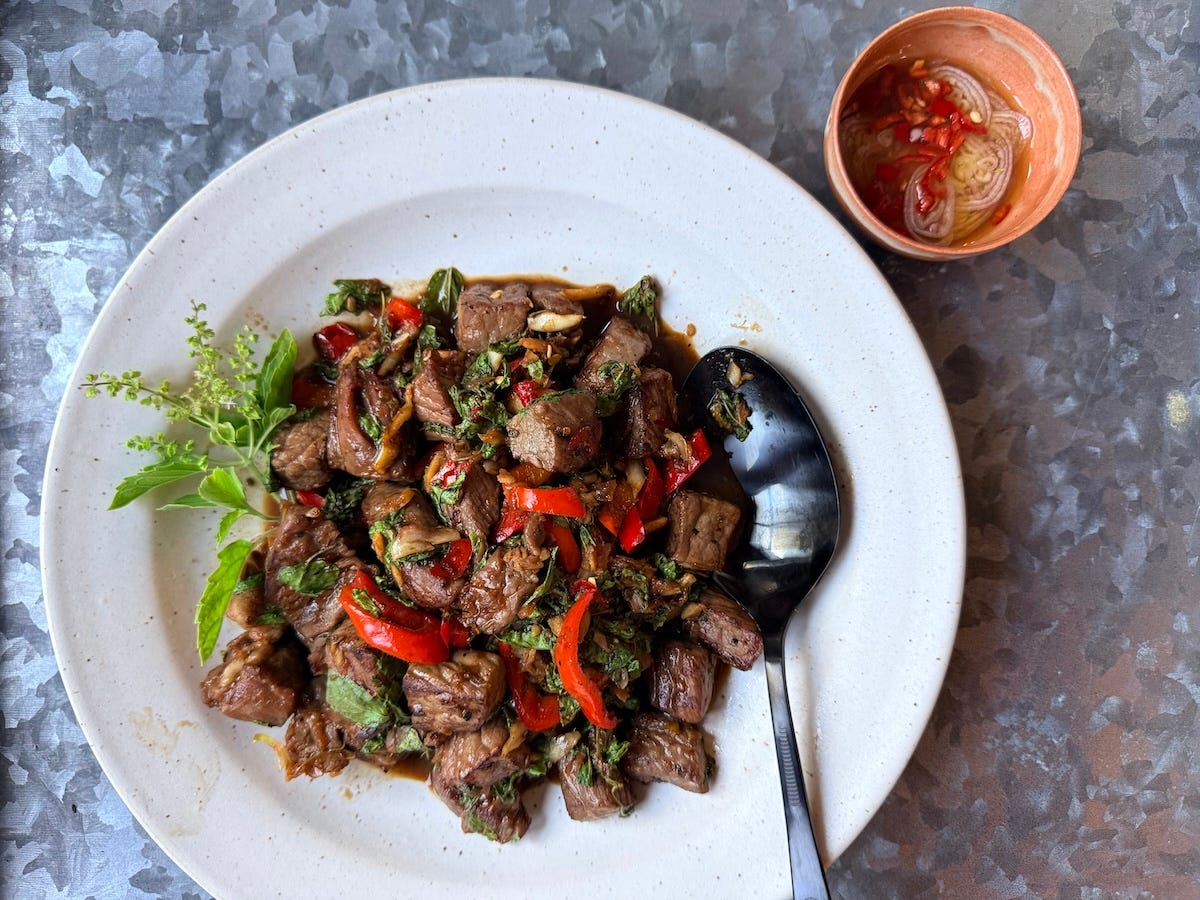
Pim cheekily named her recipe Bougie Pad Gaprao because the typical rendition uses ground meat. If you have the book, the main recipe is on page 233 followed by three (3) variations on page 234. For those of you who don’t yet have the book, I’ve shared our recipe and pro tips — including smart basil swaps — on my website. Pad gaprao is on rotation at our house. It comes together fast so get the 🆓❣️ pad gaprao recipe to experience Asian basil are at its peak.
While there’s a hurry to savor summer herbs, we’re also looking to hibernate a bit with cozy soup. There’s plenty of time to simmer for hours during winter’s depth. For now, I’m still into quickies and hacks.
This week, I needed to deal with leftover rotisserie chicken. The store bought bird saved my cooking life last Sunday when I was too tired to cook from scratch. Its comforting roasted flavor, convenience and affordability rescued me. But what to do with the leftovers? Yes, you can make a sandwich or salad but those dishes often blatantly remind you that you’re still eating the same bird. Day-after rotisserie chicken can be dry as a cotton ball and hard to swallow.
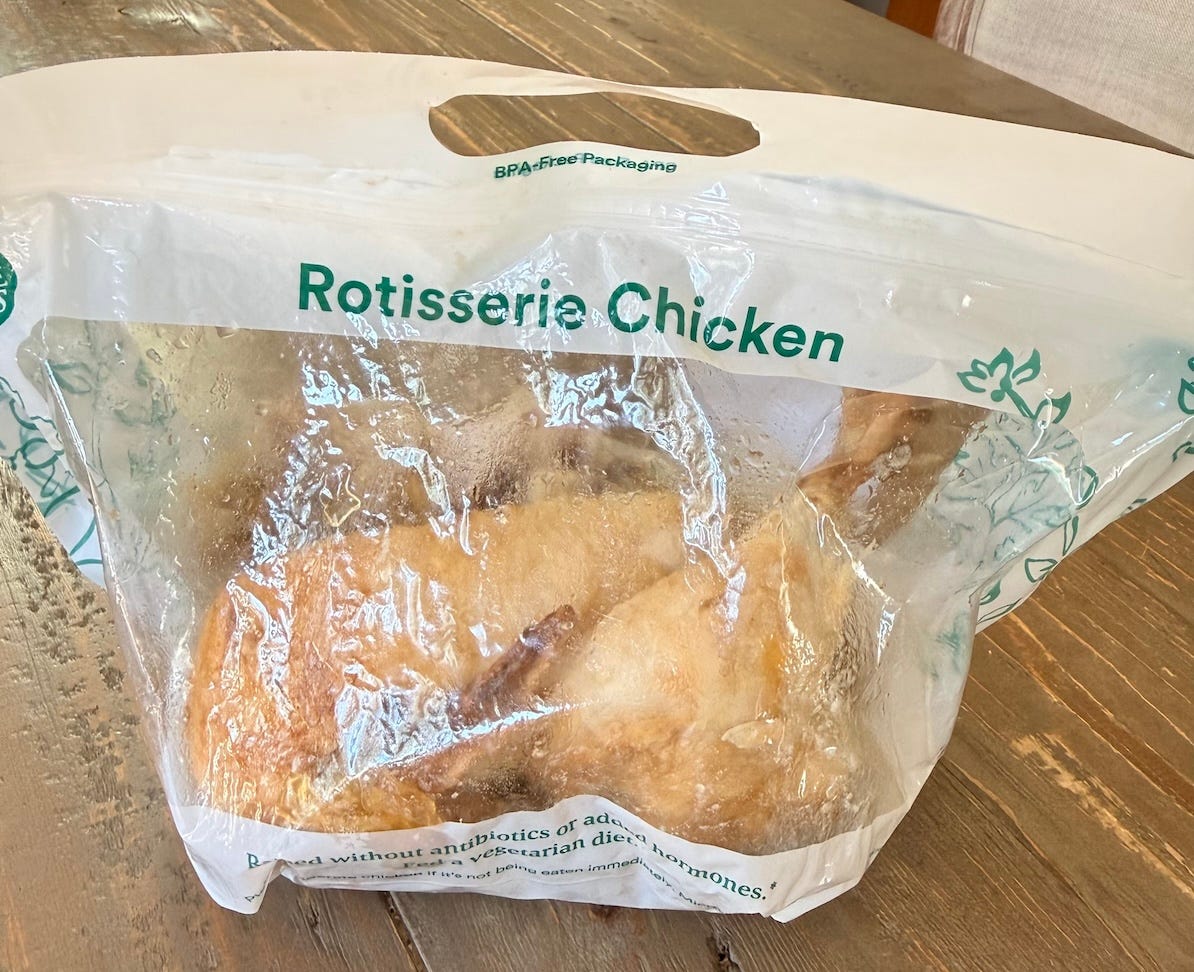
Not wanting to discard more than half of the bird, I transformed its flesh and all the scraps into a Vietnamese-Chinese noodle soup. It took about 45 minutes and transported me to a family friend’s Chinese barbecue shop in San Diego. Mr. and Mrs. Tan owned the shop that my parents frequented. While the adults talked, I scarfed down Mrs. Tan’s specialty — mì vịt tiềm (“mee VEET tiam”), a braised duck Vietnamese egg noodle soup with a rich, spiced broth. It’s a specialty of the Chinese diaspora in Vietnam, particularly the one in Chợ Lớn, Saigon’s Chinatown neighborhood.

Mrs. Tan gave my mom her recipe, which I used to create the recipe for my first cookbook, Into the Vietnamese Kitchen. That twenty year old recipe on page 220 remains my favorite iteration but it’s time consuming to prepare. Who wants to roast duck or go find one? When traffic is perfect, the closest Chinese barbecue shop is 45 minutes away! And nowadays, what’s sold at those shops as roast duck is anemic.
Wanting a cozy shortcut and aiming to use up my rotisserie chicken, I cooked up this shortcut version with chicken. This 45-minute Mì Gà Tiềm hack transforms the chicken into a remarkably fun and special treat. The flesh moistened up, but most importantly, the results made me forget that we were eating humble leftovers. Rory dreaded eating rotisserie chicken dishes but he perked up when I served him a bowl of this noodle soup.
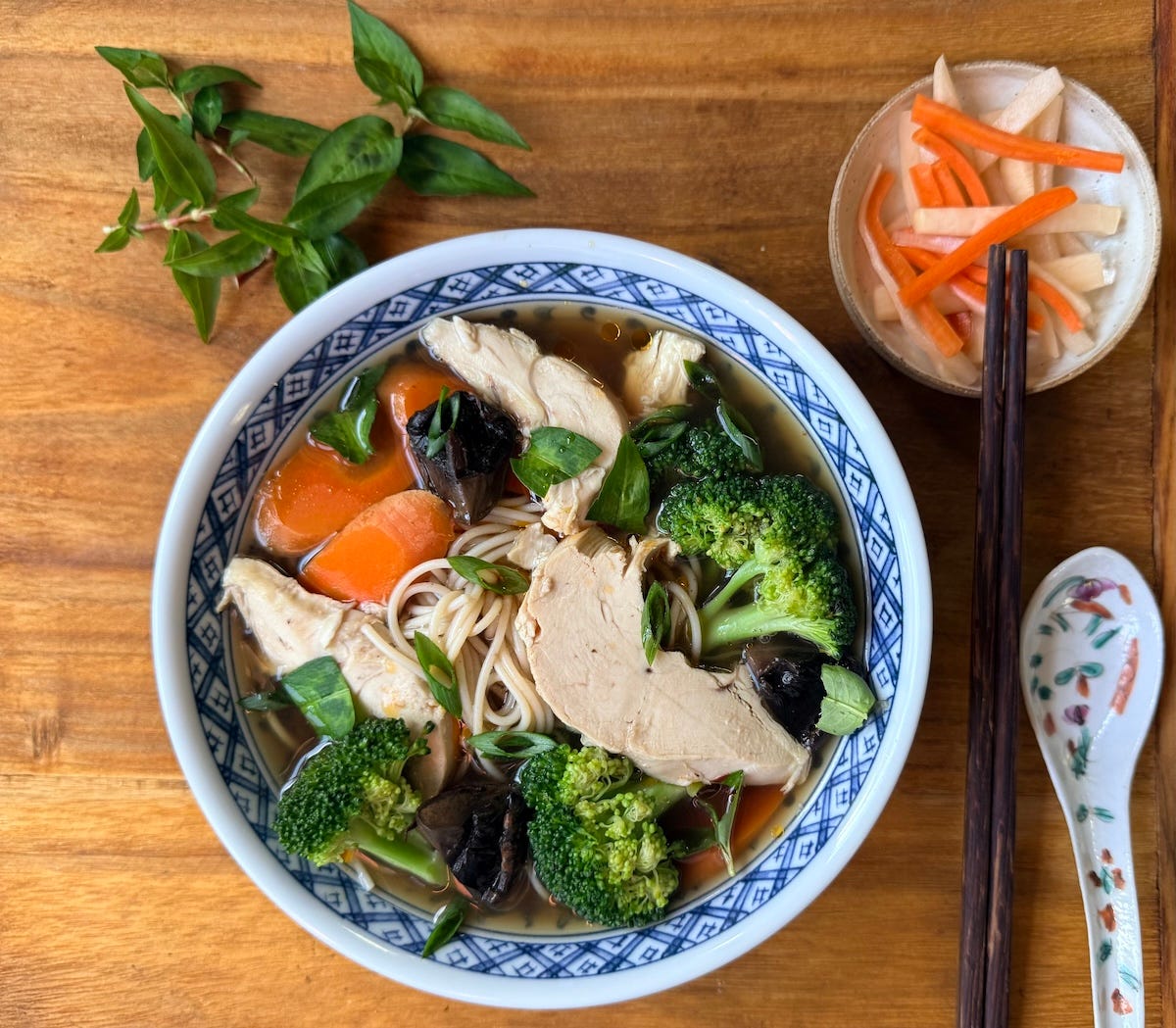
When you make this shortcut Mì Gà Tiềm (“mee GAH tiam”), you’ll realize its many virtues.
It uses every bit of the bird for a potent broth. Use your roast chicken leftovers, if you want. Rotisserie chicken isn’t the only game in town. 😆
If you don’t have enough meat, at least turn the leftover scraps into tasty broth. Add mushroom, tofu and napa cabbage and you have quick and easy soup for lunch.
Use Chinese egg noodles, rice noodles, soba, or ramen. Instant ramen is fine.
Employ fresh or dried mushrooms, depending on the time used.
Below you’ll find the recipe in text and a downloadable PDF. Plus you’ll have all my recipe development notes for you to tinker with.
Ok, the clock is running and you’re hungry. Let’s make this noodle soup!
Support Pass the Fish Sauce as much as you can. Become paid subscriber for this recipe and access to 225+ others, along with class discounts and much, much more.

Friends,
The last time Kansas elected a Democrat to the Senate was 1932. Yet on Friday, Democratic Senate candidate Adam Hamilton received his second endorsement from a Republican former Kansas governor in less than a month, in his race against Republican incumbent Senator Roger Marshall.
The top Senate Republican super PAC is so concerned that Marshall could lose the race that it’s diverting funds to Kansas from North Carolina, where it’s canceled its remaining ads against Democrat Roy Cooper — basically conceding North Carolina (by the way, a Democrat hasn’t won statewide federal office in North Carolina in nearly two decades).
To say it’s not looking good for Republicans is an understatement.
Trump is an albatross around the necks of every Republican running for Congress or governor. He’s also posing problems for plenty of Republican candidates for state office.
Why?
It’s not that Americans have suddenly discovered that Trump is a despicable human being. His personality has been on national display for more than a decade.
It’s not that Trump’s hold over his MAGA base has significantly weakened. Polls show self-identified MAGAs are still firmly in his camp.
It’s not that most Americans have become angry that the major beneficiaries of Trump’s tax cuts are big corporations and the very rich, or that the burdens of his spending cuts disproportionately fall on the poor (as less nutrition assistance and Medicaid), or that his mass deportations are violent and cruel. There’s no evidence that these policies are suddenly swaying voters.
And it’s not that voters have become any more aware of Trump’s lies. He continues to say the U.S. is experiencing a “golden age” with a “roaring economy” that’s doing “better than any other country” in the world, and that any negative public perception is due to a “public relations” problem.
No, the real problem for Trump and Republicans is Americans are hurting, and they know it’s because of Trump and Republicans.
A new AP-NORC poll shows a record low 26 percent of Americans approve of Trump’s handling of the economy, while just 17 percent approve of how he’s handling the cost of living. These are comparable to George W. Bush’s ratings during the 2008 financial crisis and George H.W. Bush’s just before he was swept out of office. The Conference Board’s Consumer Confidence Index fell to 81.9 in September, its lowest since April 2014.
In Kansas, for example, Trump’s tariffs have caused China, Canada, and Mexico to retaliate by sharply cutting demand for wheat, sorghum, and soybeans. As a result, Kansas grain silos are so swollen that grain brokers have been forced to reroute human-grade grain into dog food.
At the same time, tariffs on foreign-produced aluminum and steel have driven up the prices of farm machinery and replacement parts. Trump’s decision to lift certain foreign beef import restrictions has hurt the beef sales of local cattle ranchers.
Trump’s war in Iran has choked off shipping of sulfur and phosphate in the Persian Gulf, causing nitrogen and phosphate fertilizer prices to surge by over 100 percent. The blockage has also caused diesel prices to soar, making farmers pay $200 per acre just to fuel their tractors.
These higher costs and lower crop sales have resulted in the closure of roughly 700 Kansas farms over the past year. Many remaining farmers are barely holding on.
This explains why Kansas’s former Republican governor Mike Hayden endorsed Democrat Adam Hamilton over Republican incumbent Roger Marshall in Friday’s Wichita Eagle:
“Sen. Marshall time and again has chosen to back the tariffs and the war, despite what is happening back in Kansas. Kansans need a senator willing to stand up and say this isn’t working.”
There it is, folks.
Americans can bear Trump’s awful personality. Some might succumb to his MAGA cult. They might believe many of his lies.
But they can’t abide what Trump’s policies are doing to them and their families.
Forget the rip-roaring stock market. When it comes to voting, kitchen-table economics — the financial realities average people talk about over the kitchen table, such as the prices they’re paying and the money they’re earning — are more potent than anything else.
I continue to warn against complacence. It’s still vitally important that we vote, and that we encourage everyone we know — especially those who share our values — to vote. And it’s crucially important to remain vigilant against Trump’s interference in our elections.
But with a little more than four weeks to go, I’m breathing a wee bit easier. I hope you are, too.
My thanks to WorkOS for sponsoring this last week, once again, at DF.
SSO is table stakes for enterprise deals, but building it into your app yourself means writing SAML controllers, parsing XML assertions, and handling IdP-specific quirks for each provider. Learn how SAML flows work, the tradeoffs between building or buying, and best practices for security, routing, and UX.
Or, skip the hassle and add SSO with WorkOS. Read their developer’s guide to learn more — everything from how SSO works to why WorkOS is the fastest way to add it.
