❌

Normal view

James Beard’s Amazing Persimmon Bread Recipe

By: David
2 November 2026 at 08:38

Like most Americans, even French people aren’t so familiar with persimmons. They may see them at the market, look at their curiously, but don’t stop to buy any. Or if they do, they take them home, bite into an unripe one, make a face, and toss them out.

One of my friends living north of San Francisco in Sonoma County had an enormous persimmon tree. Each fall, the leaves would drift off the tree, leaving bright orange globes of fruit dangling off the sparse branches. The beautiful, gnarled wood was quite a contrast to the smooth, brilliantly-colored orbs of fruit. (The wood of the persimmon tree is not just beautiful but it’s prized by makers of many of the finest golf clubs in the world and is considered superior to most others woods or man-made materials.)

The most common persimmon you’re likely to find is the Hachiya, a slightly elongated fruit that tapers to a point. They’re incredibly tannic and astringent when not ripe and need to be squishy-soft and feel like a full water-balloon before using. Once ripe, the sweet jelly-like pulp can be spooned out and pureed through a blender, food processor, or food mill, although some folks like to eat it as is or frozen. The pulp freezes beautifully, and in fact, I’ll often freeze some for late-winter use. To ripen Hachiya persimmons, simply let them sit on your countertop until very soft. If they don’t riped at the same time, you can store the puree in the refrigerator until the others have ripened. You can hasten the process by putting persimmons in a well-sealed container; adding an apple, which gives off a lot of ethylene gas, which will speed things up.

The other common persimmon is the Fuyu, which is squatter than the Hachiya and matte-orange. Unlike the Hachiya, the Fuyu is meant to be eaten hard and is delightfully crunchy. I peel them, then mix pieces into an autumnal fruit salad along with dates, slices of Comice pears, pomegranate seeds and yes…even some bits of prunes.

Finding recipes for using persimmons can be difficult. I invented a recipe for a quick Persimmon Cake for my book Ready For Dessert, which I make often for Thanksgiving. And I also like James Beard’s Persimmon Bread, a nifty recipe from his classic book on breadmaking, Beard on Bread, published decades ago.

I was fortunate to meet James Beard several times when he came to dinner at Chez Panisse. In the years after he passed away, we’d get all sorts of luminaries coming through our kitchen, people like James Beard, Jane Grigson, and Richard Olney, who were really wonderful cooks and writers.

The most charming thing about this simple Persimmon Bread recipe is that Beard gives bakers an inexact amount of an ingredient: sugar. So go ahead just this one time to improvise a little. Although I recommend using the higher amount of sugar, feel free to use whichever quantity you’d like…after all, you have permission from the granddaddy of all cooks, James Beard himself.

Print

Persimmon Bread

Adapted from Beard on Bread by James Beard
Using the higher amount of sugar will produce a moister and, of course, sweeter bread. I often use bourbon, as I like the flavor, but cognac, rum or brandy work well, instead. if you only want to make one loaf, cut the recipe in half. If you make two, this bread freezer beautifully.
Course Bread
Cuisine American
Keyword bread, Persimmon, raisins, walnuts
Servings 12 servings

Ingredients

  • 3 1/2 cups (420g) sifted flour
  • 1 1/2 teaspoons salt
  • 2 teaspoons baking soda
  • 1 teaspoon ground nutmeg
  • 2 to 2 1/2 cups (400-500g) sugar
  • 1 cup (8oz, 225g) melted unsalted butter cooled to room temperature
  • 4 large eggs at room temperature, lightly beaten
  • 2/3 cup (160ml) Cognac or bourbon whiskey (see headnote)
  • 2 cups (500ml) persimmon puree (from about 4 squishy-soft Hachiya persimmons)
  • 2 cups (200g) walnuts or pecans toasted and chopped
  • 2 cups (270g) raisins or diced dried fruits (such as apricots, cranberries, or dates)

Instructions

  • Butter 2 loaf pans. Line the bottoms with a piece of parchment paper or dust the pans with a little flour and tap out any excess.
  • Preheat oven to 350ºF (180ºC).
  • Whisk the flour, salt, baking soda, nutmeg and sugar together in a large mixing bowl.
  • Make a well in the center of the dry ingredients then stir in the butter, eggs, liquor, and persimmon puree. Avoid overmixing the batter, but if there are some lumps, you can whisk it a few times briskly to smooth it out. Fold in the nuts and raisins.
  • Bake 1 hour, or until toothpick inserted into the center comes out clean.
Notes

Storage: Will keep for about a week, if well-wrapped, at room temperature. The Persimmon Bread can be frozen, too.

    Tarte au citron: Lemon Tart Recipe

    By: David
    9 January 2026 at 16:27

    Not everyone thinks of citrus fruits as “winter fruits.” But that’s when oranges, grapefruits, tangerines, tangy lemons, and enticing limes are often at their peak. And that’s a good thing because there’s nothing that brightens up any season – but especially winter – better than a classic French lemon tart.

    French lemon tart recipe

    Any bakery in Paris will have a Tarte au citron on offer. Some are on the sweet side, others tart. I like my lemon tart, well…tart, for sure and when I search for lemons at my market, I choose the plumpest, juiciest ones I can find. Fortunately, good lemons are available just about anywhere, so anyone can make this tart. Most of us don’t even have to wait until winter!

    https://www.davidlebovitz.com/2009/05/tart-au-citron-french-lemon-tart/

    I juiced my lemons, cracked some eggs, and got to work on the tart.

    For the base, I used Paule’s pastry dough, which is so easy to make and hasn’t failed me yet. It’s delicious and buttery, and goes particularly well with the delicious lemon topping.

    https://www.davidlebovitz.com/2009/05/tart-au-citron-french-lemon-tart/

    I cooked the filling, a sunny, luscious lemon curd, on the stovetop with the fragrant zest of the lemons, then poured the warm filling through a strainer to make it as smooth as possible.

    https://www.davidlebovitz.com/2009/05/tart-au-citron-french-lemon-tart/ One could pipe whipped cream on it or top it with meringue. To do so, let it cool and spread or pipe whipped cream over the top or serve a dollop alongside. If you want to give a go at meringue, check out my Lime Meringue Tart recipe or the marshmallow topping that I use on my Pumpkin Pie with Marshmallow Topping.

    https://www.davidlebovitz.com/2009/05/tart-au-citron-french-lemon-tart/

    Both are delicious, but just as it is – or as the French say, nature – is just fine with me.

    French lemon tart

    Print

    Lemon Tart

    I recently updated this recipe to increase the amount of filling and I dialed down the sugar a bit due to frequent questions about reducing sugar in recipes. You can taste the filling in step 3 and if you'd like it sweeter, add up to 1/4 cup (50g) more sugar If you find that you have a bit too much filling for your tart shell (they seem to vary), any remaining lemon filling that you don’t use can be spread on toast, fresh biscuits, or scones. You could substitute fresh lime juice for the lemon, and if you have Meyer lemons, reduce the sugar to 1/2 cup (100g). You can use a favorite tart dough recipe, or the one I’ve linked to.

    Ingredients

    • 1 cup (250ml) freshly-squeezed lemon juice
    • grated zest of two lemons preferably unsprayed
    • 3/4 cup (150g) sugar
    • 12 tablespoons (170g) butter salted or unsalted, cut into cubes
    • 4 large eggs
    • 4 large egg yolks
    • One pre-baked 9-inch (23cm) tart shell

    Instructions

    • Preheat the oven to 350ºF (180ºC).
    • In a medium-sized non-reactive saucepan, heat the lemon juice, zest, sugar, butter, eggs and egg yolks. Have a mesh strainer nearby.
    • Stir until the butter is melted, then whisk the mixture continuously until the mixture thickens and holds its shape when you lift some of it up with the whisk and it visibly mounds up when dropped back down over the rest of the mixture in the saucepan. It should just take a few minute.
    • Pour the warm lemon curd though a strainer into a bowl (or directly into the tart shell), scraping with a rubber spatula to press it through.
    • Smooth the lemon filling in the prebaked tart shell and pop it in the oven until the curd is just set. It’ll take about 5 to 6 minutes.
    • Remove from the oven and let cool before slicing and serving.

    Related Links

    Recipes to Use Up Leftover Egg Whites

    Lemon Verbena Ice Cream

    Moroccan Preserved Lemons

    Tips for Freezing Eggs

    What is non-reactive cookware?

    French lemon tart recipe-13

    Cherry Compote

    By: David
    5 June 2024 at 18:14

    I think I have something wrong with me. I seem to be afflicted with a particular malady that forces me to buy way too many summer fruits when they’re in season. It gets particularly dire when faced with apricots and cherries, two fruits whose seasons are much shorter than the others. The first fresh apricots I saw were back in upstate New York, around the 1980s, and I’d never seen them before. Someone brought us a basket of the tender, squishy little orange fruits to the restaurant that I worked at, and I remember being completely taken off guard, as the only apricots I’d ever seen were the dried ones. And while I loved the crinkly dried specimens, those fresh beauties with a red blush were a whole other taste entirely.

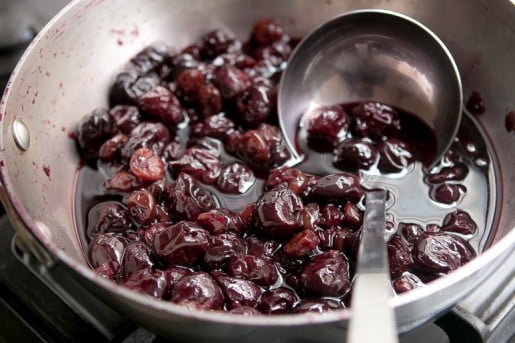
    Fresh Cherry Compote recipe

    Then, when I moved to California, I discovered how abundant fresh apricots are (or can be), as they are in France. But no matter how abundant – or not – cherries are when the season is in full swing, I always consider them extra-special fruits and give a prominent place in my kitchen. At the beginning of the season, they’re incredibly expensive and rarely good. Then, as the season moves along, they start showing up in larger mounds at the market, and the prices get gentler, coaxing me to buy as many as I can heft.

    Fresh Cherry Compote recipe

    Fresh Cherry Compote recipe-3

    This week, I was helpless when faced with an overload of summer fruits at the market. And in addition to a giant bag of apricots, two bulging sacks of tomatoes, and eight white nectarines, I bought 2 kilos (about 4 1/2 pounds, give or take a few cherries) of fresh cherries — and from the looks of the other shoppers, it was more than any normal person would buy. (Although I think I made the vendor’s day.) But I couldn’t help it. They were Burlat cherries and I’d bought a small bag from the same vendor last week at the market, and there he was again, tempting me with more. Once I got home, I got my cherry pitter out, and pitted half of them, saving the others to eat fresh. (Except I almost polished off the fresh ones I was reserving as I was pitting these!)

    Fresh cherries are, of course, great fresh. But cooking them can deepen, and even improve their flavor, especially nice if you get home and find yourself with a bag of rather wan ones. Or ones that you might snag at the end of the market, when the vendors are trying to get rid of any extras that might not keep until the next market day.

    Fresh Cherry Compote recipe-4

    In addition to being the answer to what the heck you (or I) are going to do with all those cherries, this recipe also deftly answers that age-old question: Can I freeze that? And the answer is a big, resounding, “Heck, yeah!” Once the compote has cooled, it freezes perfectly in zip-top freezer bags or other containers that you prefer to use, and will last up to a year. (You can also freeze pitted fresh cherries on their own as well.)

    And let me tell you, it’s great to stumble upon a bag of cherry compote that may have moved to an unfavorable position in your freezer as summer shifted into fall – or winter, when they can become quickly forgotten. Once defrosted, and perhaps rewarmed, they’re terrific served with vanilla ice cream, plain yogurt, or alongside a cake, such as almond cake, gâteau de savoie, or angel food cake.

    Fresh Cherry Compote recipe-5

    I like to boost their flavor with a handful of dried sour cherries, added midway during cooking, so they plump up and absorb the cherry juices, which add another dimension of cherry flavor. A shot of kirsch also dials up the flavor nicely.

    Print

    Cherry Compote

    Be sure to use a larger pot that you think. For 2 pounds (1kg) of cherries, I used a 6-quart (6l) pan. Since the cherry juices will foam up as they cook, using a larger pot – and removing the lid from time-to-time – will keep your from having to clean up a sticky mess. I’ve didn’t use much sugar here, so you can add more to taste, if your cherries aren’t as sweet as mine were. If you can get sour cherries, feel free to add some in place of the sweet cherries. If so, you may need to increase the sugar a little, to taste as well.

    Ingredients

    • 2 pounds (1kg) fresh cherries
    • 1/4 cup (50g) sugar
    • cup (40g) optional: 1/3 dried sour cherries
    • 2 teaspoons kirsch (or another fruit-based liqueur, or eau-de-vie)
    • 1-2 drops pure almond extract

    Instructions

    • Stem and pit the cherries. Put them in a large, nonreactive pot or saucepan and stir in sugar. Turn the heat to medium, cover, and cook for 10 minutes, lifting the lid and stirring them frequently, to encourage juicing and to make sure the liquid the cherries exude doesn’t foam up and overflow.
    • After 10 minutes of cooking, add the sour cherries, if using, and cook for 5 to 10 more minutes, until the cherries are wilted and completely cooked through.
    • Remove from heat and stir in the kirsch and almond extract. Let cool before storing or serving. The juices will thicken as the compote sits.

    Notes

    Storage: The cherry compote can be stored in the refrigerator for up to 5 days. It can be frozen for up to one year.

    Related Recipes

    No-Recipe Cherry Jam

    Cherry Mess

    Quick-Candied Cherries

    Cherries in Red Wine Syrup

    Lemon Yogurt Cake with Apricot-Cherry Compote

    ❌