Normal view

Cherry Jam

By: David
31 July 2026 at 11:01

One of the first “recipes” on this blog was No-Recipe Cherry Jam, posted in 2005, which wasn’t quite a recipe. Nevertheless, a lot of people successfully used those guidelines to make cherry jam over the last fifteen years. The basis for it was how I’ve been making jam forever, using 3 parts sugar to 4 parts fruit puree. The standard ratio is to use equal parts sugar to fruit puree but I like to use less.

I often make cherry jam with sweet cherries, which are what one usually finds at the market. But if you can find sour cherries, those are wonderful in the mix, but when fresh, they have a short shelf life so should be used, pronto.

So feel free to mix things up, cherry-wise!

Unlike other recipes, making jam can require a bit of using your instincts, rather than relying on set times and temperatures. Checking the jam texture on a chilled plate is the best way to tell you when it’s done. (As an example, jam usually sets between 218-220ºF,103-104ºC, but this one set a few degrees higher.) Because cherries are low in pectin, this one often “sets” a few degrees higher, although don’t expect cherry jam to be as stiff as other jams that you might be used to, or buy. It’ll be a bit runny, which is just how it should be.

One tool I do recommend is a cherry pitter. Not everyone has one, and they do fall into the “single use” category, but come cherry season, mine gets a good workout. I wrote more about why you should get a cherry pitter here.

The biggest question I get about jam recipes is people asking about reducing the amount of sugar in them. Sugar in jam does a couple of things. One, it helps the mixture jell, along with any natural pectin in the fruit. And two, it preserves it. If you use less, the jam will be runnier and won’t last as long.

Europeans tend to like their jams runnier than their American counterparts, so in the morning, you can have a European experience when you spoon some of this jam on your morning toast, as we do.

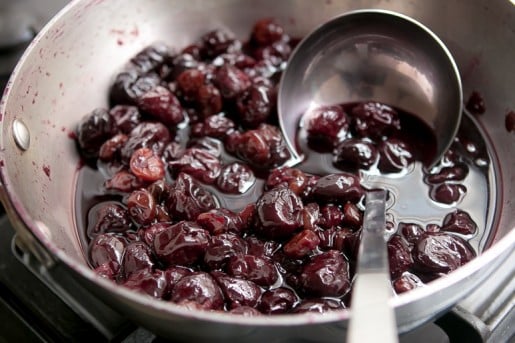
Unlike other jams that wrinkle when you do the wrinkle test (putting a spoonful of jam on a frozen plate, returning the plate to the freezer and when the jam wrinkles with you nudge it, it’s done), this one will be more like thickened syrup. It’s done when it’s thick and sticky and holds its shape for a few moments after you drag a spoon through it (below.) The cherries will be shiny and glossy, like beautiful ruby-colored jewels.

Print

Cherry Jam

If you only have 1 pound (450g) of cherries, feel free to cut the recipe in half. The liqueur is optional but heightens the flavors of the jam. Use only enough so it complements the fruit – you don't want to overwhelm it. As mentioned, this jam will be a bit on the runny side when "set." Sour cherries will produce a softer-set jam than sweet cherries.
Course Breakfast
Cuisine American
Keyword cherries, cherry, jam

Ingredients

  • 2 pounds (900g) sweet or sour cherries or a mix
  • 2 1/2 cups (500g) sugar
  • freshly squeezed juice of one medium lemon plus additional juice if desired
  • 1-2 drops of almond extract or 1-2 teaspoons of kirsch or another liqueur, such as amaretto or vodka

Instructions

  • Remove the stems and pit the cherries. Put them in a large non-reactive pot. If using only sweet cherries, add 2-3 tablespoons of water to the pot. (Sour cherries will exude enough liquid on their own so no need to add additional water.) Put a small plate or saucer in the freezer.
  • Cover the pot and cook over medium heat, stirring occasionally, until the cherries are wilted and cooked through, about 10 minutes.
  • Remove the lid and stir in the sugar and lemon juice. Increase the heat to medium-high and cook, stirring frequently until the mixture thickens. It's hard to say how long it will take, but when the mixture resembles the sixth picture in the post, the one in the pot with the bubbles, turn off the heat and test the jam by putting a small spoonful on the frozen dish. Return the dish to the freezer for a few minutes until the jam on it is cool. Run a spoon through it and if the liquid is very thick and leaves a clear patch, as shown in the photo in the post, it's done. If not, return the plate to the freezer and continue to cook the jam, testing it at various intervals, until it's done. (If you want to use a thermometer to check the jam, it should be ready somewhere between 220º and 225ºF, 104º-107ºC.)
  • When ready, turn off the heat and stir in the almond extract or liqueur (or both, if you wish). If desired, you could add an extra squeeze of lemon juice to balance the sweetness. Ladle into clean jars.

Notes

Storage: This jam will last several weeks in the refrigerator. If you wish to can it, you can find instructions here.
 

burrata with crushed cherries and pistachios

By: deb
3 July 2025 at 13:42

Last summer, a friend came to a barbecue and said, “We had soccer and then a birthday party and I had no time to make anything but I brought this” and started unloading items from a grocery bag. There were no clean cooking utensils so she and I proceeded to use our hands to break open balls of burrata and spread them on a plate, smash open cherries and pit them, sprinkling them over, crushed pistachios with the bottom of a pot, and finished the whole platter with olive oil, lots of sea salt, black pepper, and fresh mint we picked from sprigs. We lined the plate with rounds of storebought crostini, I snapped a picture and later when I shared it, dozens of you messaged me to demand a recipe or tutorial.

Read more »

Clafoutis

22 May 2025 at 00:13
best clafoutis recipe

Have you tried the classic French dessert called clafoutis? (It’s pronounced klah-foo-tee.) If not, please let me introduce you to this delightful and simple treat. Clafoutis is a delicious cross between a cake and a custard with a crackled top and luscious, fruit-studded interior. It’s sweet but not too sweet, making it the perfect ending to a lovely summer supper.

Clafoutis is typically baked with cherries, but you’ll see that I used berries here, and you’ll find more options below. My three-year-0ld loves clafoutis. She’s been asking for more “cherry cake” since last summer, and it’s about time we made more.

I made clafoutis over and over again last summer until I got the proportions of this recipe just right (nine times, to be exact). Each attempt was tasty, but the recipe I’m sharing today is perfection. I had to find the right balance between the amounts of flour, sugar, liquid and eggs to yield a silky interior that’s full of flavor but not too eggy or wet. Here it is!

Continue to the recipe...

The post Clafoutis appeared first on Cookie and Kate.

Summer Fruit Recipes

By: David
17 June 2026 at 08:20

It’s summer! Whether you’re in or outdoors, hopefully for all of you there are beautiful summer fruits and berries to be had, and I hope that you’re able to get your hands on as many of them as you can. I am loading (actually, overloading…) myself up at the market. While a good portion on the fresh fruit gets eaten just as-is, some of it goes into the following dessert recipes that I continue to make year after year. Others go into jam, which is a great way to preserve all those summer fruits and berries, and make them last through fall and winter.

Cherry season is behind most of us (sniff…sniff…), but if they are still lingering where you live, you can type “cherry” or “cherries” into the search engine at the top right corner of the page to find cherry recipes. (And we don’t get a bountiful array of fresh raspberries and blackberries here, so I don’t have many recipes that use them on the blog.) But for nectarines, strawberries, peaches, plums and other summer fruits, here are some of my favorite recipes on the blog…

Summer Fruit Galette with Frangipane

I’ve seen so many galettes this year on social media, that it’s tempting to already call galettes The Dessert of the Year. (Okay, there were plenty of Banana Breads as well. And it’s hard to knock Banana Bread, even my low(er) fat one.) But for the bang-for-the-buck, it’s hard to beat the silly-easy galette, made with a fail-safe dough that gets rolled out, topped with fresh fruit, and baked until ripe ‘n ready. Mine has a layer of frangipane under the fruit to keep some of those juices away from the bottom crust, so it stays crisp. It also tastes good, too! Apricots work especially well in this one but you can use nectarines, plums, peaches, or…

Strawberry Rhubarb Galette

…rhubarb and strawberries! Yes, the classic combo works well as a galette, too. But don’t let tradition stand in the way of deliciousness and you can swap out cherries, raspberries, or blackberries for the strawberries.

Apricot Jam

When I was a cook in upstate New York back in the 1980s (!) I remember someone brought us a (as in 1) basket of fresh apricots from California, which I’d never seen before. I made a simple tart with them and only eight lucky customers could get a taste of it. (Or maybe I cut it into ten?) Fast-forward to today, summer brings a cavalcade of fresh apricots to the markets and toward the end of the season, I don’t have time to shed any tears as I’m piling apricot jam into pots, to save them for the coming months. It’s Romain’s favorite jam so I make sure there’s enough to keep him happy, because I’ve learned what happens when I don’t : 0

Summer Fruit Tart (with frangipane)

Another summer fruit favorite, yes, with more almond cream than the galettes above, this is that classic French tart that you’ll find in many pastry shops all year round, using everything from pears to pineapple. Don’t love almonds, or want to take it in a different direction? Replace the almonds with hazelnuts for a special treat.

Plum-Strawberry Jam

While apricots are Romain’s favorite for jam, I am 100% on team plum. The luscious tang of juicy plum, and the high natural pectin content, makes this one of the easiest jams to make. And it’s not too difficult to eat, either.

Plum Sorbet

While I miss the purple Santa Rose and Elephant Heart plums we got in California, France has its own special selection of delectable plums, including Mirabelles, quetsches, and even wild plums. While the wild plum trees that we used to pick/glean from have been pruned by the absentee owners (phooey!) we found another source last summer. And the only thing better than free plums is free wild plums, which come in an array of snazzy colors and are extra tangy, perfect for those of us that like some pucker in our pastries.

Plum Flaugnarde

The cousin of clafoutis, this flaugnarde features a jumble of plums baked in a silky custard. They’re so pretty I almost hate to bake them. But then, when I pull it out of the oven, I’m happy to have a beautiful baked gratin dish of custardy plums for dessert on a warm summer night.

Plum-Rhubarb Crisp

Two tart fruits come together, baked under a buttery blanket of streusel. If these two bedfellows are available at the same time where you live, you’re doubly lucky!

Mirabelle Jam

The elusive Mirabelle plums have a cult-like following and while some mistakenly think they aren’t available in the U.S. (they were briefly banned a few years ago), if you’re lucky, you can indeed find them. They’re intensely flavored and sweeter than other plums, and make a wonderful confiture with jewel-like fruits suspended in a shimmering jelly, which are lovely heaped on toast in the morning. (If you want to get a taste of Mirabelles but can’t find them, Bonne Maman makes a golden plum Mirabelle jam that’s exported from France.)

Angel Food Cake

While I wasn’t a fan of Angel Food Cake growing up, which my mother usually made to accompany strawberries, I became a convert as a grown-up. Perhaps it had to do with writing an ice cream book and having an overload of egg whites to use up. (And Angel Food Cake is an express route to doing that.) Nevertheless it’s a treat along with summer fruits and berries, either baked as a compote or fresh, tossed in a little sugar and perhaps a dash of crème de cassis. The spongy cake is an ideal way to make sure you get every drop of the fruit syrup that’s surrounding the airy slab. It’s French cousin, Gâteau de savoie, is equally enjoyable, and doesn’t require an Angel Food Cake pan.

Roasted Strawberry Miso Ice Cream

Roasting strawberries is lesser-known way of coaxing out their flavor, but works well when making ice cream as it concentrates them and reduced the water, so the ice cream stays creamier. Adding a touch of salty miso provides a curious contrast to the berries juicy sweetness, and a little umami to boot.

Strawberry Spritz

Once you make the (very) easy base for this Strawberry Spritz, you can use it to make Strawberry Margaritas, too. (And if you’ve got a hankering for a classic Spritz, I’ve got you covered there, too.) But this Spritz is a great, light apéritif to enjoy all season long. I was drinking lots of these a few weeks ago when strawberries were at their peak. If they available where you live, go infuse some in vermouth blanc for a great spring/summer sipper.

Spiced Plum Cake with Toffee Glaze

Toffee glaze is one of those things you could put on an old sneaker, and it would make those dilapidated Reeboks taste great. Even better (and more recommended) is this spiced plum cake, which isn’t too rich or too sweet. Crunchy toasted almonds on top are a nice contrast to the buttery glaze.

Peach Shortcakes with Butterscotch Sauce

Speaking of buttery sauces, butterscotch with peaches is a natural. Grammar-correct keeps asking me: A natural what? But I think you can figure that out. If not, give them a try together and you’ll see what I’m talking about.

Vin de pêche

If you’re fortunate enough to have a peach tree or can get some of the leaves, they lend a delicate almond-like flavor to this intriguing apéritif wine. I try to make a few bottles every year and serve chilled glasses as the season’s change, reminding me of summer, and reminding me that the light almond flavor of peach leaves in wine is something to put on my calendar for the following year.

Bourbon Peach Cooler

Peaches and bourbon are natural partners, and they don’t mind sharing space in a tumbler with the classic French apéritif, Bonal. But not to worry if you don’t have it; I offer some substitutes that you might already have on your liquor shelf. This cocktail isn’t just pretty, it’s also a pretty effective way to beat the heat. (Yup, nectarines or plums could replace the peaches, if you’re so inclined.)

Nectarine-Berry Popsicles

A vintage metal popsicle mold that was a find at a flea market prompted these summer ‘sicles. You can load ’em up with berries and since I used white nectarines, the popsicles were extra-pretty in pink. But anyone would say “yes” to them in yellow, if you go with standard nectarines.

Mixed Berry Shortcakes

Mixed berry anything automatically makes something my favorite dessert. I love, love, love the juicy tumble of strawberries, blueberries, blackberries, red currants, or whatever else you’ve got. Bring the berries on!

Blueberry Cobbler

While I am nostalgic for the overload of blueberries that I grew up with New England, when I do find myrtilles, I try to keep them as close to their pure state as possible. Topped with crumbly drop biscuits, all that’s needed is a scoop of vanilla ice cream to complete the picture, but white chocolate-fresh ginger ice cream would also be welcome…and appreciated, on this cobbler.

Mango Frozen Yogurt with Blueberry Compote

While everyone’s mind is on peaches and nectarines, don’t forget mangoes, their tropical counterpart, which go just as well with summer berries. Blueberries particularly come to mind but raspberries and strawberries could fill in for them.

Strawberry Frozen Yogurt

With pretty swirls of crispy meringue, this tangy frozen yogurt can be part of a composed dessert, which I like to serve in the summer, being generous with the fresh fruit…and filling in the blanks with frozen yogurt and meringues.

Blueberry Buckle with Lemon Syrup

I don’t know if blueberries get any better than in this buckle, which do indeed “buckle” under the weight of almost too many blueberries…if that’s even possible. A dousing with tart lemon syrup keeps things moist and tangy. You can skip the cream with this one. It’s great on its own.


Cherry Compote

By: David
5 June 2024 at 18:14

I think I have something wrong with me. I seem to be afflicted with a particular malady that forces me to buy way too many summer fruits when they’re in season. It gets particularly dire when faced with apricots and cherries, two fruits whose seasons are much shorter than the others. The first fresh apricots I saw were back in upstate New York, around the 1980s, and I’d never seen them before. Someone brought us a basket of the tender, squishy little orange fruits to the restaurant that I worked at, and I remember being completely taken off guard, as the only apricots I’d ever seen were the dried ones. And while I loved the crinkly dried specimens, those fresh beauties with a red blush were a whole other taste entirely.

Fresh Cherry Compote recipe

Then, when I moved to California, I discovered how abundant fresh apricots are (or can be), as they are in France. But no matter how abundant – or not – cherries are when the season is in full swing, I always consider them extra-special fruits and give a prominent place in my kitchen. At the beginning of the season, they’re incredibly expensive and rarely good. Then, as the season moves along, they start showing up in larger mounds at the market, and the prices get gentler, coaxing me to buy as many as I can heft.

Fresh Cherry Compote recipe

Fresh Cherry Compote recipe-3

This week, I was helpless when faced with an overload of summer fruits at the market. And in addition to a giant bag of apricots, two bulging sacks of tomatoes, and eight white nectarines, I bought 2 kilos (about 4 1/2 pounds, give or take a few cherries) of fresh cherries — and from the looks of the other shoppers, it was more than any normal person would buy. (Although I think I made the vendor’s day.) But I couldn’t help it. They were Burlat cherries and I’d bought a small bag from the same vendor last week at the market, and there he was again, tempting me with more. Once I got home, I got my cherry pitter out, and pitted half of them, saving the others to eat fresh. (Except I almost polished off the fresh ones I was reserving as I was pitting these!)

Fresh cherries are, of course, great fresh. But cooking them can deepen, and even improve their flavor, especially nice if you get home and find yourself with a bag of rather wan ones. Or ones that you might snag at the end of the market, when the vendors are trying to get rid of any extras that might not keep until the next market day.

Fresh Cherry Compote recipe-4

In addition to being the answer to what the heck you (or I) are going to do with all those cherries, this recipe also deftly answers that age-old question: Can I freeze that? And the answer is a big, resounding, “Heck, yeah!” Once the compote has cooled, it freezes perfectly in zip-top freezer bags or other containers that you prefer to use, and will last up to a year. (You can also freeze pitted fresh cherries on their own as well.)

And let me tell you, it’s great to stumble upon a bag of cherry compote that may have moved to an unfavorable position in your freezer as summer shifted into fall – or winter, when they can become quickly forgotten. Once defrosted, and perhaps rewarmed, they’re terrific served with vanilla ice cream, plain yogurt, or alongside a cake, such as almond cake, gâteau de savoie, or angel food cake.

Fresh Cherry Compote recipe-5

I like to boost their flavor with a handful of dried sour cherries, added midway during cooking, so they plump up and absorb the cherry juices, which add another dimension of cherry flavor. A shot of kirsch also dials up the flavor nicely.

Print

Cherry Compote

Be sure to use a larger pot that you think. For 2 pounds (1kg) of cherries, I used a 6-quart (6l) pan. Since the cherry juices will foam up as they cook, using a larger pot – and removing the lid from time-to-time – will keep your from having to clean up a sticky mess. I’ve didn’t use much sugar here, so you can add more to taste, if your cherries aren’t as sweet as mine were. If you can get sour cherries, feel free to add some in place of the sweet cherries. If so, you may need to increase the sugar a little, to taste as well.

Ingredients

  • 2 pounds (1kg) fresh cherries
  • 1/4 cup (50g) sugar
  • cup (40g) optional: 1/3 dried sour cherries
  • 2 teaspoons kirsch (or another fruit-based liqueur, or eau-de-vie)
  • 1-2 drops pure almond extract

Instructions

  • Stem and pit the cherries. Put them in a large, nonreactive pot or saucepan and stir in sugar. Turn the heat to medium, cover, and cook for 10 minutes, lifting the lid and stirring them frequently, to encourage juicing and to make sure the liquid the cherries exude doesn’t foam up and overflow.
  • After 10 minutes of cooking, add the sour cherries, if using, and cook for 5 to 10 more minutes, until the cherries are wilted and completely cooked through.
  • Remove from heat and stir in the kirsch and almond extract. Let cool before storing or serving. The juices will thicken as the compote sits.

Notes

Storage: The cherry compote can be stored in the refrigerator for up to 5 days. It can be frozen for up to one year.

Related Recipes

No-Recipe Cherry Jam

Cherry Mess

Quick-Candied Cherries

Cherries in Red Wine Syrup

Lemon Yogurt Cake with Apricot-Cherry Compote

Cranberry Chutney

By: David
13 December 2023 at 15:17

Have you ever gone away for a few weeks and found out that you’d left the freezer door ajar? Well, I did. And let me tell you, it wasn’t pretty.

Before traveling, since I’m anti-gaspillage (against food waste), I jammed whatever I could into my already-stuffed freezer, including a half-eaten tomato tart, which I thought would be nice to have ready-and-waiting upon my arrival home, partially-used blocks of butter, and the miscellaneous leftover ends of bread that one collects when one constantly buys too much bread. When I returned, I realized that one of those bread pieces had been caught in the door and kept it from sealing closed.

Oddly, the fridge doors have an alarm, which beeps if they’re not completely shut, but the freezer door doesn’t. Coming home to an array of items that were half-frozen, half-defrosted (with gloopy liquid oozing out of them), possibly defrosted and then refrozen, and a few that were unidentifiable, was a bummer.

Some things I knew had to go – like sausages, stock, and a rather moldy half-eaten tomato tart, that I was sure could be reheated when I returned from my travels. (I won’t share a picture of that, but it looked like it needed a good shave.) But I also had several precious bags of cranberries that I’d stashed away for Thanksgiving and while they weren’t completely defrosted, I didn’t want to (or know if I could) refreeze them, so I decided to make chutney…and a whole lotta it.

Fortunately, all my candied and dried fruits were in fine condition and since I was cleaning my freezer, I also did a little purge of my drawers of things that weren’t sparking joy in my kitchen, and cooked them all up with some spices, some honey, orange juice, and vinegar, to make this tangy-tangy condiment.

(Just a note that dried fruits always spark joy in me. But a drawerful of little crinkled up cellophane bags with thirteen raisins or two dried apricots in them, don’t.)

To share my joy with you, I whittled my catastrophe-size recipe down to a reasonable recipe, but you’re welcome to double, triple, or quadruple it. Although it’ll keep for a few weeks in the refrigerator, I had so much that tightly sealed the overload into freezer bags and placed them back in the congélateur. However next time I’m headed out of town, I’m going to make sure my freezer is tightly sealed, because I’d be a bummer to lose those.

Print

Cranberry Chutney

Feel free to use any type, or combination, of dried fruit. Dates, figs, raisins, apricots, candied ginger, dried cherries, cranberries, pineapples, or other favorites, work well. (Of course, there's no need to chop the raisins or dried cranberries or cherries, if using.) You could also include chopped candied orange or lemon peel in the mix. Any tart apple is fine to use, but if using Golden Delicious apples, make sure to chop them very fine (unless you like chunks of apples in your chutney) as they don't break down as other apples do. If using frozen cranberries, no need to thaw them in advance. Just add them frozen and cook as directed. An interesting addition is to cook the chutney with a very small branch of rosemary. It'll lend an herbaceous note to the chutney. Remove it after the chutney is cooked. Or a tipple of whiskey (or an anise-based spirit, such as pastis) added right before the end of cooking could also be nice.
Course Side Dish
Keyword chutney, cranberry, sauce
Servings 3 cups (750ml)

Ingredients

  • 12 ounces (340g) cranberries fresh or frozen (if using frozen, no need to defrost before using)
  • 1 cup (125g) diced dried fruit (see headnote)
  • 1 tart apple cored, and finely diced (peeled or unpeeled)
  • 2/3 cup firmly-packed (140g) light brown sugar
  • 1/2 cup (125ml) orange or apple juice
  • 6 tablespoons (90ml) apple cider vinegar plus more if desired
  • 1 tablespoon honey
  • 1/4 teaspoon ground cinnamon
  • 1/4 teaspoon ground dried ginger
  • 1/8 teaspoon ground cloves
  • pinch red chile flakes
  • pinch salt

Instructions

  • Mix all the ingredients together in a large saucepan.
  • Cook over medium-high heat, stirring frequently, until the cranberries pop and begin to break down and release their juices, and the apple pieces are cooked through. Time will vary but it'll take about 10 minutes or so.
  • Remove from heat and when the chutney is cool enough, taste and add 1 (or 2) tablespoons additional vinegar, if desired.

Notes

Serving: Serve with turkey (at Thanksgiving or another holiday), or with poultry, pork, roasted vegetables, or even cheese.
Storage: Store in jars in the refrigerator until ready to use. The chutney should keep for at least a month. It can also be frozen for up to six months. If you wish to can it, you can find guidelines at the National Center for Home Food Preservation website.
 
❌