❌

Normal view

James Beard’s Amazing Persimmon Bread Recipe

By: David
2 November 2026 at 08:38

Like most Americans, even French people aren’t so familiar with persimmons. They may see them at the market, look at their curiously, but don’t stop to buy any. Or if they do, they take them home, bite into an unripe one, make a face, and toss them out.

One of my friends living north of San Francisco in Sonoma County had an enormous persimmon tree. Each fall, the leaves would drift off the tree, leaving bright orange globes of fruit dangling off the sparse branches. The beautiful, gnarled wood was quite a contrast to the smooth, brilliantly-colored orbs of fruit. (The wood of the persimmon tree is not just beautiful but it’s prized by makers of many of the finest golf clubs in the world and is considered superior to most others woods or man-made materials.)

The most common persimmon you’re likely to find is the Hachiya, a slightly elongated fruit that tapers to a point. They’re incredibly tannic and astringent when not ripe and need to be squishy-soft and feel like a full water-balloon before using. Once ripe, the sweet jelly-like pulp can be spooned out and pureed through a blender, food processor, or food mill, although some folks like to eat it as is or frozen. The pulp freezes beautifully, and in fact, I’ll often freeze some for late-winter use. To ripen Hachiya persimmons, simply let them sit on your countertop until very soft. If they don’t riped at the same time, you can store the puree in the refrigerator until the others have ripened. You can hasten the process by putting persimmons in a well-sealed container; adding an apple, which gives off a lot of ethylene gas, which will speed things up.

The other common persimmon is the Fuyu, which is squatter than the Hachiya and matte-orange. Unlike the Hachiya, the Fuyu is meant to be eaten hard and is delightfully crunchy. I peel them, then mix pieces into an autumnal fruit salad along with dates, slices of Comice pears, pomegranate seeds and yes…even some bits of prunes.

Finding recipes for using persimmons can be difficult. I invented a recipe for a quick Persimmon Cake for my book Ready For Dessert, which I make often for Thanksgiving. And I also like James Beard’s Persimmon Bread, a nifty recipe from his classic book on breadmaking, Beard on Bread, published decades ago.

I was fortunate to meet James Beard several times when he came to dinner at Chez Panisse. In the years after he passed away, we’d get all sorts of luminaries coming through our kitchen, people like James Beard, Jane Grigson, and Richard Olney, who were really wonderful cooks and writers.

The most charming thing about this simple Persimmon Bread recipe is that Beard gives bakers an inexact amount of an ingredient: sugar. So go ahead just this one time to improvise a little. Although I recommend using the higher amount of sugar, feel free to use whichever quantity you’d like…after all, you have permission from the granddaddy of all cooks, James Beard himself.

Print

Persimmon Bread

Adapted from Beard on Bread by James Beard
Using the higher amount of sugar will produce a moister and, of course, sweeter bread. I often use bourbon, as I like the flavor, but cognac, rum or brandy work well, instead. if you only want to make one loaf, cut the recipe in half. If you make two, this bread freezer beautifully.
Course Bread
Cuisine American
Keyword bread, Persimmon, raisins, walnuts
Servings 12 servings

Ingredients

  • 3 1/2 cups (420g) sifted flour
  • 1 1/2 teaspoons salt
  • 2 teaspoons baking soda
  • 1 teaspoon ground nutmeg
  • 2 to 2 1/2 cups (400-500g) sugar
  • 1 cup (8oz, 225g) melted unsalted butter cooled to room temperature
  • 4 large eggs at room temperature, lightly beaten
  • 2/3 cup (160ml) Cognac or bourbon whiskey (see headnote)
  • 2 cups (500ml) persimmon puree (from about 4 squishy-soft Hachiya persimmons)
  • 2 cups (200g) walnuts or pecans toasted and chopped
  • 2 cups (270g) raisins or diced dried fruits (such as apricots, cranberries, or dates)

Instructions

  • Butter 2 loaf pans. Line the bottoms with a piece of parchment paper or dust the pans with a little flour and tap out any excess.
  • Preheat oven to 350ºF (180ºC).
  • Whisk the flour, salt, baking soda, nutmeg and sugar together in a large mixing bowl.
  • Make a well in the center of the dry ingredients then stir in the butter, eggs, liquor, and persimmon puree. Avoid overmixing the batter, but if there are some lumps, you can whisk it a few times briskly to smooth it out. Fold in the nuts and raisins.
  • Bake 1 hour, or until toothpick inserted into the center comes out clean.
Notes

Storage: Will keep for about a week, if well-wrapped, at room temperature. The Persimmon Bread can be frozen, too.

    skillet pierogi with mushrooms

    By: deb
    21 October 2026 at 17:25

    Even though we’re having a relatively warm (and delightful) fall, my cravings for carbs-wrapped-in-carbs, caramelized onions, and earthy skillets of vegetables don’t care. Plus, as we’re in the thick of busy times — this year it’s college applications, middle school adjustments, me, working on a new cookbook for you — any time a full meal can be made in one pan and not feel joyless or compromised, it’s going immediately in our dinner rotation. This sure did.

    skillet pierogi with mushrooms-2
    skillet pierogi with mushrooms-4

    Read more »

    Lamb Tagine recipe

    By: David
    18 October 2026 at 15:50

    One of the first lessons I learned, right after I moved to Paris, was to never, ever be on time for a dinner party. When i got my first invitation to a dinner party, my hosts told me, “Come at 8pm…which in Paris, means to come at 8:20 or 8:30pm.”

    Subsequently, when I have guests for dinner, I expect them to be at least 20 minutes late, although there’s much debate on how late you’re actually supposed to be. But if you’re on time, or early, your host likely won’t not be ready and you’ll probably catch them by surprise.

    It’s a tricky balance when you’ve inviting people for dinner, since you want make sure when everyone’s at the table, dinner will be ready and perfectly cooked. If your friends show up very late, and you’ve made something like pork roast, which can take a while to bake, but will dry out if overcooked, you’re sunk.

    So one technique I rely on is braising. Braising is cooking something long and slow, which softens cuts of meat and poultry, and infuses whatever you’re cooking with flavor. In the case of a tagine, a North African dish that benefits from braising, your cooking the meat in a broth of onions, aromatics, and spices, which all come together after a stint in the over to make a perfect one-pot meal, that’s can be kept warm in the oven until everyone is at the table.

    In Paris, with so many Arabic and North African butchers around, it’s easy to find cuts of meat that lend themselves to slow-braising, and tagines are quite popular in France. When I wrote my book, My Paris Kitchen, someone wrote to me, wondering why I had non-French recipes in my book. Just like people in other countries, such as Americans who make Mexican and Asian foods at home, or Dutch people who eat rijsttafel, an Indonesian meal composed of many side dishes, French people regularly eat a variety of foods from other cultures, especially in Paris, which is a melting pot, where you can enjoy couscous in Belleville, dosas in the Indian quarter, and Vietnamese noodles in the thirteenth arrondissement. But really, you can get all those foods in just about every corner of the city.

    Tagines are simple to make, and once you’ve made one, you’ll wonder what took you so long to make one? You’re basically just browning the meat in a Dutch oven or large pot, then sautéing an onion with spices and seasonings, adding a few spoonfuls of tomato paste or a can of tomatoes, some stock or water, then braising it in the over for a few hours.

    This is my basic recipe that I make often. It works great with a lamb shoulder, which you can have your butcher cut into pieces for you. If you can only get a whole lamb shoulder, you can skip the sautéing step and just braise the lamb shoulder whole. If you can get lamb shanks, this recipe works well with four of them.

    I like to serve it with pearl couscous, which you can see above. It’s basically pasta pearls, and goes by several different names. Regular couscous is also an option, as is rice-shaped pasta, known as orzo

    Print

    Lamb Tagine

    You can substitute a cut up chicken for the lamb. If using chicken, reduce the oven time to 1 to 1½ hours. I also like to add prunes, raisins or dried apricots or cranberries to the tagine, during the last 20 minutes of cooking.
    You can vary the spices depending on what you have or can get. The saffron is optional since that can be more difficult (and expensive) to obtain, but I like the flavor of it in a tagine. Sometimes I use tomato paste in my tagines, and other times I add a can of crushed tomatoes.
    I put a jar of harissa, North African hot sauce, on the table, for guests who like a little spice with their tagine. (And hosts like me, who like it too!) A favorite brand of harissa in the U.S. is made by NY Shuk.
    Course Main Course
    Cuisine Mediterranean
    Keyword tagine
    Servings 6 servings

    Ingredients

    • 1 lamb shoulder cut into 4 pieces
    • 1 1/2 teaspoons kosher or sea salt plus more, to taste
    • 1 medium onion minced
    • 2 1/2 cups (600ml) chicken stock or water
    • 1 teaspoon ground ginger
    • 1 teaspoon ground cumin
    • 1 teaspoon ground turmeric
    • 2 teaspoons paprika
    • 1 teaspoon ground cinnamon
    • freshly-ground black pepper
    • 1 small bunch fresh cilantro tied with a string, plus a few sprigs for garnish
    • a pinch of saffron threads (optional)
    • 2 tablespoons tomato paste or one 14 ounce (400g) can crushed tomatoes
    • Harissa for serving

    Instructions

    • Massage the pieces of lamb shoulder with the salt.
    • Heat a few tablespoons of oil in a Dutch oven over medium-high heat, and sear the lamb pieces very well, turning them only after they’re nicely browned (this step adds flavor to the tagine.) As you cook the lamb pieces, don’t crowd them in. If your Dutch oven isn’t big enough to cook them all in a single layer at the same time, brown the lamb pieces in batches.
    • Preheat the oven to 350ºF (175ºC). Once the lamb is browned, remove the pieces from the pot and set them on a plate. (If there is a lot of fat in the pan, you can remove some of it, but leave a film of it in the bottom of the pan.)
      Add the chopped onion to the pot and some of the stock (or water), then scrape the bottom of the pan with a flat wooden spatula to release the flavorful browned bits. Add the spices, the rest of the water, the bunch of cilantro, the saffron, if using, and the tomato paste or crushed tomatoes. Give everything a quick stir to mix everything together.
    • Cover the pot and bake in the oven for 2 1/2 to 3 hours, turning the lamb over in the liquid a few times during baking. The liquid should just be simmering gently. If it’s boiling, turn down the heat. Add more liquid if necessary while it's cooking so the meat is half submerged in liquid. When the meat starts to fall off the bone, that’s when it’s ready. Taste the liquid and add more salt if desired.
    • Pull the meat off the bones. Spoon the meat and some juices into bowls over a bed of couscous or pearl couscous (pasta). Garnish with a sprigs of fresh cilantro.

    Notes

    To serve, remove the cilantro and discard. Squeeze some lemon juice into the liquid and add more salt, if desired. Serve with rice or bulghur, along with juices from the tagine. At the table, make sure you have a tube of harissa handy, the fiery Moroccan hot sauce.


    simple chicken tacos

    By: deb
    30 September 2026 at 23:00

    Twenty years ago, I started this website because I wanted a place to share recipes I was excited about, as it’s practically coded into my DNA to be an unfettered yap about the things I love. [This is me.] The larger context was that upon reaching so-called adulthood, I’d found that while I knew how to cook, there were still so many things I hadn’t figured out, such as: how to turn a can of tomatoes into not just an okay pasta sauce, but a spectacular one; how to make really good meatballs; perfect hummus; and a crumb cake I’d want to make forever.

    Read more »

    tomato risotto with frizzled red onions

    By: deb
    16 September 2026 at 17:28

    If you’re one of those people who gets irritated by the specter of pumpkin spice — or, gasp, Halloween decor — on an 85-degree week in September; if you understand that there are what will feel like infinite months left to spend shivering and longing for stew, and there’s no reason to beckon them any sooner; if you find yourself gritting out “but there’s another week of summer!” at your screen when confronted with ads for wool coats and other things you simply refuse to acknowledge before you must, come sit down. You’re among friends.

    Read more »

    Moelleux of Summer Fruits

    By: David
    12 September 2026 at 16:32

    This may or may not happen to you, but sometimes when I’m a guest in someone’s home, where everyone pitches in to make dinner, all eyes (or just the host’s eyes) fall on me to make dessert. Gulp. I happy to pitch in with the cooking or bringing along a few baked goodies for the weekend, but I’m not always prepared to bake on the spot.

    If you’re lucky, there may be a scale, a cake pan, a sharp knife, and hopefully sugar, butter, eggs, and flour. If you’re really lucky, there might be a whisk and a spatula, too. But if you’ve ever tried to peel a dozen apples with a steak knife because it’s the only one that’s even close to sharp, or eyeball 1 cup/140g) of flour, you know what I’m talking about. I once did a post on Things I Bring When I’m a Guest for the Weekend, which raised the ire of some, but I require a minimum of a knife, a spatula, a bowl, and a cake pan if I’m going to bake something, like a cake.

    You’re likely familiar with the Moelleux au chocolat, the soft warm individual melting cakes that everybody loves. (If you have the kind of friends that have six to eight ramekins, well, that’s great.) I recently saw French food writer and journalist François-Régis Gaudy (his book, Let’s Eat France, translated into English, is a lot of fun and pretty amazing) make a Moelleux à la abricot on his Instagram page, which didn’t require a mixer or any special equipment. Not even a whisk!

    His Apricot Cake was a very casual affair, baked in a rectangular mold on a sheet of parchment paper, and came out of the oven rather free-form, looking exactly like something that would come out of a French home cook’s kitchen, when baking dessert for friends. I’m fine with that but didn’t know if you were, so I thought I’d tinker with it and make it in a cake pan, which is easier to slice. I also fiddled around with the ingredients, as well as putting the brown granulated sugar on top (rather than underneath), to give the moelleux a nice sheen.

    I used a springform cake pan but you can use any similar-sized vessel; an 8-, 9- or 10-square or round cake pan would work, or even a baking dish. The baking time will vary but if your experience with using a variety of ovens in other people’s homes is anything like mine, you’ll find that each one is different, and what one says is 350ºF/180ºC will be different than another whose dial says 350ºF/180ºC. I don’t travel with an oven thermometer but may add that to things I bring when I’m staying with people.

    Tip: If you’re staying in someone’s place for the weekend, you can mix the dry ingredients in a container or zip-top bag then put the dessert together when you get there.

    I made one cake with apricots first, which was sensational, but knowing fresh apricots are harder to come by elsewhere, I made another one with plums, which came out great as well. It would work with other summer fruits and berries but I really like the tanginess of apricots or plums against the moist cake layer, so stuck with those two. A handful of berries wouldn’t hurt either, but I do recommend keeping it simple.

    Print

    Moelleux aux fruits d'ete

    Inspired by a recipe from French food writer and journalist François-Régis Gaudry
    The ground almonds are really delicious in the dessert, but if you can't get ground almonds (sometimes called almond meal or almond flour), you can use 1 1/4 cups (175g) of all-purpose flour in place of the mix.
    The picture in the post of the batter shows 3 eggs being added, and I took that photo when I first tested the recipe, which I did a few more times after that. The final recipe that I came up with, below, uses 2 eggs.
    Course Dessert
    Servings 8 servings

    Ingredients

    • 1 1/2 pounds (680g) apricots or plums (or another summer fruit, see headnote)
    • 3/4 cup, plus 2 tablespoons (100g) almond flour
    • 1/2 cup (65g) all-purpose flour
    • 1 1/2 teaspoons baking powder preferably aluminum-free
    • 1/4 teaspoon salt
    • 1 cup plus 2 tablespoons (230g) granulated sugar
    • 5 ounces (140g) unsalted butter at room temperature
    • 2 large eggs at room temperature
    • 1 teaspoon vanilla extract (or 1/2 teaspoon almond extract)
    • 1 1/2 tablespoons coarse granulated brown sugar such as tubinado sugar (or granulated white sugar)

    Instructions

    • Halve the fruit and remove the pits. Slice the fruit into 3/4- to 1-inch (2-3cm) wedges. Set aside. Preheat the oven to 350ºF (180ºC.) Grease a 9-inch (23cm) springform pan very well with butter or non-stick spray. (If you don't have a springform pan, you can use another cake pan but it may be harder to get the cake out so you may want to also line the bottom with parchment paper.)
    • In a medium mixing bowl, stir together the almond flour, all-purpose flour, baking powder, salt, and sugar. (My preferred tool to use for this step is a silicone spatula.) Add the soft butter and mix it in with the spatula until it's broken up into little pieces, roughly the size of kernels of corn. Stir in the eggs and vanilla extract, until it's almost smooth. It's fine if there are small pieces of butter visible.
    • Scrape the batter into the prepared pan and smooth the top. Arrange the wedges of fruit on their sides in concentric circles over the batter, snugly placing the wedges against each other, pressing them gently into the batter as you go. Avoid putting them right up against the sides of the pan. It's best to leave some room for the batter to rise between the fruit and the pan, to avoid juices from the fruit adhering to the sides of the pan as the moelleux bakes. (It's unavoidable - and natural - if using juicy fruits, like plums, to have juice run out. But placing the slices not right up against the sides of the pan will help you get the cake out of the pan later.)
    • Sprinkle the coarse sugar over the top and bake until the center just feels set; a toothpick inserted into the center should come out free of cake crumbs stuck to it, about 1 hour. Remove from the oven and set on a cooling rack. If any fruit juices have bubbled up and stuck to the sides of the pan, run a knife around the outside of the cake, which will help it release later.

    Notes

    Notes: If you want to make this gluten-free, I'd go with the almond flour rendition, and use a gluten-free flour substitute in place of the wheat flour. If you want to reduce the sugar in the recipe, you could cut it by 6 tablespoons/75g and skip the sugar on top, although I wouldn't.

    cucumber salad with sesame and rice vinegar

    By: deb
    12 August 2026 at 21:51

    It is an error that needs correcting that in the near-20 years of plugging recipes into this url, only a few truly star cucumbers — and highly unrepresentative too, given that we are probably eating some format of cucumbers at half the nights of the week with dinner, and snacking on them throughout all of the other days. Crunchy, cold, hydrating, inexpensive, and taking well to any region of ingredients you wish to apply, I don’t need to sell you on their appeal, especially as we slog through our nth heat wave of the summer. I suspect that the lack of cucumber representation in the archives has more to do with the fact that little about cucumber salads brings out my inner obsessive recipe finetuner; usually I’m just throwing it together.

    Read more »

    Cherry Jam

    By: David
    31 July 2026 at 11:01

    One of the first “recipes” on this blog was No-Recipe Cherry Jam, posted in 2005, which wasn’t quite a recipe. Nevertheless, a lot of people successfully used those guidelines to make cherry jam over the last fifteen years. The basis for it was how I’ve been making jam forever, using 3 parts sugar to 4 parts fruit puree. The standard ratio is to use equal parts sugar to fruit puree but I like to use less.

    I often make cherry jam with sweet cherries, which are what one usually finds at the market. But if you can find sour cherries, those are wonderful in the mix, but when fresh, they have a short shelf life so should be used, pronto.

    So feel free to mix things up, cherry-wise!

    Unlike other recipes, making jam can require a bit of using your instincts, rather than relying on set times and temperatures. Checking the jam texture on a chilled plate is the best way to tell you when it’s done. (As an example, jam usually sets between 218-220ºF,103-104ºC, but this one set a few degrees higher.) Because cherries are low in pectin, this one often “sets” a few degrees higher, although don’t expect cherry jam to be as stiff as other jams that you might be used to, or buy. It’ll be a bit runny, which is just how it should be.

    One tool I do recommend is a cherry pitter. Not everyone has one, and they do fall into the “single use” category, but come cherry season, mine gets a good workout. I wrote more about why you should get a cherry pitter here.

    The biggest question I get about jam recipes is people asking about reducing the amount of sugar in them. Sugar in jam does a couple of things. One, it helps the mixture jell, along with any natural pectin in the fruit. And two, it preserves it. If you use less, the jam will be runnier and won’t last as long.

    Europeans tend to like their jams runnier than their American counterparts, so in the morning, you can have a European experience when you spoon some of this jam on your morning toast, as we do.

    Unlike other jams that wrinkle when you do the wrinkle test (putting a spoonful of jam on a frozen plate, returning the plate to the freezer and when the jam wrinkles with you nudge it, it’s done), this one will be more like thickened syrup. It’s done when it’s thick and sticky and holds its shape for a few moments after you drag a spoon through it (below.) The cherries will be shiny and glossy, like beautiful ruby-colored jewels.

    Print

    Cherry Jam

    If you only have 1 pound (450g) of cherries, feel free to cut the recipe in half. The liqueur is optional but heightens the flavors of the jam. Use only enough so it complements the fruit – you don't want to overwhelm it. As mentioned, this jam will be a bit on the runny side when "set." Sour cherries will produce a softer-set jam than sweet cherries.
    Course Breakfast
    Cuisine American
    Keyword cherries, cherry, jam

    Ingredients

    • 2 pounds (900g) sweet or sour cherries or a mix
    • 2 1/2 cups (500g) sugar
    • freshly squeezed juice of one medium lemon plus additional juice if desired
    • 1-2 drops of almond extract or 1-2 teaspoons of kirsch or another liqueur, such as amaretto or vodka

    Instructions

    • Remove the stems and pit the cherries. Put them in a large non-reactive pot. If using only sweet cherries, add 2-3 tablespoons of water to the pot. (Sour cherries will exude enough liquid on their own so no need to add additional water.) Put a small plate or saucer in the freezer.
    • Cover the pot and cook over medium heat, stirring occasionally, until the cherries are wilted and cooked through, about 10 minutes.
    • Remove the lid and stir in the sugar and lemon juice. Increase the heat to medium-high and cook, stirring frequently until the mixture thickens. It's hard to say how long it will take, but when the mixture resembles the sixth picture in the post, the one in the pot with the bubbles, turn off the heat and test the jam by putting a small spoonful on the frozen dish. Return the dish to the freezer for a few minutes until the jam on it is cool. Run a spoon through it and if the liquid is very thick and leaves a clear patch, as shown in the photo in the post, it's done. If not, return the plate to the freezer and continue to cook the jam, testing it at various intervals, until it's done. (If you want to use a thermometer to check the jam, it should be ready somewhere between 220º and 225ºF, 104º-107ºC.)
    • When ready, turn off the heat and stir in the almond extract or liqueur (or both, if you wish). If desired, you could add an extra squeeze of lemon juice to balance the sweetness. Ladle into clean jars.

    Notes

    Storage: This jam will last several weeks in the refrigerator. If you wish to can it, you can find instructions here.
     

    spaghetti aglio e olio

    By: deb
    28 July 2026 at 22:15

    Do you ever look around at the ingredients available to you, the energy you have to give to the cooking process — or, as I recently explained to a medium-sized child shortly before I got uninvited from future family events, the amount of fudge you have left to give from your, uh, bucket of fudge — and decided to boil spaghetti, toss it with garlicky olive oil, and call it dinner?

    Read more »

    Pan-Fried Eggplant (Gaji-gui)

    Pan-fried eggplant (gaji-gui) is a quick Korean side dish made with flour-coated eggplant and a savory soy sauce seasoning. Tender, juicy, and wonderfully smoky, it's ready in just 10 minutes.

    house lemonade

    By: deb
    17 July 2026 at 16:23

    I realize as far as recipes go, suggesting one needs one for lemonade is questionable. What’s next, a set of detailed instructions for salted water, simple syrup, or buttered noodles? (Whoops!) But it turns out I have opinions on everything and there’s no time like the nth heat wave of the summer to share what I consider the correct, best formula for lemonade and it is — who could have ever seen this coming? — mine.

    Read more »

    hot dogs with vinegared iceberg and potato chips

    By: deb
    1 July 2026 at 19:58

    In something I never expected to have to clarify, this is a hot dog recipe but it is not a recipe for hot dogs. I know that I have a history of making foods from scratch that most sane people do not feel the need to — cream cheese, fig newtons, bagels, vanilla extract, and [coming soon] almond extract too — but I do still leave “grinding meat with spices, salt, and curing agents into a smooth, fine emulsion” before being “stuffed into casings and smoked” to the experts, usually at Hebrew National.

    Read more »

    Dakgomtang (Korean Chicken Soup)

    Dakgomtang is a comforting Korean chicken soup with tender chicken and a light, slightly milky broth. Served with rice, soy sauce relish, and spicy seasoning paste, it makes a delicious and satisfying meal.

    strawberry chiffon shortcake, perfected

    By: deb
    17 June 2026 at 18:02

    In 2007, when this website was still in its infancy, I shared a recipe for a layered strawberry chiffon shortcake. I’d never made a chiffon cake before, but I brought it to a friend’s rooftop birthday BBQ, correctly assuming that no one would be unhappy with a towering, featherweight cake sandwiched with whipped cream and fresh strawberries, however inexpertly made.

    Read more »

    Strawberry Jam

    By: David
    17 June 2026 at 08:22

    Strawberry Jam recipe

    I was recently gifted an overload of strawberries: I bought four baskets from a vendor at the market, whose booth I shop at often, and he threw in two extra baskets for free, the equivalent of a carte de fidelité (loyalty card) in Paris. So I’ve spent the past few days washing, hulling, cutting and cooking my unexpected bounty.

    I’ve been making a number of things with the gorgeous strawberries. But I also realized that while I have a Strawberry-Rhubarb Jam recipe on the site, I didn’t have a strawberry jam. So here it is.

    Strawberry Jam recipe

    Although I’m giving you a recipe for the amount of strawberries that I used, you can use the same proportions if you have just a basket…or a bushel. You’ll just need to do a slight amount of math. Only the cooking time will change, so keep an eye on things.

    Jam-making is not something you walk away from and you need to rely more on look and feel, rather than exact times. Another thing about jam-making is that fruit and berry jams are always better made in small batches; the shorter the cooking time, the better the flavor. So if you have more than 2-pounds (900g) of strawberries, consider making jam in a couple of batches rather than one big one.

    Frozen zabaglione recipe

    Print

    Strawberry Jam

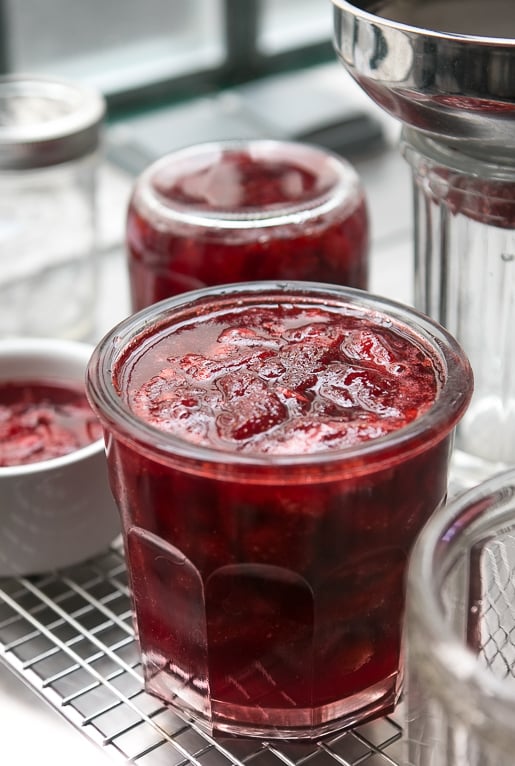
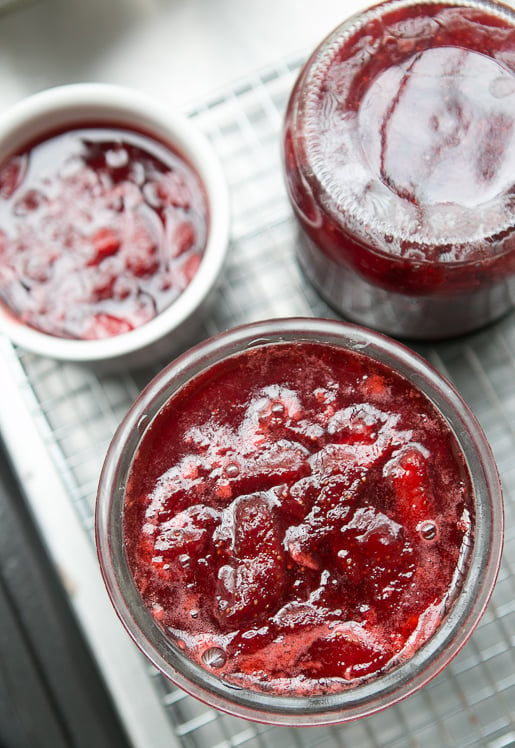
    Many traditional recipes use an equal amount of sugar to fruit, by weight, but I find it’s okay to decrease it to these proportions. Sugar is both a thickener and a preservation agent. If you reduce it too much more, your jam may not thicken and won’t keep for a long time. (Which is okay if you want thinner jam, you keep it in the refrigerator, and eat it relatively quickly.) This recipe can be scaled up or down, depending on how many strawberries you have. But if you want to make a lot more, best to make it in a couple of batches. To prepare the jars, pour boiling water into them, as well as into the lids. Let them sit 5-10 minutes, then carefully pour out the hot water and set them upside down on a cooling rack until ready to fill. Since I keep my jams in the refrigerator, I don’t put them up them in a traditional sense. I usually just overturn the jars and let them cool, which provides a reasonable seal, then refrigerate them. I find my jams keep well this way for up to one year. Check the National Center for Home Food Preservation website for instructions on how to can fruit jams. Note: Last season strawberries tend to have less natural pectin than ones that arrive earlier. So your jam may be less jelled. One strategy is the finely grate a green apple into the strawberries before cooking them, which adds pectin. (There are guidelines here for using liquid and powdered pectin.) I don’t mind the slightly runnier jam and it’s terrific on yogurt or served with fresh goat cheese for dessert.

    Ingredients

    • 2 pounds (900g) strawberries
    • 1 1/4 pounds (2 2/3 cups, 580g) sugar
    • one lemon organic or unsprayed
    • optional: kirsch (or eau-de-vie, or crème de cassis)

    Instructions

    • Wash and hull the strawberries and cut them into quarters. If some are larger or smaller, just make sure the pieces all about the same size.
    • 2. Toss them in a large pot, such as a Dutch oven casserole made of a nonreactive material, with the sugar. Cut the lemon in half, squeeze the juice into the pot, and add the lemon halves to the berries. Stir well, cover, and let sit a couple of hours (up to 8 hours) at room temperature, stirring one or two times while they marinate.
    • Put a small plate in the freezer. Turn the heat on under the strawberries to medium-high and cook the strawberries, stirring occasionally, as they reduce and the juices thicken. If a lot of foam rises to the surface, skim it away. When the syrup is the consistency of warm maple syrup – it will take about 10 to 15 minutes or so, depending on the pot and berries, turn off the heat and put a spoonful of the jam on the frozen plate and return the plate to the freezer. Check it in a few minutes; if it wrinkles when you nudge it, it’s done. If not, return the plate to the freezer and cook the jam a little more, testing it again. It may take a few times before you get it to the right consistency.
    • When the strawberry jam is done, remove the lemon and stir in a few drops of kirsch, if using, then ladle the jam into the prepared jars.

    Related Recipes and Links

    Apricot Jam

    No-Recipe Cherry Jam

    Pickled Strawberries

    Easy Jam Tart

    Eggplant Jam

    Baking Ingredients and Substitutions

    snow pea salad with avocado

    By: deb
    3 June 2026 at 22:05

    One of my most exasperating traits — or, perhaps one that makes me ideally suited for this space I invented, coincidentally, to suit my collection of traits — is that I have a terrific amount of random ingredient preparation ideas in the overflowing file cabinet of my brain that will spill into conversations the second I hear the triggering keyword.

    Read more »

    chicken salad for celery enthusiasts

    By: deb
    20 May 2026 at 17:22

    I’m not sure if this is a sign of hitting a certain age — like a sudden interest in bird feeders (check, and please tell me about yours), or beekeeping (well, in the TikTok sense, not sorry), and animated conversations on the best pillows (I hate mine) — but I’ve found over the last year that I have very strong opinions on chicken salad and the correct way to make it, which, naturally, is my way. I hope I’m in the right place to release them into the world.

    Read more »

    Abalone Pot Rice

    Learn how to clean abalone and make abalone sotbap, a nourishing Korean stone pot rice dish with tender abalone, miyeok, garlic, and crispy scorched rice at the bottom.

    raspberry swirl cheesecake bars

    By: deb
    8 May 2026 at 18:46

    While I’m not from a cheesecake family — it is never unwelcome, but we are more deeply devoted to things like pastry creams, chocolate pudding, and stellar coffee cakes — I married into one, which means that even though this site’s cheesecake archives are very well-populated, not a single peep of protest could be heard as far as my apartment walls reach (to be fair, a short distance) as I tinkered with these bars over the last few weeks.

    Read more »

    sidecar

    By: deb
    24 April 2026 at 19:56

    If there’s anything that’s been consistent about this site in its near-20 years of beaming (babbling?) hypertext to servers and back to you, it’s that I’m very bossy when I get into something new, especially cocktails. When I fell in love with Porch Swings, I wanted you to as well. Ditto for Blood Orange Margaritas (but only when in season), a Perfect Manhattan era that spanned over a decade, Boulevardier that has been woven into almost every year since, and a Slushy Paper Plane phase last year. This past winter and spring still, it’s been Sidecars, 1920s-era cocktails with about as many conflicting stories as my kids regale us with when they didn’t do their homework.

    Read more »

    ❌