You’ve never had trouble getting started, Aries. Give you half a reason to move and you’re already out the door, keys in hand, while everyone else is still asking about parking. November hands you an unfamiliar problem: too much fuel and too many places to spend it. Mars spends nearly the whole month in Leo, the sign that loves a big gesture, and right in the middle of it all, your planet teams up with Jupiter, the one that makes everything bigger. Opportunities will come at you from all sides. Your job this month is deciding which ones get your best effort and which ones get a polite no.
The first week and a half is a warm-up, and a pleasant one. Around the 10th, Venus forms a sextile with Mars, which smooths out your edges in a way people will notice. You’ll come across as charming and easy to talk to, a welcome change of pace for someone who usually leads with intensity. Use it. If you’ve been putting off a conversation with a collaborator, a landlord, a crush, or a boss, this is your window. People are more inclined to say yes when they like the person asking, and right now, they like you. Sextiles don’t do the heavy lifting, so you still have to pick up the phone. They just make the call go better.
Then comes the 16th, when Mars and Jupiter meet in Leo. This is the headline of your month. Mars brings the drive, and Jupiter brings luck, abundance, and an unshakable belief that bigger is better. Together in a fire sign, they make you feel capable of anything. Ideas you’d shelved will look doable again. Projects that stalled out over the summer will pick up speed. People will want in on whatever you’re building. You might catch yourself pitching three new plans before lunch, and the wild part is that some of them will be good. Enjoy this. A conjunction like this one doesn’t come around every month, and you’ve earned a stretch where doors open easily.
This is where I have to be your friend about it, though. Jupiter doesn’t do moderation, and Mars in Leo wants applause. Put those two together and you get a person who says yes to everything, because every yes feels like a win the second it leaves your mouth. Three weeks later, all those yeses come due at once. Before you commit to anything around the 16th, ask yourself one blunt question: would I still want this if no one was watching? If the answer is yes, go all in. If it’s a maybe, give it a week. The good stuff will still be there. Whatever only felt exciting because the energy was high will fade on its own.
The 19th brings two aspects on the same day, and they pull you in opposite directions. The Sun squares Mars, which can put you head-to-head with someone whose ego is just as big as yours. A coworker who wants credit. A family member who insists on doing it their way. A partner who’s tired of hearing about your new plan. Your instinct will be to win the argument. Fight that instinct, or at least delay it until you’ve cooled off. Squares create pressure, and pressure makes you say things you’ll have to walk back by the weekend. Not every disagreement needs a victor, and you’ll save yourself a lot of cleanup by letting this one go.
The same day, Mars forms a trine with Chiron, and that one is much gentler. Chiron has been retrograde in your sign, poking at old sore spots, and for a lot of Aries, the oldest one is being told you’re too much. Too eager, too blunt, too quick to jump. You’ve spent years sanding yourself down so other people could stay comfortable. This trine gives you a chance to make peace with that. Your intensity has gotten you through things that would’ve flattened most people. You can keep the parts of it that serve you and let go of the guilt you’ve attached to it. That’s healing, and you don’t have to make a big production out of it.
On the 25th, Mars leaves Leo for Virgo, and the mood changes noticeably. Leo energy loves the launch. Virgo energy loves the follow-through. After weeks of big ideas and bigger promises, Mars in Virgo asks you to sit down and handle the details. Return the emails. Build the spreadsheet. Read the contract all the way to the end. This won’t be your favorite part of the month, Aries, but it might be the most important one. Everything you said yes to while Mars was in Leo now needs a plan, a schedule, and maybe a few frank conversations about what you can deliver and when.
The good news is that Mars in an earth sign gives you staying power you don’t always have. You’ll find it easier to focus on one task for longer stretches, and chores that would normally bore you to tears might feel satisfying, the way a finished to-do list does. Lean into that. If you overcommitted mid-month, this is when you sort it out. Finish what you can, hand off what you can’t, and send the apology text for anything you have to drop. People forgive a dropped ball a lot quicker when you’re upfront about it, and they remember who owned their mistakes.
Your whole life, people have told you to slow down. You can ignore them for now. What this month asks is that you aim before you fire. You’ve got a full tank and a sky that’s backing you, which is a great combination as long as you choose where it goes. Spend it on the people and projects you’d fight for on a bad day, too. That way, when December rolls around, you can look at what you built and feel proud, with enough left over to enjoy it. Go get it, Aries. Just pick your targets first.
Thus concludes your monthly highlights. For more specific celestial analyses, make sure to read your daily and weekly horoscope as well. Good luck, Aries! See you next month.
English actor Patrick Stewart, who became world-famous as the star of “Star Trek: The Next Generation” and the “X-Men” movies, died on Wednesday at his home in Los Angeles. He was 86. Kelly Bush Novak, his longtime spokesperson, announced that he died from Alzheimer’s disease and Lewy body dementia, which is marked by features of Parkinson’s disease.
“He has been held in the warm embrace of family and friends, surrounded by live music, prayer, tears, laughter and the kind of profound emotion that only he could inspire after a lifetime of devotion to us all,” Bush Novak wrote. “We will forever cherish the peaceful ease and reflection on his face, an enduring reminder of his invincible grace.”
Stewart’s distinctive baritone voice and striking bald head made him one of the most familiar actors to American audiences, but until the late 1980s, he was virtually unknown in the U.S. Before his casting as Capt. Jean-Luc Picard on “Star Trek: The Next Generation,” he had spent decades as a classical theater performer in Britain, especially in the works of Shakespeare. He joined the Royal Shakespeare Company in 1966, where he met fellow actor Ian McKellen, who would become a longtime friend and collaborator.
Over the course of his career, he received four Emmy nominations for his television work, as well as two Laurence Olivier Awards and a Tony nomination for his role in “Macbeth.” In 1996, he won a Grammy for best spoken word album for children for “Prokofiev: Peter and the Wolf.” He was knighted by Queen Elizabeth II in 2010.
Later in his career, Stewart reprised his role as Picard in various “Star Trek” films and a recent spinoff series. His role as professor Charles Xavier in the “X-Men” film series from 2000 to 2017 helped propel his career to new heights and usher in a new era of superhero films. He is set to appear as Xavier in “Avengers: Doomsday,” which will be his final on-screen film appearance.
“I think I’ve been in denial about my life for a very long time,” Stewart told The Guardian in 2023. “I never really took on board how successful I had become. Even today I sometimes think, ‘You’re a lucky son of a b**ch, Patrick,’ when something unexpected or good happens to me.”
Stewart was born on July 13, 1940, in Mirfield, England, a small town in West Yorkshire. He is survived by his wife Sunny Ozell, an American singer, whom he married in 2013; his son, Daniel, also an actor; and his daughter, Sophie.
A few years ago, I was on a plane with my Kindle Paperwhite in my lap, and when I grabbed the seatbelt to strap in, the buckle hit the screen and cracked it. It was still usable, but the bright spot was distracting. — Read the rest
SF comics writer and artist Matt Howarth, 72, died October 5, 2026 of complications following a triple bypass.
Howarth was born in 1954. He became active in the fanzine space in 1969, co-founded Howski Studios with Tony Sciarra, and began drawing professionally soon after, publishing multiple SF/F graphic novels and comics such as the Those Annoying Post Brothers. He contributed artwork to books including The Dune Encyclopedia (1984), Clans of the Alphane Moon (1984), Time Out of Joint (1984), Dr. Bloodmoney (1985), and The Zap Gun (1985)by Philip K. Dick; Dr. Adder (1984) and The Glass Hammer (1985) by K.W. Jeter; Eclipse (1985) by John Shirley; Sunglasses After Dark by Nancy A. Collins;as well as several columns in New Pathways. In 1990 he published a short “The Prescott Experiment” in New Pathways. He published one novel, SF The Eden Retrieval,in 2011.
The death of history's most successful publisher (permalink)
I published my first story in 1988, when I was 17 years old. Today, at 55, I've published more than 30 books, with three more coming in the next year or so. In the intervening years, I've spent a lot of time thinking and talking about publishing.
I've had plenty of opportunity to reflect on publishing: I've been a bookseller and worked in libraries, I wrote a column for Publishers Weekly, self-published a few books of my own, published the first-ever book licensed under Creative Commons, and broke several Kickstarter records for audiobook projects. But most of all, I've worked with publishing professionals: publicists, marketing directors, operations people, copyeditors, and, above all, editors.
My first novel editor was the magnificent Patrick Nielsen Hayden, who supported my publishing career from the very start, donating to help send me to the Clarion science fiction writers' workshop and inviting me to come read slush at Tor Books whenever I was in New York. Patrick didn't teach me everything I know about publishing, but he sure taught me a lot about publishing, and hardly a day goes by without my having cause to reflect on one of our many discussions over our decades-long professional and personal association.
Out of all the things I learned about publishing from Patrick, one truth stands out above all: publishing is "the act of making something public." Publishing may or may not involve editing, layout, printing, binding, marketing or other activities that we associate with publishing houses, but publishing always involves identifying a work, identifying an audience, and finding ways to connect that work to that audience.
This definition does a lot of useful work. For one thing, it locates publishing as part of the hard problem of human society, namely, "getting people to care about something that matters to you." Beyond publishing, this is the crux of politics, religion and commerce:
For another, this definition lets us understand that (for most of its existence) Google was the most successful publisher in human history. No other institution of any kind connected more works with more audiences. Lots of people have heard of Google's wildly unsuccessful motto "Don't be evil," but far fewer are familiar with Google's wildly successful mission statement, "organize the world's information and make it universally accessible and useful."
But all of that is in the past tense. With its AI projects – AI summaries, the Gemini chatbot – Google has abandoned the practice of "connecting works with audiences." Today, Google's function is to plunder all the works on the internet and chop them up and arrange them in an unimaginably vast, multidimensional array for the explicit purpose of preventing audiences from connecting with those works.
For most of its history, Google operated in a virtuous cycle with publishers whereby they allowed Google to crawl their sites and Google located audiences and connected them with the pages on those sites. Today, that cycle has turned vicious, with Google acting as a parasite that extracts value from the web's publishers and offers nothing in return.
This is entirely in keeping with the enshittification hypothesis: that once a platform is liberated from the disciplining forces of competition, regulation, labor and interoperability, it will squeeze its suppliers and users and harvest all the value for itself:
But AI represents a new phase in enshittification. Google has assayed enshittificatory gambits in the past, like deliberately worsening its search results in order to force you to search repeatedly, which gave the company more chances to show you ads:
But as sleazy as those gambits were, they were profitable. In some important sense, they were sustainable. Assuming Google could carry on indefinitely scamming its users in this way, they'd continue to bring in more cash than they spent, and continue to be the world's most successful publisher, connecting works and audiences (albeit in a deliberately degraded way).
Contrast this with AI, the money-losingest endeavor in the history of human civilization. Google is losing hundreds of billions of dollars on AI. The more AI Google does, the worse the company's financial footing becomes. If Google does this for long enough, it may cease to exist altogether. This collapse can only be prolonged by Google's ongoing extraction of value from web publishers, who no longer have their works connected with audiences via Google search results. Instead, Google usurps those audiences, shows them as many ads as it can, and still loses money in the bargain.
In Tim Wu's Age of Extraction, Wu lays out a thesis about how intermediaries – middlemen who perform a useful function connecting different groups, firms and individuals – are prone to developing "main character syndrome," abandoning their role as facilitators for others and abusing their position to make themselves the prime beneficiary of the transactions they facilitate:
Google has a scorching case of main character syndrome, and nowhere is that more obvious than in its AI-fueled transformation into web-scale parasite. The fact that this gambit might well destroy Google and the publishers the company once served – rather than merely enshittifying search with worse results and more ads – makes the whole thing look more like a Mafia bust-out than the enshittification of the first half of the 2020s:
"Red Team Blues": "A grabby, compulsive thriller that will leave you knowing more about how the world works than you did before." Tor Books http://redteamblues.com.
"Chokepoint Capitalism: How to Beat Big Tech, Tame Big Content, and Get Artists Paid, with Rebecca Giblin", on how to unrig the markets for creative labor, Beacon Press/Scribe 2022 https://chokepointcapitalism.com
“Once Is Enemy Action,” a science fiction novel about the origins of modern technofascism. Today's words: 514 (27116 total).
"The Post-American Internet," a sequel to "Enshittification," about the better world the rest of us get to have now that Trump has torched America. Fourth draft completed. Submitted to editor.
A Little Brother short story about DIY insulin PLANNING
This work – excluding any serialized fiction – is licensed under a Creative Commons Attribution 4.0 license. That means you can use it any way you like, including commercially, provided that you attribute it to me, Cory Doctorow, and include a link to pluralistic.net.
Quotations and images are not included in this license; they are included either under a limitation or exception to copyright, or on the basis of a separate license. Please exercise caution.
"When life gives you SARS, you make sarsaparilla" -Joey "Accordion Guy" DeVilla
READ CAREFULLY: By reading this, you agree, on behalf of your employer, to release me from all obligations and waivers arising from any and all NON-NEGOTIATED agreements, licenses, terms-of-service, shrinkwrap, clickwrap, browsewrap, confidentiality, non-disclosure, non-compete and acceptable use policies ("BOGUS AGREEMENTS") that I have entered into with your employer, its partners, licensors, agents and assigns, in perpetuity, without prejudice to my ongoing rights and privileges. You further represent that you have the authority to release me from any BOGUS AGREEMENTS on behalf of your employer.
From the moment Alex Gibney announced he was working on “Musk” in 2023, it became one of the most anticipated documentaries around – and a source of trepidation for its titular subject, tech mogul Elon Musk. But we may have underestimated how far the world’s wealthiest man and his ilk would go to prevent audiences from seeing it.
Weeks before “Musk” hit theaters, its distributor, Bleecker Street, couldn’t buy ads on TikTok, YouTube, Mark Zuckerberg’s Meta-owned Facebook and Instagram or, here’s a shocker, Musk’s own X. A Hollywood Reporter story published on Sept. 25 made YouTube and Meta reverse course – a rare case of two media giants shamed into living up to their free-speech claims.
But this attempted media suppression shows “Musk” has struck a nerve, despite its namesake dismissing it as a “hit piece that misses.”
What happened to Bleecker Street, then, is both familiar to Gibney and extraordinarily alarming. “You can see how a few platforms coalescing around the endorsement of what these tech viziers are doing decide that a criticism of tech power is somehow political and can’t be allowed in terms of open discourse on their platforms,” Gibney told Salon. “So that was really disconcerting.”
It’s shaping up to be a dark autumn for Silicon Valley’s villains. In early December, Luca Guadagnino’s “Artificial” turns our attention to OpenAI CEO Sam Altman, played by Andrew Garfield.
Meanwhile, “Musk” was recently joined in theaters by Aaron Sorkin’s “The Social Reckoning,” in which Jeremy Strong portrays Zuckerberg as a soulless ghoul prioritizing clicks over user safety. In “You Can See Everything,” notorious prankster Nathan Fielder shadows notorious (for different reasons) Theranos fraudster Elizabeth Holmes in the days before she went to prison.
Gibney also profiled Holmes in his 2019 work “The Inventor: Out for Blood in Silicon Valley,” which adds another layer of coincidental symmetry: Fielder’s film hits theaters on Oct. 16, the same day “Musk” opens nationwide.
But “Musk” is unquestionably a tougher watch, and given its subject’s extensive integration into the second Trump administration, it can’t help but be political.
Of course, “Musk” isn’t campaigning for anything except our need to confront the existential threat posed by one man exercising significant control over our media and our military.
A chorus of testimony from people who were once closest to Musk builds a profile of a megalomaniacal con artist. Two of Musk’s most incisive critics, his ex-wife Justine Musk and former right-wing influencer Ashley St. Clair, describe him as a gaslighter and a nuke, respectively.
But perhaps the most damning testimonial comes from Musk himself – or rather, existing audio recordings of Musk delivered by a CGI version of the Tesla and SpaceX CEO, since he refused to participate.
All of it boils down to simple questions Gibney poses at the film’s outset: How could Musk assume so much power, and why have we given it to him? I discussed those questions with Gibney, and what they taught him about Musk and our penchant for enabling men like him, in a wide-ranging conversation transcribed below.
This interview has been edited for length and clarity.
Salon: You’ve done a documentary on Putin. You did one on Scientology, a famously litigious organization. You have a vast filmography featuring subjects who might have taken issue, or have taken issue, with what was said in your documentaries. Where does this rank in terms of threat level, legal or otherwise?
Gibney: Well, high. I mean, when just before “Going Clear” was released, the Church of Scientology took out full-page ads in the New York Times and the L.A. Times with a big picture of me, sort of denouncing me. And there were people, you know, who would pop up in dark parking lots, you know, sort of accosting me, trying to kind of destabilize me psychologically. But I think in this case, he’s the richest man in the world. He has a lot of resources… And he has this platform, Twitter, which has become a kind of Thunderdome of hate and vitriol, and that activates, you know, unpredictable characters who sometimes act on their own…
That said, I don’t want to exaggerate what’s happened to me so far. Other people put themselves at greater risk than I, in the sense that they came forward and appeared on camera.
One of the things that you said in other interviews, and I think you actually said this in the documentary as well, is that you used to be a fan of Elon Musk’s products.
I mean, I looked at him from afar. I have some history on this whole electric car thing because I was brought in long ago to help with the editing of a doc called “Who Killed the Electric Car,” which is about GM’s first foray into the world of electric cars. A woman I met on that film, Jessie Deeter, later produced a film called “Revenge of the Electric Car,” and Elon Musk is in that. And Jessie, when she worked with him on that, was a big fan. [Deeter is also a producer on “Musk.”]
(Courtesy Bleecker Street Film / Gregg Segal)
So, you know, I had a certain connection to him. And I’m a big electric car guy. I own one — not a Tesla— but I own one, and I had a Tesla Powerwall in my house. I also sort of liked the kind of mumbling charisma that he had for a while, because he seemed like very much a regular guy. He was joking with people around on Twitter and stuff like that.
That said, he could also do unpredictable, chaotic and sometimes offensive things. But largely speaking, my view of him was positive. But I was interested in the fact that he accumulated so much power, and so that was the basis on which I dug in back in 2022.
Do you think that his ability to amass this much power is related to the fact that he is doing it in the American capitalist system, or do you think he could have done it in any other place in the world?
Well, I mean, there are a lot of intersections of opportunities for Elon Musk, and I also think he discovered, to use a phrase of his, the anomaly in the matrix for the American system. And that is money. He discovered that not only can you get a lot of money from the federal government, but if you have a lot of money, you can use it to influence sometimes how much money you get from the federal government or state governments. So I think there was that.
The other big thing is that in America we also have a kind of grudging admiration for the P.T. Barnum-like qualities of certain larger-than-life entrepreneurs, you know, and you see that a lot in Silicon Valley . . . That is a kind of cultural trope in this society for which I think we have a weakness. We sort of like to see them trick us all, though we also do like to see them go down after they’ve tricked us. So I think for all those reasons that maybe Elon was able to succeed here in a way that really exploited some of the flaws in our system and our psyche.
There’s also a propensity in our culture to believe in some superhuman aspect of genius, which I think your documentary gets at very well.
Yeah, it’s also that our weakness for money, or the power of money, in this culture also causes us somehow to think that if you’re wealthy, you’re also wise rather than just ruthless, right?
I often think of that famous line from “Citizen Kane,” where Orson Welles is joking with somebody, you know, having been very successful playing this William Randolph Hearst character, who said, “It’s no trick making a lot of money if all you want to do is make a lot of money.” Meaning, if you’re ruthless and determined, you can make a lot of money. Doesn’t mean you’re a genius, and it doesn’t mean that you’re a tech genius either.
I also think Elon Musk, having seen the ascent of Steve Jobs, was sort of defining himself in that way too – or going back to Thomas Edison, who had his own P.T. Barnum-like qualities in terms of inventing a character for himself to play. It’s not just the investor; it’s the inventor.
“Musk” runs for almost four hours. Did you always know it would be that long?
No. In fact, I had a cut of the film in the spring of 2024 that was under two hours. We were moving to release that and put it into the fall festivals. Then, in Butler, Pennsylvania, Trump is nearly assassinated, and Musk hitches his wagon to the Trump train. And my friends at HBO said, “You’re not done. You have to follow this story because it could go to places that you don’t expect, and having spent as much time as you have, you have to follow it to at least a moment of greater conclusion.”
So I did, and that ended up being the reason that it’s at such a length. You see patterns from the first film that then repeat themselves, but on a much larger scale, in the second film. Suddenly economic power meets political power, economic and technological power meets political power, and that is the making of an epic story.
(Courtesy Bleecker Street Film / Ken Cedenoupi / UPI Alamy News) Elon Musk
In addition, it just so happened that as he embarked on his political project, a lot of people that I was talking to in the background, trying to persuade them to come forward, did come forward because they saw some of the more problematic aspects of Musk wielding power as part of MAGA world. That gave the story a kind of human dimension as well.
Weirdly, you know, I was having trouble kind of putting it all together, and I didn’t really get a sense of how to shape it until I watched Guillermo del Toro’s “Frankenstein,” which in itself was a kind of take on the tech bros. That helped me kind of find a way forward in terms of what became a kind of epic narrative.
How so?
Well, you know, you start with a scientist who wants to do something big and important. And there’s even a sense of idealism about his ambition. But then he literally creates a monster, and the whole enterprise becomes utterly reckless and irresponsible and all about his own sort of grandiosity. Rather than a mission that might help people, it becomes about him.
What are you hoping this documentary will do in terms of making people a little bit more aware of who Elon Musk is and getting at the man behind the curtain, so to speak?
Well, I mean, it is an agent provocateur. I don’t provide a solution, but I do provide, I think, a pretty compelling story, which asks the kind of fundamental question I posed at the beginning, which is, how did this guy get so much power, and why did we give it to him? Because it’s both about him and it’s about us, and it asks some discomforting questions about how literally existential power rests in the hands of one man who is increasingly chaotic, unhinged, and seemingly pursuing power without reason. There’s a chilling moment at the end of the film where somebody asks him, “Why have you accreted so much power?” And he literally can’t answer the question…
He’s a very peculiar character who’s a chaos agent. But we’ve allowed him to become normalized in a way.
I remember writing about him being on “Saturday Night Live” and people shrugging it off, like, “Oh, it’s not that big of a deal.” But it was a very big deal. Those kinds of things make him into a character when the reality is he has massive access to power.
And he’s saying things, even on “Saturday Night Live,” that were patently untrue… Even when he says, “Did you think I was going to be a chill, normal dude?” Well, there’s a funny hidden message there, which is kind of discomforting if you really think about it. Like, if you want to drive a Tesla, be prepared to endure a lot of performative cruelty from me, including cruelty that may end up killing people. . . That’s a pretty brutal message, honestly, for “Saturday Night Live.” But it was a joke, right? And that’s the genius, in a way, of Elon Musk: he’s constantly saying stuff that is deadly serious and a joke at the same time.
Speaking of that, the images and the joke, let’s talk about using the [CGI] avatar. I remember when the news first broke about that, someone said, “Well, I wonder if that’s Alex kind of trolling Musk back.”
I mean, it’s kind of a troll-back, yeah. In a way, it’s kind of investing in him, playing in his sandbox, because he didn’t agree to appear.
And I should make it clear, as I tried to do in the film, that what we hear from him are actual audio recordings of him. In other words, they’re not AI-confected answers. We didn’t ask AI what Elon would say. We’re taking real audio recordings, but how to couch that visually? And we took our cue, having done all this research into stuff that Elon said, from something he kept going over again: This idea that we’re likely living in a simulation. So I thought, OK, how about a simulated interview?
And yes, he’s famous for trolling people. He’s famous for creating memes. What was it he said in 2020 on Twitter? He said, you know, parodying “Dune,” he said, “He who controls the memes, controls the universe,” right? OK, well, here’s a meme for you, Elon, of you.
Want more from culture than just the latest trend? The Swell highlights art made to last. Sign up here
What, if anything, about this documentary may help illuminate a few things for people, regardless of their political leanings, as we approach the midterms?
I mean, this should be our concern, whether you’re from the left or the right, is giving people unaccountable power. Also, this whole idea that our politics and, indeed, our Department of Justice and our Department of Defense can be utterly transactional.
We’re not getting the best that money can buy. We’re getting what money can buy. Period. In other words, the military stuff that you’re seeing is a third-rate frontier AI technology being fully integrated into our Department of Defense. And why is the worst technology being integrated? Because Elon Musk is literally paying for political advantage. So it’s a payback system, and we should all be outraged about that, left, right, or otherwise.
And now you’re seeing him trying to buy the midterms. He’s spending way more now than he did for the presidential campaign in 2024, and in part that’s to get more money for himself in the form of military contracts. But also, he knows that a reckoning is coming for him if the Democrats take over the House and the Senate, and there’s going to be a lot of investigations into him for corruption and abuse of power, taking our information, particularly possibly relating to DOGE, and doing God knows what with it.
Our whole system is built on a system of checks and balances, and the idea that the government is our instrument for making a better world, rather than, you know, making a few people rich…
But I think that what’s changed now with Trump is that the Department of Justice has become a protection racket for those who flatter and ally themselves with the president, and an instrument of revenge for those who oppose the president. You can’t depend on it as a kind of law-enforcing mechanism, and that may be the scariest thing of all. . . What we’re talking about is Putin’s Russia here, right? And if people want to avoid that, then I would strongly urge them to go out to the polls. Because this is a rogue administration that goes beyond any kind of sense of party affiliation. It’s a rogue administration that’s literally destroying our democracy.
Object permanence: Delta v dovening; "Play Money"; Alabama's ethnic cleansing; We trust neuroscience over psychology; Billionaires' anti-homeless pogrom; Game devs v DRM; What security means; Microsoft, tear down that wall! Publisher won't revert rights; SNL's Trump/Clinton debate; Chicago Tribune's murder; AI after AI.
No matter where you shop, you're getting screwed by Amazon. Amazon has found a way to make everything you buy – at Target, at a mom-and-pop shop, even direct from the manufacturer – more expensive. And they're not the only one: Expedia's done the same thing, but for hotel rooms.
Here's how Amazon broke the economy: first, they locked in a key group of shoppers. The vast majority of affluent shoppers in the USA have Amazon Prime accounts. Having prepaid for a year's shipping in advance, those Prime subscribers start their purchasing journey by searching Amazon, and if they find what they're looking for, that's where it ends.
America's affluent top decile – the 10% of richest Americans – do the majority of America's shopping, a phenomenon that has only been accelerated by America's precipitous slide into oligarchy, which has exhausted the savings and the credit-card limits and the home equity of the majority of Americans, who increasingly can't afford to buy anything:
If you want to sell things in America, you must sell them in the place where the top decile shops, and that's Amazon. For merchants, that is an incredibly expensive proposition: 51-60% of every dollar you spend with an independent merchant on Amazon is claimed by Amazon through junk fees, listing fees, commissions, processing fees and other scams:
Merchants don't have 51-60% margins they can afford to turn over to Amazon. To remain viable while selling on Amazon, they have to raise prices. Amazon doesn't mind if prices go up, so long as Amazon's price remains competitive. So Amazon imposes a requirement on its suppliers called "most favored nation," which requires sellers to offer their best price on Amazon:
Practically speaking, that means that when you raise your price on Amazon, you must raise your prices everywhere by the same amount, which means that no matter where you shop (Target, Walmart, the corner store or direct from the factory), you pay the Amazon Tax.
The Amazon Tax is a prime (you should forgive the expression) example of enshittification, in which an intermediary (a business that sits between buyers and sellers, AKA, "a platform") screws both customers and sellers to benefit itself.
But Amazon isn't the only example of a powerful digital intermediary that has used its market power to impose an economy-wide tax. Wherever you look online, you find digital giants who grew the way Amazon grew (buying all of their competitors) and then did what Amazon did (squeezing buyers and sellers, making prices higher everywhere).
That's what happened with Expedia. Almost every travel site you can find online has been purchased by Expedia (Hotels.com, Travelocity, and Orbitz), and the ones that aren't Expedia subsidiaries were acquired by its main rival, Priceline (Booking.com, Kayak, Agoda and even Opentable). Nearly all the hotel rooms are booked by a tiny minority of travelers – largely that same top decile that Amazon has so thoroughly captured and locked in – and hoteliers can't live without their business, and they're almost all Expedia and/or Priceline customers. Expedia accounts for 80% of all hotel bookings by dollar value.
Expedia's position, in other words, is basically Amazon's position, so Expedia is doing exactly what Amazon is doing: they charge huge fees to hotels, and then force the hotels to raise their prices everywhere through a "most favored nation" deal:
But – as Lee Hepner writes for the BIG newsletter – Expedia has figured out ways to out-Amazon Amazon. They've copied one of Amazon's sleaziest businesses, and made it worse:
Here's Amazon's sleaziest commercial practice: when you search Amazon, the top results for your search aren't the best matches for your queries; they're products sold by the companies willing to pay the most for search placement, in a "real-time auction" that runs every time you search. The cost of winning that auction comes out of your pocket through higher prices: the first result for an Amazon query is, on average, 29% more expensive than the best match. The top row is 25% more expensive. On average, the best match for your query is 17 positions down the screen, on the second page, where almost no one ever bothers to scroll:
This rip-off is Amazon's most profitable line of business, more profitable than AWS or Prime. It makes the company more than $80b/year. And – incredibly – Expedia's found a way to make it even worse.
Like Amazon, Expedia auctions off its search results. They call this their "VIP listing" program. Practically speaking, hotels have to pay for this, because it boosts booking rates by 42% (the first ten results on an Expedia search-results page get 62% of the clicks). VIP listing is expensive for the merchant – but it's even more expensive for you and me.
That's because Expedia requires hotels in its VIP listings programs to raise their prices on non-Expedia sites by 10-25%…INDEFINITELY.
Let me repeat that: to stay in business, hotels need to be on Expedia. To stay in business on Expedia, hotels have to raise their prices to pay Expedia's junk fees, but they have to raise their prices everywhere else. But to really stay in business on Expedia, hotels have to use the VIP program, which is even more expensive. And – one more time – hotels in the VIP program have to jack up their prices everywhere else, INDEFINITELY. This means that, throughout the economy, hotel prices are rising at a superinflationary rate, because Expedia – who command 80% of the market – are pushing those prices up.
This goes a long way to explaining why US hotel rates rose 58% from a 2020 average of $103/night to a 2025 average of $162/night. It explains why hotel prices rose by 5% last year, which is double the rate of inflation. And this is why Expedia stock is up 65% since the start of the Iran war, a fact that Expedia CEO Ariane Gorin attributes to "higher margins" from "higher prices":
In his coverage of the Expedia lawsuit – which brought many of these details to light – Hepner notes that hotels themselves have undergone near-total cartelization, with Hilton, Marriott, and Choice International owning the majority of all hotels after a string of acquisitions that went largely unchallenged by slumbering antitrust regulators around the world. These consolidated chains have also jacked up prices and enshittified their service, slashing housekeeping and check-in staff and allowing their facilities to slip into disrepair.
This, too, is characteristic of monopolization: whenever a monopoly takes over part of its supply chain, the rest of the supply chain consolidates to prevent itself from being ripped off by the new giant. This is the story of publishers consolidating to defend themselves from Borders/B&N, Walmart and Costco, then Amazon; and it's the story of literary agencies consolidating to resist the power of those overgrown publishers.
And it's the story of health-care, which saw consolidation in pharmaceuticals leading to mergers among hospitals, who screwed the insurers, who also consolidated.
In every case, it's the workers and the people who rely on them that get the shitty end of the stick. Hotel guests, readers and patients pay more for inferior products. Writers, editors, doctors, nurses, hotel staff and housekeepers get lower pay and worse working-conditions:
There is nothing wrong with the idea of an intermediary. Most writers can't publish and sell their own books, and few travelers can navigate finding hotels in strange cities without help. The problem of intermediaries is that when intermediaries gain monopoly power – by buying their rivals and capturing buyers and sellers – they are able to squeeze both. As Tim Wu says, this is the moment when a company that's supposed to be helping becomes a predator, acquires "main character syndrome" and makes every transaction all about the middleman, at the expense of the people buying and selling:
There are so many reasons for inflation and the cost of living crisis: wage stagnation, wars of choice in Iran, environmental cataclysm after environmental cataclysm. But under cover of these real factors is a cohort of what Matt Stoller calls "economic termites," parasites that have infested the walls of our economy and are devouring it from within.
You can't solve this by shopping. Calling the hotel direct won't fix it: they have to be on Expedia to survive, and to be on Expedia, they have to sign up for VIP service, and to keep VIP service, they have to make their prices higher everywhere. To fix this, we need systemic action: the corporate death penalty for the companies that are consuming the structural members of our society.
"Red Team Blues": "A grabby, compulsive thriller that will leave you knowing more about how the world works than you did before." Tor Books http://redteamblues.com.
"Chokepoint Capitalism: How to Beat Big Tech, Tame Big Content, and Get Artists Paid, with Rebecca Giblin", on how to unrig the markets for creative labor, Beacon Press/Scribe 2022 https://chokepointcapitalism.com
“Once Is Enemy Action,” a science fiction novel about the origins of modern technofascism. Today's words: 508 (25536 total).
"The Post-American Internet," a sequel to "Enshittification," about the better world the rest of us get to have now that Trump has torched America. Fourth draft completed. Submitted to editor.
A Little Brother short story about DIY insulin PLANNING
This work – excluding any serialized fiction – is licensed under a Creative Commons Attribution 4.0 license. That means you can use it any way you like, including commercially, provided that you attribute it to me, Cory Doctorow, and include a link to pluralistic.net.
Quotations and images are not included in this license; they are included either under a limitation or exception to copyright, or on the basis of a separate license. Please exercise caution.
"When life gives you SARS, you make sarsaparilla" -Joey "Accordion Guy" DeVilla
READ CAREFULLY: By reading this, you agree, on behalf of your employer, to release me from all obligations and waivers arising from any and all NON-NEGOTIATED agreements, licenses, terms-of-service, shrinkwrap, clickwrap, browsewrap, confidentiality, non-disclosure, non-compete and acceptable use policies ("BOGUS AGREEMENTS") that I have entered into with your employer, its partners, licensors, agents and assigns, in perpetuity, without prejudice to my ongoing rights and privileges. You further represent that you have the authority to release me from any BOGUS AGREEMENTS on behalf of your employer.
Editor, critic, and publisher Malcolm Edwards, 76, died October 3, 2026. He had Parkinson’s disease.
Malcolm John Edwards was born December 3, 1949 in London, England. He received a degree from the University of Cambridge. He worked at several publishing houses, including Gollancz from 1976-89, HarperCollins from 1991-7, and Orion Books from 1998-2019, first as managing director, then as deputy CEO and group publisher. For Gollancz, he edited the SF Masterworks series, re-releasing SF novels from notable genre authors including Joe Haldeman, Samuel R. Delany, and Ursula K. Le Guin. He later co-edited the companion series, Fantasy Masterworks, with Jo Fletcher. After this, he undertook the SF Gateway project, an ebook library noted as the largest digital SF/F library of its kind at the time, which launched in 2011 alongside the third edition of The Encyclopedia of Science Fiction.
Edwards was active in the UK SF fandom space throughout the 1970s and ’80s, and soon he was working as a critic and magazine editor. He edited for Vector in 1972-4, penning several editorials and reviews. He was the administrator of the Science Fiction Foundation for three years and edited its journal, Foundation: The Review of Science Fiction, in 1975-80. He was a founding board member of Interzone, which he edited in 1982-3. He also wrote one novel around this time, Succubus (1985) with Robert Holdstock under the name John Stock, and one work of short fiction, BSFA Award winner “After-Images” (1983).
He wrote several works of non-fiction, in frequent collaboration with other authors. He wrote Spacecraft in Fact and Fiction (1979) with Harry Harrison; The Complete Book of Science Fiction and Fantasy Lists (1983) with Maxim Jakubowski; and Alien Landscapes (1979), Magician: The Lost Journals of the Magus Geoffrey Carlyle (1982), and Lost Realms (1984) with Robert Holdstock; among others. He edited anthologies Constellations: Stories of the Future (1980), The Gollancz / Sunday Times SF Competition Stories (1987), and A Is for Brian (1990), the latter with Margaret Aldiss and Frank Hatherley. As a fiction editor, he worked with numerous authors, including J.G. Ballard, Philip K. Dick, Stephen King, William Gibson, Terry Pratchett, and more. In 1996, as part of HarperCollins, he won the British Book Award for Imprint & Editor of the Year.
Author and editor David Kopaska-Merkel, 69, died August 26, 2026.
David C. Kopaska-Merkel was born January 11, 1957 in Charlottesville VA. He attended William & Mary, earned a doctorate in geology, worked for the Geological Survey of Alabama in Tuscaloosa, and wrote several articles and books on geology and paleontology. He began writing speculative work in short fiction, starting with his first published story “Mecroniya” (1981), but soon began publishing poetry, beginning with “on the river” (1984) under the name Lawrence Harding and accumulating well over 1,000 published poems. He served as the president of the Science Fiction Poetry Association from 2011 to 2014. In 2017, he was voted a SFPA Grand Master, and in 2025, the association awarded him the President’s Lifetime Service Award. He lived in Birmingham AL.
Several of his works have been recognized with awards, including Rhysling Award winner “The Tin Men” (2005); Rhysling Award nominees “Valley of Years” (2000), “Medusa’s Tale” (2002), “meteor shower” (2002), “Tsunami Child” (2005), and “Rattlebox III” (2009); and Dwarf Stars Award nominee “If She Knew She Was a Ghost” (2017). He was published in Abyss & Apex, Dreams & Nightmares, Eldritch Tales, The Magazine of Speculative Poetry, Scifaikuest Online, Space & Time, Star*Line, Strange Horizons, and many more. His over 30 collections include underfoot (1991), Elgin Award nominee Edible Zoo (1994), Y2K Survival Kit (1999), The Ruined City (2003), I don’t know what you’re having (2005), Drowning Atlantis (2007), Hasp Deadbolt, Private Eye (2007), Brushfires (2010), The Tin Men (2011) with Kendall Evans,Elgin Award nominee SETI Hits Paydirt (2014), Gods and Monsters (2015), The Ambassador Takes One for the Team (2019), Unwelcome Guests (2024), and Risk Assessment(2025). Some Disassembly Required (2022) won an Elgin Award.
Kopaska-Merkel was also a storied editor. Among his projects, he edited Dreams & Nightmares spanning more than 100 issues over approximately 40 years, beginning in 1986, making the magazine one of the oldest recognized speculative poetry magazines. He edited Star*Line from 1996 to 2002 and a 2020 guest issue of Eye to the Telescope. He edited nine issues of the Rhysling Poetry Awards Anthology, and the 2023 issue of the Dwarf Stars Poetry Award Anthology with Miguel O. Mitchell. He contributed numerous works of non-fiction, primarily to Star*Line, but also to Dreams & Nightmares, The Magazine of Speculative Poetry, Mindsparks, Scifaikuest, and Xenophilia.
He is survived by his wife, Sheila, and their daughters.
Fan and organizer Robin Johnson, 89, died July 6, 2026 in Ballarat, Australia of underlying causes after a fall.
Johnson was born March 9, 1937 and lived variously in Melbourne, Sydney, Hobart, and Ballarat, as well as in England. He chaired the first Australian Worldcon in 1975 as well as Thylacons 1-3. He was awarded the Ditmar Awards Special Award in 1974 and in 1983, and he received the Big Heart Award at Worldcon in 2007.
SF/F fan and bookseller Dave Nee, 73, died August 6, 2026 of an apparent heart attack.
David Chin-Kuo Nee was born in 1953. He attended high school in the San Francisco Bay Area and studied at the University of California, Berkeley. In 1974, he co-founded The Portable Bookstore with Debbie Notkin and Tom Whitmore as a service running books to local organizations. It would be renamed The Other Change of Hobbit and became a physical store in Berkeley at the suggestion of Sherry Gottlieb, founder of the eponymous bookstore A Change of Hobbit. The physical store relocated multiple times over the decades, finding homes in downtown Berkeley and El Cerrito, before closing in 2014.
Besides bookselling, Nee wrote bibliographies for Thomas M. Disch and Michael Bishop in 1982 and 1983. He also had a long-time involvement with San Francisco Pride, being chair of the SF Pride Safety Committee.
He is survived by his husband, David Scott Marley.
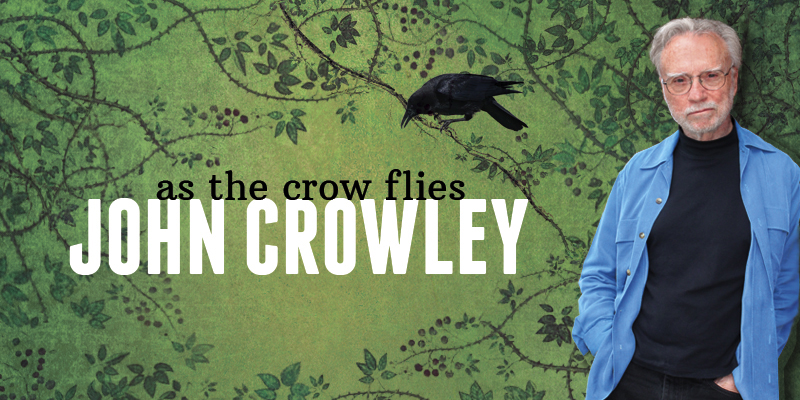
John William Crowley was born December 1, 1942 in Presque Isle ME, where his father, a doctor and captain in the Army Air Corps, was stationed. The family moved several times until settling in Indiana in 1953. He earned an English degree from Indiana University in 1964 and moved to New York City and worked in photography and documentary film writing. Crowley became a freelance writer in 1966, married his wife Laurie Block in 1984 and had twin daughters, and began teaching fiction at Yale University in 1993.
Crowley’s first novel, SF The Deep,was published in 1975. He soon published Beasts (1976), Engine Summer (1979), and Little, Big (1981), his first published work of fantasy and perhaps his best-known work, once called “a neglected masterpiece” by critic Harold Bloom. The novel won a World Fantasy Award and a Mythopoeic Award and was a finalist for a Hugo Award, a Nebula Award, a BSFA Award, and a Seiun Award. He went on to write the highly ambitious Ægypt series, beginning with Ægypt (1987) and followed by Love & Sleep (1994), Dæmonomania (2000), and Endless Things (2007); and he wrote other standalones including The Translator (2002), historical novels Lord Byron’s Novel: The Evening Land (2005) and Four Freedoms (2009), Mythopoeic Award and Grand Prix de l’Imaginaire winner and Locus and World Fantasy Award finalist Ka: Dar Oakley in the Ruin of Ymr (2017), and Flint and Mirror (2022).
Crowley’s shorter fiction is also celebrated, most notably “Great Work of Time” (1991), a World Fantasy Award winner and Nebula Award finalist for Novella. He wrote Hugo and Nebula Award nominee “Snow” (1985) and Locus Award winner and Hugo and Sturgeon Memorial Award finalist “Gone” (1996). His short fiction has been published in F&SF, Omni Best Science Fiction, Interzone, and Asimov’s, and collected in World Fantasy Award-winner Novelty (1989), Antiquities (1993), Novelties & Souvenirs (2004), Totalitopia (2017), and And Go Like This: Stories (2019). Some of his non-fiction was gathered as In Other Words (2007) and Reading Backwards (2019). His work was the subject of critical study Snake’s-Hands: The Fiction of John Crowley, Michael Andre-Driussi & Alice K. Turner, eds. (2003).
Crowley’s numerous awards include an American Academy and Institute of Arts and Letters Award in Literature (1992) and a World Fantasy Life Achievement Award (2006).
Forget "Don't be evil"; Google's true motto is a form of vulgar spidermanism: "With great power comes no responsibility." The internet's de facto boss is an absentee landlord.
Google – a thrice-convicted monopolist – is the gateway to the internet, with more than a 90% search market share that it attained by buying out all its competitors and bribing Apple more than $20b/year not to start a rival search engine:
Google likes to position itself as a wise steward of the internet. They say they use their vast troves of data about the internet and its users to connect the right person with the right information at the right moment. As their mission statement has it, "organize the world's information and make it universally accessible and useful":
The tacit argument is, "Sure, we repeatedly violated antitrust law in order to monopolize the internet, but the internet needs a monopolist. It's scary out there! We have amassed power so that we can protect and guide you."
It's a bullshit argument and no one should accept it – but even if you think it's worth harnessing monopoly power to promote a wise king to rule over the internet, you'd still want Google to take that responsibility seriously. If we're to have a landlord for our civilization's digital nervous system, let's not have it be an absentee landlord.
Google is an absentee landlord. In 2019, they chose to deliberately worsen search results in order to make you search repeatedly to find the information you're seeking, because every fresh query lets them serve fresh advertisements:
Not all of Google's enshittification can be attributed to deliberate sabotage. Much of it is the result of neglect. Ask Google for a product review and they'll pass over the most rigorous, honest websites on the internet in favor of affiliate scammers who repackage Amazon best-of lists to peddle overpriced, underperforming junk that's sometimes so bad it's dangerous:
And of course, Google AI search results present the company with a highly refined and confident-sounding way to launder spam into product recommendations:
Could Google do better? Provably so. Kagi, a small company that runs a search engine powered by Google's own search index consistently delivers results that are substantially superior to Google's – using Google's own infrastructure:
If Kagi (a startup with a handful of engineers) can extract useful search results from Google's databases, then Google – a thrice-convicted monopolist that's had its pick of thousands of the top computer scientists from the world's most prestigious universities for a generation – could also do so.
They just choose not to.
They're too big to fail. They're too big to jail. They're too big to care.
Google's AI search isn't a way to fix its broken core product: it's a way to partially remediate the damage Google itself inflicted on the open internet, while imprisoning the web in a walled garden that would make Steve Jobs drool:
It's a deadly combination: Google has committed hundreds of billions to stock buybacks and its AI money-furnace, financed by mass layoffs targeting the people who keep the core services useful. The too-big-to-care company is still the internet's gatekeeper, but half the guards at the gate have been fired and the other half have pulled so much overtime that they keep falling asleep on the job.
Google has become a scammer's paradise.
Take Google's "answer box." This is the part of the search results page that tries to answer your query directly, without sending you elsewhere for that info. Back in 2023, Google's Answer Box was taken over by scammers who impersonated airline help desks. When Google's users searched for airlines' toll-free phone numbers, Google directed them to phones that rang in the scammers' boiler room, where they were tricked into giving up their passport info and credit card numbers to boiler-room thieves:
(This was an especially devastating attack because the airlines themselves hide their customer service phone numbers – as enshittified monopolists, they want your money, not your complaints – so it's normal to search Google for the number you're seeking, rather than scouring the airlines' deliberately confusing customer service sites.)
This is especially galling because Google has an extensive "verified merchant" program that goes to enormous lengths to establish the true identity of every merchant whose businesses are listed on Google, in maps, ads and search results. Google "knows" which URLs belong to the airlines. If it can be tricked into scraping a different website for the airlines' phone numbers, that's because Google couldn't be bothered to connect its own database of canonical airline URLs to the process that serves phone numbers to the 90% of the web-using public who search with Google.
Google's database of the canonical URLs for businesses doesn't stop at airlines or even large businesses. Nearly every local merchant has undergone Google's verification process, which includes a step where Google physically mails a postcard with a unique number to the merchant's registered address, which the merchant must then key into Google to prove that they're located where they say they are.
Despite this, Google's ad-sales system will happily sell anyone the right to advertise a different website for queries for specific merchants, and those ads appear above the real result for the business's website. To make this even worse, Google's spent years making it more difficult to distinguish ads from "organic" search results, changing the font and size of the "ad" warning to make it harder to spot, and making the font and color of the ad itself closer to the color of the search results below it.
This is a gift to fraudsters. I had my own run-in with it in 2023, when I was tricked by a Google ad into ordering dinner from my local Thai place using a scam site that had cloned the restaurant's menu. The scammers marked up the price by 15%, then passed the order on to the restaurant, pocketing the vig:
This scammer – based out of a UC Berkeley dorm-room – had copied hundreds of restaurant websites, then bought Google ads for the restaurants' names, ensuring that searchers would see the scam result before the real one. Remember: Google knows what the true URL is for every one of those restaurants but it sold the scammer ads for a different URL that appeared when people searched for the restaurant by name.
Google could trivially add a step to the ad sales pipeline that detects mismatches between a merchant's known URL and the URL in an ad bought against the merchant's name. It could automatically resolve these mismatches by sending an email to the merchant's verified email address that says, "Hey, are you buying an ad with a new URL? If so, just reply to this email."
I don't know why Google doesn't do this. Maybe they make huge sums from these scam ads and they don't want to forego the revenue. Or maybe they just don't care.
Whichever it is, there's real consequences for this negligence by the internet's absentee landlord. Take abortions: fake abortion clinics – where pregnant women are bullied or tricked out of the abortions they're seeking – buy Google ads against the names of real abortion clinics. Google makes millions sending abortion-seekers to fake abortion providers:
Google started off as the ideal "intermediary" – the fancy economist's term for a "middleman." They took as their duty to figure out the best websites for you to look at based on your interests, serving as an honest broker between internet users and internet publishers. In the quarter-century since the company's founding, as it transformed itself into a monopolist, it developed the curse of every intermediary: it got Main Character Syndrome.
This is Tim Wu's formulation: the reason for an intermediary existence is to serve the parties to the transaction. Ebay says it exists to connect buyers and sellers, Uber is supposed to connect drivers and riders, dating sites are supposed to connect people with their love-matches. But intermediaries are cursed with an enviable position: by dint of sitting between these different groups of people, the intermediary learns everything about both sides of the transaction, while each side only knows about its own position.
Amazon knows the price you're willing to pay, it knows who's set the lowest price, and it knows how many identical items that match your query are for sale. But the sellers don't know any of that, and you only know some of it. By capitalizing on that information (rather than using it to efficiently match buyers and sellers), Amazon can match you with the sellers willing to pay the highest junk fees, rather than the ones who offer the best price for the best goods:
This is Wu's Main Character Syndrome in action. Once Amazon attains a dominant market share, it can maximize its own welfare at the expense of its buyers and sellers, transforming itself from a helper to a parasite:
Google says it wants to "organize the world's information and make it universally accessible and useful," but every dime it spends fighting fraud (a critical part of this mission!) is a dime it can't spend on stock buybacks, executive compensation and AI servers. "Organize the world's information and make it universally accessible and useful" is the mission of a good intermediary; "do the absolute minimum to fight fraud" is the mission of a formerly good intermediary with terminal Main Character Syndrome.
Google keeps finding ways to expose its users to fraud while lining its own pockets. That restaurant markup scam that caught me in 2023? Three years later, it's way worse.
San Francisco City Attorney David Chiu just filed suit against GuestReservations.com, BookOnline.com and Booking Holdings for running a massive version of the restaurant menu scam – one that extracted millions from people booking hotel rooms:
Here's how the scam worked: these companies put up websites with deceptive URLs, like SanFranciscoMarriott.GuestReservations.com, and then bought the associated Google ad-word ("San Francisco Marriott"). At the top of Google searches for "San Francisco Marriott booking" was the ad for SanFranciscoMarriott.GuestReservations.com. This site would sell you a room at the Marriott, at a markup of 35% to 85%.
This is a pure ripoff. If Google had served the correct result at the top of the page – if it had used its own database of confirmed merchants and their associate websites to validate its ads – then people booking hotels would have saved 35% to 85% on their rooms.
City Attorney Chiu says that the perps here registered domains for all kinds of hotels, even tiny ones in small towns, all over America. That means that it's not just visitors to San Francisco who got screwed by these creeps – it's also San Franciscans who booked hotel rooms around the country.
Google bears the lion's share of the blame here, but Visa and the other credit card companies are critical to these scams. Card companies allow merchants to set terms of service that refuse refunds under almost any circumstances, and, more often than not, the card issuers side with the merchants over their own customers when they call to cancel a charge from one of these scammers.
I discovered this for myself when I was tricked into buying theater tickets from a ripoff site that had registered the URL of the show I wanted to go to. I figured out that I'd been rooked within a minute of clicking the buy button, but it took months and multiple appeals – and ultimately a threat to cancel my credit card – to get Visa to refund me.
Visa – another bloated monopolist with terminal Main Character Syndrome – can see that it has merchants who generate zillions of appeals and charge-backs because they run scam businesses like these. They could treat these merchants as the fraudsters they are, but because the crooks wreathe themselves in gauzy excuses and lengthy terms of service, Visa enables these massive, nationwide cons.
Google, Visa and the other monopolists who serve as de facto regulators for our society have arrogated to themselves the power to observe every transaction and block the obvious scams. We pay for their failure to take minimal, obvious steps to protect us from the scammers who thrive on their platforms.
Why should they? They're the main characters. They're Bizarro-world spidermen, whose great power confers no responsibility.
"Red Team Blues": "A grabby, compulsive thriller that will leave you knowing more about how the world works than you did before." Tor Books http://redteamblues.com.
"Chokepoint Capitalism: How to Beat Big Tech, Tame Big Content, and Get Artists Paid, with Rebecca Giblin", on how to unrig the markets for creative labor, Beacon Press/Scribe 2022 https://chokepointcapitalism.com
“Once Is Enemy Action,” a science fiction novel about the origins of modern technofascism. Today's words: 623 (1336 total).
"The Post-American Internet," a sequel to "Enshittification," about the better world the rest of us get to have now that Trump has torched America. Fourth draft completed. Submitted to editor.
A Little Brother short story about DIY insulin PLANNING
This work – excluding any serialized fiction – is licensed under a Creative Commons Attribution 4.0 license. That means you can use it any way you like, including commercially, provided that you attribute it to me, Cory Doctorow, and include a link to pluralistic.net.
Quotations and images are not included in this license; they are included either under a limitation or exception to copyright, or on the basis of a separate license. Please exercise caution.
"When life gives you SARS, you make sarsaparilla" -Joey "Accordion Guy" DeVilla
READ CAREFULLY: By reading this, you agree, on behalf of your employer, to release me from all obligations and waivers arising from any and all NON-NEGOTIATED agreements, licenses, terms-of-service, shrinkwrap, clickwrap, browsewrap, confidentiality, non-disclosure, non-compete and acceptable use policies ("BOGUS AGREEMENTS") that I have entered into with your employer, its partners, licensors, agents and assigns, in perpetuity, without prejudice to my ongoing rights and privileges. You further represent that you have the authority to release me from any BOGUS AGREEMENTS on behalf of your employer.
Fan and organizer Robin Johnson, 89, died July 6, 2026 in Ballarat, Australia of underlying causes after a fall.
Johnson was born March 9, 1937 and lived variously in Melbourne, Sydney, Hobart, and Ballarat, as well as in England. He chaired the first Australian Worldcon in 1975 as well as Thylacons 1-3. He was awarded the Ditmar Awards Special Award in 1974 and in 1983, and he received the Big Heart Award at Worldcon in 2007.

 Login